







Abstract
The present paper is the first to conceptually assess the viability of mass timber construction (MTC) as an alternative construction material/method in Australia. It fulfills an identified need to examine an innovative construction process providing much needed information concerning the technologies current position and future disruption to traditional construction methods. A common tool used in business management studies, the PESTEL model, Political, Economic, Social, Technological, Environmental and Legal is employed to provide structure for a strategic analysis of the technology. Mass timber construction clearly demonstrates some advantages including cost savings, primarily in the reduction in on-site labour costs; a lower environmental impact and use of a renewable resource; and possibility of improved amenity and reduced running costs for owners and occupiers. The estimated market potential for MTC in Australia indicates that a local plant might be viable as the market grows, and warrants funding to underpin a full feasibility assessment.
Introduction
Mass timber construction (MTC) is a building process that uses engineered wood products as the primary structural material of choice. Mass timber construction is typically used in applications as a substitute for wet-poured steel reinforced concrete, solid section ‘tilt-slab’ concrete, and steel framing. Mass timber construction is ideally suited to low- to medium-rise structures, and has been used internationally to great effect in public occupancy buildings (such as libraries), and detached and multi-residential housing.
Cross-laminated timber (CLT) is one particular MTC product. It is fabricated by bonding solid-sawn timber together in transverse and longitudinal layers with structural adhesives to produce timber panels. Depending on the natural characteristics of the timber species and the method of assembly, the cross-lamination process provides strength and stiffness properties similar to a ferroconcrete slab (Forest and Wood Products Australia 2012).
Mass timber construction technologies offer important sustainability benefits for the construction sector. The improved utilisation of sawn log production provides increased value to timber producers, and is a better value-adding proposition than other uses of chips and other sawmill waste. As it is a timber product, carbon sequestration (Depro, Murray, Alig and Shanks 2008) provides economic value, especially as the world moves towards a mechanism of pricing carbon. Mass timber construction represents a lower embodied energy consumption than many other building processes, such as the production of steel and concrete (Lehmann and Fitzgerald 2012). Because MTC makes use of wood fragments, it can recycle timber that has been previously used, and indeed can be recycled itself. Countries in which the markets for MTC are maturing include Austria, Germany, Switzerland, Sweden, Norway, and the United Kingdom, with use in Australia just beginning. Estimates from the UK indicate that 0.3 million cubic metres of this ‘manufactured’ timber has been constructed up until 2010, with an estimated 1 million cubic metres forecast in 2015 (Crespell and Gagon 2010). However, outside of the European centric stronghold, MTC is yet to gain a substantial foothold; for example, there have been fewer than five projects in total in Australia thus far.
Challenges for any new market are many, including establishing a local supply chain, assembling engineering expertise, and a necessary shift in accepted sales and marketing models. Anecdotally, the authors have learnt that some of the larger tier one developers in the Australian market (including multinationals) are adopting a stance of vigilance, waiting for some trigger to tip the balance, perhaps the actions of a competitor, or a change in the way that carbon is priced, or a change in the mood or awareness of the market towards MTC use and its advantages. This wait-and-see position rests against a growing impetus for increased sustainability in building and construction and the allure of a new technology offering efficiencies in on-site costs, with the attendant potential to improve the bottom-line. There is benefit in exploring ways that this typically cautious stage of technology adoption might be accelerated in order for it to achieve sufficient penetration and establish a foothold, and that is the primary focus on this paper.
The lens to be applied here is one commonly used in business management studies; the PESTEL model: Political, Economic, Social, Technological, Environmental, and Legal influences upon an industry considering adopting a new technology a approach or method. A PESTEL review is a multifaceted approach to assessing big-picture forces to better understand an organisation's strategic orientation (Aguilar 1967) to make considered and informed decisions about organisational activities. The present paper aims to provide the forestry, timber manufacturing, developer, and construction sectors, in Australia, in particular, though the approach and findings are easily adapted for other markets, a comprehensive overview of the opportunity that MTC provides in order to establish a strategic direction. What follows is an analysis of each facet of the PESTEL model. The review outlines the opportunities and hurdles that the industry may encounter, concluding with a calculation of the suggested potential market for MTC and several recommendations. A number of the considerations to be canvassed can fit more than one of the PESTEL categories, and others interact with each other across categories. Rather than produce a labyrinthine paper, the authors have treated each point separately and included it in the section judged most appropriate. Additionally, this treatment is not meant to be exhaustive – there are bound to be other elements we have not included – but this should not detract from the overall approach and outcome.
Political Influences
This section shall explore important elements of a political nature relating to the adoption of MTC in Australia, in particular.
The environmental movement and forestry industry
The 1970s were a time of particularly strong environmental controversy over logging in Australia (Dargavel 2005). Major political (and often physical) clashes occurred between the forestry industry and environmental lobby groups. Voter sentiment carried considerable influence and lobby power for the environmental movement grew significantly, leaving the Australian forestry industry badly placed to adapt to change or deal with the conflict (Dargavel 2005). While the heyday of this conflict has largely passed, it still simmers, with regular flashpoints over issues, such as logging of old-growth forests and woodchipping capturing the public's attention.
The ‘Australian Forest Industry in the Year 2020’ report (Thompson and Kelly 2007) projected a grim forecast for the Australian timber industry, an industry battered by negative community and political attitudes concerning the economic, social and environmental benefits of forestry-related products. A salient example attesting to the industry's turmoil was the very public battle between Gunns Timber and the Tasmanian Conservation Trust over a Supreme Court challenge concerning the establishment of a new pulp mill in Tasmania (Beniuk 2012). In that case, mediation and government intervention produced a compromise but the damage was done (or the battle won) and the mill has not gone ahead.
It is difficult to predict how MTC will evolve in this environment. It is likely that the deciding influence will relate to the source of the raw materials for the MTC components. Using waste product or recycling/repurposing existing timber is likely to be viewed favourably by the environmental movement, while chipping felled timber might draw their ire, tempered by the reduction in waste from switching from sawmilling timber to using the whole lot for MTC components. Treading a path that results in approval from the environmental movement may also have the benefit of securing the favour of government and, consequently, the forestry industry's future.
Emissions reductions
Fulfilling an election promise, in 2014 Australia's new Liberal Coalition Government repealed the carbon tax legislation that had been legislated only a year or so prior (Department of Environment 2014). This was painted in the media as a significant step away from Australia's responsibilities to the environment and the global push towards carbon abatement (at least in terms of sentiment if not concrete action). The Carbon Tax, according to some in the media, was an unpopular impost introduced on a foundation of politics rather than to benefit the environment (Davison 2014). In its place, the government introduced the Clean Energy Act, a more direct action plan to tackle carbon emissions. The government committed to reduce greenhouse emissions by 2020 (Nachmany et al. 2014).
Taken together the examples in The environmental movement and forestry industry and Emissions reductions sections highlight the back and forth nature of politics and public opinion. It is very difficult to provide a clear set of guidance on matters relating to the forestry, environment, and politics in Australia as debates are generally highly emotive. However, if MTC production is framed in terms of carbon sequestration (provided the components are produced from chipped plantations) or a reduction in emissions from a shift from the more carbon-intensive concrete and steel production, or if some MTC production can be derived from recycled timber, there might be an opportunity to capitalise on government incentives to reduce carbon footprints.
Trade unions
The trade union movement, especially those involved in the construction industry, has a number of critical impacts in the political sphere on the likelihood of widespread adoption of MTC. In Australia, most larger or commercial projects over four storeys are subject to ‘Enterprise Bargaining Agreements’ that are negotiated with a highly unionised workforce. Unions such as the Construction, Forestry, Mining, and Energy Union (CFMEU) can hold considerable sway over progress on construction sites, typically under the guise of protecting its members from on-site safety issues. Given the established use of MTC in Europe, there should be little need to lodge significant occupation health and safety concerns for local adoption. However, because MTC use can result in lower onsite labour needs, it might be expected that unions representing workers in these industries may seek to make it difficult for developers and builders to rapidly convert to MTC on a large scale.
Individual workers, and therefore their unions, are an important aspect of the construction industry in terms of sustainable building practices (Burgmann, McNaughton and Penney 2002). In the United States, Canada, United Kingdom, Germany, and Australia, unions are involved in activities that are associated with what are termed ‘green-collar initiatives’ (Snell and Fairbrother 2011, p. 84). The union movement is adopting a new environmental politic because of structural changes in the building and construction markets driven by sustainability initiatives. While at the heart of union ethos is ‘jobs defence’ where the unions’ interests may be in conflict with industry progress, the unions’ commitment to environmental politics will be tested (Snell and Fairbrother 2011).
The union movement's involvement in a broad spectrum of environmentally focused projects within many and varied industry sectors may bode well for MTC and the structural changes within the construction sector. With unions primed to accept that environmental policy shall considerably challenge, influence and impact all manner of existing processes towards a more sustainable green economy (International Trade Union Confederation 2009), new product innovations such as MTC may be embraced. Evidence of progressive action by the unions in support of positive environmental activities is found in the trade unions’ involvement with the various bodies to introduce green skills training at national and state levels (Snell, Fairbrother and Hart 2009).
Tufts (2011) argues that it is not a question of ‘if’ unions are the most affective stakeholder in the environmental policy change, rather to what degree are unions actively participating in conditions that influence action and policy. A case in point is the role the unions played, alongside state and national governmental bodies, to influence and affect a change in the Materials Potential market for MTC in Australia section of the Green Star code to allow certified timber under the Programme for the Endorsement of Forest Certification (PEFC) as certified material and thus attract the full points allocation within the rating tools that determine the omnibus ‘star rating’ (CFMEU 2009; Sustainable Forestry Initiative 2009). This initiative, however, does not impact on union power on construction sites. The advent of MTC and its considerable reduction in on-site labour requirements for the construction of buildings threaten the very core of unionism; the protection of jobs in the labour-force market. There will be an increase in off-site labour for the manufacture of MTC components, but this is not likely to be equal to the reduction in on-site labour on building sites.
Economic Influences
This section examines some of the economic factors related to the uptake of MTC in Australia.
Building and construction economics
According to Van De Kuilen, Ceccotti, Xia and He (2011), MTC is very cost-effective for the construction of buildings up to about 10 storeys, as well as for projects, such as libraries, schools, and other utilitarian spaces. However, no whole-of-life cycle calculation was found in the literature that takes account of all of the embodied costs and savings of MTC versus traditional construction methods. Three published case studies provide both indications and some inconsistencies that highlight the need for a more comprehensive analysis.
Yates, Linegar and Dujic (2008) report an assessment of the Murray Grove building in the United Kingdom. This nine-storey building, in which eight floors used CLT, saw a 30% increase in material costs of the cross-laminated solid timber components compared with what would have been the costs of using reinforced concrete construction. However, the increase in material costs was offset by a reduction of 17 weeks (26%) in site time, to a total of 49 weeks construction. While this does not include the factory time to prefabricate the MTC panels, the full attendant costs involved in working on-site are significantly more than those involved in working in the factory. Any process that shortens the amount of time an outside building site is active will make a significant difference to the overall project costs.
Lend Lease developed the MTC Forte building in Melbourne, Vic, Australia. They reported a 30% saving in on-site time and claimed that the construction process was safer (likely because of less on-site time given that an active building site is a complex and inherently hazardous place despite significant safety precautions and procedures) and more precise than traditional construction materials. Lend Lease also noted overall reductions in construction traffic to and from site, less disruption to the community, and less waste (Patterson 2013 in Walsh 2013, para. 6). An important consideration regarding the Forté building is the very insular supply chain. For that particular project, Lend Lease was the developer, builder, and contractor – effectively they were their own end client. This meant a significant risk mitigation strategy compared to employing an independent supply chain consisting of disparate organisations working in unison to deliver a project. This provided Lend Lease maximum control over scheduling and program timelines, allowing them ultimate control over the entire construction process. A detailed financial analysis would be required to determine the overall size of the savings derived from this level of control and removal of middlemen.
Byle (2012) reported on a MTC building that incorporated concrete masonry for a two-storey ‘knock-down and rebuild’ project in Montana the use of MTC was more economical to the tune of 6% if materials were sourced internationally and shipped from Europe, and 12% if materials were produced locally.
The aforementioned case studies assessed the economic utility of MTC through different value equations. The first two case studies assessed the value of MTC on an accelerated on-site construction program. However, the equation did not quantify the time savings in monetary terms. In the case of Forté of the reported material costs were estimates, as such difficulties exists for those attempting to assess the total benefits of the technology. It is likely that such information is not published for commercial reasons. The first case study used an equation centred on material costs and engineering services only. The Byle (2012) calculation makes mention of the considerable time saving yet fails to attach a monetary value to such savings that would significantly influence the output. These approaches failed to provide a truly holistic indication of the total cost – on-site costs, materials, etc., – associated with MTC compared to traditional forms of manufacture.
Dunn (2015) reports a more comprehensive evaluation that incorporated a comparison between using primarily timber versus concrete and steel construction. The comparison was inclusive of material and construction costs for four different types of building; a seven-storey building, an eight-storey apartment complex, a two-storey aged care facility, and a single industrial structure. Each project was independently assessed, including all material costs, installation, construction costs, and delivery (including international shipping) to the project location in Sydney, NSW, Australia. In all four cases, the timber construction solutions were found to be less expensive than the competing non-timber solution, with savings ranging from 2.2 to 13.9%. The eight-storey apartment building was constructed using CLT components and found to be 2.2% less expensive than the traditional concrete construction, representing a saving of approximately $110 500 (2.2%) over the $5.126 million construction cost.
Finance and insurance
Non-standard property insurance and finance facilities are critical for the early adoption of MTC projects in Australia. Ahn, Pearce, Wang and Wang (2013) identified insurance and liability problems with warranties for non-standard green materials and methods, and conflicts between public policy and/or regulations concerning sustainable development. The risks of using a new system are a consideration for finance and insurance for MTC. The lack of longer-term in-use studies around MTC and events, such as fire, flood and earthquake, will likely be taken into account. Mass timber construction, specifically CLT, has been tested and evidence indicates that it is less susceptible to seismic damage compared to more traditional forms of construction (Mohammad, Gagnon, Karacabeyli and Popovski 2011).
The Survey of International Tall Wood Buildings (Forestry Innovation Investment and Binational Softwood Lumber Council 2014) reviewed 10 MTC projects – between 5 and 10 storeys – constructed between 2008 and 2013. It is established that insurance alterations were not an issue for the majority of projects reviewed; however, for the Tamedia project in Switzerland, the owner/developer was required to have coverage for third-party liability and contractors ‘all risks’ insurance. In a related project, the construction team on the Bridport House project in London was required to inform the insurer that the project was constructed of timber although the policy premium did not increase.
In terms of finance, the Tall Wood Survey uncovered a relationship between self-financing and prototype or pilot projects. For some projects, the initial investment in MTC was seen not only in terms of wealth creation but also an investment in future development; part of a an overarching research and development strategy to test designs, materials, processes, performance, and market acceptance (Forestry Innovation Investment and Binational Softwood Lumber Council 2014). Of the 10 projects investigated within that report, 6 involved either partial or fully self-funded lending.
Forest industry economics
The production of MTC systems might seem a viable opportunity to support local timber manufacturing in Australia. However, considerable investment (money and expertise) would be required to establish a local facility to produce sufficient grade and quantity of MTC components to supply a typical 10-storey construction project. To ensure cost competitiveness of MTC, production must be relative to the cost of a comparable thickness in ferroconcrete. MTC producers in Europe utilise various grades of material and given the vast volumes are able to produce the finished product economically. Local production would, however, cut the current considerable shipping costs from Europe. The effectiveness of MTC buildings to withstand earthquakes and other disasters better than concrete and steel might provide for a future export opportunity for a local industry to more seismically active zones across Asia.
A centralised zone of manufacturing in Europe affords many organisations considerable opportunity to collaborate and develop MTC technology. Such alliances potentially reduce costs that can be passed down the supply chain, bridging the gap between MTC and traditional forms of construction. These alliances also support the development of specialised resources (such as computer aided technology for panelisation) and methods of training (for mechanical fixing and installation of product), increasing stakeholder value (Nordin, Oberg, Kollberg and Nord 2010). In order to accelerate the uptake of MTC and fully realise the benefits available, greater collaboration with European partners and a sharing of technology – including custom penetration and service routeing, complex integration of connection details, and specified fixing and connection details – would significantly improve the manufacturing position in Australia.
Consumer economics
It may be difficult for a general consumer to discern any significant difference between apartments produced from MTC components when compared to other buildings assembled using traditional materials, and they may not be perturbed anyway so long as they are convinced that there are no disadvantages in terms of strength, rot, warping, termites, and so on. One of the advantages of using MTC is the opportunity to finish the timber surfaces and make them feature in their own right. In this case, consumers might realise that the timber is structural, or simply believe that it is a façade. Anecdotal evidence suggest that factors, such as price, location and value, are more pervasive; however, a project is currently under way to gain a better understanding of the views of potential consumers towards using MTC in multi-storey residential buildings.
Researchers are beginning to investigate the lived environment and perceptions of residential apartment living within mass timber buildings. Research exploring user perceptions of greener buildings in general reveal that respondents tend to rate the design of the building and the healthiness of living in a green building as much higher then conventional buildings (Leaman and Bordass 2007). There is an open question as to whether potential buyers would perceive the use of MTC to contribute to a building's greenness by virtue of the sequestered carbon, or whether they might believe that the increased use of timber has been at the expense of wildlife habitat. If it is the former then exposed and highlighted timber components and messages emphasising the ‘beauty of wood’ may make MTC buildings a premium product. This too is currently being investigated by the authors.
Performance claims related to the Forte building by Lend Lease point to MTC having ‘better thermal performance, requires less energy to cool and heat, which reduce water and energy costs on average of $300 per year or up to 25% less than a typical code-compliant apartment’ (Patterson 2013 in Walsh 2013, para. 8). Recent research exploring the thermal characteristics of MTC reveals some promising results for improved performance. A study by Dewsbury, Geard and Fay (2013) explored varying configurations using 90 and 110 mm soft- and hard-wood partition systems to simulate the effect of MTC. Using timber improved thermal performance between 9 and 11% when compared to a standard stud partition wall system (Dewsbury et al. 2013).
Social influences
Mass timber construction has a number of potential health and social benefits that offer an advantage over traditional construction methodologies.
Health benefits
Timber is visually warm and engenders a socially positive experience for building occupants (Fell 2013). Architects and designers working in the healthcare sector are exploring the physiological benefits of incorporating nature into indoor environments through a greater use of gardens, views of trees, and the use of timber finished surfaces (Fell 2013; Frumkin 2001). The University of British Columbia and FPInnovations established a relationship between timber and human health. In their study, participants registered lower sympathetic nervous system (SNS) activation because of the presence of visual timber surfaces in an environment (Fell 2013). The SNS is involved in the fight or fright response and chronic stress. A reduction in SNS activity leads to a reduction in physiological stress responses; therefore, timber buildings may hold the key to a number of stress-related health benefits (Fell 2013).
In a related study, Kelz, Grote and Moser (2011) found that differences in students recorded heart rate when they attended class in a control condition, a typical classroom (plasterboard walls, linoleum floor, chipwood cupboards), and the experimental condition a classroom made of solid wood (floors, ceilings, cupboards and walls). The results revealed that student's heart rate decreased and students perceived lower level of stress when interacting with teachers and students throughout the school year.
Occupancy comfort
As a poor conductor of heat, timber minimises ‘thermal bridging’, which is a weakness in the building's envelope allowing for energy transfer to the surrounding area (North 2013). An additional benefit is the achievement of excellent airtightness for the overall building because of precision pre-fabrication. Precision pre-fabrication results in an improved seal with fewer joints, gaps, and penetrations supporting the creation of a comfortable internal environment (Forestry Innovation Investment and Binational Softwood Lumber Council 2014).
As with many other building management systems, optimal building performance can also be achieved through demonstrating to occupants how to effectively and efficiently operate systems, such as heating, cooling and airflow/ventilation (Forestry Innovation Investment and Binational Softwood Lumber Council 2014). Educated occupants overall satisfaction ratings were overwhelmingly positive in the areas of thermal comfort, the cost of utilities and an overall subjective rating of wellbeing (Forestry Innovation Investment and Binational Softwood Lumber Council 2014).
Positive attitudes towards timber
After conducting a longitudinal study over a 7-year period, Parry-Husbands and Parker (2014) reported that respondents (N = 1031) rated wood, based on its look and feel, significantly higher compared to alternative materials, such as bricks, concrete, steel and plastic. They also found that respondents were ‘somewhat more likely’ and ‘much more likely’ to purchase wood products from sustainable sources (though they were not asked to trade-off this preference for a price premium). The use of marketing messages about sustainable forest harvesting, including forest stewardship and chain of custody certification, is vitally important to ensuring acceptance of wood products in the market. Such promotional activities could be extended to the promotion of MTC in order to gain social acceptance.
Technological influences
Timber construction is considered as an ancient technology. Mass timber construction represents an update or evolution in this long and widely used method.
Off-site manufacturing
Mass timber construction components are typically customised to meet specification, meaning that service penetration, windows, doors, heating, ventilation, air-conditioning, and cooling, elements are all routed and traced off-site, reducing on-site trades and thus a considerable reduction in on-site labour. Timber is lightweight and durable, ideal for construction on reclaimed land as it weighs less than traditional concrete and steel (Buchanan et al. 2008). The considerable advantage in using timber over wet-pour concrete is the elimination of set and dry times, reducing the construction program and allowing other trades to begin work sooner.
Material hybridisation
Mass timber construction technology is now evolving to include complementary materials, or the obverse, steel and concrete incorporating timber. Incorporating timber, concrete and steel elements, in many cases, provides the most suitable engineered solution for projects, for example, when timber elements are unable to span great distances without significant increases in size and steel members are required. The combination of ‘outriggers’, horizontal concrete structural members protruding from a central core of the building, and CLT allows for the construction of multi-storey buildings beyond the current 10 into the vicinity of 15–20 storeys (Van De Kuilen et al. 2010).
Engineering and design
Computer aided design (CAD) programs coupled with precision cutting and routeing are able to model and construct with great accuracy the specifics of a project and ensure that each component is precisely manufactured. These components are then marked for identification purposes allowing for rapid sequential onsite installation. Recognition of the considerable shift in emphasis towards a services oriented approach (connection details, specification, design and pre-fabrication details) in sales and marketing, delivering the core benefits of services is required to optimally promote the technology.
Engineered by nature
Timber is a hygroscopic material. It has the ability to exchange moisture with the surrounding air under ambient conditions through a process of ‘desorption’ and ‘absorption’ (Karacabeyli and Douglas 2013). The hygric capacity of timber is advantageous as it provides a ‘buffer against short-term changes in humidity and temperature, unlike metal-framed enclosure’ (Karacabeyli and Douglas 2013, p. 406). However, a word of caution, panels that are subjected to extreme weather conditions, humidity and/or liquid water, during the erection phase are at an increased risk of dimensional change and other effects, including checking (timber cracking) and warping (distortion), is to be avoided (Karacabeyli and Douglas 2013). Best practice material handling processes shall ensure that MTC components are fit for purpose.
Environmental influences
Mass timber construction offers a number of benefits when it comes to sustainability and environmental factors. Most notably, timber is a renewable resource; however, a plethora of additional attributes are also found when using timber in construction.
Carbon storage
Timber stores carbon. Forests are a major store of carbon and when a forest plantation is properly managed, it can significantly contribute to a reduction in carbon dioxide in the atmosphere (Department of Agriculture, Fisheries and Forestry 2008). As part of the process of photosynthesis, trees absorb carbon dioxide and produce oxygen. In order to produce 1 kg of timber, a tree consumes 1.47 kg of carbon dioxide and returns just over a kilogram of oxygen into the atmosphere (Australian Greenhouse Office 2004). The use of timber in the construction of buildings forms a considerable ‘carbon storage’ system. Using timber ensures that the carbon dioxide consumed during the growth of the trees is essentially fixed indefinitely within the MTC components (Nunery and Keeton 2010).
Global warming
The energy required to produce various materials for the construction industry, including steel and concrete, is contributing to global warming (Sagheb, Vafaeihosseini and Ramancharla 2011). By comparison, timber, which is a naturally grown and engineered material, actually contributes to an overall removal of greenhouse gasses from the atmosphere (Nowak and Crane 2002). Even when calculating back into the cost equation, the amount of energy required to take a sawn log and produce a final structural/aesthetic product the overall net result is far better than steel (Sagheb, Vafaeihosseini and Ramancharla 2011). Using timber harvested from sustainably managed plantations results in a net reduction in atmospheric greenhouse gases (Australian Greenhouse Office 2004).
Sustainable development
The Green Building Council of Australia (GBCA) advocates across all levels of government to promote a green building agenda. As part of the GBCA ‘Green Star’ program several design tools and calculators are provided to developers, builders, and specifiers for the production of sustainable building practices and green rated built environments. Before 2012, the timber category section of the ‘Green Star Rating Program’ only provided the equivalent number of points to that of alternative materials, such as concrete, that are emissions-intensive compared to the use of timber in construction (Lenzen and Treloar 2002). Recently, a new category recognises ‘the use of reused timber, legally sourced timber and timber sources from forests whose conservation values are not degraded’ (Green Building Council of Australia 2011, p. 1).
Recent amendments to sustainability tools that acknowledge the life cycle benefits in terms of building with timber are significant steps forward for MTC. Life cycle assessments (LCAs) are based on a modelling tool that includes in its calculation the energy expended and other costs in resource extraction, material production, construction, maintenance, replacement, demolition, and transportation (Karacabeyli and Douglas 2013). The LCA results for MTC use vary primarily because of the number and configuration of assessment categories used in the calculations (see Karacabeyli and Douglas 2013; Passer, Cresnik, Schulter and Maydl 2007; Robertson, Lam and Cole 2012). However, when considering full LCAs of construction materials, timber generally has a lower overall environmental footprint (Robertson, Lam and Cole 2012) and lower use of energy in production and extraction compared to alternatives (Timber Development Association 2013).
Construction site environment
Mass timber construction has benefits for microenvironments, such as the immediate environment surrounding the designated construction site. Construction companies often need to consider neighbouring residents to ensure a harmonious relationship during the construction process. As MTC components are primarily produced in off-site manufacturing facilities, there is a significant reduction in on-site noise pollution, traffic congestion, and site waste compared using ferroconcrete and steel frame construction. Karacabeyli and Douglas (2013) suggest that planning is the key to ensuring on-site benefits are realised. Practical advice includes configuring predetermined routes for travel when delivery materials to site, and ensuring that the movement of trucks is unobstructed. This is especially important for oversized loads that are commonplace in MTC use. Ensuring that the site has sufficient room to store panels and that a proper handling space, including undercover or adequately protected storage of timber components, allows for correct material flow.
Legal
The legality of harvested timber resource has gained considerable governmental attention recently. In the commonwealth of Australia, imported and locally sourced timber is now subjected to assessment under the Illegal Logging Prohibition Act (2012).
Timber legality
Independent verification schemes aim to establish the origin and sustainability of timber supplies around the world. There are indications that illegal logging is on the decline (Lawson 2012), especially in countries like Brazil and Indonesia, but it remains a significant problem. Therefore, it is critical that policy-makers learn from the past and take affirmative action to alter the nature of the problem (Lawson 2012). In 2012, the Australian government passed a bill that
Prohibits the importation and sale of timber products containing illegally logged timber; prohibits the processing of illegally logged domestically grown raw logs; requires importers of regulated timber and processors of raw logs to comply with ‘due diligence’ requirements; requires the accurate description of legally logged timber products for sale in Australia; establishes enforcement powers and offences, and imposes penalties (Parliament of Australia 2012, para. 1).
There are two global sustainable forest management certifications designed to attest to the legitimacy of sustainably produced timber – the Forest Stewardship Council (FSC) scheme and the PEFC. Both systems have the ultimate goal of promoting sustainable forest management and ensuring that illegally harvested timber does not enter the supply chain in Australia. The FSC program originally targeted large-scale forest organisations, whereas the PEFC was established by industry associations to foster the interests of small scale private forest owners (Cashore, Auld and Newsom 2004). The FSC scheme provides an equal footing to the economic, social and environmental sectors and their interests, whereas the PEFC provides forest owners with the final say in policymaking debates, leading to criticism concerning a lack of respect for environmental concerns and a claimed focus on economic gains for stakeholders (Gulbrandsen 2005). More recently, similar criticism has been levelled at the FSC (Johansson and Lidestav 2010). The requirement for the supply chain to hold certification under both schemes in order to trade in sustainable timber credits can be an imposition on business in terms of auditing costs, staffing the quality assurance program and registration for trademark usage, etc.
A stringent focus on the timber supply chain for projects in Australia might lead to an increase in the price of local raw product and a drive to more effectively use offcuts and other ‘waste’ and value-add to chipping. All of these considerations might make a local MTC industry more attractive and viable.
Wood first policies
As a measure towards reducing greenhouse emissions, governments around the world are introducing policies that require architects and designers to consider using of timber wherever possible in the construction of buildings. For example, France passed a law requiring the use of timber for the construction of new buildings except when the owner provides evidence of incompatibility, typically concerning safety, health or the function of the proposed building (Legifrance 2010). In Canada's British Columbia the Wood First Act (2009) aims ‘to facilitate a culture of wood by requiring the use of wood as the primary building material in all new provincially funded buildings’ (Parliament of British Columbia 2009, para. 2). In Japan, the Wood First Law highlights the considerable focus on timber in public buildings and signifies a shift away from the use of concrete and steel (Forestry Innovation Investment 2012). Such actions should lead to an overall increase in the use of timber and provide impetus for innovations such as MTC technologies.
Potential market for MTC in Australia
In order to understand the potential market for MTC in Australia an analysis exploring the types of construction (houses, multi-residential, education, recreation, etc.) for which MTC is currently being used in Europe and the United States would be instructive. The basis of the analysis that follows adopts many components from Karacabeyli and Douglas (2013) and Gagon and Pirvu (2011) who identified the potential market for MTC in the United States and Canada, respectively.
Construction statistics and scenario analysis
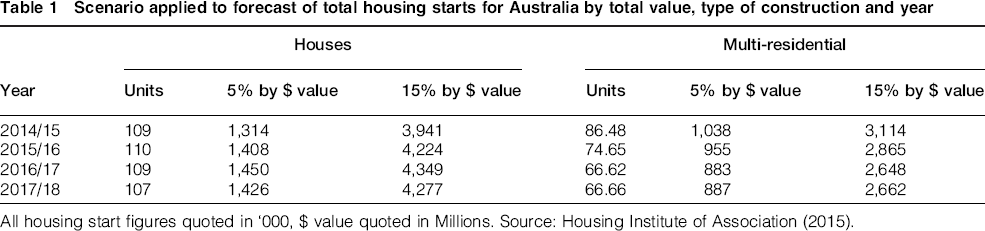
In Australia, anecdotal evidence from MTC reference groups determined that mid-rise construction of one to four storeys, including housing, multi-residential, education, recreation, commercial and accommodation structures, are prime targets for MTC. As the rate of uptake in Australia is unknown, two market penetration scenarios were considered in the analysis based on market penetration rates estimated for the US and Canada (Gagon and Pirvu 2011; Karacabeyli and Douglas 2013): a conservative 5%, and 15% estimate. Table 1 provides the output of the two scenarios using the Housing Industry Association's forecast of housing construction work to 2017/18. Owing to the way the data were parsed, this section of the market analysis primarily focused on housing starts, a measure of the actual number of new homes and multi-residential buildings actually started in a given year.
Scenario applied to forecast of total housing starts for Australia by total value, type of construction and year
All housing start figures quoted in ‘000, $ value quoted in Millions. Source: Housing Institute of Association (2015).
Not all housing projects or multi-residential developments are suitable for MTC construction; therefore, a more conservative estimation of the total market potential of MTC was calculated at 10% of the total equating to $231.3M (5% scenario) and $693.9M (15% scenario) projected for 2017/18. However, these figures represent the total value of the building and not the MTC component.
In order to calculate the timber component the authors sought industry advice on the percentage of the total value that adequately represents MTC. Responses varied in accordance with the uniqueness of the type of projects each industry insider was working on, however, for detached housing the nominated proportion of structural timber reported represented approximately 30% of the total value for the project (figures were based on quantities in quotations for actual projects). Likewise, the feedback was similar – 20–30%, for multi-residential construction. Therefore, a figure of 25% timber content was adopted revealing the total market potential for the timber portion of the combined housing and multi-residential markets to be $57.8M (5% scenario) and $173.4M (15% scenario).
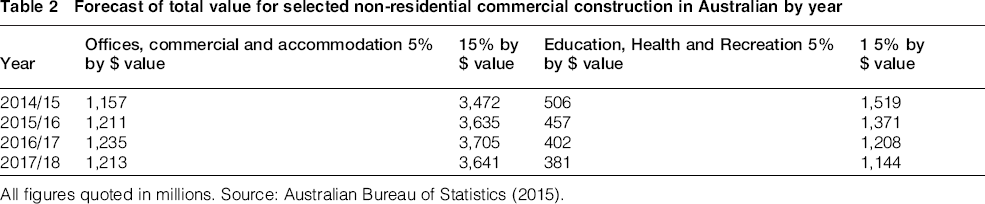
Turning to the commercial building sector, data were downloaded from the Australian Bureau of Statistics (ABS). Using a trend analysis, a forward forecast of the likely activity was calculated, and the six categories were combined into two broader groups and the scenario analysis applied. The potential total value for each category is found in Table 2.
Forecast of total value for selected non-residential commercial construction in Australian by year
All figures quoted in millions. Source: Australian Bureau of Statistics (2015).
Like the housing analysis, not all construction projects are suitable for a conversion to MTC. Industry insiders estimate that given the current rate of progression a conservative estimate of 10% of the value in each scenario would provide an adequate indicator. Therefore, the conservative estimation of the total market potential of MTC in 2017/18 for offices, commercial and accommodation construction types $121M (5% scenario) and $364M (15% scenario) and for education, health and recreation the market potential is $38M (5% scenario) and $114M (15% scenario).
In terms of the timber component for the commercial sector, the Dunn (2015) case studies indicated that timber consumed approximately 30% of the total project cost. Therefore, the application of 30% as the timber component was adopted to calculate the market potential. Overall, the projected market potential for MTC in Australia at financial year-end 2017/18 is estimated to be $105M (5% scenario) and $316M (15% scenario).
The potential for investment in MTC in Australia seems an attractive proposition given the potential return based on market projects presented here. However, this review provides a mere snapshot in time based on an idealistic appraisal of a technology that has yet to realise its full potential. This distorts the opportunity and provides an important consideration for investment in MTC; there is still a considerable amount of market development to be done in order to realise returns.
Summary and Recommendations
Mass timber construction offers a considerable opportunity as a viable alternative or mainstream construction method in Australia. There are significant financial savings associated with MTC use, primarily because of the reduction in on-site labour costs. Evidence is emerging of other benefits through improvements in the lived environment and reduced running costs for heating and cooling.
The local forestry industry and other components of the building supply chain have a tremendous opportunity to develop products for this MTC in the construction sector. The reclamation of lower grade material and opportunity to recycle timber from demolition and other wastage sources for the production of CLT production provides both financial and political advantage in an increasingly carbon-constrained world. These factors might open the door to government assistance to establish a local industry if doing so aids the nation's commitments to reduce overall carbon footprints through sequestration and a reduced reliance on more energy-intensive processes involved in the production of steel and concrete.
Research is needed to explore whether increased timber usage in various building types would be favoured by the community and consumers, in particular. It is conceivable that a price premium might be leveraged on the back of clever marketing campaigns capitalising on the inherent beauty of wood combined with an increased interest in sustainability. Higher Green Star ratings for MTC use should act to improve public perceptions.
At the time of writing, several industry ‘reference groups’ funded by the FWPA, typically headed by university research academics, are collaborating with industry stakeholders to implement a clear strategy for the establishment of MTC in Australia. Inclusive in these groups are organisation such as Planet Ark, a not-for-profit organisation with a vision of a world where people live in balance with nature. Such organisations provide an important channel of objective information to the market proffering the virtues of timber to the general consumer standing as a credible source of information.
In terms of recommendations, the following section provides a non-exhaustive list of feasible activities designed to promote MTC in Australia.
Industry stakeholders can spearhead the promotion of MTC when tendering for government-funded projects citing the ‘timber first’ policy adopted by France, Canada and Japan as case studies, or road maps, driving the local market. Industry stakeholders can lead the charge in publicising the virtues of MTC through the marketing of research findings – such as the Dunn's (2015) timber-concrete comparison paper – to the wider construction, architectural, property developer and engineering sector. Industry should back peak bodies and associations. This is an approach supported by the key findings in the Survey of International Tall Wood Building (Forestry Innovation Investment and Binational Softwood Lumber Council 2014) for the development of MTC in places, such as Europe, Canada, and the United States. Industry can collaborate to secure funding to pursue a full feasibility appraisal for the development of MTC plant in Australia. Anecdotally, making a case for the establishment for a MTC plant in Australia is not so much about the level of investment required in plant and equipment to establish a viable facility, but rather the relative proximity to plantation resource and the capacity utilisation given the demand for product. Industry stakeholders could support researchers in exploring the barriers to entry and formulate roadmaps aiding industry in the progression of MTC. Those considering supply agreements for the distribution of MTC in Australia should ensure negotiations include considerable collaborative components – inclusive of product and design training, shared intellectual property, support for local testing (fire and acoustic) of product, etc. – and cooperative project management to ensure the delivery of projects given the manufacturers considerable expertise.