







Abstract
This exploratory survey examines the relationship between selected dimensions of spirituality and self-perceived effective leadership practices of health-care managers. Kouzes and Posner's Leadership Practices Inventory and Beazley's Spiritual Assessment Scale were administered to a sample of health-care managers. Significant statistical relationships were found between and among the dimensions of both subscales. Analysis of variance revealed a statistically significant difference in three effective leadership practices by ‘more spiritual than non-spiritual’ managers. The confirmatory factor analysis of our theory-based model revealed a moderately positive correlation between spirituality and leadership (r = 0.50). The paper concludes with a conceptual theory postulating a rationale for the relationship between spirituality and effective leadership.
Introduction
The purpose of this research was to perform an exploratory empirical examination of the relationship between selected dimensions of spirituality and the self-perceived leadership practices of health-care managers.
In the forward to Mitroff and Denton's 1 A Spiritual Audit of Corporate America: A Hard Look at Spirituality, Religion and Values in the Workplace, Warren Bennis states, ‘the authors demonstrate we are all on a spiritual quest for meaning and the underlying cause of organizational dysfunction, ineffectiveness, and all manner of human stress is the lack of a spiritual foundation in the workplace’. Mitroff and Denton's research, which is based on both a conceptual and quantitative integration of spirituality in the work environment, provides support for their conclusions that ‘individuals and organizations that perceive themselves as “more spiritual” do better’.
Hundreds of articles and books about spirituality and the workplace are now appearing, but most are not empirical. They are either theory-based or anecdotal. 2,3 In 1999, two editions of the Journal of Organizational Change Management were devoted to the subject of spirituality in the workplace. 4,5 The academy of management has established an interest group called management, spirituality and religion. However, it is highly evident that there is almost a total lack of quantitative and empirical research in this subject area. 1,6–8
Yet, research indicates that the majority of Americans desire spiritual growth and look to the workplace to provide some support for this yearning. 3,9 Although it was taboo to talk about manager or employee spirituality for many years, some now believe people are suffering by not being able to address that part of themselves and lead a more integrated life. 3,10
Thousands of leadership studies have described and examined almost every socioeconomic and psychological variable, and their relationship to some aspect of leadership. 11–14 While the psychology of religion is a well-developed discipline, no boundary spanning work has been done with leadership studies. 11–13,15 Examination of the extensive work by the above listed authors revealed no empirical studies examining potential relationships between the concepts of spirituality and leadership. A search of all dissertations during the past decade found only five relevant studies. 16–20
Clearly, there is a need for exploratory and empirical research in this area. There may be a potential theoretical conflict between spirituality and effective leadership, whereby a highly spiritual leader might face a situation requiring a compromise of either his/her spirituality or a desired organizational outcome (i.e. leadership effectiveness). Alternatively, leaders with higher levels of spirituality may make decisions that are more effective in the long run. A highly spiritual leader might exhibit greater compassion/empathy that could encourage subordinates to invest in situations where the outcomes are risky or uncertain. The nature of the positive or negative linkage between spirituality and effective leadership is not well explored. The nature of the empirical relationship between spirituality and effectiveness will have implications both for effective leadership practice as well as leadership education.
Spirituality
Individual spirituality in organizational settings is a construct conceptualized and operationalized by Beazley 16 to measure dimensions of spirituality appropriate to an organizational setting. His research resulted in the development of the Spirituality Assessment Scale instrument©. According to Beazley, spirituality is defined as ‘a faith relationship with the transcendent’. The faith relationship is defined as: a trust in, and loyalty to, centres of value that are of ultimate concern to a human being and to the images of power with which the individual align himself or herself, and upon which he or she acts, in order to survive in an uncertain world.
Transcendent is defined as ‘beyond and independent of the material universe’. The definitive dimension of spirituality is defined as the part that is essential to the concept of spirituality and exclusive to it. ‘Correlated dimensions of spirituality refer to behavioural dimensions that are not exclusive to spirituality but that nevertheless contribute because that may be correlated with influences other than spirituality’.
The definitive and correlated dimensions of spirituality for purposes of this study are the ones identified and defined by Beazley.
16
The definitive dimension of spirituality is defined as the part that is essential to the concept of spirituality and exclusive to it. The two definitive dimensions are composed of living the faith relationship and prayer or meditation involving the transcendent:
Living the faith relationship means that an individual lives life in accordance with a conscious experience of the transcendent dimension whether that means to follow the will of a transcendent power, to adhere to transcendent principle or in some way to align oneself with and put one's faith in ultimate values associated with that dimension; Prayer or meditation involving the transcendent means the individual practices some form of prayer, meditation, spiritual centring or quiet periods of reflection focused on the transcendent dimension. Honesty is the quality or condition of truthfulness with self and others, fairness in dealing, and the absence of fraud, deceit and dissembling; Humility is modesty in behaviour, attitude and spirit marked by a willingness to learn, to be wrong and to put others' agendas ahead of one's own; Service to others is an act of assistance or benefit that can be scaled along a motivational continuum from ‘self-centred’ service at one end to ‘service without thought of reward’ at the other.
The correlated dimensions of spirituality refer to the dimensions that are not exclusive to spirituality but nevertheless contribute to its definition. The correlated dimensions are honesty, humility and service to others:
The operational definition for selected dimensions of spirituality was the self-reported scores on Beazley's
16
Spiritual Assessment Scale© administered to a sample of health-care managers. This instrument provides the measurement of both the definitive and correlated dimensions of spirituality.
Transformational leadership
Effective transformational leadership practices have been identified, defined, operationalized and measured extensively by Kouzes and Posner.
21
These practices encompass five behaviours. The Kouzes and Posner model has been extensively applied in many organizational settings, and is viewed as theoretically and practically sound.
22
Kouzes and Posner's effective leadership behaviours are represented and defined by the following five practices:
Effective leaders challenge the process (CTP): Leaders know the importance of a challenge. ‘Leaders know well that experimentation, innovation, and change all involve risk and failure, but they proceed anyway.’ This practice allows a leader to exercise his creative powers; Effective leaders inspire a shared vision (ISV): Leaders cannot lead a group or an organization to an unknown destination. Leaders are able to work with others and design mutual purposes and visions. They have the ability to inspire others and communicate the relationships of their work as a whole: ‘Leadership is a dialogue, not a monologue’; Effective leaders enable others to act (ETA): Leadership is not a do-it-yourself project. ‘Exemplary leaders enlist the support and assistance of all those who must make the project work.’ They are proud of creating a climate of teamwork, trust and empowerment. They know that leadership is a relationship founded on trust and confidence: ‘Without trust and confidence, people don't take risks. Without risks, there is no change. Without change, organizations and movements die’; Effective leaders model the way (MTW): Leaders know that behaviour is caught and not taught and that one model is worth a hundred critics. Modelling is a powerful teaching and learning tool and creates the ability to emulate successful behaviour. ‘Leaders model the way through personal example and dedicated execution’; Effective leaders encourage the heart (ETH): When frustration and disappointment develop, leaders know how important it is for individuals to be encouraged. ‘Encourage’ comes from the work ‘courage’ and means to help others though words and actions of support. Encouragement enables others to develop the courage and emotional strength to overcome their fears and take necessary actions. Those who wish to ETH of another must have a heart themselves.
The operational definition for self-perceived effective leadership practices was the self-reported scores on Kouzes and Posner's Leadership Practice Inventory© (LPI) instrument administered to the sample of health-care managers.
Problem statement
As minimal empirical research has been performed in the area of spirituality and effective leadership, the purpose of this research was to identify the relationships, if any, between the various dimensions of health-care manager's spirituality and their self-perceived, effective leadership practices. If spirituality is an important underlying root component of effective transformational leadership, then spirituality should be positively related to effective leadership practices. For the purposes of this study, the following question were addressed: What is the empirical relationship between health-care managers' spirituality (composed of the definitive and correlated dimensions), and their self-perceived effective leadership practices (composed of the dimensions of challenging the process, inspiring a shared vision, modeling the way, enabling others to act, and encouraging the heart)?
Relevant qualitative and quantitative research examining the linkage of spirituality to transformational leadership is summarized in Table 1. With the exception of Trott
19
and Zwart,
20
this research tends to be qualitative. Most of it tends to support some relationship between spirituality and effective leadership. It is also evident that significant research findings link Beazley's correlated dimensions of spirituality to leadership. Honesty, humility and service to others are attitudes in behaviour that have been recognized by religious and spiritual institutions as important to human effectiveness prior to research verification by 20th century scholars. In a recent review of various leadership theories, Fry
23
argues that spiritual leadership theory is not only inclusive of other major extant motivation-based theories of leadership, but it is also more conceptually distinct and parsimonious. Strack and Fottler
8
call for more research into the linkages of spirituality and effective leadership. The present paper will test the following hypotheses:
Health-care executives who are more spiritual will also exhibit higher levels of each of the five effective leadership practices defined by Koves and Posner
21
; The definitive dimension of spirituality is highly correlated with each of the five effective leadership practices; Each of the correlated dimensions of spirituality are significantly correlated with each of the five effective leadership practices.
Significant qualitative and quantitative research examining spirituality's relation to effective leadership
Method
Subjects
The survey data on self-perceived effective leadership practices and selected dimensions of spirituality were collected from a convenience sample of 319 health-care managers. The survey respondents were attendees in one of three leadership seminars sponsored by the Studer Group and the Pensacola Leadership Institute. The three seminars held in January and February 2001 were focused on achieving service excellence. One of the seminars was created specifically for a large profit of the health-care system. Other seminars were open to participants from around the country. Participants in the survey were assured of confidentiality and the anonymity of their responses. There were no identifiers on the questionnaires. The survey instruments were distributed and collected onsite at the sessions. A response rate of over 80% was achieved (n = 384).
Measures
Selected dimensions of spirituality were measured using Beazley's 16 30-item Likert scaled instrument, the Spirituality Assessment Scale©. Beazley's model for measuring spirituality was selected because it met the criteria established by psychology of religion scholars. 24 That is, Beazley's model was theoretically sound, the variables aggregated at similar levels of abstraction, the reliability adequate and it possessed face validity. This latter criterion is very relevant in spirituality and religious studies. However, like most instruments used in psychology of religion studies, basic statistical data found with established assessment tests were not available. In addition, it was the only instrument developed specifically to measure the spirituality of managers in an organizational setting. 24
The Spiritual Assessment Scale© created by Beazley is a 30-item Likert-scaled instrument that measures the definitive and correlated dimensions of spirituality as described earlier. Written permission to use Beazley's copyrighted instrument in this research was obtained from the author.
The following is a description on Beazley's 16 scoring methodology for his Spirituality Assessment Scale© and rationale:
The Spirituality Assessment scale© contains 30 measurement items chosen on the basis of factor loading from principal components analysis. The number of items from each of the dimension are as follows:
Living a faith relationship with the transcendent that includes prayer or meditation – 11; Service to others – eight; Humility – six; Honesty – five.
The definitive and correlated dimensional items of spirituality must be scored separately because it is possible for an individual to possess the correlated dimensions of spirituality without being ‘spiritual’ as that concept has been defined by the scale. In addition, certain definitive and correlated dimensional items have to be reversed because some items are phrased positively and others negatively regarding the presence of the dimensions.
Once the ‘Definitive Dimension Score’ and the ‘Correlated Dimension Score’ were determined, the two scores were combined into a ‘Spirituality Score’. The definitive dimension score ranged from 11 to 77, the correlated dimension score from 19 to 133 and the spirituality score from 30 to 210. The higher the spirituality score, the greater one's spirituality is assumed to be, but scores of at least 45 on the definitive dimension and a score of at least 77 on the correlated dimensions are necessary to indicate the presence of ‘spirituality’ as defined and measured by the scale.
A definitive dimension score of <45 and a correlated dimension score of 77 or greater indicates that the individual manifests some of the correlated dimensions of spirituality, but that the manifestations of those dimensions stem from sources other than spirituality (such as philosophical beliefs).
Setting a definitive dimension score of 45 as a minimum score to indicate spirituality was based on multiplying 10 of the definitive dimensional items by a ‘neutral’ score of 4 plus the 11th item multiplied by a slightly favourable score of 5.
Setting the correlated dimension score of 77 as a minimum score to indicate spirituality was based on multiplying 18 correlated dimensional items by a ‘neutral’ score of 4 plus the 19th item multiplied by a ‘slightly favourable’ score of 5.
Effective leadership practices were measured using Kouzes and Posner's 21 leadership construct, the LPI©. Written permission to use Kouzes and Posner's copyrighted instrument to this research was obtained from Dr Posner.
Kouzes and Posner developed their model over many years asking thousands of managers' 38 open-ended questions on their best experiences with leading others to get extraordinary things done. Their work was supplemented by in-depth interviews and quantitative analysis. Their results revealed that five practices allowed leaders to establish and maintain their credibility, and to earn the confidence of followers who were then motivated from within to get extraordinary things done. When at their best, according to Kouzes and Posner, leaders: (1) CTP; (2) ISV; (3) ETA; (4) MTW and (5) ETH. Kouzes and Posner designed an inventory of items that measured these five practices.
After going through a series of pretests, and drawing on critiques of item wording from 21,000 managers and their subordinates, Kouzes and Posner ended with 30 items cast in a five-Likert format (later modified to a 10-point scale). Leaders indicate the degree to which they perceive their ability to practice these behaviours on the Likert Scale. Based on a sample of 30,913 respondents in a wide variety of professions, Posner and Kousner 25 report coefficient reliabilities of 0.81 for challenge process, 0.88 for ISV, 0.86 for ETA, 0.82 for MTW and 0.92 for ETH. ‘Test-retest reliabilities were 0.93 and above, and social desirability bias tests were not statistically significant.’ According to an independent review of this instrument in the 1995 Mental Measurement Yearbook, ‘here is good evidence to support the reliability and validity of the LPI. The conceptual scheme on which the LPI is based is elegant and the test items have excellent face validity as well as psychometric properties’. 26
Data analysis
Initially, the demographic responses to the survey were tabulated and converted into frequency distributions. The items on Beazley's Spirituality Assessment Scale© that required reverse ranking were aligned for unidimensionality. This was not required on the LPI as none of the scale items required reverse ranking. Subsequently, the internal consistency of the following seven subscales for both instruments were determined with Cronbach's alpha: 27 CTP, ISV, ETA, MTW, ETH, definitive dimension of spirituality and correlated dimension of spirituality.
A frequency distribution was created categorizing survey responses by Beazley's scoring criteria. The means and standard deviations (SD) were derived for each subscale for both instruments. A Pearson product-moment correlation matrix was derived between and among the subscales of both instruments. 27 A one-way analysis of variance (ANOVA) was completed for the five dimensions of leadership, and for the definitive and correlated dimensions of spirituality instruments by whether they were classified as ‘more spiritual than non-spiritual’ by Beazley's scoring criteria. 28
Finally, a confirmatory factor analysis (CFA) was used to test the fit for the model involving the components of the two latent constructs, spirituality and leadership. 29 The model fit was tested with the chi-square distribution.
Scale reliabilities and sample demographics
Table 2 presents the means, SDs and alpha reliability coefficients for each of the seven dimensions of the two constructs (the definitive dimension [DEF DIM SPIR] and the correlated dimension [CORR DIM SPIR]) and the five dimensions of Kouzes and Posner's leadership construct (CTP, ISV, ETA, MTW and ETH). All these scales showed acceptable reliability. 27 The alpha coefficients for each of the dimensions were as follows: CTP =0.83, ISV = 0.85, ETA = 0.73, MTW = 0.74, ETH =0.90, DEF DIM SPIR = 0.91 and CORR DIM SPIR = 0.74.
Reliability–alpha coefficients
Note: * = ALPHA Reliability Coefficients
CTP, challenge the process; ISV, inspire a shared vision; ETA, enable others to act; MTW, model the way; ETH, encourage the heart; DEFDIMSPIR, definitive dimension of spirituality; CORRDIMSPIR, correlated dimension of spirituality
The demographics of the health-care managers who participated in this research are shown in Table 3. Almost one-half (45.7%) were between the ages of 41 and 50 and over two-thirds were women (68.1%).
Demographics of study participants
A substantial majority were white (86.3%). The education level revealed that over two-thirds (73.7%) possessed a bachelor's degree or higher. More than half (62.5%) were employed by a for-profit health-care enterprise.
Results
Correlation coefficients among the dimensions
Table 4 shows correlation coefficients of all spirituality and leadership variables. The Pearson product-correlation coefficient between the definitive and correlated dimensions of Beazley's spirituality scale was moderate with r = 0.30. The correlations between the leadership dimensions were considerably higher, range being r = 0.79 and r = 0.63. All of the correlations between and among the subscales were statistically significant at the 0.01 level except for the following three: the definitive dimension of spirituality and ETH dimension subscales correlation of 0.14 was statistically significant at the 0.05 level; the definitive dimension of spirituality's correlation with the CTP dimension of 0.05 was not statistically significant from zero and the definitive dimension of spirituality's correlation with ISV of 0.11 was not statistically significant from zero.
Correlation coefficients among the dimensions for effective leadership practices and spirituality
Note: Correlation greater than [0.15] significant at 0.01 level; correlation greater than [0.14] significant at 0.05 level
CTP, challenge the process; ISV, inspire a shared vision; ETA, enable others to act; MTW, model the way; ETH, encourage the heart; DEFDIMSPIR, definitive dimension of spirituality; CORRDIMSPIR, correlated dimension of spirituality
‘More spiritual versus less-spiritual’ health-care managers
The result of the ANOVA testing using the ‘more spiritual than less-spiritual’ health-care managers as the independent variable and the self-perceived effective leadership practices of health-care managers as the dependent variable are presented in Table 5. A statistically significant difference at the 0.05 level was found for health-care managers who were ‘more spiritual than less-spiritual’ on three of the self-perceived effective leadership practice dimensions: ETA, MTW and ETH. The differences in the mean scores on the leadership dimensions between the two categories was small ranging from 2.03 to 3.59. It is interesting to note, however, that the greatest differential in mean scores 3.59 was on the ETH dimension.
ANOVA test of difference between ‘more spiritual than less-spiritual’ health-care managers and their self-perceived effective leadership practices
Note: More spiritual = ≥45 score on definitive dimension of spirituality and ≥77 score on correlated dimension of spirituality
CTP, challenge the process; ISV, inspire a shared vision; ETA, enable others to act; MTW, model the way; ETH, encourage the heart; DEFDIMSPIR, definitive dimension of spirituality; CORRDIMSPIR, correlated dimension of spirituality
Creation of the model and path diagram
The last research question addressed was: ‘What are the empirical latent relationships between health-care managers’ spirituality composed of the definitive and correlated dimensions and their self perceived effective leadership practices composed of the five dimensions: challenging the process, inspiring a shared vision, modelling the way, enabling others to act, and encouraging the heart?' A theory-based model that suggested a positive relationship between spirituality and effective leadership practices was developed using Lisrel XIII©. 29,30 The theory was based on the earlier description of many scholars and practitioners who have posited a link between spirituality and leadership.
The results of the theory-based model are shown in Figure 1. The two constructs, spirituality measured by Beazley's construct and leadership measured by Kouzes and Posner's construct, are represented by circles and their underlying dimensions are represented by square boxes. Arrows radiating from the constructs indicate the factor coefficients that exist between the latent and observed variables. Arrows to the left of the dimensions indicate the error variance for each observed variable. The numbers at the far left of the model, 0.18 and 0.11, represent the correlation between the error variances for CTP and ISV and between ETA and MTW.
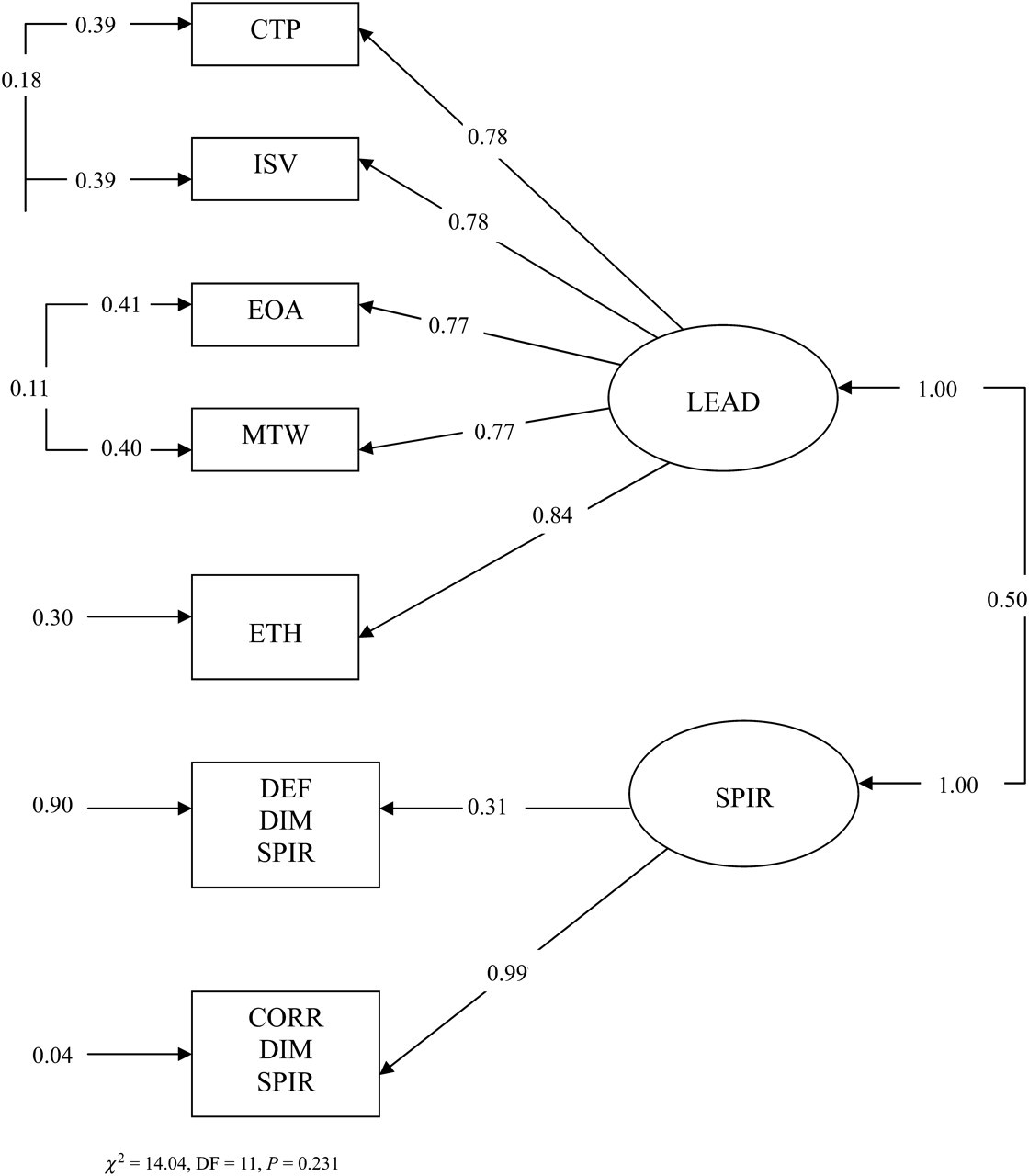
Path diagram for spirituality and leadership
It is interesting to note that all of the effective leadership practice dimensions show very high factor coefficients within the leadership construct (r values of 0.78, 0.78, 0.77, 0.77 and 0.84), while there is a moderately low factor coefficient within spirituality for the definitive dimensions (r = 0.31). There is also an extremely high factor coefficient (r = 0.99) for the correlated dimension.
Finally, the correlation between spirituality and leadership was moderately positive with r = 0.50. The chi-square value of 14.04, degrees of freedom = 11 and P = 0.231 indicated that the model provided a good fit. 29 The error variances associated with the two sets of leadership dimensions, i.e. challenging the process with ISV and for ETA and MTW, are correlated with values of 0.18 and 0.11 indicating a slight response bias.
Discussion
Our data in this exploratory study indicate that there was a statistically significant correlation between the spirituality dimensions and the leadership dimensions at either the 0.01 or the 0.05 level except for two relationships. There was a statistically significant difference at the 0.05 level between the leadership dimension's mean scores and the health-care managers who were ‘more spiritual than non-spiritual’ on three practices: ETA, MTW and ETH. The CFA theory-based model indicated a moderately positive correlation (r = 0.50) between the latent constructs of spirituality and leadership.
One must be circumspect in drawing conclusions, however, due to common source bias. Responses may covary because of consistencies in respondents rather than similarities in true sources for spirituality and leadership. Health-care executives who have increased self-opinions might score themselves very high on both when others may not concur.
A discussion of the results of this study must be balanced with consideration of the following limitations of this research. No one instrument is capable of capturing all of an individual's spirituality any more than any one instrument can capture all of the dimensions of the human personality. 31 Leadership and spirituality are multidimensional concepts that involve beliefs, values and behaviours, which must be lived out in the context of others 2,21,32 and are not easily captured by any one instrument. Because there are hundreds of definitions for each construct, agreement on measurement is virtually impossible. 33,34 Moreover, the sample itself was self-selected to attend a two-day seminar on customer service in health care. Consequently, they may not be representative of health-care executives. Finally, same source bias is a concern, as these health-care executives provided data for both spirituality and self-perceived leadership practices. Because of the above listed factors, a discussion of these results is approached with caution.
Interestingly, the spirituality of health-care managers in our sample differed significantly from Zwart's 20 study population of business executives. She reported mean scores on the definitive dimension, correlated dimension and total spirituality of 42.81, 79.13 and 121.94. This correlates with our mean scores of 61.54, 115.09 and 176.63 in the present study population of health-care managers. The demographics of both groups were comparable with both having a majority of women. Zwart's study population included 59% women and this research population had 68% women. These primary differences were the sample size (Zwart = 159 vs. this present study = 319) and this study population was composed solely of health-care managers. These differences might be attributed to a self-selection process, i.e. health-care managers attending a particular seminar might be more spiritual than their counterparts.
The findings of the ANOVA testing revealed a positive statistically significant difference at the 0.05 level in mean scores on the following three effective leadership practice dimensions between the category of ‘more spiritual than less-spiritual’: ETA, MTW and ETH. This result, although interesting, has to be moderated because of the small difference in the mean scores on these dimensions between these two categories. The mean scores range from a small differential of 2.03–3.59. As noted earlier, the largest differential in any of the mean scores was in ETH with a mean score differential of 3.59. Those health-care executives with higher levels of measured spirituality were much more likely to ETH than less-spiritual executives. Since the mean score for ETH was 43.80, the 3.59 difference was about 8%.
The correlation coefficients between and among the scales reported moderately weak correlation coefficients between the leadership dimensions and the definitive dimensions of spirituality (from 0.05 to 0.15). Three relationships were statistically significant at the 0.05 level. The correlation between the five leadership practice dimensions were much stronger ranging from r = 0.34 to r = 0.46. All of those correlations were statistically significant at the 0.01 level.
This research was based on the theory of many scholars who had posited that spirituality and leadership were related. Consistent with this theory the correlation between spirituality of this sample of managers and their self-perceived effective leadership practices was moderately positive (r = 0.50) based on the Lisrel VIII© theory-based model.
One of the most interesting findings was the strength of the path coefficient (r = 0.99) on the correlated dimension of spirituality. Several explanations can be suggested for this extremely high path coefficient on Beazley's correlated dimension. Honesty, humility and service to others, which comprise the correlated dimension of spirituality as identified and measured by Beazley, have been shown to be important components of effective leadership. Management and leadership authors whose work was reviewed earlier agree that humility, honesty and service to others are important dimensions of leadership effectiveness. In management and leadership literature, rarely are these dimensions purported to be grounded on spiritual and religious traditions. 35 Honesty, humility and service to others have always been recognized as essential dimensions of spirituality and as vital dimensions for building healthy relationships with the self and with others.
The definitive dimension's path coefficient was only moderate with r = 0.33. It is significant to note that the mean score on the definitive dimension was 61.54 with an SD of 13.34. The definitive dimension consisted of 11 question items with a maximum score on each of the items of seven, for a maximum potential score of 77. This mean score could still be considered high on the definitive dimension.
The importance of Beazley's correlated dimension of spirituality's link to effective leadership could be an indication that this dimension might represent another construct as well. It is plausible that the combination of honesty, humility and service to others is a construct for love or trust or a significant portion of those constructs. Researchers have postulated that love is an essential component for effective leadership. 35 The ability to generate trust between leaders and followers is recognized as an important aspect of effective leadership. 21
There are two possible explanations for the link between spirituality and effective leadership found here and previously postulated for many scholars. First, there is a conceptual and theoretical similarity between the concepts. 8 Secondly, it is consistent with psychology of religion scholars' research that views spirituality as a combination of beliefs, values and practices lived out consistently. Such beliefs, values and practices impact and influence the self, others and the world. In a similar manner, effective leadership also requires behaviours and practices that influence self, others and the world.
Hopefully, other researchers will see implication of this research as well as the of the theory suggested here. Potential areas for future research are listed below:
Conceptually refine the model postulated herein regarding the convergence of the four quadrants of spiritual reality and effective leadership practices; Test the empirical relationship between the Beazley's model and Kouzes and Posner's model in other populations of managers and leaders; Test the above relationship using subordinate's evaluations of the leadership behaviours of more spiritual managers vs. less-spiritual managers; Use Beazley's scale extensively in other populations so that large-scale norms for his dimensions of spirituality can be established; Determine how Beazley's Spirituality Assessment Scale© dimensions might be related to beliefs and practices of Christians, other religions as well as mystical and secular spirituality systems; Examine the relationship between managers' spirituality and significant life events and crisis; Examine the relationship between managers' spirituality and values. How do terminal and instrumental values relate to and affect managers' spirituality.
36
How does an individual's correlated dimension of spirituality relate to other values?; Examine the relationship between various life circumstances and the manager's spirituality. Do various economic, health and other factors affect a manager's spirituality; Determine if a manager's spirituality is related to various personality measures. Determine the relationship between psychological traits and spirituality; Examine the relationship between manager's spirituality and his or her health as well as his or her ability to handle stress and burnout; Examine the relationship between Beazley's Spirituality Assessment Scale© and other scales developed by psychology of religion scholars.
This study theoretically and empirically identified dimensions of spirituality
16
of health-care managers to which effective leadership practices
21
are related. This study indicates that the spirituality of health-care managers is linked to their self-perceived leadership practices.