







Abstract
Summary:
The irregular use of antiretroviral therapy (ART) can result in ART-resistance but can also lead to a sensitization between agents with a cross-sensitivity. We report a case of nevirapine-associated toxic epidermal necrolysis resulting in death in an HIV-infected man.
Keywords
Introduction
HIV infection increases the risk of drug eruptions including Stevens-Johnson syndrome (SJS) and toxic epidermal necrolysis (TEN). 1 Nevirapine, a potent non-nucleoside reverse transcriptase inhibitor that is known to cause cutaneous eruptions, is a standard component of first-line highly active antiretroviral therapies (HAART) for HIV infection.
Case Report
We are reporting on a case of TEN in an HIV-infected man, treated with nevirapine (Viramune®, Boehringer Ingelheim, Germany) and who died despite early cessation of his antiretroviral agents.
A 32-year-old man who was seropositive for HIV-1 with a baseline CD4 cell count of 300/μL (CDC-Classification A2) was admitted to the local district hospital with a three-day history of a generalized skin eruption. He had no history of drug allergies.
Prior to initiating nevirapine, abacavir and lamivudine, his regimen of efavirenz 600 mg once daily had been frequently interrupted due to neurological side-effects. Fourteen days after initiating his new HAART regimen, including nevirapine 200 mg once daily, he developed a maculopapular exanthema on the trunk and proximal extremities. Upon appearance of his rash, the patient had immediately discontinued all of his antiretroviral medications and was admitted to his local district hospital.
Eight days after cessation of HAART, the rash became generalized with the painful mucosal erosions, palmoplantar bullae and a positive Nikolski sign (i.e. detachment of epidermis upon pressure). The epidermal sloughing progressed rapidly over the subsequent 48 hours (Figure 1) and despite intensive care no improvement could be achieved. Nine days later, the patient was transferred to our hospital. Examination revealed denuded skin over almost 100% of the body surface area (BSA) as well as extensive mucosal erosions.
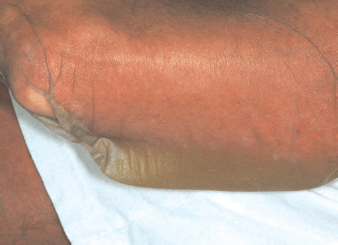
A 30 cm blister on the arm
The patient was immediately transferred to the intensive care unit of the regional burn centre and despite all efforts died of circulatory shock 11 days after admission.
Discussion
Rash is the most frequently observed adverse event of nevirapine and manifests as a maculopapular eruption with or without systemic symptoms, such as fever, oedema, myalgia and arthralgia. The rash is usually mild and self-limited and typically develops within the first one to eight weeks of therapy. 2 Some studies indicated an association between human leukocyte antigen-Cw8 and nevirapine-hypersensitivity reaction. 3
Nevirapine is reported to cause severe rashes in 3-4%, 4 and SJS or TEN in 0.3% of patients. 5 These patients should never be rechallenged. 2
Identification of a single antiretroviral drug as the cause of a drug eruption is often difficult. In contrast to nevirapine, severe cutaneous hypersensitivity reactions to abacavir and lamivudine are rare.6,7 The history of an irregular use of efavirenz with a possible sensitization, the new initiation of the nevirapine treatment (cross-sensitivity) and the timecourse of the skin eruptions lead us to believe that nevirapine was responsible for the TEN in this patient.
In this case, adhering to the recommended lead-in period did not prevent the outcome of a lethal TEN. The withdrawal of a drug with a long elimination half-life when signs of even early and mild cutaneous reactions are apparent may be too late in some cases.
Considering the high risk of severe cutaneous adverse reactions associated with nevirapine SJS/TEN in particular, we suggest the immediate cessation upon occurrence of a rash with blistering, mucosal involvement or systemic symptoms and admitting the patient to a hospital with an intensive care department if the epidermal detachment involves >30% BSA.