







Abstract
Anyone who participates in the provision of health care, whether a practitioner, manager or policy-maker, needs to ensure they are familiar with the most up-to-date guidance and rulings from their country's advisory organizations. This edition of What's on the Web looks at websites produced by national health care advisory organizations, especially those involved in advising on medicines and other interventions.
If you would like to alert readers to useful web pages or suggest topics for this column, please send details to:
National Institute for Health and Clinical Excellence
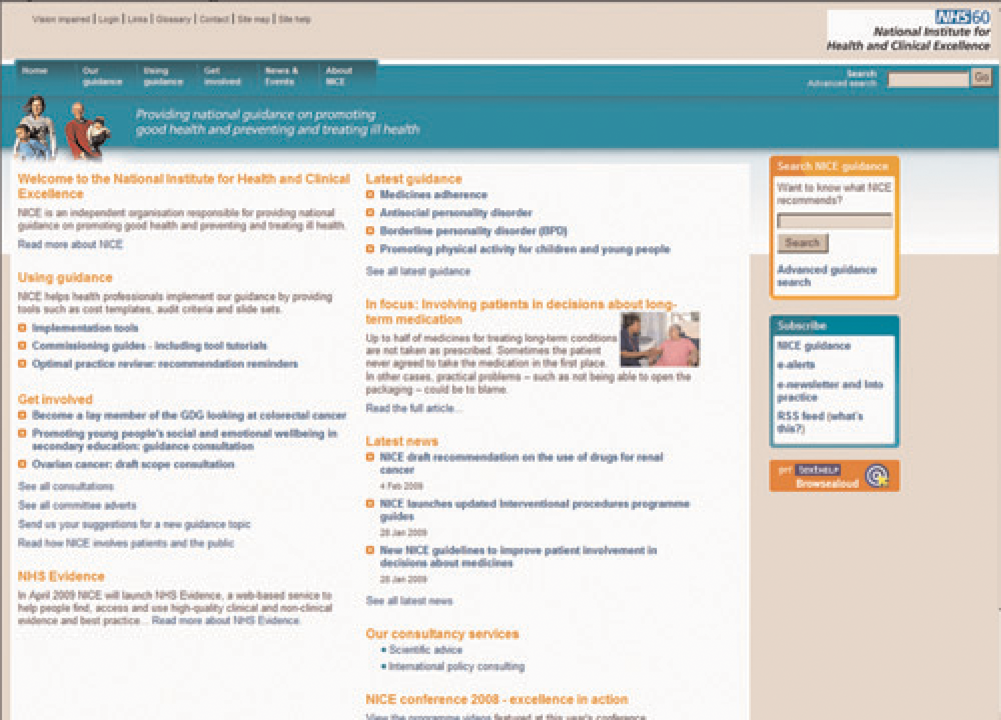
The National Institute for Health and Clinical Excellence is an independent body, funded by the UK government, which provides guidance about which drugs and health care technologies should be available by the National Health Service (NHS). It also provides clinical guidance regarding the diagnosis and management of specific conditions and on public health topics (such as physical activity and the environment, that suggests ways to encourage physical activity, including a role for local authorities).
Each set of guidance is available in a number of versions, aimed at different audiences. For health care professionals and policy-makers this usually includes the full guidance (in both Word and pdf formats), as well as a quick reference guide. For patients and carers there is also a leaflet explaining the guidance for a lay audience. Some guidance has extra material to help the NHS implement its recommendations. Costing reports and templates allow managers to estimate the savings and costs of new interventions or pathways.
The site has both a simple and advanced search function. In both instances, phrases can be searched for by enclosing the terms in quotation marks. The advanced search screen allows the user to limit searches by date (month and year). On the whole, however, it is easier to browse the site, as it is well set out. Guidance can be browsed by topic, by type (e.g. clinical guidelines, public health guidance) or by date.
At the time of writing there were a few technical hitches on the site (for instance, the online form for suggesting topics was unavailable). Also, some users may find the costings templates will not run if their systems do not accept uncertified macros. Despite these pitfalls, this is a very well-organized site that is of use to policy-makers, health care practitioners and patients.
US Food and Drug Administration, Centre for Drug Evaluation and Research
http://www.fda.gov/cder/index.html
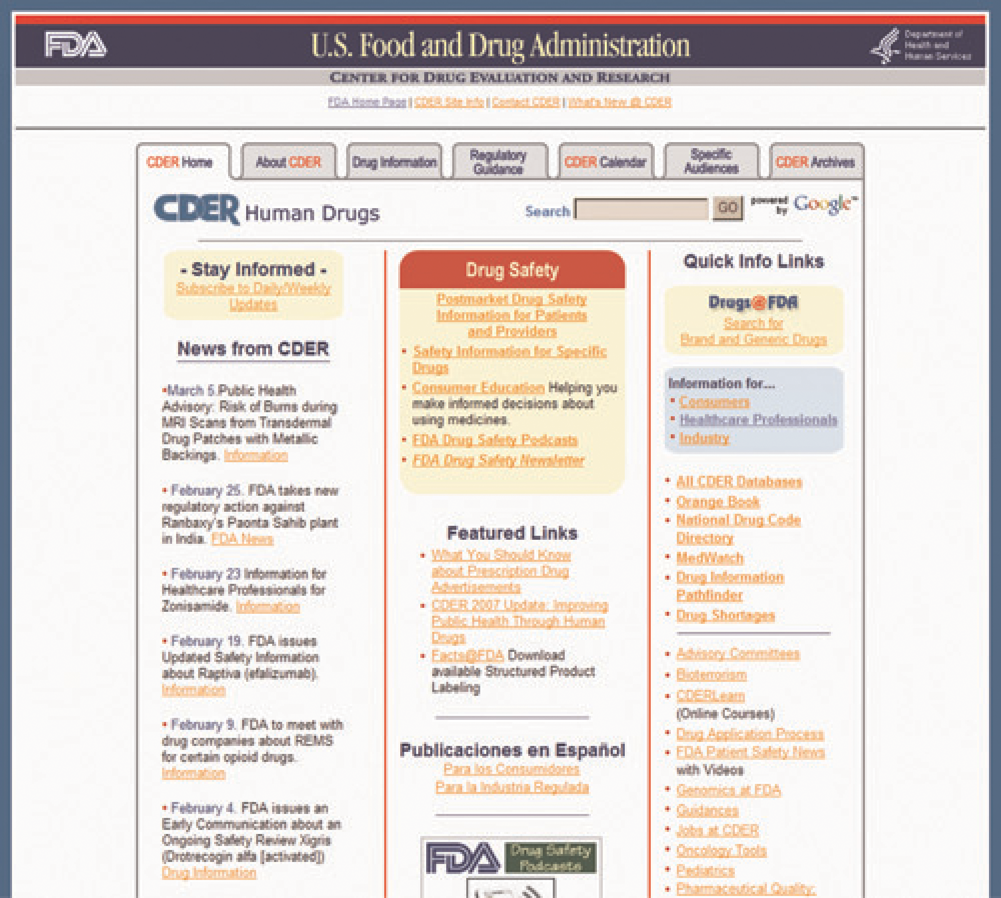
The Centre for Drug Evaluation and Research is part of the US Food and Drug Administration (FDA). One of its responsibilities is to approve drugs for prescription use. The site includes a searchable database of all drugs it has approved for use in the USA. Drugs approved since 1939 are listed by drug name. Each drug entry has an overview page which lists the companies that manufacture the drug, in what form, dosage and strength, and whether it is available on prescription, over the counter or discontinued. The latest official drug product label is also available to view and download. This contains the full prescribing information including a description of the drug, clinical pharmacology, indications, contraindications, warnings, precautions, adverse effects and safety information. Documentation associated with the marketing approval of each drug approved since 1998 is also accessible to view and download, such as FDA reviews of evidence submitted by the drug company on safety and effectiveness. As the database is updated daily, the very latest approvals, updates to existing approved drugs and labelling are presented.
The search interface allows searching by drug name via a search box. Users are then automatically directed to the brand name and the generic name for the drug of interest. An alternative A–Z browse function is provided, though selection of a drug this way will not automatically identify its equivalent brand or generic name. Therefore use of the search box is advised to avoid missing potentially relevant information. Advanced searching by FDA application number and limiting by date are also offered.
In general, the website could be confusing for new users and those unfamiliar with the drug approval process. However, a useful glossary, instructions for searching and frequently asked questions are provided which are essential to understand the information provided for each drug. The database is a useful resource to find out the very latest information on particular drugs for use in the USA. It also makes freely available all the documentation and evidence presented in the FDA approval process for particular drugs allowing close scrutiny for those requiring this level of information.
Pharmaceutical Management Agency of New Zealand (Pharmac)
The Pharmaceutical Management Agency (Pharmac) is part of the New Zealand Medicines System, which aims to enable patient access to equitable, effective, economical and appropriate medications. New Zealand provides publicly funded health care for all residents with a system of subsidized prescriptions. Pharmac's role is to aid evidence-based decisionmaking about which medicines should be funded. Pharmac considers funding applications from pharmaceutical suppliers, health care professionals and consumer groups, following a transparent decisionmaking process to minimize bias and maximize clarity. The website includes a helpful flowchart detailing this process and provides documentation for all stages of drug evaluation to support transparency. The Pharmac process encourages participation by consumers, health care professionals, district health boards and pharmaceutical companies, and the website contains appropriate sections for all these stakeholder groups. Of particular note is the excellent section for patients and consumers, which includes information on drug safety and adverse events reporting.
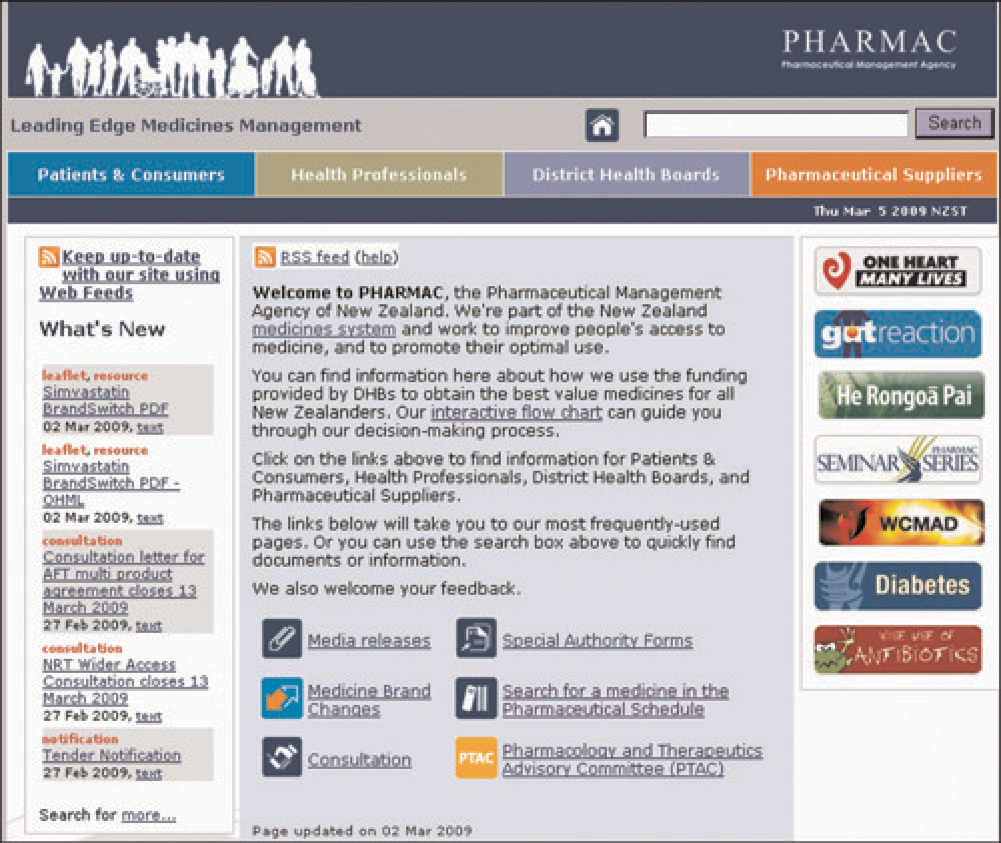
Full access is available to the New Zealand Pharmaceutical Schedule, the list of prescription drugs and products subsidized by the NZ Government. There are information sheets on recent awareness raising campaigns promoting the optimal use of medications, such as antibiotics, and effective self-care considerations for diabetes and heart disease. Many of these information sheets are available in English, Te Reo Maori, Niuean, Samoan and Tongan.
The homepage includes a ‘What's new' section, listing all additions and amendments to aid current awareness. Pharmac also offers an option to subscribe to an RSS feed to receive notification of new developments and a simple search function, enabling date searching as well as the use of Boolean operators and parentheses. Documents are tagged to prioritize ranking of search results. The search help facility enables browsing by year and document tag. Search results are presented in a helpful summary, including thumbnails of the documents retrieved. This website is colourful and easy to use with access and content tailored to meet the needs of its user groups.
Selected additional websites
http://cadth.ca/index.php/en/home