







Abstract
Patients are increasingly using the internet to access information on health care and services, as well as writing reviews of their own experiences. With patient choice increasing in many health systems, payers, purchasers and providers are attempting to take control of this trend by designing and managing their own patient opinion websites. This essay identifies and explores three aspects of online reviews of health care: the role of patients as judges of health care quality; the motivation behind patients posting reviews; and patients’ use of such information. It then discusses how useful patient opinion websites might be in supporting patient choice in health care markets and in expanding voice channels for quality improvement.
Introduction
Patient opinion websites are emerging in different forms around the world, following the trend for consumer review platforms found on websites such as Amazon and TripAdvisor. As well as independent platforms, health care providers are setting up dedicated websites. In England, the National Health Service (NHS) has launched websites for patient reviews of hospitals and general practitioners (GPs); in the USA, insurer Wellpoint has partnered with Zagat to provide a feedback website. These are intended to support patient choice by providing information for patients to use in choosing their health care provider, as well as for the collection of feedback on which to base quality improvement.
Providing choice and increasing patient involvement in health care have become common themes in policies in many health care systems. These policies are underpinned by the theory that, by invoking the mechanisms of voice and exit, 1 choice and patient involvement will drive improved quality and efficiency. However, these policies are subject to much debate. Critics argue that it is neither practical nor appropriate to offer full choice to patients within health care. Issues include the economic implications of offering patient choice within finite budgets, questions over equity, and the appropriateness of adopting consumerist approaches within public services. Voice channels have been criticised for favouring educated patients and for their over-use by the most vocal, as opposed to the least well-treated, as well as for lacking sufficient incentives for providers to improve care. 2
Patients and online feedback
While official sites for the rating of individual doctors are a relatively new phenomenon, the publication of performance data for hospitals is well-established in a number of countries. These reports are available on the internet and are examples of ‘data-driven’ websites for quality assessment. However, the advent of Web 2.0 has been heralded as an important milestone in health care and in the changing relationship between doctors and patient. ‘The defining feature [of Web 2.0] is that information flows, usually for free, between peers rather than down a traditional chain of author, publisher and reader.’ 3 This ability for peers to interact with the web and, by implication, with each other has led to the rise of consumer review platforms in many markets. In the USA health care market, more than 40 sites exist for patients to rate their doctors, the most controversial being www.ratemds.com, which includes reviews from the USA, the UK, Canada and Australia. In the UK, a comparable site, www.iwantgreatcare.org, was set up in 2008, with 25,000 comments posted in the first six months of operation (N Bacon, personal communication). In addition, feedback on doctors is not restricted to dedicated opinion websites; patients can also post feedback on opinion platforms on local business services such as www.bview.co.uk and www.angieslist.com.
The launch of these platforms has polarized debate. Those in favour (mainly patients, journalists and the owners of the websites themselves) argue that feedback is overwhelmingly positive, that patients have a right to know if providers are sub-standard and that doctors should be positive about receiving feedback to identify opportunities for improvement. Advocates point out that it is only doctors who are negative about these initiatives, highlighting the persistence of medical paternalism. In contrast, detractors, mainly doctors, highlight the potential for libel and reputational harm and the inability of patients to assess the quality of care. The unpopularity of opinion websites has been the subject of letters and commentary in medical journals and newspapers, and sites have been threatened with legal action. 4
Patients as reviewers of health care quality
I remember the time Shipman gave to my Dad. He would come around at the drop of a hat. He was a marvellous GP apart from the fact that he killed my father. (Christopher Rudol at the Shipman Inquiry) 5
The relationship between doctors and patients has changed considerably since Talcott Parsons defined the sick role of patients, where patients deferred unquestioningly to the authority of doctors. 6 Many factors are seen to be shifting this power relationship, with patients increasingly positioned as consumers within health care markets. However, critics of patient opinion sites draw attention to the information asymmetries which exist between patients and doctors, combined with the uncertainty around health outcomes, suggesting that the patient may be unable to assess health care effectively. A USA survey showed that up to 50% of adults surveyed were not even aware of any major differences in the quality of care. 7 Patients are therefore simply not skilled or knowledgeable enough to provide informed reviews of health care in the same way they might be able to review hotels, cameras or washing machines.
In contrast, advocates of feedback sites argue that reviews are not expected to provide a critique of technical quality but rather the patient's perception of the quality of care is a complementary measure. Technical competence is obviously important to patients; however, patients assume that the qualifications, membership of professional bodies, and position within their health care organization all indicate that the technical ability and ethics of the doctor are without question. Supporting this is the tendency for the quality of the patient experience to be considered as a critical component of care. Good communication skills are a major part of this, forming an inherent part of the doctor's role in activities such as extracting medical information and in involving the patient in treatment decisions. Good communication skills have been linked with reduced distress and improved self-efficacy, 8 better outcomes 9 and reduced complaints. 10 Capturing patients’ experience of care is therefore seen as an important component of measuring the quality of care. It is argued that patients should be free to exchange experiences in order to make informed decisions.
In contrast, critics of this approach argue that patients’ opinions are subjective and dependent on their preferences and expectations. The latter change with the severity of illness and frequency of doctor visits11,12 Sex, age, socioeconomic group and ethnicity have also been found to influence health seeking behaviour and therefore expectations and satisfaction ratings. 13 The challenges which patients face regarding the interpretation of data such as mortality14,15 will also affect the accuracy of patients’ reviews. The concern is therefore that less-informed patients will struggle to recognize the personal preferences and expectations which may have influenced a patient's online review of their health care, as well as the reviewer's competency to assess the technical quality of the health care delivered.
Why patients post online reviews
I once told Jeff Bezos [founder of Amazon.com] I thought his plan to supplement professional book reviews on Amazon with reviews written by anyone who felt like it was crazy. Even if you got people to take the trouble to contribute, who'd give credence to the opinion of someone they'd never heard of? Wisely, Jeff ignored my advice. (Scott Cook, founder of Intuit [major USA software company]) 16
For the UK government, the initiative to gather patient feedback via the web is inextricably tied up with quality improvement: ‘To resort to voice, rather than exit, is for the customer or member to make an attempt at changing the practices, policies, and outputs of the firm from which one buys or the organization to which one belongs.’ 1 However, as those who have posted or used a review on TripAdvisor or Amazon will attest, consumers may not be concerned with service improvement when posting reviews. Researchers in the field of consumer behaviour have explored the motivations for both positive and negative word-of-mouth communication for consumer products. In 1998, Sundaram et al. 17 focused on a range of products, from shampoo and kitchen knives to cars to see to what extent motivation varied when someone posted a review. They found that altruism was a significant motivator for both positive and negative word-of-mouth reviews, with consumers keen to guide others to share positive, or avoid negative, experiences (Table 1). The category of ‘helping the organization’ can also be viewed as a form of altruism, in that consumers want to help to make the organization (or individual provider) in question more successful. In contrast, the motivation alluded to by doctors concerned about opinion websites is labelled here as ‘vengeance', in the negative word-of-mouth category, where consumers may post negative reviews to retaliate against providers or manufacturers for not meeting their expectations. As well as the range of motivation driving word-of-mouth reviews in general, online forums can satisfy additional needs for the consumer. They can provide ‘moderator-related utility’ if the site has been set up to facilitate an easy route for complaints. 18 There is also an opportunity for increased collective consumer power: online reviews can reach a wide audience, they may be available for extended periods of time, and the subject of the comment is able to access the review. However, the fact that users of these reviews do not have insight into the motivation of the reviewer adds another obstacle to the reader's successful interpretation of the information.
Motivation for word-of-mouth communication regarding products and services
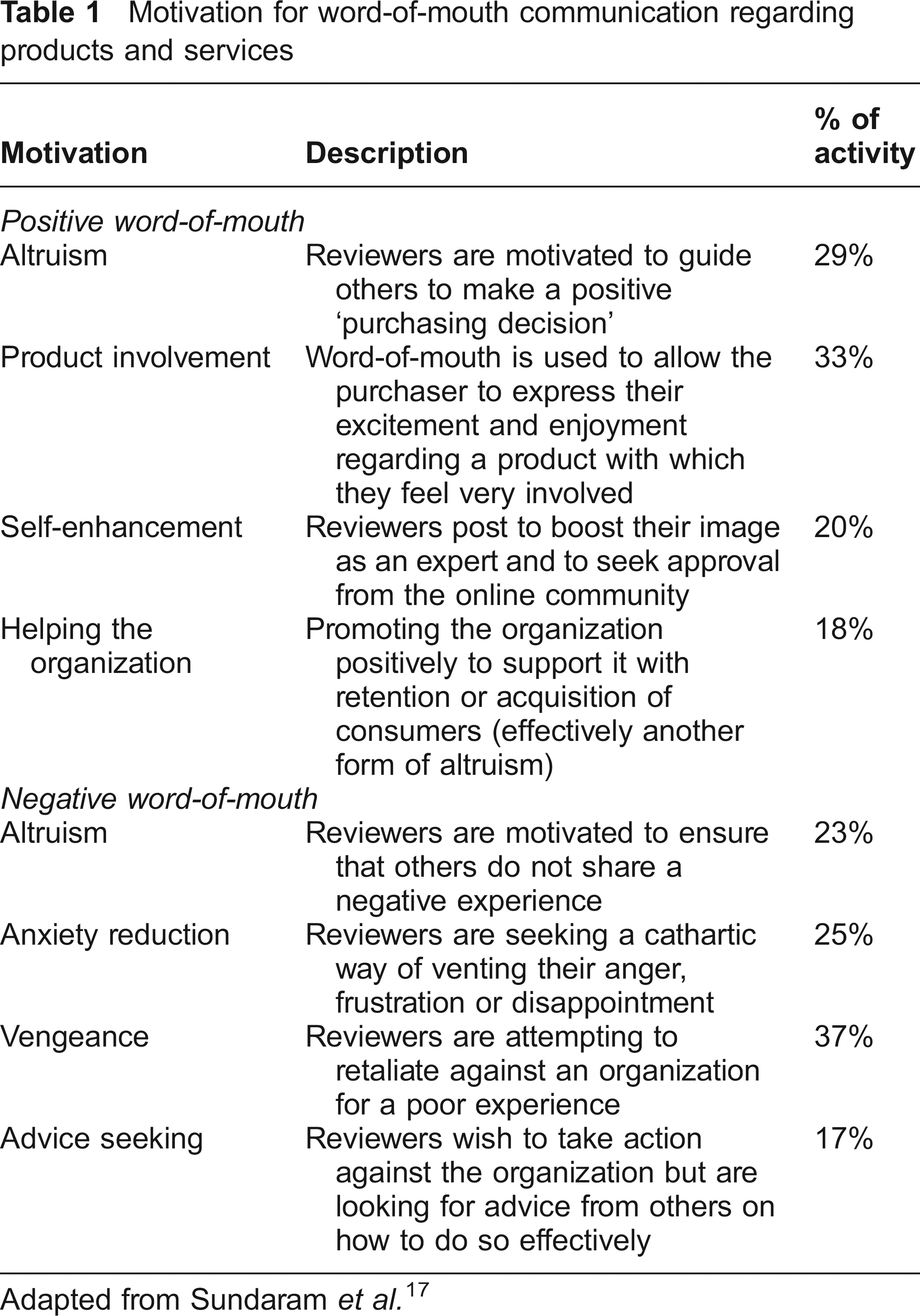
Adapted from Sundaram et al. 17
Patients as users of reviews
‘It's critical that people evaluate a doctor-based on clinical competence, not just bedside manner. But harrumphing that consumers should shun these sites because they can't verify their claims smacks of medical paternalism. After more than a decade of shopping, chatting, dating, and researching all sorts of topics online, people know that on the Internet what you see is not always what you get. Doctors should give them credit for that.’ 19
Users of reviews have two major challenges to deal with when assessing feedback posted on websites. First, they must assess the competence and expectations of the reviewer in judging the quality of the health care received and second, evaluate the potential motivation behind the review. Complicating matters is that, for health care, the user is unlikely to have the ability to assess the skills of the reviewer, regardless of how much information is available to them about the individual. Offline, individuals will attempt to determine the credibility of the reviewer through social and contextual cues. 17 However, in their research on consumer products, Brown et al. 20 found that online assessment of a reviewer's credibility appears to be more strongly linked to the consumer's perception of the website, rather than to their perception of the reviewer. In assessing the credibility of websites, consumers have been found to value the independence of sites, placing more faith in websites which are not channels for advertising or official messages. Other studies conclude that the quantity of reviews is a more important determinant of buying behaviour than the quality of reviews. 21 There are similar findings in studies of health information-seeking which suggest that website design can play a large part in individuals’ judgement of the credibility of health information. For the majority of users, ‘consulting the Internet has more to do with a desire to obtain as much information and as many perspectives as possible, to make sure nothing important has been missed’. 22
How useful is this feedback?
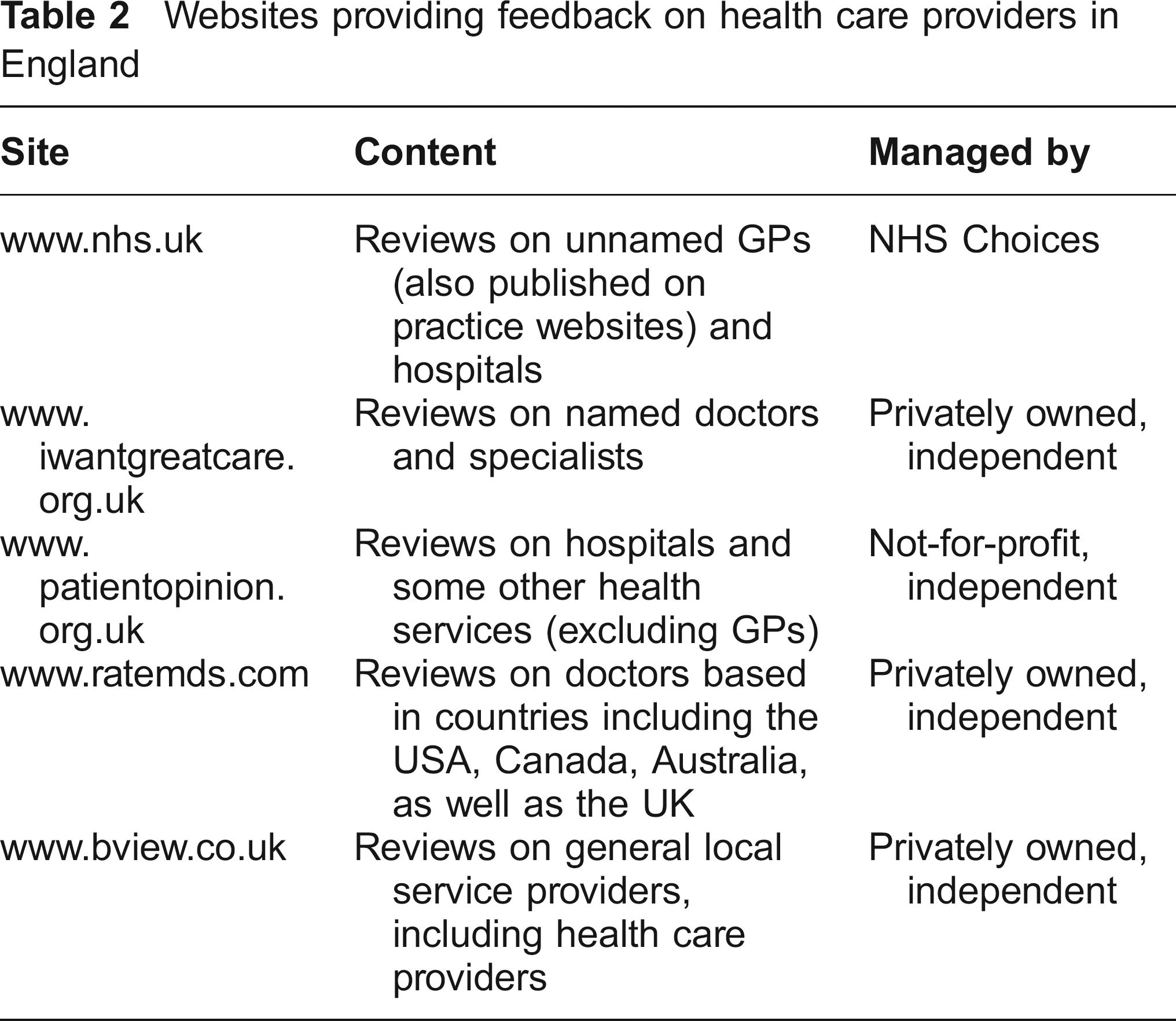
Growth in the volume of online patient reviews suggests that patients are embracing the opportunity to review their health care. Table 2 gives some examples of websites available in the UK for the review of primary care. However, it remains unclear how this information can be harnessed by health care providers to support their wider goals and whether patients will find value in using provider-run sites.
Websites providing feedback on health care providers in England
Enabling choice
Purchasers recognize the need to provide comparative information to support choice of medical providers by patients, demonstrated by the efforts in many countries to publish performance data. Despite this, only 40% of patients in Europe feel they have enough information to choose between GPs. 23 Evidence regarding the public use of reporting in health care suggests there are several reasons for a lack of use, including design and clarity, 14 the fact that patients are simply not aware of the variability of quality between health care providers, 15 and, in the UK, an historical lack of choice. 24
Assuming that patients do start to investigate the choices available to them, a number of questions arise regarding the usefulness of opinion sites. The first is the patient's ability to evaluate the credibility of the reviewer and their posting. As an information user, the patient is unaware of the factors affecting both the reviewer's level of satisfaction and their motivation for posting the review. Further research is required to understand how well patients evaluate online reviews and what can be done to assist in this evaluation. Secondly, a greater understanding is needed of the reasons why patients seek reviews, whether it is their single source of information and, more importantly, whether it informs or instigates a decision to change general practice or assist the patient in other ways, for example managing future interactions with their doctor or practice. This may determine whether patients turn to quantitative or to patient opinion websites, and whether they value platforms managed by health service providers or prefer independent websites.
Publishing feedback to improve services
Health care organizations are expecting to use patient opinion platforms as a ‘voice’ channel to improve the services offered by providers. To some extent, this ignores the fact that these platforms may have more in common with the word-of-mouth channels for consumer products, where users have a range of reasons for posting feedback. The opportunity offered by independent websites to make comments, with relative impunity, regarding individual clinicians, may offer more appeal than a website managed by a health care organization. Patients who are seeking retaliation, or who are determined that others will not share their negative experiences, may have more flexibility to do this on an independent site. Notwithstanding this, in order to improve health care quality, a key feature of health service platforms is that comments will be fed back to the provider, albeit anonymously. This may attract patients who treat this as a channel for voice, in that they have a desire to assist in improving the service. They may view the channel as an alternative to complaints processes if they believe the provider to be unresponsive to complaints or such processes are too difficult to access. Anonymity may also appeal to patients, particularly those with long-term illnesses, who do not want to jeopardise the relationship with their doctor. The lack of opportunity to complain anonymously has been recognized as a flaw in the current complaints process. 25 Patients may also perceive an opportunity to exercise more effective collective power, given the potential size of their audience and the longevity of comments posted on the internet.
However, the usefulness of this information may be diluted by the fact that patients cannot leave feedback on named individuals, thereby reducing the opportunity for remedial action. Another question is how complaints can be resolved without breaching confidentiality or privacy issues, as well as how feedback fits with other data and the potentially conflicting pressures from quantitative indicators. Finally, it is important to reflect on whether these platforms address inequity, seen to be associated with voice, given the growing recognition of the digital exclusion of parts of society. While there is evidence that some ‘hard-to-reach’ groups may readily access the Internet, there is growing evidence that the Internet reinforces inequity in the use of voice, with access affected by age, sex, education, socioeconomic group, disability and health status. 26 , 27 It is important to understand whether a growing reliance on the Internet for the collection and distribution of health care information will reinforce social exclusion for those who most need access to health care.
On a more positive note, outside of health care, this information is seen as providing a rich source of information for quality improvement. Provision of this information, often by those with altruistic aims, has been referred to as ‘letting volunteers build your business’. 16 For health care, these platforms provide a channel for capturing information which may not be available through other means, particularly given the impossible task of designing patient surveys which capture every eventuality. Within the UK, a number of NHS organizations are reportedly working with www.iwantgreatcare.org to gather and evaluate patient reported information (N Bacon, personal communication). In addition, patient advocacy groups have already seen the value of this information: a number of charities and patient groups, including Diabetes UK and The Stroke Association, have already formed partnerships with www.iwantgreatcare.org to help them improve the experience for the patients they represent. 28 However, questions remain on whether this information can be harnessed effectively and whether sufficient incentives exist for it to be employed for quality improvement.
Conclusion
The biggest challenge in assessing patient opinion platforms is the lack of research concerning how these platforms might be used by patients, why they are used and the usefulness of the information gathered. Research on word-of-mouth marketing has tended to focus on consumer products and services; the findings regarding motivation for both posting and using reviews need to be tested in health care.
The increasing use of opinion sites suggests that patients are seeking new ways to provide feedback on providers. It seems unlikely that clinicians will be able to prevent reviews being posted in some form, somewhere, on the Internet. Understanding the reasons for use of these sites would provide an insight into issues such as patients’ preferences for independent or official sites and how feedback can be leveraged for quality improvement.
The publicity concerning these platforms may distort their relative importance, whether it is in assisting with quality improvement or in providing information for patients to decide on providers. It is unclear to what extent patients will look to online feedback to inform their choice of provider and whether it will make patients more likely to switch. In addition, although it is important to acknowledge that the popularity of internet applications can grow rapidly, as shown by phenomena such as online social networking, it is also important to ensure that this channel does not receive disproportionate attention at the expense of improving traditional channels for communication between patients and practitioners. This will ensure that those who most need access to health care are able to voice their complaints and feedback regardless of their access to the Internet.