







Abstract
This edition of ‘What's on the web’ reviews websites that provide information about studentship and fellowship award schemes for both clinical and non-clinical researchers. The included organizations provide funding opportunities to researchers based in the UK and elsewhere at different stages of their research careers.
If you would like to alert readers to useful web pages or suggest topics for this column, please send details to:
Wellcome Trust
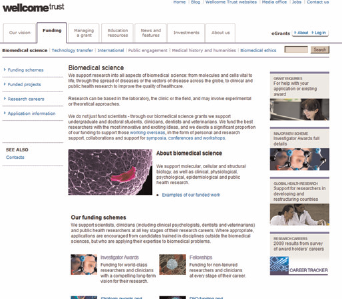
The Wellcome Trust is a global charitable foundation dedicated to producing improvements in global health through the provision of grants to promising researchers. Grants are funded through a broad investment portfolio, allowing the organization to be independent. The Trust has identified five major areas in which to provide funding: health benefits of genomics, neuroscience, global infectious diseases, ageing and chronic diseases, and the effect of the environment on health.
Grants are available to individuals at every stage of their career but the emphasis is on people in the early stages. For instance, there are Research Training Fellowships aimed at graduates with little or no research experience and New Investigator Awards for researchers who are five years or less into their first academic appointment.
Eligibility varies from award to award. Most are available to UK residents, and selected grants are available to other European countries (for example, Senior Research Fellowships in Clinical Science). A significant proportion of funding is available for researchers in low and middle-income countries, particularly those who are carrying out research on public health topics. Applications are particularly encouraged from researchers based in developing countries, particularly sub-Saharan Africa and South and South-east Asia. Alternatively, researchers can be based in the UK and working with partners in a developing country.
As well as listing the grants available and how to apply, the site provides information about managing a grant once it has been awarded. This is helpfully arranged into things the recipient will need to know at the different stages of a grant and includes information on how to determine start and finish dates of a grant, how payments are made and advice about publications following the end of the grant.
The search facility on the site is a basic search box, similar to the provision made by most sites and the best way to navigate the site is to browse. Tabs across the top of the page provide access to the various site sections and include tabs for ‘Funding', ‘Managing a grant’ and ‘News’. Within each section, further navigation is enabled via hyperlinks. Overall, the site is well laid out and easy to navigate, the only potential drawback is the wealth of information about the Trust and its activities that may tempt the user into interesting parts of the site that are not relevant to them.
Marie Curie Actions
http://cordis.europa.eu/fp7/mariecurieactions/home_en.html
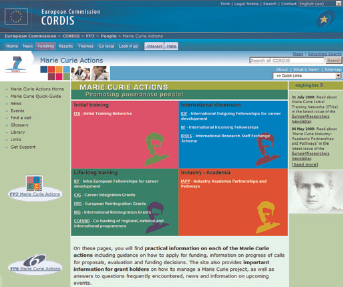
Marie Curie Actions provide a range of fellowships and other funding opportunities for researchers. They are part of the 7th Framework Programme for Research and Technological Development, also known as FP7, funded by the European Union. Marie Curie Actions come under the People Programme of FP7 which is aimed at supporting the career development of European and international researchers.
From the homepage access to all of the various funding schemes is available from the central pane, however it is more useful to consult the ‘Quick-Guide’, on the left, that enables potential candidates to filter the various schemes and view further details of those that match their level of experience. There is also a PDF pocket guide available for download from the library section which provides a concise and accessible overview of the various Marie Curie Actions.
The ‘Find a Call’ section contains the latest calls for proposals which are still open for applications. It is here that all of the documentation for each call can be downloaded including details on deadlines for applications, how to apply, any specific eligibility criteria, and background documents about the wider FP7 scheme which may need to be consulted. Some of the documents appear quite detailed and lengthy. Applications are submitted electronically via the electronic proposal submission service. As well as open calls, forthcoming and past calls can also be viewed. At the bottom on the page there is a useful email alerting service where users can register to receive email notification of the latest calls as they are announced.
Various support services for potential applicants are provided under the ‘Get Support’ section, which are essential given the complex nature of some of the documentation for the open calls. Contact details for advisors based in each country, called a national contact point, are provided to help with queries relating to applications under this scheme and others within the wider FP7 programme. A general enquiry service and a frequently asked questions section are also available, together with a glossary to help with decoding the many acronyms that are used.
Under the ‘Links’ section is Euraxess, a web-based search facility for those looking for research jobs and funding opportunities in Europe. It is here that organizations in receipt of Marie Curie Action funding advertise their research posts.
The Marie Curie Actions website is a useful resource for either researchers starting out or those with more experience who are looking for career development funding opportunities in Europe. The homepage of the website is slightly confusing due to the various tabs and links which appear at the top of the page which are for the FP7 general website. However, if users stay within the Marie Curie Action site it is well structured and easy to navigate.
Economic and Social Research Council
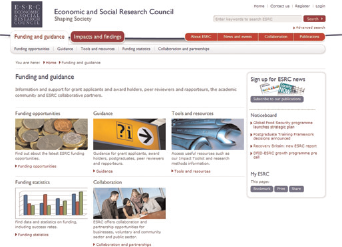
The Economic and Social Research Council (ESRC) has a dedicated section on its recently updated website about research funding, available under the 'Funding and Guidance’ tab at the left hand side of the home page. It is a substantial resource providing ‘Information and support for grant applicants and award holders, peer reviewers and rapporteurs, the academic community and ESRC collaborative partners’. The overall appearance of the site is clear and well laid out with a good use of illustration and space.
Funding opportunities via ESRC are available at all stages of a researcher's career from postdoctoral through to professorial level. Although the website does have a search facility, the more effective approach to identifying any relevant opportunities is likely to be scanning individual sections of the website where the material has been helpfully organized into subcategories to facilitate browsing.
For example, the ‘Postgraduate Studentship’ section opens with a brief overview of the support offered by the ESRC, and leads on to further information on additional pages about its Postgraduate Training Framework, ESRC's Doctoral Training Centres, funding guidelines and recognized departments.
Much of the information supplied is both complex and detailed and could be difficult to view purely on screen. Where this is the case, e.g. the Postgraduate Funding Guide, a PDF document is provided giving the user the opportunity to conveniently save or print the document so that it can be viewed offline. Helpfully, the size of the document and the publication date are both clearly shown so the user can be clear about the document's status before downloading.
Other features of the site include a ‘Latest Opportunities’ list, as well as the facility to sign up for RSS feeds to track updated online content such as news items and funding opportunities. The ‘You are here’ reminder at the top of each page greatly helps the user in navigating around the site.
The relaunched website has improved significantly in both appearance and functionality.
Selected additional websites
Organizations that offer international funding
http://cordis.europa.eu/fp7/home_en.html
European funding is available to support transnational collaborative research in a range of disciplines, including health.
http://www.commonwealthfund.org/Fellowships/Harkness-Fellowships.aspx
Grants for mid-career health services researchers and practitioners from selected countries to spend up to 12 months in the USA to conduct original research.
http://www.rhodeshouse.ox.ac.uk/
Rhodes Trust scholarships enable postgraduate students from all over the world to study at the University of Oxford, UK. Applications can be made for any full time postgraduate degree available at the university.
http://www.rockefellerfoundation.org/
Provides funding for projects that fall within its initiatives. Current initiatives include climate change resilience, strengthening food security in Africa, linking global disease surveillance networks and transforming health systems.
Organizations that offer grants with more limited eligibility criteria
http://www.fulbright.co.uk/fulbright-awards
Open to UK or USA citizens, exchange grants are available for study or research in any discipline.
Offers funding across all disciplines for various activities including early career fellowships and research projects. The international networks section allows for multinational teams to apply for funding, but they must have a principal investigator based in the UK. A mailing list makes it easy to stay up to date.
http://www.mrc.ac.uk/Fundingopportunities/Fellowships/index.htm
Funding for fellowships, studentships and global health trials. Awards are available mainly for UK-based researchers, but there is also provision for overseas applicants.