







Abstract
Isambard Owen, born in Chepstow to a Welsh father, studied at Cambridge and St George's Hospital where he qualified in 1875 and was later physician and Dean. In 1904 he moved to Newcastle-upon-Tyne as Principal of Armstrong College. He left in 1909 to become Bristol University's Vice-Chancellor, retiring in 1921. Although not resident in Wales he was an ardent Welshman. After joining the Cymmrodorion Society in 1877 he became involved in the struggle to improve primary and secondary education in Wales, partly by promoting use of the Welsh language in schools. His main contribution to Welsh academic life was in the foundation of the University of Wales and, later, of the medical school in Cardiff. He wrote the University's Charter and from 1895 until 1910 was its Senior Deputy Chancellor – and stand-in for two Princes of Wales (later Edward VII and George V) who served as Chancellor.
Herbert Isambard Owen (‘Bertie’ to his family) was born on 28 December 1850 at Bellevue House, Chepstow. The house on Steep Street, called High Trees since 1889, now houses offices of Monmouthshire County Council. A plaque outside, in English and Welsh, commemorates Isambard's birth (Figure 1). In 1853 the family moved to Gloucester. Isambard Kingdom Brunel (1806–59) was his godfather. 1
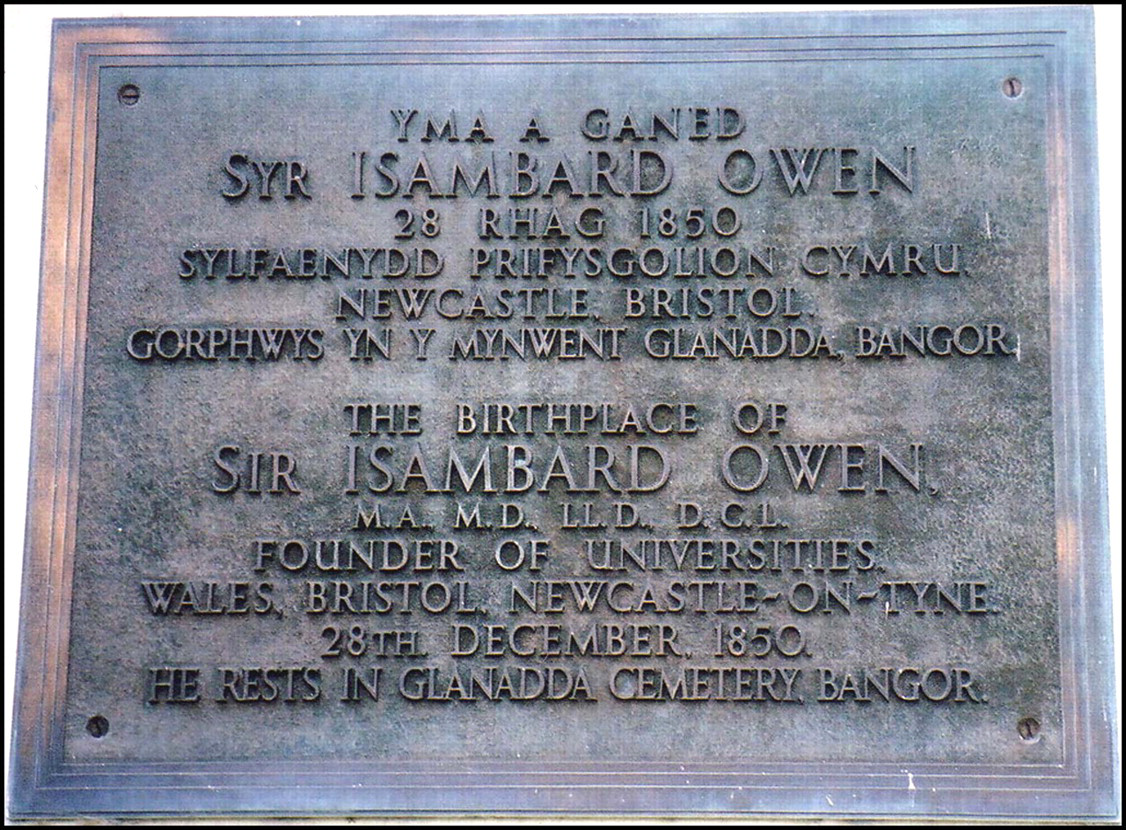
The plaque, commemorating Isambard's birthplace in English and Welsh, placed outside High Trees, Chepstow in 1954, reproduced courtesy of Henry Hodges
Isambard's father, William George Owen (1810–85), born in Caernarvon, was Brunel's assistant at the Great Western Railway and eventually its Chief Engineer. Isambard's mother, Amelia Sarah Martin, born in London in 1817, was the daughter of Charlotte Martine, a Catholic Parisienne whose second husband, Abraham Martine, a Jew and a Bonapartist, vanished after Napoleon's downfall. Charlotte fled to Bath and married a Mr Perry. After Charlotte's death Amelia was brought up a Protestant. She married William at Hurst Parish Church, near Reading, on 18 February 1837. 2
Isambard was the Owens' youngest child. Ellen Phoebe had died in 1846 aged eight; George Wells (b. 1839) and William Lancaster (b. 1843) became engineers; Charles Maynard (1848–1929) studied at Emmanuel College, Cambridge, and became a successful (and rich) solicitor.
Isambard attended King's School, Gloucester, then boarded at Rossall. His father's chief clerk in Gloucester, Thomas Thomas, introduced him to Wales and its literature. Isambard's subsequent enthusiasm for things Welsh is emphasized in his daughters' biography. 3
Medicine and St George's
Although Isambard was interested in architecture, his father wanted him to study medicine. In 1868 he entered Downing College, Cambridge; he was six feet tall, with a high forehead, blue eyes and a Roman nose (Figure 2). He took the Natural Sciences Tripos, graduating BA in 1872. When he entered St George's Hospital Medical School in September 1871, the family lived at 29 Eastbourne Terrace, Hyde Park, London. He qualified MRCS in 1875, MB (Cantab) 1876, MRCP 1878, MD (Cantab) 1883, and was elected FRCP in 1885. His MD thesis, The Treatment of Acute Rheumatism, presented the results of treatments used at St George's Hospital in 1877–78.
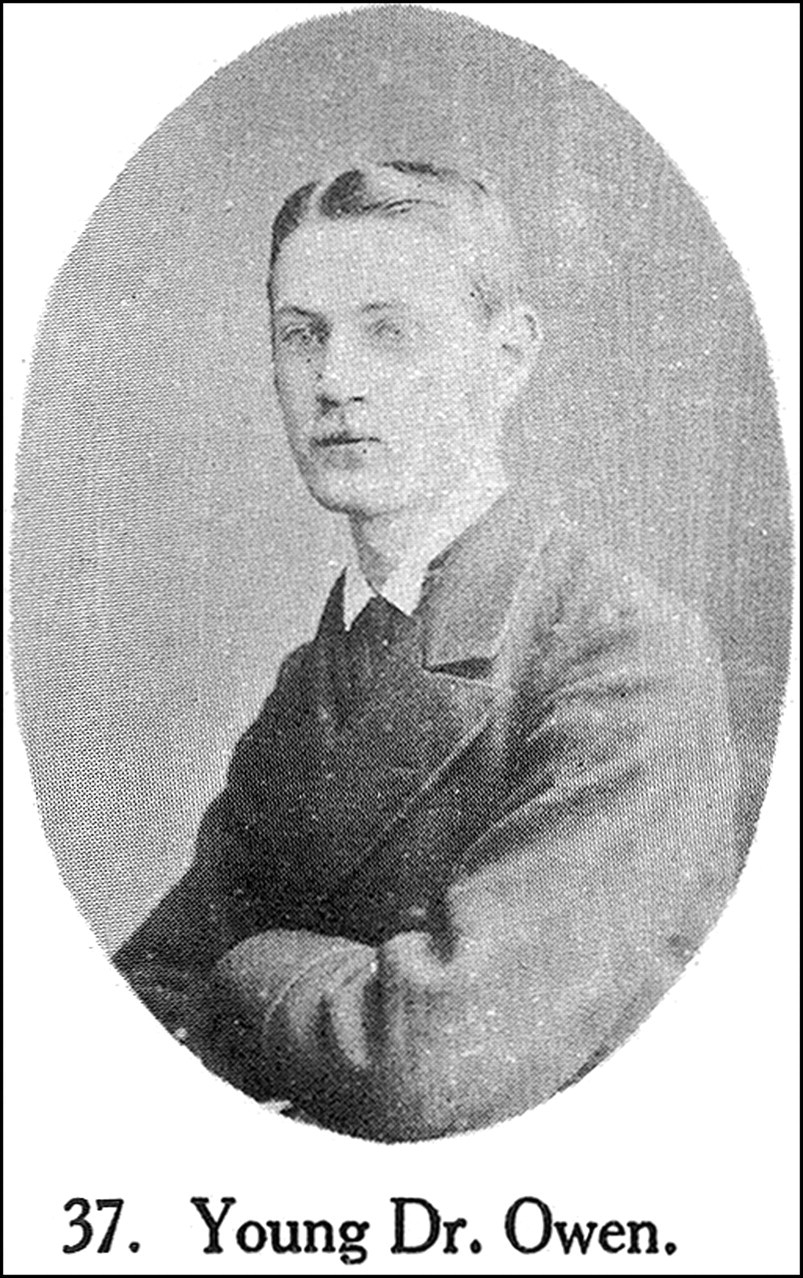
Young Doctor Owen (figure 37 in Sir Isambard Owen: a biography; privately published by Isambard Owen's daughters 1 )
At St George's he was Assistant Curator of the museum (1876), Medical Registrar (1877–80), Curator of the Museum (1881–82) and Assistant Physician from 1883 until appointed Physician in 1894. As a junior doctor he lived with his parents at 41 Gloucester Gardens, Paddington, and subsequently lived and practised at 5 Hertford Street and 40 Curzon Street. 4
In 1882–83 he was Assistant Physician at the ‘Consumption Hospital, Brompton’; he resigned in 1884 to become Dean at St George's and showed initiative and foresight, particularly in appointing Patrick Manson (1844–1922) as Lecturer in Tropical Medicine in 1894. 5 According to the British Medical Journal he was Dean for five years. 6 In October 1904 St George's Hospital Gazette notes his deanship as lasting from 1896 to 1902; 7 however, his obituary in the same journal states that he was appointed Dean in 1893 and served for about 10 years. 8 The minutes of a quarterly meeting of the medical school committee on 3 July 1893 record his appointment as Dean, while on 5 November 1902 the Hospital Board, informed of the joint appointment of Jaffray and Latham to succeed him, wrote thanking Isambard for the admirable manner in which he had conducted the affairs of the school.
Isambard was Joint Honorary Secretary of the Medical Society of London from 1881 to 1883 and its Orator in 1904 when he was made an Honorary Fellow. From 1884 to 1888 he was Secretary of the British Medical Association's (BMA's) Collective Investigation Committee, formed by Sir George Murray Humphry (1820–96), then BMA President, to advance clinical and epidemiological aspects of medicine. Isambard reported on links between disease and intemperance. 9 He was Secretary (1891), Vice-president (1892) and President (1903) of the BMA's Medicine Section. From 1892 to 1897 he was Joint Honorary Secretary of the Metropolitan Counties Branch and represented it on the BMA's Central Council (1896–99). He was a member of the Parliamentary Bills Committee (1894–97) and of the Medical Charities Committee (1899–1902). 10
From 1884 until 1898 there was agitation over university education in London because its University was simply an examining body. Teachers from University College (UCL) and King's College (KCL) tried to establish an 'Albert University of London' while London's Royal Colleges of Physicians and Surgeons petitioned for degree-giving powers through a ‘University of Westminster’. A Royal Commission (1888) under Lord Selborne rejected the ‘Westminster’ proposal and considered the ‘Albert’ scheme unsatisfactory. In January 1894 another Royal Commission, under Lord Cowper, recommended reconstruction of the existing university as a teaching university with a Senate, Academic Council, Faculties and Boards of Studies, but by legislation rather than by Charter. Before the requisite Act of Parliament was passed in 1898 Isambard and Sir James Fowler (1852–1934) drafted a new scheme for a ‘University of Westminster’ – to include the Royal Colleges, the London medical schools and the Society of Apothecaries. 11 The scheme was published in the BMJ but, soon after, Parliament created the administration needed to execute the Cowper Commission's recommendations and the ‘Westminster’ scheme was abandoned. 12
In 1901 Senate suggested to its Medical Faculty, of which Isambard was Vice-Dean (1901–04), the amalgamation of preclinical teaching in one large department thus allowing closure of small, poorly equipped departments; the Faculty supported the idea. Isambard explained the scheme for an ‘Institute of Medical Sciences’ at South Kensington in his oration to the Medical Society of London in May 1904. 13 The Faculty changed its mind in 1905 and the University abandoned the scheme in 1907; however, there was some amalgamation – Westminster (in 1905), St George's (1908) and Charing Cross (1911) arranged for preclinical teaching at KCL.
Newcastle-upon-Tyne
In October 1904 Isambard became Principal of Armstrong College, Newcastle-upon-Tyne – founded in 1871 as the College of Physical Science and incorporated with the University of Durham three years later. He may have been chosen because of a plan to unite Armstrong College with the College of Medicine, founded in 1834 by local medical practitioners and associated with the University of Durham from 1852. 14
Isambard prepared a plan to change the University of Durham's constitution. He proposed two divisions – Durham and Newcastle – independent of Senate in ‘collegiate’ matters and with equal weight on 'University' questions. His draft Bill met with general approval but some worried about secularization of the University and ceding of academic authority from the Dean and Chapter to the Senate. Some also suspected Isambard wished to transfer the University to Newcastle. 15 Durham graduates, mainly clergymen, were opposed. Although a long parliamentary struggle seemed likely, the Act was approved on 1 August 1908. Durham University could now expand – but without Isambard. He resigned to become the second Vice-Chancellor of the newly established University of Bristol; the first, Conwy Lloyd Morgan, served only six months.
Marriage 16
Isambard married Ethel Holland-Thomas (1868–1928) at Montreux on 5 April 1905. He was 54, she was 37. They had met in 1903 at the home of Warrington Haward (1841–1921), a surgeon at St George's. She was the seventh daughter of Captain and Mrs Lewis Holland-Thomas. Her father, a sea captain, prospered from pearling in the Pacific and gold prospecting in California. He acquired land on which San Francisco now stands but sold it and settled in Cae'r Fynnon, Talsarnau, Merionethshire, where Ethel was born. Another daughter was the mother of (Sir) Lewis Thomas Casson (1875–1969), actor and husband of Dame Sybil Thorndike (1882–1976).
Ethel had written a novel, The Evolution of a Wife, published in 1896 and was a gifted violinist. She spoke Welsh, English, French, German, Spanish and some Italian. Isambard could read Welsh but his wife helped him with conversational Welsh. She became a member of the Gorsedd 17 with the bardic name Eluned Holland.
Their first home was 2 Brandling Park, Jesmond Dene. One child died soon after birth in June 1906. Elizabeth Clémence Heulwen was born on 25 March 1908; Clémence Bonaparte was godmother at her christening, conducted in Welsh in Newcastle Cathedral. Sir John Williams (1840–1926), Physician to the Royal Household, was a godfather. Mabel Angharad Hedydd was born on 14 July 1910 in Bristol and christened, also in Welsh, in Bristol Cathedral (Figure 3). Sir James Hills-Johnes, VC (1833–1919), a retired general and past Treasurer of University College, Aberystwyth, was godfather.
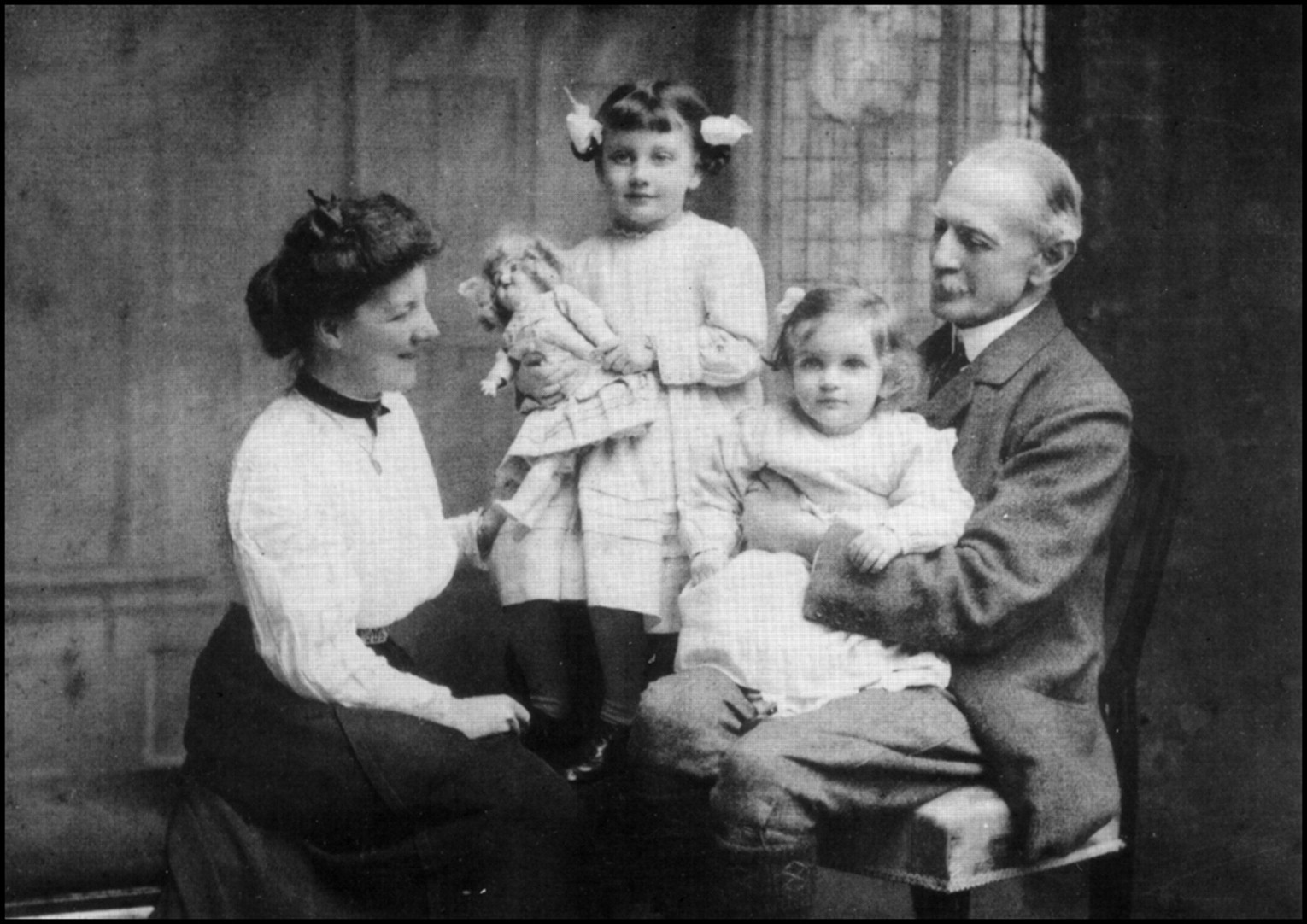
Sir Isambard Owen with his wife, Ethel, and daughters Heulwen and Hedydd (photograph given to DGJ by Heulwen and Hedydd Isambard Owen)
The Welsh connection 18
From school days Isambard was fascinated by the literature, history and traditions of Wales but had little opportunity to study them. In 1873 he attended a meeting to revive the dormant London-based Honourable Society of Cymmrodorion at which Sir Hugh Owen (1804–81), a new council member, suggested that a ‘Cymmrodorion Section’ should meet annually at the Welsh National Eisteddfod to discuss Welsh educational matters; Isambard attended regularly.
He joined the Cymmrodorion in 1877 and it played a big part in his life. He became a councillor in 1879 and drafted a new prospectus. He assisted the editor of Y Cymmrodor, Thomas Powel (1845–1922), contributed many articles and edited Volumes VIII, IX and X. In 1914 he was awarded the Cymmrodorion Medal but, owing to the war, did not receive it until January 1921.
On 15 November 1880 Prince Louis-Lucien Bonaparte (1813–91), son of Lucien Bonaparte (1775–1840) and Napoleon's nephew, was nominated for honorary membership of the Cymmrodorion. A distinguished philologist, he spoke Welsh and was interested in the language and its dialects. Isambard became his private physician and close friend. According to Isambard's obituary, his subsequent duties were often discharged ‘under stress of ill-health, for in early days, when travelling with a Napoleonic Prince, he had picked up some form of fever which frequently recurred’. 19 The Prince died in 1891. His library included many rare Welsh books. Isambard, an executor, asked Gladstone, then Prime Minister, to help keep the library in England but the unique philological collection was sold to the Newberry Library, Chicago, for about £1500.
Isambard shared in the general concern about the poor quality of Welsh education. In 1880 a Departmental Committee was set up, with Lord Aberdare (1815–95) as Chairman, to examine intermediate and higher education in Wales. The report recognized the prevalence of the Welsh language but suggested that its use in schools, by interfering with learning of English, was educationally disadvantageous. It advocated teaching entirely in English even though in some areas most children could understand only Welsh. In 1882 the Cymmrodorion became interested and conducted an inquiry about the position of Welsh in elementary education. Isambard prepared the report.
At the Cymmrodorion Section in Aberdare in 1885 Isambard argued that teaching in Welsh would aid, not hinder, the acquisition of English. With others he established a ‘Society for Utilizing the Welsh Language’ – to influence public opinion, conduct research and produce suitable textbooks. In 1886 he gave evidence for the Cymmrodorion to the Royal Commission on Elementary Education in England and Wales. In a memorial he covered the teaching of Welsh and the importance of Welsh in teaching other subjects in Welsh-speaking districts.
At Caernarvon in 1886 the Cymmrodorion was disappointed that girls' education was ignored in provisional proposals for an Intermediate Education Act. Isambard's motion proposing the formation of an Association for Promoting the Education of Girls in Wales was passed, although some medical men objected. The Bill promoting intermediate education in Wales, according girls the same educational opportunities as boys, received the Royal Assent in August 1889. Joint education committees were set up to organize intermediate schools throughout Wales. Isambard was a member of the Academic Group of the Central Welsh Board, set up in 1896, which inspected and examined the intermediate schools.
Isambard was involved in the foundation of Wales' National Library and its National Museum. In 1899 he attended the initial meeting about the library at Sir John Williams' London house and in 1904 spoke on ‘The Ideal of a Welsh National Library’ at the Cymmrodorion Section at Rhyl. He helped to draft the Library's Royal Charter, granted in 1907, but was never on its Court of Governors. In March 1907 he joined the Organisation Committee appointed by the Council of the National Museum and was instrumental in drafting its Charter of Incorporation.
The University of Wales 20
Isambard's main contribution to Welsh academic life came with the foundation of the University of Wales. The original University College of Wales was founded at Aberystwyth in 1872. Following the Aberdare Committee's report, two new university colleges were opened – one for South Wales and Monmouthshire in Cardiff (1883) with John Viriamu Jones (1856–1901) as Principal and one for North Wales in Bangor (1884) with Henry Rudolph Reichel (1856–1931) as Principal. Students of all three colleges acquired their degrees through examinations at English or Scottish universities. The Aberdare Committee recognized the growing support for a Welsh University able to confer degrees, although grammar school headmasters, educated mainly at Oxford or Cambridge, generally were opposed to the idea. It accepted that a Welsh University would benefit higher education in Wales but could not decide whether it should be a teaching university or simply an examining body as in London. It also worried whether it would attract students from outside Wales.
In September 1886 the Principals of the University Colleges – Viriamu Jones, Reichel and Thomas Charles Edwards (1837–1900) from Aberystwyth – met with their Senates to plan a university that would appeal to the public, Welsh MPs and the Government. A Welsh Educational Conference was held in Shrewsbury in January 1888. In March a deputation led by the Earl of Powis, with Isambard as Honorary Secretary, met Welsh MPs at the House of Commons and demanded support for a University of Wales. 21
Invited by a Draft Charter Committee, Isambard began work, aided by his solicitor brother, Maynard. Their draft envisaged a federal organization, initiative in educational matters resting mainly with the individual colleges. On 6 January 1893 representatives of the University Colleges and the Welsh Joint Education Committee discussed the Charter. Some press coverage was favourable, some critical. Isambard responded to the criticisms. In March and April he met with each of the University Colleges to clarify the Charter and answer questions. He did the same at the House of Commons on 18 May. A week later the three University Colleges formally petitioned Queen Victoria for a Charter of Incorporation for ‘The University of Wales’. The Bill was approved. On 30 November 1893 the Great Seal was affixed to the Royal Charter constituting the University of Wales.
On 8 June 1894 the University Court, of which Isambard was Provisional Honorary Secretary, authorized him to have a seal made and appointed him Acting Registrar until a Registrar was appointed. In January 1895 Lord Aberdare was elected Chancellor with Viriamu Jones as Vice-Chancellor, the post to rotate between the three Principals. Isambard was elected Senior Deputy Chancellor; he was not paid and was still a physician at St George's. His brother Maynard was appointed Solicitor. The Vice-Chancellor, although the academic head, was not the Chancellor's deputy. Lord Aberdare was to be a resident Chancellor; when he was absent one of two Deputy Chancellors was to take his place, the duties being limited to occasional presidency of University Court committees or of a congregation of the University. However, Lord Aberdare died a few weeks after his election. The Prince of Wales (later Edward VII) was elected in his place; as the Prince would not be resident and might not always be able to attend University functions, the senior deputy was in his absence to be acting head of the University in all but purely academic matters. 22 Even though Isambard himself was not resident his office thus became arduous and responsible.
At Aberystwyth in June 1896 Isambard handed the Prince of Wales the Deed of Appointment as Chancellor, addressed him on behalf of the University Court and delivered to him the instruments of his office – the key of the University, the Seal and a copy of the Charter and Statute. Isambard was rewarded with a knighthood when the Prince of Wales was crowned Edward VII. Isambard installed the new Prince of Wales (later George V) as Chancellor in 1902. Correspondence in the archives of the University of Wales, Bangor, reveals that one of Isambard's most enjoyable duties as Deputy Chancellor was to write long letters to the private secretaries to the two royal Chancellors of the University of Wales to keep them au fait with significant events in the University's life. 23
Viriamu Jones, Principal of the University College at Cardiff, died in June 1901. Isambard, asked to succeed him, declined, expressing concern about abandoning his professional career.
When Isambard went to Armstrong College in January 1905 some Welsh academics were concerned about a Principal of a University College in Northumberland having undisputed authority over another University's affairs. Their disquiet increased when it was announced that the Prince of Wales would be absent from Britain from October 1905 to 2 May 1906.
At the Cardiff Cymmrodorion Society on 7 November 1905, T Marchant Williams claimed Isambard had assumed the functions of a Principal or Head of the University without the direct authority of the University Court and without a specific sanction of the Charter, but he admitted Isambard had a sound knowledge of the administrative and general affairs of the University. He continued questioning Isambard's role in the University of Wales and in 1908 wrote in his newly founded periodical, The Nationalist: ‘… this … clinging to his post by Sir Isambard against the wishes … of the Court … tends to weaken the influence and authority of Sir Isambard on the Court and in the country, and directly works to the disadvantage of the University as a national institution’. 24
Although many in the University of Wales tolerated Isambard's appointment to Newcastle, his move to Bristol in 1909 completely altered the situation. Cardiff and Bristol were geographically close and had rival interests. Reichel pointed out ‘Clearly the two roles were no longer compatible and with profound regret the University found itself obliged to drop the pilot who steered it so long and with such unerring skill’.
Isambard recognized the unrest within the University Court. In January 1910 he told the Registrar he would not stand again for the Deputy Chancellorship. In June Lord Kenyon was elected in his place. Isambard received plaudits for his immense contributions to the University and in November 1911 was admitted Doctor in Legibus (LLD), honoris causa, in a ceremony at Bangor.
The medical school
After he had stepped down Isambard's advice was still sought, particularly about the foundation of a Welsh medical school. He supported the idea from 1886 when the Government refused to fund a preclinical school at Cardiff. The money needed was sought from Welsh sources, including the London Welsh. Doctors from South Wales who subscribed and Welsh doctors in London rallied to a call for subscriptions from Isambard and his fellow secretary Miss Caroline Williams. 25
In 1890 Isambard pointed out that Cardiff had a good infirmary and that its University College already taught physics, chemistry and biology. If anatomy and physiology/histology were added, with some provision for materia medica, it could prepare students for examinations at London University or the Conjoint Board. That year Viriamu Jones told the South Wales Branch of the BMA of the intention to establish full-time professors of anatomy and physiology. The chairman, William Thomas Edwards FRCS (1821–1915), donated £1000 toward an endowment fund as did Dr William Price, a prominent Cardiff general practitioner who had been Edwards' apprentice. 26 When Professors J Berry Haycraft (1857–1922, physiology) and Alfred W Hughes (1861–1900, anatomy) took up their appointments in 1893 the fund stood at £6000. In 1896 there were 40 medical students at Cardiff – 26 preparing for London qualifications. 27
In March 1904 Isambard was among the deputation that asked the Chancellor of the Exchequer to increase the grant for the Welsh University colleges. Principal Griffiths from Cardiff mentioned its successful medical departments. Isambard, Vice-Dean of London's medical faculty, said Cardiff students were welcomed at London schools. Welshmen, all former students of Cardiff, had won four of the six gold medals awarded recently in the final examinations. 28
In 1904 Isambard suggested to the University Court that if it petitioned for a Supplemental Charter for the affiliation of Colleges it should apply also for the power to grant medical degrees. 29 Isambard, answering questions about the University's Charter in Cardiff in March 1893, was asked about the possibility of awarding medical degrees. He said they might as well ask for power to confer baronetcies, given the general reluctance to add to the 20 bodies already able to grant registrable qualifications. Now, to minimize opposition, Isambard said Sir John Williams (Obstetric Physician to the Royal family) agreed the Court should apply for the power to award medical degrees even if it would not be used immediately, as this would avoid unnecessary expenditure in the future.
In 1906 the University of Wales received a Supplemental Charter enabling it to confer degrees in medicine. However, its MB BCh was not registrable with the GMC until after the enactment in 1911 of the University of Wales (No. 2) Bill, the wording of which owed much to Isambard's drafting skills. 30 As Cardiff had no clinical school its students went elsewhere for clinical training and, although they could now take the Welsh degree, few bothered. The first to do so was JWT (later Sir Tudor) Thomas who graduated MB BCh Wales and MB BS London in 1916 (having qualified LRCP MRCS in 1915). 31
Around 1909 Cardiff University College announced it would establish a Chair of Pathology at Cardiff Infirmary and the Treasury granted it £1500 a year, some of which helped pay for the Chair. 32 Planning now began for a full medical school teaching preclinical and clinical subjects for the new degree in medicine and surgery.
In 1912 Isambard was asked to advise on the best site for it – the old College site in Newport Road or with the new buildings in Cathays Park. He reported that from the Infirmary it took 18 minutes to walk to Cathays Park and five minutes to the Newport Road buildings (the site chosen).
In March 1914 Lord Kenyon led a deputation which asked Lloyd George, then Chancellor of the Exchequer, for a grant towards a complete national medical school in Wales. 33 However, there were concerns in Wales and within Whitehall about the best way to ensure the all-Wales dimension of a medical school if it remained an integral part of University College, Cardiff. As there were tensions between the three Colleges on matters other than medicine, in 1916 the Government set up a Royal Commission on University Education in Wales under Lord Haldane; it reported in 1918. Isambard presented a memorandum on the University of Wales.
Isambard's testimony influenced the Haldane Commission's recommendation that the medical school should become an independent College within the federal University of Wales. 34 This was hardly surprising since Haldane was his Chancellor at Bristol. When Haldane said ‘I gather that your mind … leans to the notion of an independent organisation?’, Isambard replied ‘That seems to me the simplest solution out of the difficulty’. 35 In May 1918, after the Haldane Report was published, the University College authorities, opposed to full independence, asked Isambard to meet them and explain his remark which had caused a furore in Cardiff. Now he changed his mind and argued strongly that the Medical School should remain within the College. He spoke for the status quo on key occasions during the 1920s when debate continued about the wisdom of implementing the Haldane recommendations. Although in October 1925 the University Court favoured independence, the School of Medicine remained within the College until the Welsh National School of Medicine was established in 1931. Even then preclinical departments remained within the College. For his efforts on behalf of the College its Principal, Albert Howard Trow (1863–1939), wrote a letter of thanks to Isambard. It was dated 15 January 1927; Isambard had died the day before.
Bristol
On 30 September 1909 Isambard, Vice-Chancellor-Elect, delivered his inaugural address at the University of Bristol – created in 1909 by the merger of University College Bristol and Merchant Venturers College. University College, founded in 1876, was the first higher education institution in England to admit women on an equal basis to men; it was supported by the Fry (chocolate) and Wills (tobacco) families. The Medical School, established in 1833, affiliated with the College in 1879 and became fully incorporated with it in 1893. Bristol appointed Isambard for his diplomatic skills, hoping that his familiarity with the problems of merging colleges (in London's Faculty of Medicine, in Newcastle and in Wales) would help with merging University College Bristol and the Merchant Venturers College. 36
HO Wills, the first Chancellor, died in 1911 and was succeeded by Viscount Haldane whose installation in October 1912 was an impressive occasion organized by Isambard. Seventy honorary degrees were conferred and Isambard faced widespread criticism about the suitability of some honorees. Problems also arose when, in an attempt to improve the quality of the academic staff, three of them were given notice; a move interpreted as an attack on academics' security of tenure. Later he faced allegations that Council, a predominantly lay body, interfered habitually in academic matters and over-rode the Senate. There was a storm of protest in the national press fed by rumours of dismissals and of revolt, friction and unrest in the University. 37
Isambard rode out the storm. A busy man, he represented the University on the General Medical Council (1910–25), served on the Bristol Education Committee and was a Member of the Council of St David's College, Lampeter (1912–16). He examined for several universities, the Royal College of Physicians and the Royal Army Medical Corps. A keen Freemason, he was Worshipful Master of the St Vincent Lodge, Bristol, and Senior Grand Deacon of the Province of Bristol. 38
During the First World War he corresponded frequently with Whitehall over the War Office's requisitioning of buildings. He was a Lieutenant Colonel with the Bristol University Volunteer Corps, Honorary Commandant of the Second Battalion Gloucestershire Volunteer Regiment and in 1917 a captain in Bristol's Medical Volunteer Corps.
As the War drew to a close, plans were needed for future development. Henry and George Wills gave the University £220,000 for new buildings. In February 1918 Isambard wrote to Fisher, President of the Board of Education asking for more money or for tax relief on the donations. Bonar Law, Chancellor of the Exchequer, refused to help. However, building went ahead. The architect was George H Oatley (1863–1950), best known for his work at Bristol University from 1912 to 1925. Isambard was not in office when the work was completed because Treasury rules covering superannuation meant retirement at 70.
On moving to Bristol Isambard rented Hereford House, a six-storey Queen Anne house in Clifton Park opposite Christ Church. After his retirement the family moved to Abbey Gate, Weston-Super-Mare, a two-storey house facing the South Wales coast; and he indulged in his preferred leisure activities – cycling along the quiet country lanes, gardening, joinery and reading his favourite authors, Dickens, Dumas, Scott and especially The Ingoldsby Legends. 39 In 1921, the year he retired, he was the first person to be made an Honorary Fellow by the University of Bristol.
Late in 1926, spent mostly in touring France, the Owens sold Abbey Gate, intending to move to London. Isambard's blood pressure was high and his consultant advised no more cycling. They returned to Paris. On 14 January 1927, in a hotel near the Panthéon, Isambard suffered a stroke and died, aged 76. He was cremated at Père Lachaise in Paris. Reichel arranged the funeral service in Bangor Cathedral and Isambard's ashes were buried at Glanadda Cemetery, within view of the University College and close to his old friend Cadwaladr Davies.
Isambard has one unusual ‘memorial’. In reply to a letter Isambard wrote in 1925 congratulating Oatley on his knighthood, the latter commented on Isambard's role in the building of the university:
Yours very sincerely, George H Oatley.
The inscription is virtually invisible from the ground because of its relatively small size, its elevated position and its situation immediately above a large grotesque. A guide book to the tower published in 2003 mentions a quotation cut in the outer stonework at its top 40 and that during the Second World War Oatley wrote to his nephew, Oswald Coop, 41 stating that the quotation was: ‘I0 TRIVMPHE STET DOMVS I O!’ 42 but no one in Bristol appears to have been aware of the exact nature of the inscription, its location or its significance. In 2006 or thereabouts one author (HGM) who lives in Bristol learned of Oatley's letter and the inscription. The tower was being cleaned in readiness for the University's centenary and therefore access to the top of the tower was available for a short time via the hoists used in the cleaning process. David Skelhorne, the surveyor supervising the renovations, had noticed the inscription and the conjunction of the Greek letter ‘Phi’ with a Latin word but was unaware of its association with Isambard Owen. HGM went up in a hoist with the University's Pro-Chancellor (Dr Stella Clarke) and examined the inscription on the northeast side of the tower. The scaffolding obstructed sight of the whole inscription for one picture but later the use of a telephoto lens from a site in Woodlands Road provided illustrations (Figures 4a and b).
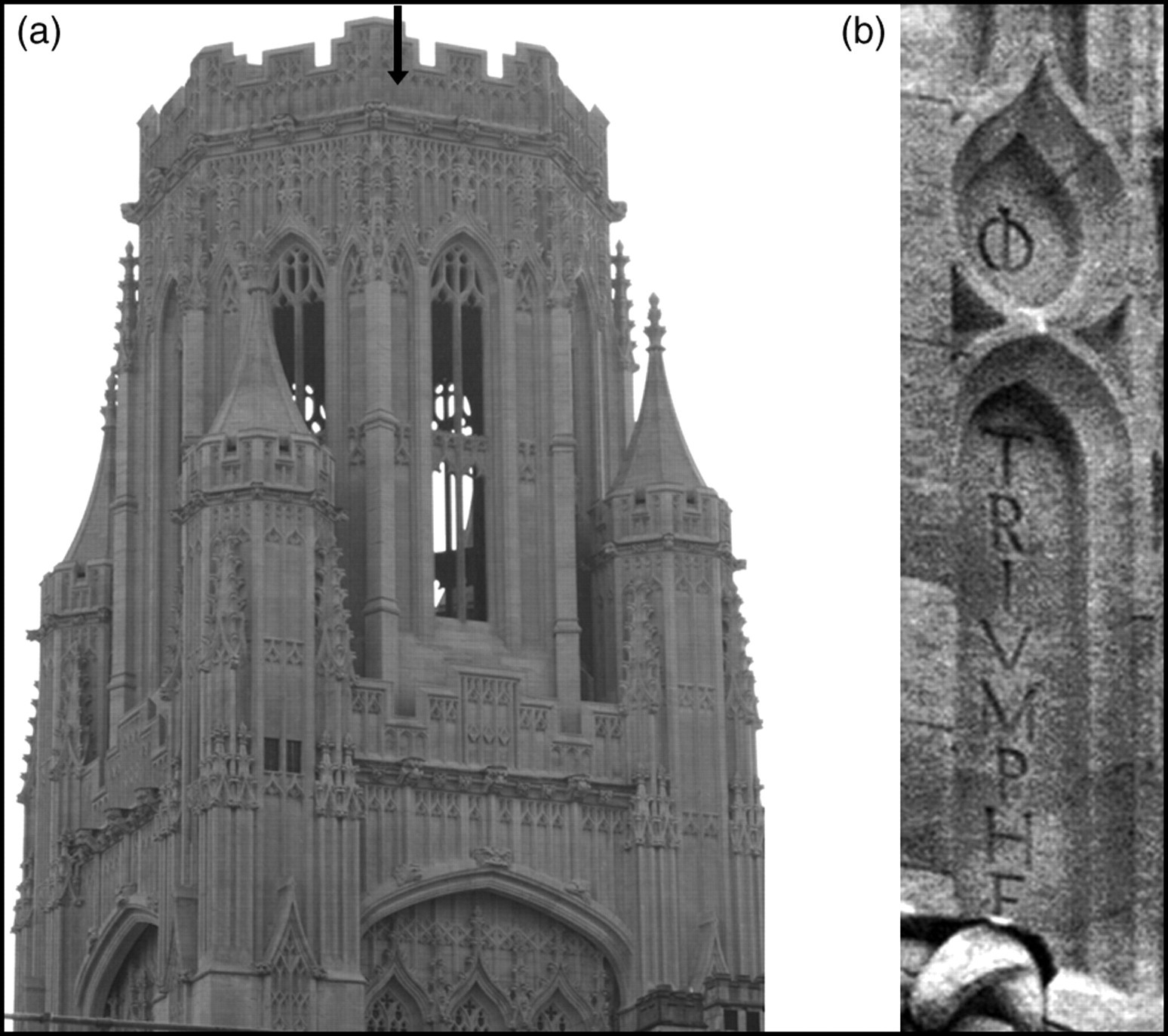
(a) A photograph of the north and east sides of the top of Bristol's University Tower (the position of the inscription is marked with an arrow), and (b) a close-up of the inscription
Duncan Kennedy, Bristol's Professor of Latin Literature, told HGM that ‘I O Triumphe’ translates as ‘Hail O Triumphant Ones’ and was the chant Roman crowds used on greeting homecoming victorious generals and on other triumphal occasions. In 1864 ‘Io Triumphe’ was the first of an outstanding series of songs, with words by BF Westcott and music by John Farmer, composed for Harrow School where Oatley's son was a pupil from 1918 to 1923. 43 On a more topical note it is the chant of Occidental College, Los Angeles, where Barack Obama studied for two years before transferring to New York's Columbia University. 44
Footnotes
Acknowledgements
We are grateful to Alun Roberts who was for many years Registrar and Secretary of the University of Wales College of Medicine; now retired, he is writing a two-volume history of the school; the first volume has been published. He read a draft of this paper and made helpful comments and suggestions about Isambard Owen's role in the foundation of University of Wales and its medical school. John Cule was also helpful in this regard. Nallini Thevakarrunai, the history librarian at St George's Hospital Medical School, cleared up the confusion about Isambard Owen's term of office as its Dean. Elen Simpson of the Archives Department, University of Wales, Bangor, helped with access to its Isambard Owen collection. Michael Richardson and Hannah Lowrey kindly provided guided access to the Bristol University Special Collections Archive.