







Abstract
The Montpellier physician Bernard de Gordon flourished in the late Middle Ages in the era when university education first evolved in the training of European physicians. Fragmentary details of his life and medical influence are known from seven books, particularly his extensive (163 chapters) text Lilium Medicine and from Chaucer's reference to him in the Canterbury Tales. Chaucer lists Bernard de Gordon as one whose writings were part of the core curriculum of the best-trained European doctors of medieval Europe. Bernard de Gordon was one of that small group of medieval physicians who reverently followed Galenic lore which had endured for a thousand years yet who began to challenge its details and to experiment clinically with new methods of treatment. In his writings, Bernard de Gordon made the first reference to spectacles and to the hernial truss. His writings also contained detailed desiderata for the ethical best practice of medicine of his day, extending the principles of both Hippocrates and Haly ibn Abbas. Unlike many of the surviving writings of other medieval medical teachers, his texts have within them a tone of humility and acknowledged fallibility. Bernard de Gordon holds a small but significant place in the evolving pre-Renaissance chronology of medical professionalism.
Bernard de Gordon was an influential doctor of the late Middle Ages. A clinician and teacher at the school of medicine at Montpellier, he was one of the pioneering pre-Renaissance medical experimentalists. As such, he joins that exclusive group of fewer than a dozen doctors and medical teachers who began to challenge the received lore of Hippocrates and Galen.
In the chronology of Western medicine, Bernard de Gordon holds a special place because of his adherence – indeed promotion – of all that was hitherto best in medicine and yet at the same time he developed new expositions about medicine, its practice and the professionalism of those who practised it. Of his Regimen of Health, 1 one of his last texts completed in 1308, it is said by scholars that ‘Bernard de Gordon emphasized the vital connection between practice and theory’, 2 thus forming a nexus between the pragmatic empiricism of surgeons and the Scholastic teaching of internal medicine that was the pedagogic paradigm in his era.
The fragmentary details of Bernard de Gordon's life are known essentially from internal evidence in surviving copies of his seven dated books; 3 details in his massive text, the Lilium Medicine; 4 the Practica summaria derived from it as a vade mecum for medical students; and from copies of texts including his The Methods of Treatment. 5 Bernard de Gordon's fame and postcontem-porary authority are affirmed from references by Geoffrey Chaucer 6 (c. 1342–1400) and those of 20th-century scholars of medieval medical education.7–9 Much conjecture,6, 7 to the point of combative debate, 10 has been associated with the analysis and interpretation of Bernard de Gordon's extant writings.
This paper gives a 21st-century précis-perspective of the significance of Bernard de Gordon's life and works.
Biography
Although one of the most influential medical authorities for almost 300 years, biographic details of Bernard de Gordon are scant indeed. Some authorities suggest that he could have been a Scot, 2 perhaps from the Scottish–English border village of Gordon, southeast of Edinburgh and east of Peebles. Others, including CH Talbot of the Wellcome Institute, have speculated that the Gordon family could have been Italian. 11 After Bernard's retirement from Montpellier (sometime before 1330) he lived in Provence and the posthumous prologue of a 1480 edition of his works lists him as French. 10
Most authorities refer to him as French, either because he taught at Montpellier or because all references refer to him as either Bernard de Gordon or Bernard de Gourdon, or because his writings strongly suggest a Continental or meridional (southern France) origin. 12
Dr Luke Demaitre, one of his most scholarly biographers, felt that the most plausible assumption of his place of birth, taking into account almost every piece of internal evidence in Bernard's writings, was that he was from a village in southern France with the name of either Gordon or Gourdon. 12
There exist several villages named Gourdon in southern France, the two nearest to Montpellier being one near Cahors and one in Provence. Although Demaitre favours the Département Lot, 13 300 km northwest of Montpellier, a more plausible claim for Bernard's birthplace is Gourdon in Provence. This is the closest Gourdon to Montpellier and was easily accessible by a sea route and by littoral paths linking villages of the Côte d'Azur with the major academic centre, port and centre of commerce, Montpellier, to the west. Gourdon of Provence, a high French village above Grasse, has since the Dark Ages been part of a major centre for the collection and preparation of medicinal herbs and perfumes (Figure 1).
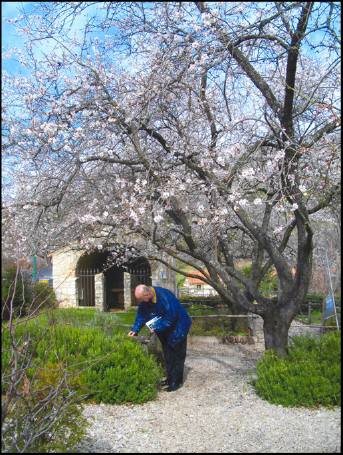
The author is shown collecting Rosmarinus officinalis in the medieval apothecaries’ garden in the village of Gourdon, France. This village, 800 metres above Grasse in Provence in the Côte d'Azur, is posited as the most likely home of Bernard de Gourdon [Gordon] (fl. 1270–1330), author of the Lilium Medicine (1305), and doctor and teacher for three decades at Montpellier, 215 kilometres to the west
A later painting of Bernard de Gordon, showing him fancifully teaching beside Hippocrates, Galen and Avicenna may be seen in the collection of the Bibliotheque Nationale in Paris. 14 Chaucer gives no clue to his birthplace, placing him in the Canterbury Tales’ Prologue list between Constantine the African and the two undoubted English physicians, Gilbertus (c. 1180–1250) and John of Gaddesden (1280–1361). 15
Although some biographers refer to up to 86 references to Bernard's life and works, 2 ‘most on analysis [are] reducible to the Lilium Medicine and extrapolation from it’. 16 What is certain is that Bernard de Gordon taught at Montpellier for three decades.2,7–10,17–19
Medical writings
Bernard de Gordon's enormous compendium and sixth of his seven works. The Lilium Medicine, was published on 5 February 1305. 3 It consisted of 163 chapters each divided into six sections. This methodological approach was the forerunner of the style used for the ensuing 600 years, from Sydenham's to Osler's writings. Bernard first defined a disease and then described it. He then described the anatomical changes it produced in affected organs. He adopted this approach four centuries before Morgagni's (1682–1771) concept of the organ basis of disease.
In the second section of each disease entry, Bernard de Gordon then gave a summary of the perceived cause of the disease in question; in the third section he described the symptom complex and occasionally the clinical signs accompanying the disease; in the fourth he discussed the natural history of the disease; and in the fifth he summarized the best-practice medical and surgical treatment of his day.
In the final section of each chapter, the ‘clarificacio’, 20 he wrote about contemporary controversies, these reflecting the emergence of the questioning of Galenic dogma. He was not alone in these first stirrings of pre-Renaissance questioning of received teaching (John of Arderne [1306–90], the Newark and London surgeon was another) but the tone of his writing was unusual in his era and probably regarded as radical.
Bernard nevertheless revered Galen (131–200) and in his Lilium Medicine referred to Galen more than 600 times as ‘God's servant’. 20 Bernard was one of the first to challenge Galenical dogma, doctrine that had held sway for 1000 years. An example from folio 42 of the Lilium reads:
It happened to me one time that a certain very old surgeon suffered an intolerable earache. The universal purgings and particular treatments according to the teachings of Galen, Avicenna and all the other authors proceeded, but they were utterly without effect. Then I applied camomile oil and in truth he was cured. 21
Bernard's descriptions of specific diseases were detailed and practical. In Part 2 (Chapter 25) of Lilium Medicine he wrote:
Epilepsy is a disease of the brain, removing sensation, motion and erection from the whole body, accompanied by a very serious disturbance of movement, because of an occlusion made in the non-principal ventricles of the brain … sometimes the paroxysm is very long and violent, sometimes short … epilepsy often comes to children either because of some disorder in their nurse, or when the children drink wine, and become drunk; and sometimes epilepsy comes on account of poisonous reptiles. 8
He promoted exercise and particularly emphasized the importance of exercise for pleasure:
Exercise is one of the best things that can be imposed upon the human body. 22
A section of the Lilium contains four sections on bloodletting, uroscopy, pulse taking and his ‘Regimen sanitatis’.5, 17 This group of practical doctrine was often circulated as an independent treatise entitled ‘On the Preservation of Human Life’. 23 Bernard wrote and taught a detailed, almost mathematical approach to materia medica. His precise prescriptions were complex and contained many ingredients. An example is his prescription for ‘Indigestion due to cold wetness’. This contained:
hyssop, absinth, calamint, anise, fennel, ameos [possibly cow parsley or wild angelica], cicely, spikenard, squinanti [?], aromatic cane, honey and roses. 24
He wrote about the contagious nature of the exanthemata and of leprosy and scabies. 25 He was the first to describe the use of a truss for hernia and the invention and use of spectacles 26 which he called ‘oculus berelli-nus’. 27 Among other descriptions of disease he described ‘heroes’, the syndrome of obsessive infatuation. He wrote that when it is not treated early in its manifestations it could progress to mania and death.
Bernard de Gordon's teaching style was a mixture of the transmission of traditional medical lore leavened by his own experience. He taught that a physician should develop the skill of selecting facts when acknowledged authorities disagreed. In this context he wrote that a physician should ‘know how to reconcile them [contradictory sources]’ 28 and to use ‘subtlety and ingenuity’ in interpreting and selecting the ‘better sources’. 29 An analysis of Bernard's internal references has shown that he overwhelmingly taught the traditional Greek–Roman curriculum but that 1.4% of his writings referred to the works of his own contemporaries, 30 the beginnings of the pre-Renaissance ethos which ultimately, after Vesalius (1514–64), was to change the medical curriculum. His teaching style was to refer to rules and aphorisms which was the pedagogic paradigm of his era.
Ethics and professionalism
In the 10th century Haly ibn Abbas (930–994) in his Pantegni had emphasized the need for medical students to study both the general sciences and the arts in addition to the received Arabic translations from Hippocrates and Galen. The Montpellier School of Medicine developed the pedagogic paradigm combining instruction on the ‘elementary sciences’ (primitivis scienciis) 31 with that of practical clinical medicine. At Montpellier Bernard de Gordon and two other masters of medicine (Arnold of Villanova (fl. 1313–35) and Jordan de Turre (c. 1238–1310)) taught mathematics as part of the medical curriculum. In the Montpellier text On Degrees, these medical teachers included detailed measurements in their descriptions of compound medicines. 32
Bernard's own education was one steeped in pre-medical liberal arts that included mathematics, literature and what later became known as the trivium (grammar, rhetoric and logic) and the quadrivium (geometry, arithmetic, astronomy and music). 33 As was the practice in European schools of medicine of his era, he had probably entered university by the age of 12 years. Some universities, for example Toulouse, apparently admitted boys as young as eight as students. 34
Bernard de Gordon further developed the Hippocratic traditions of medical ethics. He promoted the ethics of professional competence and courage and taught that compassion was essential in the treatment of patients. He reinforced the Hippocratic doctrine of doctors’ behaviour. His ethics were specific to his time. In some respects they were paternalistic and authoritarian. The extended Hippocratic ethics that he taught remained unchanged until the later decades of the 20th century. For example, he advised that poisonous medicaments should first be tested ‘on people in hospitals and on the Friars Minor in case that they should proved fatal’. 35
At the beginning of the 14th century Bernard summarized the qualities needed in a doctor, whether he be a physician or a surgeon. He listed eight desiderata, the first five of which he modelled on those proposed by the Arabic physician, Haly ibn Abbas (930–94). Bernard de Gordon's ‘ethical list’ comprised: good vision, manual deftness and dexterity; a good memory; clear judgement; sharp intellect; and being well-educated and up-to-date ('sciens’). To this list he added an ethic of diligence and hard work with a manifest air of responsibility and punctuality, and the practice of the scientific aspects of medicine of his day rather than recourse ‘to such quackeries as magic, incantations and soothsaying’. 36
What was the place of Bernard de Gordon in the chronology of modern Western medicine? Scholars have compared the writings of Bernard de Gordon unfavourably 10 with two of his contemporaries 2 Peter of Abano (1250–1315) 37 at Padua and Taddeo Alderotti (also called Thaddeus of Florence [1223–1303]) at Bologna. The medical historian Fielding Garrison in his encyclopaedic History of Medicine affords Bernard de Gordon a single sentence only. 38 Peter of Abano's Conciliator differentiarum contained the first full-length human figure portraying its dissected muscles. 39 Taddeo Alderotti had meticulously re-translated the Greek medical texts directly into Latin and had corrected Constantine the African's Arabic–Latin translations of Hippocrates, Galen and Haly ibn Abbas. 40 Bernard's Lilium was not listed among the other comprehensive series of texts used at Oxford until at least the end of the 14th century.41, 42
Other scholars 7 regard as significant in the evolution of medical professional thought the combination of Bernard's clinical teaching, clinical challenging of received Galenic lore in the context of humble questioning and his further development of Hippocratic ethics of significance in the evolution of medical professional thought.
The tenor of Bernard's writing is humility. His writings carry the explicit message of acknowledged fallibility, a truism that every honest doctor knows. An example is to be found in his wrestling with what today would be called differential diagnosis 43 in the context of the protean manifestation of leprosy. In discussing whether the absence of facial signs would preclude a diagnosis of leprosy, he concluded:
Even though I had to change my mind after having worked diligently in this profession, I would no longer judge lightly whether one is leprous or not. However, God knows the truth, I do not know. 44
In this context he also taught his pupils that when a doctor found the treatment of a particular patient ineffective, he should not ‘persist in his error … [but] correct his course … [and seek new therapeutic possibilities by] bending over his books day and night’. 45
It is these cognate themes of defining how medicine should be best practised, in a personal ethos of diligence, open-mindedness and humility that makes Bernard de Gordon's biography significant in the chronology of medical heritage.
Footnotes
Acknowledgements
The author thanks Sir David Watson and staff of Green-Templeton College, Oxford and Ms Rhiannon Harris, essential oils scientist, of La Martre, Provence, France, for the provision of resources and encouragement which helped to make this research possible.