







Abstract
A highly contagious behavioural affliction is now endemic in highland areas of Scotland. Pretravel advice ought to include a health warning to sport-lovers venturing north into wild, highlands of Gaeldom. It particularly affects young adults and predominates in men, although women are affected. The disorder can be acute or chronic and when severe, it can threaten one's life and limbs. Acute attacks may bring spontaneous recovery in months, but the chronic state can last for a life-time. Death will overtake some before it runs its inevitable course.
Keywords
A century of affliction
First identified by the Victorian adventurer, Sir Hugh Munro in 1891, 1 the syndrome takes his name. Munro became the first-recorded casualty of the disorder. He explored the tops of most of Scotland's high mountains and recorded heights of those over 3000 ft (1000 m) above sea level. Unwittingly, his actions were to prove contagious and affect many deluded followers. Compelled, possessed and obsessed they have followed in his footsteps, their eyes fixed on summits of nearly 300 Scottish mountains. Deranged acolytes are recognized by their fixed ideas. ‘3000 ft and above’ is their rallying cry. Single-mindedly, the faithful trudge the wilds of Scotland in a quest for salvation from an onerous compulsion.
A rare occurrence for many years, those who succumbed often wandered off into the wastes of the Scottish Highlands, some never to be seen again (Figure 1). Commando training in World War II exposed military conscripts to this affliction and brought many Englishmen and Europeans into first contact with this strange malady. Some survived war campaigns, only to fall victim to the terror of the heights, acute or chronic Munrosis. 2
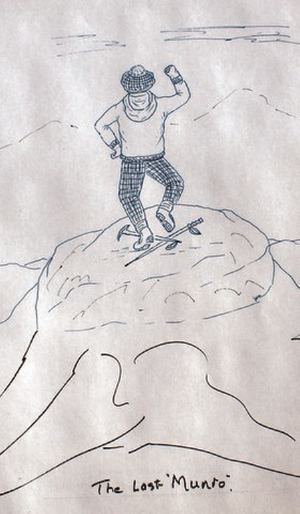
A Compleater (Illustration: Valerie McIntosh)
Incidence
Social and sexual emancipation and improved transportation have exposed more of the Scottish population to risk and the ailment is now distributed across the land.
It affects every social class, with continuing erosion of the male sexual bias. 3 Once affected, few seem to be able to escape this disturbing affliction. Although exposed to the same malign, contagious environment, local populations appear to have developed some immunity, and ghillies, shepherds and map surveyors have an acquired immunity.
The incidence peaks in the late teens and early 20s, but can take a chronic course, which continues into and beyond middle age. Stoics with fused knees, arthritic hips and incipient angina can be seen struggling to meet objectives ordained by the disorder. Scots are most vulnerable, but symptoms are now encountered in those living south of the Scottish border, with cases reported from near Europe.
Behavioural anomalies
The condition is life threatening with deaths reported regularly in the affected. Acute side-effects are common in the musculo-skeletal system, with sprains, strains, bruises, broken bones, and longer-term effects result in osteo-arthritis of lower-limb joints.
Like smoking addicts, those with the compulsion maintain their bizarre behaviour despite evidence that their actions are harmful to health. The affected are disabled by an obsession that can interfere with work and social life, destroy marriage and severely strain the most stable of marital and sexual relationships. The partner, powerless to intervene, has to watch fixed beliefs take firmer hold on the loved one. The grand compulsion makes greater demands than any new lover. Social effects are, however, minimized when partners suffer together.
Symptoms
Classic symptoms of the disorder mimic early dementia, with mindless wanderings over bog and moor, along return compass bearings to remote map reference points in a forsaken wilderness of rock or snow. As many of the desired peaks remain shrouded in mist or whiteout, masochism is a predominant trait in those deranged people. They exhibit tunnel vision ignoring smaller scenic peaks for an undistinguished mound, which happens to be a few feet higher than the decreed parameter. They often view the mist and miss the view. Most are incapable of pronouncing Gaelic names of lofty objectives.
Exposed to bone chilling cold and breath-wrenching gale, usually in mind-blowing solitude, these creatures drive on to new heights of illogical absurdity. Along knife-edge crests, across shattered pinnacles, under beetling cliffs, over steep slopes and screes they struggle, up steep interminable inclines, along storm-swept ridges to unremarkable, protuberant prominences; relics of a glacial past and granite backbone of Scotland.
Some are compelled to climb the mountains in straight lines from east to west, or west to east. Others climb them in one mission from north to south, others do so, all in summer, or more dangerously, all in winter. The ‘Munro-bagger’ proceeds with unquenchable zeal from top to top, ticking off summits 4 to complete entries in Munro's Tables. 5
A few sell their homes to undertake a continuous attack on these mountain mammoths. They become totally committed to their miserable fate and demonstrate other symptoms of physiological and psychological disturbance. They develop snow blindness in winter from squinting upwards at distant peaks and succumb to wind chill and hypothermia. ‘Munro neck’ develops from repetitive upward gaze, ‘Munro ankle’ from running over boulder strewn screes and ‘Munro-bagger's gait’ from racing to the summit in shortest possible time. Some of the most disturbed deny any suffering and suggest they climb ‘for exercise, to commune with nature, to see the view, or distance themselves from the spouse’. Others rationalize by referring to, ‘the challenge, or the achievement’.
Affecting only those who venture above 3000 ft (1000 m) of altitude in Scotland (inability to comprehend metric conversions is a common failing in sufferers) the syndrome is never contracted across the Anglo-Scottish border, although foreign visitors exploring the Scottish Highlands do succumb and often exhibit more rabid features of the affliction.
Case history
A 67-year-old man was first affected in his teens. He spent many consecutive week-ends in fair weather and foul, striving to reach high tops. His wife succumbed to similar behaviour. With completion of the first cycle of obsessive achievement, incapable of behavioural change, they repeated their efforts again and again. Now recovering from postcardiac surgery, he is committed to a fourth inexorable cycle of compulsion, struggling ever onwards and upwards to ultimate demise, still lacking the insight to appreciate the incongruity of his behaviour.
Risk of relapse
Many of the fit and young submit themselves to intense exposure and over-activity for a year and finally free themselves from the compulsion. In many recorded cases, the cycle restarts with a repetition of symptoms to further blight a young life. Paradoxically, with the passing of the years, smoking and obesity ensure some finally escape the clutches of the disorder. Breathlessness and angina can prevent over-exposure, and encourage a return to an obsession-free existence. With advancing years; this strange psychological state burns itself out and the very elderly can finally escape this burden. A few with cardiac transplants and postcoronary bypass surgery still yield to the malignant inner driving force and expose themselves repeatedly to a cyclic process that will ultimately hasten death.
Treatment
There is no certain treatment for this condition and prevention is better than cure. Avoidance of the afflicted and all exposure to Scotland's highest mountains is the only certain way to dodge this devastating phenomenon. Never to set foot on Scottish hills listed in the Munro Tables guarantees immunity.
Some have tried behaviour therapy to break from the clutches of this addiction. Aversion therapy uses the presentation of photographs of the Munros to the individual, with concurrent administration of increasingly severe electric shocks. This regimen has been criticized on the grounds that treatment is not more painful than that experienced during the compulsive hill activity.
Prevention and avoidance
The risk averse avoid exposure and adverse effects, if aware that the malady never takes hold south of the Highland Boundary Fault and the Grampian Mountains, and they are totally protected if avoiding travelling north, beyond a demarcation line drawn from Stonehaven to Helensburgh. Those blissfully unaware of the scourge, which threatens to decimate the flower of Scotland's youth, should be warned of this obsessive/compulsive disorder that results from recurrent exposure to high altitude in the Scottish Highlands.
Morbidity register
A published account of those with the disorder is maintained by the Scottish Mountaineering Club. The list of those who have audited the full cycle of their compulsion ‘compleaters’ and have lived to reach their ultimate summit now runs to thousands. 6 Many more are unwilling to record their deviant ways and attainment of the final goal. Increased leisure time and affluence suggest that ever more people will be exposed to this demon of the hills.
Support services
Support Clubs have been established to provide advice and support for sufferers and families, and publicize dangers inherent in an apparently benign preoccupation. Despite worthy intent, most support groups degenerate into convivial free-drinking associations debased by the afflicted, who have a predilection for alcohol. Emergency medical services have been expanded. Volunteers and rescue teams risk life and limb in support of crazed individuals who expose themselves to physical injury, climatic extremes and the perils of high altitude.
Recommendations
Risk factors for infection need to be publicized and the general public warned of the dangers lurking for the unwary in highland affrays.
The time may perhaps have come to curb this malignant influence by creating a quarantine exclusion zone, north of a line from Stonehaven to Helensburgh in Scotland (Figure 2). Beyond this Highland Demarcation Line, health warnings should be displayed:
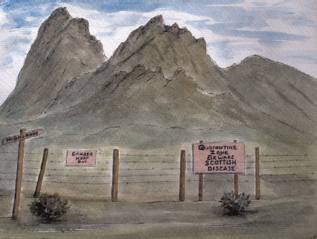
Quarantine exclusion zone (Illustration: Iain McIntosh)
Avoid climbing on northern mountains and prevent spread of a peculiar, Scottish disease