







Abstract
Fracture of dental roots during extraction leads some dentists to refer patients to oral surgeons for surgery, when removal of the root fragment is indicated. Lack of financial resources and unavailability of specialists in some regions of the world forces dentists to attempt the same themselves, occasionally without success. This article highlights how a general practitioner may safely use a simple dental injection needle to remove such fractured root-stumps prior to attempting surgery or referring a case. The benefits to the patient are economic and temporal.
Introduction
Dental extraction is a basic service offered to patients in the dental outpatient department of many hospitals. In developing countries the dental surgeons working at these clinics are nearly always general practitioners whose repertoire of skills includes simple extraction.
An anesthetized tooth is grasped with special forceps and the tooth utilized as a lever to dilate alveolar bone. Previous root canal treatment, badly decayed crowns and sclerosed, inelastic alveolar bone predispose the tooth to fracture when luxation forces are applied.
The decision to remove or leave the root fragment is based on the presence or absence of infection in the tooth pulp. Conventionally, a fragment of root apex is left in situ while larger root fragments necessitate removal. When general dental practitioners do not have the experience, motivation, facilities, confidence or time, they refer the case to an oral surgeon.
Technique
The bleeding extraction socket is dried with gauze and under bright light the root canal is identified as an orifice in the centre of the root (Figure 1).
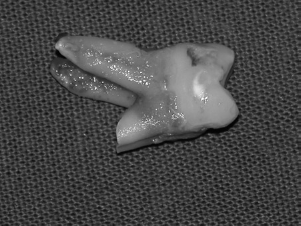
Fractured tooth root with residual fragment retained within socket
A 26-gauge hypodermic needle is inserted into the root canal and wedged tightly into place. With gentle manipulation it is possible to retrieve the root fragment impaled onto the stainless steel needle (Figure 2).
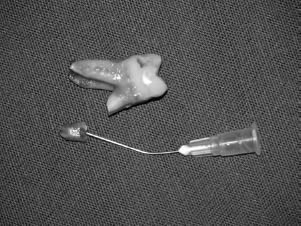
Dental injection needle firmly wedged into root canal
Discussion
A variety of endodontic files and reamers have been suggested for use in such cases. However, cost and cross-infection are obvious disadvantages of these specialized instruments. Hypodermic needles would be available even in the most basic of government dispensaries. Our technique therefore utilizes a sterile, inexpensive, readily available hypodermic needle and offers the general practitioner a final attempt at root removal before he or she must resort to a referral.