






Abstract
Purpose
A performance-improvement service project consisting of a series of drug information interventions was developed for pharmacy staff to improve the quality and consistency of drug information provided by clinical pharmacists at a university medical center. The impact of interventions was primarily assessed by attendee satisfaction; a secondary measurement was the use of the Stanford Drug Information Center (the center).
Methods
Five interventions reviewing different electronic drug-information references were presented in September and October 2005. The 1hour presentations consisted of live demonstrations to pharmacy staff. A handout with step-by-step instructions on how to access and search each reference was created and distributed along with a follow-up evaluation. At the end of the interventions, all of the handouts were compiled into a permanent drug-information resource manual. In addition, data regarding inhouse pharmacist call volume to the center and the type of questions asked by inhouse pharmacists were collected for 6 months before and after the interventions.
Results
Evaluations of the interventions were positive and indicated that the learning objectives for each session had been met. The number of requests from inhouse pharmacists actually increased for the 6-month period after the interventions, as compared to the 6-month period prior to the interventions.
Conclusion
Feedback from pharmacy staff was positive, and the performance improvement goal was met through the intervention program, as well as the development of a permanent drug-information resource manual. However, further education of pharmacy staff did not translate into decreased requests (lower call volume) to the center.
The Stanford Drug Information Center (the center) has been in operation since 1979 and is the primary drug information resource for areas of the hospital without a designated clinical pharmacist and for hospital-affiliated clinics. Decentralized clinical pharmacists are first-line resources for requests regarding patient-specific questions from health care providers on the inpatient units. Physicians are the primary requestors of information from the center, followed by pharmacists and nurses. Unlike some drug information centers, Stanford Hospital and Clinics accept calls from the community. Nevertheless, the majority of requests come from Stanford affiliates. Additional services provided by the center include coordination of the Pharmacy and Therapeutics Committee, publication of drug information newsletters, drug-shortage communications, online formulary maintenance, nursing interventions, adverse drug reaction and medication error tracking, reference management for the pharmacy, and precepting of pharmacy residents and students.
Surveys evaluating drug information centers in the United States have reported an average of 2.5 pharmacists per center, plus residents, students, and secretarial staff 1 ; four employees total per cen-ter 2 ; and 1.93 full-time equivalents (FTE) of professional staff, plus 0.76 FTE of support staff, in addition to staffing by residents and students as part of their experiential education. 3 In comparison, the Stanford center is currently staffed by only one full-time pharmacist, one drug information resident, rotating pharmacy practice residents, and students. Between 2002 and 2005, the center received an average of 151 requests (178 questions) per month and 1,818 requests (2,139 questions) per year. A total of 1,722 requests were received in 2005, and 1,746 requests were received in 2006.
Even though the center is understaffed in comparison to the average, it still ranks within the top third of centers in terms of requests received per month. 1 Additional services provided by the center are comparable with similar drug information centers. Because of the center's workload, staff members were supportive of a performance improvement project that could reduce call volume without sacrificing patient care.
Computer work stations throughout Stanford Hospital and Clinics provide pharmacists with access to online drug information databases, as well as other resources available through the Lane Medical Library Web site, the medical library for Stanford University. The Lane Medical Library Web site includes more than 1,700 online journals (eJournals), 1,000 online books (eBooks), and numerous clinical information databases. Many hospital pharmacists are not aware of the amount of information accessible to them from each work station. Providing education on how to use the drug information resources available to assist with responding to drug information requests should enable pharmacists to be more efficient. A performance-improvement service project consisting of a series of drug information interventions was developed for pharmacy staff to ensure the quality and consistency of drug information provided by clinical pharmacists. The project was consistent with the American Society of Health-System Pharmacists' definition of performance improvement and endorsed by Stanford Hospital and Clinics pharmacy management. Measurement of the impact of the interventions was primarily assessed by attendee satisfaction. A secondary measurement assessed drug information service utilization. It was hypothesized that providing education on drug information references would decrease the volume of calls from Stanford Hospital and Clinics' pharmacists to the center, as an educated pharmacy staff should display more confidence in answering drug information requests.
Materials and Methods
In August 2005, a survey was sent to approximately 60 pharmacists at Stanford Hospital and Clinics. Pharmacists surveyed included full-time, part-time, and per diem pharmacists, as well as pharmacy management. Some of the questions on the survey were used to determine what resources pharmacists wanted to learn more about, what questions pharmacists wished they could answer more quickly, and what categories of questions were the most difficult to answer. From the 22 surveys returned, the two most common resources pharmacists indicated an interest in learning more about were SkolarMD (which is now Clinical Resources @ Ovid) and MD Consult. The majority of pharmacists also indicated an interest in being able to find answers to drug-of-choice types of questions more quickly. No consensus was found in terms of questions that were the most difficult to answer.
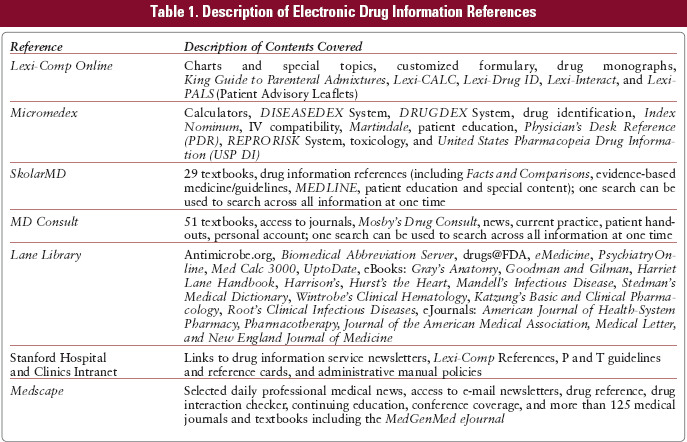
The results from the survey were used to help tailor a series of five drug information interventions scheduled for September and October 2005. Four major drug information references were selected to be presented: Lexi-Comp Online, Micromedex, SkolarMD, and MD Consult. A fifth session covered other references including the Lane Medical Library Web site (eMedicine, UpToDate, and selected eJournals and eBooks), Stanford Hospital and Clinics Intranet, and Medscape. The decision to present SkolarMD and MD Consult was based on survey results, while the other references selected represented resources commonly used by the center. A brief overview of the drug information references covered in the interventions is presented in Table 1.
Description of Electronic Drug Information References
Each intervention was presented by the drug information resident between 12:00 and 1:00 PM on five different occasions between September and October 2005. The elements of each presentation were very similar and each began with a free lunch sponsored by a drug manufacturer. Three learning objectives were stated at the beginning of each presentation and consisted of having pharmacists describe the databases or information each reference contained, identify questions each reference could best help them to answer, and become familiar with the search methods for each resource. The presentations consisted of a live demonstration on a projection screen of how to navigate and search through each resource. A handout with step-by-step instructions on how to access and search the references was created and distributed to pharmacy staff. When the interventions concluded, the handouts were compiled into a handbook for use as a reference tool. The drug information handbook was made available to all pharmacists on the pharmacy department's shared network drive and made accessible from any pharmacy work station in the hospital. A sign-in form was used to record the number of pharmacists attending each session. A follow-up evaluation was also distributed before each session and was collected immediately after each intervention. On the evaluation, pharmacists were asked to state if the learning objectives were met for a particular session and what new information was learned. Information obtained from the evaluations was compiled to help determine the impact of the presentations on pharmacy staff. In almost every case, pharmacists stated the three learning objectives for each session had been met (39/40 evaluations returned). Pharmacists were given the opportunity to list new information that was learned on the evaluations. Comments suggested some staff had not previously used the references, did not know some of the references had so much to offer, or had learned a new tool within a particular reference.
Data regarding inhouse-pharmacist call volume to the center and the type of questions asked by pharmacists were collected for 6 months before and after the drug information interventions. March through August 2005 represented 6 months before the interventions, as the interventions were given in September and October 2005; November through April 2006 represented 6 months after the interventions. When comparing the number of Stanford Hospital and Clinics pharmacist requests before (132) and after (147) the interventions, the number of calls received at the center was actually greater after the interventions and represented a higher percentage of the overall requests (before interventions, 15%; after interventions, 19%). One possible explanation is that after the interventions, pharmacy staff may have been more aware of the type of information the center could provide (See Tables 2 and 3; Figures 1 and 2).
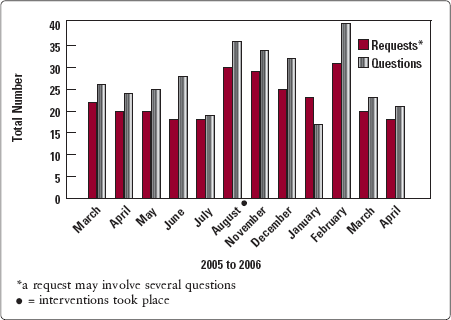
Stanford Hospital and Clinics monthly pharmacist call statistics before and after drug information interventions (interventions given during September and October 2005).
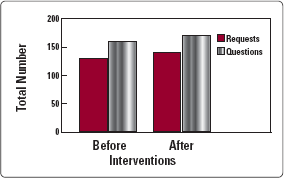
Stanford Hospital and Clinics total pharmacist call statistics before and after drug information interventions (interventions given during September and October 2005).
Stanford Hospital and Clinic Pharmacist—Call Statistics Before Drug Information Interventions (March to August 2005): 886 total calls (148 calls/month)
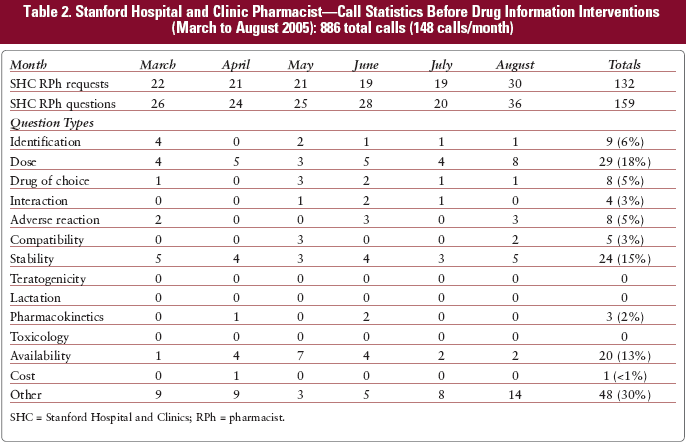
SHC = Stanford Hospital and Clinics; RPh = pharmacist.
Stanford Hospital and Clinics Pharmacist—Call Statistics After Drug Information Interventions (November 2005 to April 2006): 790 total calls (132 calls/month)
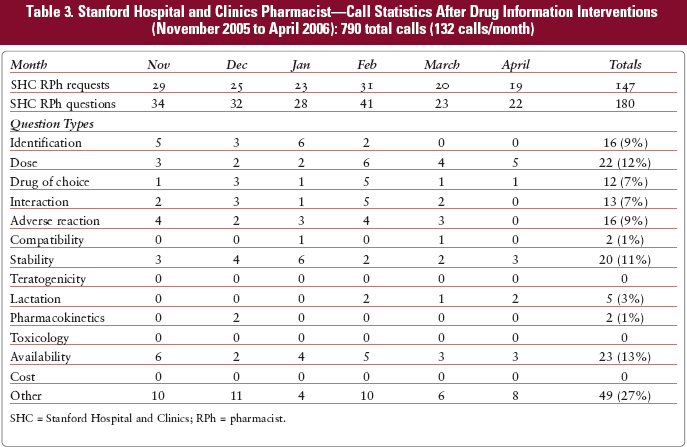
SHC = Stanford Hospital and Clinics; RPh = pharmacist.
At the center, each request is logged into a database and categorized—based on the type of question received. Additional data were collected that were compared with the four most common question types requested by Stanford Hospital and Clinics pharmacists 6 months before and after the interventions. The four most common question types remained the same before and after the interventions, with a slight variation in their order. The most common question type requested fell within the “Other” category. “Other” question types included latex content, pharmacy law, regulation, hospital policy, and how to use Stanford Hospital and Clinics references. It was expected that the number of questions regarding how to use Stanford Hospital and Clinics references would have increased after the interventions (as more individuals would be using them), but this remained similar before and after the interventions. During March through August 2005, there were eight requests (5% of total Stanford Hospital and Clinics pharmacists requests) on how to use Stanford Hospital and Clinics references, compared with 11 requests (6% of total Stanford Hospital and Clinics pharmacists requests) between November 2005 through April 2006. Other common question types included dose and administration, stability, and availability.
A limitation to the performance improvement project was that each presentation was given only one time and thus not all pharmacists, in particular those on the evening shift, were able to attend. Even so, many of the pharmacists that work on the day shifts also rotate through evening or swing shifts and were probably able to attend some of the interventions. As evening shift pharmacists are responsible for more patient care units, it was felt that it would be difficult for a large contingent of evening staff to devote an hour away from their staffing duties. For those unable to attend, the drug information resource manual was available. For each session, there was a significant turnout of 19 to 30 pharmacists, residents, and students. Students represented approximately 10% of the overall attendance, while the rest of the audience represented paid hospital employees. While few pharmacists were able to attend all five sessions, at least 70% of the pharmacy staff attended one or more sessions. Some names on the sign-in sheet were illegible, and it is possible that some pharmacists did not document their attendance.
Conclusion
Few reports regarding drug information programs for hospital pharmacy staff are available in the literature, but those that are have demonstrated that courses devoted specifically to drug information education are valuable tools to encourage pharmacist performance improvement.4,5 In the current study, the performance improvement goal was met through the interventions, a permanent drug information resource manual was created, and feedback from pharmacy staff was positive, but the number of requests to the center did not decrease.