







Abstract
The increasing complexity of cancer chemotherapy now requires that pharmacists be familiar with these highly toxic agents. This column will review various issues related to preparation, dispensing, and administration of cancer chemotherapy, and review various agents, both commercially available and investigational, used to treat malignant diseases.
The views expressed in this article are those of the author(s) and do not reflect the official policy of the Department of Army, Department of Defense, or US Government.
Indications
The MAID regimen is used as adjuvant or neoadjuvant therapy of operable soft tissue sarcoma1-3 and primary therapy of metastatic or inoperable soft tissue sarcoma.1,4-9 MAID has also been used as primary therapy of metastatic or inoperable sarcomas of bone5,6,9 and Ewing sarcoma. 9
Drug Preparation
Follow institutional policies for preparation of hazardous medication when preparing mesna. Use mesna injection, 100 mg/mL. Mesna is also available as 400 mg tablets for oral use. Dilute in 250 to 1,000 mL of 0.9% sodium chloride or 5% dextrose in water for infusion.
Follow institutional policies for preparation of hazardous medications when preparing doxorubicin. Use doxorubicin injection 2 mg/mL or doxorubicin powder for injection. Dilute the powder for injection with 0.9% sodium chloride to a concentration of 2 mg/mL. Dispense in 250 to 1,000 mL of 0.9% sodium chloride, 5% dextrose in water, or a saline/dextrose solution for infusion. Doxorubicin may be mixed in the same bag with dacarbazine.5,6 Since dacarbazine is light-sensitive, bags containing doxorubicin and dacarbazine should be protected from light immediately following preparation.
Follow institutional policies for preparation of hazardous medications when preparing ifosfamide. Use ifosfamide powder for reconstitution or ifosfamide injection. Reconstitute powder for injection with sterile water for injection, 0.9% sodium chloride, or 5% dextrose in water to a concentration of 50 mg/mL. Dispense in 250 to 1,000 mL of 0.9% sodium chloride, 5% dextrose in water, or a saline/dextrose solution for infusion.
Follow institutional policies for preparation of hazardous medications when preparing dacarbazine. Reconstitute to a concentration of 10 to 20 mg/mL with sterile water for injection, 5% dextrose in water, or 0.9% sodium chloride. Dilute with 250 to 1,000 mL 5% dextrose in water or 0.9% sodium chloride. Dacarbazine is light-sensitive and should be protected from light immediately following preparation.
Drug Administration
In the MAID regimen, all four drugs are administered by continuous intravenous (IV) infusion.
Supportive Care
Ondansetron 16 to 24 mg orally and dexamethasone 12 mg orally, given 30 minutes before MAID on days 1 through 4; aprepitant 125 mg orally, given 30 minutes before MAID on day 1; and aprepitant 80 mg orally, given 30 minutes before MAID on days 2 and 3. Granisetron 2 mg orally and dexamethasone 12 mg orally, given 30 minutes before MAID on days 1 through 4; aprepitant 125 mg orally, given 30 minutes before MAID on day 1; and aprepitant 80 mg orally, given 30 minutes before MAID on days 2 and 3. Dolasetron 100 to 200 mg orally and dexamethasone 12 mg orally, given 30 minutes before MAID on days 1 through 4; aprepitant 125 mg orally, given 30 minutes before MAID on day 1; and aprepitant 80 mg orally, given 30 minutes before MAID on days 2 and 3. Palonosetron 0.25 mg IV, given 30 minutes before MAID on day 1; dexamethasone 12 mg orally, given 30 minutes before MAID on days 1 through 4; aprepitant 125 mg orally, given 30 minutes before MAID on day 1; and aprepitant 80 mg orally, given 30 minutes before MAID on days 2 and 3.
The antiemetic therapy should continue for at least 3 days after the completion of MAID to prevent prolonged nausea and vomiting. A meta-analysis of several trials of serotonin antagonists recommends against prolonged (greater than 24 hours after completion of chemotherapy) use of these agents
14
; making a steroid, or steroid and dopamine antagonist combination, most appropriate for follow-up therapy. One of the following regimens is suggested:
Dexamethasone 4 mg orally twice a day for 3 days ± metoclopramide 0.5 to 2 mg/kg orally every 4 to 6 hours ± diphenhydramine 25 to 50 mg orally every 6 hours if needed for restlessness, starting on day 5 of MAID. Dexamethasone 4 mg orally twice a day for 3 days, ± prochlorperazine 10 mg orally every 4 to 6 hours ± diphenhydramine 25 to 50 mg orally every 6 hours if needed for restlessness, starting on day 5 of MAID. Dexamethasone 4 mg orally twice a day for 3 days ± promethazine 25 to 50 mg orally every 4 to 6 hours ± diphenhydramine 25 to 50 mg orally every 6 hours if needed for restlessness, starting on day 5 of MAID. Patients who do experience significant nausea or vomiting with one of these regimens should receive an agent from a different pharmacologic category.14-16 A few small studies suggest substituting granisetron for ondansetron in subsequent treatment cycles; however none of these reports found the improvement to be statistically significant.15-19
Metoclopramide 0.5 to 2 mg/kg orally every 4 to 6 hours if needed ± diphenhydramine 25 to 50 mg orally every 6 hours if needed for restlessness. Prochlorperazine 10 mg orally every 4 to 6 hours if needed ± diphenhydramine 25 to 50 mg orally every 6 hours if needed for restlessness. Prochlorperazine 25 mg rectally every 4 to 6 hours if needed ± diphenhydramine 25 to 50 mg orally every 4 to 6 hours if needed for restlessness. Promethazine 25 to 50 mg orally every 4 to 6 hours if needed ± diphenhydramine 25 to 50 mg orally every 4 to 6 hours if needed for restlessness.
A few small studies suggest that higher doses of granisetron (3 mg or 40 to 240 mcg/kg IV)15-19 may be effective in treating breakthrough nausea; however, none of these reports found the improvement to be statistically significant.
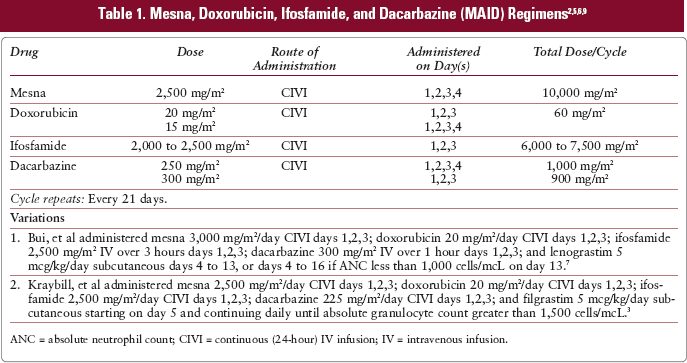
ANC = absolute neutrophil count; CIVI = continuous (24-hour) IV infusion; IV = intravenous infusion.
Since febrile neutropenia was reported in 25% to 59% of patients in the trials of MAID reviewed, prophylactic use of colony-stimulating factors is recommended.2,5,7
Major Toxicities
Most of the following toxicities are presented according to their degree of severity. Higher grades represent more severe toxicities. Although there are several grading systems for cancer chemotherapy toxicities, all are similar. One of the frequently used systems is the National Cancer Institute (NCI) Common Terminology Criteria for Adverse Events (available at http:/ctep.info.nih.gov). Oncologists generally do not adjust doses or change therapy for grade 1 or 2 toxicities; but make, or consider, dosage reductions or therapy changes for grade 3 or 4 toxicities. Incidence values are rounded to the nearest whole percent unless incidence was less than or equal to 0.5%.
Pretreatment Studies Needed
Aspartame aminotransferase/alanine aminotransferase (AST/ALT) Total bilirubin Serum creatinine Complete blood cell (CBC) count with differential Cardiac ejection fraction with multigated acquisition scan or echocardiogram
Prior to each treatment
AST/ALT. Total bilirubin. Serum creatinine. CBC count with differential.
White blood cell count (WBC): greater than or equal to 3,000 cells/mcL.4-6,9 Absolute neutrophil count (ANC): greater than 1,500 cells/mcL.7,8 Platelet count: greater than or equal to 100,000 cells/mcL.4-9 Serum creatinine: less than 1.5-fold institutional normal value.7-9 Serum bilirubin: Less than 1.5 mg/dL4; less than 1.5 to 2-fold institutional normal value (less than 4-fold if sarcoma metastatic to liver).7-9 AST/ALT: less than 1.5 to 2-fold institutional normal value (less than 4-fold if sarcoma metastatic to liver).7-9
In clinical practice, a pretreatment ANC of greater than or equal to 1,000 cells/mcL and platelets of greater than or equal to 75,000 cells/mcL are usually considered acceptable.
Dosage Modifications
Ifosfamide:
Dacarbazine:
Hold MAID for 1 week for WBC less than 3,000 cells/mcL or platelets less than 100,000 cells/mcL.4,5 Restart MAID only when WBC reaches 3,000 cells/mcL and platelets reach 100,000 cells/mcL.6,9 For WBC nadir less than 500 cells/mcL or neutropenic fever, reduce ifosfamide and mesna doses by 500 mg/m2/day.
5
For platelet nadir less than 50,000 cells/mcL, reduce dacarbazine dose by 50%.
5