







Abstract
The increasing complexity of cancer chemotherapy now requires that pharmacists be familiar with these highly toxic agents. This column will review various issues related to preparation, dispensing, and administration of cancer chemotherapy, and review various agents, both commercially available and investigational, used to treat malignant diseases.
The views expressed in this article are those of the author(s) and do not reflect the official policy of the Department of Army, Department of Defense, or US Government.
Indications
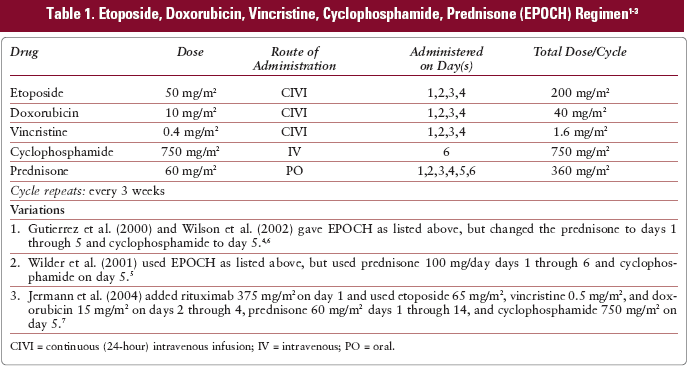
EPOCH has been studied as salvage treatment for relapsed or refractory Hodgkin and non-Hodgkin lymphomas,1-5 and as initial therapy for non-Hodgkin lymphomas.2,6,7 Current guidelines for treatment of non-Hodgkin lymphomas list EPOCH, with rituximab, as an initial regimen for mantle cell and diffuse large B-cell lymphomas. It is also recommended (without rituximab) as initial therapy for acquired immunodeficiency syndrome (AIDS)-related B-cell and peripheral T-cell lymphomas. 8
Drug Preparation
Etoposide
Follow institutional policies for preparation of hazardous medications when preparing etoposide. Use etoposide injection 20 mg/mL. Dilute with 0.9% sodium chloride or 5% dextrose in water to a final concentration of 0.2 to 0.4 mg/mL. Etoposide can be mixed in the same container as the doxorubicin and vincristine, so the 3 drugs can be administered as a single infusion.
9
Doxorubicin
Follow institutional policies for preparation of hazardous medications when preparing doxorubicin. Use doxorubicin injection 2 mg/mL or doxorubicin powder for injection. If the powder for injection is used, it should be reconstituted to a concentration of 2 mg/mL with 0.9% sodium chloride. Dilute in 250 to 1,000 mL of 0.9% sodium chloride, 5% dextrose in water, or a saline/dextrose solution for infusion. Doxorubicin can be mixed in the same container as the etoposide and vincristine, and the 3 drugs administered as a single infusion.
9
Vincristine
Follow institutional policies for preparation of hazardous medications when preparing vincristine. Use vincristine sulfate injection 1 mg/mL. Withdraw the volume required. CIVI = continuous (24-hour) intravenous infusion; IV = intravenous; PO = oral.
Vincristine can be mixed in the same container as the doxorubicin and etoposide, so the 3 drugs can be administered as a single infusion.
Cyclophosphamide
Follow institutional policies for preparation of hazardous medications when preparing cyclophosphamide. Use cyclophosphamide powder for injection. Reconstitute cyclophosphamide to a concentration of 20 mg/mL with sterile water for injection or 0.9% sodium chloride. Dilute with 100 to 250 mL of 0.9% sodium chloride injection or 5% dextrose injection.
Prednisone
No special precautions are required. Prednisone is available in 1,2,5, 5, 10, 20, and 50 mg tablets and as 1 and 5 mg/mL oral solutions. Store at controlled room temperature (15° to 30° C).
Drug Administration
In the EPOCH regimen, doxorubicin, etoposide, and vincristine are all administered by continuous intravenous (IV) infusion.
Cyclophosphamide is administered by IV infusion over 10 to 30 minutes. Some institutions allow doses less than 1,000 mg to be administered as a slow (1-to 10-minute) IV push.
Prednisone:
Prednisone is given orally (PO) and usually as a single-daily dose. Administration with, or immediately after a meal, milk, or a small snack, is recommended to minimize gastric irritation.
Supportive Care
If a serotonin antagonist and steroid combination is used on the days when doxorubicin, vincristine, and etoposide are given, 1 of the following regimens is suggested:
Ondansetron 16 to 24 mg PO, given 30 minutes before etoposide, doxorubicin, and vincristine. Granisetron 2 mg PO, given 30 minutes before etoposide, doxorubicin, and vincristine. Dolasetron 100 to 200 mg PO, given 30 minutes before etoposide, doxorubicin, and vincristine. Palonosetron 0.25 mg IV on day 1 only, given 30 minutes before etoposide, doxorubicin, and vincristine.
If a neurokinin antagonist is also used, 1 of the following regimens is suggested:
Ondansetron 16 to 24 mg PO and aprepitant 125 mg PO, given 30 minutes before etoposide, doxorubicin, and vincristine. Granisetron 2 mg PO and aprepitant 125 mg PO, given 30 minutes before etoposide, doxorubicin, and vincristine. Dolasetron 100 to 200 mg PO and aprepitant 125 mg PO, given 30 minutes before etoposide, doxorubicin, and vincristine. Palonosetron 0.25 mg, on day 1 only, and aprepitant 125 mg PO, given 30 minutes before etoposide, doxorubicin, and vincristine.
If a mildly-emetogenic regimen is used, 1 of the following regimens should be used:
Give the first prednisone dose 30 minutes before starting the etoposide, doxorubicin, and vincristine infusion. Prochlorperazine 10 mg PO or IV ± diphenhydramine 25 to 50 mg PO if needed, given 30 minutes before etoposide, doxorubicin, and vincristine infusion. Metoclopramide 0.5 to 2 mg/kg PO or IV ± diphenhydramine 25 to 50 mg PO if needed, given 30 minutes before etoposide, doxorubicin, and vincristine infusion. Promethazine 25 to 50 mg PO, or 12.5 to 25 mg IV ± diphenhydramine 25 to 50 mg PO if needed, given 30 minutes before etoposide, doxorubicin, and vincristine infusion.
Patients who experience significant nausea or vomiting with 1 of these regimens should receive an agent from a different pharmacologic category added to the previous prophylactic antiemetic regimen.11-13 The following regimens are recommended:
Patients who received a steroid only—add a dopamine antagonist. Patients who received a dopamine antagonist only— add a steroid. Patients who received a steroid and dopamine antagonist—substitute a serotonin antagonist for the dopamine antagonist.
If a steroid and dopamine antagonist combination is not effective, a serotonin antagonist and steroid combination may be required.
Wilson et al. (1993) reported mild nausea, adequately managed without antiemetics, following cyclophosphamide administration. 1 When it does occur, onset of cyclophos-phamide-induced emesis is often delayed for up to 12 hours after drug administration and may persist for up to 120 hours.14,15 Although not well documented in the literature, some clinicians divide the daily antiemetic dose into 2 doses on days when cyclophosphamide is administered. Use of 1 of the aforementioned regimens for prevention of mild emesis is recommended.
Prophylactic therapy should continue for 2 to 3 days. A meta-analysis of several trials of serotonin antagonists recommends against prolonged (greater than 24 hours) use of these agents; making a steroid, or steroid and dopamine antagonist combination most appropriate for follow-up therapy. 16
For most patients, prophylactic antiemetic therapy, particularly with a serotonin antagonist, is not generally required.11-13 If needed, 1 of the following regimens may be given 30 minutes prior to therapy:
The prednisone 60 mg/m2 PO days 1 through 6 of EPOCH may provide adequate control of nausea and vomiting without use of another antiemetic agent. Prochlorperazine 10 mg PO or IV ± diphenhydramine 25 to 50 mg PO if needed, given 30 minutes before days 1 through 6. Metoclopramide 0.5 to 2 mg/kg PO or IV ± diphenhydramine 25 to 50 mg PO if needed, given 30 minutes before days 1 through 6. Promethazine 25 to 50 mg PO or 12.5 to 25 mg IV ± diphenhydramine 25 to 50 mg PO if needed, given 30 minutes before days 1 through 6.
Metoclopramide 0.5 to 2 mg/kg PO every 4 to 6 hours if needed ± diphenhydramine 25 to 50 mg PO every 6 hours if needed. Prochlorperazine 10 mg PO every 4 to 6 hours if needed ± diphenhydramine 25 to 50 mg PO every 6 hours if needed. Prochlorperazine 25 mg rectally every 4 to 6 hours if needed ± diphenhydramine 25 to 50 mg PO every 4 to 6 hours if needed. Promethazine 25 to 50 mg PO every 4 to 6 hours if needed ± diphenhydramine 25 to 50 mg PO every 4 to 6 hours if needed.
A few small studies suggest that higher doses of granisetron (3 mg or 40 to 240 mcg/kg IV)17-21 may be effective in treating breakthrough nausea; however, none of these reports found the improvement to be statistically significant.
Since severe (grade 3 or 4) neutropenia was reported in up to 26% of patients in the 3 trials reviewed, and febrile neutropenia was reported in 11% to 17% of patients,1-3 prophylactic use of colony stimulating factors may be appropriate with the EPOCH regimen.24,25
Vincristine is a moderate vesicant, and extravasation should be avoided. If extravasation occurs, stop the infusion immediately, and aspirate as much of the extravasated solution as possible before withdrawing the needle. The limb should be elevated and cooled intermittently (ice packs for 15 to 20 minutes, 4 times a day, for 3 days).26,27
Although Larson (1982 and 1985) reported applying ice to all extravasations,26,27 most other groups suggest dry heat for 30 minutes, 4 times a day, for 3 days 28 and hyaluronidase 150 units/mL injected intradermally at the extravasation site has been recommended for treatment of vinca alkaloid extravasations. 28
Major Toxicities
Most of the toxicities listed below are presented according to their degree of severity. Higher grades represent more severe toxicities. Although there are several grading systems for cancer chemotherapy toxicities, all are similar. One of the frequently used systems is the National Cancer Institute (NCI) Common Terminology Criteria for Adverse Events (http:/ctep.info.nih.gov). Oncologists generally do not adjust doses or change therapy for grade 1 or 2 toxicities; but make, or consider, dosage reductions or therapy changes for grade 3 or 4 toxicities. Incidence values are rounded to the nearest whole percent unless incidence was less than or equal to 0.5%.
Pretreatment Laboratory Studies Needed
Aspartame aminotransferase/alanine aminotransferase (AST/ALT) Total bilirubin Serum creatinine Complete blood (cell) count CBC with differential Cardiac ejection fraction
CBC with differential Serum creatinine
Cardiac ejection fraction (EF): greater than or equal to 40%.
1
Absolute neutrophil count (ANC): greater than or equal to 1,000 cells/mcL.
1
Platelet count: greater than or equal to 100,000 cells/mcL.
1
Serum creatinine: less than 1.5 mg/dL.
1
Creatinine clearance (CrCl): greater than or equal to 40 mL/min.
1
Serum bilirubin: less than 2.5 mg/dL.
1
In clinical practice, a pretreatment ANC of 1,000 cells/mcL and platelets of 75,000 cells/mcL are usually considered acceptable.
Dosage Modifications
Etoposide: reduce dose by 50% if total bilirubin 1.5 to 3 mg/dL.
32
Doxorubicin:
Reduce dose by 25% for ALT or AST 2 to 3 times the upper limit of normal (ULN).32,33 Reduce dose by 50% for total bilirubin greater than 1.2 mg/dL, and less than 3 mg/dL or ALT or AST greater than 3 times and less than or equal to 5 times the ULN.
32
Reduce dose by 50% for total bilirubin greater than 1.2 mg/dL, and less than 3 mg/dL and ALT or AST greater than 3 times and less than or equal to 5 times the ULN.
33
Reduce dose by 75% for total bilirubin greater than or equal to 3 mg/dL and less than or equal to 5 mg/dL or ALT or AST greater than 3 times and less than or equal to 5 times the ULN.
32
Reduce dose by 75% for total bilirubin greater than or equal to 3 mg/dL and less than or equal to 5 mg/dL.
33
Omit dose for ALT or AST greater then 5 times the ULN.
32
Vincristine: reduce dose by 50% for the following32,33:
Bilirubin greater than or equal to 1.5 mg/dL and less than or equal to 3 mg/dL, or; ALT or AST greater than or equal to 2 times the ULN and less than or equal to 3 times the ULN, or; Any elevation of alkaline phosphates above the ULN. Cyclophosphamide
32
:
Reduce dose 25% for bilirubin greater than 3.1 gm/dL or ALT or AST greater than 3 times the ULN. Do not give the drug for bilirubin greater than 5 mg/dL.