





Abstract
The Director's Forum series is written and edited by Michael Sanborn and Robert Weber and is designed for guiding pharmacy leaders in establishing patient-centered services in hospitals and health systems. Another specific goal of this column is addressing many of the key challenges that pharmacy directors currently face while providing information that will foster growth in pharmacy leadership and patient safety. Bar-code medication administration (BCMA) is an important medication safety program for hospitals, and the involvement of the pharmacy director in its implementation and evaluation is critical. This installment of the Director's Forum describes the necessary steps for implementing and evaluating a BCMA program.
Introduction
Growing evidence of the number of medical errors that occur throughout the US health care system has prompted an increased interest in using technology to improve safety. Medication errors, which occur at a rate ranging from 19% to 36% in hospitals and over half of which occur during medication administration, are a significant concern for patients, health care organizations, and clinicians. 1 Bar-code medication administration (BCMA) systems are an example of technology being employed to reduce medication administration errors. These systems electronically compare a patient's identity and medical information (eg, in an electronic medication order) against a bar-coded medication, alerting the nurse of the potential for a medication administration error. It is hypothesized that these alerts, if properly interpreted and acted on by nurses, will help prevent medication administration errors. Furthermore, the Institute of Medicine recommends using BCMA systems to ensure the timeliness and accuracy of medication administration. 2 Several studies have shown that bar-coding systems reduce medication dispensing errors and adverse drug events in a hospital pharmacy (by 63%), in addition to reducing medication administration errors (by 50% to 60%) (University of Pittsburgh Medical Center, unpublished data, 2004). 3
Despite these predictions, a recent survey by the American Society of Health-System Pharmacists shows that a small percentage of hospitals have implemented BCMA technology. 4 The reasons for this limited implementation may include the expense of bar-code systems and, more importantly, the significant efforts required for evaluating and changing the medication-use process to maximize the use of bar-code technology.
There is a paucity of literature that describes the steps necessary for implementation and evaluation of a BCMA system by an organization. A report describing the practical aspects of bar-coding medication provides some guidance to the mechanics and suggests that reliable processes must be in place for patient and caregiver identification, as well as for medication bar coding. 5 In addition, a recent report highlights work-arounds in BCMA systems that threaten their effectiveness. 2 Because of the barriers to implementation of BCMA systems, such as the cost of the aforementioned processes and the exposed work-arounds, communication by organizations of the impact that these systems have on preventing medication errors is vital.
This article presents the University of Pittsburgh Medical Center's (UPMC's) experience in implementing a system for BCMA. The specific aims of this article include (1) establishing the conceptual framework for using bar-code systems as part of an organization's safety plan, (2) designing a multidisciplinary process for selecting a bar-code system, (3) installing the computing infrastructure for support of bar coding, (4) establishing an inventory control system that ensures nearly 100% bar coding of medications, (5) revising pharmacy and nursing medication processes to enhance functionality, and (6) developing quality indicators for barcode systems. Information is provided on a real-world experience that informs pharmacy directors who are seeking to make their medication systems safer using BCMA.
Background
The UPMC Presbyterian hospital is a 647-bed academic medical center affiliated with the University of Pittsburgh Schools of the Health Sciences, with nationally recognized patient care programs in critical care medicine, organ transplantation, orthopedics, geriatrics, cardiology, and internal medicine. Prior to implementation of BCMA, the system for medication dispensation at UPMC Presbyterian was a fully automated bar-code process employing robotics (McKesson Automated Healthcare, Inc., Pittsburgh, Pennsylvania), medication carousels, and an integrated electronic health record (Cerner PharmNet and Cerner HNA Millenium, Kansas City, Missouri) that provided pharmacists with ready access to patient medical record data, including progress notes, laboratory results, and allergy information. The system for nursing medication administration comprised a paper medication administration record (MAR) that relied on manual implementation by the nurse of the best practices for medication, including allergy and duplicate medication screening, along with timely and accurate medication administration. Currently, UPMC Presbyterian implements a comprehensive interdisciplinary medication safety program that uses an evidence-based model and supportive data from the United States Pharmacopoeial Convention's MEDMARX, recognized as one of the most credible medication error reporting systems. 6
Conceptual Framework
The goal of UPMC Presbyterian with regard to medication-patient safety is elimination of medication errors through the systematic reporting, analysis, and sharing of medication error information and problem-solving strategies across the organization. The institution's framework for medication-patient safety focuses on using reporting systems and other data sources to identify problems, as well as implementing evidence-based interventions to improve safety in medication prescribing, administering, and dispensing. The framework is endorsed by the institution's executive management and trustees, with all planning for medication safety focused on designing programs that are consistent with this framework.
BCMA was compatible with the organization's medication safety conceptual framework. Because a bar-coded medication dispensing system (Robot-Rx, McKesson) and an integrated electronic health record with emerging decision-support capabilities were already in place, UPMC Presbyterian was well positioned for establishing the BCMA program. Moreover, the program was regarded as an enhancement of the current medication safety system through the continued use of new technology.
Data from the organization's medication error reporting system was used to examine BCMA's potential impact on safety. Serious medication errors—as defined by the National Coordinating Council on Medication Error Reporting and Prevention index—were reviewed for an 8-month period prior to implementing BCMA. 7 Using this index greatly enhanced the ability to identify the breadth and scope of system problems, as indicated by near misses (categories A and B) and sentinel serious events (categories D through I). Analysis revealed a potentially significant impact from BCMA's prevention of serious medication administration errors associated with high-risk medications (opiates, antibiotics, medications for diabetes and cardiovascular conditions, etc). Table 1 lists the drug products associated with serious medication administration errors that were determined potentially preventable through use of BCMA.
Drugs Associated With Serious Administration Errors at University of Pittsburgh Medical Center Presbyterian

Implementation Steps
Bar-Code Medication Administration System Selection
Selecting a BCMA system requires a multidisciplinary approach, including hospital leadership, physicians, nurses, pharmacists, and information system specialists. At UPMC Presbyterian, a steering committee with representatives from each of these areas was developed that conducted site visits, reviewed BCMA system demonstrations from vendors, and developed specific criteria for selection. Table 2 describes some of the criteria that were developed for selection of a BCMA system.
Selected Criteria for Choosing a Bar-Code Medication Administration System

BCMA = bar-code medication administration.
Establishing Computing Infrastructure
The Steering Committee evaluated the current information system infrastructure and purchased equipment that promoted portability (eg, wireless connections, computer carts) and integration with the institution's electronic health record. This required a systematic “swap out” of computer devices, as well as facility upgrades, to accommodate wireless connections and handheld BCMA scanners. These processes take time but are a necessary part of the work plan for implementing BCMA systems. Another consideration in using wireless devices is the impact on the security of the information system data. Developing a “single sign-on,” or one sign-on password, for access to multiple applications (including BCMA) was critical in encouraging user compliance at UPMC Presbyterian. Handheld BCMA devices (from Cerner) that were easy to read and operate were selected for the project. Finally, patients' bar-code–readable wristbands were evaluated for durability and scanning capability.
Medication and Patient-Specific Bar-Code Processes
The unit-dose medication system is widely accepted as the standard for medication use within health systems. This system employs an individually packaged dosage, which is available as a commercial product or as an extemporaneously packaged item, for administration to patients. Although these systems promote safety by reducing confusion over the proper drug and dosage for administration, they do not necessarily prevent all potential medication administration errors. For example, if a medication is available as a given dosage strength and an alternative strength is ordered, the nurse may use the commercially available dosage form and modify it to give the ordered dose (eg, furosemide 10 mg order administered as one-half of a furosemide 20 mg tablet). To eliminate this potential for error, UPMC Presbyterian has developed a system that provides the immediate medication container for nearly 100% of the hospital's drug formulary.
Most hospital pharmacy computer systems use the national drug code (NDC) as a unique identifier for drug products. The NDC identifies the drug, formulation, strength, package size and type, and the drug's manufacturer. Manufacturers that place bar codes on their products embed the NDC information in the bar codes; however, there is currently no published database that lists the readability of a manufacturer's bar codes by specific software systems, making the initial preparation for bar-code medication packaging a labor-intensive process. UPMC Presbyterian accomplished this process by using the BCMA software for validation of the drug products requiring bar coding through scanning the pharmacy inventory to determine whether each product could be read by the BCMA system and revising the inventory shelf labels to indicate which products contained bar codes that were recognized by the BCMA software. Because the bar-code readability of drug products varies, the process of properly labeling the inventory storage bins in a pharmacy prevents the ordering of products that are not recognized by the BCMA system.
The assessment of the drug formulary at UPMC Presbyterian showed that approximately 49% of the available drug products were recognized by the BCMA system. Extemporaneous packaging by the pharmacy was required for the drug products without a commercially available bar code or those not recognized by the BCMA system. There are a variety of methods for packaging that allow medication administration as unit-of-use at the patient's bedside. Figure 1 represents the packaging process implemented by UPMC Presbyterian to ensure 95% to 100% availability of bar-code medications.
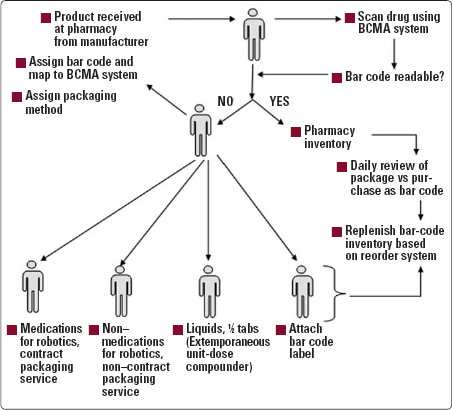
Suggested workflow for bar-code medication administration (BCMA) packaging.
Medication Processes Redesign
Implementing a BCMA system requires an evaluation and revision of the current medication process workflow. Developing a process for which patient identification occurs as the first step is vital to the accuracy of the BCMA system. This is done by scanning patients' wristbands to verify their identities. Specific procedures must be developed based on the following medication processes:
Physician review of medications on the BCMA electronic record Medication scanning practices Medication administration practices Availability of unit-dose medications ready for BCMA administration Order verification and review procedures
An example of clarifying medication scanning practices is illustrated in an observational study conducted by Koppel et al. 5 The study identified work-arounds for medication scanning, including scanning without visual check of the MAR, not scanning patients first to verify their identities, administering medication without using the BCMA scanner, placing bar codes for medications on paper or other documents, and scanning the medication bar code after the medication was removed from its package. Organizations should use this reference to develop effective medication administration rules in a BCMA system.
Developing Quality Indicators for Bar-Code Medication Administration
BCMA systems are designed for prevention of medication errors by alerting nurses to the potential for a medication administration error. There is a scarcity of literature on the impact of bar-code medication systems on compliance to safety processes and on their ability to prevent medication errors. A study by Poon et al. demonstrated a reduction in medication errors in the pharmacy as the result of implementing a BCMA system.
3
At UPMC Presbyterian, the goal in developing quality indicators was evaluation of the compliance to key safety processes, as well as better understanding of how the alert system could be revised and refined. Quality indicators focused on the following areas:
Bar code scanning compliance to ensure accurate patient identification Percentage of medication administration warnings that actually prevent an error Observation of medication administration practices Staff satisfaction with the BCMA system.
Table 3 lists potential quality indicators that can be used when evaluating a BCMA system.
Quality Indicators for a Bar-Code Medication Administration System

There is no denominator for this metric; BCMA = bar-code medication administration; NCC MERP = National Coordinating Council on Medication Error Reporting and Prevention.
Lessons Learned
As discussed earlier, data have been published on work-arounds associated with the BCMA systems. (See Koppel et al. for further information.) This section briefly reviews some of the lessons learned at UPMC Presbyterian during implementation of a BCMA system.
First, with respect to planning and implementing BCMA, significant variations in the medication ordering and administration processes were observed within the hospital, including how the MAR was used and how medication order information was entered into the pharmacy computer system. For example, if human insulin was ordered by a physician, it usually was done so as a detailed order with dosage based on the patient's blood glucose level. Nursing staff then documented the detailed human insulin order on the previously used handwritten MAR, and the pharmacy entered the human insulin order into the pharmacy ordering system with the simple designation “as directed”—because the pharmacy used the computer system as a product-dispensing system. Because the BCMA system used information from the pharmacy computer system to populate the electronic MAR (e-MAR), this practice provided the nurse with inadequate information for safe administration of the insulin. Consequently, medication order entry practices had to become more patient focused and had to consider the medication administration practices of the nursing staff. During the initial implementation of BCMA in UPMC Presbyterian's pilot units, there were many instances in which the medication order entry into the pharmacy computer system and the resultant order on the e-MAR did not contain all of the parameters necessary for administration of the medication by the nurse. The pharmacy medication order entry discrepancies were a continual problem as the institution expanded its implementation; this may have been the result of not making the pharmacy more aware of the nursing medication administration process. A key lesson learned from the implementation experience was the importance of establishing a focus group of pharmacists and nurses who could review the current medication administration process, as well as identifying the information required by the nurse to ensure effective pharmacy medication order entry.
Another example of medication order discrepancies was associated with the assignment of medication administration times. Because pharmacists were entering medication orders outside of a given nursing unit, they were often unaware of the most appropriate medication schedule for a patient, so they used a standard medication administration time. This practice created errors in medication administration times and delayed therapy where it was clinically warranted. Thus, a focus group of pharmacy and nursing personnel should be established to determine whether the use of standard medication administration times is beneficial.
As UPMC Presbyterian evaluated the effectiveness of BCMA, the institution quickly learned that the warning system for potential errors triggered by scanning a patient's wristband or a medication bar code affected the users' perceptions of the BCMA system. As a result, it was suggested that the warnings and alerts be examined and simplified to eliminate nuisance alerts.
Developing a steering committee to address the planning, implementation, and operational issues for BCMA is an effective strategy. In terms of information sharing, the Steering Committee at UPMC Presbyterian generated support for BCMA as a part of the safety culture and increased general awareness of errors as systems problems as opposed to individual fault. The Steering Committee designed a plan that included pharmacy, nursing, and information system personnel who provided direct support to users during the first 10 to 14 days of each unit's BCMA implementation. This support was integral in building the confidence of the nursing and pharmacy staff in using the BCMA system.
BCMA serves as an important catalyst for preventing medication administration errors. UPMC Presbyterian has asked users questions about the value of the BCMA system in the care of their patients to gauge organizational acceptance of this program, and it is clear that the degree to which individual clinicians adopt and implement the BCMA system depends on their belief in the system's ability to support a safe medication administration system and to increase the efficiency of their work. The BCMA system functions in as close to real-time as possible so that errors are prevented before they reach the patient. To continue promoting acceptance and understanding of the BCMA system, organizations must develop methods of sharing information about the errors it has prevented.
Conclusion
The success of BCMA implementation at UPMC Presbyterian depended on the organizational commitment of resources and a viable plan for reducing barriers to safer practices. BCMA use underscores the need for a continued emphasis on developing the functionality of and enhancing practitioners' use of the system. This can be accomplished by focusing on (1) adding system functionality to effectively screen for related events in medication administration, (2) continually eliminating nuisance alerts, (3) revising order-entry practices to make them consistent with the approved standard administration times and methods of nurse medication administration, (4) revising order-writing practices for inclusion of proper route of administration and dosage forms to meet specific patient needs, and (5) addressing process issues related to bar-code packaging and scanner functionality service. Implementing an effective BCMA system will help further promote the hospital pharmacy's role in developing a patient-centered pharmacy.
Footnotes
Acknowledgments
This article is dedicated to the memory of Mark T. Hopkins, former Chief Information Officer for UPMC Presbyterian Shadyside, who died of cancer in November 2007. Mark's vision for computing infrastructure and information system integration, as well as his tireless efforts in implementing UPMC's BCMA system, was an inspiration to us all.