






Abstract

Primary treatment for celiac sprue includes complete avoidance of gluten-containing foods and products. Approximately 90% of patients have a good response to complete gluten restriction, with the remaining patients having either a response to soy restriction or glucocorticoid therapy and having “temporary” disease symptoms or fatal outcome. For those who have a response to complete gluten restriction, dietary restriction is not enough because gluten can be hidden in other sources, including medications.
Gluten can be found in medications directly or indirectly; however, the US Food and Drug Administration currently does not require labeling of gluten content on package inserts or any precautionary statement for patients with celiac disease. 3 Directly, gluten is often found in the inactive ingredients of products (such as starches or starch derivatives) that are listed in the package insert but that can be changed without updating the package insert. These inactive ingredients also are not well recognized by health care professionals or patients as potential sources of gluten. In addition, variations between brand and generic drugs, as well as between generic drugs by different manufacturers, can lead to hidden sources of gluten. Indirectly, gluten can be transferred through manufacturing processes. Manufacturers may not know how materials were obtained or processed if their ingredients are purchased from another company, and those ingredients previously may have come into contact with other materials containing gluten. See Table 1 for a list of manufacturers who do not use gluten.
Gluten-Free Manufacturers
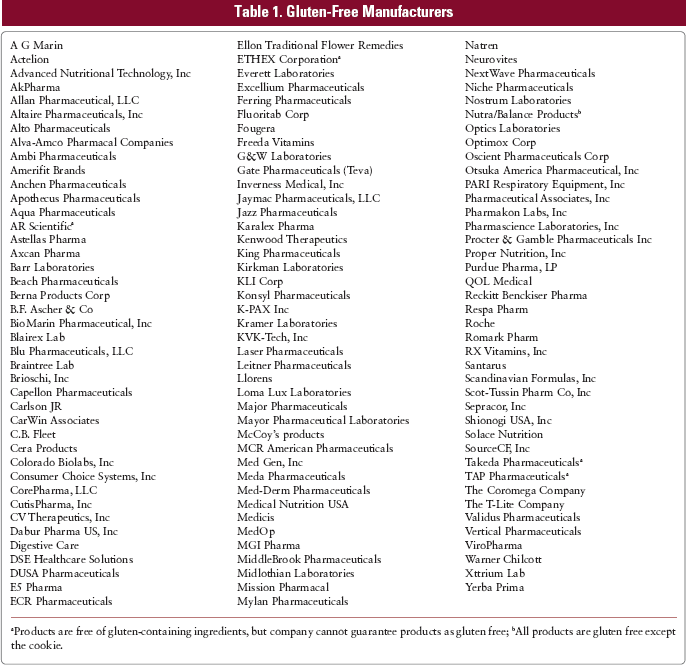
Products are free of gluten-containing ingredients, but company cannot guarantee products as gluten free;
All products are gluten free except the cookie.
Ultimately, because a “good” source does not exist, patients must double-check the content of every medication before ingestion, which can be time consuming depending on the number of medications being taken and the availability of the information. Many patients consult their pharmacists, who may or may not have the time to double-check the content of the medications with the manufacturer. This results in many pharmacists relying on secondary resources or enlisting the aid of a drug information center. Transfer of patients with celiac sprue from community to acute-care settings poses additional safety issues because many institutional health care providers have set formularies that do not consider gluten-free status as primary criteria for selection.
The Web site glutenfreedrugs.com, which is maintained by a clinical pharmacist, is available for health care professionals and patients, but the information should always be double-checked with the manufacturer. 3 Other resources include the Celiac Disease Foundation (www.celiac.org) and the Celiac Sprue Association/United States of America, Inc (www.csaceliacs.org); however, neither of these Web sites provides information about the gluten content of specific medications.
In addition to answering the questions of patients and health care professionals regarding the gluten content of medications, the University of Kansas Drug Information Center has compiled a list of gluten-free manufacturers. The list is a good starting point for practitioners when searching for a gluten-free medication, but as stated previously, double-checking with the manufacturer regarding specific products as inactive ingredients and recognizing that manufacturing processes can change is essential.
The editors of Hospital Pharmacy are interested in how pharmacists currently provide patient care plans for celiac sprue. Share your experiences with Dr. Dennis Cada (