






Abstract

In January 2009, Hospital Pharmacy published an article entitled “ISMP Medication Error Report Analysis” that contained a section on the ‘Risk of Cutting Certain Medication Patches.’ 1 The article highlighted the risk of cutting fentaNYL patches, but also described several delivery systems for transdermal products: reservoir membrane–modulated systems, microreservoir systems, drug-inadhesive layer systems, and matrix systems. Each system offers a unique mechanism for drug delivery; however, these unique mechanisms are often not considered in drug prescribing because typically 1 drug is only available in 1 delivery mechanism. Thus, confusion may arise when 1 type of patch may be cut for dose optimization versus cutting another type will disrupt the control mechanism imposed by the patch. For example, Lidoderm (lidocaine) patches are considered drug-in-adhesive layer systems and can be safely cut to deliver a smaller dose, whereas most fentaNYL patches are considered reservoir membrane–modulated systems and cutting the patch will disrupt the membrane, allowing the entire dose to be available immediately.
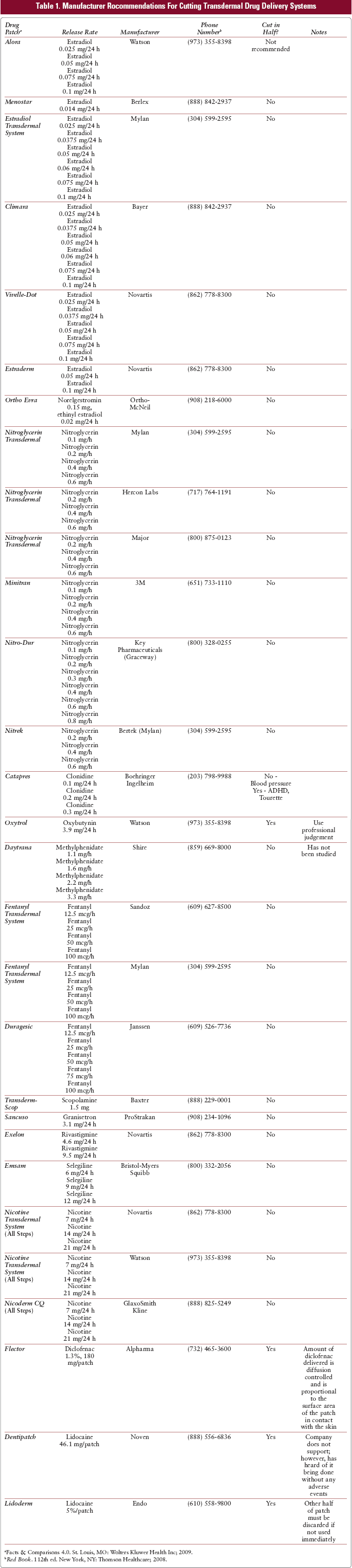
Table 1 summarizes manufacturer information regarding whether a specific patch may be cut, and will be a good resource for practitioners in the optimization of patient care. However, it will be essential for practitioners to always double-check if the product design has been updated.
Manufacturer Rocommendations For Cutting Transdermal Drug Delivery Systems
Facts & Comparisons 4.0. St. Louis, MO: Wolters Kluwer Health Inc; 2009.
Red Book. 112th ed. New York, NY: Thomson Healthcare; 2008.