






Abstract

When a patient's serum creatinine changes and we need to know how to adjust the vancomycin dosage based on this new value of serum creatinine, the method described below can give a quick approximation of the needed dosage change.
For example, a patient in our hospital was on vancomycin 1000 mg every 12 hours. His serum creatinine was 1.0 mg/dL on May 25, 2010, with a measured vancomycin serum level of 8.0 mg/L (a rather low level). The next day, his serum creatinine was measured to be 1.4 mg/dL, and it was time to give him his next dose. Approximately what dosage change could be quickly calculated while waiting for the patient's measured vancomycin serum level?
On May 25, 2010, using Bayesian pharmacokinetics (based on measured level of 8.0 mg/L), we obtained patient's specific parameters to be Vd = 57.209 L, ke = 0.09061193 hours −1 (corresponding to t1/2 = 7.648 hours).
We can use the equation
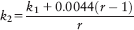
as derived in the note below to calculate the new elimination coefficient.
Let r = (1.4/1.0) = 1.4, and k1 = 0.09061193 hours −1, then k2 = 0.06597995 hours −1 (corresponding to t1/2 = 10.503 hours). Thus, the patient's new specific parameters are now approximately Vd = 57.209 L, ke = 0.06597995 hours −1, and a new dosage could be quickly calculated based on these values.
Just how good an approximation are these specific parameters? After a measured vancomycin serum level came back (value of 19.100 mg/L at 4:15 P.M. on May 26, 2010), using Bayesian pharmacokinetics, we obtained patient's new specific parameters to be Vd = 56.878 L, ke = 0.0621301 hours−1 (corresponding to t1/2 = 11.154 hours), which give a predicting concentration value of 19.099 mg/L; the approximated values above of Vd = 57.209 L, ke = 0.06597995 hours−1, give a predicting concentration value of 18.339 mg/L (relative error = 3.98%).
Here is another example. Another patient in our hospital was also on vancomycin 1000 mg every 12 hours. Her serum creatinine was 1.40 on May 25, 2010, with a measured vancomycin serum level of 11.90 mg/L obtained at 3:00 A.M. Her vancomycin specific parameters calculated from Bayesian pharmacokinetics were Vd = 67.094 L, ke = 0.0556358 hours −1 (corresponding to t1/2 = 12.456 hours). On May 28, 2010, her serum creatinine was measured at 3:45 A.M. to be 1.10. What are her approximate vancomycin specific parameters? What should her dosage be?
Answer: r = (1.1/1.4) = 0.786, k1 = 0.05563584 hours −1, so
At 11:20 A.M., a later time on the same day, May 28, 2010, a vancomycin serum level was measured to be 11.50 mg/L. Using Bayesian pharmacokinetics, this patient's new specific parameters were calculated to be Vd = 66.990 L, ke = 0.0652726 hours −1 (corresponding to t1/2 = 10.617 hours). Thus, a possible dosage could also be 750 mg every 8 hours for the patient's trough level to be between 15 and 20, agreeing with the above approximate dosage. We also note that the approximate values (above) of Vd = 67.094 L, ke = 0.06960925 hours −1 give a predicting concentration value of 10.364 mg/L at 11:20 A.M. on May 28, 2010 (relative error = 9.88%).
Note: Vancomycin half-life can be approximated by

where
Re = 0.00083 (CrCl) + 0.0044
with

where Female = 0.85 if female, Female = 1 if male.
Thus,
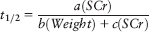
where
a = 0.693

c = 0.0044
ie,

where x is defined to be

And so we have

Let

be the ratio between two serum creatinine values, then
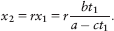
Since

substitute for x2 from the equation above, we have

Since

we have a particular simple equation in approximating ke
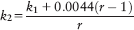
where