





Abstract
Each month, subscribers to The Formulary Monograph Service receive 5 to 6 well-documented monographs on drugs that are newly released or are in late phase 3 trials. The monographs are targeted to Pharmacy & Therapeutics Committees. Subscribers also receive monthly 1-page summary monographs on agents that are useful for agendas and pharmacy/nursing in-services. A comprehensive target drug utilization evaluation/medication use evaluation (DUE/MUE) is also provided each month. With a subscription, the monographs are sent in print and are also available on-line. Monographs can be customized to meet the needs of a facility. Subscribers to The Formulary Monograph Service also receive access to a pharmacy bulletin board, The Formulary Information Exchange (The F.I.X.). All topics pertinent to clinical and hospital pharmacy are discussed on The F.I.X.
Through the cooperation of The Formulary, Hospital Pharmacy publishes selected reviews in this column. For more information about The Formulary Monograph Service or The F.I.X., call The Formulary at 800-322-4349. The June 2011 monograph topics are on ipilimubab, omacetaxine mepesuccinate, insulin degludec, teduglutide, and droxidopa. The DUE/MUE is on gabapentin extended-release.
Generic Name: SPINOSAD 0.9% TOPICAL SUSPENSION
Proprietary Name: Natroba (ParaPRO / Pernix Therapeutics)
Approval Rating: 1S
Therapeutic Class: Pediculocides
Similar Drugs: None
Sound- or Look-Alike Names: None
Indications
Spinosad 0.9% topical suspension is indicated for the topical treatment of head lice infestation in patients 4 years and older. 1 This topical suspension is thought to exhibit both pediculocidal and ovicidal activity. 2
Unlike all other lice therapies, spinosad does not require an extensive lice management program. However, it should be combined with a basic lice management protocol consisting of cleaning recently worn clothes or hats and used bedding and towels in a washer with hot water or having them dry cleaned; cleaning all personal care items (eg, combs, brushes, hair clips) in hot water; and combing the hair with a fine-tooth comb or special nit comb to remove the dead lice and nits.1,3
The various pediculocides approved by the US Food and Drug Administration (FDA) are summarized in Table 1.1,4 Non-pharmacological therapies used to control lice include the use of essential oils, fixed oils, silicone-based fluids, and physical removal of the lice and nits by a specialized comb. 3
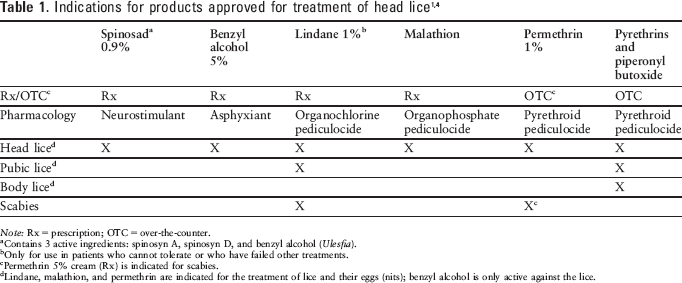
Note: Rx = prescription; OTC = over-the-counter.
Contains 3 active ingredients: spinosyn A, spinosyn D, and benzyl alcohol (Ulesfia).
Only for use in patients who cannot tolerate or who have failed other treatments.
Permethrin 5% cream (Rx) is indicated for scabies.
Lindane, malathion, and permethrin are indicated for the treatment of lice and their eggs (nits); benzyl alcohol is only active against the lice.
Clinical Pharmacology
Spinosad is made by fermenting a soil-derived actinomycetes bacterium, Saccharopolyspora spinosa, to produce a mixture of spinosyn A and spinosyn D.1,5 The commercial spinosad contains spinosyn A and spinosyn D in a 5:1 ratio. 1
Spinosad causes neuronal excitation in the insect. The insect becomes paralyzed and dies after this period of hyperexcitation. 1 It primarily exerts activity against insect nicotinic acetylcholine receptors and secondarily against gamma-aminobutyric–gated chloride channels.6,7 The topical suspension also includes an unspecified quantity of benzyl alcohol, which may contribute to its clinical activity. 1
Cross-resistance has not been observed in pyrethroid-resistant species. In laboratory-based cytotoxicity assays on isolated head lice, the median lethal doses were 1.2 ng per insect with spinosad and 2.4 ng per insect among permethrin-susceptible strains; values ranged from 0.9 to 2.2 ng per insect with spinosad and from 40.2 to 642.6 ng per insect with permethrin among permethrin-resistant strains. 8
Pharmacokinetics
The topical absorption of spinosad was evaluated in 14 children (4 to 15 years of age) with head lice. Spinosad 1.8% topical suspension was applied to the scalp for 10 minutes and was washed off, and then plasma samples were collected. All collected plasma samples had spinosad concentrations below the level of detection (3 ng/mL) using a direct liquid chromatography coupled with tandem mass spectrometry assay method. The concentration of benzyl alcohol in the plasma samples was not determined. 1
Comparative Efficacy
The efficacy and safety of the spinosad 0.9% topical suspension was compared with permethrin 1% and nit-combing in 2 phase 3, multicenter, randomized, investigator-/evaluator-blinded, parallel group studies. The combined studies included 1,038 subjects who were 6 months and older with active head lice infestation. Subjects in a given household who were 6 months or older with 3 or more live lice present on the day of enrollment were included. The primary participants were the youngest members of the household infested with lice, and nonprimary subjects were other members in the household who received the same treatment and were evaluated for all safety parameters. The mean age of treated subjects ranged from 14 to 19 years, and the overall age of participants ranged from 0.5 to 84 years. Approximately 80% of study subjects were girls and women. Spinosad topical suspension was applied to dry hair covering the scalp, left for 10 minutes, and then rinsed; after this, the hair was shampooed. Permethrin was applied according to the product instructions and was followed by shampooing. Subjects were evaluated for head lice at baseline and days 7, 14, and 21. Subjects found to have lice on day 7 were given additional treatment with the same drug. Both studies were 3-arm studies randomized 4:4:1 to receive spinosad 0.9% without nit-combing (243 subjects in study 1 and 203 subjects in study 2), permethrin 1% with nit-combing (256 subjects in study 1 and 214 subjects in study 2), or spinosad with nit-combing (59 subjects in study 1 and 63 subjects in study 2). The primary efficacy endpoint was the proportion of primary participants free of lice (no live lice, adults, or nymphs) as assessed by the trained evaluator 14 days after the last treatment. In the first study, 84.6% of spinosad-treated participants compared with 44.9% of participants who underwent permethrin with nit-combing treatment were free of lice (number needed to treat [NNT], 2.5; P < .01). In the second study group, 86.7% of participants in the spinosad arm compared with 42.9% participants in the permethrin arm achieved complete lice removal (NNT, 2.2; P < .01). The secondary outcome of the studies was the proportion of all patients in a household that required 1 or 2 treatments for complete lice removal. The proportion of all patients requiring only 1 treatment with spinosad without nit-combing was approximately 25% higher than that of permethrin with nit-combing. The results of these 2 studies were pooled for the safety evaluation. Application-site erythema was observed in 6.8% of patients in the permethrin arm compared with 3.1% in the spinosad arm (P =.007). The rates of ocular hyperemia and application-site irritation were not significantly different in the 2 treatment arms.1,2
Contraindications, Warnings, and Precautions
The contraindications, warnings, and precautions for the FDA-approved products available for the treatment of head lice are compared in Table 2.
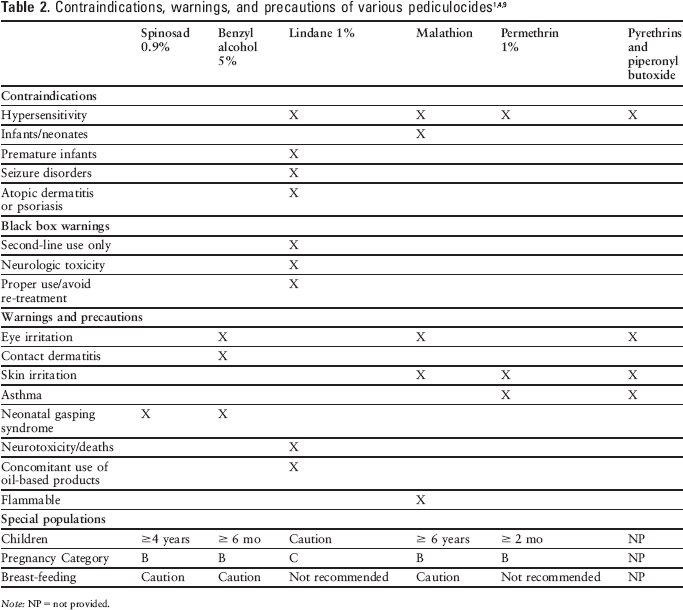
Note: NP = not provided.
Contraindications
The prescribing information lists no contraindications but advises against the use of spinosad in children younger than 6 months because the product contains benzyl alcohol. 1
Warnings and Precautions
Intravenous administration of benzyl alcohol–containing products has been associated with neonatal gasping syndrome. The syndrome consists of severe metabolic acidosis, gasping respirations, progressive hypotension, seizures, central nervous system (CNS) depression, intraventricular hemorrhage, and death in preterm, low–birth weight infants. Neonates may be at risk for gasping syndrome if they are treated with benzyl alcohol–containing products. The amount of systematic exposure to benzyl alcohol from the proper use of spinosad suspension will be at a level substantially lower than that reported in association with gasping syndrome; however, the minimum amount of benzyl alcohol required to produce this toxicity is unknown.1,9
Eye irritation may occur if there is eye exposure. Patients should be advised to avoid exposure to the eyes. Advise patients to flush eyes immediately with water if the suspension comes into contact with the eyes. 1
Safety in children younger than 4 years has not been established. Use is not recommended in patients younger than 6 months because of the potential for increased systemic absorption as a result of the high ratio of skin surface area to body mass and the potential for an immature skin barrier. 1
Natroba use during pregnancy is classified as Pregnancy Category B. There are no studies in pregnant women, and animal reproductive studies did not reveal teratogenicity. Teratogenic effects were not observed at any of the tested dosages; maternal toxicity only occurred in animals given oral dosages of 50 to 200 mg/kg/day. 1
Women should use caution if they plan to use spinosad during breast-feeding. Although spinosad is not systemically absorbed and should not be present in human milk, the benzyl alcohol in the formulation may be absorbed and excreted in the milk. Breastfeeding women should discard breast milk for 8 hours (5 half-lives of benzyl alcohol) after use to avoid accidental ingestion of benzyl alcohol by the infant. 1
Adverse Reactions
The most common adverse reactions (occurring in at least 1% of participants with spinosad and permethrin) have included ocular erythema, application-site irritation, and application-site erythema. 1 The incidences of adverse reactions reported in the clinical studies are summarized in Table 3. Other less frequently occurring adverse reactions have included application-site dryness, application-site excoriation, alopecia, and dry skin. 1
Common adverse reactions reported in the spinosad versus permethrin clinical trials for the treatment of pediculosis capitis 1

Drug Interactions
Drug interaction studies have not been conducted with spinosad. 1
Recommended Monitoring
Patients should be monitored for treatment response. The hair should be examined for live lice periodically after a course of treatment.
Dosing
Spinosad topical suspension should be applied to dry scalp and hair. Only the amount of product necessary to cover the scalp and hair should be applied. Enough suspension should be applied to first completely cover the scalp, then should be worked toward the ends of the hair while avoiding contact with the face and eyes. Depending on hair length, up to 120 mL (1 bottle) may be required to adequately cover the hair. The suspension should be left on the hair and scalp for 10 minutes and then rinsed off with warm water. Treatment should be repeated in 7 days if live lice are observed. 1
Product Availability and Storage
Spinosad 0.9% topical suspension received FDA approval on January 18, 2011. 10 It is a light orange, opaque, viscous liquid suspension containing water, isopropyl alcohol, benzyl alcohol, hexylene glycol, propylene glycol, cetearyl alcohol, stearalkonium chloride, ceteareth-20, hydroxyethyl cellulose, butylated hydroxytoluene, and FD&C Yellow #6.
Spinosad 0.9% topical suspension is supplied in 4-ounce (120 mL) high-density polyethylene bottles. These bottles should be stored at room temperature (25°C [77°F]), with excursions permitted between 15° and 30°C (59° and 86°F). The bottles should be kept out of the reach of children. 1
Conclusion
Spinosad offers an alternative to traditional pediculocides and has a unique mechanism of action. Use with a nit comb is not required because of its ovicidal and pediculicidal activity; however, a nit comb can be useful to remove dead nits and lice after spinosad treatment. Use of a pediculocide management program along with spinosad will provide effective removal of lice in most patients. Spinosad was more effective than permethrin but has not been compared with other pediculocide treatments (eg, benzyl alcohol lotion, malathion).