







Abstract
Background
There is a paucity of data comparing practice patterns between board-certified specialists with added qualifications in cardiology (AQCV) and cardiovascular pharmacists without these credentials.
Purpose
The purpose is to characterize differences in practice between inpatient pharmacists with and without AQCV.
Methods
We conducted a multicenter, retrospective, cross-sectional, case-controlled survey. An AQCV pharmacist list was extracted from the Board of Pharmacy Specialties Web site. Hospitals with AQCV pharmacists comprised the case group. Hospitals were excluded if the AQCV pharmacists did not provide direct patient care, practiced in the outpatient setting, or were in a Veterans Affairs hospital. Each case hospital was matched to hospitals without an AQCV pharmacist in a 1:3 ratio (case:control) by region, cardiovascular discharges, and teaching hospital status. Institutions completed a survey characterizing their pharmacy services.
Results
Fifty-six hospitals completed the survey (21 AQCV, 35 non-AQCV). More AQCV pharmacists participated on rounds (100% vs 82.9%, P = .04) and devoted more time performing administrative tasks (20.5% ± 15.3% vs 11.1% ± 8.1%, P = .001) than non-AQCV pharmacists. Conversely, AQCV pharmacists spent less time providing clinical care (52.4% ± 14.5% vs 66.2% ± 19.8%, P = .007), were less involved with drug protocol management (71.4% vs 91.4%, P = .05), and performed less order verification than non-AQCV pharmacists.
Conclusions
Practice patterns differ between inpatient pharmacists with and without AQCV. Further research is needed to determine whether AQCV credentialing improves patient outcomes and to delineate what specific tasks performed by inpatient cardiology pharmacists may improve patient outcomes.
Many national pharmacy organizations currently endorse pharmacist specialization credentialing, similar to credentialing in other health professions, in order to meet the vision for the future of pharmacy practice and improve patient care.1–8 The American College of Clinical Pharmacy (ACCP) anticipates that the recognition of specialized pharmacists’ knowledge and skill will be important and advocates that all clinical pharmacists engaged in patient care be board certified.5,9 In addition, the American Society of Health-System Pharmacists (ASHP) requires residency program directors of postgraduate year 2 (PGY-2) programs to be board certified, if board certification is available, in order to achieve accreditation. 8
Current pharmacist credentialing is optional for pharmacists and is done primarily through the Board of Pharmacy Specialties (BPS). In addition to the 6 specialty areas of board certification (nuclear pharmacy [BCNP], pharmacotherapy [BCPS], nutrition support pharmacy [BCNSP], psychiatric pharmacy [BCPP], oncology pharmacy [BCOP], and ambulatory care pharmacy [BCACP]), BPS also designates “added qualifications” to BCPS pharmacists with “enhanced” training and experience within a specialty area, currently cardiology (AQCV) and infectious diseases (AQID). 3
To obtain AQCV, BCPS pharmacists complete an application and submit a portfolio, similar to a curriculum vitae, with enhanced focus on cardiology activities. All submitted portfolios are reviewed by a portfolio review committee and assessed for whether the 5 required areas have been achieved. An examination is not taken for added qualifications certification. Recertification occurs every 7 years by the submission of an updated portfolio.
There is a significant cost to the pharmacist associated with the credentialing process. 3 The initial application fee is $600 for first-time pharmacotherapy applicants. An annual certification maintenance fee of $100 is required to remain within good standing with BPS and recertification is required every 7 years at a cost of $400 by examination or BPSapproved continuing education materials. For AQCV, the initial application fee is an additional $100 with a recertification fee of $50 during renewal years. Additional costs that may also be incurred include the Pharmacotherapy Self-Assessment Program (PSAP) series for continuing education credits, the Pharmacotherapy Preparatory Course offered annually, and any travel expenses to and from the testing site.
Although pharmacy credentialing is strongly advocated by the pharmacy profession, there is a paucity of data demonstrating that board certification, including the AQCV distinction, improves patient outcomes. Critics of the board certification movement question whether the benefits justify the expenses incurred. It is assumed that credentialed pharmacists provide better patient care than noncredentialed pharmacists. However, this hypothesis has not been tested. The purpose of this study is to determine whether differences in practice exist between inpatient cardiology pharmacists with AQCV and inpatient cardiology pharmacists without the AQCV distinction.
Methods
This is a multicenter, retrospective, cross-sectional, case-controlled survey. A list of BCPS AQCV pharmacists was derived from publically available data on the BPS Web site in July 2011 for inclusion in the study ( Flowchart for inclusion and exclusion of board-certified pharmacotherapy specialists with added qualifications in cardiology (AQCV) hospitals (cases) and their matches (controls). COTH = Council of Teaching Hospitals.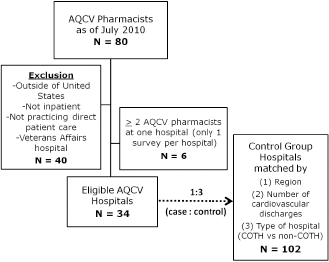
A survey was sent to all eligible AQCV pharmacists as well as directors of pharmacy at all matched hospitals. For hospitals with 2 or more AQCV pharmacists, the survey was only sent to one individual as the sole representative of that hospital. Survey questions addressed current practices of pharmacists providing direct care to patients in the medical cardiology area and the level of pharmacist involvement in the area of cardiology including medication policy and procedures. (Full survey questions can be found in the
Results
Baseline characteristics of hospitals with AQCV credentialed inpatient cardiology pharmacists compared to non-AQCV inpatient cardiology pharmacists
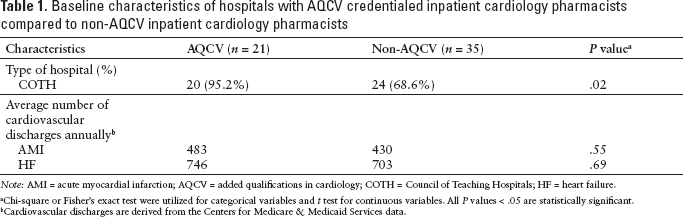
Note: AMI = acute myocardial infarction; AQCV = added qualifications in cardiology; COTH = Council of Teaching Hospitals; HF = heart failure.
Chi-square or Fisher's exact test were utilized for categorical variables and t test for continuous variables. All P values < .05 are statistically significant.
Cardiovascular discharges are derived from the Centers for Medicare & Medicaid Services data.
Differences in practice between AQCV credentialed inpatient cardiology pharmacists compared to non-AQCV inpatient cardiology pharmacists
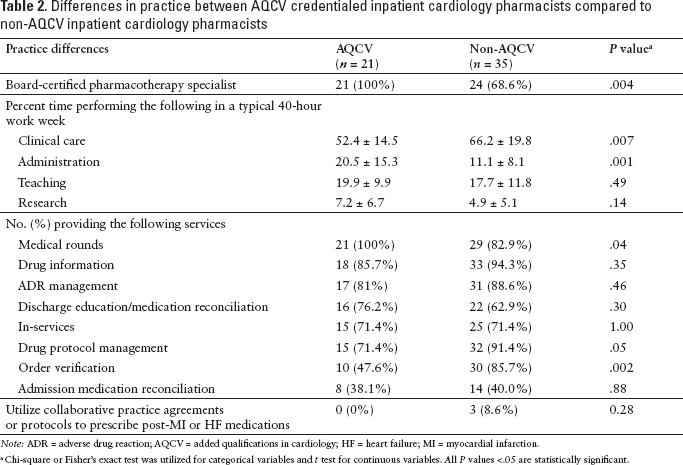
Note: ADR = adverse drug reaction; AQCV = added qualifications in cardiology; HF = heart failure; MI = myocardial infarction.
Chi-square or Fisher's exact test was utilized for categorical variables and t test for continuous variables. All P values .05 are statistically significant.
Differences in practice between AQCV credentialed inpatient cardiology pharmacists compared to a subgroup of non-AQCV inpatient cardiology pharmacists with BCPS

Note: ADR = adverse drug reaction; AQCV = added qualifications in cardiology; BCPS = Board-Certified Pharmacotherapy Specialist; HF = heart failure; MI = myocardial infarction.
Chi-square or Fisher's exact test was utilized for categorical variables and t test for continuous variables. All P values .05 are statistically significant.
Discussion
This is the first study, to our knowledge, to demonstrate that practice patterns differ among credentialed and noncredentialed inpatient cardiology pharmacists. Differences in practice patterns were seen between AQCV and non-AQCV pharmacists in time spent in administrative and clinical tasks as well as performing order verification. These differences remained after comparing a subgroup of the non-AQCV pharmacists with BCPS to AQCV pharmacists.
Despite the advanced training and experience that is required to attain AQCV certification, we were somewhat surprised by the observation that inpatient AQCV pharmacists spend less time on direct patient care and more time performing administrative tasks compared to non-AQCV pharmacists. However, there may be plausible reasons for this observation. First, given the advanced training and experience of AQCV pharmacists, their role on hospital committees related to cardiovascular disease (eg, quality improvement committees, P&T, etc) may be more prominent and diminish the time spent on direct patient care. Second, because significantly more AQCV pharmacists practiced in teaching hospitals, they may be more likely to be involved in academic committees (eg, colleges of pharmacy or medicine) than cardiology pharmacists without AQCV. Third, AQCV pharmacists, by nature of both their training and affiliation with teaching institutions, may be more likely to participate in postdoctoral training of clinical pharmacists (eg, residency and/ or fellowship training). Not only would participation in these training programs increase administrative responsibilities (eg, serving as residency program director, completing performance evaluations, etc), but it would also increase involvement in “clinical teaching.” In this way, AQCV pharmacists may utilize their postdoctoral trainees to maintain their clinical contact while allowing time for administrative tasks. Finally, although there were no statistically significant differences observed between the 2 groups with respect to either teaching or research, AQCV pharmacists spend slightly more time participating in both teaching and research than non-AQCV pharmacists (27.1% vs 22.6%, respectively).
Similar to pharmacy credentialing, board certification for physicians is voluntary. However, in contrast to the pharmacy profession where a minority of clinical pharmacists are board certified, approximately 85% of all licensed physicians, nearly 800,000, are board certified through one of the 24 member boards (specialty and subspecialty areas) that make up the American Board of Medical Specialties (ABMS). 2 Existing data suggest that board-certified cardiologists perform better on process of care measures compared to credentialed general practitioners, but these improvements did not lead to improved clinical outcomes. 10 Unlike the pharmacy profession, many medical centers and insurance companies may require physicians and other practitioners to be credentialed in order to obtain practice privileges or bill for clinical and cognitive services rendered. Consequently, the majority of these practitioners voluntarily become credentialed. If data emerge demonstrating that credentialed pharmacists improve patient care, perhaps credentialing will become a requirement to practice clinical pharmacy and also open the door to reimbursement for clinical pharmacy services. That will likely lead to higher uptake of the credentialing process by clinical pharmacists.
In a survey of directors of pharmacy at academic institutions and nonacademic institutions in the University HealthSystem Consortium and Pharmacy Systems, Inc databases, academic institutions were found to have significantly more board-certified pharmacists as compared to nonacademic institutions (26% vs 6%, P < .001, respectively). 11 This was attributed to having incentives in place (94% vs 29%, P < .001) and a higher perceived value of board certification at academic institutions versus nonacademic institutions (odds ratio, 7.87; 95% CI, 1.18-52.5; P = .033), respectively. The perceived value of pharmacist board certification on an institutional and administrative level was evaluated using a 5-point Likert scale with 1 being very low value and 5 being high value. In a multivariable logistic regression model, the perceived value of board certification was found to be a strong predictor of the number of board-certified pharmacists and the availability of incentives, both reimbursement type and professional advancement type. Our results reflect these findings in that a statistically greater percentage of the AQCV group is employed by academic institutions compared to non-AQCV pharmacists. There may be a greater likelihood of academic institutions to promote pharmacist credentialing and attract board-certified pharmacists through incentives; however, our study did not specifically ascertain whether incentive programs exist at the institutions surveyed.
Compared to a 2006 national survey of non-VA hospitals, the provision of clinical pharmacy services by hospitals participating in our survey was similar to or exceeded the national average. 12 More cardiology clinical pharmacists at hospitals participating in our survey appeared to provide drug information and participated in medical rounds than the national average. 12 This could be representative of the increasing number of clinical pharmacy services being implemented and conducted at all hospitals across the United States over time, or this may show that both our AQCV and control hospitals have a high incidence of clinical pharmacy services compared to the entire US non-VA hospital cohort.
Despite the support for certification, there continues to be a lack of outcomes data explicitly linked to board-certified pharmacists. Previous research correlates clinical pharmacy services with decreased mortality; however, it is not known whether board-certified pharmacists improve patient outcomes.13–16 For AQCV pharmacists in particular, the requirements to obtain certification are specifically outlined and necessitate achievements in patient care, research, education, and advancement of the profession. Pharmacists meeting these requirements and achieving subsequent credentialing arguably display strong individual attributes as pharmacy practitioners. These attributes, however, may not be utilized in practice depending on the hospital environment, pharmacy workflow, and vision of a pharmacist's role at each respective hospital. For example, order verification is not one of the 5 core clinical pharmacy services associated with favorable health outcomes, yet approximately one-half of AQCV pharmacists who responded to this survey routinely perform this task. 17 In contrast, medication history taking/reconciliation and collaborative practice agreements are among the core clinical pharmacy services but were performed by a minority of respondents to this survey. Further research is needed to determine whether these differences in practice between AQCV and non-AQCV pharmacists result in differences in patient care and health outcomes.
Limitations
This study has the limitations of a survey design. Responses were assumed to be truthful and representative of the hospital practices in the medical cardiology area. It was also assumed the respondents understood the questions asked. The analysis is based on a 41.2% response rate with a higher relative response rate from AQCV than non-AQCV hospitals, thus there is the possibility of nonresponse bias. We attempted to account for this by sending a reminder e-mail 2 weeks after the initial survey. The differences seen in administrative functions could be a function of selection bias. Again, we attempted to account for this by controlling hospital characteristics; however, individual characteristics could not be precisely matched.
Conclusion
Differences exist between AQCV and non-AQCV pharmacists working in the medical cardiology area in terms of practice patterns, and this may play a role in patient outcomes. Further research should focus on determining whether AQCV improves patient outcomes and delineate what specific tasks performed by pharmacists improve outcomes in inpatient medical cardiology patients.
Footnotes
Acknowledgments
The authors have no conflicts of interest.