







Abstract
BACKGROUND:
Over-the-counter (OTC) medication packages are important sources of information for consumers during product selection and use. Consumers may not be able to access information from OTC packages if external tags, namely price or anti-theft tags, are improperly placed.
OBJECTIVE:
To determine the amount and type of information concealed by anti-theft tags and price tags affixed on OTC drug packages.
METHODS:
A field study was performed by evaluating packages containing acetaminophen and combinations of acetaminophen in stores located in Houston. Five packages for 4 products selected from each store after an initial survey for presence of an external tag were examined. A data collection sheet was prepared that extracted the type and amount of information concealed by these tags. Data were analyzed by performing descriptive analyses to provide an understanding of the information obscured.
RESULTS:
A total of 24 stores were considered in the study, and 67 products and 285 packages were evaluated. External tags, both anti-theft and price tags, obscured significant amounts of information on the principal display panel (53.4%) and the Drug Facts panel (47.7%) of OTC packages. These tags concealed crucial information on various aspects of labels such as brand names (42.3%), product description (36.3%), warnings (51.5%), uses (10.4%), and purposes (7.2%).
CONCLUSIONS:
Results suggest that improper use of external tags clearly obscured important information on OTC medication packages necessary for consumers to make informed decisions regarding product selection and use. Tagging practices should be altered to allow consumers full access to drug information on the product.
Over-the-counter (OTC) drugs have gained popularity in the past few years due to increased emphasis on self-care and self-medication practices among consumers. 1 More than 100 000 OTC medications are currently available in the marketplace with around 1000 active ingredients. 2 It is estimated that 40% of Americans use at least one OTC product within every 48 hours.1,3 Overall, Americans utilize approximately 5 billion OTC products annually. 3 Consumers should have adequate knowledge regarding product information to make appropriate selection.
The OTC drug package is usually the most important source of information available for consumers while making a product selection.4,5 Obstruction of vital information on the package would create problems for consumers during product selection and future use.
Use of External Tags
External tags affixed on OTC drug packages mainly include anti-theft tags and price tags. Electronic article surveillance (EAS), or anti-theft tags, is widely used by drugstores, supermarkets, and grocery stores to stop drug diversion and counterfeiting. Anti-theft tags activate alarm systems in case of theft. Employee theft and consumer shoplifting is of great concern for all retailers. These 2 reasons account for the majority (77%) of merchandise losses 6 and cost $33.2 billion annually to the retail industry. 7 It is reported that OTC products are the most frequently shoplifted items from drugstores and supermarkets.7,8 Thus, use of anti-theft tags is prevalent in drugstores.8,9
Price tags help consumers compare different products, as well as provide information on pricing discounts. In addition, item pricing is mandatory by law in only 4 states: California, Massachusetts, Michigan, and Rhode Island. 10 The law requires the price of each item including OTC medications to be clearly and conspicuously exhibited in all retail outlets in these states. At times, multiple price tags are used to advertise any change in price due to sales, clearances, or discounts; this further increases the possibility of obscuring information on OTC packages.
FDA Guidelines
Because OTC medications can be purchased from any retail outlet, patients may not receive guidance from healthcare practitioners regarding product use. The Food and Drug Administration (FDA) has reported that improper use of OTC medications leads to numerous hospitalizations every year. 2 Therefore, to improve readability of labels and promote safe use of OTC drugs, the FDA announced guidelines titled “Over the Counter Human Drugs: Labeling Requirements” in March 1999 that mandated certain information on OTC medication labels, such as product ingredients, uses, warnings, and directions, to be clearly visible. The FDA expects this information, called the Drug Facts panel, to be provided in a format that has better readability, with increased print size for all OTC products.
Drug Misuse
Acetaminophen is the highest selling OTC analgesic— used by millions of consumers annually. Misuse or prolonged use of acetaminophen is responsible for around 100 deaths and 2000 hospitalizations every year due to hepatotoxicity. 11 In addition, acetaminophen can cause liver damage when used concomitantly with alcohol. 12 The FDA's recent campaign highlighted that excessive use of acetaminophen can cause liver damage. 13 The FDA requires a consistent, universal alcohol warning on all OTC analgesic packages to be clearly legible so that consumers are aware of the increased risk for liver toxicity. 14 Consumers may not be able to make informed purchase decisions if such information on the packages is obscured by external tags. The objective of this study was to evaluate the amount and type of information obscured by external tags, both price and anti-theft, on currently available OTC medication packages containing acetaminophen.
Methods
STUDY DESIGN
A field study design was used by performing content analysis to evaluate the information obscured by external tags on OTC drug packages currently marketed in the Houston metropolitan region. The study was conducted at 24 stores selected using a stratified random sampling technique to include various types of stores. Stores were selected randomly using information printed in the telephone book yellow pages, which included national chain drugstores (6), local independent drug stores (12), supermarkets (3), and grocery stores (3). Data collection was preceded with consent from store managers or pharmacists on duty. An initial survey was conducted in each store to determine the presence of an external tag on OTC medication labels. Stores that did not use external tags (3 chain pharmacies, 4 supermarkets) or used external tags but refused to provide informed consent (7 chain pharmacies, 17 supermarkets, 1 independent drugstore) were excluded from the study.
DATA COLLECTION
Procedure
Only products from the analgesic section of each store containing acetaminophen and/or combination of acetaminophen were considered in this study. An initial data collection survey was developed to obtain information such as product name, product strength, product count, presence of external tags, and type of tag.
Packages selected for this study were based on a certain priority. First priority was given to packages that had both price and anti-theft tags affixed, followed by the presence of only anti-theft tags and only price tags. If >4 products fulfilled the first criteria, then 4 were selected randomly. The first 5 packages of each of these products were considered for further data collection.
Instrument
Data collection sheets were developed to report information such as product description, package dimensions, package orientation, number of principal display panels (PDPs), type and number of tags, their location, and amount and type of information obscured by these tags. The type of information concealed by these tags was further categorized into 3 main sections of the package such as information on the PDP, Drug Facts panel, and non-drug facts. Codes were developed for the type of information obscured in each of these categories. Data were coded as completely obscured or partially obscured depending upon the amount of information blocked by tags. If a section of the information was obscured, but not completely covered, it was indicated as partially obscured. In addition, a digital picture indicating tag location was taken for each package. Data were collected during November and December 2002.
DATA ANALYSIS
Data collected were coded and analyzed using SAS statistical package (version 8.2) to report descriptive analyses regarding the quality and quantity of information obscured by external tags. Frequency analysis was performed to determine the percent distribution of the type of tags, their location, and the amount of information obscured.
Results
A total of 67 products and 285 packages were evaluated for presence of external tags. Data were collected from 24 stores for a response rate of 42.8%. There were more anti-theft tags (n = 175, 61.4%) compared with price tags (n = 110, 38.6%). None of the packages had multiple tags. The survey investigated placement of the tag on the surface of the package and was classified as front, side (left), side (right), top, bottom, and back. It was observed that anti-theft tags were predominantly present on the right side of the packages, while price tags were on the top (Figure 1).
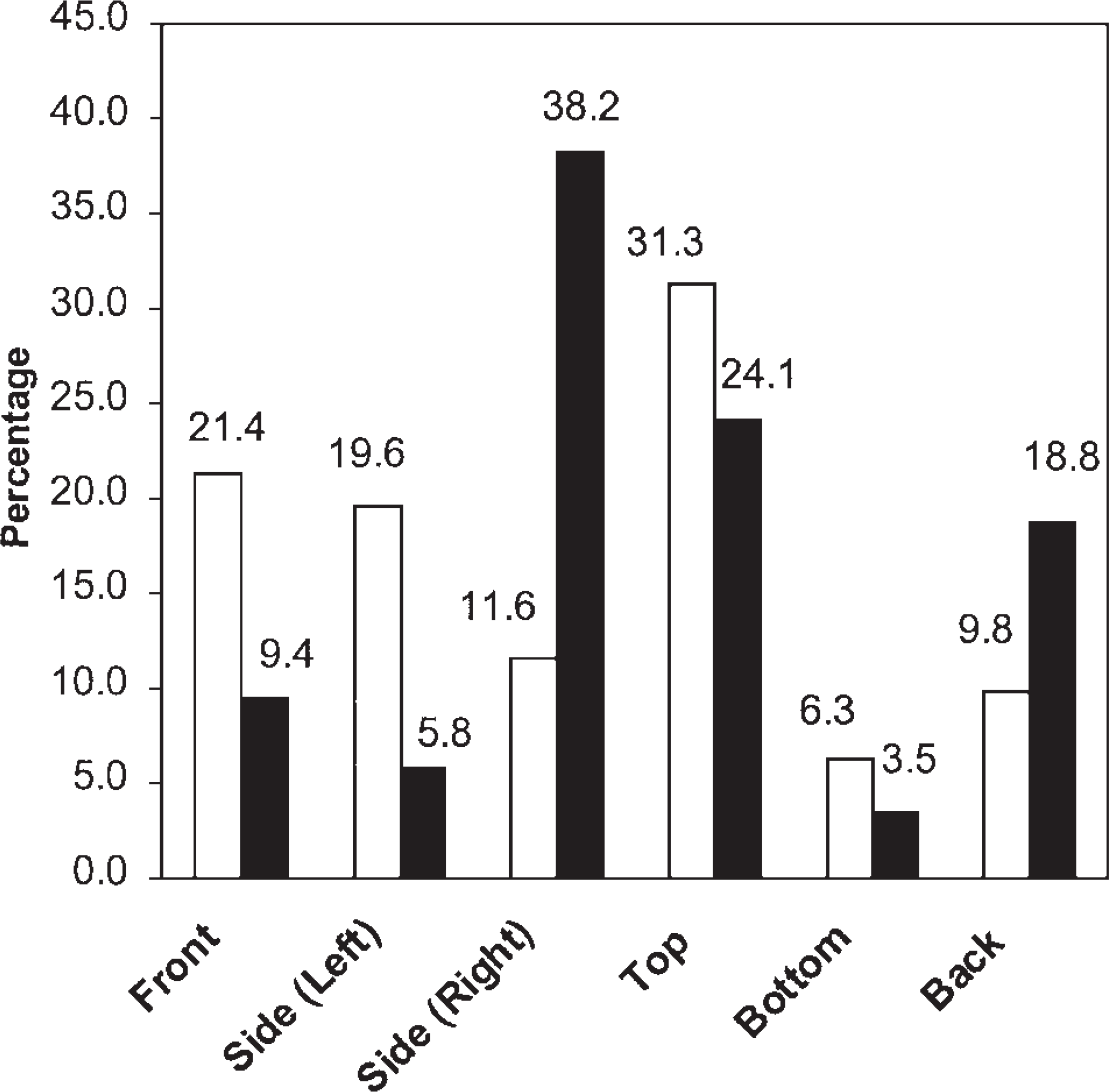
Location and placement of anti-theft and price tags on over-the-counter medication packages. □ = Price tags (%); ▪ = Anti-theft tags (%).
Most of the packages (92%) had ≥2 principal display panels with identical information. This is important since information blocked by external tags on one PDP could be viewed on another PDP. It should be noted that information on the Drug Facts panel is not repeated on packages, as is the information seen on multiple PDPs.
INFORMATION OBSCURED
Examples of external tags obscuring and concealing information on OTC medication labels can be seen in Figure 2. Detailed information regarding specific information concealed by external tags, either partially or completely, as coded in this study, can be viewed in Table 1. Some tags obscured multiple sections either partially or completely. In general, external tags obscured information on the PDP such as brand name (42.3%), product description (36.3%), product count (18.8%), and warnings (15.2%).
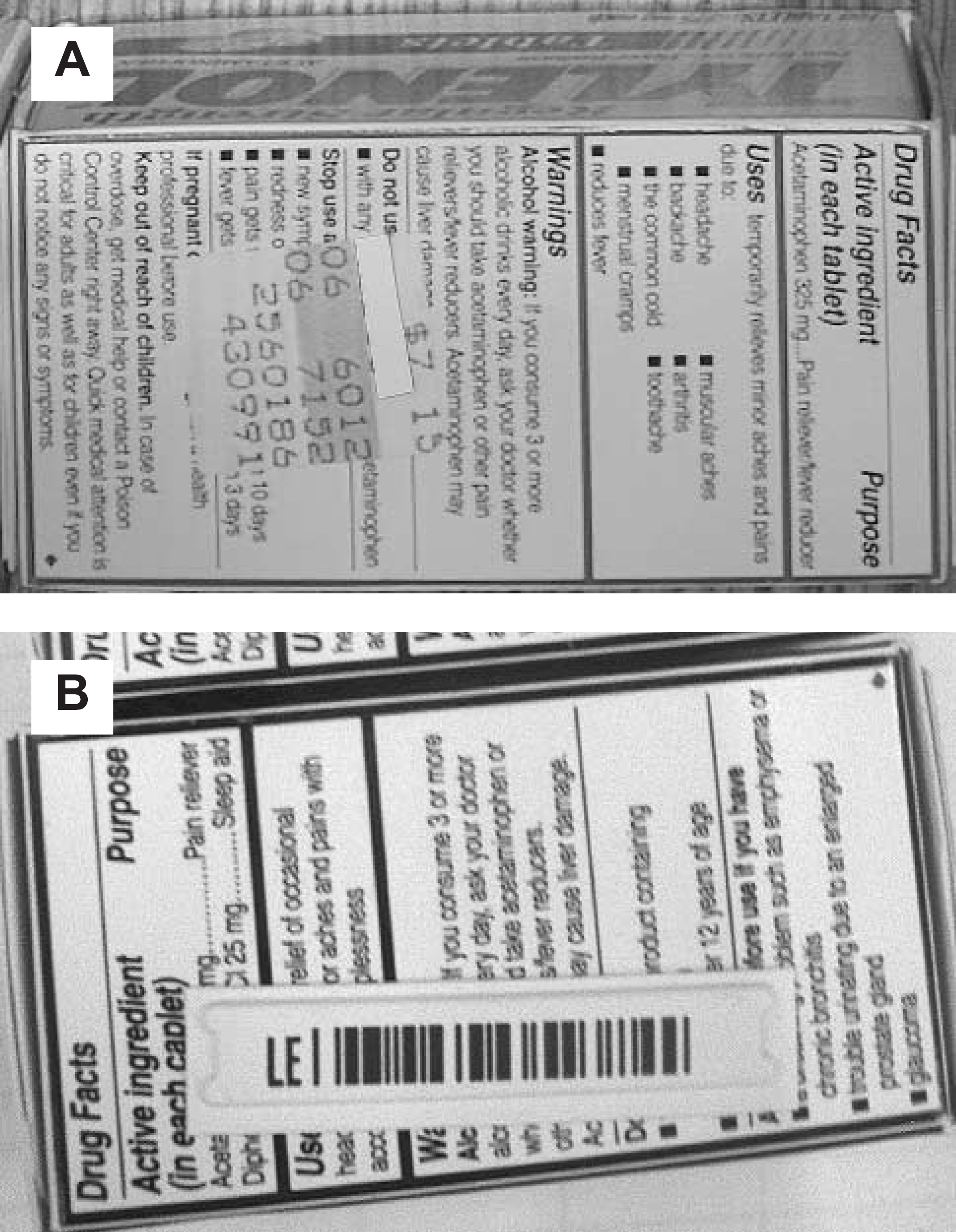
Examples of information obscured by price (A) and anti-theft (B) external tags.
Amount and Type of Information Concealed by External Tags on OTC Medication Packages
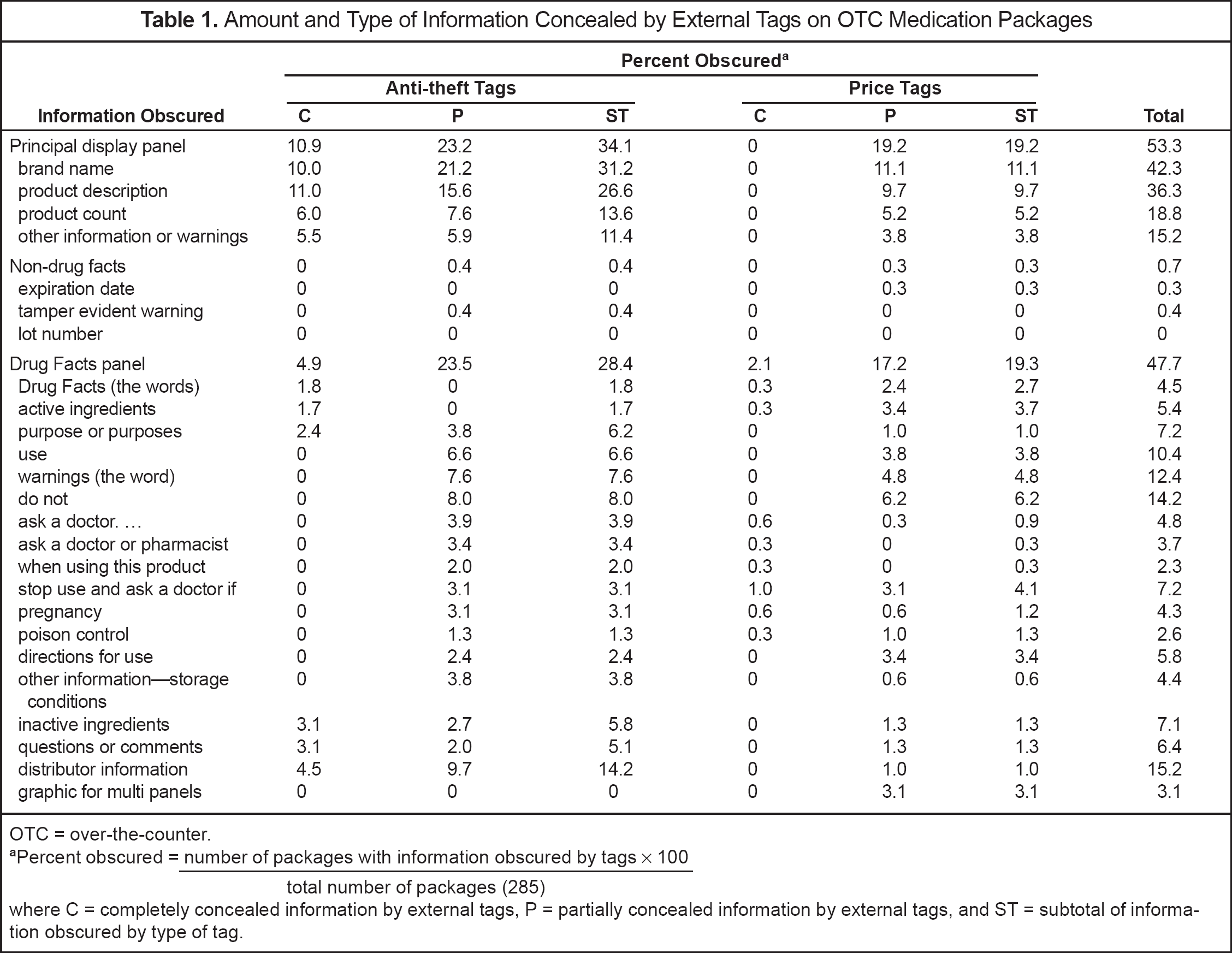
OTC = over-the-counter.

where C = completely concealed information by external tags, P = partially concealed information by external tags, and ST = subtotal of information obscured by type of tag.
Information obscured on the Drug Facts panel can be viewed in Table 1. Approximately 48% of the packages had information on the Drug Facts panel obscured by external tags. Many packages had various types of information in the warnings section of the Drug Facts panel (51.5%) obscured by external tags (Table 1).
Anti-theft tags concealed slightly more vital information, especially on the Drug Facts panel compared with price tags (Table 1). This may be attributed to the size as well as placement of anti-theft tags. The tags were mostly present on the side and back of the package where information on the Drug Facts panel is predominantly represented. In addition, the likelihood that a certain type of information would be completely obscured was higher with anti-theft tags than price tags due to the size of anti-theft tags. Greater numbers of the packages had information on the PDP obscured by anti-theft tags than by the price tags. Similarly, packages had more information on the Drug Facts panel obscured by anti-theft tags than by price tags.
Discussion
We found that anti-theft tags and price tags obscure relevant information necessary for consumers to make informed product purchase decisions. The practice of using anti-theft tags was quite profuse with respect to OTC drug packages. These results should be evaluated keeping in mind certain issues and concerns pertaining to compliance with the FDA OTC labeling guidelines, protection of consumers' rights, and overall malpractice with respect to tagging practices for OTC medication packages.
POLICY ISSUES
According to the FDA guidelines, information on OTC medication labels should be easy to read and understand for consumers without any impediment. By obscuring relevant information required by the FDA on the Drug Facts panel, one may be violating FDA guidelines. 2 Our study revealed that some stores used price tags to advertise their discounts. These stores may obscure a significant amount of federally mandated information on OTC medication packages. Although not obligatory in Texas, other states, such as California, Massachusetts, Michigan, and Rhode Island, require item pricing for OTC packages. 10 The magnitude of information obscured by tags in such states may be much higher. These state laws, by their requirements, may be indirectly contradicting FDA guidelines and should consider revising their laws by providing exemption for special commodities such as OTC medications with respect to item pricing. An option for the retail industry could be to provide barcode scanners along shopping aisles for consumers to easily access the latest pricing information. 15
Our study indicated that improper use of external tags predominantly concealed information on the Drug Facts panel such as warnings, purposes, and directions for use. Lack of information on OTC drugs can result in adverse drug events and nonadherence to drug therapy. 2 Safe use of OTC products may be at risk if consumers do not have access to information on warnings obscured due to external tags. The FDA, being a regulatory body for structuring the format of OTC medication labels, should incorporate a supplementary clause in their OTC labeling guidelines regarding placement of external tags. A specific area around the bar code could be designated for such tags or the FDA may consider the possibility of restricting the use of multiple PDPs, thus allocating the residual space to enhance OTC label readability.
MANUFACTURER AND RETAILER ISSUES
Manufacturers and retailers affix anti-theft tags on OTC medication packages to protect their products from employee theft and customer shoplifting. Generally, these tags can be placed during manufacturing, distribution phase, and/or at the store level. When anti-theft tags are inserted or imbedded inside packages during manufacturing or packaging stages, the process is termed source tagging. 8 Such practices could prevent concealing product information and at the same time serve as a useful device to reduce theft. Anti-theft tags should be placed inside the package if the product has a secondary package; however, if it is a primary package, manufacturers can use technology to affix anti-theft tags under the label (Figure 3). This latter suggestion may require additional costs. However, such costs may compensate for the benefits of using these tags efficiently not only as anti-theft devices, but also for inventory control and understanding consumer purchase behavior. One can also use advanced technology to develop new systems to improve theft identification by developing smaller anti-theft tags or anti-theft tags that are coupled with bar codes.
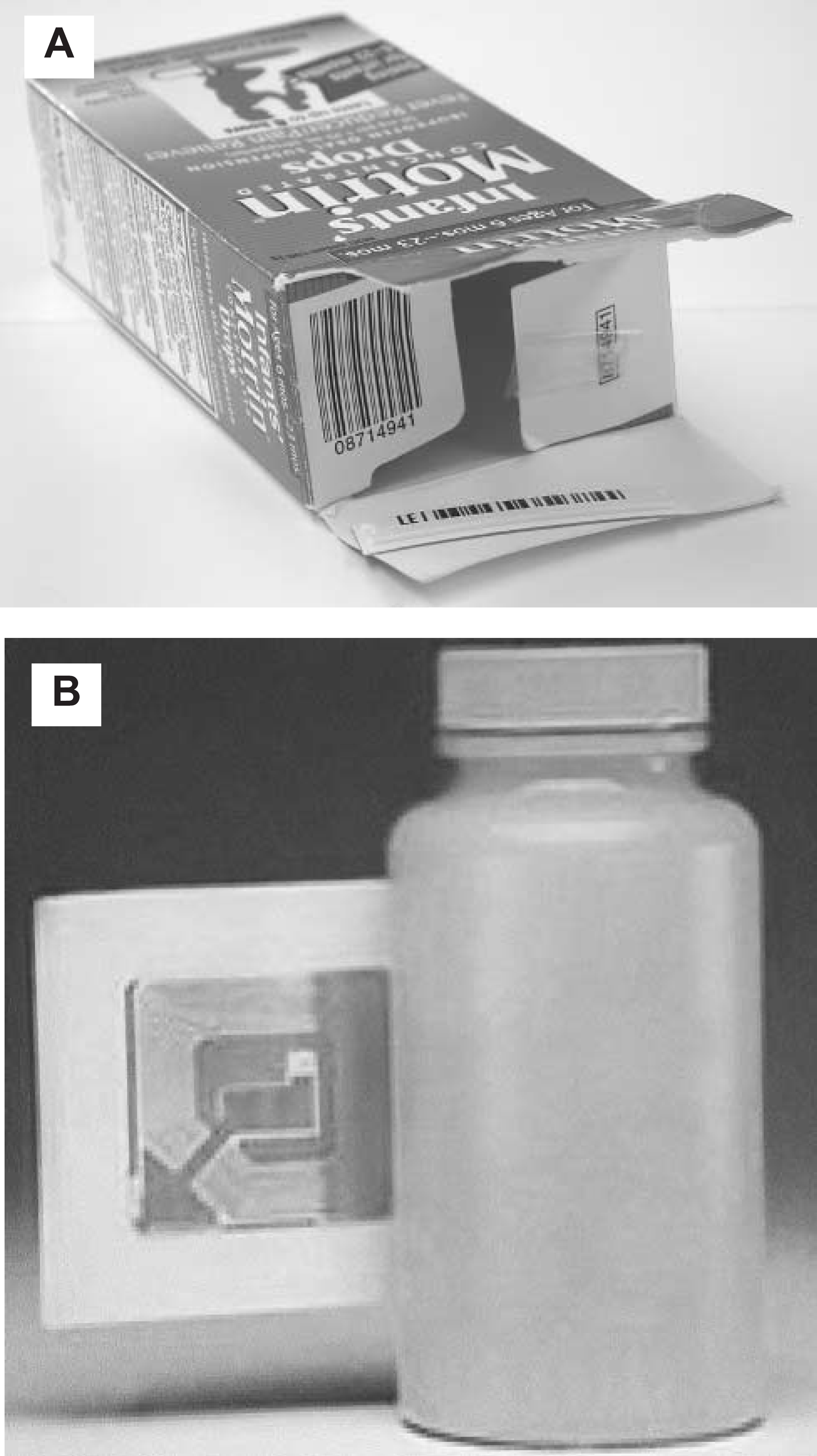
Recommendations for placement of anti-theft tags inside the secondary package (A) or under the label in the absence of secondary package (B).
Even though stores like Wal-Mart are encouraging suppliers to place tags at the manufacturing level, many stores manually affix anti-theft tags at the store level. 16 For example, a recent investigation conducted by the Attorney General's office in New York resulted in legal action against a national drugstore chain for placement of anti-theft tags on outer packaging of certain OTC medications that obscured important information on the label. 17 The drugstore chain agreed to evaluate all OTC products in its New York stores for placement of tags and was also required to pay $40 000 to study the issue. If tagging is necessary at the store level, then retailers should educate their personnel regarding FDA requirements and the importance of information on OTC medication packages. Adequate training to identify appropriate tagging locations on OTC drug packages could reduce the amount of information obscured on the Drug Facts panel.
CONSUMER RIGHTS AND ISSUES
Consumers have the right to receive clear, unhindered information on OTC medication labels. External tags are affixed with a strong adhesive, which detracts consumers from removing them. Even when an individual may want to remove the tag, it will likely tear some of the information on the label. There is also the issue of being charged with product tampering, which detracts consumers psychologically from accessing such information. Further, such tags may be used by stores where the crime rate is high and in poor neighborhoods with low consumer health literacy. Thus, if tags obscure information on OTC drug packages, consumers would have to make judgments on product use and the anticipated adverse effects.
LIMITATIONS
Application of the results should be made by keeping in mind certain limitations of this study. The survey was conducted only on products containing acetaminophen or a combination of acetaminophen and another OTC product. Further, a random sampling on all products in each store was not conducted. This could possibly introduce some bias in the estimation on the total amount of information obscured, as well as the number of products actually affected by tagging practices. Exclusion of stores that used tags but did not allow us to collect data may also have affected the results. However, based on our experience in data collection, this may have resulted in an underestimation rather than overestimation of the amount of information obscured. Half the stores in this study were independent drugstores, which may or may not be reflective of other regions of the country. Only stores in the Houston area were considered; hence, results may not be generalized to other regions of the country.
Conclusions
Price tags and anti-theft tags affixed on labels obscure a considerable amount of relevant information required by the FDA for consumers to make informed product purchase decisions. Improper use of external tags may further aggravate the problem of drug safety and OTC medication label comprehension, especially with respect to information on warnings and product use. Such drugs are safe only when used per label instruction. Manufacturers, distributors, retailers, and policy makers may consider the following recommendations to improve tagging practices:
• exemption of OTC medications from state price tagging requirements,
• adequate use and placement of bar-code technology, as well as scanners in store aisles,
• improvement in technology to increase source tagging and the use of advanced EAS tags with multiple uses,
• deletion of duplicate PDPs with an allocation of a specific area for placement of external tags,
• adequate training and education for individuals who tag OTC products.
Footnotes
Acknowledgements
We thank Laura Bix PhD, Assistant Professor, and Robert H Clark PhD, Assistant Professor, School of Packaging, Michigan State University, for their insight on this project. In addition, we thank graduate students Gauri Shringarpure and Amit Kulkarni for their help in data collection.