







Abstract

TO THE EDITOR: Research has shown that intravenous, but not oral ascorbate, can produce concentrations selectively toxic to cancer cells, which has renewed the interest in ascorbate as therapy for cancer.1,2 The protocol was approved by the ethics committee of The Center for Improvement of Human Functioning, Wichita, KS. Written informed consent was obtained.
Average Pharmacokinetic Parameters of Ascorbate Over 5 Treatment Cycles a
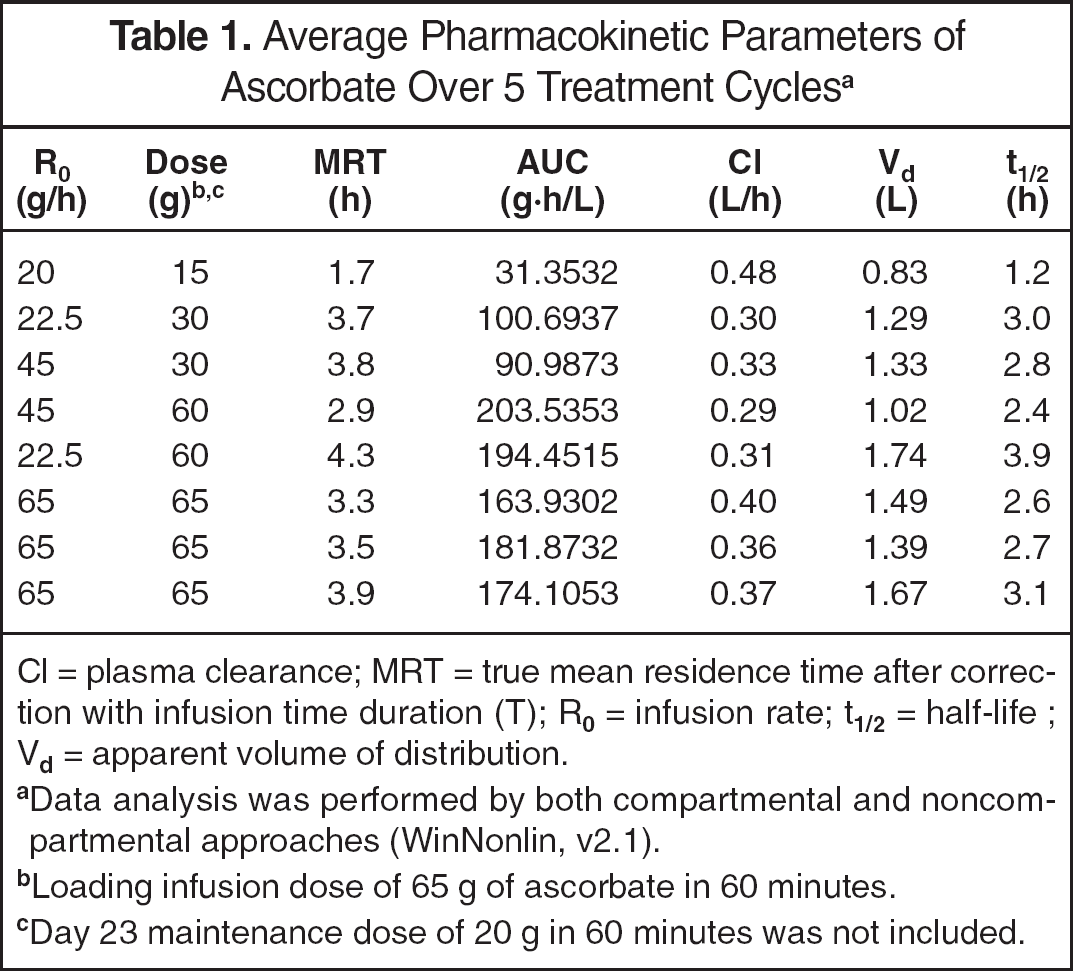
Cl = plasma clearance; MRT = true mean residence time after correction with infusion time duration (T); R0 = infusion rate; t1/2 = half-life; Vd = apparent volume of distribution.
Data analysis was performed by both compartmental and noncompartmental approaches (WinNonlin, v2.1).
Loading infusion dose of 65 g of ascorbate in 60 minutes.
Day 23 maintenance dose of 20 g in 60 minutes was not included.
Under disease state conditions, Hickey's dynamic flow model predicts maximum ascorbate recycling by renal tubular reabsorption. 4 Because these pumps could be considered a capacity-limiting step, the higher ascorbate turnover rate at megadoses in healthy subjects could be assumed to be a result of saturation of ascorbate reabsorption after renal excretion. However, the postulated role of ascorbate in maintaining or reestablishing a reducing internal environment might make a difference. Tissue stores are thought to be near saturation at 60 mg, and increased excretion would occur at higher doses.3–5 This information is supported by studies with healthy humans; therefore, the conclusions are based on facts that need to be revised for patients with malignancies, which are demanding higher ascorbate levels (at millimolar range) than healthy cells. Consequently, the consumption of higher ascorbate amounts by these tissues may account for most of the systemic ascorbate in excess. Under such a condition, mega-dosage will saturate neither the tubular ascorbate reabsorption nor the sodium-dependent transporters, which results in longer systemic half-life, slower clearance, and probably a smaller apparent volume of distribution (higher concentrations due to reabsorption) than expected.
The information obtained from this preliminary pharmacokinetic assessment of ascorbate at megadoses allows a better understanding of its disposition in cancer patients. This information will help us to optimize the dosage to be used in a perspective clinical trial in order to maximize the therapeutic benefits.
Footnotes
Acknowledgements
We thank The Center for the Improvement of Human Functioning International and the Puerto Rico Cancer Center for their financial support.