







Abstract

TO THE EDITOR: The elevation of alanine transaminase (ALT) levels to more than 3 times the upper limit of normal is seen in 2% of mirtazapine-treated patients. However, mirtazapine has rarely been associated with any lethal liver injury. A MEDLINE search yielded only 2 published case reports of mirtazapine-induced liver injury.1,2 We describe another case of liver injury in a patient taking mirtazapine. To the best of our knowledge, this is the first case report of mirtazapine-induced hepatocellular-type liver injury.
Patient's Liver Function Tests Throughout Hospital Stay
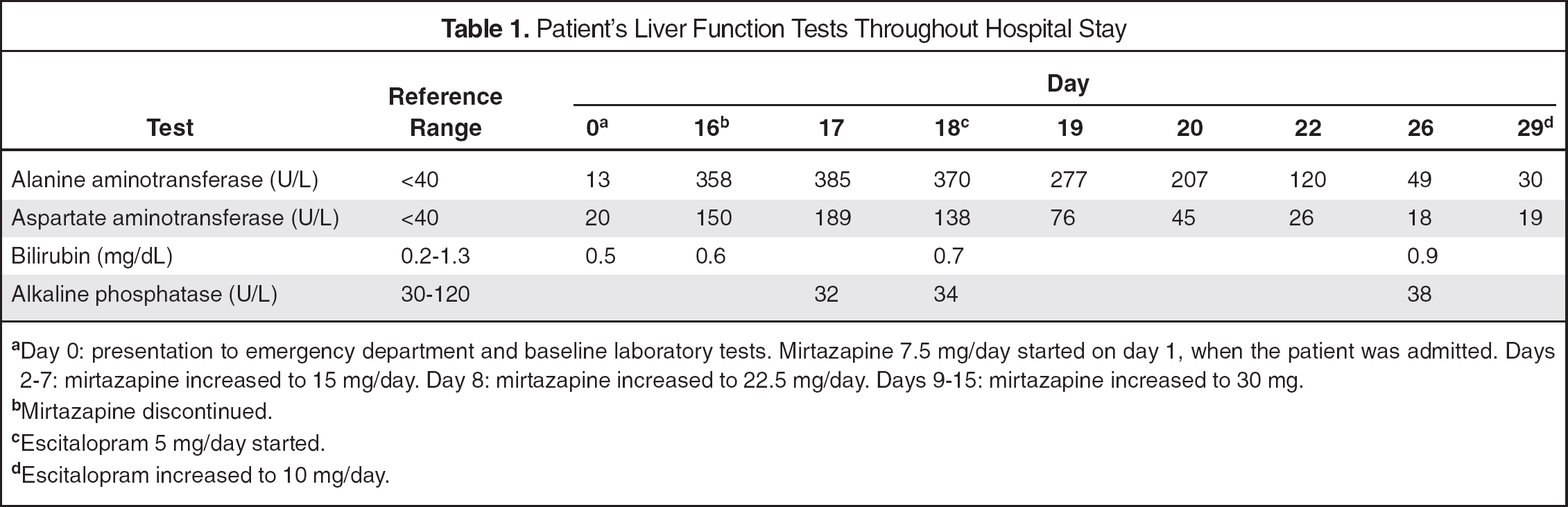
Day 0: presentation to emergency department and baseline laboratory tests. Mirtazapine 7.5 mg/day started on day 1, when the patient was admitted. Days 2-7: mirtazapine increased to 15 mg/day. Day 8: mirtazapine increased to 22.5 mg/day. Days 9-15: mirtazapine increased to 30 mg.
Mirtazapine discontinued.
Escitalopram 5 mg/day started.
Escitalopram increased to 10 mg/day.
Drug-induced liver injury is a term that describes abnormalities in liver enzyme levels related to medication intake. The pathology of drug-induced liver injury is divided into cholestatic, hepatocellular, or mixed injury, depending on the particular abnormality detected in the liver function tests. Cholestatic-type injury is characterized by direct damage to the canalicular membranes and bile transporters, resulting in bile duct obstruction and elevation of ALP (as defined by an ALT/ALP ratio of ≤2).5,6 In contrast to cholestatic injury, hepatocellular injury presents with high ALT levels with little or no change in ALP. 5 Furthermore, acute hepatocellular liver injury is defined by ALT levels greater than 2 times the upper limit of normal or an ALT/ALP ratio of 5 or higher. 6 Mirtazapine-in-duced liver injury is associated mainly with cholestatic-type injury. Two case reports on 3 patients with mirtazapine-induced liver injury have been published.1,2 According to the ALT/ALP ratio criteria, 6 2 of these cases were mixed cholestatic-hepatocellular type and the other was cholestatic type.1,2 In our patient, only his ALT and AST levels were elevated. Thus, our patient's laboratory findings suggested the presence of acute hepatocellular injury. Mirtazapine-induced liver injury can result in a diverse pattern of liver function test results depending on the liver injury type.
