







Abstract
The thermal decomposition of the hexahydrate of samarium trichloride under an air atmosphere and under low pressure has been monitored through the use of ultraviolet–visible (UV-vis) diffuse reflection spectroscopy. The unique ability of lanthanide spectroscopy to investigate the near environment surrounding the samarium ion allowed for the identification of the hexa-, penta-, tetra-, tri-, di-, and monohydrates in both cases, as well as the formation of samarium oxychloride formed as the final decomposition product. The decomposition temperatures and the products observed in this report are compared to those obtained by other thermal and iso-thermal analyses of this compound, as well as the analogous decomposition of europium trichloride hexahydrate. Structural and environmental variations associated with the compounds, as indicated by the reflectance spectra, are discussed.
INTRODUCTION
Thermo-gravimetric,1–3 differential-thermal,4,5 and isothermal dehydration 6 analyses have all been used to investigate the decomposition of the hexahydrate of samarium trichloride (SmCl3·6H2O) under a variety of experimental conditions. However, with each new study, the decomposition products and temperatures reported as compared to previous studies have often proven to be contradictory. The hydrated lanthanide chlorides are used as precursors in the preparation of a wide variety of rare-earth compounds. Thus, a more complete understanding of their properties is needed.
A great deal of additional and useful information can be gleaned from the extension of these studies to use optical spectroscopy as a monitor of the decomposition products. The narrow nature of both absorption and emission features associated with the lanthanide element and the sensitivity of those features to the near environment of the lanthanide ion results in the ability to monitor the loss of individual waters during the dehydration process.7,8 Inferences can be made regarding the metal ion's environment for each of the decomposition products that are formed.
In the past, diffuse reflection spectroscopy 7 and luminescence spectroscopy 8 have both been successfully employed to study the mechanism of the thermal decomposition of the hydrates of europium trichloride as well as the intermediates and products themselves. To better elucidate the findings associated with the europium studies and to more completely understand the decomposition of samarium trichloride, we have initiated a study of the thermal decomposition of samarium trichloride hexahydrate monitored using diffuse reflection spectroscopy. The results completed under an air atmosphere and at low pressure are discussed and comparisons are made to the other methods of monitoring the decomposition in order to possibly bring each of the methods into agreement. The results are also considered with regard to the data obtained by the spectroscopic investigations of europium chloride hexahydrate.7,8
EXPERIMENTAL DETAILS
SmCl3·6H2O was prepared by reacting approximately 0.1 g of samarium oxide (Sm2O3) with excess hydrochloric acid (1 mL, 12 M HCl). The hydrated samarium trichloride formed as a crystalline solid in the acidic solution. The crystalline solid was collected and washed three times with acetone to remove the excess HCl. This material may contain additional adsorbed waters, but as these waters will not affect the spectroscopy of the material, the authors will identify it based upon the hexahydrate, from which the optical properties arise.
A small sample of SmCl3·6H2O was placed either on a microscope slide or in a sealed pipette attached to a low-pressure vacuum of about 10 Torr. These were in turn positioned on a Corning PC-220 Laboratory hot plate. A thermometer was placed in proximity to the sample to monitor sample temperature. The temperature measurements resulting from this instrumental configuration were calibrated using the known melting points of benzoic acid (121–123 °C), citric acid (152–154 °C), and caffeine (235–239 °C). A 500 W halogen lamp was positioned above the sample and the reflected light was collected at an angle of approximately 60° from the incident light source by an Ocean Optics fiber-optic probe coupled with an Ocean Optics USB-2000 miniature fiber-optic spectrophotometer. An initial reflectance spectrum, R, was collected at room temperature and converted to log (1/R) to give band intensities that were a good approximation of their true values. Subsequent spectra were observed as the temperature of the sample was slowly increased ∼5 °C in a stepwise manner. The sample and thermometer were allowed to equilibrate at the new temperature for at least 10 minutes before collection of the corresponding spectrum. This resulted in an approximate heating rate of 0.5 °C/min.
Because of this method of heating, an inherent error in identifying the start as well as the completion of the decomposition process of about 5 °C results for each time the decomposition process is studied. However, this error was minimized in two ways. First, the flexibility of this method allows for the heating rate to be slowed throughout temperature ranges of interest. During the temperature range of each of the decomposition processes the increment by which the temperature was increased was dropped to ∼2 °C per 10 minute equilibration period. Secondly, many samples were prepared and the decomposition process was observed multiple times for each sample. Because the heating process varied for each experiment, the composite gave the full range of temperatures in the range studied.
RESULTS AND DISCUSSION
Monitoring the diffuse reflection spectra allowed for the easy identification of the intermediates and products resulting from the thermal decomposition of SmCl3·6H2O in air. The log (1/R) spectrum characteristic of each composition is shown in Fig. 1. The absorption transitions are labeled with the electronic level to which the samarium ion is excited from the ion's 6H ground state as described by Deike. 9 The decomposition appeared to follow the same steps and the decomposition products are identified in accord with those observed during the analogous thermal decomposition of the iso-structural EuCl3·6H2O. 8 These assignments are included in Fig. 1, as are the temperatures at which the characteristic spectra were collected.
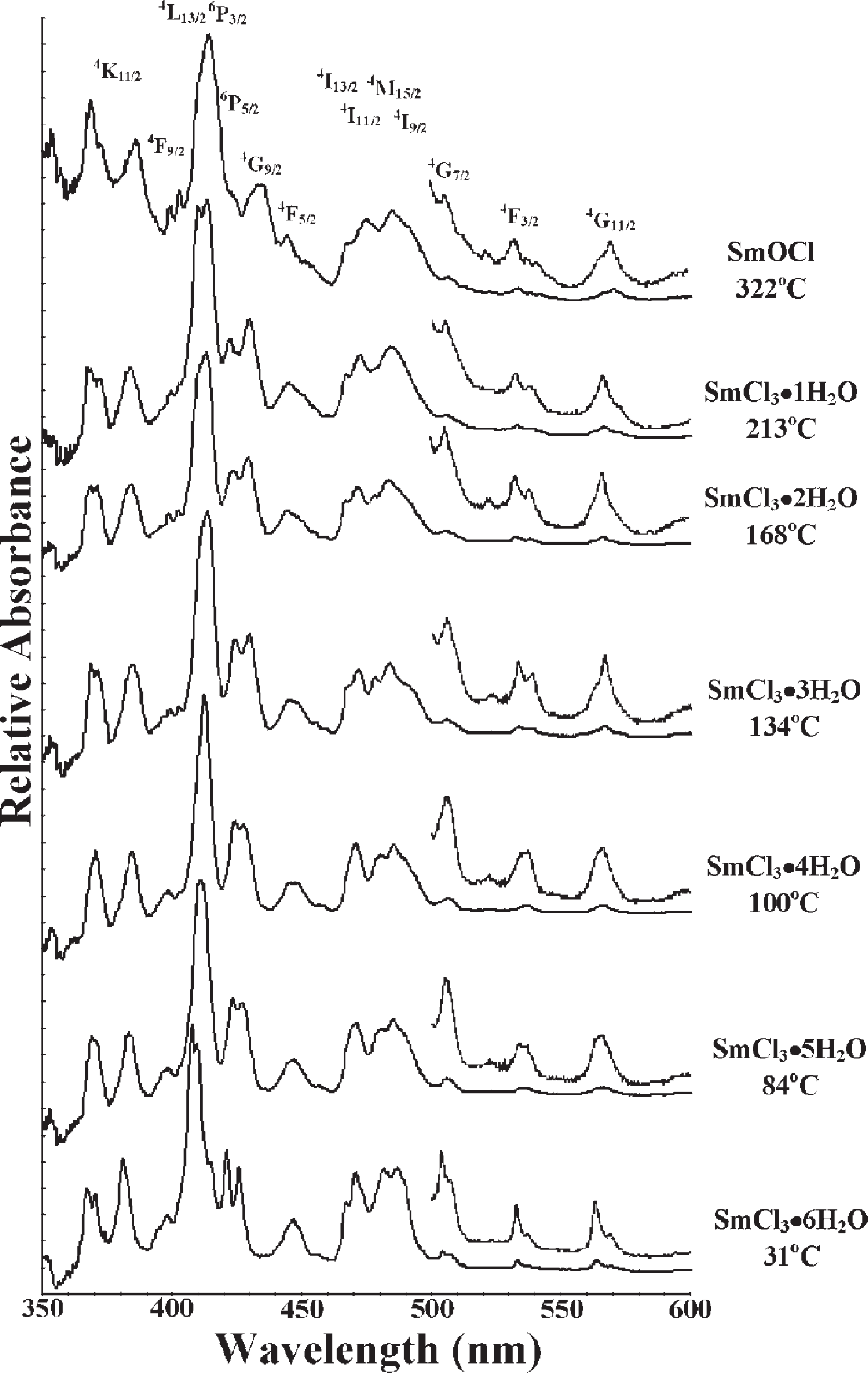
Log (1/R) spectra of the decomposition products identified during the thermal decomposition of SmCl3·6H2O in air.
The diffuse reflection spectrum shown in Fig. 1, which typifies SmCl3·6H2O, was collected at 31 °C. An identical spectrum (the hexahydrate fingerprint spectrum) was obtained throughout the temperature range from ambient temperature (25 °C) to 70 °C. At a temperature falling between 70 and 77 °C, a new fingerprint spectrum appeared with the loss of the original features, indicating the formation of a new species believed to be the pentahydrate. The pentahydrate's fingerprint spectrum was maintained without change from 77 to 89 °C. At temperatures of 95–107 °C a third fingerprint spectrum was maintained, which was associated with the formation of the tetrahydrate. The trihydrate has regularly been identified by a variety of methods used to study this decomposition process. This is likely due to the relatively extended range of thermal stability that it exhibits. A fingerprint spectrum that can be assigned to the trihydrate remained unchanged throughout the temperature range 114–155 °C. The formation of the dihydrate proved to be more difficult to identify. This resulted from a fingerprint spectrum that was remarkably similar to that associated with the trihydrate and an extremely small window of thermal stability. The dihydrate's fingerprint spectrum was observed only through the temperature range 161–168 °C. At 168 °C the dihydrate began the decomposition to the monohydrate. The monohydrate was easily identified because its fingerprint spectrum differs significantly from the dihydrate, and the spectrum remains unchanged from 175 to 315 °C. Above the temperature of 315 °C, the fingerprint spectrum of SmOCl signals that the final step in the decomposition has occurred and the identifying spectrum is maintained to temperatures up to 460 °C. The temperatures observed by diffuse reflection that can be associated with each thermal decomposition step (corresponding to the loss of one fingerprint spectrum in conjunction with the formation of another) as the compound dehydrates are listed in Table I.
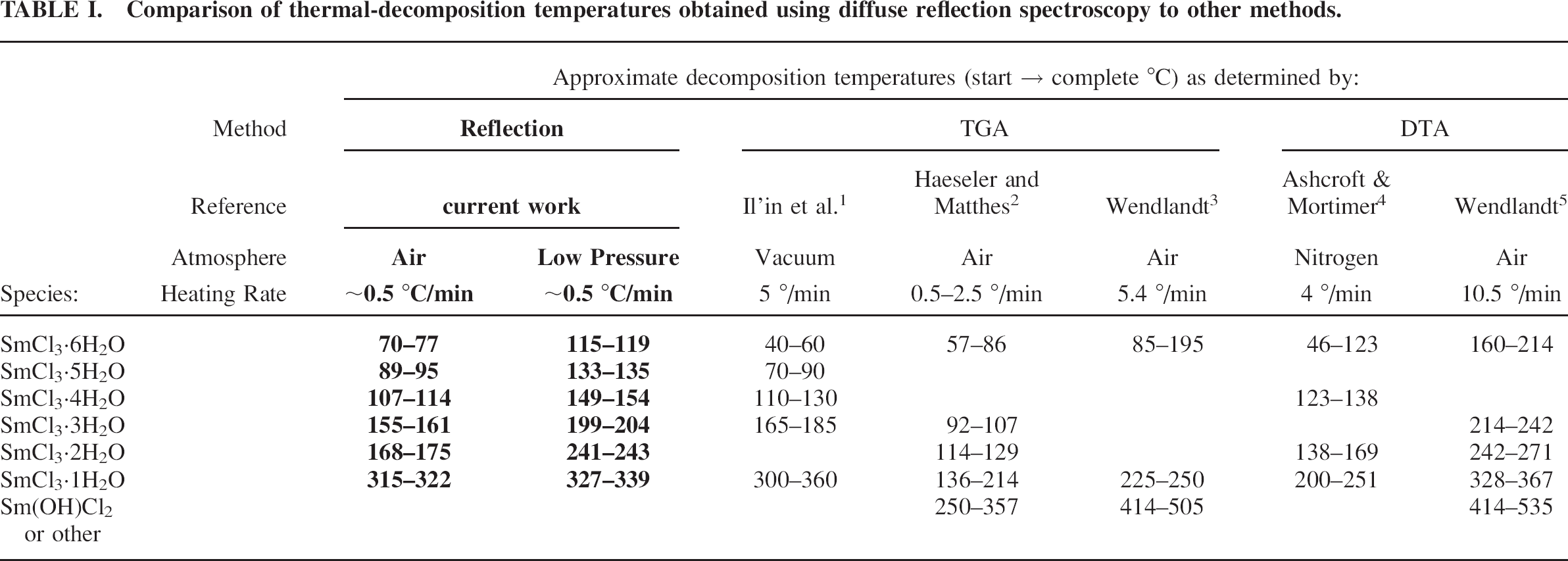
Comparison of thermal-decomposition temperatures obtained using diffuse reflection spectroscopy to other methods.
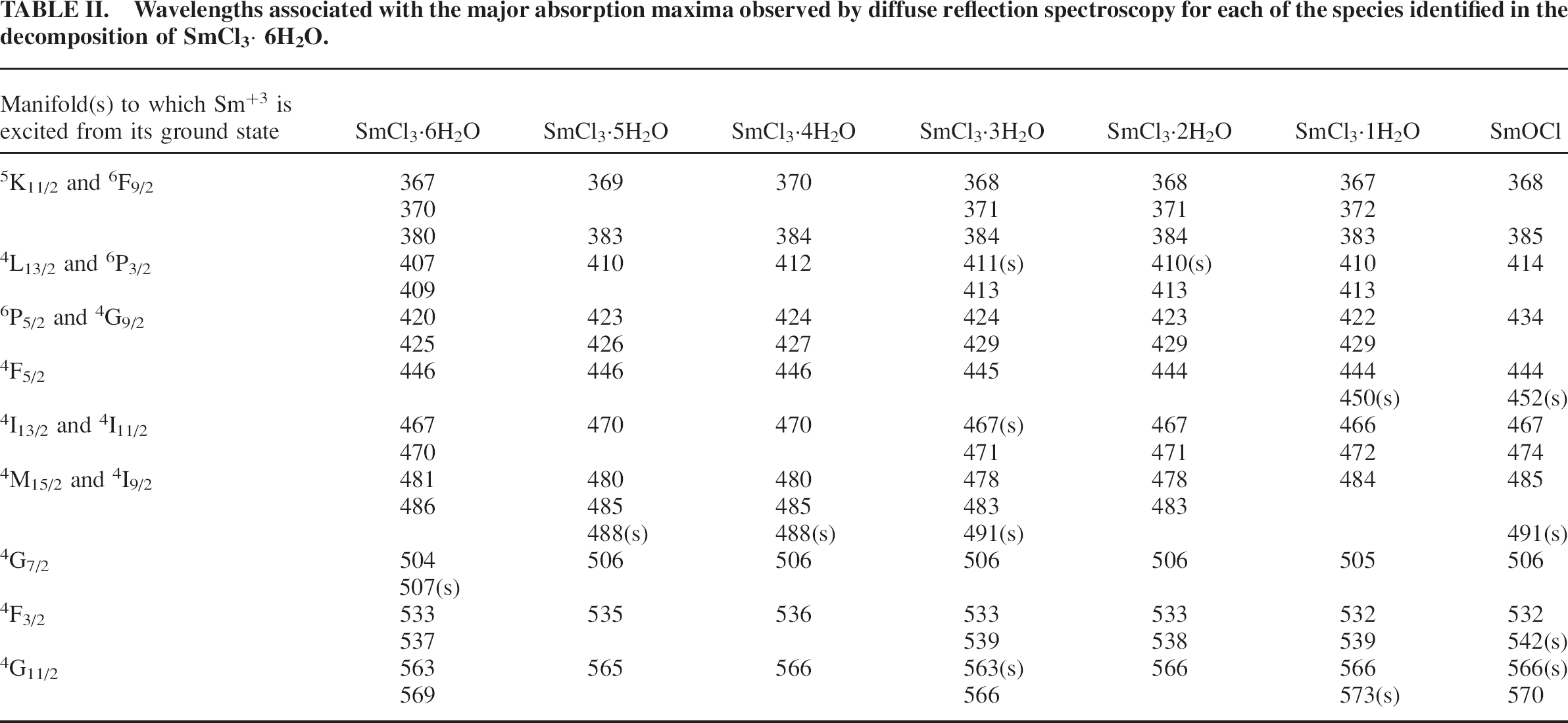
The evacuated sample gave identical fingerprint spectra to those obtained in air. The log (1/R) spectra exhibited by the evacuated sample along with the temperature at which they were collected are shown in Fig. 2. Due to the decreased efficiency of the instrument to measure the diffuse reflection of a small sample enclosed in an evacuated glass capillary tube, the spectrum in the wavelength region 350–400 nm became unobservable. There was also significantly less resolution associated with spectra collected at higher temperatures. Even with these deficiencies, the features were consistent for each of the decomposition products. There was no apparent shift in the positions of any of the observed absorption maxima as compared to the products formed by decomposition in air. The wavelengths associated with the observed absorption maxima are listed in Table II for each of the species identified in this study.
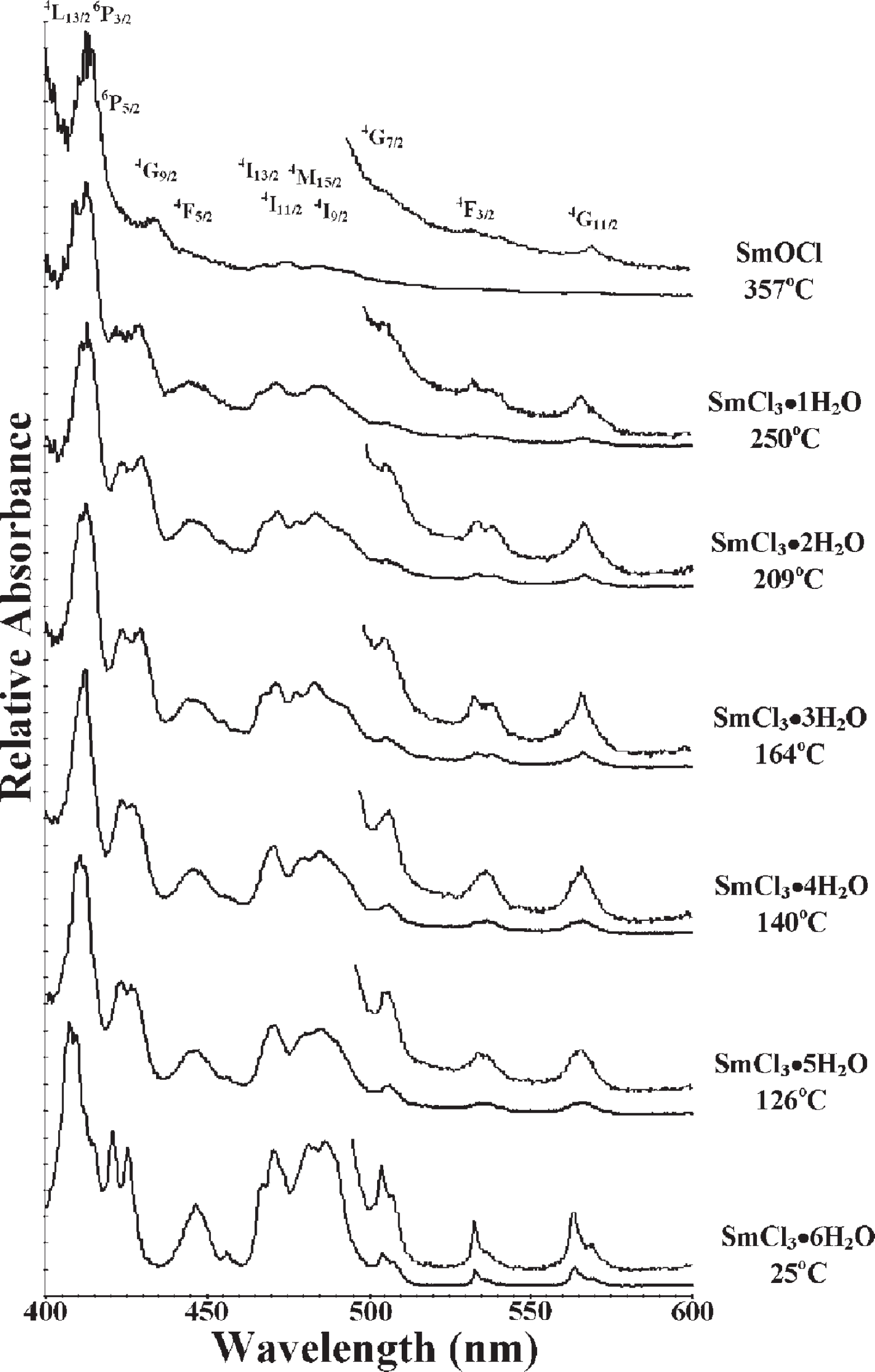
Log (1/R) spectra of the decomposition products identified during the thermal decomposition of SmCl3·6H2O under partial vacuum.
Wavelengths associated with the major absorption maxima observed by diffuse reflection spectroscopy for each of the species identified in the decomposition of SmCl3·6H2O.
The only variation between the data from the air sample and the evacuated sample was in the decomposition temperatures observed. The evacuated sample's decomposition temperatures were significantly increased compared to those observed from the decomposition in air. This result agrees with a similar although less pronounced trend observed in the decomposition of the europium compound. 7
The hexa-, penta-, tetra-, and trihydrates did not begin to decompose under vacuum until 115, 133, 149, and 199 °C, respectively. In each case this is almost 40 °C higher than the decomposition temperature observed in air. The dihydrate remained stable until 241 °C, which corresponds to a 50 °C jump in the decomposition temperature. The formation of the oxychloride from the monohydrate showed the least variation, only increasing about 10 °C to a decomposition temperature of about 327 °C. The thermal-decomposition temperatures observed during the heating of the compound under a low-pressure vacuum are included in Table I.
The decomposition of the monohydrate to the oxychloride has often been identified as a two-step process corresponding to the formation of a hydroxychloride as an intermediate before decomposing to the oxychloride final product.2,8 This intermediate was not observed by diffuse reflection during the decomposition process. That does not mean that it does not occur. In the decomposition of the hexahydrate of europium chloride, the hydroxychloride was sporadically identified via luminescence spectroscopy but was also not apparent when the decomposition was studied by diffuse reflection. It is possible that a luminescence study of the decomposition of SmCl3·6H2O could better elucidate the formation of this product. However, even in the luminescence study of europium chloride, the formation of the hydroxychloride was difficult to identify. 8
COMPARISON TO OTHER METHODS
The decomposition of SmCl3·6H2O has been studied multiple times through the use of thermo-gravimetric analysis (TGA)1–3 and differential-thermal analysis (DTA),4,5 as well as isothermal dehydration. 6 The thermal-decomposition temperatures observed by diffuse reflection are listed in Table I, as are those reported for other thermal analyses of this system described in the literature.1–5 In most studies, decomposition temperatures have been identified that are consistent with those observed using diffuse reflection spectroscopy. The only variations are in the decomposition process to which they are assigned.
Some of this variation may result from the adsorption of additional water molecules onto the hexahydrate. It is well known that when samarium chloride is collected from aqueous solution the coordination sphere surrounding samarium ion contains six water molecules. That is why all other thermal studies of these materials present no data regarding the initial composition other than the TGA data.1–6 It was simply assumed that the hexahydrate was the starting material. This is not a problem for optical spectroscopy because it is this coordination sphere that is reflected in the optical spectra exhibited by the compound.
It is also well known that the samarium chloride hexahydrate is extremely hygroscopic. If crystalline samples of this compound are exposed to air, additional water will be adsorbed until an aqueous solution forms. These additional waters are not coordinating and will have no major effect upon the optical properties of the sample. However, the additional waters will cause problems with gravimetric analyses that assume an initial mass based on the compound SmCl3·6H2O. The authors will identify the initial spectrum obtained during the decomposition as resulting from the hexahydrate, since additional adsorbed water molecules do not change the observed spectrum. The initial composition may actually contain multiple additional waters that are lost with no change in the optical spectrum preceding the initial decomposition step observed in this study.
The TGA study of Haeseler and Matthes 2 should have given a much better baseline for comparison, since the decomposition was completed under an air atmosphere with a heating rate nearing that associated with the current study. However, while the decomposition temperatures are consistent with those observed under an air atmosphere by spectroscopy, the assignments of decomposition steps are incongruent. These include the loss of the first three waters of hydration as a group in a temperature range between 57 and 86 °C. 2 Diffuse reflection spectroscopy showed a stepwise decomposition with the pentahydrate remaining stable up to temperatures of 89 °C and the tetrahydrate remaining stable up to 107 °C. Similarly, in their analysis the tri-, di-, and monohydrates all were identified as decomposing at much lower temperatures than those identified by the diffuse reflection measurements. The formation of a Sm(OH)Cl2 intermediate preceding the formation of the oxychloride further differentiates the analysis. As described above, the formation of the hydroxychloride was not identified in this study. However, based on the observation of the hydroxychloride in the decomposition of europium chloride, the decomposition process giving rise to this product should fall at a decomposition temperature somewhat higher than that associated with the monohydrate.
It is not known why this report conflicts so significantly with the data that was obtained by the other TGA study 1 and this diffuse reflection study. The decomposition temperatures nearly match those observed and only differ in the assignment of the product's composition. This could give the idea that such products could have been misidentified. Given the nature of thermo-gravimetric analyses such incorrect assignment would appear impossible. One possibility would be that the hygroscopic nature of SmCl3·6H2O could have allowed for additional water mass associated with the starting material employed for the analysis. Many of the lanthanide trichlorides are known to have occluded waters adsorbed onto the system, increasing the water content above that of the hexahydrate. If an octahydrate is assumed, the initial decomposition observed in the TGA would result in the formation of the pentahydrate, followed by the tetra-, tri-, and monohydrate, as seen in the previously discussed TGA study 1 as well as in the current study. Since the spectroscopic measurement is independent of mass, any adsorbed waters would not interfere with the measurement as they could in the TGA study. The decomposition temperatures reported by Haeseler and Matthes 2 are included in Table I.
A final TGA analysis, that completed by Wendlandt, 3 is completely inconsistent with all data obtained in any other TGA study. The thermal-decomposition temperatures associated with the plateaus reported by this study 3 are given in Table I. The rate at which the temperature is increased and the atmosphere over the decomposing sample are both consistent with other studies, but all of the observed temperatures are significantly higher than any identified. The significant inconsistency of this data compared to the other TGA studies as well as the data obtained by monitoring the optical features of the products brings to question the validity of the reported data, making comparison impossible.
Another DTA study was completed by Wendlandt and Bear. 5 This analysis shows the same inconsistency described previously for Wendlandt's TGA analysis. 3 The reported decomposition temperatures 5 are given in Table I. Each of these temperatures is again much higher than those observed by any of the methods already discussed. This inconsistency is more pronounced in Wendlandt's studies of europium chloride. The DTA data for the decomposition of europium chloride reported along with the samarium chloride data mentioned above 5 is inconsistent with TGA data reported by Wendlandt in a different study. 10 All other studies of the decomposition of europium chloride, including three other TGA, two other DTA, as well as luminescence 8 and diffuse reflection 9 studies give decomposition temperatures similar to his TGA data. 10 Based on the inconsistency between Wendlant's reported DTA data and that reported for so many other studies, the question of validity of the data precludes comparison to the current data.
COMPARISONS TO EuCl3·6H2O
The decomposition from the hexa- to the pentahydrate corresponds to a general collapse of peak manifolds at wavelengths of about 369, 410, 425, 470, 506, 535, and 565 nm, with the most significant at 425 nm. A similar collapse occurs during the formation of the tetrahydrate from the pentahydrate, which is most apparent in the narrowing of the peak manifold located at 410 and 425 nm. This general trend was also observed in the features of the diffuse reflection spectra reported for the hexa-, penta-, and tetrahydrates of EuCl3, 7 and in the luminescence study of the initial decomposition of EuCl3·6H2O. 8 The observed collapse would correspond to a slight increase in the metal ion's site symmetry and appears to hold true for the decomposition of both samarium and europium trichlorides. This agrees with the conclusions drawn from the Eu+3 luminescence study that indicated the metal ion occupies a C3 site that is being distorted towards a C2 site. 8 As the waters of hydration are lost, the site is still consistent, it is just moving nearer to the C3 site.
Conversely, upon the loss of another water of hydration corresponding to the formation of the trihydrate from the tetrahydrate, the transition manifolds described above exhibit a greater splitting, especially the transition manifolds located at 370, 425, 470, and 535 nm. In fact, the variations seen in several of these manifolds are sufficient that it could be safely surmised that the metal ion's site has changed. While this site cannot be ascertained from the diffuse reflection spectrum of the hydrated samarium chloride, it appears to be less symmetrical than the preceding tetrahydrate. The diffuse reflection 7 and luminescence 8 studies of the decomposition of EuCl3·6H2O exhibit similar trends, including the expansion of the manifold's splitting and the change in site symmetry. In fact the loss of allowedness observed for the transition between the 7F0 and 5D0 electronic states observed in the absorption feature of the Eu+3 ion in EuCl3·3H2O indicates that the symmetry may have increased from a C n towards a D n site. 7 The opposite observation exhibited in the luminescence study 8 would indicate that this increase is nebulous at best. The expansion of the peak manifolds observed in each of the studies indicates the possible decrease of “n” from 3 towards 2.
Very little variation in the diffuse reflection spectra of the compositions occurs associated with the dehydration of the samarium sample from the tri- to the dihydrate. A small shift in the transition manifold located at 410 nm and slight change in the strengths of the manifolds at 425 nm are the only significant changes associated with this decomposition. This is consistent with the studies of hydrated europium chloride,7,8 where slight variations greatly hampered the identification of the formation of the dihydrate. With regard to the metal ion's symmetry, the loss of this water of hydration does not result in any significant change in the metal ion's environment.
A further expansion of the manifolds is observed upon the decomposition of the dihydrate to the monohydrate. The studies of europium7,8 indicate the formation of a new metalion site, but it is impossible to confirm this from the diffuse reflection of the samarium compound. There is a strong similarity between the spectrum associated with this composition and the spectrum associated with the hexahydrate, as was seen in the luminescence study of europium, 8 but otherwise little can be said.
The formation of SmOCl from the monohydrate corresponded to a significant change in several of the absorption features, especially those features located at 400, 425, 450, and 565 nm. The extent of changes allow for an easy identification of the change in site symmetry associated with the formation of the oxychloride. This large change in spectroscopic features is also reflected in both the spectroscopic studies of europium.7,8
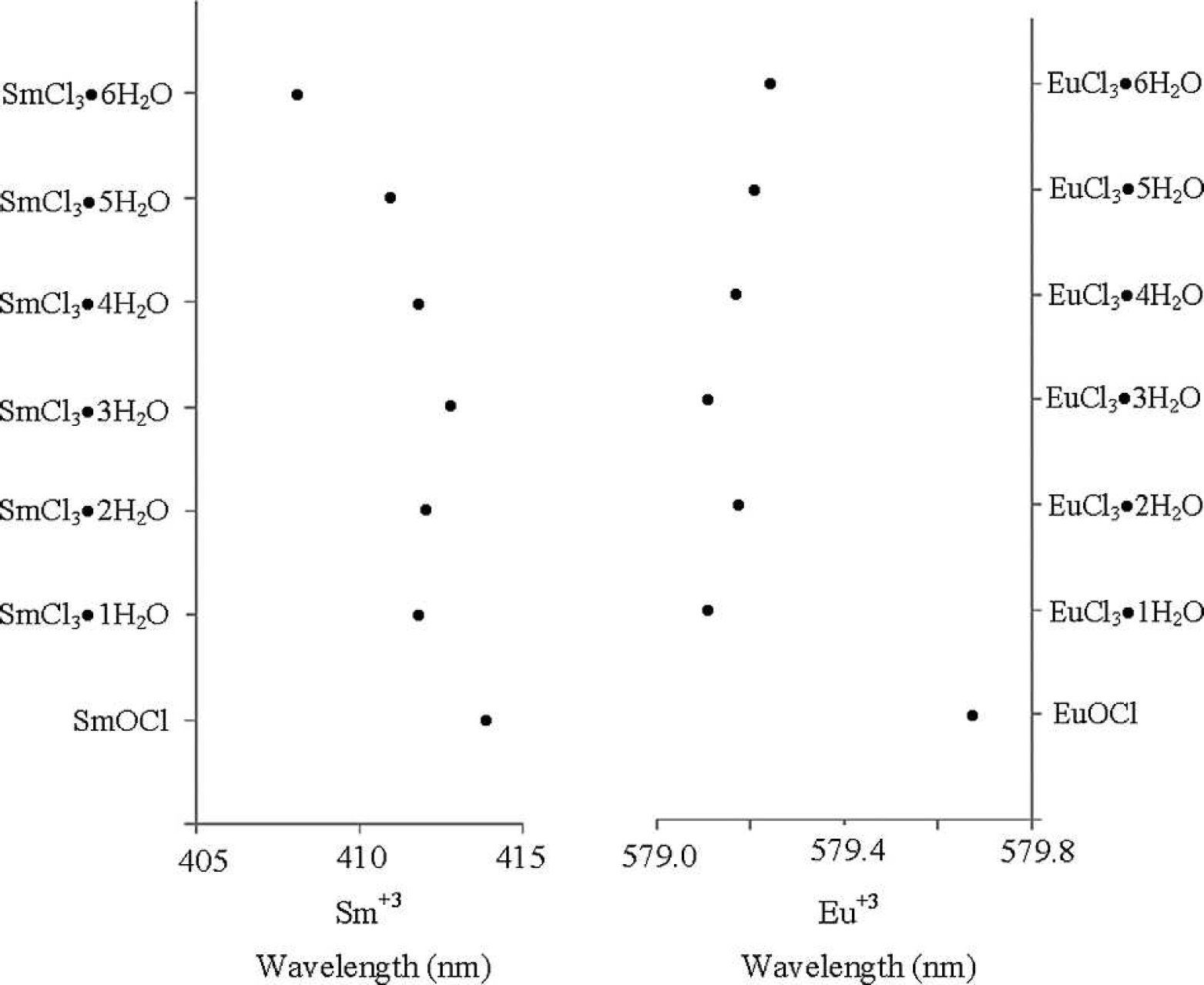
Nephelauxetic shifts of the 6H → 4L13/2 absorption manifold of Samarium and the 5D0 → 7F0 emission manifold of Europium seen during the decomposition of the corresponding trichloride hexahydrate.
A similar plot can be made based on the data seen in the europium luminescence study. 8 The emission feature associated with the transition between the 5D0 and 7F0 electronic states of the europium exhibit shifts as well, 8 though significantly less than the samarium compound. This shift covers a range of wavelengths of less than one nanometer. The study of europium chloride 7 did not have adequate resolution to see these shifts. A plot of position of the 5D0 → 7F0 emission manifold position versus the product of the decomposition of EuCl3·6H2O is also given in Fig. 3. It is interesting that the shifts observed between the initial hydrates for the europium compound through the dihydrate are the reverse of the samarium sample. Where the samarium structure appears to collapse through the decompositions to the trihydrate, the shifts for the europium compound show an expansion of the environment around the metal ion. The decomposition to the dihydrate of the samarium compound exhibits an expansion while the same species of the europium sample exhibit a contraction of the coordination sphere. The shifts corresponding to the decomposition to the monohydrates and oxychlorides of both compounds are consistent, corresponding to an expansion to the monohydrate and major collapse to form the oxychloride. This collapse would correlate with the formation of the very stable oxychloride product in both of the decompositions.
As discussed above, the metal ion's site does not change significantly during the first decomposition processes, indicating minor changes in the crystal structure. The inverted shifts associated with the formation of the penta, tetra, and trihydrates are likely a result of the increased ionic size of the samarium ion as compared to the europium ion. This increased size could result in a destabilization of the metal ion's site in the crystal structure. As each of the initial coordinating waters is removed, the other bonds become more stable. This stability may be reflected in a collapse of the coordination sphere. The smaller size of the europium ion probably allows for more initial stability in this site. The greater stability would result in a more condensed site. However, as the waters are lost, this initial stability is decreased in small increments expanding the coordination sphere of the metal ion.
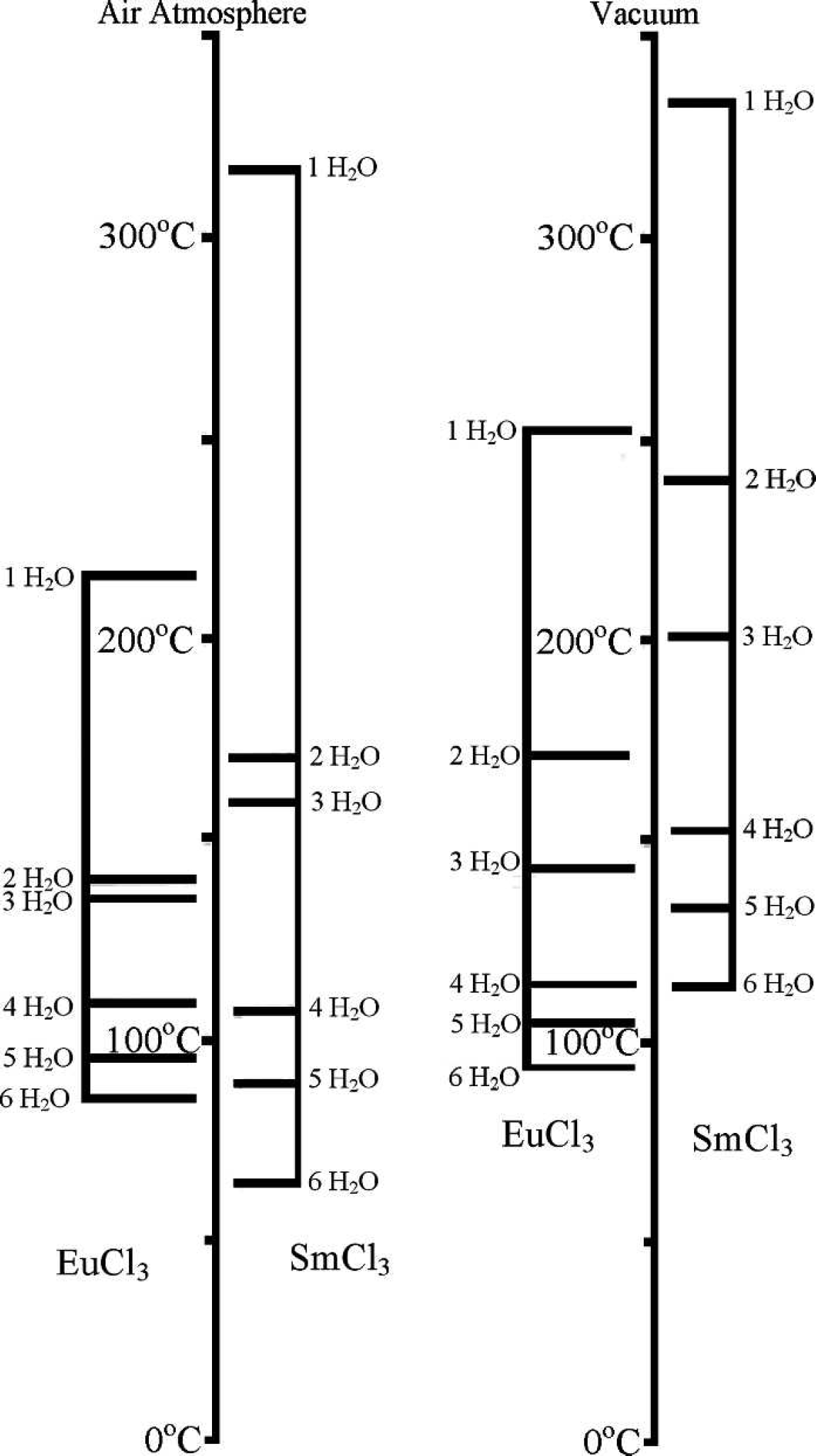
Comparison of SmCl3·6H2O and EuCl3·6H2O decomposition temperatures under air and partial vacuum atmospheres.
As is evident in the comparison, the range of decomposition temperatures associated with the decomposition of SmCl3·6H2O in air greatly expands compared to that associated with EuCl3·6H2O. The decomposition temperatures of the hexa-, penta-, and tetrahydrates were each depressed while those for the tri-, di-, and monohydrates were increased. This relationship is also seen in the data presented by Ashcroft and Mortimer, 4 who investigated the DTA of both samarium and europium samples under a nitrogen atmosphere. They reported the hexahydrate of samarium chloride initiating decomposition at a lower temperature than the europium compound. 4 The decomposition of the tetra-, di-, and monohydrates was also observed at higher temperatures than the similar europium compositions. 4
The increase in the range of air decomposition temperatures associated with samarium chloride as opposed to europium chloride is most likely based upon the stability of the bonds. As discussed above, the nephelauxetic effect gives an indication of the initial instability of these bonds in the samarium compound, while the europium chloride appeared to have an inherent stability based on the size of the europium ion. The decomposition temperatures of the di and trihydrates are very similar for both compounds. With regard to the decomposition of the monohydrates of the two compounds, the nephelauxetic effect appeared to show greater stability (larger red shift) for the samarium chloride monohydrate than the initial hexahydrate compound. Conversely, the monohydrate of europium chloride exhibits the least stability (largest blue shift) of all the decomposition products. This greater stability for the samarium sample could result in a much higher decomposition temperature than that observed for the europium compound.
The samples that were heated under a vacuum both exhibited an increase in the temperatures required to decompose the various hydrates. The europium compositions that contained larger numbers of water (hexa-, penta-, tetra-, and trihydrates) increased, at most about 10 °C. The decomposition temperatures of the di- and monohydrates increased significantly to nearly 40 °C higher than the corresponding sample decomposed in air. The samarium sample exhibited significant increases on the order of 40–50 °C for the decompositions of the hexa-, penta-, tetra-, tri-, and dihydrates. Only the decomposition of the monohydrate showed a relatively small increase in the decomposition temperature of about 10 °C.
The increase in decomposition temperature upon the application of a low-pressure vacuum was very surprising. One possible explanation is the stabilization of the coordinated water's bond by expansion of the coordination sphere surrounding the metal ion upon the decrease in pressure. This expansion in the coordination sphere could possibly result in decreasing interactions between the six water molecules. The greater stability of the bonds would result in increased decomposition temperatures.
This possible expansion of the coordination sphere with the application of low pressures in conjunction with the size-related stability of the compounds may also give rise to the significantly larger increase in decomposition temperatures seen for the samarium compound as opposed to the europium compound. The apparent low stability described above of the hydrate bonds in the samarium chloride hexa-, penta-, and tetrahydrate gave much lower decomposition temperatures under an air atmosphere. These temperatures increased almost 40 °C upon the application of vacuum, indicating that the stability of the hydrate bonds greatly increased under low pressure. The same europium chloride hydrates reflecting the size-related stability described above showed minor increases of 5 to 10 °C, implying a slight increase in bond stability.
Another interpretation of the increased decomposition temperatures resides in the decreased ability of a vacuum to transfer heat as efficiently as air or nitrogen atmospheres. Since diffuse reflection spectroscopy investigates the surface of the sample, the loss of thermal conductance could result in a delay in the decomposition of the material, resulting in increased observed decomposition temperatures. However, since both the samarium and europium chlorides were studied in identical manners, it would be assumed that similar increases in the decomposition temperatures would be observed. Since the decomposition temperatures associated with the samarium chloride sample repetitively soared to nearly five times that exhibited by the europium chloride sample on the application of vacuum, it would appear that the phenomena is likely to be dependent on the lanthanide species.
CONCLUSIONS
Each of the hydrates formed upon the thermal decomposition of samarium trichloride hexahydrate could be distinguished by diffuse reflection spectroscopy, along with the temperatures at which they decompose. The decomposition temperatures associated with the process in air and vacuum were determined and were comparable to those reported in most other studies.
The process followed the same general trends exhibited in the decomposition of europium trichloride hexahydrate as studied by diffuse reflection. The products obtained and identified were completely consistent. The spectroscopic trends with regard to the metal ion's site symmetry also fell neatly in line, but an inconsistency arose between the results for the two compounds with regard to the expansion and contraction of the environment around the metal ion as indicated by the nephelauxetic effect. Similarly, the effects of a low-pressure vacuum atmosphere resulted in consistent increases in decomposition temperatures for the two compounds but resulted in large differences in the magnitude of the changes.
Footnotes
ACKNOWLEDGMENTS
The authors wish to acknowledge the support of the WSSU Faculty Development Committee with regard to obtaining the equipment associated with this research.