







Abstract
A fiber-optical probe for pH sensing and real-time imaging is successfully fabricated by connecting a polymer imaging fiber and a gradient index (GRIN) lens rod which was modified with a sensing film. By employing an improved metallographic microscope, an optical system is designed to cooperate with the probe. This novel technique has high-quality imaging capabilities for observing remote samples while measuring pH. The linear range of the probe is pH 1.2–3.5. This technique overcomes the difficulty that high-quality images cannot be obtained when directly using conventional imaging bundles for pH sensing and imaging. As preliminary applications, the corrosion behavior of an iron screw and the reaction process of rust were investigated in buffer solutions of pH 2.0 and 2.9, respectively. The experiment demonstrated that the pH values of the analytes' surface were higher than that of buffer solutions due to the chemical reaction. It provides great potential for applications in optical multifunctional detection, especially in chemical sensing and biosensing.
INTRODUCTION
Optical fiber sensors display desirable features such as electromagnetic immunity, capability of remote measurements, and miniature analytical detectors so that small volume samples such as single biological cells can be measured.1,,–6 Optical fiber-based pH sensors and biosensors have been considered one of the most important analytical methods in diverse fields such as environmental sciences, medicine, agriculture, and biosensing.7,,–11 A major advantage of this approach is that no exogenous indicator is added to the solution, providing for relatively unperturbed measurements. However, a difficulty in measuring the pH value of an analyte is that real-time image information cannot be obtained while sensing, which is necessary when extremely precise positioning is required. Meanwhile, a continuing challenge in microscopy techniques involves overcoming the limitation that the sample must be brought to the microscope stage.12,13, Several methods for solving this problem have been proposed by researchers.14,,–16 However, either the instrument was too expensive or the obtained images of analytes were not clear.
In this paper, based on our previous work,17,,–19 we developed a simple, low-cost instrument composed of a probe and an optical system. It had two functions, pH sensing and imaging. By employing a high numerical aperture (NA = 0.45) gradient index (GRIN) lens rod and a polymer imaging fiber, we developed a pH-sensitive probe that also provided high-quality non-contact imaging. By improving a metallographic microscope, the optical system was fabricated to cooperate with the probe. The preliminary application of this instrument to obtain the images and pH values of the analytes' surfaces is also demonstrated in this paper.
EXPERIMENTAL
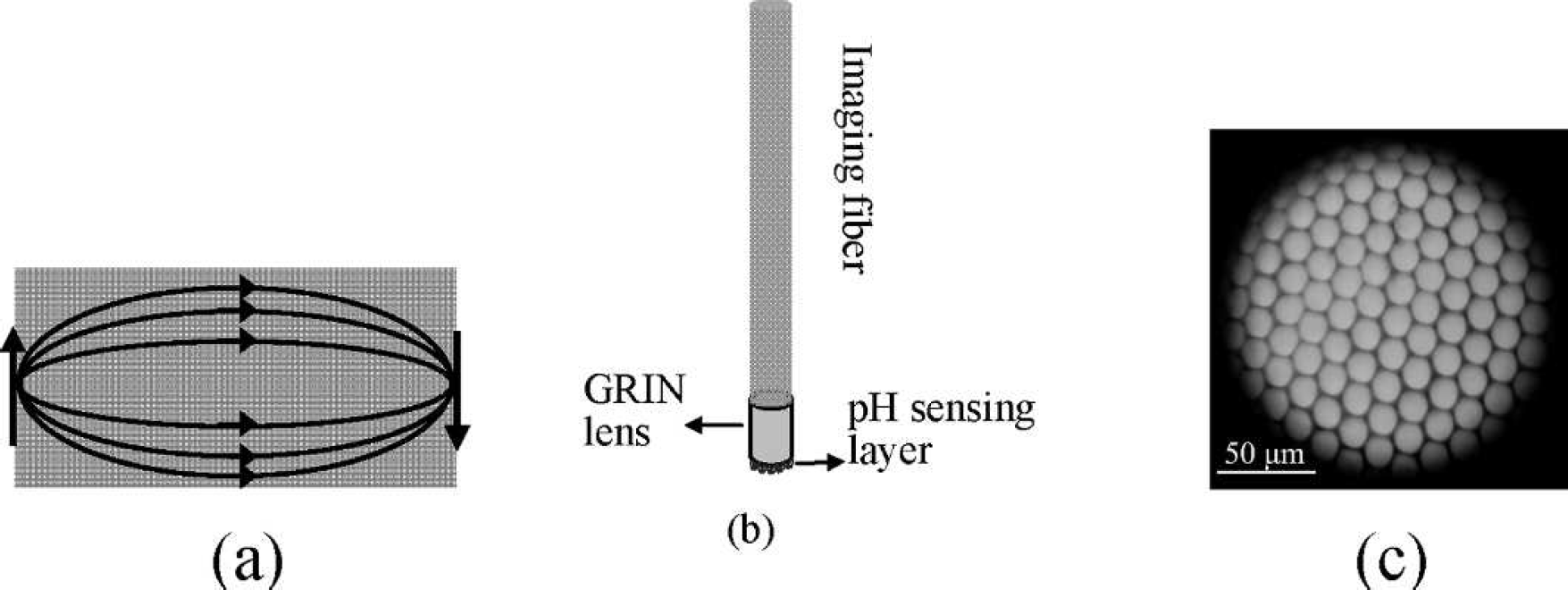
(
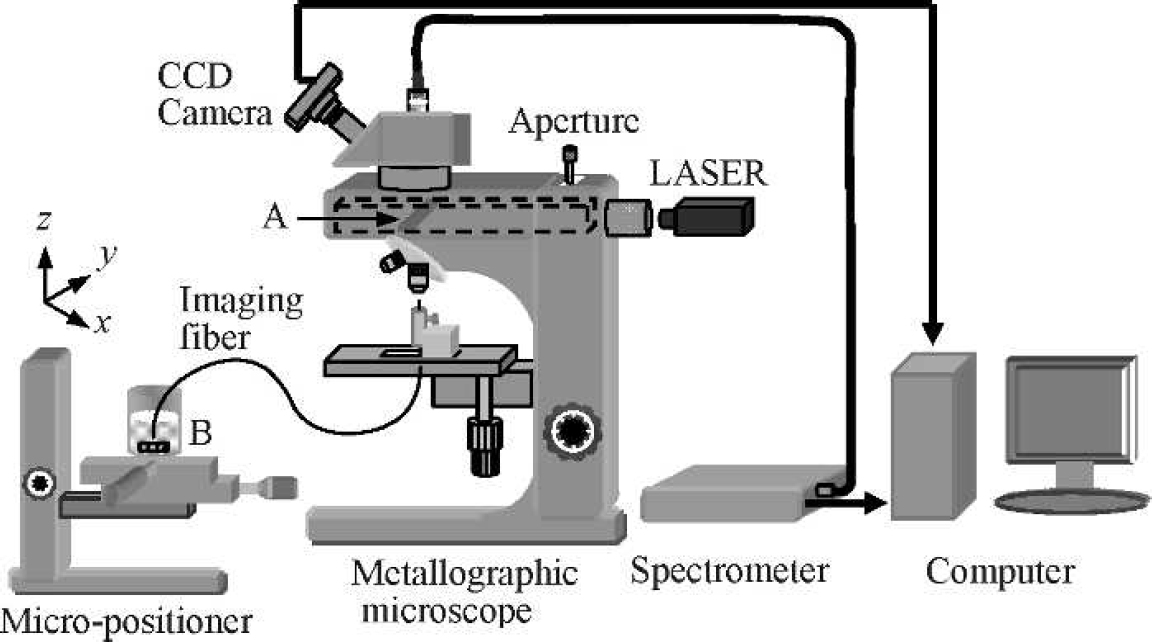
Instrument for pH measurement and imaging. (
RESULTS AND DISCUSSION
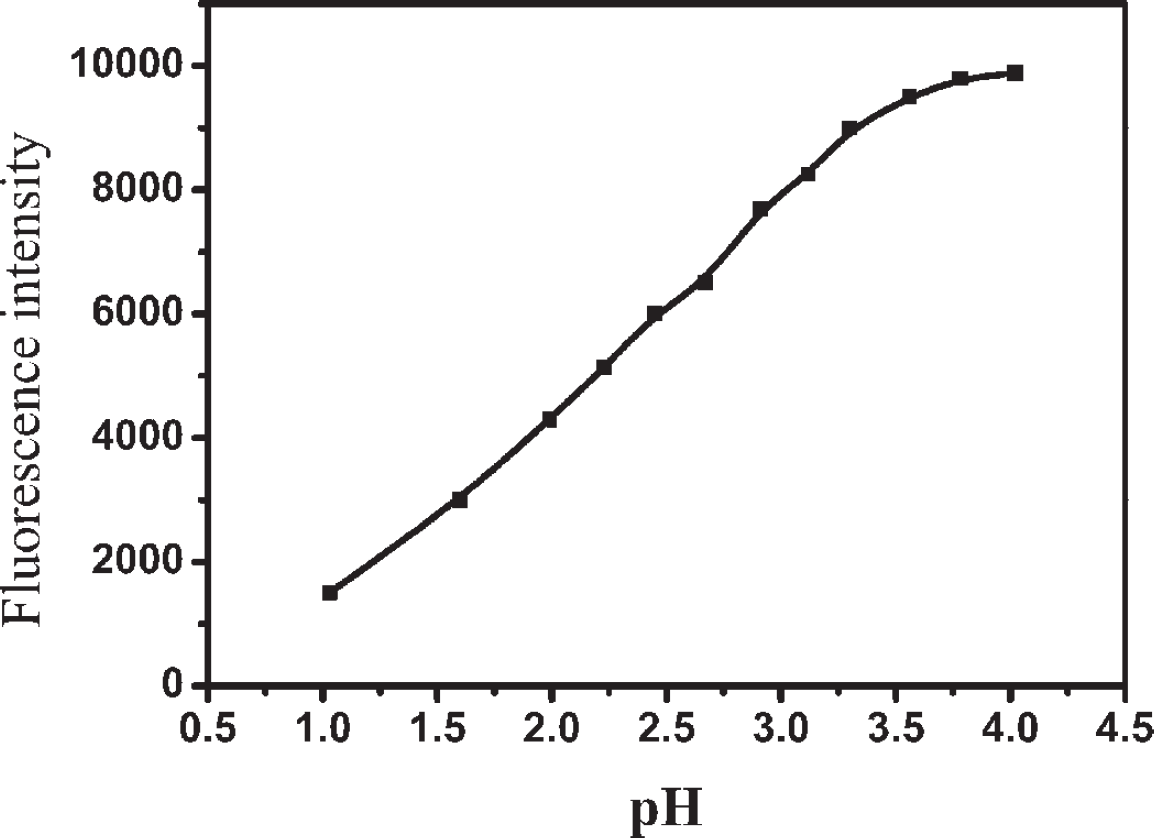
Calibration curve of eosin-CA–modified probe for pH sensing and imaging.
The pH sensing layer was very thin, so it had shorter response times and little influence on the probe's imaging capability. The experiment demonstrated that the probe had clear imaging capability if the distance between analytes and the GRIN lens was in the range of 1 to 3 mm, so the images of analytes were captured when the distal end of the probe was approximately 2 mm distant from the surface of the analytes. The pH value was measured by controlling the xyz-micropositioner to reduce the distance between the analyte surface and the GRIN lens to less than 1 mm, even connected. When the probe was brought into contact with iron or rust immersed in acid buffer solution, the mean fluorescence increased spontaneously due to the reducing of hydrogen ions and returned to its initial value once the probe was moved away from the analytes.
Figures 4a through 4c show the changes of a screw immersed in a pH 2.0 buffer solution. The images were obtained by employing the GRIN lens-based probe and microscope system (Fig. 2) with 4× microscope objective and 16× eyepiece, where the distal end of the probe was placed over the surface of screw. The 3.6-mm-diameter screw with screw pitch of 0.6 mm could be clearly seen from the images (Fig. 4), which demonstrated that the probe had high quality imaging. It can be seen that air bubbles formed quickly (Fig. 4b), gradually grew, and rose in the solution. The change process of the other screw with thick rust cladding is shown in Figs. 4d through 4f, in which the distinct changes of the rust morphology occurred. The thickness of the rust became thin and the color of the rust became weak with time. It can be seen from Figs. 4d and 4e that the external loose rust cladding gradually disappeared and the inner screw gradually emerged. Three air bubbles were produced (Fig. 4b) and grew (Fig. 4c) with time. In this experiment, the chemical reaction equations expected at the surface of the screw and rust are as follows:
Images obtained through the GRIN lens-based probe show the changes of analyte surfaces with time. (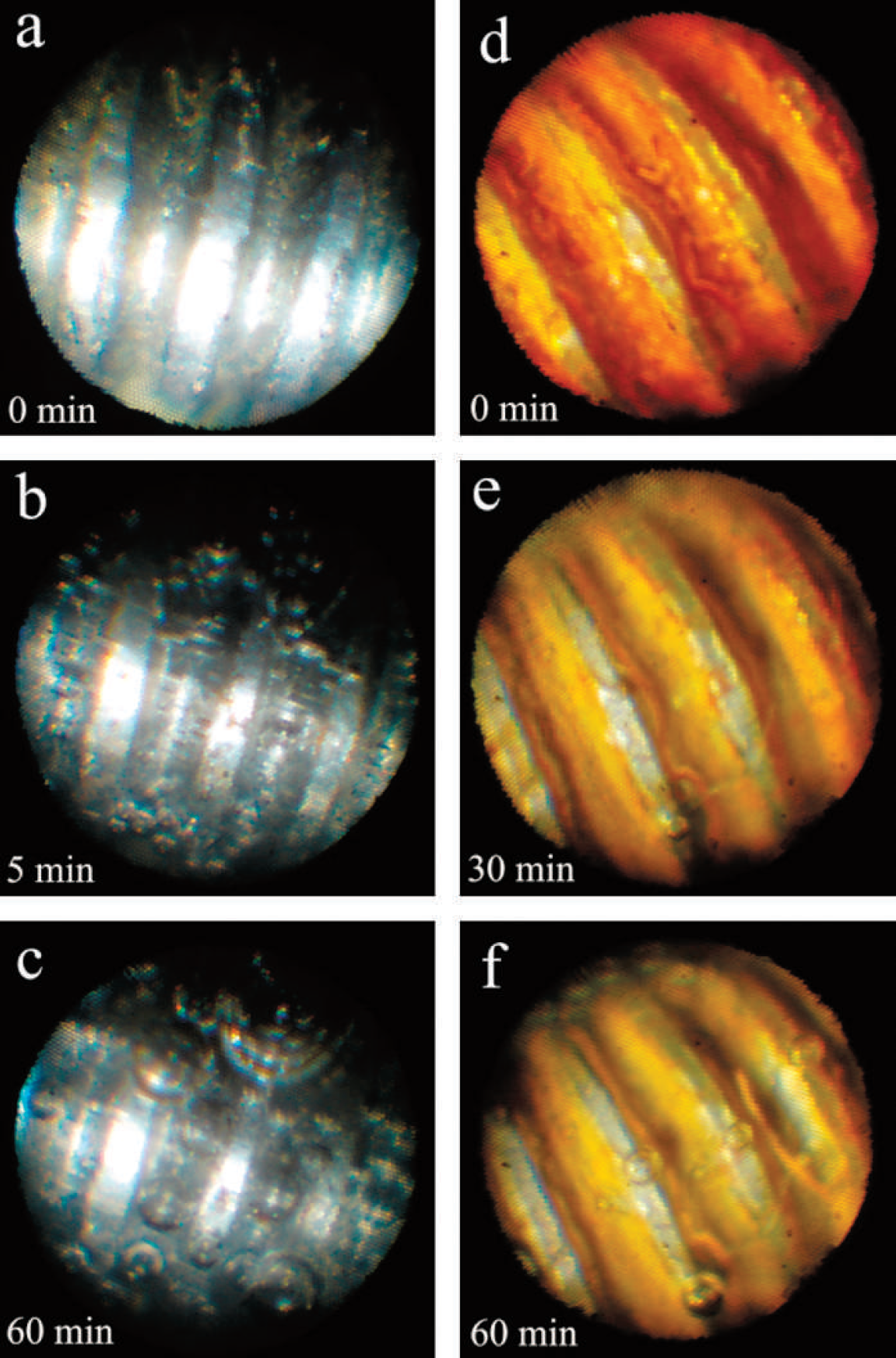


When the iron screw was immersed in acid buffer solutions, the bubbles of hydrogen (Figs. 4c and 4f) were produced from the surface of screw due to the reduction of hydrogen ions, and iron was oxidized to ferrous ion simultaneously (Eq. 1). Rust is a hydrous ferric oxide (Fe2O3·nH2O). When it is immersed in acid buffer solutions, ferric ions and water are produced (Eq. 2).
While the images of the surface corrosion were monitored, the pH values of the metal surface were evaluated simultaneously. Figure 5 shows the pH curves of the analytes immersed in pH 2.0 and pH 2.9 buffer solutions, respectively. As shown in Fig. 5a, the pH value of the iron surface was approximately 2.2, which was about 0.2 pH units higher than that of the pH 2.0 buffer solutions. This result is due to the consumption of hydrogen ions in reaction Eq. 1. Though the air bubbles could be seen after the iron screw had been immersed for 5 minutes in the pH 2.0 buffer solution (Fig. 4b), the pH of the iron surface didn't reach equilibrium immediately after the occurrence of the bubbles (Fig. 5a). This was the result of the diffusion of hydrogen ions. When the hydrogen ions react with the iron, the concentration of hydrogen ions around the iron surface should decrease. However, it could be continuously complemented by the ambient hydrogen ions. This was the process of consumption and complement tending towards a dynamic balance. After 20 minutes, the consumption of hydrogen ions in reaction and the complementarity of hydrogen ions from ambient solution reached equilibrium (see Fig. 5a). Meanwhile, the pH curve became constant.
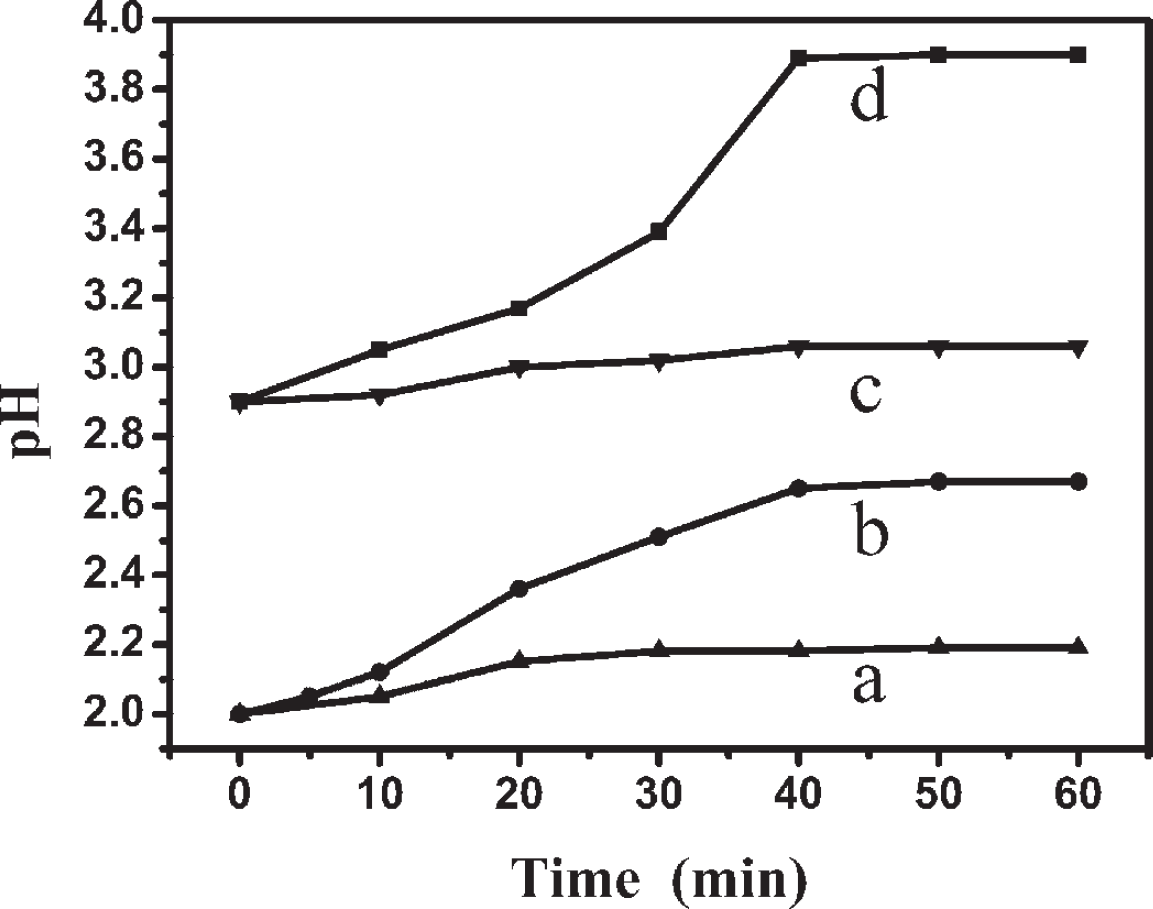
Change of pH with time monitored using the GRIN lens-based probe placed over the surface of the analyte. (
As shown in Fig. 5b, the pH value of the screw with thick rust cladding was rising in the initial 40 minutes, resulting in 0.65 pH units of the rust surface higher than that of the buffer solution. Because the rust (Fe2O3·nH2O) reacted with hydrogen ions, leading to a decrease of hydrogen ions and an increase of water over the surface of rust, the concentration of hydrogen ions was lowered. Comparing Figs. 5a and 5b, it can be seen that the pH value of the rust surface was higher than that of the iron surface. There were three reasons for this. First, the reaction rate of rust with hydrogen ions was faster than that of iron with hydrogen ions according to Eqs. 1 and 2. Second, the structure of rust was loose, which accelerated the reaction rate. Third, the water was produced in the reaction Eq. 2, which also decreased the concentration of hydrogen ions. The pH values of the iron screw and screw with thick rust cladding were also measured in pH 2.9 buffer solutions. In that solution, the pH values of the iron surface and the rust surface were approximately 0.16 (Fig. 5c) and 0.9 (Fig. 5d) pH units higher than that of the buffer solutions, respectively. The four curves of pH change in Fig. 5 demonstrate that rust cladding could consume the hydrogen ions and then decelerate the reaction of iron and hydrogen ions. This conclusion is also shown by the images in Fig.4. As is well known, rust is loose material and it is also permeable to water and air, so rusting continues under the rust layer, finally leading to complete destruction of the iron when the iron is exposed to moist air. However, these experiments indicated that in acid solution, rust could first react with hydrogen ions, leading to a decrease of hydrogen ion concentration and increase of pH, so the iron under the rust layer was protected to some extent by the rust and reduced corrosion rate. The instrument described here enabled the initial stages of corrosion to be visualized and measured. It was helpful for us to further study the metal corrosion. These experiments demonstrated that remote analytes could be imaged and their pH could be quantitatively measured by this technique.
CONCLUSIONS
A GRIN lens rod-based probe and optical system were successfully designed and fabricated for pH sensing and imaging. The instrument was simple and low cost. This technique had the capabilities of measuring pH and capturing the analytes' morphology in remote or otherwise inaccessible places. As preliminary applications, the corrosion behavior of an iron screw and the reaction process of rust were investigated in pH 2.0 and 2.9 buffer solutions, respectively. By employing different indicators, the sensor could be improved to reveal both temporal and spatial details of the pH or other chemical information around analytes. This bi-functional technique could be developed to investigate small body cavities, monitor pH in the stomach, or diagnose cancer without biopsy. Moreover, it has many potential other applications such as solid catalyst catalyzing, environmental monitoring, inspecting pipes for corrosion, and other remote measurements. The probe's resolution was limited by the diameter of the individual cores of the imaging bundle. It may be improved by employing an imaging bundle with smaller cores in the future.
Footnotes
ACKNOWLEDGMENTS
This work was supported by the National Natural Science Foundation of China (project number: 60437020) and the High-tech Research and Development Program of China (No. 2007AA032452).