







Abstract
The attenuated total reflection (ATR) mode in Fourier transform infrared (FT-IR) spectroscopy has been used to detect the sugar transformations of carrots under various storage conditions. The composition of the sugars was assessed by principal component analysis (PCA) and principal component regression (PCR). The changes in the sucrose concentration of the trachea and phloem of the carrot after storage are evident.
Keywords
The quality and taste of vegetables have been topics of interest for many years. In the example considered in this paper, changes in the taste of carrots on storage have been studied. Hasselbring reported that the sugars in carrots are transformed from sucrose to reducing sugars under 0 °C or 4 °C storage. 1
The Niigata prefecture is one of the areas in Japan that receives heavy snowfall. In addition, the accumulated snow in Niigata is wet and heavy, in contrast to “powder snow.” The temperature of the ground under the snow is approximately 0 °C and rarely drops below −10 °C throughout the winter. The technique of storing carrots under the snow has been used for many years in Niigata to improve their flavor. Such storage causes the flavor of carrots to become more sweet and mild than either before storage or when stored in a refrigerator; thus, carrots stored in this way have an increased value. Recently, such storage techniques have become more noteworthy from an environmental perspective because these methods save electric power and avoid contributing to global greenhouse gases.
There are two traditional storage methods using snow that have long been employed in Niigata. One method is the storage of the carrots under the snow without digging them out until spring (this method is called “Yuki-shita” in Japanese, in which “yuki” means snow and “shita” means under), and the other is the storage of carrots in a large snow storehouse near the snow, but not actually within it (this method is called “Yuki-muro” in Japanese, where “muro” means storehouse). The latter method relies on the chilly air from a large amount of stored snow, which results in an atmosphere with a temperature several degrees above freezing and with high humidity. The humidity is the characteristic difference compared with storage in a refrigerator, which has a low humidity. A very large-scale “Yuki-muro” can store snow for approximately one year. Thus far, the changes in flavor caused by storage using snow have been investigated by gas chromatography with the goal of improving the flavor. 2
The taste changes in carrots that are stored using snow are thought to originate from the metabolism of carrots during storage. However, the mechanisms of such changes are not fully understood. Therefore, the study of the transformation and movement of the carbohydrates in carrots under storage is essential.
In this paper, we use mid-infrared attenuated total reflection (ATR) spectroscopy and chemometric techniques to analyze the transformation of the sugars within carrots, which is thought to be one of the main factors causing the changes in taste, under various storage methods traditionally utilized in the heavy snowfall area. In particular, we have focused on distinctions between sugar composition in carrots that are caused by metabolic differences under the different storage conditions.
The samples used in this study were Japanese carrots (Daucus carota L. subsp.) of the “Hamabeni” cultivar that were planted in the Tsunan area in the Niigata prefecture in 2009. “Hamabeni” is one of the standard carrots that can be obtained in retail stores in Japan. The samples were sliced into 5-mm-thick sections and cut into four block-shaped pieces, as shown in Fig. 1a. We cut and measured two positions in the trachea (the center and the slightly inner part of the meristem line) in the sectional plane and two positions in the phloem (the outer part of the meristem line). The measurements were performed on two different pieces for each storage condition to check for reproducibility. To verify the reproducibility of the original state, we also performed measurements on carrots planted in 2010. The length of each carrot is approximately 18 cm, and the cutting position is 4 to 5 cm from the head of the carrot. The storage condition in the refrigerator is approximately 4 °C, with 14% humidity, whereas the “Yuki-muro” storage condition is also 4 °C in temperature, but with 95 % humidity. The “Yuki-shita” storage condition (outer-yard storage) is not well characterized, although Ishihara et al. reported that, in the Tsunan area, the temperature at 0 cm depth in the ground under the snow is 0.5 to 3.0 °C and the temperature at 10 to 20 cm depth under the ground is 1.0 to 2.0 °C. 2 These conditions may be typical of “Yuki-shita.” The storage period of all of the samples is 120 days. After the carrots were taken from long-term storage, they were stored in the refrigerator in the laboratory for several days until our experiments.
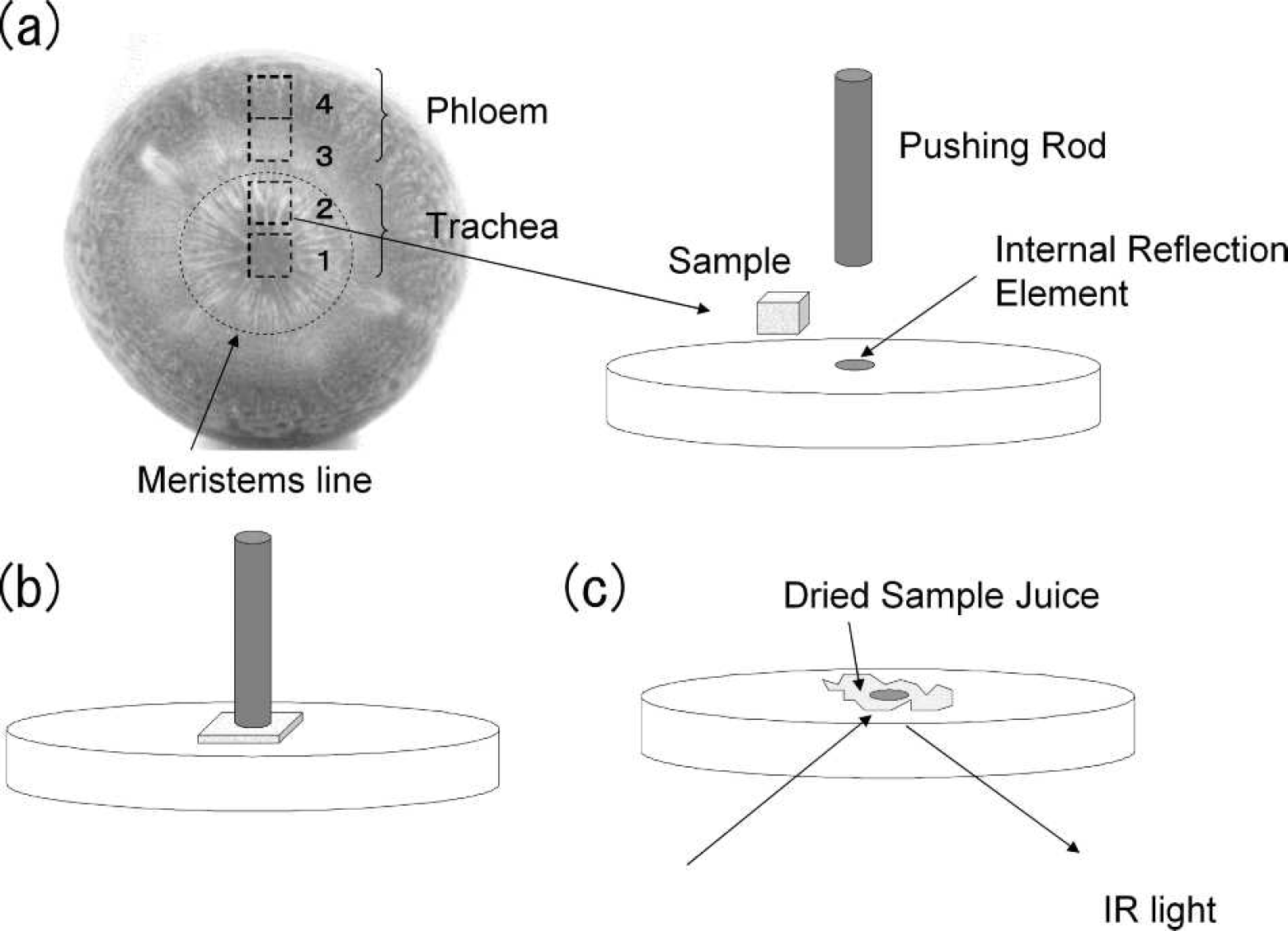
A schematic illustration of the sequence of measurements of ATR spectra of the sugars in carrots. (
The spectral measurements were performed immediately after cutting the sample pieces. The sample was placed onto the internal reflection element (IRE) (Fig. 1a) and crushed by the pushing rod of the ATR accessory (Fig. 1b). After the sample was crushed, it was removed from the IRE. The carrot juice that remained on the IRE was dried by an air dryer without heating for approximately two minutes (Fig. 1c). After this treatment, the ATR spectra were measured. The instrument used in the analysis was a Spectrum One (PerkinElmer) Fourier transform infrared (FT-IR) spectrometer equipped with a deuterated triglycine sulfate detector and the PIKE MIRacle accessory incorporating a Ge IRE; the angle of incidence was 45°. The measurements were performed using a spectral resolution of 4 cm−1 with 16 co-added scans and a zero-filling factor of 2.
Standard solutions of glucose, fructose, and sucrose were prepared from analytical-grade reagents obtained from Wako Chemicals, as these three sugars are the main sugars in carrots. The calibration set was composed of one solution of each sugar, 27 binary mixtures, and 27 ternary mixtures. For each sugar, 2 g was dissolved in 20 mL of pure water. Then, 0.1 mL, 0.2 mL, and 0.3 mL from the solutions were mixed in various ratios, and pure water was added to obtain 1-mL mixed solutions. The ATR spectra of the solutes in the standard solutions were also measured, as shown in Fig. 1c, after being spotted on the IRE and dried.
Spectra were exported from the Spectrum One spectrometer and imported directly into The Unscrambler (v10.0; CAMO ASA, Norway). Models were developed using the spectral region between 950 and 1210 cm−1, in which most of the information regarding sugar composition is located. All of the spectra were normalized to the integrated intensity in this spectral region without baseline correction. We used principal component analysis (PCA) and principal component regression (PCR) to process the data. The calibration for the evaluation of the sugar content ratios was conducted using only the standard solutions.
High-performance liquid chromatography (HPLC) measurements were conducted after filtration with an LC-ELSD (Evaporative Light Scattering Detector) System (Shimadzu) and Shodex Asahipak NH2P-50 4E column in order to estimate sugar content of ground samples.
Figure 2 shows representative ATR spectra of the sugary regions of carrots before storage, after storage in a refrigerator, after storage in “Yuki-muro” conditions, and after storage in “Yuki-shita” conditions for 120 days. The position of each numbered spectrum corresponds to that displayed in Fig. 1a. Figure 2a shows the spectrum obtained from the original carrot before storage. The apparent spectrum of the phloem shows a sucrose-rich spectrum, whereas the spectra at the trachea indicate the presence of mixed sugars. As shown in Fig. 2b, when the carrots were stored in the refrigerator, the relative concentration of sucrose is seen to be lowered in the phloem compared with the original carrot, whereas the relative concentration of sucrose in the trachea of the carrot is seen to be slightly increased. As shown in Fig. 2d, the relative ratios of sucrose in the phloem and trachea of the carrot are at higher levels in the sample stored under “Yukishita” conditions. The results from the samples stored in “Yuki-muro” conditions are intermediate between the results from the samples stored in the refrigerator and those stored under “Yuki-shita” conditions. The changes in the sugar composition are evident when observing the shapes of these spectra.
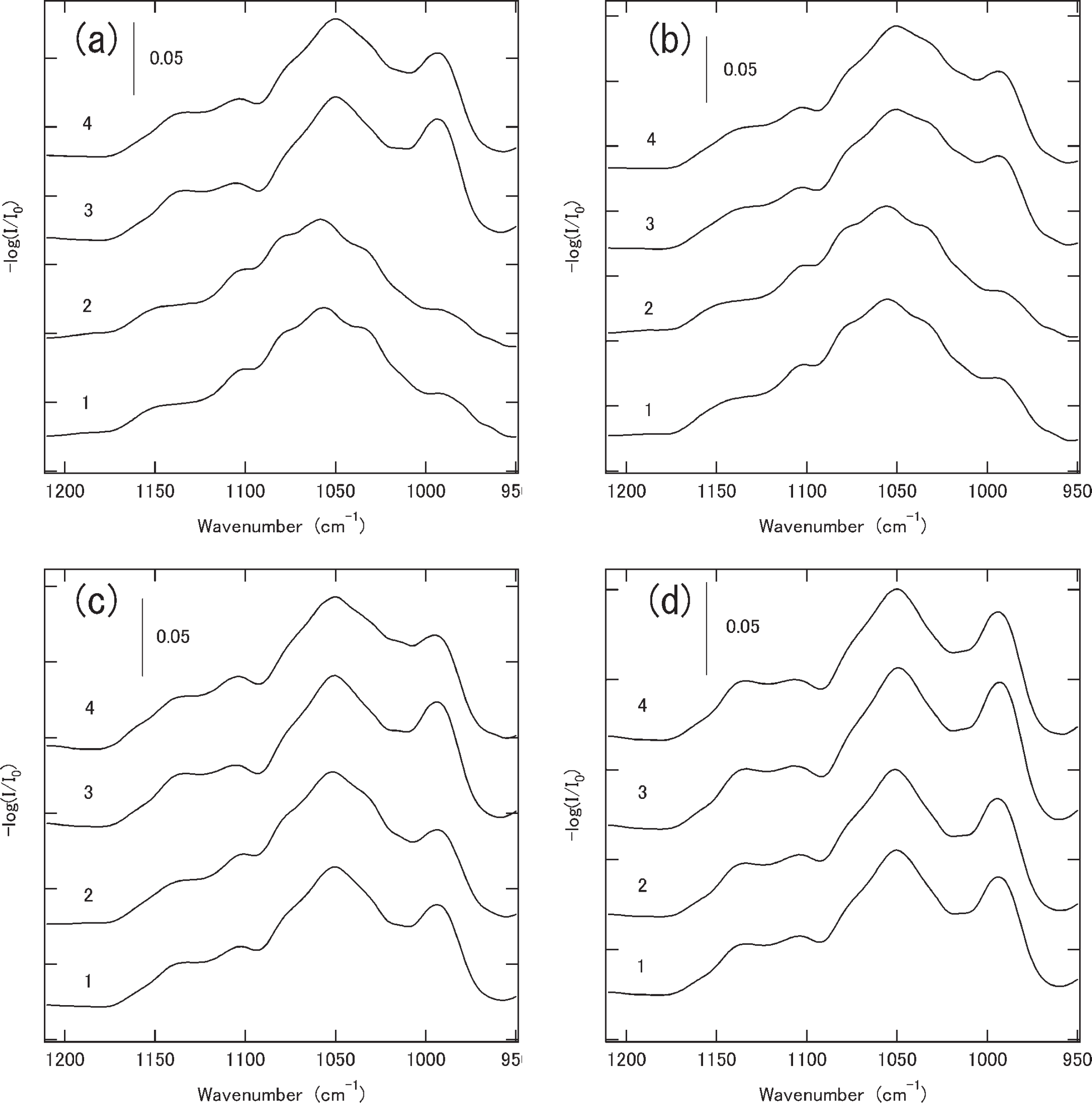
Representative ATR spectra of carrots. (
The analytical methods using chemometrics are shown in many papers.3,–8 In Fig. 3, we summarize the sugar composition ratio obtained from PCR analysis at each position of the sliced sections. The results shown are the mean values of two pieces, but no large fluctuations in the data were observed between the two different pieces in each storage condition. The tendency toward an increasing sucrose ratio in the tracheas of carrots stored under snow is evident.
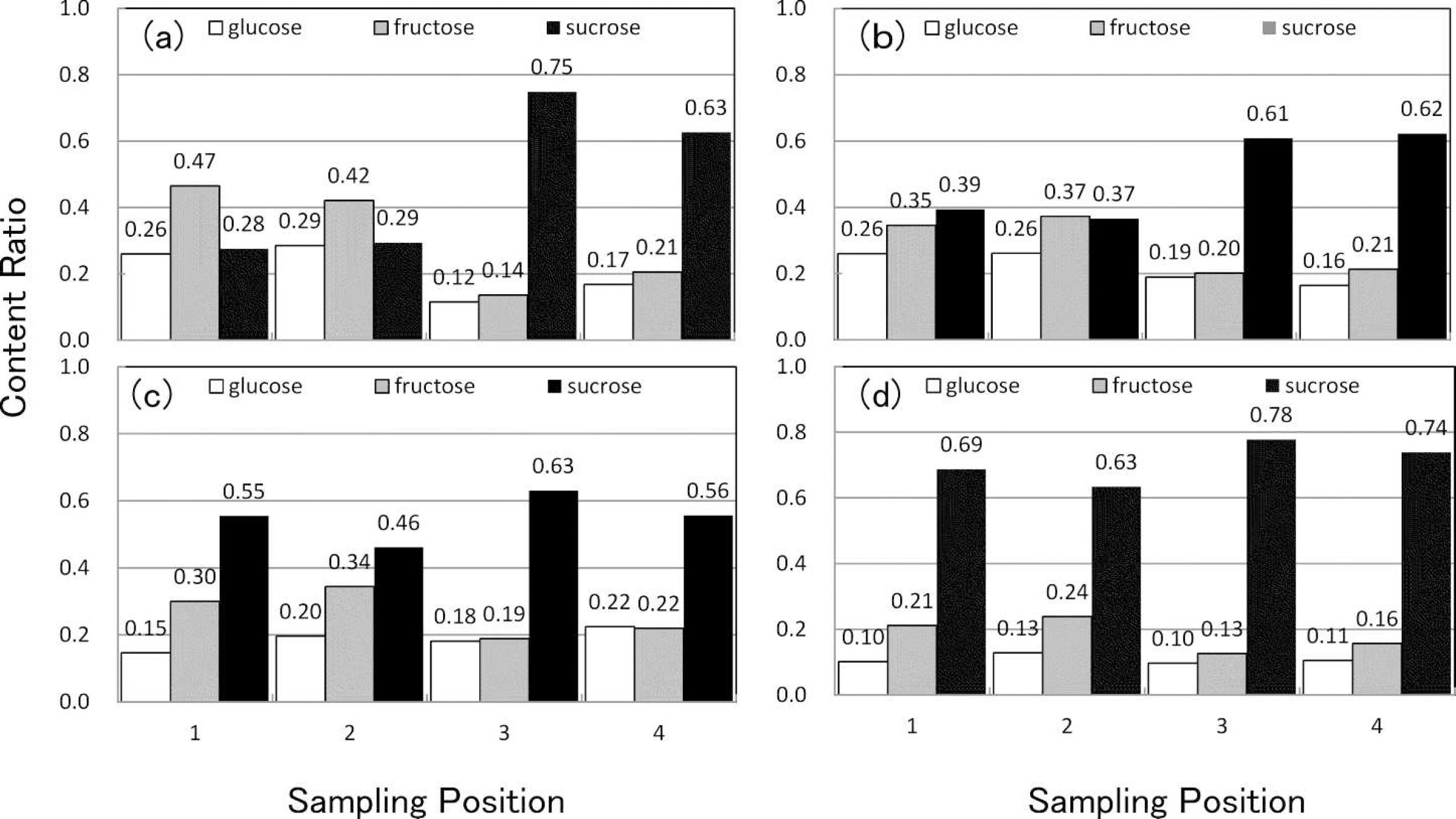
Histograms of the composition ratios of each sugar at different sampling positions. (
In our HPLC analyses, the total sugar increases in concentration 20-30% after 120 days of storage in each of the storage conditions. The concentration of sucrose was greatly increased in the “Yuki-shita” sample, whereas that concentration increased only slightly in the “Yuki-muro” sample and decreased slightly in the refrigerator sample. These results are consistent with the results from the ATR and PCR analyses. In combination with the results from HPLC and mid-infrared spectroscopy, these results allow us to conclude that the transformation to the different types of sugars occurs under different storage conditions. In particular, the evidence of extremely different behaviors in the trachea and phloem parts of the carrot suggests that the metabolism of carrots is strongly influenced by the storage conditions. In other words, the differences in the metabolism of carrots under different storage conditions generate the different tasting carrots. These large differences must be triggered by certain signal substances.
It is difficult to quantify taste, as this property is a matter of individual and personal opinion. However, many people claim that the taste of carrots after storage in “Yuki-shita” and “Yuki-muro” conditions is clearly improved as compared with original and/or refrigerator-stocked carrots. In addition, the taste of carrots from storage in “Yuki-shita” is extremely sweet, whereas that from storage in “Yuki-muro” is somewhat less sweet. Such slight differences in taste are thought to be valuable for targeting consumers. We have conducted our experiments only on the “Hamabeni” cultivar. If we conducted the same experiments on different carrot varieties, the results might be different, forcing us to reanalyze the storage conditions to fit our taste.