







Abstract
Despite the existence of various methods to remove cosmic spikes from Raman data, only a few of them are suitable for process Raman spectroscopy. The disadvantages of these algorithms include increased analysis time, low accuracy of spike detection, or reliance on variable parameters that must be chosen by trial and error in each case. We demonstrate a novel approach to detecting cosmic spikes in process Raman data and validate it using a wide range of experimental data. This new method features a multistage spike recognition algorithm that is based on tracking sharp changes of intensity in the time domain. The algorithm effectively distinguishes cosmic spikes from random spectral noise and abrupt variations of Raman peaks, allowing accurate detection of both high and low intensity cosmic spikes. The procedure is free from variable user-defined parameters and operates reliably in a fully automated manner with a wide range of time-series process Raman data sets containing more than 40 to 50 spectra.
INTRODUCTION
The advent of multi-channel detectors such as charge-coupled devices (CCD) and photodiode arrays had a great impact on the development of Raman instrumentation by enabling much faster analysis. 1 However, these detectors are sensitive to cosmic rays that contaminate the recorded spectra with spurious spikes. These spikes have variable intensities and bandwidths and occur randomly in both time and frequency domains. The random nature of cosmic spikes makes it difficult to filter them out in an automatic and reliable manner. The need to remove cosmic spikes is widely recognized2–10 and dictated by the data processing complications that they cause, especially when univariate analysis is used. Multivariate techniques such as principal component analysis can separate cosmic spikes from Raman peaks, but the principal components of higher orders often remain partially contaminated.
One way to remove cosmic spikes is to acquire two Raman spectra of the same sample. Because of the very low probability of two cosmic rays striking the same detector pixel in two sequential spectra, choosing the lowest intensity value recorded at each pixel or using more elaborate algorithms based on the same idea4,5 results in a spike-free spectrum. This approach is widely used in the spike-filtering software supplied with many commercial Raman spectrometers. Although cosmic filters based on double acquisition are effective and conceptually simple, they double the analysis time and are prone to errors when identical sampling conditions cannot be provided for the consecutive spectra.
Alternative methods of automatic spike removal require hardware modification such as dividing the spectrograph slit into several tracks 6 and analyzing the entire CCD image 11 to detect cosmic spikes. The utility of these methods is very limited due to the necessity of modifying the spectrometer or geometry of the collection fibers and incorporating post measurement data analysis with added detector noise from multiple tracks.
Several mathematical algorithms for cosmic spike detection and removal have been reported.2,3,12,13 Their main disadvantage is an inability to simultaneously achieve full automation and high detection accuracy; this results from a dependence on variable parameters defined by the user and the requirement that cosmic spikes must be much narrower than Raman peaks (which is not always the case in practice). A number of mathematical algorithms have been developed for Raman imaging5,7,8,14,–16 but these are not suitable for other applications.
Process Raman spectroscopy is one application of the technique where existing cosmic filters do not provide satisfactory results. When the chemical composition of a reaction mixture changes rapidly and variable spectral background is present, double spectral acquisition is not appropriate and current mathematical algorithms do not provide the required speed, accuracy, and automation. One of the most well-established spike-removal algorithms for time-series Raman data, the UBS method, 5 uses two variable parameters and is prone to misdetections when the profile of Raman spectra changes over time due to chemical changes in the sample. These misdetections cause disproportionate intensity changes of the most varying Raman bands such that intensities of some bands are reduced while other bands remain intact. The distortion of peak ratios caused by such modifications compromises valuable information in the Raman data. To the best of our knowledge, only two reported cosmic filters have been developed specifically for process Raman spectroscopy. In one of them, 9 a statistical analysis based on second derivatives calculated along the sample (time) axis is used to distinguish cosmic spikes from smooth chemistry-induced spectral changes. Full neighboring spectra are used to correct the contaminated spectra. This algorithm has several disadvantages such as a reliance on two user-defined parameters, an inability to deal with heavily contaminated data sets caused by interferences in neighboring spectra, and a high risk of misdetections due to fundamental limitations of the absolute value of second spectral derivatives as the means of cosmic spike detection. The other method 10 is based on a moving window approach2,3,12,13 and cannot simultaneously provide full automation and high detection accuracy due to difficulties associated with detection of cosmic spikes that have bandwidths comparable with those of strong Raman peaks.
In the present work, we report a fully automated cosmic spike removal algorithm with no variable parameters and exceptionally high detection accuracy, the efficacy of which has been proven with a wide range of batch and continuous flow reaction data.
THE ALGORITHM
Within these conditions, intensities of the Raman bands change rather smoothly from sample to sample, reflecting gradual chemical changes in the reaction mixture. In contrast, a cosmic spike appears as an abrupt and considerable increase in signal at a random location in the spectrum. The probability of another cosmic spike occurrence at the same location in the following spectrum is very low so the increased signal usually falls back to the original baseline immediately. Such behavior is specific to cosmic spikes and is used to distinguish them reliably from smooth intensity variations caused by the chemical process.
Part of the present algorithm was designed to mimic the way we visually judge whether a spike on a Raman spectrum has a cosmic or chemical origin, based on random occurrence of unusually sharp spectral features.
The procedure devised for detecting cosmic spikes consists of the following steps:
The initial Raman data set, comprising a series of consecutive spectra (e.g., Fig. 1a), denoted S(i,j), where i and j are sample numbers and wavenumbers, respectively, is differentiated along the time (sample) axis at each wavenumber separately using a forward difference method:

At each wavenumber, the maximum and the minimum points in the
Step 2 is repeated independently for each wavenumber until the newly identified maximum and minimum values no longer exceed the threshold (Figs. 2b and 2c). The standard deviation values and corresponding thresholds are decreased after each iteration as new outliers are expunged from the data set. The final values of standard deviations for each pixel are saved and will be used later (see next section). Calculating the threshold without the outliers is necessary for maintaining high cosmic spike detection accuracy in heavily contaminated data sets because a single high-intensity cosmic spike can result in a significantly overestimated value of standard deviation that impedes detection of other less intense cosmic spikes at the same wavenumber (Fig. 2a).
When a true cosmic spike has occurred, the intensity change at a specific wavenumber will change over time as illustrated in the top part of Fig. 3a. The differentiated representation of the data is shown in the lower part of Fig. 3a, demonstrating the characteristic positive and negative features. Before the outliers identified in steps 2 and 3 can be labeled as cosmic spikes two additional tests are implemented to improve accuracy of detection:
The first test removes (from the suspicion list) situations where, for pairs of consecutive points in the differentiated data (
The pair of points in D (positive followed by negative) that pass the previous test are subject to another test that checks whether the two points adjacent to the outlier pair are also outliers. The goal is to filter out all sequences of repeated rises and repeated falls in intensity S over time (top parts of Figs. 3f–3h) that would imply that a suspected cosmic spike is not a sudden event but rather a consequence of a more prolonged sequence of significant intensity changes that cannot be caused by a single cosmic ray and therefore should be examined more carefully. The present algorithm is designed to detect single cosmic spikes and such complex sequences of signal variation are removed from the suspicion list.
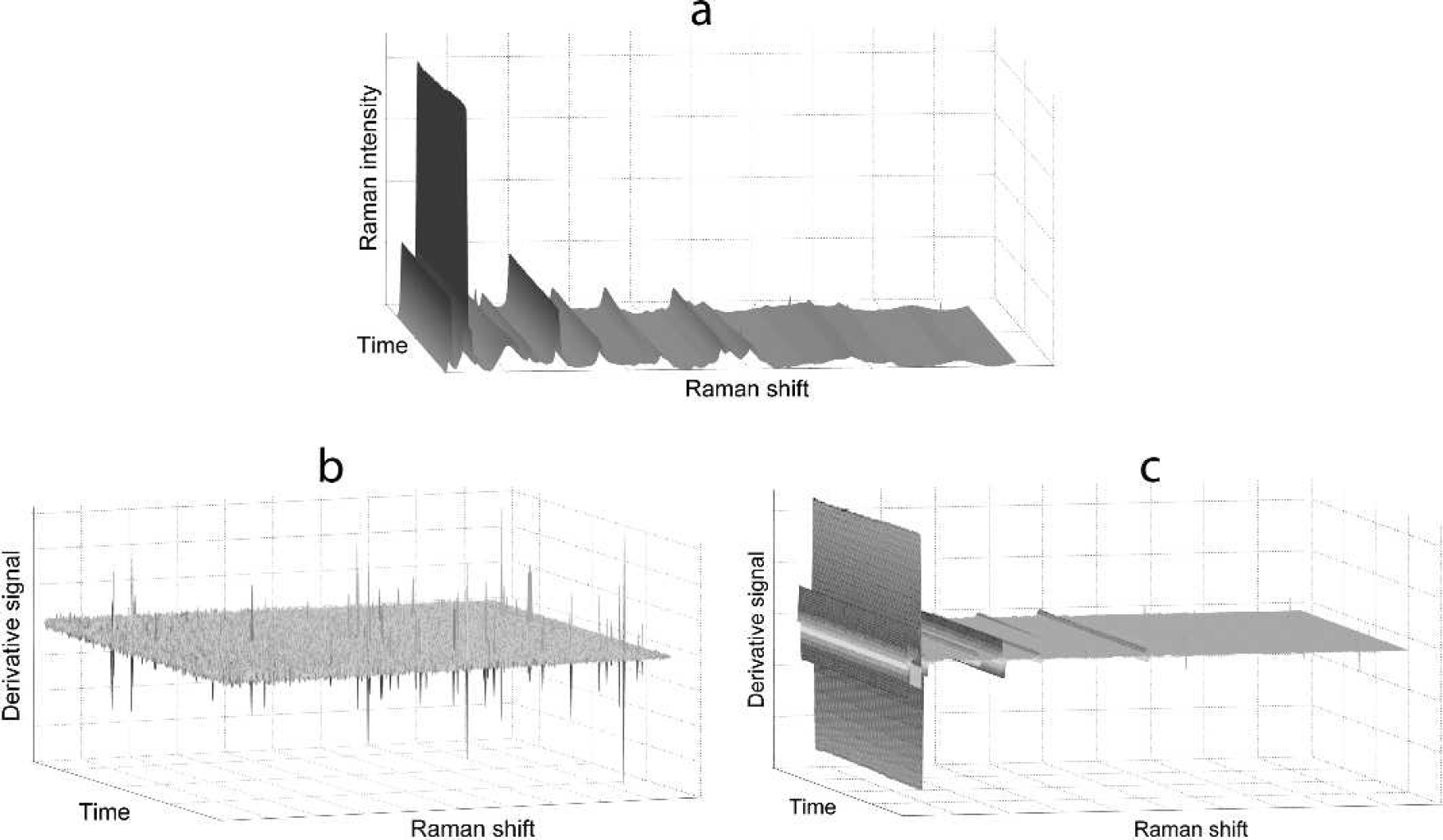
An example of original and differentiated data sets for Raman spectra measured over a period of time: (
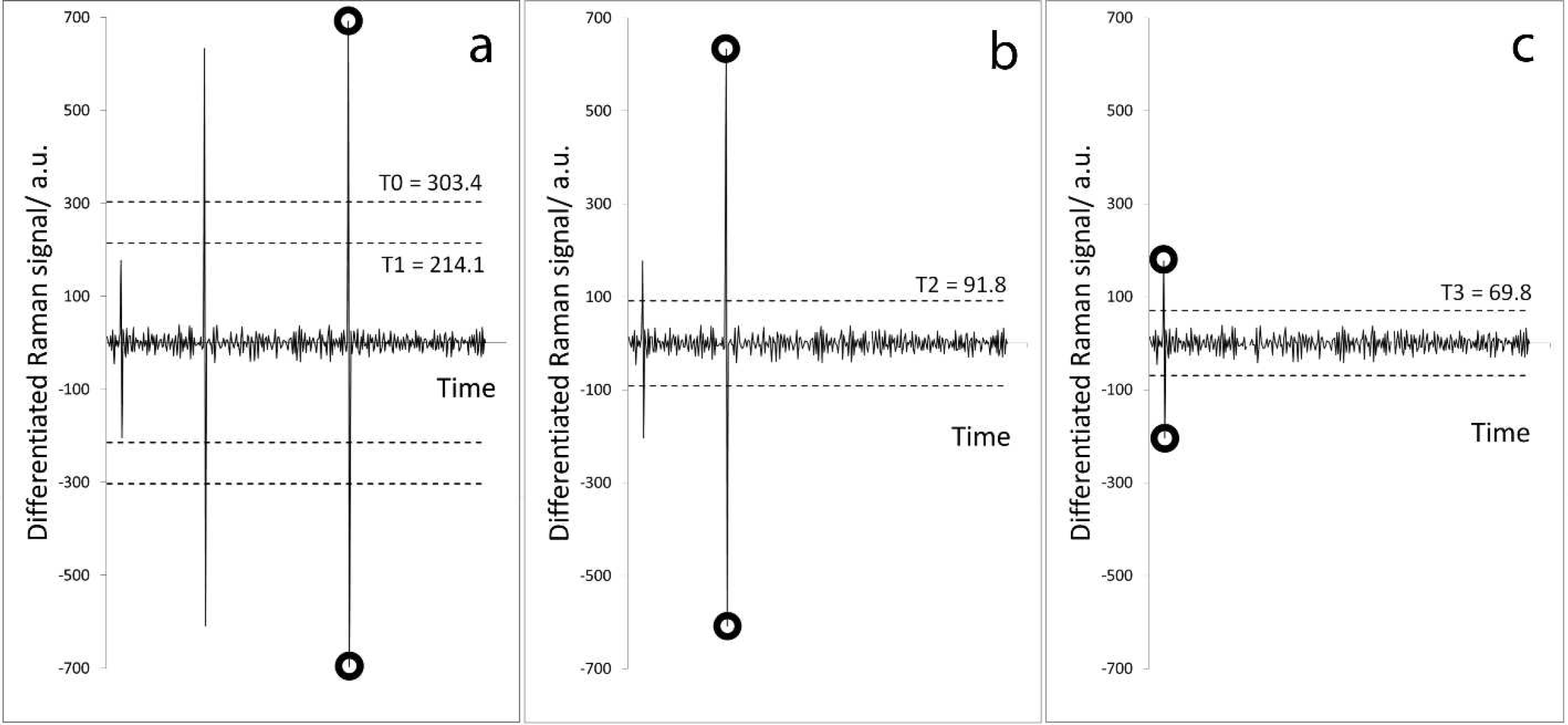
An illustration of the cosmic spike detection process for real data at a selected wavenumber: during the first stage (
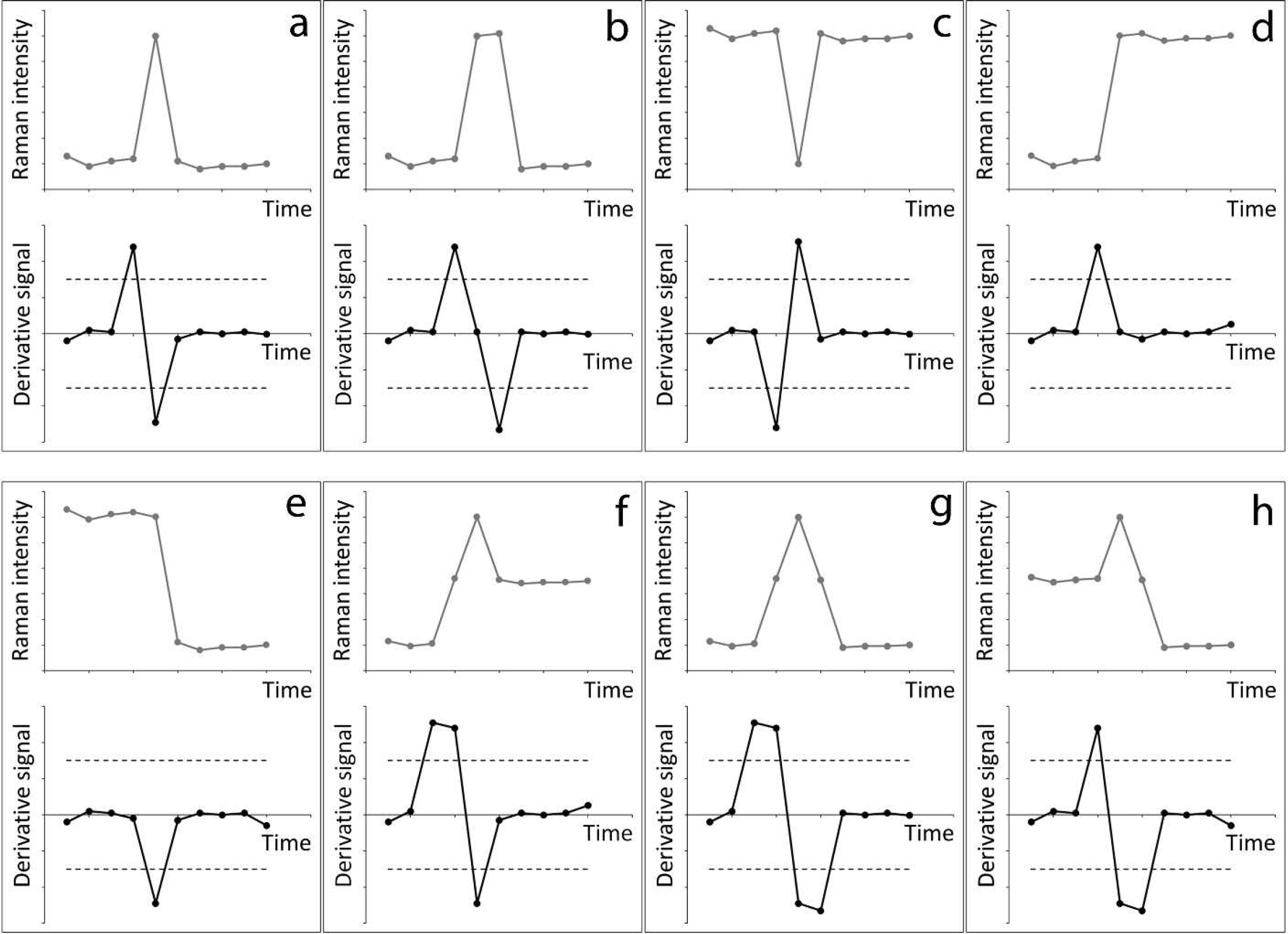
Schematic illustration of cosmic spike detection filters for simulated data. The points correspond to intensity measurements at a single wavenumber over time (top part, shown in grey) and the corresponding differentiated data (bottom part, shown in black). The dotted lines show threshold boundaries. Example (
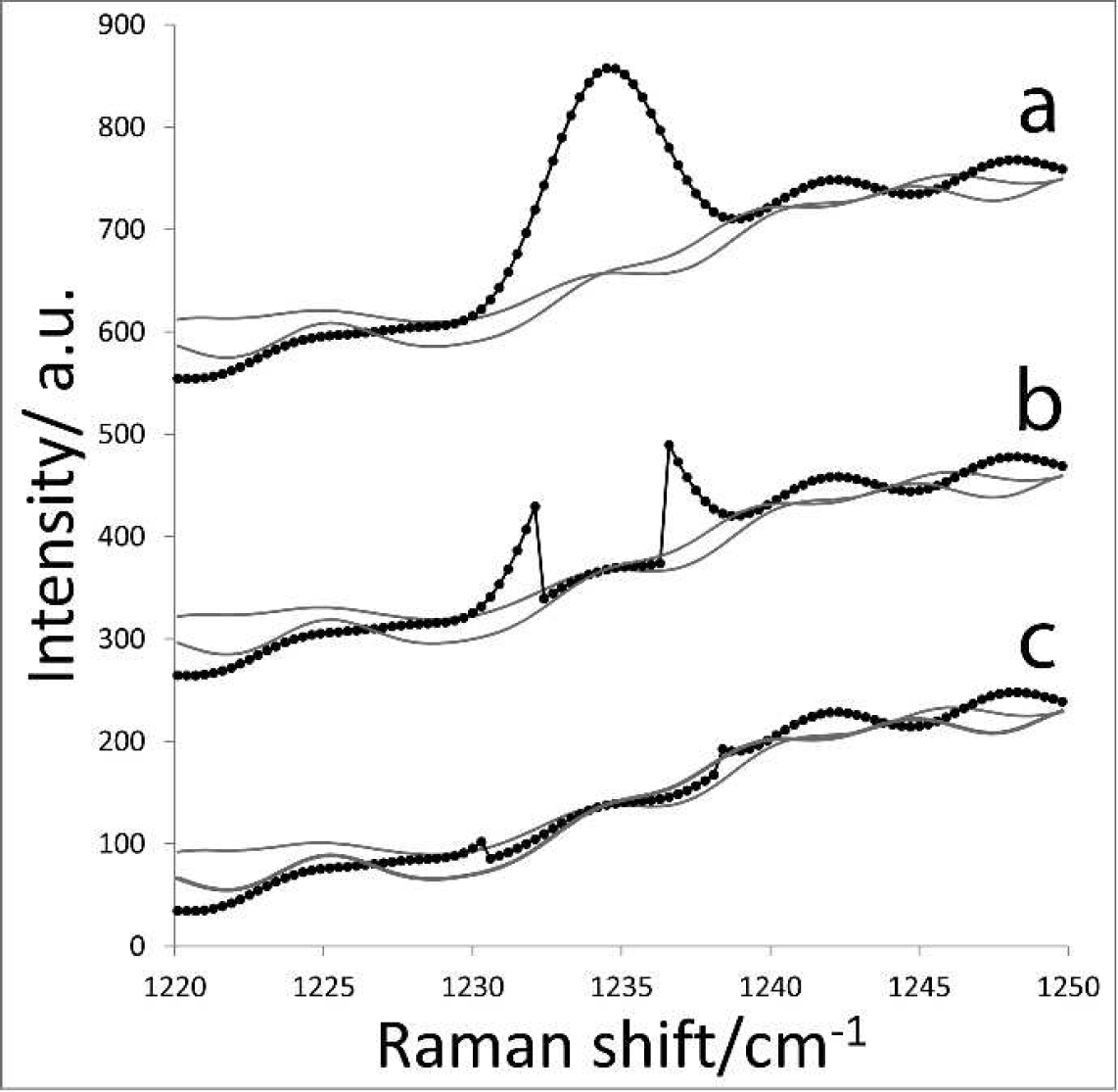
Effect of shoulder extension step on cosmic spike correction. Black line with experimental points shows a spectrum contaminated with a cosmic spike. Gray lines indicate neighboring spectra. (
To extend the detected spike centers to their full widths, the cosmic spike shoulders are located by applying a much lower value of threshold t2(1,j) (e.g., half of the standard deviation instead of four standard deviations) to the
Using a very low threshold causes a substantial presence of false positives (spectral noise) in the resulting matrix. Tests 4a and 4b remove some of the noise, but the main mechanism of separating cosmic spike shoulders from noise is based on rejection of all outliers except for those directly adjacent to the detected cosmic spikes (along the wavenumber axis). Any such pixel that exceeds the low threshold value t2 becomes part of that spike and the matrix of cosmic spikes is updated. Such expansion of the spike boundaries is repeated, pixel by pixel, in a conditional loop, until either the threshold t2 for both neighboring pixels is no longer exceeded or the maximum predefined number of iterations is performed, whichever condition is met first. The maximum number of iterations is set to half the width of the typical cosmic spike to prevent irrelevant extension of the spike boundaries beyond the typical spike width that is a known constant for a given Raman instrument (30 pixels in our instrument). Figure 4c shows the effect of spike extension on improving appearance of the spike-corrected spectrum. The remaining discontinuities on Fig. 4c at the spike boundaries are no bigger than the spectral noise and are not visible when more neighboring spectra are overlaid. These discontinuities are too small to influence the information contained in the spectra. For these reasons further smoothing of the spike boundaries in the corrected spectra were not considered. Note that shoulder correction may not be necessary when apodization is not used. This feature was added to the algorithm to demonstrate its ability to work with interpolated spectra and filter cosmic spikes occupying more than one pixel in the detector.
Once all cosmic spikes have been processed in this way the signal at the contaminated pixels can be replaced using a missing-point algorithm. In the present work, we replaced the contaminated data points with the average signal of two adjacent spectra at that wavelength.
EXPERIMENTAL SECTION (VALIDATION)
The algorithm was tested on the five process Raman data sets listed in Table I. All Raman spectra were obtained using an Rxn-1 Raman spectrometer (Kaiser Optical Systems) and 250 mW of 785 nm laser excitation with either an immersion ballprobe 17 (data set 1) or a specially designed probe for microfluidic applications 18 (data sets 2–5). The immersion ballprobe was fitted to an MR Filtered Probe Head (Kaiser Optical Systems). In all cases one excitation and one collection fiber were used for spectral acquisition.
Summary of the Raman data sets used to validate the cosmic spike filter.
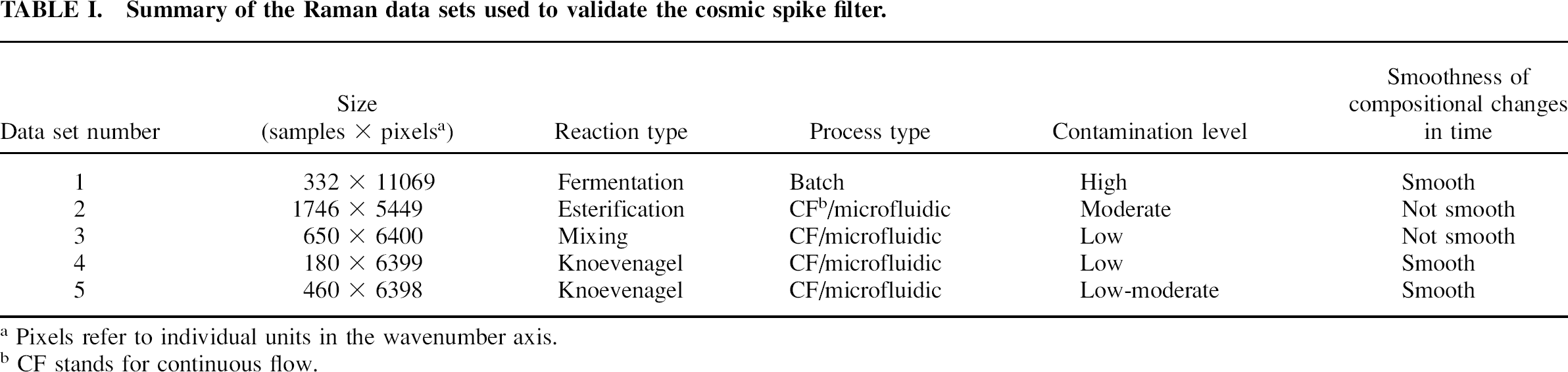
Pixels refer to individual units in the wavenumber axis.
CF stands for continuous flow.
The data sets were selected to study the utility of the cosmic spike filter in a variety of typical process types:
is a heavily contaminated Raman data set obtained from batch fermentation of glucose. Its variable baseline was used to study the effect of background variations on the filter performance. Data set 1.1 will represent the original data and 1.2 will represent the data after removing the background using the curve-fitting procedure 19 with a 6th-order polynomial baseline rejection method.
is an acid-catalyzed esterification reaction between methanol and acetic acid carried out in continuous flow. The reaction was studied at four different flow rates that were dynamically changed in a step-wise manner. The steps caused fast compositional changes in the signal collection volume that could potentially lead to misdetection of cosmic spikes. To make these changes more pronounced, data set 2 was modified by selecting 30 consecutive spectra at each flow rate and adding them together as shown in Fig. 5. This represents a realistic situation where a sample is measured at a series of different conditions (or when there are different sets of samples with different compositions) without any intermediate data points. The original data set is denoted as 2.1 and the modified data set as 2.2. The modified data set consists of 210 spectra.
refers to intermittent pumping of methanol and acetic acid into a microreactor with 5 min intervals (5 min “on” and 5 min “off”). Abrupt resumptions of pumping caused sharp peak-shaped compositional changes in the flow that were detected with Raman spectroscopy. This data set is an example of a process where very fast changes of Raman peak intensities resemble the characteristics of cosmic spikes and thus could be misinterpreted by the algorithm. It usually occurs in continuous flow systems with unstable pumping or other sources of instability.
is monitoring of a continuous flow Knoevenagel condensation reaction in a steady state. In contrast to data set 3 the chemical composition in the reaction mixture varied in a smooth but random manner due to mixing instabilities. Low contamination of this data set with cosmic spikes is useful to evaluate the ability of the cosmic spike filter to distinguish cosmic spikes from noise and repeated spectral changes.
is the same Knoevenagel condensation reaction implemented in a “flushed steady-state” methodology 20 that assumes fast analysis of a rapidly flowing media with a compositional gradient along the flow path. This gradient mimics situations where chemical composition of the reaction mixture changes continuously and rapidly, causing significant differences between adjacent Raman spectra within the data set.
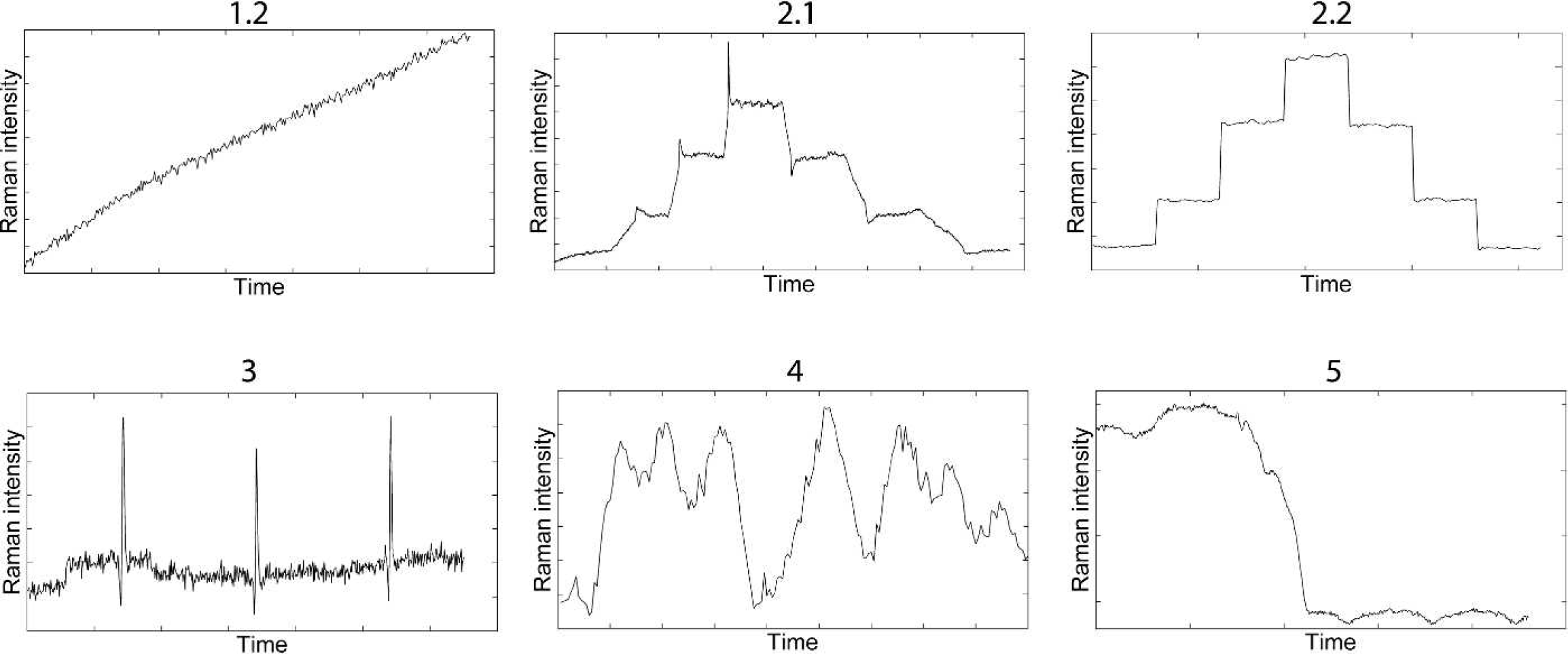
Plots of intensity versus time for the most variable Raman peak in each data set indicating the dynamics of compositional changes (see Table I). The following Raman peaks were used: 879 cm−1 for data set 1.2, 893 cm−1 for data sets 2.1 and 2.2, 1030 cm−1 for data set 3, and 1601 cm−1 for data sets 4 and 5.
The challenges for the cosmic spike filter were to correctly detect cosmic spikes in all of these very diverse data sets and to distinguish the cosmic spikes from the inherent spectral noise and Raman band intensity variations to preserve the valuable chemical information recorded in the Raman spectra. Furthermore, this should be achieved in a completely automated way, without the need to modify or preset any parameters.
To illustrate the importance of all cosmic spike recognition steps with regards to spike detection accuracy, three variants of the original algorithm were created, each being deprived of at least one functional feature related to cosmic spike recognition:
Modified algorithm A: standard deviations σ in steps 2 and 3 are calculated without removing outliers from the data set; tests 4a and 4b are applied.
Modified algorithm B: σ is calculated as described in steps 2 and 3; test 4a is applied; test 4b is not applied.
Modified algorithm C: σ is calculated as described in steps 2 and 3; tests 4a and 4b are both not applied. Any positive point in the
RESULTS AND DISCUSSION
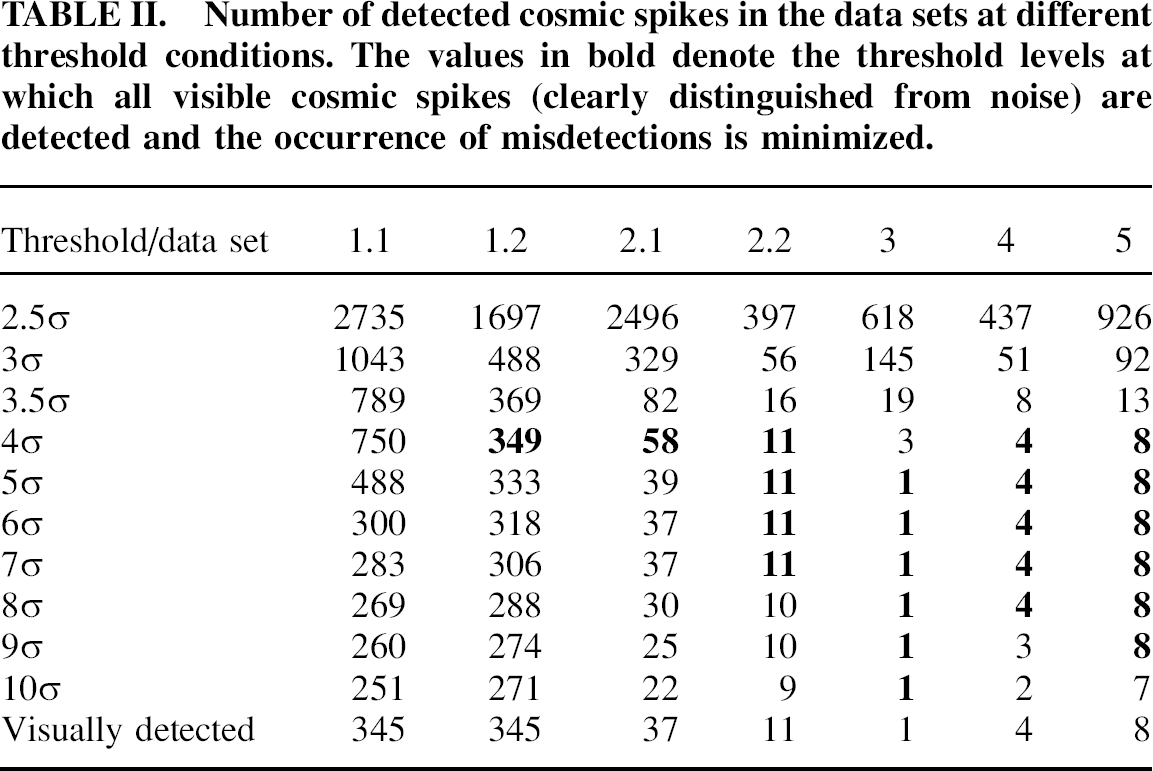
Table II shows the effect of threshold factor on the number of spikes found by the algorithm in the tested data sets. According to the table, all tested data sets require a minimum threshold of 4σ in order to minimize misdetections, while the upper threshold limit varies between the data sets. For data sets 1.2 and 2.1, which contain a large number of cosmic spikes, a threshold value of 4σ is most optimal. For the data sets with low spike abundance (2.2, 3, 4, and 5), the range of optimal thresholds extends up to 10σ, typically starting from 4σ or 5σ.
Number of detected cosmic spikes in the data sets at different threshold conditions. The values in bold denote the threshold levels at which all visible cosmic spikes (clearly distinguished from noise) are detected and the occurrence of misdetections is minimized.
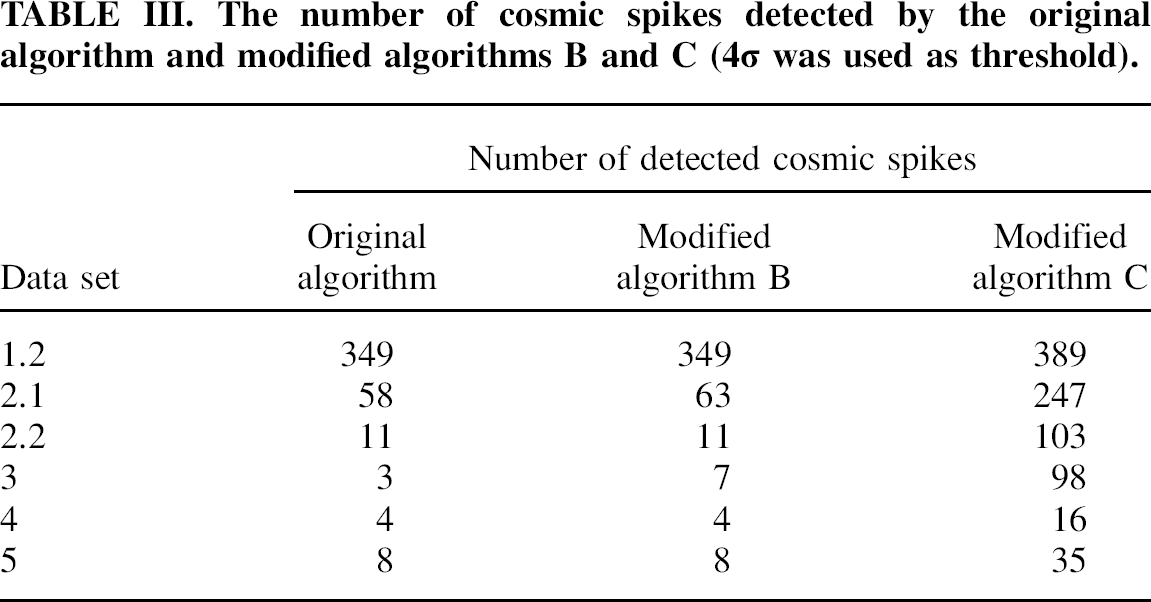
The number of cosmic spikes detected by the original algorithm and modified algorithms B and C (4c was used as threshold).
Note that in data set 2.1 a threshold value of 5σ seems to be more optimal than 4σ due to an apparently smaller number of misdetections (39 is closer to 37 than 58). However, the table does not show that clearly visible cosmic spikes were missed at 5σ in this data set. By reducing the threshold to 4σ the missed spikes were detected although at the expense of adding more misdetections to the results.
Given that mistaking spectral noise for cosmic spikes does not cause any significant damage to the information content and that some misdetections of this type are statistically expected in all data sets, it is reasonable to ease the requirements for threshold selection and consider the possibility to find a common optimal threshold for all tested data sets. The data in Table II suggest that 4σ can be used as the common optimal threshold; it ensures detection of all visually noticeable cosmic spikes and only a low chance of misdetecting spectral noise for cosmic spikes.
It is important to note that Table II is generated with fairly large steps between threshold values. Additional values between existing points (such as 4.2σ, 4.5σ) could have been added and the result discussed in more detail. However, the present level of detail is consistent with some uncertainty in judging the origin of spikes when their intensities are comparable with spectral noise and the low importance of completely avoiding misdetections. By suggesting an optimal fixed threshold value of 4σ without comparing it with other values in the range 3.5σ−5σ we acknowledge that (1) the best threshold may be slightly different depending on the data set and, importantly, (2) that there is little or no benefit to optimize it to higher precision than has been demonstrated here. Assuming that all variations in the data set are normally distributed (which is a very approximate model when expecting possible baseline correction artifacts and chemistry-induced intensity variations), 4σ corresponds to a reasonable boundary that represents (a) humans' ability to visually see an outlying spike, (b) a fairly low statistical expectation of outliers (spectral noise) above this boundary, and (c) a window within which cosmic spikes have a negligible potential to notably distort the data.
The ability of the present algorithm to perform effectively with a wide range of data types without changing the threshold is unmatched by other cosmic correction methods. This can be explained by the use of a derivative prior to calculating the signal variation and performing these calculations independently for each wavenumber.
It is also worth noting that baseline variations in data set 1.1 have a significant effect on the algorithm's fidelity. Table II reveals a large number of misdetections that occurred by applying the algorithm to data set 1.1 with thresholds 4σ and 5σ. Finding a more acceptable threshold may not always be possible for such data sets, especially when the baseline fluctuates in a random or unpredicted manner. Therefore, it is necessary to perform a correction of the variable baseline before using the cosmic spike filter.
Application of modified algorithm A to the other data sets produced similar or identical results to those obtained with the original algorithm, which can be explained by the low level of contamination in these data sets, i.e., the absence of any wavenumber affected by more than one cosmic spike.
These results demonstrate that excluding outliers from standard deviation calculations is essential for the filter to correctly detect multiple cosmic spikes on one wavenumber and to ensure independence of the result from other significant outliers regardless of their origin.
These exceptions include significant but repeated signal changes, as well as step increases or decreases in intensity caused by compositional changes in the signal collection volume. In continuous-flow processes, these variations occur due to mixing/pumping instability (data sets 3 and 4), step-wise modifications of flow rate (data sets 2.1 and 2.2), and changes in temperature or other conditions (data sets 1 and 5). In batch reactions, fast variations of spectral response can be caused by thermal effects, dilution, or addition of reagents to the reaction mixture during the process. The algorithm's ability to distinguish cosmic spikes from the effects of such variations on Raman spectra is necessary to prevent loss of important process information while using the cosmic spike filter.
The present algorithm is designed to retain the pertinent chemistry-related information in Raman spectra while removing the cosmic spikes by performing four independent tests for each suspected spike. Firstly, a strong rise in the Raman intensity is detected. Secondly, it is confirmed that the signal returns to the expected value in the following spectrum. In the third and fourth tests, spectra recorded before and after the suspected spectrum are assessed to identify repeated increases and decreases in intensity at the selected wavenumber. This multi-step approach allows cosmic spikes to be effectively distinguished from process/chemical variations, as illustrated by the results in Table III where the effects of applying the original and modified algorithms to the tested data sets are compared.
Comparison of the number of spikes found by the original algorithm and algorithm C provides information about the aggregate importance of tests 4a and 4b. The difference in the results between algorithms B and C indicates the contribution of test 4a. And finally, algorithm B in comparison with the original algorithm shows the importance of test 4b.
The significantly higher number of misdetections obtained with algorithm C compared to those of algorithm B highlights the importance of test 4a in distinguishing cosmic spikes of lower intensity from random spectral noise.
The role of test 4b is revealed by comparing the results obtained with the original algorithm and algorithm B. These results are different only with data sets 2.1 and 3, which contain abrupt peak-shaped changes in Raman band intensities that can be easily confused with cosmic spikes. Therefore, test 4b is not important in data sets with smooth variations in the sample composition. However, it greatly reduces the risk of mistaking abrupt intensity variations for cosmic spikes, which is very useful in continuous flow systems with high pumping instability.
To study this effect, 13 data sets with different numbers of samples were generated by selecting the first n spectra from data set 1.2, where n changed incrementally from 5 to 200. The original algorithm was applied to each of these sub-sets and the number of detected spikes was compared with the number of cosmic spikes found by the reference method. The reference method involved applying the original algorithm to the full data set 1.2 and determining how many detected cosmic spikes were found in the corresponding first n spectra. Ideally, these numbers should be the same or similar. However, the results show that this is not always the case. According to Fig. 6, as the number of samples is reduced to 40 or lower the algorithm generates an increasingly higher number of misdetections. This observation suggests that the algorithm is universally applicable to Raman data sets with no less than 40 to 50 spectra. For smaller data sets, the threshold value has to be increased.
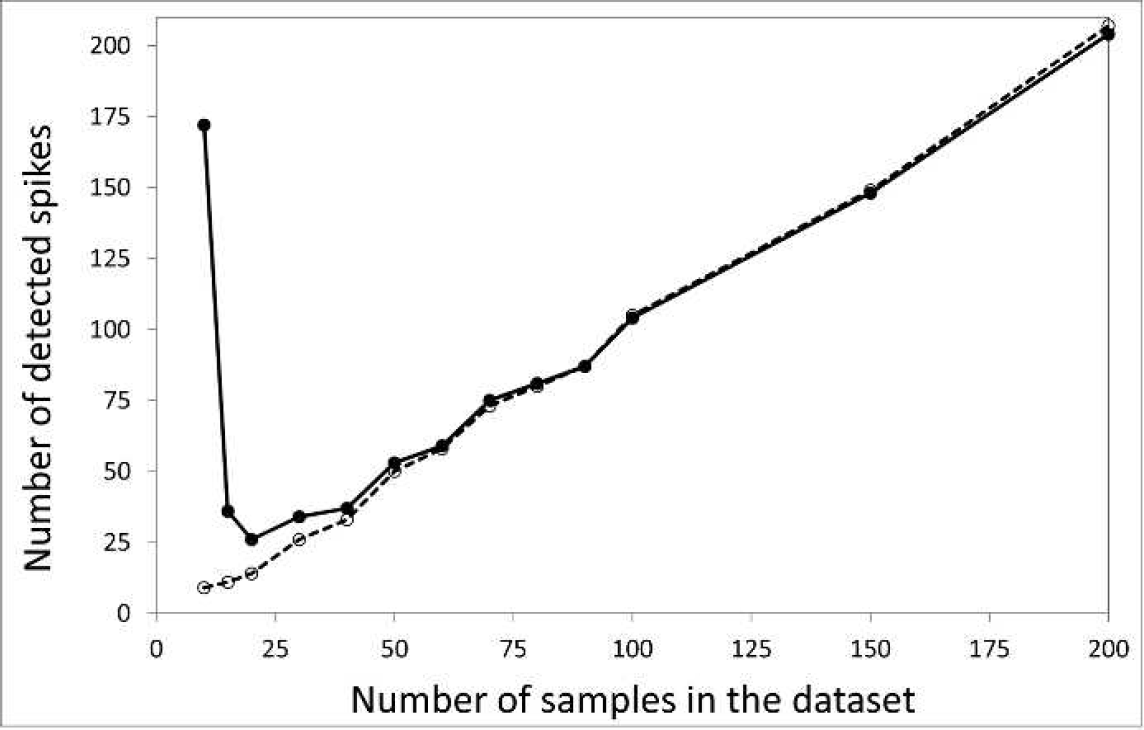
Effect of data set size on the algorithm accuracy. The solid line shows the number of detected spikes in individual sub-sets and the dashed line represents the number of cosmic spikes found from the full data set.
CONCLUSIONS
A novel fully automated algorithm for detecting cosmic spikes in process Raman data sets has been developed and validated using a wide range of experimental data. A unique multi-stage spike recognition process has been shown to provide exceptional efficiency in distinguishing low-intensity cosmic spikes from random spectral noise and variations of Raman peaks. The algorithm operates reliably without any user-defined parameters for data sets containing more than 40 to 50 spectra. Given the wide range of data types used to test the algorithm, it has the potential to be applicable to any process Raman data set without modifications, even if it contains step-change variations in the intensities of Raman peaks. It takes less than 3 seconds for an ordinary computer to process a million data points, offering the possibility of fast automatic removal of cosmic spikes in real time. Although the real-time detection will have to be delayed by one or two spectra that are necessary for the correct identification of cosmic spikes, the effect of this delay can be reduced by increasing measurement frequency.
Footnotes
ACKNOWLEDGMENTS
SM was supported by the Scottish Funding Council, Centre for Process Analytics and Control Technology (CPACT), Center for Process Analysis and Control (CPAC), the University of Strathclyde, Mac Robertson fund, and Royal Society of Chemistry. The Royal Society is thanked for the award of a University Research Fellowship to AN. The authors are grateful to Wes Thompson and Shannon Ewanick for acquiring the fermentation data, and Tom Dearing, for useful comments during preparation of the manuscript.