







Abstract
In continuation of our contribution to “The Axial Transfer” (Appl. Spectr. 2012. 66(8): 934–943), this paper describes the distribution of localized incident radiation in multiple scattering layers of arbitrary thickness and analyzes the lateral intensity profiles of radiation leaving the sample from its illuminated and non-illuminated surfaces. The theoretical profiles are calculated with different approximations of the equation of transfer. We derive for both non-absorbing and absorbing layers simple analytical expressions and verify their accuracy and range of applicability by comparison with Monte Carlo simulations. Particular emphasis is given to the analysis of the radial absorption, an under-theorized and under-investigated feature that can help to identify weak or hidden absorbers. In addition, we contribute to the description of how the radial reflectance is affected by anisotropy or by error sources like multiple surface reflection for samples in glass cells or deflectance (sideway loss) of radiation in small samples. Finally, the theoretical results are compared with experimental data of radial reflectance for quasi non-absorbing and absorbing powder layers.
Keywords
INTRODUCTION
The radial spread of radiation remitted from multiple scattering materials is of essential importance in high-resolution optical imaging. Examples are found in the fields of half-tone printings where the absorption of a pigment dot increases by acceptance of scattered radiation from outside the dot,1,2 emulsion photographs where the formation of halos reduces the image contrast,3,4 and tomography of buried objects where scattering controls the ultimate microscopic resolution. 5
One begins to understand scattering of packed particles from basic electromagnetic theory.6,–9 However, geometrical optics based on Chandrasekhar's equation of Radiative Transfer (CRT)10,11 is still the most widely used approach to multiple scattering. Soon after publication, the model was applied to calculate the interaction with point or line sources of irradiation localized inside or at the surface of the diffuser.12,13 The calculations were extended to collimated light beams penetrating the diffuser normal to the surface14,–17 and the results were experimentally tested using e.g., fiber optics technology. Theoretically, the radial reflectance curves are mainly evaluated with the classical diffusion approximation of radiative transfer (DRT) or with a cubic lattice model using fixed mean scattering and absorption lengths. 18 These methods deliver reasonable results for the far distance range. The near range needs more sophisticated solutions of CRT, which can be achieved e.g., by series expansion into higher order spherical harmonics,19,20 by MC-simulations or by statistical photon density calculations. 21 The importance of the near distance range becomes evident if one realizes that half of the lateral reflectance arises from optical distances σρ < 3 (for definition of symbols see Table I). Thus, the reflectance analysis of packed substrates with typical scattering coefficients of σ = 102 −103 cm−1 requires resolution beyond the limits of fiber optics. The corresponding equipment has been developed for medium 22 and strongly 23 scattering materials.
Definitions of some symbols
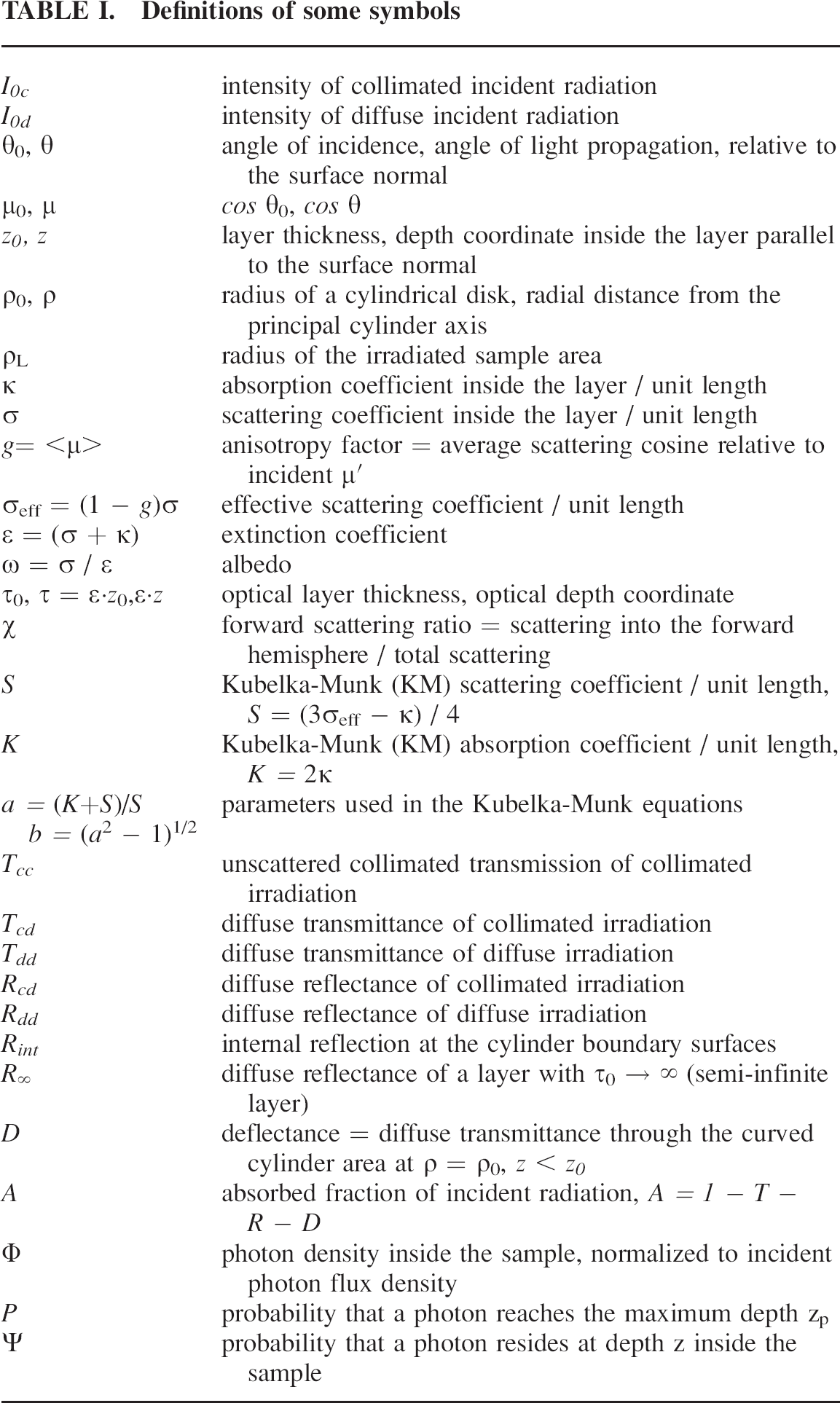
In continuation of our contribution to “The Axial Transfer”, 24 this paper describes the distribution of localized incident radiation in multiple scattering layers of arbitrary thickness and analyzes the lateral intensity profiles of radiation leaving the sample from its illuminated and non-illuminated surfaces. The theoretical profiles are calculated with different approximations of the equation of transfer including deconvolution from the profile of the excitation source. These procedures are very elaborate and one of our main objectives is to find analytical approximations that are simple, but precise enough for practical applications. We especially emphasize the importance of signal detection with radial offset from excitation as a feature to discover buried species not only by diffuse reflectance absorption but also by Raman emission, for example.25,26
The theory of radial absorption is not yet fully developed and we experimentally contribute to this field by the analysis of radial-resolved reflectance spectra. In addition, we contribute to the description of sources of errors like multiple surface reflection of samples in glass cells or deflectance (sideway loss) of radiation in small samples such as pharmaceutical tablets.
THEORY
Definitions, symbols, and most of the photometric equations are adopted from Part I. 24 In the interest of readability, we report the symbols in Table I as well.
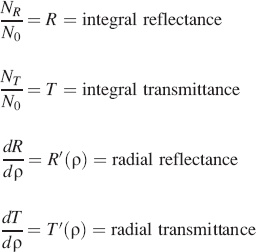
In the following section, the layer is irradiated with a narrow collimated or diffuse beam centered at ρ,z = 0. The reflectance (transmittance) is evaluated as a function of the distance ρ from the irradiation center. With N0 = number of incident photons, and NR (NT) = reflected (transmittted) photons we use the following relations:
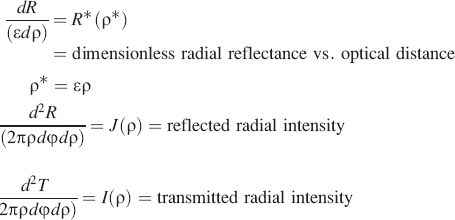
From Beer's law and geometrical factors, one obtains for the emitted (M) radial reflectance at distance ρM = (xM
2
+ yM
2
)1/2 from the center of excitation (X)

where Φ(ρX,z) is the photon flux density of primary and secondary excitations inside the layer as a function of the sample depth z and the radial distance ρX = (xX2 + yX2)1/2 from the axis of incidence, and
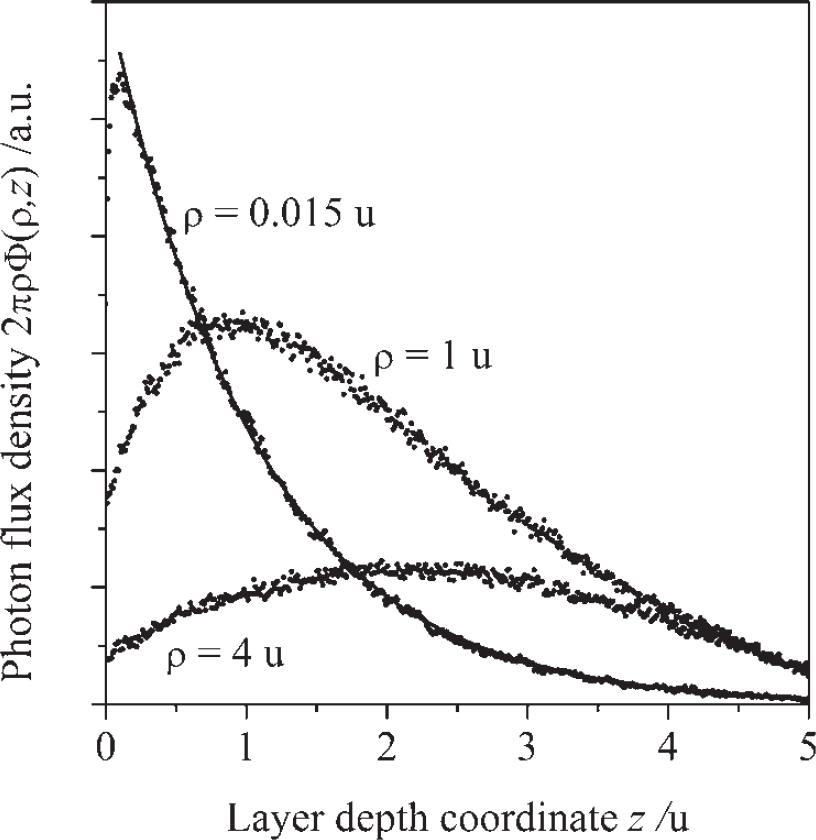
Selected photon flux densities 2πρ·Φ(ρ,z) as function of the sample depth z and the radial distance ρ from the axis of irradiation. Isotropic Monte Carlo simulations for a non-absorbing layer of thickness z0 = 5 u, and scattering coefficient σ = 1 u−1 (with u = arbitrary unit length). Number of incident photons N0 = 5·105. The solid line is the exponential fit of the curve at ρ = 0.015 u.
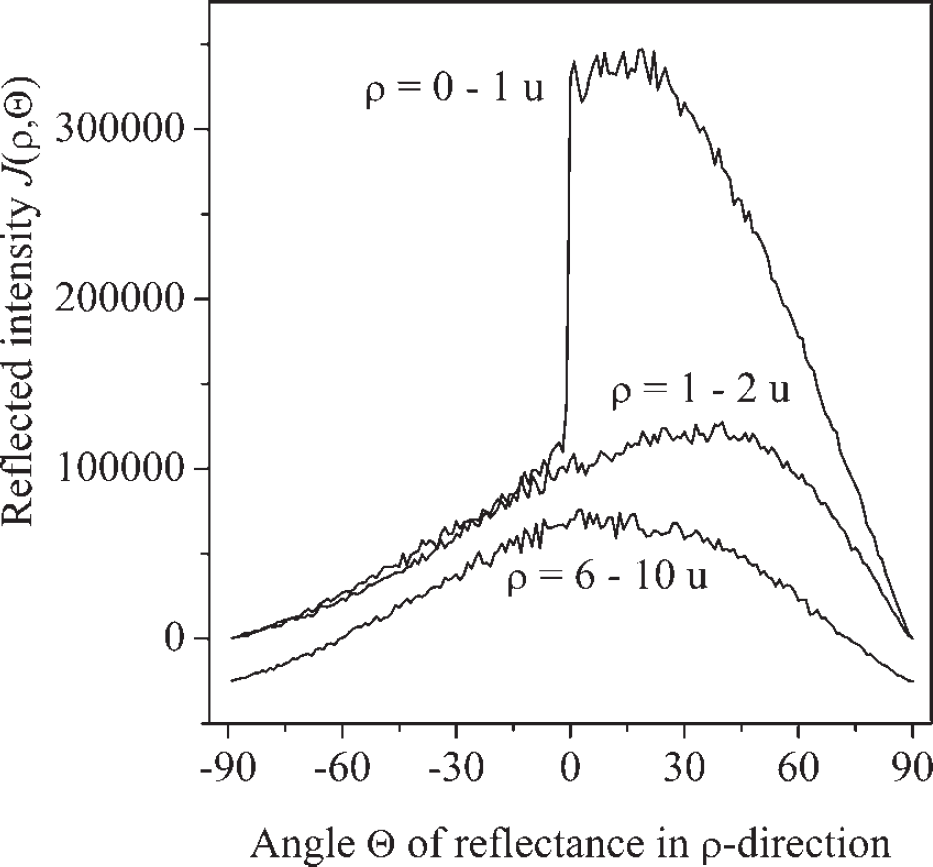
Angular resolved reflectance J(Θ,ρ) at different distances ρ from the axis of incident δ-irradiation. For clarity, the curve for large ρ is vertically displaced by −25 000 a.u. Isotropic MC-simulation with N0 = 4.107 photons.
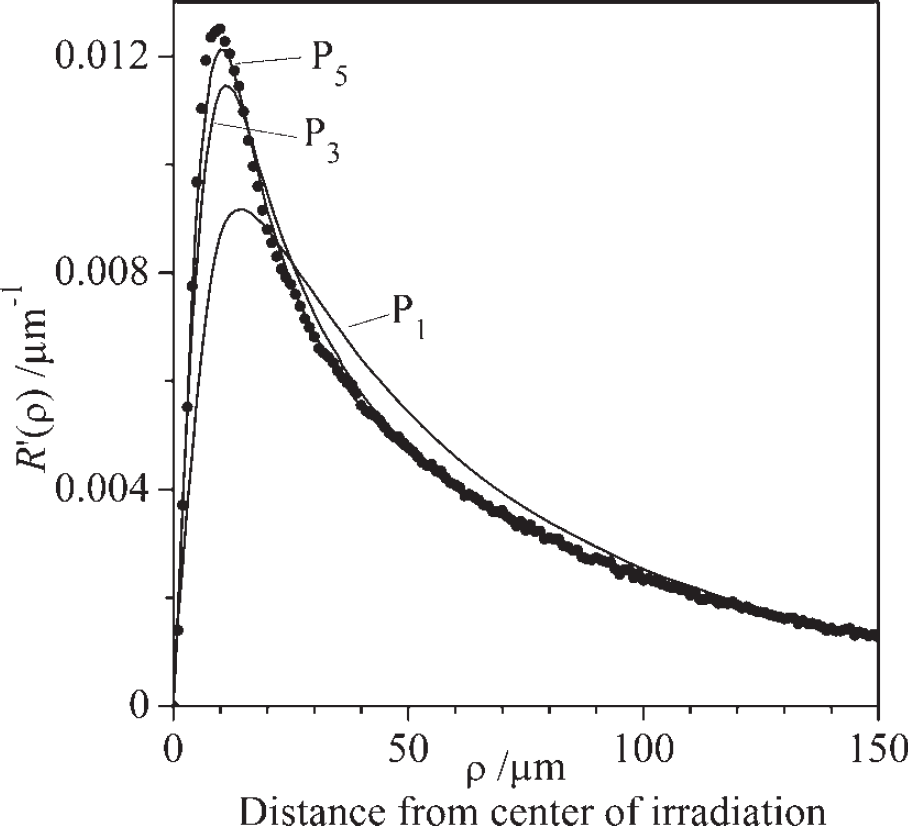
Radial reflectance R′(ρ) of a semi-infinite layer, σ = 300 cm−1, κ = 3 cm−1. Gaussian irradiation profile with e−2-half-width = 12 μm. Points: calculations with MC-simulation. Solid lines: PL–approximations (L = 1, 3, 5) of the CRT-equation.
Some DRT-solutions of Eq. 1 are given e.g., for semiinfinite layers and normal incidence by different authors.14,–17 A CRT-solution for arbitrary layer thickness is described in detail by Brun 20 applying transmission theory, transformation in the reciprocal space, convolution with the irradiation profile, and expansion into spherical harmonics up to P5. The full analytical solution of Eq. 1 seems to be impossible. The mathematical problem arises from the near distance (nd) range, which is of extreme importance for the dot gain in halftone printings and the resolution limit in spectral micro-images. About 30% of the totally reflected photons leave the sample in the range of 0 < ρ* < 1 and additional 30% in the range of 1 < ρ* < 3.5 (values for non-absorbing optically thick layers; for absorbing or thin layers the fractions are even higher). In these ranges, the angular distribution of reflectance deviates extremely from Lambert's cosine-law as can be seen in Fig. 2.
The nd-range emits strongly into +ρ-direction. The far distance (fd) range with approximately symmetric angular reflectance begins not before ρ* > 5 and covers the last 25% of total reflectance. Thus, the classical diffusion model, which is a very good approximation for the description of axial radiation transfer upon uniform irradiation of the whole sample surface (see Part I 24 ), is not accurate enough to quantitatively reproduce the nd-range upon point irradiation. We overcame this limitation by expanding the symmetric P1-approximation of Chandarasekhar's equation of radiative transfer, which is equivalent to the classical diffusion approximation, by additional odd P3- and P5-terms that consider the radial component of the Φ-gradient. As demonstrated in Fig. 3, the results are convincing. The figure compares the different approximations for a semi-infinite layer with optical parameters that are typical for packed powders used as pharmaceutical excipients or as white pigments. The high scattering power of the layer requires a focused laser as excitation source and microscopic lateral resolution so that the spatial extension of the source becomes clearly visible as the rising part of the R′(ρ)-curve. All approximations give equal results in the fd-range, whereas at short distances only P5 comes close to the Monte Carlo curve that is considered as reference solution.
The P5-expansion is mathematically very challenging especially if convolution with the radial profile of the excitation beam is included. However, one can solve the system via series expansion of the irradiated system into consecutive scattering processes. This method allows one to separate the total radial reflectance and transmittance into a sum of R′n(ρ)- and T′n(ρ)-curves emitted after n = 0,1,2, … ∞ scattering events, see Fig. 4.
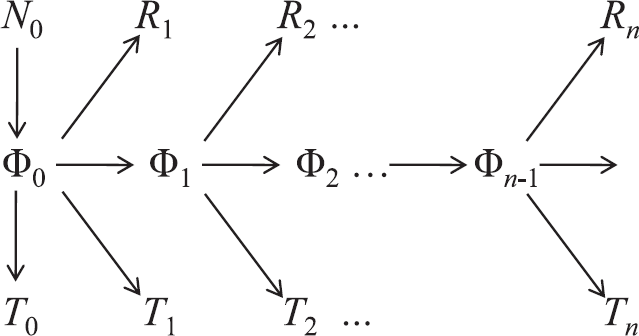
Separation of the total reflectance and transmittance in n consecutive scattering events.
Upon small spot irradiation (δ-irradiation) of normal incidence, where 
and

The radial transmittance T′(ρ) is equal to the right sides of Eq. 2 or Eq. 1 when the z2-terms are substituted by (z0 — z)2. Insertion of Eq. 3 into Eq. 1 yields R′2(ρ) and T′2(ρ). The terms of higher order are obtained with the recursion formula
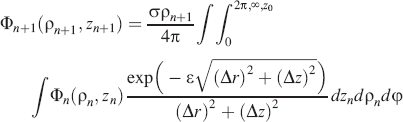
where
THEORETICAL SECTION

where
Figure 5 shows MC-simulations of three different layer thicknesses in comparison with the results of Eq. 5. The latter equation excellently describes the T′(ρ)-curves of layers with τ0 < 8, whereas the curve maxima of thick layers are rendered at distances that are somewhat too short. In these cases, the exponential factor of Eq. 5 should be replaced by a properly normalized Gaussian with maximum at negative ρ-values. Equation 5 is valid also for the far-distance range ρ > z0 of the radial reflectance. The amplitude of this exponentially decaying range decreases with increasing layer thickness and vanishes completely for semi-infinite layers. The near-distance range of R′ behaves completely differently. Here, the reflectance is mainly controlled by processes that are remitted after a small number of scattering events. These processes depend only very little on the layer thickness but strongly on the scattering coefficient. The range of σρ < 2.5 can be described with sufficient accuracy by the first ten terms R′1–R′10 of partial radial reflectances.
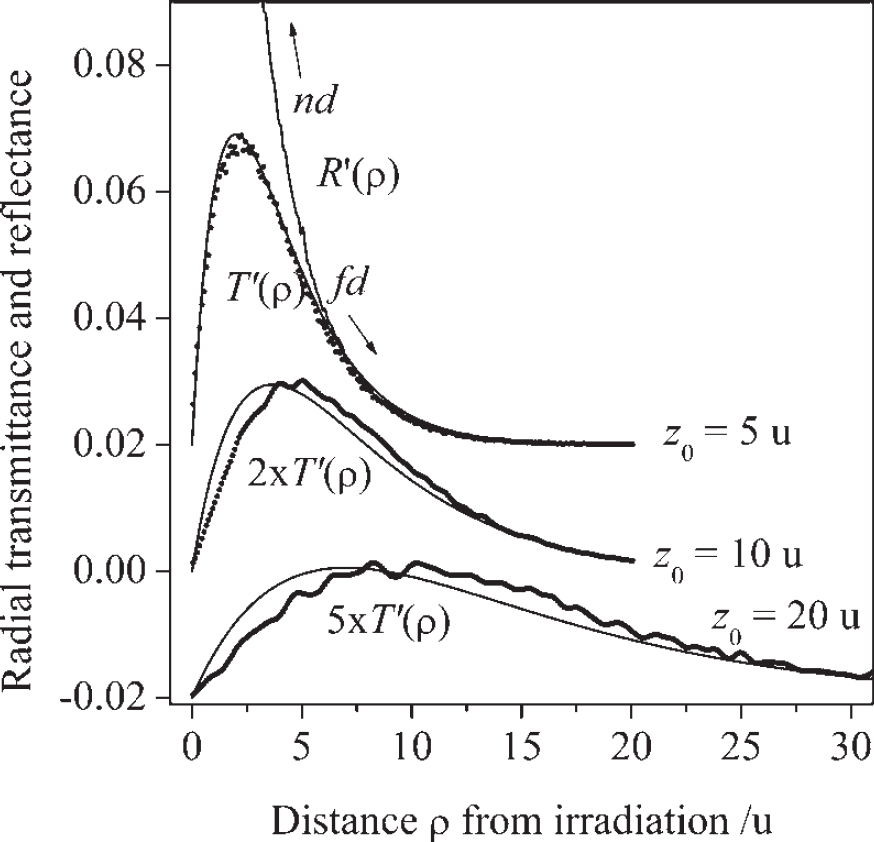
Radial transmittance and reflectance for three different layer thicknesses. Noisy curves: MC-simulations. Smooth curves: Analytical results according to Eq. 5. Neighboring curves are vertically displaced by 0.02 units.
In part I we demonstrated for semi-infinite layers the proportionality between the mean values of penetration depth (MPD) and radial spread (MSR) of reflected radiation, see Fig. 9 and Eq. 22 of Part I.
24
We now use the penetration depth profile in the diffusion approximation, dR/dzp = σ(Tcc + 1. 5Tcd)Tdd/2 and project it into the radial direction to obtain R′(ρ). The projection yields for non-absorbing layers and 8-irradiation
Radial total reflectance R′tot and single scattered reflectance R′1 of a nonabsorbing semi-infinite layer. MC-simulations (noisy, points) and analytical results according to Eqs. 6 and 2 (smooth, solid lines). For clarity, the results for diffuse incidence are vertically displaced by +0.1 reflectance units against normal incidence (μ0 = 1). Presentation in general dimensionless coordinates. Semi-logarithmic presentation of the radial reflectance as in Fig. 6 over a wider distance range. Noisy curve: MC-simulation. Smooth curve: DRT-projection of the depth profile into the radial distance direction. Radial reflectance of non-absorbing layer against absorbing layer for z0 = 100 u. Points: Monte Carlo simulations. Lines: Analytical approximations according to Eq. 8. Diffuse reflectance spectra of a Gaussian absorption band vs. the detection distance ρ from the point of irradiation (z0 = 20 u, σ = 0.3 u−1, κmax = 0.03 u−1). The absorbance is referenced for the same distance σ outside the absorption band. Top: absorber is equally distributed over the sample depth. Bottom: same amount of absorber is concentrated in the central sample region at z = z0/2.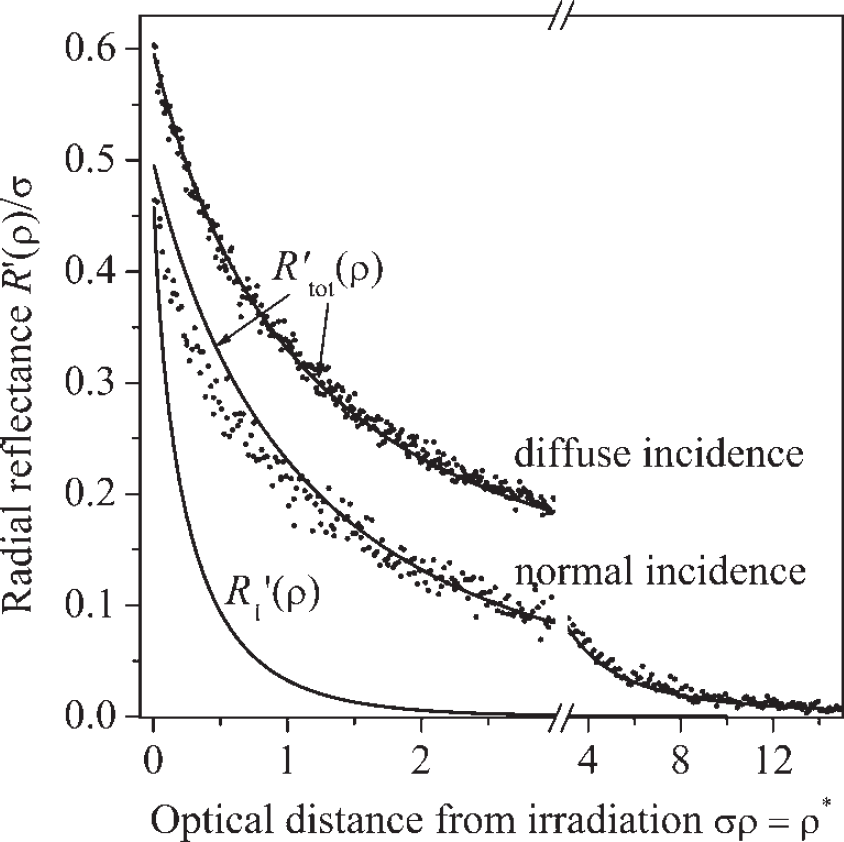
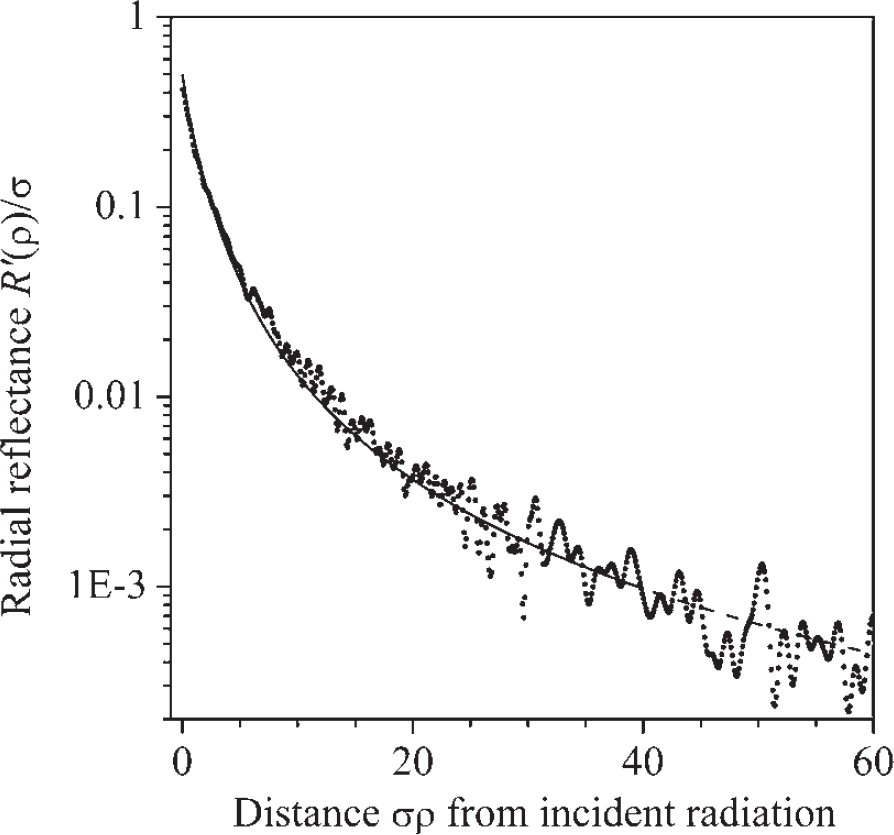
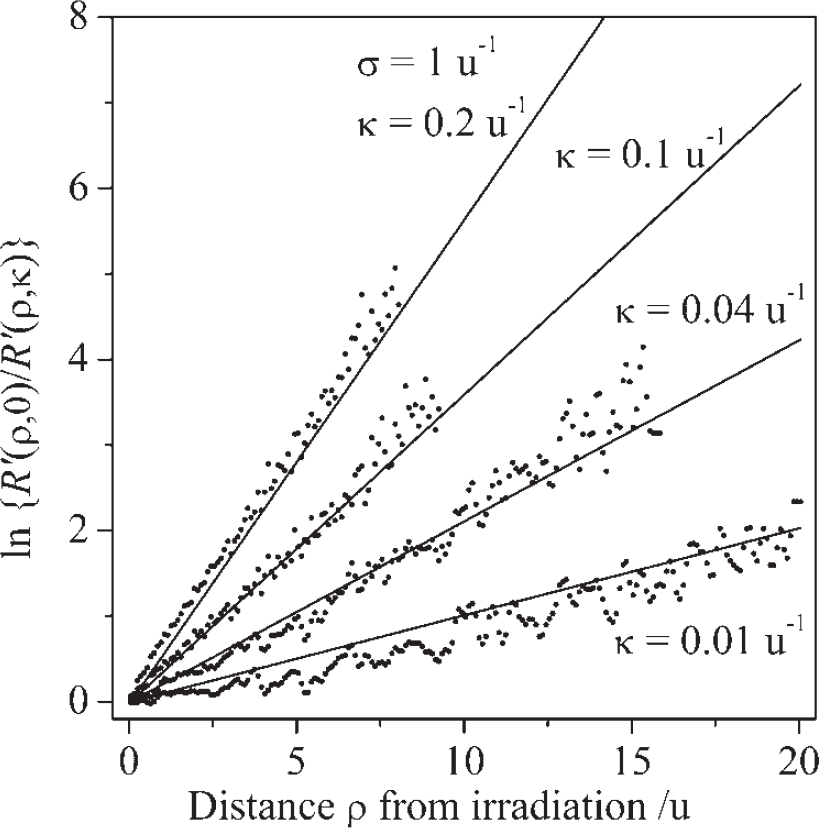
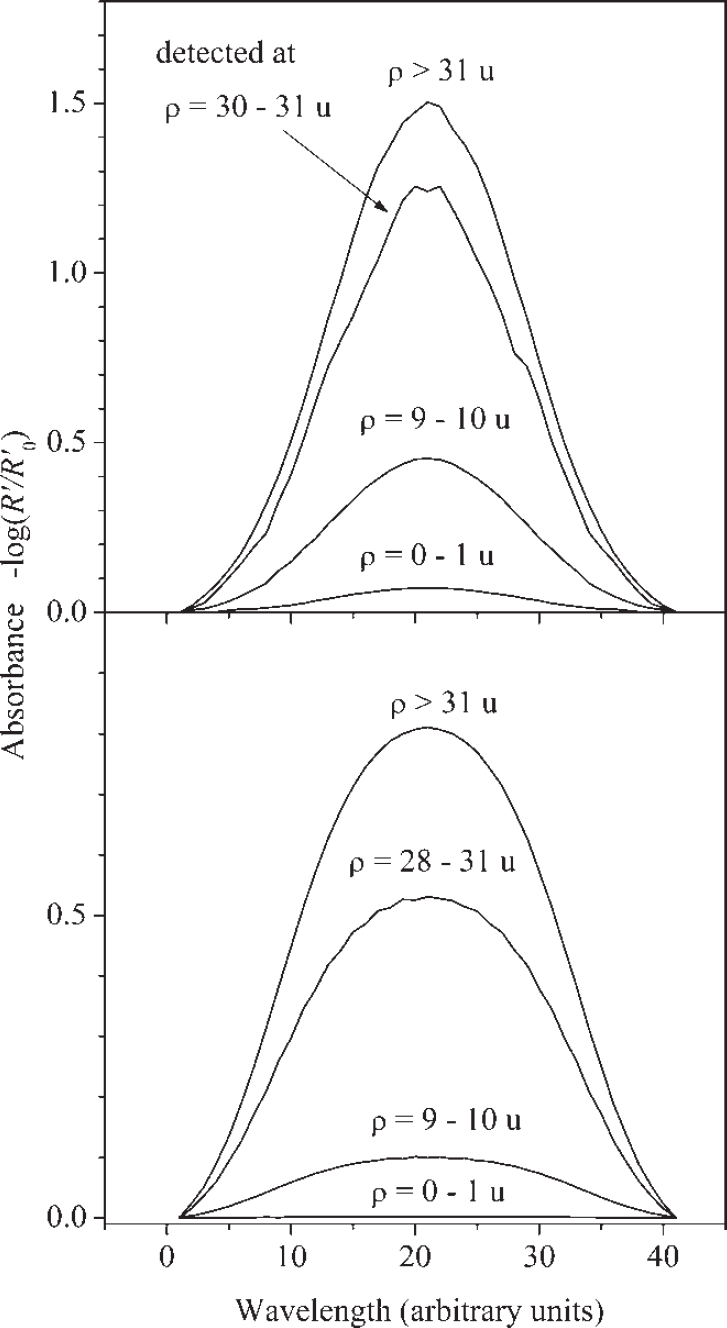
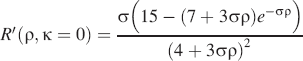
Figure 6 compares the result of Eq. 6 with MC-simulations. For diffuse irradiation, Eq. 6 is a perfect approximation. For normal irradiation, some differences are found in the near distance range σρ < 1. The range close to incidence is mainly controlled by R′1(ρ) of Eq. 2, light that is backscattered and remitted directly from the incident beam, and this part of reflectance neither follows the diffusion equation nor Lambert's cosine law. The shape of R′1(ρ) is also plotted in Fig. 6. In the very near distance range, the curve increases from zero to its maximum at σρ ≡ ρ* ≈ 0.004 (this range is not apparent in the figure because we quantize with ΔερG = 0.01 to avoid too noisy MC simulations). Then the curve decays with a final exponential of exp(−ρ*) and a pre-exponential factor proportional to (ρ*)−2. Figure 6 starts approximately at the curve maximum. Here, the radial reflectance for normal incidence is determined to 95% by R′1(ρ). The integral reflectance up to ρ* = 1 is determined to 50% by R1. The total single scattered reflectance of non-absorbing thick layers amounts to
Figure 7 highlights the far distance range of the radial reflectance, where MC and Eq. 6 also produce equal results. It should be noted that the final slope of the radial reflectance is proportional to (ρ*)−2, as obtained also for R′1 from Eq. 1, which means that the reflected intensity is proportional to ρ−3. This result is in accordance with Farrell et al. 16 , whereas other authors17,23 propose a final intensity slope proportional to ρ−2.
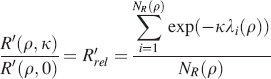
Because the individual path lengths cover a wide range (ρ < λi < ∞), Eq. 7 must be solved numerically or with the help of simplifying approximations. The simplest numerical solution is obtainable for R′1, where λi(ρ) = zi + (zi2 + ρ 2 )1/2. The depth coordinate zi of the first scattering event depends on ε−1. Integration over z yields a convex curve of –ln(R′1) versus ρ with a final slope of κ and a steeper initial slope that depends inversely on ε. The curves of the consecutive absorbances –ln(R ‘n) extend to larger ρ and show decreasing convexity. For n > 10 the –ln(R′n)-curves change into concave ones. The total absorbance curve -ln(R′rel) is slightly non-exponential, especially for weak absorbers with albedos close to unity. For medium to strong absorbers the absorbance can be approximated by a single exponential.
Figure 8 depicts some results of MC simulations. The straight lines are analytical approximations of the MC-curves assuming the validity of one exponential equation
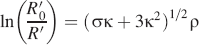
This equation describes with sufficient accuracy the first two decades of radial absorbance. It should be noted that this result is lower by approximately a factor 3–1/2 than the attenuation coefficient
The consequences of radially increasing absorption are presented in Fig. 9 for a Gaussian absorption band. The radial reflectance spectrum R′(ρ,κ) is referenced against the reflectance outside the band and the relative radial absorbance is plotted for selected distances from the incident δ-irradiation.
In Fig. 9, top, the absorber is uniformly distributed over z. Close to the region of incidence the absorbance is very low, because the path length of the remitted radiation inside the sample is short. With increasing ρ, the spectra gain more and more absorbance, but they lose their Gaussian shape somewhat in the log-presentation. So it is evident that laterally resolved absorption spectroscopy can help to identify weakly absorbing species. However, it is also evident that spectral imaging upon spot irradiation and detection of the same spot is not the best choice in strongly scattering media. In Fig. 9, bottom, the same amount of absorber is concentrated in a small Δz-layer at the z0/2-center of the sample. Now the absorption close to irradiation becomes negligible because almost no light reaches the center of the layer. With increasing ρ the absorption depth increases and the absorption band becomes clearly detectable, although with a strongly distorted Gaussian shape. So laterally resolved absorption spectroscopy can help to identify hidden absorbers as, for example, in coated tablets.
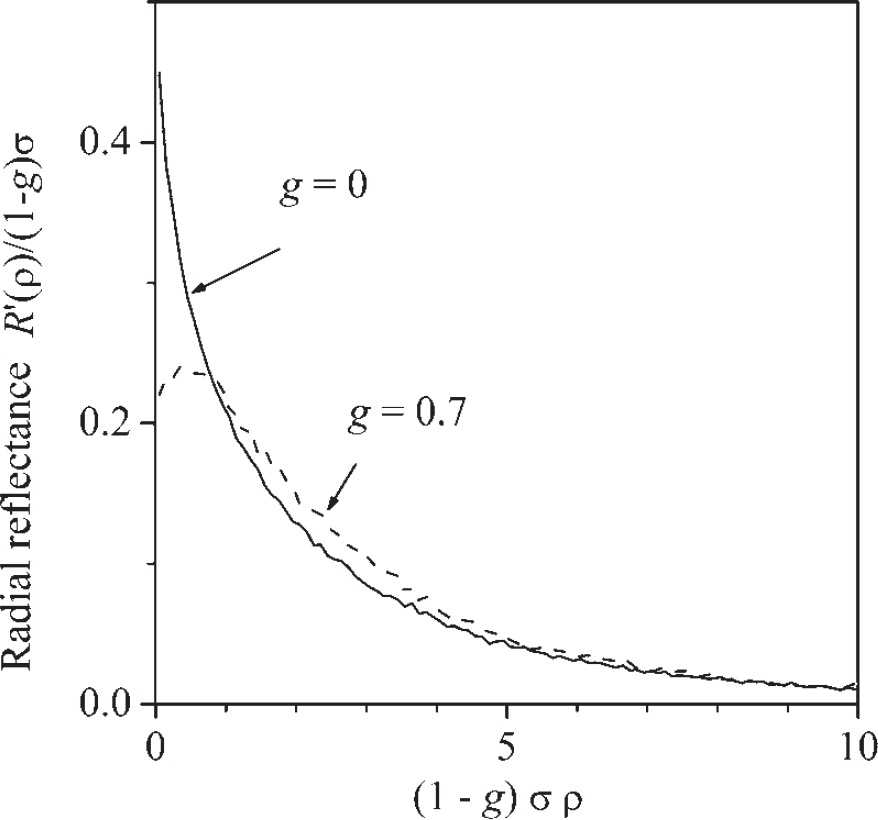
Radial reflectance of a non-absorbing layer, σ = 1 u−1, z0 = 10 u. Comparison of isotropic (g = 0, solid line) and anisotropic (g = 0.7, broken line) single scattering. Presentation in general dimensionless coordinates.
The anisotropy factor is classically determined from a combination of collimated and diffuse intensity measurements. The method is successfully applied to turbid media with low volume densities of scattering particles, typically embedded in a liquid phase. Examples are biological tissues, whole blood, or polymer micro-bead suspensions in water. The review of Cheong et al. 27 demonstrates that the anisotropies in those aqueous systems approach values of g > 0.9.
According to Mie calculations, we found that the maximum anisotropy of single spherical particles can be estimated by the approximation gmax ≈ m−1/2 where m is the refractive index of the particle relative to the surrounding medium. Hence, the high g-values of solid/water dispersions are reduced in solid/air dispersions. In addition, forward diffraction is partly suppressed in packed systems by the close proximity of the particles. This effect further reduces anisotropy. We tried to determine anisotropy in powder layers by angular-resolved transmission measurements and extraction of the direct transmittance Tcc. The direct signals are extremely weak, even in very thin layers, and difficult to interpret because the effective scattering cross sections are mostly larger than the geometrical particle cross sections. Hence, direct transmission requires matter-free axial linear channels through the whole layer with diameters wider than the wavelength of light.
Instead of measuring Tcc, we propose for packed layers the evaluation of polarized radial reflectance as a function of the distance from the center of irradiation. Figure 11 presents the calculated g-dependence of the degree of polarization under the somewhat arbitrary limits that i) only the single scattered reflectance R1 remains polarized, and ii) also R2 and R3 remain polarized to 50% and 25%, respectively. The calculations are compared in the Experimental Section with a real sample.
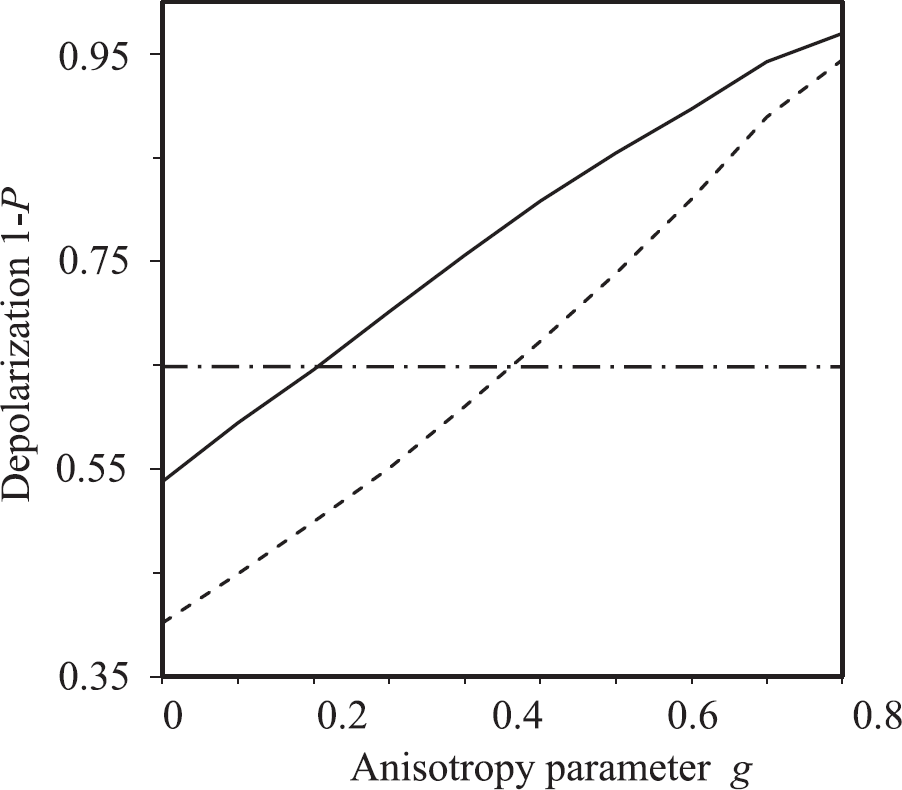
Depolarization of reflectance at distance ρ = 10 μm from the center of Gaussian spot irradiation (e−2 w = 12.5 μm), σeff = 540 cm−1, κ = 0.7 cm−1. Solid line: MC simulation, where only R1 contributes to polarization. Dashed line: R1, and partly also R2 and R3 contribute. Dashed-dotted line: experiment on alumina powder layer.
Samples with rough surfaces where no systematic long-range phase correlations exist between the scattered surface waves. Back reflection to the bulk remains unenhanced. Typical examples are uncompressed powders.
Samples with rough surfaces placed in optical cells. The cell walls enhance back reflection and radial spread. A typical value for the Fresnel reflection coefficient at the two boundaries of quartz glass is F = 0.18. This figure is obtained for diffuse internal irradiation and the assumption of a small air gap between the powder and the cover so that no total reflection occurs.
Samples with smooth surfaces like solid/liquid dispersions, liquid/liquid emulsions, super-gloss finish prints, etc. A large portion of the internal diffuse radiation is thrown back at the sample surface by total and partial Fresnel reflection; it can be estimated from the simple empirical approximation
Scattering liquids like C) placed in optical cells with walls of thickness zw. The amount of Fresnel reflection remains almost unchanged against case C), but the radial spread increases strongly because now reflection occurs mainly at the outer cell wall boundary.
The radial spread increases in the series A) < B) ≈ C) < D). Quantitatively, the mean point spread radius <ρR> of reflectance can be approximated as

Figure 12 presents radial reflectance curves of a solid/liquid dispersion (σeff = 40 cm−1) in a commercial optical cell of path length z0 = 0.1 cm and cell walls of thickness zw = 0.07 cm. Without surface reflection, the simulated curve a) yields the mean point spread radius of <ρR>ideal = 470 μm. Addition of total surface reflection at angles μ < 0.7 (n2/n1 = 1.4) yields curve b) with <ρR>real = 730 μm. Further addition of the cell walls yields curve c) with <ρR>real = 2700 μm. The main contribution to the radial spread arises clearly from the cell walls, which act as quasi-light guides, and it should be noticed that curve c) extends to distances that can be longer than the dimensions of the cell so that part of irradiation is lost by deflectance.
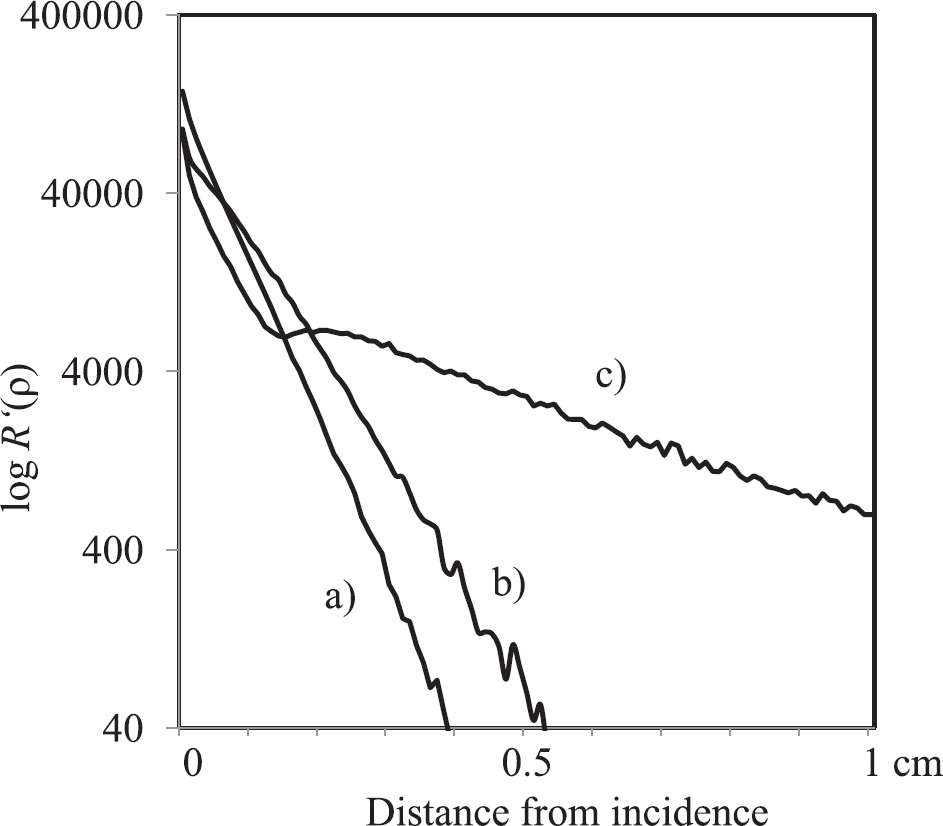
Radial reflectance R′(ρ) of a thin layer with z0 = 0.1 cm and scattering coefficient σ = 40 cm−1. a) no internal surface reflection. b) total internal surface reflection at |μT | < 0.7. c) as b) but with additional glass covers of zd = 0.07 cm.
The deflectance is logarithmically presented in Fig. 13 against the dimensionless optical cylinder radius σρ0 with the optical layer thickness σz0 as parameter. For easier reading, Table II shows some data in metric dimensions. Reliable R-and T-values are obtained only if D < 0.005 or, for higher precision, D < 0.001. This condition is feasible for thin layers (z0 ≤ 0.1 cm) with sample radii of ρ0 = 0.5–1 cm. Thick layers of z0 ≤ 1 cm need larger sample radii with the experimental problem that the photometric spheres of commercial spectrometers do not offer wide enough sample ports to collect all R or T even if the condition of large sample radius is met. Medium scattering materials (σ ≥ 10 cm−1) are especially susceptible to misinterpretation of R- and T-data. If the material is measured in a conventional UV/Vis-cell with z0 = 2ρ0 = 1 cm, the fraction of D can be very high (see Table II), especially in emulsions or solid/liquid dispersions where the cell windows with their high fraction of total internal surface reflection act as light guides for the enhancement of D.
Diffuse deflectance D, diffuse reflectance R, diffuse transmittance Td, and mean point spread radius <ρR> of a non-absorbing cylinder with scattering coefficient σ, cylinder thickness z0, cylinder radius ρ0. δ-irradiation at ρ,z = 0 in direction of the principal cylinder axis (μ0 = 1).
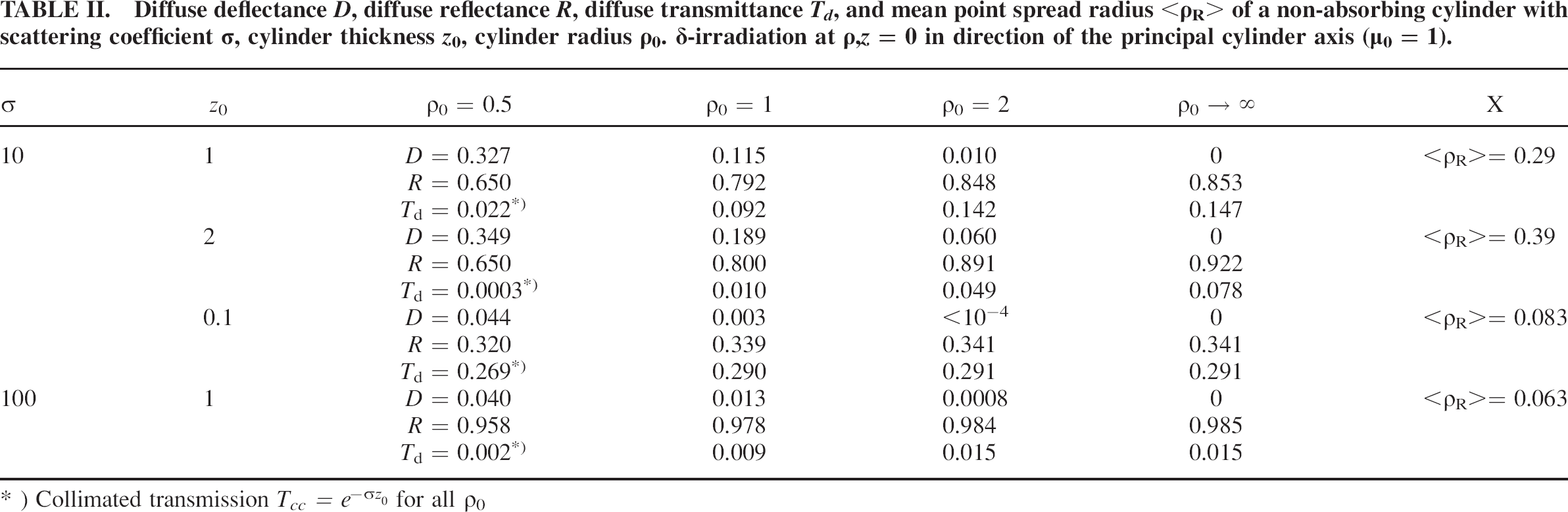
Collimated transmission Tcc = e−σz0 for all ρ0
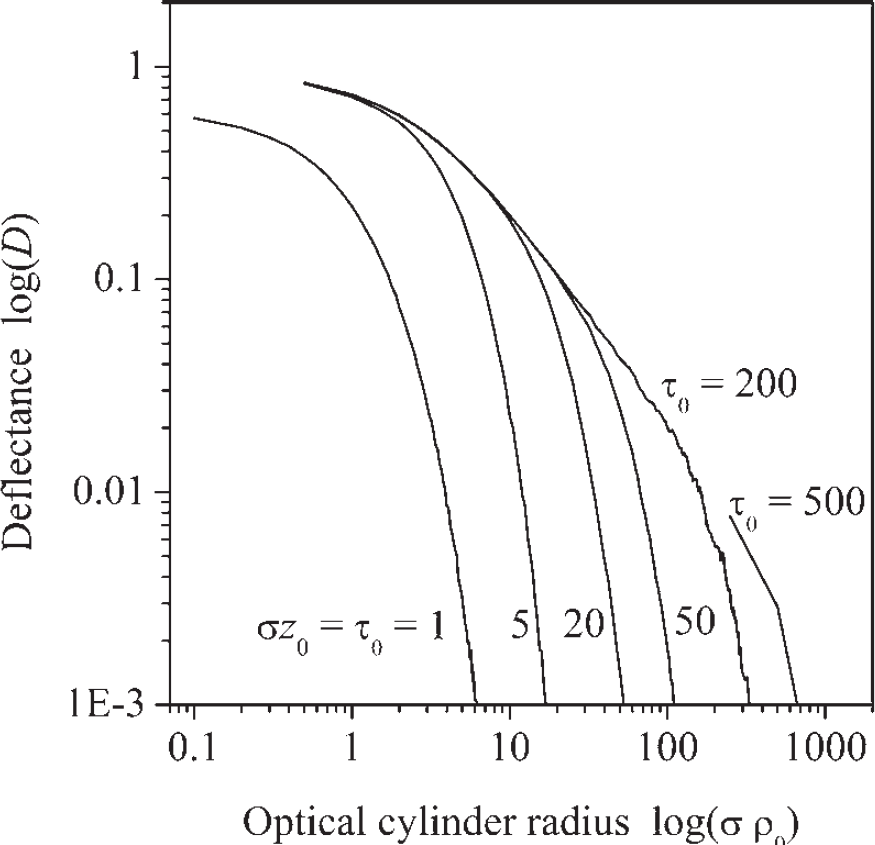
Deflectance of a nonabsorbing scattering cylinder upon δ-irradiation at ρ,z = 0, μ0 = 1, as function of the optical cylinder radius σρ0, with the optical cylinder height σz0 as parameter.
EXPERIMENTAL SECTION
In this experimental section we want to offer an exemplary overview of some practical applications of the theory on the systems considered in the previous section. With selected experiments we want to show how Monte Carlo simulations and the proposed simplified analytical expressions can help in the interpretation of experimental data, in the detection and prediction of chemical species, and in the estimation and correction of experimental errors.
First we present results of radially resolved reflectance measurements. Inverse Monte Carlo simulations, including the spatial extension of the irradiation source and analytical solutions, according to Eqs. 6 and 8, are used to extract optical parameters from quasinon absorbing and absorbing layers.
In the second part of the chapter we show experiments on potentially high error-affected systems. Inverse MC simulations will be used in this case for the indirect quantification of the Fresnel coefficients and anisotropy factors.
Scattering coefficients, absorption coefficients, and spot spread radii of “white” powder layers obtained from radial resolved reflectance measurements at λ = 633 nm with laser irradiation focused to a Gaussian spot of e 2 -width = 12.5 μm.
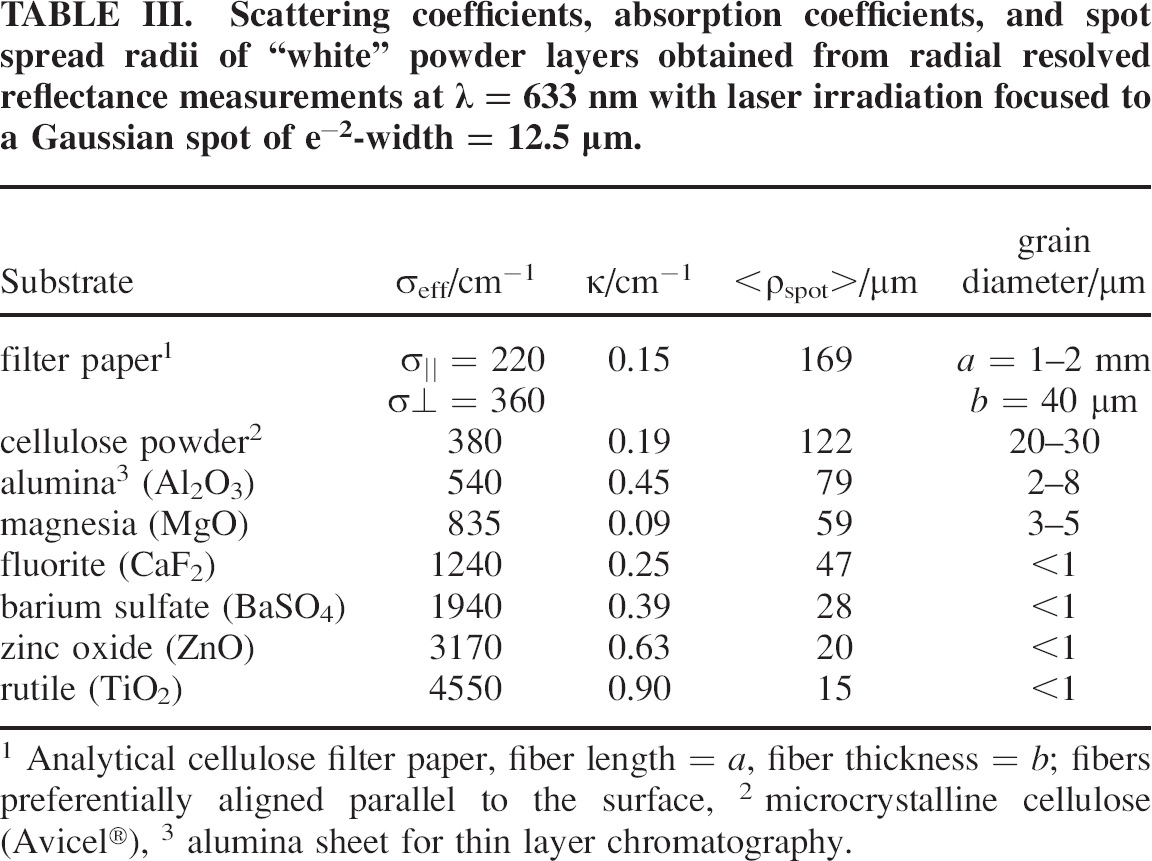
Analytical cellulose filter paper, fiber length = a, fiber thickness = b; fibers preferentially aligned parallel to the surface
microcrystalline cellulose (Avicel®)
alumina sheet for thin layer chromatography.
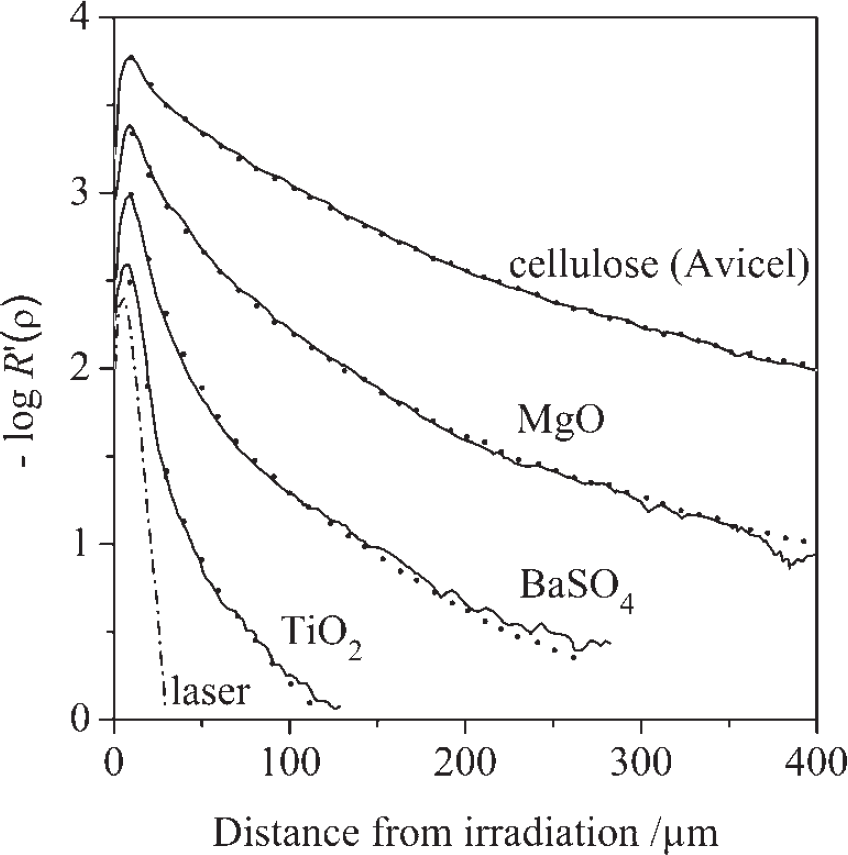
Experimental (lines) and back simulated (points) radial reflectance curves of some white pigments. Irradiation at λ = 633 nm, detector aperture ν = 23°. Neighboring curves are vertically displaced by 0.4 log-units.
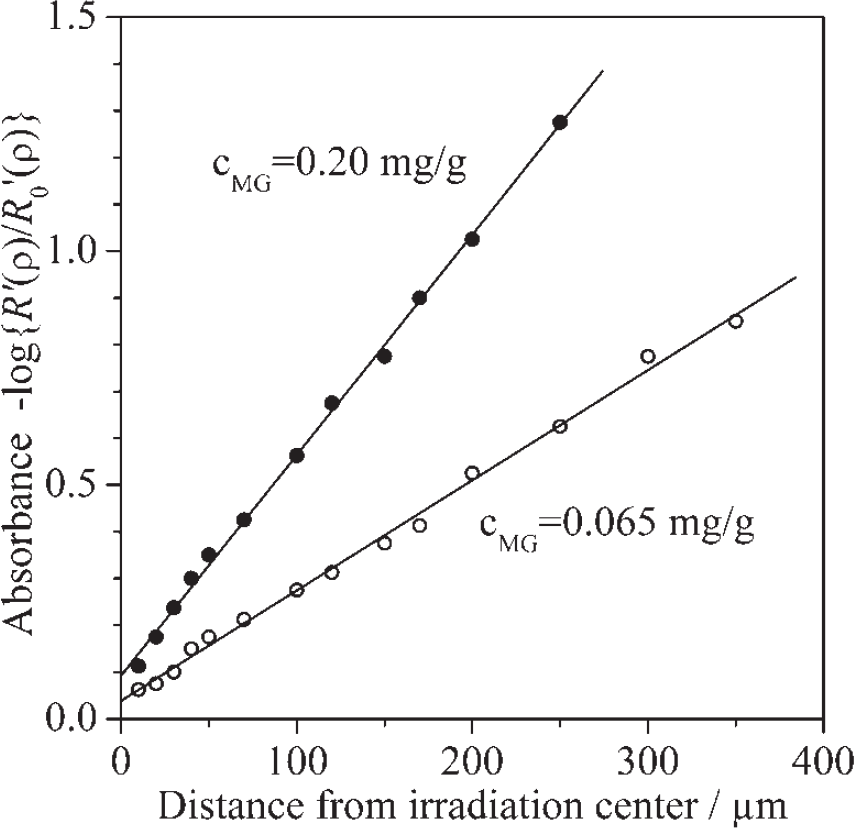
Radially resolved absorbance curves (λ = 633 nm) of microcrystalline cellulose (Avicel®) dyed with different loadings of malachite green (MG) as given in Table IV. Reference: undyed cellulose.
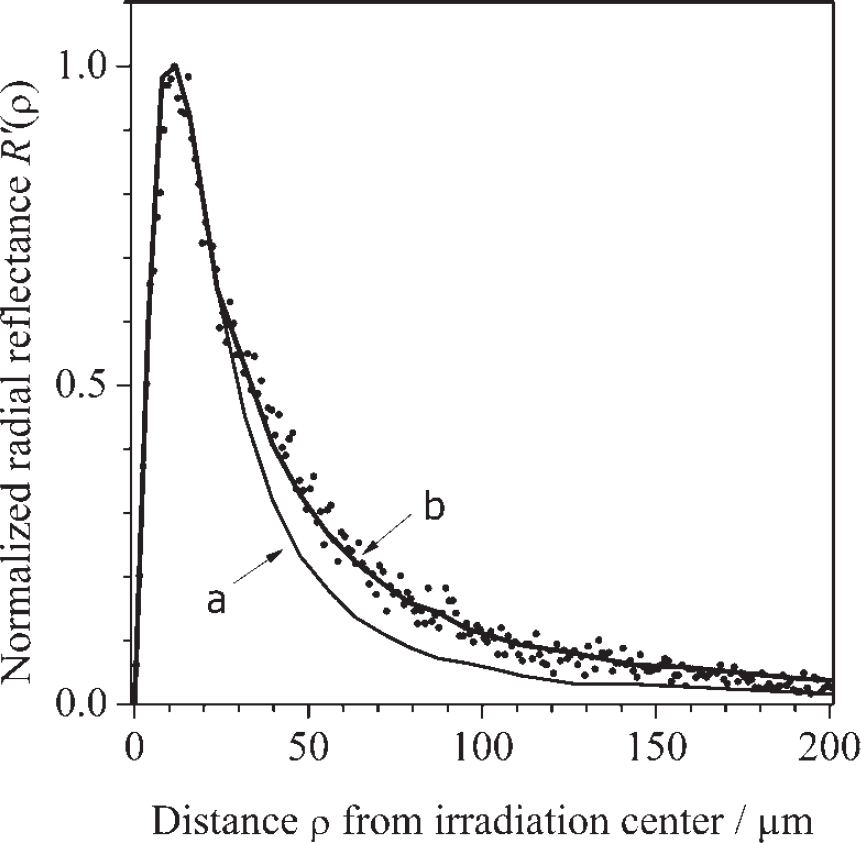
Radial reflectance curves of printing paper, focused laser irradiation at λ = 633 nm with e−2-half width = 12.5 μm. a) bare paper. b) same paper covered with polymer laminate of thickness zw = 4 μm. Monte Carlo simulations (points) of both curves yield σ = 1050 6 50 cm−1, κ = 0.3 cm−1 and an additional internal Fresnel reflection coefficient F = 0.6 for the laminate.
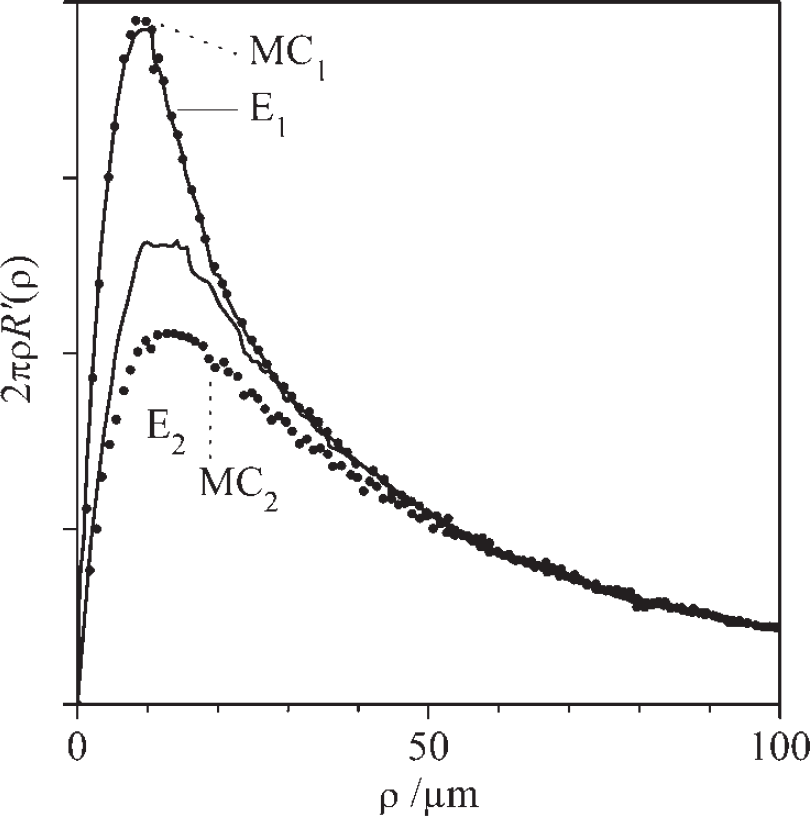
Polarization-dependent radial reflectance for packed alumina particles. Solid lines: experimental values. Dotted lines: MC simulation.
A special situation was met in filter paper, where the cellulose fibers are preferentially oriented with their long axes parallel to the paper surface. Thus one expects different scattering coefficients in axial and radial directions. We were able to analyze this type of anisotropy by R′(ρ)-curves as function of the layer thickness.

Radiation intensities emitted at λ = 800 nm from multiple scattering samples (d = particle diameter) in quartz cells of different thicknesses z0. Rexp = experimental reflectance through the illuminated window, Texp = experimental transmittance through the rear window, D = deflectance through the side windows. Spectrometers: Lambda 9 and 1050 (Perkin-Elmer) equipped with photometric spheres. The experimental sum of all three emission processes (fifth column) was measured with the samples in the center of the photometric sphere. Reflectance reference: Spectralon®.
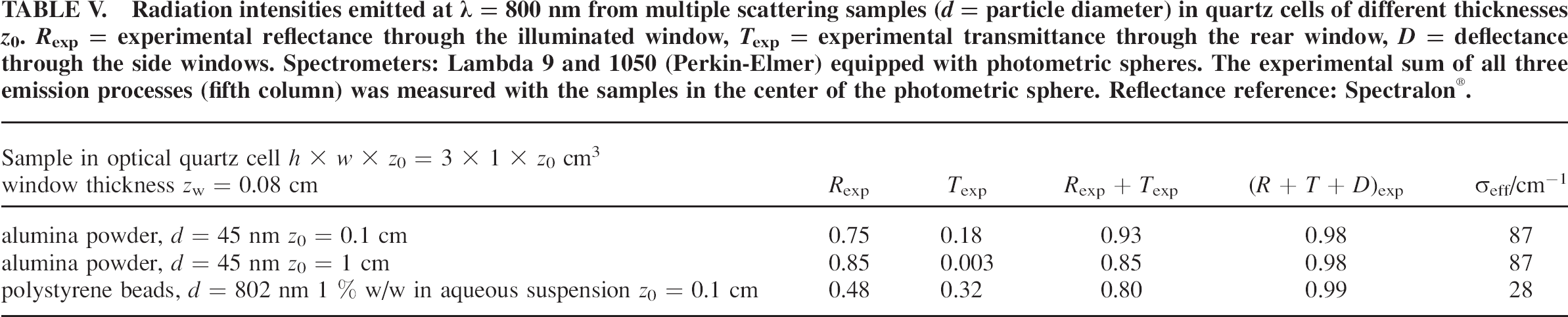
Table V presents results of three medium scattering samples measured in commercial fluorescence cells. The experimental (exp) data were obtained with photometric sphere equipment in the standard sample positions for transmittance Texp and reflectance Rexp. In addition, the samples were placed in the center of the sphere to detect the sum of all contributions (R + T +D)exp to re-emission. All samples show significant contributions of deflectance in the range of D = 0.05–0.2. Simulations for the uncovered samples yield much smaller values, extending partly below the plotted range of Fig. 13 (D < 10−3). Thus the high experimental values must be the consequence of radiative transport within the glass windows. Correct reflectance and transmittance data are measured in those cases only with large area cells and photometric macroequipment. For less accurate estimates one can also use internal normalization outside the absorption range with Rtrue ≈ Rexp/(Rexp + Texp) and Ttrue + Rtrue → 1.
Figure 17 presents two experimental curves, E1 = R′|| + R′⊥ and E2 = 2 R⊥, as well as simulated data for isotropic scattering MC1 = R′ tot and MC2 = R′ tot − R′1. The experimental degree of polarization P = 1 − (E2/E1) amounts at the center of irradiation to Pmax = 0.48. This value decreases with increasing × and approaches zero for x > 30 μm. The E1-curve can be well fitted with an effective scattering coefficient and a small residual absorption coefficient, resulting in MC1. From these coefficients, R′1 and finally MC2 were calculated, assuming isotropic scattering. It can be clearly seen that E2 > MC2. Hence R′1 is not fully polarized or, much more realistically, forward scattering reduces its contribution to total reflectance. Figure 11 shows the correlation between forward scattering and the resulting depolarization of reflectance. The experimental data of the alumina layer yield an anisotropy factor of g = 0.25 if only R1 is assumed to be polarized. However it is reasonable to consider also the higher orders n + 1 of reflectance as partly polarized according to Pn+1 = αPn, where α = 0.7 for Rayleigh-spheres 28 and α = 0.65-0.8 for Miespheres. 29 Irregular particles tend to stronger depolarization 30 as well as particle aggregates. 6 In Fig. 11 we weighted the polarization of higher order reflectances with α = 0.5. Thus, the anisotropy of the alumina particles lies in the range of g = 0.25-0.5. This value is still moderate and allows one to apply the concept of effective scattering also in the field of laterally resolved reflectance.
CONCLUSIONS
Monte Carlo simulations and analytical approximations for the radial propagation of light are presented and discussed.
The calculations show a substantial difference between far and near distance range. Close to the region of incidence the reflected light undergoes mainly single-scattering processes. The signal arises from regions very close to the surface, carries only little information about absorption, maintains the polarization of the incident radiation, and is concentrated around a small angular aperture
For non-absorbing species the derived approximations are accurate enough for the transmittance and for reflectance in the far distance range, but they fail in the near and very near distance range.
For absorbing species, the absorbance increases radially with approximately exponential slope. So it is evident that laterally resolved absorption spectroscopy can help to identify weak or hidden absorbers.
In the analysis of real samples, the influence of anisotropic forward scattering and internal reflections lead to an increase of the radial spread of reflectance
The close agreement between the theoretical and experimental data confirms the validity of the model and of the assumed approximations.
Footnotes
AKNOWLEDGMENTS
For part of the work we acknowledge the financial support of the Federal Ministry of Education and Research (BMBF) and the German Research Foundation (DFG).