






Abstract
The feasibility of using near-infrared reflectance spectroscopy (NIRS) to determine the concentrations of copper (Cu) and zinc (Zn) in Ludwigia prostrata Roxb plants was investigated. Ludwigia prostrata Roxb plants were grown over a full growth cycle under controlled laboratory conditions in soils contaminated with heavy metals. The Cu and Zn concentrations in 72 L. prostrata Roxb samples were analyzed using fame atomic absorption spectrometry, and NIRS spectra were collected in the 1099–2500 nm range. Five mathematical treatments of the spectral data were compared prior to developing the calibration models (n = 48) using partial least squares regression methods. The two calibration models for Cu and Zn concentrations were evaluated according to the correlation coefficient of cross-validation (Rcv) and root mean squares error of cross-validation. The highest Rcv and the lowest RMSECV were obtained for Cu (0.9 and 7.24 mg kg−1) and Zn (0.94 and 19.17 mg kg−1), respectively. The results showed that near-infrared diffuse refectance spectroscopy can be used for the rapid determination of Cu and Zn in leaves of L. prostrata Roxb plants.
Keywords
INTRODUCTION
Heavy metals are non-biodegradable and accumulate in nature, and metal emissions and their deposition over time can lead to anomalous enrichment and contamination of the surface environment. Heavy metal contamination in soils is a major environmental problem, one that poses significant risks to human health as well as to ecosystems.1,2 Many scientific activities have been devoted to the determination of sources, types, and degree of heavy metal pollution in soils.3,4 As a result of uncontrolled industrial activities, many hazardous chemical substances, including many heavy metals, have been released leading to the deterioration of the ecosystem.5,6 Heavy metal contamination in the environment poses serious health risks because many heavy metals accumulate in living tissues throughout the food chain.7,8
A number of studies have focused on the influence of heavy metals in contaminated soils of plants. The toxic levels of some heavy metals appear to be the result of environmental pollution.9–11 Much concern has been expressed by those working in the environmental sciences, since Cu and Zn widely coexist with other heavy metals in polluted soils. Reduction of biomass production and nutritional quality has been observed in crops grown in soils contaminated with Cu and Zn, 12 and photosynthesis, transpiration, carbohydrate metabolism, and other metabolic activities have been found to be inhibited by Cu and Zn.13,14 Ludwigia prostrata Roxb is a common weed, widely distributed in South Asia. The plant has proven very useful in the enrichment and tolerance of Cu and Zn contained in sewage polluted areas. 15 In polluted soil near smelters, the total and extractable Cu and Zn of L. prostrata Roxb in soil samples measuring in the 100 m2 range were 9.3 times and 34 times higher than those in pollution-free areas, respectively. 16 The order of average concentrations of Cu and Zn in the parts of L. prostrata Roxb was roots > leaves > stems. 17 The amounts of Cu or Zn in L. prostrata Roxb show significant correlation with their concentration of Cu or Zn in soil of the sewage irrigation area. For all these reasons, L. prostrata Roxb was selected as experimental material in this study.
Among spectroscopic techniques, near-infrared reflectance spectroscopy (NIRS) has been used as a rapid, inexpensive, and accurate method for analyzing petrochemicals, pharmaceuticals, and agricultural products.18–20 The NIRS spectrum of an organic material can give a global signature of composition based basically on the assessment of the organic chemical structures containing O–H, N–H, and C–H bonds, which, with the application of chemometric techniques, can be used to elucidate particular compositional characteristics in the food matrix not easily detected by targeted chemical analysis.21,22
Near-infrared reflectance spectroscopy has been proven an efficient, rapid, and nondestructive method for quantitatively analyzing complex samples that does not require sample preparation. It has extensive application potential in the environmental monitoring field. 23 Theoretically, inorganic compounds cannot produce a direct signal in the NIRS spectrum. Nevertheless, predicting heavy metals in herbaceous plants and agricultural products can still be possible when using NIRS because heavy metals interfere with the spectral features of organic compounds or hydrated inorganic molecules.24,25 Using NIRS to detect heavy metals is generally dependent on the reactions occurring between those heavy metals and the organic or hydrated compounds that produce features of a metal organic complex in the NIRS region. Some reports show that NIRS was successfully used to determine the concentrations of calcium (Ca), potassium (K), and iron (Fe) in wine, and there are also a few reports of NIRS being used successfully to detect heavy metals in fresh or dried plant samples. 26 NIRS has also been used to measure S, Na, and B in Trifolium repens and Medicago sativa Linn 27 and to provide rapid quantitative analyses of Mo, Ca, Mg, Fe, and Mn elements in Chinese southwest tobacco (Nicotiana × sanderae). 28
Mineral analysis commonly involves using inductively coupled argon plasma, atomic absorption spectroscopy (AAS), and X-ray fluorescence spectroscopy where the sample preparation requirements can be time-consuming and in some cases are not environmentally friendly procedures. A study of accumulative characteristics of heavy metals in soil L. prostrata Roxb system has been reported 29 that concluded that the distribution of heavy metals in L. prostrata Roxb in sewage irrigation areas for Cu is root > leaf > stem and for Zn is stem > root > leaf. Zn is more mobile than Cu, which is likely to accumulate in the root of L. prostrata Roxb. The concentration of Cu in the L. prostrata Roxb stem has significant correlation with the concentration of Cu in the soil of sewage irrigation areas.
There are no studies using NIRS for the detection of Cu and Zn in L. prostrata Roxb plants in the literature. In this study, a method for quantitative analysis of Cu and Zn in L. prostrata Roxb was investigated. Partial least squares regression (PLS) was used for the calibration method due to the complexity of the spectra. The main purpose was to explore the potential and accuracy of the near-infrared diffuse reflectance spectroscopy (NIDRS) method for quantitative determination of Cu and Zn in L. prostrata Roxb. Dried and ground L. prostrata Roxb leaves were used directly for the NIDRS method to simplify the sample preparation. In addition, different pretreatments were compared to obtain the ideal chemometric models.
MATERIALS AND METHODS
The soil samples (5 kg) were placed in plastic pots (150 mm diameter × 250 mm height). Each treatment was replicated with four pots for experimental validation. The moisture level of the soil was kept to near field water content (40%) and equilibrated for two weeks. Three seedlings of L. prostrata Roxb (8 cm roots, 3 cm roots) were replicated in four pots and watered daily to 60% of the field water content.
After 180 days of growth, L. prostrata Roxb of each treatment were carefully removed from each pot at harvest and were washed thoroughly to remove adhered soil by a quick wash in deionized water. Samples (n = 72) were assigned for calibration (n = 48) and validation (n = 24) sets in the ratio of 2: 1 by the Kennard–Stone (KS) algorithm before being divided into roots and leaves.
Calibration models between heavy metals and NIRS spectra were developed using PLS regressions with leave-one-out cross-validation (LOOCV). In order to obtain the optimized model, transform baseline, first derivative calculation, multiplicative scatter correction (MSC), and standard normal variate (SNV) were used to develop Cu and Zn prediction models, separately. The data were analyzed by using The Unscrambler 10.0 (CAMO AS, Norway) and OriginPro 8.5 statistical package software. Model performance was estimated and judged by comparing the predicted and measured value data in the validation set.
The performance of the PLS calibration model was evaluated in terms of the correlation coefficients (Rcv)of cross-validation and root mean square error of cross-validation (RMSECV), which was determined by LOOCV.32,33 The factor number in the PLS model was determined by using the LOOCV with an F test. RMSECV and Rcv are defined as follows:
where yi is the reference value of the ith sample, ŷi is the predicted value of the ith sample, ym is the average of the referenced value, and n is the number of samples.
The residual predictive deviation (RPD) was recorded, which is the ratio of the standard deviation of the reference data to the standard error of prediction of the model. 34 The RPD values were classified as follows: RPD < 1.0 indicates a very poor model or predictions and their use is not recommended; RPD between 1.0 and 2.5 indicates a poor model or predictions where only high and low values are distinguishable; RPD between 2.5 and 5.0 is considered fair and recommended for screening purposes; and RPD > 5.0 indicates a good quantitative model or prediction. 35
RESULTS AND DISCUSSION
The Cu and Zn concentrations in plant leaves increased with an increased amount of Cu and Zn in soils. The Cu concentration in the plant leaves significantly increased from 55.17 ± 11.44 in the control treatment to 67.42 ± 12.15 mg kg−1 in the 250 Cu mg kg−1 soil, 77.93 ± 11.27 in 500 Cu mg kg−1 soils, and 88.97 ± 14.82 mg kg−1 in 750 Cu mg kg−1 soils. The Cu concentration at 107.95 ± 12.61 mg kg−1 was obtained in 1000 Cu mg kg−1 soils. The same trends were also observed in Zn pollution experiments. Along with an increase of Zn in soils, Zn concentration in leaves significantly increased from 161.51 ± 12.65 in the control treatment to 262.26 ± 10.68 mg kg−1 in the 1000 Cu mg kg−1 soil. However, the Zn concentration in leaves of L. prostrata Roxb was about 2.5-fold higher than the Cu concentration, although the plants grew in the soils with the same amount of Cu and Zn. The addition of Zn in soils significantly triggered Zn accumulation in L. prostrata Roxb leaves.
Statistics of the concentrations of Cu and Zn (mg kg−1) of samples in calibration and validation sets.

n = sample numbers.
SD = standard deviation.
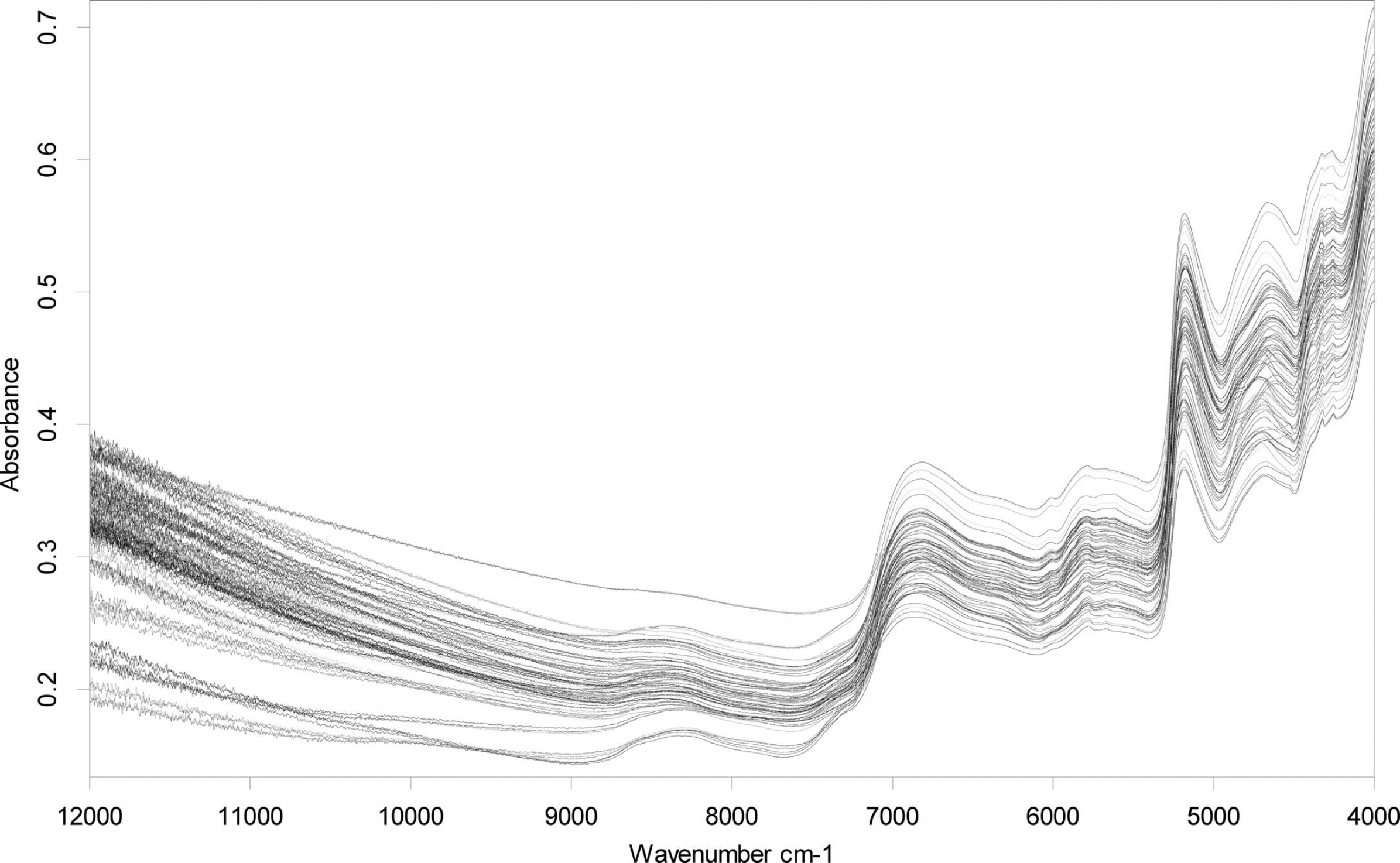
NIRS of L. prostrata Roxb samples.
PLS models and the calculation results of results of leave-one-out cross-validation and the prediction set.
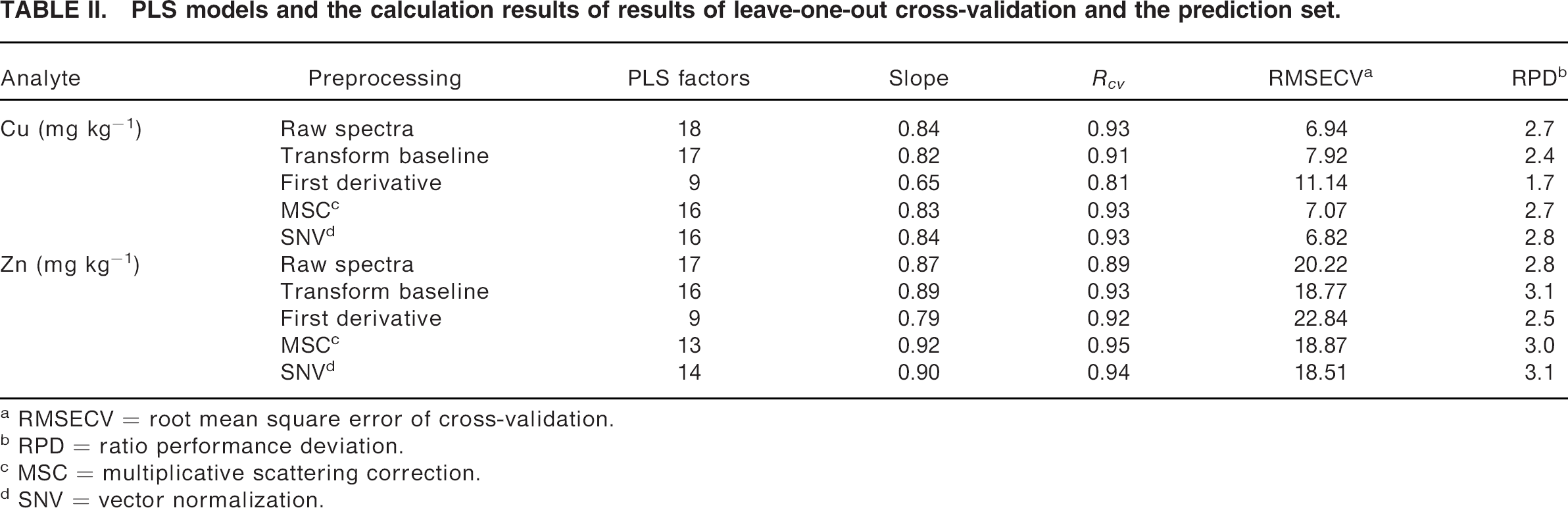
RMSECV = root mean square error of cross-validation.
RPD = ratio performance deviation.
MSC = multiplicative scattering correction.
SNV = vector normalization.
A qualitative interpretation of the RPD was provided by the authors of this paper in which NIRS calibration models with RPD values greater than 2.5 were considered fair and recommended for screening purposes. In the study, the RPDs obtained for the calibration models were higher than 2.5, so the models would be considered fair and could be used as screening tools to diagnose pollution levels of Cu and Zn in L. prostrata Roxb.
Cu and Zn can be combined with diverse organic complexes such as chelates, which represent the main source of variance for Cu and Zn treatments. Using NIRS we are able to track the Cu and Zn concentration by response. Figure 2 shows PLS loadings for Cu and Zn measured in L. prostrata Roxb leaves using NIDRS. The observed valleys and peaks can be attributed to overtone bands related to molecular groups in the matrix. Loadings in the NIRS region show the wavenumber at 7140 cm−1, between 6250 and 5882 cm−1 (around 6010 and 5950) related with O–H and C–H tones (e.g., water, sugars, and ethanol), around 4440 cm−1 related with C–H and –CH2 combinations (e.g., cellulose and carbohydrates), between 6540 and 6250 cm−1 (around 6365) related with N–H overtones(e.g., secondary amide and proteins), and between 4762 and 4545 cm−1 (around 4651) related with C–H combinations and overtones (e.g., benzene and aromatic series).37,38 Additionally, the other loadings were difficult to assign to any particular bond or chemical structure.
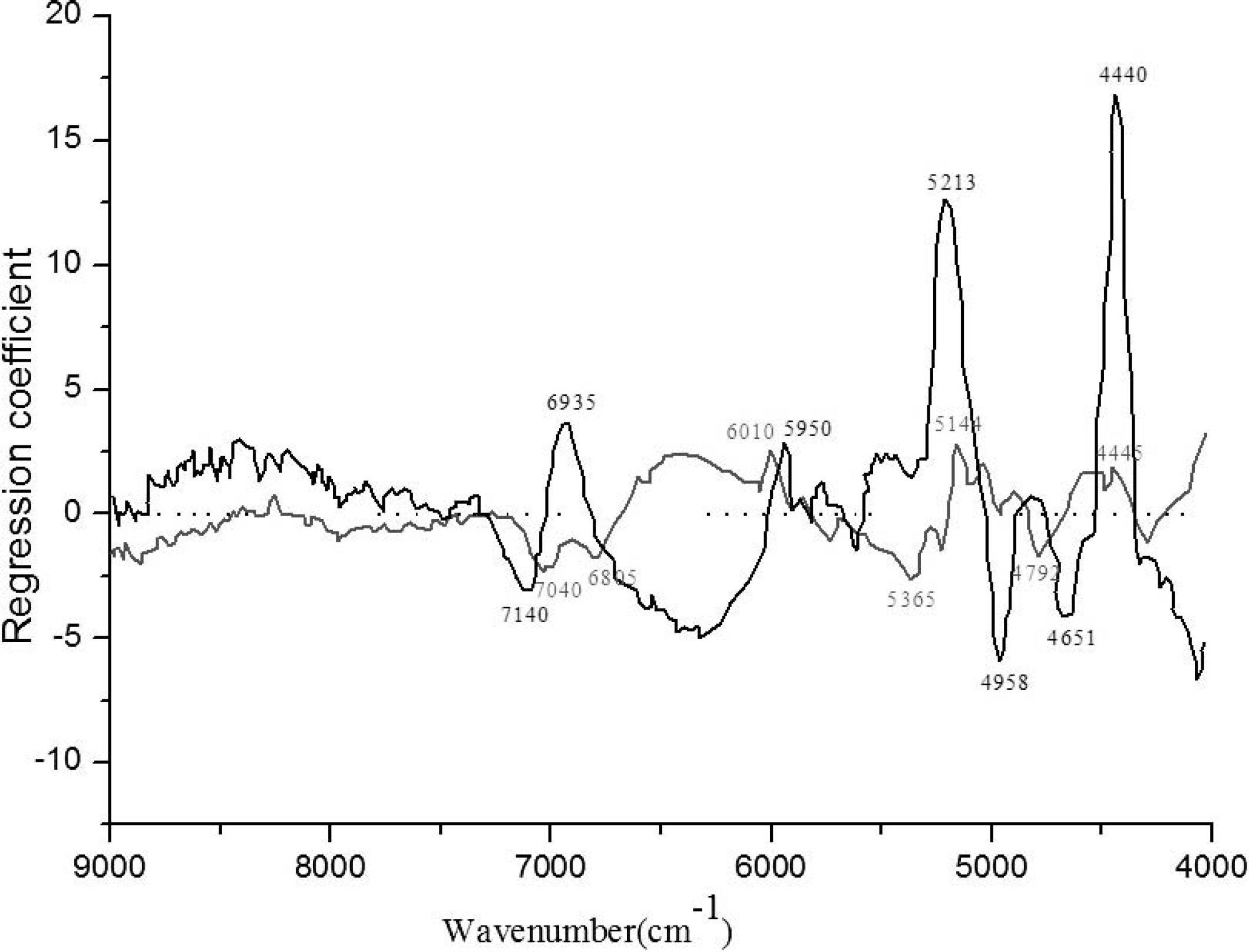
Partial least squares (PLS) loadings with SNV for Cu (red line) and Zn (black line) measured in L. prostrata Roxb.
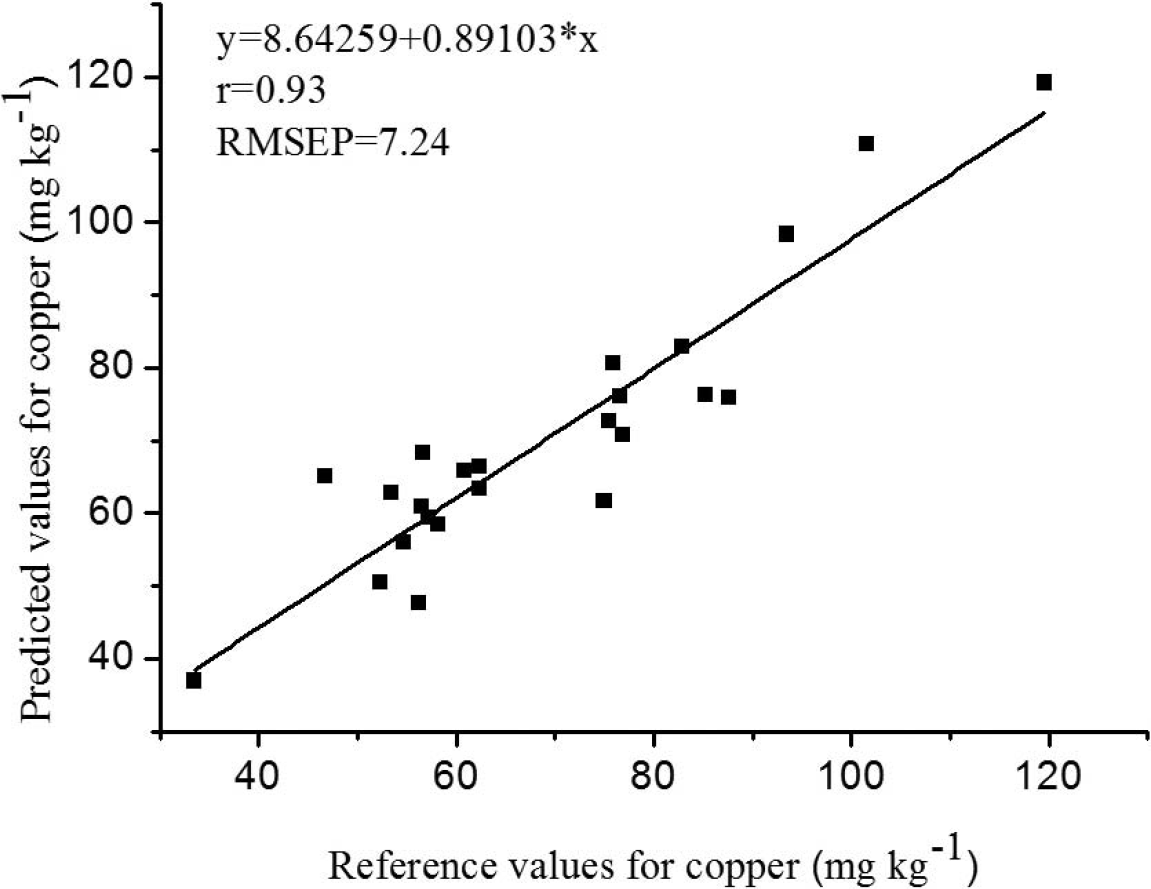
Near-infrared predicted values versus reference values for Cu in L. prostrata Roxb (n = 24).
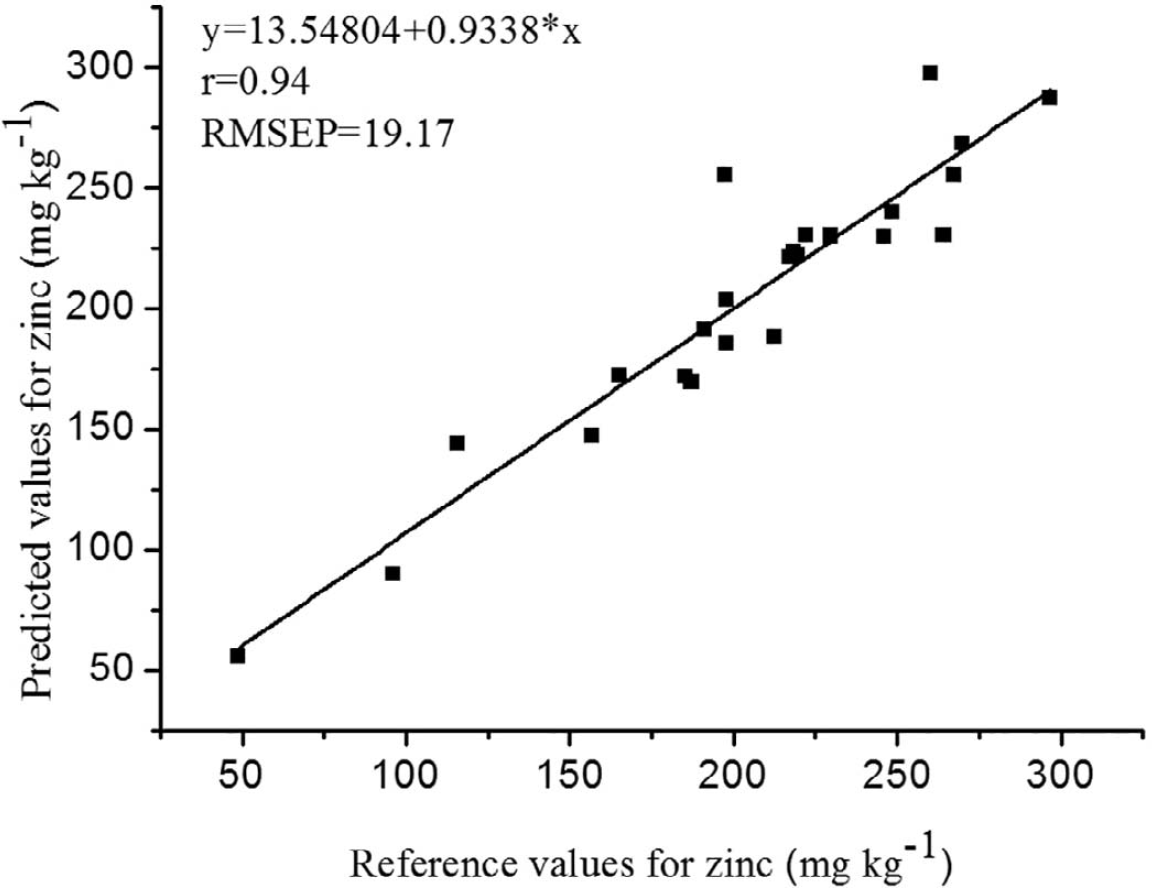
Near-infrared predicted values versus reference values for Zn in L. prostrata Roxb (n = 24).
CONCLUSION
Some relationships exist between NIRS spectra and the concentration of heavy metals in plants. The study has shown that NIRS can be used to determine the concentrations of Cu and Zn in L. prostrata Roxb plants. Five mathematical treatments of the spectral data were compared prior to developing the calibration models using PLS regression methods. The best calibration models for Cu and Zn concentrations were obtained for Cu of Rcv = 0.9 and RMSECV = 7.24 mg kg−1, Zn of Rcv = 0.94 and RMSECV = 19.17 mg kg−1. The study will offer useful information for determining Cu and Zn concentrations in plants.
Footnotes
ACKNOWLEDGMENTS
The authors gratefully acknowledge the financial support provided by National Science and Technology Support Program (31160250, 61178036), Graduate Students Innovation Foundation (YC 2013-S157), Center of Photoelectric Detection Technology Engineering of Jiangxi Province (2012-155).