







Abstract
This research explores the extent to which competitive actions of multinational corporations (MNCs) and local vendors of Internet technology products shape the diffusion of their respective products in emerging markets. Drawing on competitive technology diffusion, the Austrian perspective on firms’ market processes, and resource advantage theory, the authors develop a set of hypotheses regarding the characteristics of the competitive actions of MNCs and local vendors. They validate the hypotheses with longitudinal field data from two pairs of competing Internet technology products in search engine and consumer-to-consumer electronic markets. The findings indicate that specific market-oriented actions of local vendors and MNCs influence the diffusion of technology products. In particular, global marketing managers should concentrate on a few key actions and take new actions that differ from those of local vendors in emerging markets. This study provides a wealth of knowledge in high-technology product diffusion and demonstrates how competition between local vendors and MNCs in emerging markets differs from typical within-industry competition. In addition, this study conveys important implications to the theory of international business.
Examples of Internet Product Competition Between MNCs and Local Vendors in the China Market

eBay owns two websites in China for its different business models: www.eachnet.com for its consumer-to-consumer market and www.ebay.cn for its cross-country business-to-business market, which was ranked 1,315 in China by Alexa on April 27, 2011.
Notes: Alexa rank: Alexa's traffic rank of the websites in China as of 2011 (accessed on April 27, 2011). For companies that do not set up their regional websites, the Alexa rank is measured by their global websites visiting from the China region.
Compared with mature markets, emerging markets are characterized by a high-velocity environment in which market growth is rapid, boundaries and industry structures are blurry, and the roles of market players change continuously (Hoskisson et al. 2000; Lee 2010; Walters and Samiee 2003). Accordingly, competition in emerging market is usually more dynamic than in developed markets (Sheng, Zhou, and Li 2011). Contrary to common understanding, the toughest competitors in emerging markets are often local firms, which tend to be more effective than their foreign competitors in developing products and marketing strategies that are appropriate for their markets (Walters and Samiee 2003). In addition, low entry barriers and easy imitation of the offerings of Internet technology products (Porter 2001) result in stronger competition features and more disparate market dynamics than competition in traditional settings. As a result, IMNCs must rethink their strategies because past experiences in their home countries may not readily apply to emerging markets (Khavul et al. 2010).
As Table 1 implies, the commercial success or failure of Internet technology products in emerging markets does not rely solely on a company's resources; rather, it also relies on an effort to find the right combination of technology and marketing strategies, as well as the appropriate operationalization of those strategies (Calantone, Chan, and Cui 2006; Henard and Szymanski 2001; Wirtz, Mathieu, and Schilke 2007). Changes in the global economy, such as the recent economic crisis, also evoke the need to rethink managerial approaches to issues such as risk, competition, and ownership in global markets, in which business reality has transformed from “West leads East” to “West meets East” (Chen and Miller 2010). Of increasing importance is how to adjust newly evolving competitive conditions and adapt strategies to compete in emerging markets. Because market players’ competitive actions constitute the fundamental element of market processes, we propose two research questions on IMNCs’ and local vendors’ competitive actions in emerging markets: (1) What is the impact of the two parties’ competitive actions on the diffusion of their Internet technology products? and (2) How can global marketing managers adjust their strategies of competitive actions to compete effectively with their local counterparts?
Answering these questions requires theoretical advances to fill the gap in innovation diffusion. In line with Rogers's (2003) definition of innovation diffusion, Internet technology product marketing is the process by which an Internet technology product is communicated through certain channels over time among members of a social system. Although much research has explored multitechnology diffusion across product generations (Kim, Chang, and Shocker 2000) and product categories (Bucklin and Sengupta 1993; Chu and Pan 2008; Dewan, Ganley, and Kraemer 2010), researchers have placed little emphasis on how competitive actions and strategies between local and multinational vendors shape the diffusion of competing Internet technology products, particularly in emerging markets.
Substantial theory posits that market process factors, or competitive moves among firms, might be important in predicting product diffusion and commercial success of technology product innovation (Henard and Szymanski 2001; Rogers 2003; Souder and Song 1997). Rogers (2003, p. 222) argues that “an innovation's rate of adoption is affected by the extent of change agents’ promotion effects.” The core premise is that competitive actions generate a series of advantages that lead to superior performance (Chen 2010; Smith, Ferrier, and Grimm 2001). Building advantage through competitive moves is particularly critical in high-velocity environments because successful strategies may not have been established (Chen et al. 2010). Although emerging markets share important high-velocity characteristics, literature on competitive moves often focuses on established markets and leaves emerging markets largely unexplored (Chen et al. 2010).
Therefore, this study aims to explore the extent to which Internet technology product diffusion is a function of the competitive behaviors or actions of IMNCs and their respective local challengers in emerging markets. Specifically, we develop and test a set of hypotheses regarding the characteristics of competitive actions of both local online vendors and IMNCs and the impact of these competitive behaviors on the diffusion of Internet technology products.
Literature Review and Theoretical Foundation
Three streams of literature formed this study's theoretical foundation: (1) diffusion of competing technology products, (2) the Austrian perspective and resource advantage theory on firms’ competitive actions in their market processes, and (3) competition between local firms and MNCs. Although research on multiple technology product diffusion has revealed substitutive effects between products (i.e., increase in one product's market adoption decreases a competing product's market adoption), researchers have not examined how, at the micro level, firms’ different marketing actions create such effects. This gap can be best filled from the Austrian perspective and resource advantage theory, which view the market as a mechanism that allows firms to employ their unique resources and take a series of actions to gain temporary and comparative advantages until competitors fight back (Hunt and Morgan 1995; Rindova, Ferrier, and Wiltbank 2010). However, these competition theories based on microlevel market processes only suggest general competitive choices; they leave unexplored how specific competitive actions influence firms’ competitive advantages in emerging markets. Emerging markets in the current global economy bring marketing managers different challenges from those in mature markets. Thus, specific competition patterns between MNCs and local firms contribute value to international business and marketing research. Overall, this study integrates the three streams of research through the common core component of competitive action because they generate unique theoretical value for global marketing studies (see Figure 1).

Links Among Three Streams of Research
Diffusion of Competing Technology Innovations
Research has recognized that various relationships between technology innovations, such as substitutes, complements, and supplements bundles, can influence the diffusion of individual innovations (Rogers 2003). In general, competitive actions between Internet technology products trigger substitutive effects across technology innovations (Chu and Pan 2008; Mahajan and Muller 1996; Mahajan, Sharma, and Buzzell 1993). Motivated by the fact that newer and more efficient technologies gradually replace older technologies, one body of literature has focused on the substitutive effect in the diffusion of multiple innovations (Ding and Eliashberg 2008; Kim, Chang, and Shocker 2000; Krishnan, Bass, and Kumar 2000). Because consumers’ choice of a specific technology product is often accompanied by termination or reduced use of another product with similar functions, existing diffusion literature has also examined user switching behavior between competing technology products (e.g., Ye et al. 2008).
However, little emphasis has been placed on the dynamic relationship between competitors’ competitive actions and the diffusion of their products. Substantial theory suggests that the success of technology product innovations does not rely solely on the technological features of the products but rather on the dynamics of vendors’ specific market-oriented actions (Calantone, Chan, and Cui 2006; Henard and Szymanski 2001; Rogers 2003). The dynamics of firms’ competitive actions and, more specifically, the means by which firms guarantee the market share of their Internet technology products have remained largely unexplored. Therefore, the current study complements existing literature by examining, both theoretically and empirically, the role of competitive actions in Internet technology product diffusion within the context of competing local vendors and IMNCs.
Competition Theories Based on Firms’ Market Processes
Two competition theories based on firms’ market processes contribute to existing literature—namely, the Austrian perspective and resource advantage theory. The Austrian perspective views the market as a mechanism that allows firms to experiment by taking specific actions; some firms undertake actions in an attempt to lead, while others try to follow and imitate (Ferrier, Smith, and Grimm 1999). According to the perspective, organizational action (1) constitutes the critical market process, (2) disrupts links between competitive conduct and performance found in the routine or ordinary status of the marketplace, and (3) converts neglected opportunities to the advantage of the acting organization (Young, Smith, and Grimm 1996). Furthermore, firms that are successful in acting as leaders or seizing opportunities manage to reap profits because they occupy a temporary monopolistic position until they are imitated (Nelson and Winter 1982; Smith et al. 1991). Long-term equilibrium, however, is never reached. Excess profits of the acting firms and losses of nonresponders motivate the latter to respond. Therefore, competitive advantage is short-lived because frequent and aggressive firm-level actions disrupt the causal links between competitive conduct and performance outcomes. Thus, firms must continuously undertake a series of actions to create a new competitive advantage.
Consistent with the Austrian perspective on competition in microlevel market process, resource advantage theory provides a more focused view on the comparative advantages and market-oriented resources of firms in competition (Hunt and Lambe 2000; Hunt and Morgan 1995). The theory argues that the resource advantage that one firm has over its competitor is temporary and comparative. Competitors can overcome the existing resource advantage through various market-oriented competitive actions, such as imitating the same resource and searching for a strategically equivalent or superior resource (Hunt and Morgan 1995). The effectiveness of these competitive actions depends on characteristics of the marketplace and the competing firms, as well as the competition process of using the resource advantage (Hunt and Morgan 1995, 1997). Furthermore, literature following the resource advantage perspective has proposed various market-oriented competitive actions influenced by firm-specific resources, environmental factors, and dynamic characteristics of the market, such as changes in a firm's competitive position in competition. Overall, combining the two theoretical perspectives provides a solid theoretical foundation of our study.
Following Smith et al. (1991), we define competitive action as a newly developed and specific competitive move that a firm initiates to defend or improve its competitive position. A new competitive action may include price cuts, new product introductions, or new promotional campaigns that disrupt a market by stealing the market share from a rival. It may also include a series, or simultaneous thrust, of new actions that are implemented in a short time frame to disturb and paralyze a rival (D'Aveni and Gunther 1994). Alternatively, a manager might carefully schedule the timing of new competitive actions to disrupt a challenger's intentions. As such, our definition of newly created competitive actions captures the Austrian view of competition as new, extraordinary, and competitive behaviors. From the Austrian perspective of the market process, competitive actions are important because they threaten rivals, forcing them to implement new competitive actions and to further disturb routine competitive behaviors (Smith et al. 1991). Firms are also motivated to take new competitive actions as they realize that routine past actions are ineffective (Kirzner 1997; Miller 1990). The definition of competitive action in this research is consistent with the description of various market-oriented competitive actions in resource advantage theory. According to the theory, market-oriented competitive actions are strategically recognized, created, selected, and implemented for the purpose of neutralizing competitors’ comparative resource advantage (Hunt and Morgan 1995). Within an international competition context, the Austrian perspective and resource advantage theory provide an in-depth theoretic lens to investigate the extent to which the diffusion of Internet technology products is a function of the competitive actions of IMNCs and their local challengers. This context also enables us to examine how competitive actions affect IMNCs’ dominance in emerging markets.
Competition between Local Firms and MNCs
Literature on international business management has long examined multinational strategies and performance in overseas markets. This line of research has examined MNCs’ entry mode decisions (Chang 1995), interactions with other MNCs (Chang and Park 2005; Miller and Eden 2006; Yu and Cannella 2007), and ability to cope with socioeconomic environments of host countries (Kostova and Zaheer 1999). For example, Durand and Coeurderoy (2001) find that first moving into an emerging foreign market helps MNCs maintain their advantage more so than first moving into established markets. Lavie and Fiegenbaum (2000) find that when the Israeli market opened, MNCs were able to push domestic competitors quickly aside and eliminate many marginal players and market consolidators in several sectors.
Whereas existing literature primarily incorporates the perspective of MNCs, recent studies have begun to focus on local firms that compete with MNCs in local markets (Chang and Xu 2008; Dawar and Frost 1999; Meyer 2004; Wu and Pangarkar 2006). For example, Jaffe, Nebenzahl, and Schorr (2005) analyze the strategic options of a domestic firm threatened by the entry of an MNC. The domestic firm could choose to attack the incoming MNC, cooperate with it, defend its home position, or exit the market. Wu and Pangarkar (2006) also discuss how local firms in emerging markets could counter the threats posed by entering MNCs. Although international business research has suggested general strategic choices for MNCs and local vendors, little attention has been given to specific competitive actions in the intense competition between IMNCs and local vendors in emerging markets, in which competitive actions may be a perfect lens to study the market process.
Research Hypotheses
Despite increasing competition between multinational and local vendors of Internet technology products in emerging markets, little systematic empirical research exists on the operationalization of marketing strategies or its effect on performance. The sector of Internet technology products in emerging markets is characterized as high-velocity environments in which demand and technology are constantly changing (Walters and Samiee 2003), successful business models may not have been established, and the role of market players changes continuously (Wirtz, Mathieu, and Schilke 2007). In high-velocity environments, it is critical that engaging rivals employ their resources to execute back-and-forth competitive moves to generate a series of temporary advantages that lead to superior performance (Chen 2010; Hunt and Morgan 1995; Smith, Ferrier, and Grimm 2001). While empirical studies have often focused on established markets, the competitive dynamics between IMNCs and local competitors in emerging markets have been largely unexplored. Indeed, scholars have encouraged research on competitive moves in emerging high-velocity markets in which the need to build dynamic competitive advantage is particularly relevant (Chen et al. 2010; Smith, Ferrier, and Grimm 2001; Wirtz, Mathieu, and Schilke 2007).
Compared with local competitors, IMNCs possess proprietary assets, often in the form of advanced technologies, established brand names, and managerial know-how, which can be transferred to their foreign subsidiaries (Buckley and Ghauri 2004; Dunning 1988; Hitt et al. 2000). In addition, IMNCs often have abundant capital and experienced expatriate managers who can be assigned abroad. In contrast, domestic incumbents typically enjoy locally embedded advantages, such as established marketing and distribution channels, and access to information and network connections (Chang and Xu 2008; Lu and Xu 2006). Furthermore, managers of local vendors are often educated and trained domestically and thoroughly understand their home market. Although IMNCs possess advantageous organizational, financial, and human resources, the distinct assets of local firms equip them with remarkable capabilities to develop and execute sophisticated marketing strategies (Walters and Samiee 2003). Therefore, to compete with local vendors effectively, IMNCs must adjust their marketing strategies to the rapid pace of competition in emerging markets. From this review, our general proposition is that global marketing managers of IMNCs can improve the diffusion of their technology products by adopting an aggressive marketing strategy that comprises a series of sophisticated competitive actions. As such, we examine four dimensions of competitive actions: total competitive activity, action timing, simplicity of action repertoire, and dissimilarities between locals’ and IMNCs’ actions.
Total Competitive Activity
Total competitive activity refers to the total number of new competitive moves a firm implements in a given period (Ferrier, Smith, and Grimm 1999). The Austrian view suggests that all actions are undertaken to pursue competitive advantage and to discover profit opportunities (D'Aveni and Gunther 1994; Kirzner 1997). Resource advantage theory posits that firms that are capable of executing a large number of competitive activities possess an assortment of resources that enable such actions. The combination of these resources brings comparative advantages to firms (Hunt and Morgan 1995). In general, a firm that implements multiple new competitive activities is considered more aggressive (Young, Smith, and Grimm 1996). Some researchers have suggested that firms that remain competitively aggressive have a better chance of gaining and maintaining their competitive advantage. For example, Ferrier, Smith, and Grimm (1999) find that market leaders were more likely to experience market share erosion and dethronement when they were less aggressive than their challengers.
In the competition between IMNCs and local vendors in emerging markets, although local vendors lack the transferable assets that IMNCs possess, some have developed distinct assets by restructuring, innovating, and internationalizing and therefore are capable of executing effective competitive actions (Dawar and Frost 1999). A more aggressive local vendor that implements a larger number of competitive activities can exploit more opportunities and gain a stronger competitive advantage. In addition, as a local vendor's competitive activities increase, the vendor develops internal organizational assets in the form of action repertories and knowledge base for designing and executing effective actions. Furthermore, as the effect of local vendors’ competitive activities increases, the diffusion rate of their products also increases. In contrast, an IMNC that rests on its laurels and fails to execute an adequate number of competitive activities may not be able to keep up with the competition and thus will head toward failure (D'Aveni and Gunther 1994). In support of this idea, Chen and Hambrick (1995) show that organizational size contributes to competitive inertia and lack of aggressive action. From a customer perspective, firms’ actions affect the stimulus level of these perceptions on their products, which results in different market responses to firm actions as measured by market share at an aggregate level. In addition, more stimuli help enhance customers’ recognition of a firm's image compared with fewer stimuli. In this way, a higher action volume is beneficial to both local firms and IMNCs. Therefore, we predict that IMNCs’ and local vendors’ levels of total competitive activity are related to the diffusion rate gap between locals’ and IMNCs’ technology products.
The number of competitive activities of local vendors has a positive impact on the diffusion rate gap between local vendors’ and IMNCs’ technology products.
The number of competitive activities of IMNCs has a negative impact on the diffusion rate gap between local vendors’ and IMNCs’ technology products.
Action Timing
Action timing is the time that elapses between actions carried out by a firm and those carried out by a rival. According to the Austrian perspective of market processes, dynamic market processes constitute a race in which market players that act quickly receive high payoffs (Smith, Ferrier, and Grimm 2001). In addition, the faster a firm acts compared with its rival's actions, the more it can use these new actions to outmaneuver its rival, which in turn slows down the rival's actions (Chen and MacMillan 1992). A key principle of dynamic competition is that firms that quickly respond to their rivals’ new competitive moves slow down rivals’ competitive activities (Smith, Grimm, and Gannon 1992). Resource advantage theory provides further support for the advantage of quick response. Firms that are capable of responding quickly may possess certain enabling resources. Such resources produce comparative advantages for the quick responder. In general, empirical studies have supported the notion of a significant relationship between action timing and performance. For example, D'Aveni and Gunther (1994) find that speed is one of the most effective ways to gain a competitive advantage in hypercompetitive markets.
In the competition between local vendors and IMNCs, IMNCs typically optimize their operations at the global level by standardizing product characteristics, administrative practices, and pricing, all of which can hamper their flexibility (Dawar and Frost 1999; Lee, Chen, and Lu 2009; Luo 2001). Compared with IMNCs, local vendors are closer to the local market and are able to let the market define them (Ger 1999). In addition, local vendors have knowledge of the local economy, politics, culture, and business customs; understand the local demands and tastes; and have easy access to materials required for conducting business in local markets (Makino and Delios 1996). Thus, local vendors’ flexibility in operation enables them to carry out newly created competitive actions quickly, and the competitive effect of these actions on the diffusion of IMNCs’ products tends to be strong. Some IMNCs may also manage to acquire host-country-specific assets because they are culturally and ethnically proximate to the host country, have past operational experience, or have internalized certain local knowledge through joint ventures (Chang and Xu 2008; Cui, Griffith, and Cavusgil 2005; Luo 1997). Therefore, IMNCs can also carry out competitive actions quickly, which facilitates the prevalence of their Internet technology products. Drawing on these arguments, we propose the following hypotheses:
The timing of local vendors’ newly created competitive actions has a negative impact on the diffusion rate gap between local vendors’ and IMNCs’ technology products.
The timing of IMNCs’ newly created competitive actions has a positive impact on the diffusion rate gap between local vendors’ and IMNCs’ technology products.
Action Repertoire Simplicity
Competing local vendors and IMNCs can choose different varieties of competitive actions. For example, some vendors might carry out a narrow range of actions, while others might undertake a broad variety of actions. Action repertoire simplicity typically refers to a firm's propensity to concentrate on a narrow range of action in any given period (Miller and Chen 1996). The Austrian view posits that competitiveness is a firm's ability to conduct a range of competitive actions, and a firm's repertoire of competitive actions has a broad influence on its competitive advantage (Ferrier, Smith, and Grimm 1999). Resource advantage theory suggests that firms can gain comparative advantage if they are capable of identifying their unique resources and employing them effectively. Kirzner (1997) describes the range of activity as a collection of activities that are related to product quality, price, style, and so on, to which firms can make systematic changes based on market conditions.
Action simplicity is particularly important in high-velocity markets. The theory of dynamic capabilities argues that for firms to successfully compete in high-velocity environments, they should select a few key strategic processes (Eisenhardt and Sull 2001; Wirtz, Mathieu, and Schilke 2007). Often, these processes consist of a few simple and innovative actions so managers can respond quickly in a fast-changing situation (Eisenhardt and Martin 2000). Action simplicity is also important in fast-moving markets because audience attention span is usually short. For example, Eisenhardt and Sull (2000) argue that firms should select a few key strategic processes with a handful of simple rules rather than complicated strategies in high-velocity markets.
The diversity of action patterns evokes a stimulus that affects the extent to which actions are perceived as either simple and clear or complex and confusing (Rindova, Ferrier, and Wiltbank 2010). In this way, competitive actions affect customer perceptions of firms’ products, which results in different market responses to firm actions as measured by market share at an aggregate level. Furthermore, simple stimuli contain readily identifiable core patterns or tendencies, and they enable customers to grasp a pattern easily and improve their recognition of a firm's image (Rindova, Ferrier, and Wiltbank 2010). Therefore, we expect that action simplicity is associated with positive customer perceptions and market responses to both local firms and IMNCs. This analysis results in the following hypotheses:
The simplicity of the action repertoire carried out by local vendors has a positive impact on the diffusion rate gap between local vendors’ and IMNCs’ technology products.
The simplicity of the action repertoire carried out by IMNCs has a negative impact on the diffusion rate gap between local vendors’ and IMNCs’ technology products.
Local–MNC Action Dissimilarity
Local–MNC action dissimilarity is the degree to which local vendors and IMNCs differ in their actions. Some researchers have examined the outcomes of strategic dissimilarity among rivals. For example, Gimeno (1999) finds that strategic heterogeneity among airline industry participants contributed to changes in market share. Similarly, Gimeno and Woo (1996) find that strategic similarities among rivals increased the intensity of the competition. The literature on product differentiation (Tirole 1988) argues that competing firms may strategically differentiate their product offerings to avert competition (the strategic effect); alternatively, they may target their product offerings more closely to obtain a larger market share (the market share effect). Furthermore, Tirole (1988) demonstrates that, in general, the strategic effect dominates the market share effect; therefore, firms tend to adopt a differentiation strategy. Resource advantage theory stresses that a firm's comparative advantage in resources results in its comparative advantage in performance (Hunt and Morgan 1995). Using distinctive resources enables a firm to execute specific competitive actions that differ from its competitor's actions. Marketing researchers have found that a brand's optimal competitive strategy is contingent on its market position. As such, brands in a disadvantaged market position, with no distinctively different attributes or benefits, are preferred less when they are positioned close to the dominant brand, despite the similarity of their attributes (Carpenter and Nakamoto 1989). Such contingency is called “preference asymmetry” (Carpenter and Nakamoto 1990). The extent of preference asymmetry determines whether a high or low differentiation positioning for the weaker brand is optimal. Specifically, marketing researchers have shown that preference asymmetry can make an undifferentiated weaker brand unattractive (Carpenter and Nakamoto 1990).
In the competition between local vendors and IMNCs, whether IMNCs or local vendors benefit from enhanced dissimilarity is contingent on their market position. As IMNCs take the initiative to enter an emerging market, they become the market leader, while local vendors are just starting and learning. Therefore, it is only natural that local vendors follow in the footsteps of IMNCs. However, although increasing dissimilarity to IMNCs benefits local vendors, they are not in the shape to differentiate. As local vendors grow stronger and begin to lead the market, IMNCs are in a disadvantaged market position and are better off increasing dissimilarity to local vendors. Thus, we hypothesized the following:
The levels of local–MNC action dissimilarity have a negative impact on the diffusion rate gap between local vendors’ and IMNCs’ technology products.
Research Methodology
Data Collection
We collected competitive events information and diffusion rate data of two pairs of Internet technology products. One pair of data is from eBay (China) and Taobao in the Chinese consumer-to-consumer (C2C) electronic market from 2003 to 20061; the other pair of data is from Google (China) and Baidu in the Chinese search engine market from 2004 to 2008. Market diffusion data of eBay and Taobao were collected from Alexa Internet, one of the largest third-party data companies tracking online traffic. Alexa provides reach information of numerous websites, which is the amount of unique Internet protocol addresses accessing the websites Alexa tracks. The data provide a good estimation of the user base of C2C electronic markets. To further validate model generality, market diffusion data of Google and Baidu were collected from another third-party vendor, Google Trends, which provided search volume indexes to assist in objectively measuring the extent of users’ interests in a particular technology. Search volume indexes shows how often Google and Baidu are searched relative to the total number of searches across time. Because search is usually the predominant function of a search engine, this index serves as a reasonable approximation of user adoption of a search engine. To restrict our analysis to the regional market, we used Internet protocol addresses of access provided by Google Trends to distinguish Chinese users from other worldwide users.
We collected competitive events information of the two pairs of Internet technology products by searching the headlines and abstracts of published news reports using two dominate search engines in China (Baidu and Google). To ensure the accuracy of the reports, we cross-searched both search engines to validate the sources of the reports. We identified 2009 unduplicated news records over a five-year period. Following previous research, we defined newly created competitive actions as externally directed, specific, and observable new moves initiated by a firm to enhance its competitive position (Chen and MacMillan 1992; Young, Smith, and Grimm 1996). This definition includes only actions that have been implemented; were observable to customers, competitors, and other industry players; and were described in the business press. Following this definition, we content-analyzed the 2009 headlines and articles and coded them into the following competitive action types: marketing actions, new product research and development (R&D), pricing and earnings actions, legal actions, signaling actions, capacity actions, and service actions. The category aligns well with market-oriented resource classification in resource advantage theory (Hunt and Morgan 1995, 1997). Other studies of competitive dynamics have also used the structured content analysis technique and categorization approach (Ferrier, Smith, and Grimm 1999; Young, Smith, and Grimm 1996). Table 2 shows the keywords and sample headlines for each of these action categories. To check the reliability of our coding further, two academic researchers separately recoded three random subsamples (n = 100, 50, 10) of individual firm competitive actions into each of the seven categories. We used Perreault and Leigh's (1989) reliability index to test the coding reliability. This test yielded the values of .92, .94, and .92, respectively, indicating a high degree of coding reliability.
Classification for Competitive Action

Our data set presents several advantages for this research. First, a matched-pair design is ideal for the examination of competitive actions of local vendors and IMNCs. In our data set, the total market share of eBay and Taobao measured by the dollar amount of sales in the Chinese C2C electronic market was 80% in 2003 and 92% in 2008. Similarly, Baidu and Google (China) collectively occupied 88% of the Chinese search engine market at the time of the study. Therefore, the Chinese search engine market and C2C market can best be characterized as spatial duopoly markets in which global and local firms compete in a specific region mainly by three economic variables: adjustments over space and changes in product quality and price (Devletoglou 1965). Diffusion data in such a duopoly market can verify the hypotheses better because they free us from considering the influence of other competitors in the region and thus enable us to focus on two direct competitors in the specific market. Second, eBay and Google are good representatives of IMNCs; both achieved great success in the United States and entered emerging markets, such as China, to find new opportunities for growth. In addition, both eBay and Google were similarly involved in intense competition with the local competitors Taobao and Baidu, respectively, in China (Lemon 2009).
Measures
Following Ferrier, Smith, and Grimm (1999), we define total competitive activity as the total number of newly created competitive actions carried out by a local vendor or an IMNC, respectively, during each quarter. Then, we calculated the local–MNC action difference as the number of total new actions by the local vendor minus the number of actions by the IMNC. A positive difference score shows that the local vendor performed more competitive actions than the IMNC in a same quarter. We measured action timing by the number of days elapsed between the date of one vendor's competitive action and the date of the competitor's immediately following action. We calculated response time in the action and reaction dyads using two measures, one from the local vendor's perspective and one from the IMNC's perspective. Then, we calculated action timing difference as the average action timing measure for the local vendor minus the average action timing measure for the IMNC in a same quarter. We measured action repertoire simplicity using the Herfindahl index in each quarter. This index is commonly used to evaluate the level of diversification in economic behavior. We can express its calculation as follows:


We calculated the dependent variable, diffusion rate gap between local vendors’ and IMNCs’ technology products, as the difference between the quarterly diffusion rates of local vendors and IMNCs (i.e., the local vendor's market diffusion rate minus the IMNC's market diffusion rate in the same quarter). A positive difference score shows that the local vendor's customer base expanded faster than the IMNC's in the same quarter, and vice versa. In addition to vendors’ competitive actions, local vendors and IMNCs may differ in other aspects that influence the diffusion rate gap between their technology products. We control for the effect of local market advantage, measured by dividing each previous year's market share gap between local vendors and IMNCs by their combined market shares for the same year. Local market advantage evaluates vendors’ status in the local market. Vendors with the market advantage are expected to perform well in the next period, all else being equal. For example, IMNCs possess established brand powers and reputation at the beginning of their operation in the local market; therefore, their market share is much higher than that of the local vendors. We further control for the effect of market size because the Chinese search engine market and C2C market differ in market size, which may influence the dynamics of the corresponding vendors’ competitive strategies. Table 3 depicts summary statistics of the competitive actions.
Action Characteristics in the Competitions Between Firms

Notes: Shadowed cells indicate that the firm is superior in the specific action to its competitor.
Data Analysis and Results
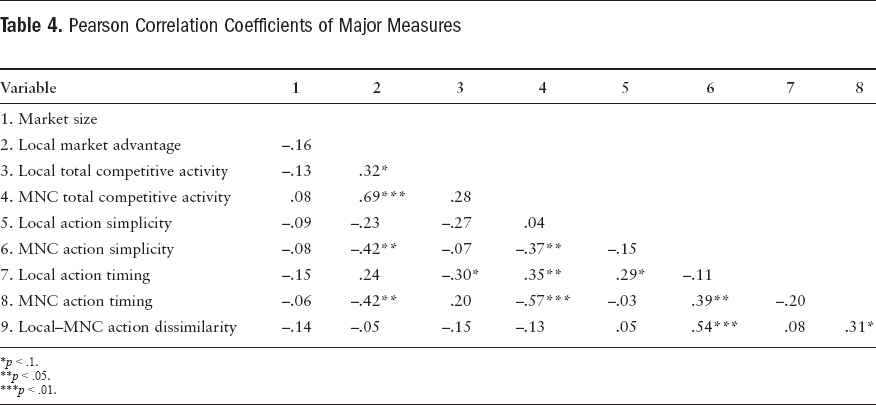
Table 4 shows the correlations between the independent variables. According to Judge et al. (1988, p. 501), multicollinearity is typically considered a serious problem only “if the correlation coefficient between the values of two regressors is greater than 0.8 or 0.9.” All correlation coefficients in this study were less than .7. We also conducted a multicollinearity test before regression analysis. We analyzed the tolerance, which is the amount of variability of the selected independent variables not explained by other independent variables and is measured by 1 - R2i. We further calculated the variance inflation factor (VIF), which measures how much the variance of the estimated regression coefficients is inflated as a result of being related to the other independent variables, following the formula of 1/(1 -R2i) (Neter, Wasserman, and Kutner 1990). The tolerance threshold should be above .10, and the VIF threshold should be less than 10. The test outcomes showed that all independent variables’ tolerance is between .262 and .905, and their VIF is between 1.105 and 3.817, which suggests no serious problem with multicollinearity (see Table 5).
Pearson Correlation Coefficients of Major Measures
p < .1.
p < .05.
p < .01.
Regression Model (Dependent Variable = Diffusion Rate Gap)

p < .1.
p < .05.
p < .01.
In our conceptual model, we explicitly predicted that local vendors’ and IMNCs’ competitive activity would be related to the diffusion rate gap between their products (Model 1). To investigate the effect of action difference on the performance difference further, we ran one additional regression model, in which the independent variable is the difference between local vendors’ and IMNCs’ competitive actions (Model 2).
We employed several estimation methods in the empirical analysis. Because ordinary least squares (OLS) estimates often perform well in practical research situations, we first ran OLS in the analysis. Moreover, our data set has the characteristics of time-series cross-sectional data (Stimson 1985); that is, there are repeated observations on the two pairs of competitors, and there are many more temporal units than spatial units (i.e., T > N). Therefore, following common practice, we further employed feasible generalized least squares and panel corrected standard error in the estimation to correct for potential groupwise heteroskedasticity and serial correlation (Beck and Katz 1995, 1996). Both of these estimations generated consistent estimation with the results using OLS. Because OLS has been repeatedly adopted in the existing literature of diffusion analysis, we focus our discussion using the OLS estimation results. We report the results in Table 5.
H1a predicted that local vendors that carried out more competitive actions would likely experience an increase in diffusion rate and, therefore, a higher diffusion rate gap than IMNCs. The coefficient of local total competitive activity is positive and significant (b = .304, p < .01). Therefore, H1a is supported. The coefficient of MNC total competitive activity in Model 1 is insignificant, so H1b is not supported. The coefficient of local vendor action timing in Model 1 is also insignificant, so H2a is not supported. The negative and significant (b = −.204, p < .10) coefficient of MNC action timing in Model 1 indicates that the diffusion rate gap becomes smaller if MNCs are slower to implement newly created competitive actions. Therefore, H2b is not supported.
H3a predicted that local vendors with more straightforward action repertoire would likely have higher diffusion rates. H3a is supported; the coefficient of local action simplicity in Model 1 is positive and significant (b = .225, p < .05). The negative and significant (b = −.185, p < .05) coefficient of MNC action simplicity in Model 1 indicates that IMNCs with more concentrated action repertoire are less likely to experience diffusion rate erosion. Therefore, H3b is supported. H4, which predicted that the level of local–MNC action dissimilarity would be negatively related to diffusion rate gap, is also supported. The coefficient of local–MNC action dissimilarity (Model 2) is negative and significant (b = −.277, p < .05).
Discussions and Conclusions
Discussion of Findings
This study shows that specific market-oriented actions of local vendors and IMNCs influence the diffusion of their technology products. The findings confirm the benefits of adopting a simple repertoire of actions. Specifically, by carrying out a simple repertoire of actions, vendors can focus on the most important and effective actions. This finding is consistent with recent literature (Rindova, Ferrier, and Wiltbank 2010); however, it is in sharp contrast with the observed relationship between simplicity and performance in mature markets. Figure 2 illustrates the relationship between action simplicity of Taobao and eBay and the diffusion rate gap between them. During the period 2004/Q4–2005/Q4, the simplicity of eBay's action repertoire decreased. The diffusion rate gap between Taobao and eBay also increased correspondingly during that period. When the simplicity of Taobao's action repertoire increased during 2003/Q1–2004/Q2, the diffusion rate gap between Taobao and eBay increased accordingly.

Firms’ Action Simplicity and Their Diffusion Rate in the Market
This research also demonstrates the potential detrimental effect of competing with local vendors on IMNC responsiveness. Cross-border operations determine IMNCs’ weaknesses in responsiveness. In contrast, responsiveness is one of the strongest advantages of local vendors because of their operational flexibility. In addition, improving responsiveness in emerging markets is important (Lee 2010); however, employing it as a major marketing strategy to compete against local vendors could be harmful for IMNCs. The negative and significant coefficient of the timing of MNC actions indicates that IMNCs that carry out faster competitive responses are more likely to experience diffusion rate erosion; Figure 3 illustrates this relationship. Here, the responsiveness of eBay increased during 2004/Q2–2005/Q3, and the diffusion rate gap between Taobao and eBay increased during the same period. The asymmetric effect of action timing on the diffusion of IMNCs’ and local vendors’ products suggests that high responsiveness is more effective for local vendors than for IMNCs.

Firms’ Action Responsiveness and Their Diffusion Rate in the Market
Another way to gain popularity for products is to undertake different actions. For example, a firm that wants to create different competitive actions must make random changes to avoid being predictable. Figure 4 depicts the relationship between action dissimilarity and the adoption rate gap for Baidu and Google. For the periods 2005/Q1–2006/Q1 and 2008/Q3, the pattern of actions that Baidu carried out differed from Google's. The adoption rate gap between Baidu and Google also increased during that time. This result implies the importance of product differentiation for local vendors. For example, Baidu initially experienced trouble promoting its technology. However, by choosing not to imitate Google, Baidu differentiated itself by providing more localized and complementary services, such as Chinese search, MP3 search, and online discussion boards. More important, the firm provided a different search experience (Thompson 2006). Now, when users search on baidu.com for the name of China's National Basketball Association star Yao Ming, for example, not only are they shown links to news reports on his games, but they are also able to join a chat room with thousands of other users to discuss him.
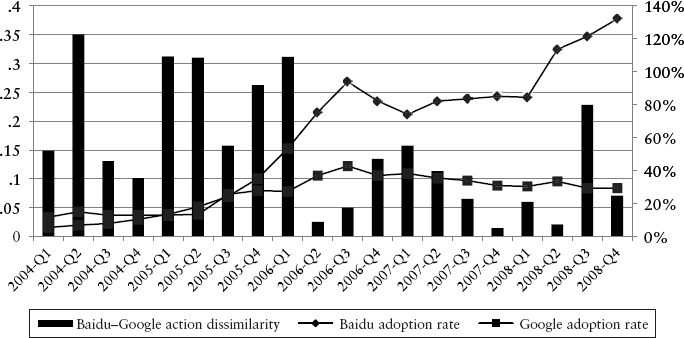
Firms’ Action Dissimilarity and Their Diffusion Rate in the Market
However, in the competition between local vendors and MNCs, whether MNCs or local vendors benefit from enhanced dissimilarity is contingent on their market position. The competition between eBay and Taobao provides a further example. When eBay took the initiative to enter the Chinese market in 2003, it was the market leader and occupied more than 70% of the market share, while Taobao was just starting up and learning (iResearch 2006). Consequently, the increasing dissimilarity to eBay benefited Taobao at first. As Taobao grew stronger and began to lead the market in recent years, eBay fell to a disadvantaged market position and was better off increasing dissimilarity to Taobao.
The positive and significant coefficient of local total competitive activity indicates that local vendors that carry out more competitive actions are less likely to experience diffusion rate erosion. Therefore, the number of local vendors’ competitive actions is an important predictor of their technology product diffusion. Contrary to our prediction, we did not find a significant effect of MNCs’ total competitive action on the local–MNC diffusion rate gap; Figure 5 illustrates this relationship. During the period 2004/Q4–2006/Q3, Baidu engaged in an increasing number of competitive actions. In doing so, the diffusion rate gap between Baidu and Google increased. When the number of competitive actions that Baidu carried out decreased during 2006/Q3–2007/Q2, the diffusion rate gap between Baidu and Google decreased accordingly. Further research could explore the conflicting effects related to the total number of actions by fleshing out the potential for directional asymmetry from both the local vendors’ and the MNCs’ perspectives.

Number of Firms’ Actions and Their Diffusion Rate in the Market
Theoretical Implications
The theoretical implications of this study are threefold. First, this study opens the door to a wealth of knowledge for high-technology product diffusion. We showed that the diffusion of high-technology products is not an independent process; rather, it is intertwined with that of competing products. Although several studies have examined multitechnology diffusion (Ding and Eliashberg 2008; Krishnan, Bass, and Kumar 2000), little emphasis has been given to the dynamics of specific market-oriented actions as factors of Internet technology diffusion. By examining the dynamics of competitive actions and their effects on the codiffusion of competing technology products, researchers can offer an explanation for why a specific technology product is substituted by others gradually and not the other way around. Furthermore, we showed that the long-term success of a technology product is not simply a technological issue; rather, it depends on internal resource-enabled comprehensive strategic actions that continuously consider external environments, such as the reactions of consumers and competitors. This is precisely in line with the implications of resource advantage theory. This research therefore contributes to the growing literature in resource advantage theory by proposing a set of measures that specifies the category of competitive actions firms can execute. This research also explored the dynamic features of competitive actions and the means by which firms compete for the prevalence of their Internet technology products. Thus, this study complements existing literature by examining, both theoretically and empirically, the role of dynamic competitive action in high-technology product diffusion.
Second, this research was set in the context of global marketing. Here, we demonstrated that competition between local vendors and MNCs in emerging markets differs from typical within-industry competition because of these firms’ distinct resources and constraints. We also explained the effect of competition between local vendors in emerging market and MNCs from a competitive action perspective. Specifically, the effects of competition yield negative influences that are caused by the presence of a group of firms on members of another group, which decrease the latter's chances of survival. Together with recent literature on bidirectional effects of action patterns in nascent markets (Rindova, Ferrier, and Wiltbank 2010), this study provides further empirical evidence on the effects of competitive action patterns in emerging markets versus those in mature market. This implication is critically important to global marketing managers who face arising challenges from regional markets. For example, one of the key intuitions on the effects of competition between local vendors and MNCs is the increasing or decreasing popularity of each respective vendor's products. Some researchers have used the dimensions of market commonality and resource similarity to gauge the relative size of these effects (Chang and Xu 2008). Our results indicate that local vendors can increase the diffusion gap between their and MNCs’ technology products by taking more actions or focusing on a small range of actions, while MNCs may benefit from the competition by adopting the strategy of taking simple actions. Because the dynamics of specific market-oriented actions, which local vendors and MNCs carry out, can influence the relative size of the effect of competition, local vendors and MNCs can use competitive actions to manipulate the relative size of these competition effects.
Third, this research has important implications for the theory of international business. Specifically, international business researchers have recently identified emerging markets as a major future research theme (Griffith, Cavusgil, and Xu 2008, p. 1227) and have proposed the following important questions: “How does operating in emerging markets influence MNC success?” and “To what extent do emerging markets present a challenge to MNCs’ existing knowledge?” Our research suggests that global marketing managers play a particularly important role in promoting the diffusion of their product and brands in emerging markets. In particular, they must rethink their marketing strategy to adapt to the high-velocity nature of the competition in emerging markets.
Practical Implications
Our study also has several managerial implications. First, our results emphasize that understanding the implications of different competitive actions is an important skill for global marketing managers (Porter 1980). The commercial success or failure of any product innovation does not rely solely on technological features; rather, it often rests in finding and implementing the proper marketing strategies (Calantone, Chan, and Cui 2006; Henard and Szymanski 2001). This study's focus on the competitive behaviors of local vendors and MNCs implies that success in the battle of innovation diffusion, in part, is a function of each firm's competitive moves. Thus, global marketing managers can incorporate competitive action analyses into their future judgment and decision making in two ways: (1) evaluating the impact of competitive moves and responses on product popularity and (2) improving plans of competitive activities in emerging markets by predicting local rivals’ competitive moves and responses.
Second, MNCs have extended their activities globally and have entered emerging markets to find new opportunities. Both surviving in this changing global economy and competing effectively with local competitors have become major concerns for global marketing managers in MNCs (Boudreau et al. 1998; Khavul et al. 2010). Our research shows that MNCs must rethink and adjust their strategies to succeed in emerging markets, as outcomes rely on the characteristics of dynamic competition in these emerging high-velocity markets. We also reveal that global marketing managers need to systematically analyze their competitive action strategies in the framework of dynamic competition. Specifically, our findings have direct implications for global marketing managers; that is, they should concentrate on a few key actions and take new actions that differ from those of the local vendors. These implications also imply two skills that will make global marketing managers effective: (1) recognition of the advantage of action repertoire simplicity in emerging markets and (2) openness to new ways of thinking and fostering the ability to explore proprietary assets of MNCs. Local vendors in emerging markets are, in many ways, challenging MNCs (Prahalad and Mashelkar 2010). Gaining the advantage by exploiting resources or stable market positions may work well in mature markets; however, such a strategy may fail in emerging markets. Characterized as high-velocity environments, emerging markets require the quick creation of situation-specific knowledge that is applied in the context of simple selections (Eisenhardt and Martin 2000). In other words, when business becomes complicated in fast-moving markets, the strategy should be simple (Eisenhardt and Sull 2001; Wirtz, Mathieu, and Schilke 2007). Recognizing the advantage of action repertoire simplicity will motivate global marketing managers to conduct a more concentrated range of actions, rather than abuse their resources. Global marketing managers applying openness and concentration to a few new ways of thinking can take advantage of the proprietary assets of MNCs, such as advanced technologies and brand names, and engage in novel competitive actions that differ from local vendors.
Finally, for IMNCs that face intense competition from local vendors, it is important that they remain flexible. Multinational corporations bring an enormous advantage when they enter emerging markets; however, they are also subject to important constraints. When MNCs enter emerging markets, their structural complexity increases. According to information processing theory, as structural complexity increases, so does the probability that the information being transmitted will be distorted or blocked (Rousseau 1978; Smith et al. 1991; Tushman and Nadler 1978). Furthermore, MNCs typically optimize their operations on a global level by standardizing product characteristics and administrative practices, which can hamper flexibility (Dawar and Frost 1999). Local companies do not have such constraints. For example, although MSN (China) and QQ have similar platforms, QQ, as a local instant messenger, has more flexibility because it can respond to users’ feedback more quickly. When receiving negative feedback about product design on Saturday, QQ can solve this problem by the following Monday. Conversely, MSN (China) product managers cannot change the product design directly and must report requirements to their U.S. headquarters. Therefore, flexibility is one of several disadvantages that global marketing managers may overlook when they face the competition of local vendors.
Limitations and Further Research
This study has limitations that could be extended in several ways. First, field data were based on the competitive events of two pairs of competing Internet technology products. Therefore, caution is required in generalizing these findings to other technology products. Second, the sample size of 36 observations is smaller than a normal sample size. Although post hoc statistical power estimation for multiple regressions (Cohen et al. 2003) indicated that the given sample size enabled us to detect some significant effects, there is the risk of underestimating insignificant relationships. This can be further explored by adding additional pairs of competing firms, such as MSN versus QQ, in future studies. Furthermore, contextual factors, such as task characteristics and country-specific settings, may play a role in shaping the popularity of technology products. Replicating this study in other contexts and collecting contextually rich data sets are necessary before the results can be generalized to other types of technology products and settings.
Third, although we found substantial support for the hypotheses, we do not know the intent of the competitive actions studied in this research. Subsequent research should be conducted to identify the intended effects of a firm's competitive actions by including subjective measures of the importance of various actions.
Finally, a widely studied subject in the literature of foreign direct investment is whether foreign direct investment brings about technology spillovers by demonstrating firms’ technological superiority or by firms competing and transacting with domestic firms (Buckley, Clegg, and Wang 2002; Sinai and Meyer 2004). An emerging stream of research in this literature centers on reverse spillovers in which some unique advantages of local firms could be transferred to foreign entrants. Integrating various spillover effects into the diffusion model from the current research would provide a richer understanding of the competitive diffusion of technology products in emerging markets. This addition to the research may also shed new light on strategies that global marketing managers could implement to improve the diffusion of their technology products.
Footnotes
1.
We stopped collecting the data in 2007 because eBay (China) sold 51% of its share to TOM Online, a Hong Kong–based firm, in 2007. This critical event changed the MNC nature of eBay (China) and, consequently, is not included in the data.
Acknowledgment
The authors acknowledge the useful and constructive comments of the three anonymous JIM reviewers. This research is supported by the National Natural Science Foundation of China (Project Nos. 70801017, 70832001, 71002029, and 71002012) and by the Shanghai Pujiang Program.