







Abstract
Countries compete intensely for foreign direct investment (FDI) and perform a wide range of activities to attract it. Research on FDI promotion often overlooks the effects of advertising. To fill this gap in the literature, this study analyzes the content of FDI advertising to explain its structure. To guide the analysis, the authors use Dunning's FDI location advantages framework. This framework represents an effective prism through which to view FDI advertising, and Dunning's location advantages are reflected in advertising content. In an effort to shed more light on FDI advertising, the authors first provide an assessment of how advertising content varies by country income classification. Next, using exploratory factor analysis, they identify the five factors represented in FDI advertising: knowledge resources, market attractiveness, economic governance, infrastructure, and natural resources. The findings suggest that high-income countries tend to focus on knowledge resources, while lower-middle-income countries focus on economic governance. Upper-middle-income countries tap into both knowledge resources and economic governance while also promoting the attractiveness of their market.
In some countries, investment promotion agencies (IPAs) spend as much as 38% of budget allocations on image-building activities such as advertising (Morisett and Andrews-Johnson 2004). Despite this significant emphasis, FDI advertising remains an underresearched topic in international marketing (Papadopoulos and Heslop 2002). Moreover, FDI research as a whole does not typically consider the various perceptual factors that influence country selection (Anholt 2002; Dinnie 2004; Papadopoulos and Heslop 2002). Therefore, the purpose of this research is to fill this gap in the literature by increasing the understanding of FDI advertising through an application of Dunning's eclectic or ownership, locational, and internalization (OLI) advantages theory (1977).
To accomplish this, we analyzed FDI advertisements appearing in major U.S. business publications to understand the national characteristics that countries promote to attract foreign investment. To guide this analysis, we applied Dunning's (1977, 1998) location factors. Using an international business theory to understand advertising content represents a unique approach to international marketing questions. Overall, this research represents a potentially useful contribution to international marketing by exploring the underresearched topic of FDI advertising. The results provide guidance for international advertisers designing FDI advertising and to academics investigating how international business theories can be applied to promotion and other marketing activities.
This article continues with a discussion of the two literature streams that inform the study: eclectic or OLI theory and research regarding FDI promotion. We also present other pertinent literature regarding country income classifications to further enhance the understanding of FDI advertising.
Literature Review
Location: The “L” in OLI
The goal of the OLI or eclectic theory is to “to offer a holistic framework by which it [is] possible to identify and evaluate the significance of the factors influencing both the initial act of foreign production by enterprises and the growth of such production” (Dunning 1988, p. 1). The theory explains FDI through three separate but related components: ownership advantages, location advantages, and internalization advantages.
Ownership advantages are the “why” of FDI. Ownership advantages represent the skills and specific assets needed to generate sufficient revenues to cover the cost of entry into markets. Internalization advantages represent the “how” of FDI. This includes the benefits that accrue from keeping ownership advantages internal to the firm and entering a country, instead of exporting them to another country. Internalization advantages are a result of market imperfections (Dunning 1988). This research focuses on location advantages. These constitute the “where” of investment and refer to advantages of specific markets that increase the likelihood of investment there. Essentially, markets or countries have factor endowments or advantages that make them attractive in some way (Dunning 1998).
Analyses of the process managers use to make investment decisions reveal how location advantages play a role in the investment location choice. The process can be organized into five stages (MIGA 2006). In Stage 1, MNEs identify the project's location determinants and the country factors that are most likely to influence these determinants. In Stage 2, a list of 8–20 locations is identified as having the strongest fit with the key location determinants. These location determinants typically involve characteristics of the market such as its size and geographic location and the presence and cost of skilled labor (Loewendahl 2001). Advertising often exhibits the strongest influence on the site selection process during the development of this “long list” of potential locations (Wells and Wint 2000). In Stage 3, detailed assessments for each location prune down the list to approximately 5, creating the “short list.” Measures of market efficiency aid in this process (Loewendahl 2001). Managers also consider incentives offered by countries at this stage (Papadopoulos and Heslop 2002). Further analysis in Stage 4 reduces the list to usually no more than 3 locations where market and site visits occur and deeper financial modeling is undertaken. Finally, in Stage 5, managers select the location, and market entry commences.
The key location determinants in Stage 2 are in essence Dunning's (1998) location advantages. In 1998, Dunning published additional details about his previous discussions of the “L” leg of the OLI three-legged stool (the article won the Journal of International Business Studies “2008 Decade Award Winning Article”). In the article, location advantages are categorized as one of the following: resource-seeking, market-seeking, efficiency-seeking, and strategic asset–seeking. These categories provide a theoretical frame for an analysis of FDI advertising, as described subsequently.
Resource-seeking investments are made in locations with an abundance of physical resources and the infrastructure necessary to process and transport these resources (Dunning 1998). Those engaged in resource-seeking investments look for locations where local partners can aid in knowledge- and capital-intensive resource exploitation. However, investments focusing on resources have declined since the 1980s and 1990s, as firms began to seek investments based more on strategic assets and efficiency (Dunning 1993; Loewendahl 2001; Narula and Dunning 2000; Porter 2000).
Market-seeking investments are made on the basis of several factors. These include a large and growing domestic market, availability and price of skilled or professional labor, proximity to regional markets such as NAFTA and the European Union, and proximity to users in knowledge-intensive sectors. They also include the quality of infrastructure and the quality of governmental institutions.
Efficiency-seeking investments are made in locations in which governments actively remove obstacles to economic activity, specialized spatial clusters exist, the presence of competitive and related firms is great, and firms regularly cooperate in the development of new initiatives. Economies of scale resulting from agglomerative markets constitute another important efficiency-seeking factor (Nachum 2000). With strategic asset–seeking investments, MNEs select locations according to the availability and price of synergistic assets; the objective of tapping into the growing geographical dispersion of knowledge-based assets; and the desire to gain access to different cultures, institutions, and consumer demands and preferences (Dunning 1993, 1998).
FDI Promotion
To apply OLI theory to FDI advertising, the broader FDI promotion process requires further review. The term “FDI promotion” includes all types of marketing activities designed to attract foreign investment through advertising, public relations, sales promotion, personal selling, direct marketing, investment seminars, trade missions, trade shows and exhibits, and the matching of prospective investors with local partners. It can be categorized into four general types of activities: image building, including advertising; investment generating, such as direct mail and industry-specific seminars; investment servicing, such as investment counseling services and permit expediting; and policy advocacy, involving lobbying for key policy and legal reforms (Morisset 2003; Wells and Wint 2000). In this context, FDI advertising represents an image-building activity.
In a study of 75 IPAs, Morisett and Andrews-Johnson (2004) find that countries tend to spend approximately one quarter of total budgets on image building, with 10% of their total budget dedicated to advertising. The authors note that developing countries tend to spend more than the average on image building—as much as 38% of the annual total budget. The research indicates that IPAs typically place nine advertisements in international media per year and that middle- and low-income countries constitute the bulk of these placements.
Academic writers have debated the effectiveness of FDI advertising. Anholt (2003, 2005) maintains that advertising is frequently an ineffective method for FDI promotion. He argues that advertising represents a small component of the overall effort of managing a country's image and by itself has little meaning. For FDI advertising to be effective, a country's other image-affecting qualities, such as its policies, foreign relations, culture, product reputation, and tourism promotion, must be consistent with the advertising message and must be coordinated across all relevant stakeholders. When this does not happen, Anholt (2007) argues that advertising may be perceived as insincere and not credible and, ultimately, as propaganda. In addition, an analysis of research on the image of Canada among investors indicates that FDI advertising is ineffective because managers were too rational to be influenced by it (Papadopoulos and Heslop 2001).
Despite these concerns regarding FDI advertising, other authors advocate for its value. Although promotion may not play a direct role in the final selection of a country for foreign investment, research has suggested that managers are influenced by advertising when developing lists of possible investment locations (Papadopoulos and Heslop 2002). In this sense, advertising acts to influence managers’ perceptions of locations and ultimately their decision-making processes. Several studies support this perspective (e.g., Morisset 2003; Wells and Wint 2000).
In one of the studies, Wells and Wint (2000) interviewed IPA managers from ten countries. The locations varied in terms of size, location, and stage of development. The authors compared country promotion strategies with eventual success in attracting FDI. The results suggest that advertising may be best utilized for image building, informing the investor public of the government's new attitude toward FDI, or to prime investors for future investment-generating activities such as trade missions and personal selling. Other research suggests that FDI advertising can highlight a previously unknown strength to the investment community or can serve to improve a country's overall profile (Johnson 2006).
Morisset's (2003) study explores the relationship between FDI inflows and FDI promotion for 58 countries. The author measures FDI promotion using the budgetary resources allocated to each of four FDI promotion categories. The results indicate that policy advocacy had the greatest impact on FDI inflows, followed by that of image-building activities. Specifically pertaining to investment promotion, the study demonstrates that investment promotion is most effective in countries with positive investment climates and relatively high levels of development.
Research Questions
This literature suggests that the effectiveness of FDI advertising may be rooted in the promotion of appropriate country features. As individual countries enjoy differing location advantages, country promotion is expected to vary in terms of the national features that are emphasized. This study uses Dunning's (1998) location advantages to represent those country features. Consequently, we expect to find differences between countries with respect to Dunning's location advantages in a sample of FDI advertising, which leads to the study's first research question:
RQ1: Are Dunning's location advantages reflected in FDI advertising content?
When investigating location advantages, differences between countries should also be considered. Some countries, by virtue of their natural endowments of resources or the ability to create them, are better positioned to attract foreign investment (Porter 1990). Globalization creates a marked effect on this disparity. Its greater emphasis on knowledge- and information-intensive resources has highlighted the gap in created assets and income disparity among countries (Narula and Dunning 2000). In accordance, Narula and Dunning (2000) suggest that the best method to categorize these differences between countries would be to use the World Bank's (2010) four-level income categorization scheme: low income, lower-middle income, upper-middle income, and high income. As such, this classification scheme represents a potentially effective method to categorize countries in a way that will relate strongly to each country's advertising content.
Narula and Dunning (2000) posit that low-income and lower-middle-income countries have few location advantages and that most advantages are composed primarily of natural resources and only scattered created-asset advantages. Bangladesh, Haiti, Kenya, and Tajikistan are examples of the low-income group. The lower-middle income includes countries such as Angola, Georgia, India, and Ukraine. Collectively, these two income groups tend to have rudimentary infrastructures, limited domestic industries, undeveloped support sectors, and few agglomerative economies. From a political perspective, these two country groups are characterized by inconsistent regulation, poor governance, and political instability (Rodrik 1989).
In low- and lower-middle-income countries, FDI typically takes the resource- or market-seeking form (Loewendahl 2001). In contrast, upper-middle-income countries, such as China, Mexico, South Africa, and Turkey, have invested more time and resources in developing asset-creating location advantages and consequently receive FDI that seeks markets, efficiency, and strategic assets. These countries have more developed infrastructures, benefit from the intermediate quality of created assets, and experience improving agglomerative economies.
High-income countries, such as Australia, Bahrain, Singapore, and the United Kingdom, possess an abundance of created-asset advantages stemming from sound infrastructures, highly skilled labor forces, and large agglomerative economies. High-income countries, and to a lesser extent, upper-middle income countries, also have stable and responsible macroeconomic policies that promote high levels of FDI (Burgess and Steenkamp 2006). These conditions lead to the second research question:
RQ2: How does the content of FDI advertising differ by country income group?
Methods and Procedures
Advertisement Selection
To address the two research questions, we performed a content analysis of FDI advertisements placed in major U.S. business publications. We selected advertisements from the four most widely read business magazines in the United States in terms of readership as reported by the Marketer's Guide to Media (see Table 1): BusinessWeek, Forbes, Fortune, and The Economist. We collected all advertisements related to FDI promotion, regardless of size and length, over a 55-month period from January 2007 through July 2011, resulting in 546 advertisements. We identified advertisements as FDI promoting if the content advocated a country as a place for building, establishing, or purchasing a business and if the primary message was designed to provide information to foreign investors about the country or create an attractive image of the country as a place for foreign investment (method taken from Wells and Wint 2000). Table 1 displays the count of advertisements from each source and, for statistical accuracy, includes counts for duplicate advertisements.
Descriptive Statistics: Magazine Content Analysis (January 2007–July 2011)

Total audience refers to the number who have read or looked into each magazine in the past six months as reported by the Simmons Market Research Bureau (Nielsen Business Media 2011).
Income classifications are based on the World Bank's (2010) classification scheme.
Although we collected all FDI advertisements in the magazines, we only coded a subset of them. We excluded multiple-page advertisements because we considered them fundamentally different from single- and half-page advertisements. Multiple-page advertisements are similar to advertorials; research indicates that advertorials aim to achieve credibility by using third-party, journalistic-style endorsement, which is a fundamentally different approach from traditional commercial advertising (Cameron, Ju-Pak, and Kim 1996). Similarly, we excluded single-page advertisements that were labeled as “advertorial” or “special advertising section” for the same reason. Consequently, we coded only single- and half-page nonadvertorial advertisements. Limiting a sample to only a set of the overall advertisements that might be included is common practice for content analyses (Kassarjian 1977) and helps control for confounding factors such as ad size (Wang and Chan 2001) and ad budget (Spears 2003). Excluding multiple-page advertisements also increases the homogeneity of the sample and reduces the amount of information to code, which should increase intercoder reliability and reduce coder fatigue (Weber 1990).
Of the 396 single- and half-page advertisements, 251 of them were duplicates. Following accepted content analysis practice (Baack, Wilson, and Till 2008; Hatzithomas, Zotos, and Boutsouki 2011), we also removed duplicates, resulting in a sample of 145 unique FDI advertisements representing 31 countries. We then categorized countries using income categories from the World Bank (2010) classification scheme, which is a common practice in FDI-related studies (Narula and Dunning 2000). We identified the number of advertising campaigns each country employed during the 55-month period across the four business magazines. We defined a campaign as an interrelated set of advertisements sharing the same theme and/or slogan (Sasser, Koslow, and Riordan 2007). Table 2 displays the countries and their associated income classifications and advertisement characteristics.
Ad Characteristics by Country

Income classifications are based on the World Bank's (2010) classification scheme.
A campaign is defined as an interrelated set of advertisements that share the same theme and/or slogan (Sasser, Koslow, and Riordan 2007).
Coding Process
The content of the advertisements were coded for 24 items from the four categories of location advantages for FDI, as indicated in Dunning's (1993, 1998) framework. The strength of the arguments presented for each item was coded using a five-point scale (1 = “item not present,” and 5 = “item clearly represented by strong arguments”). Argument strength was defined as follows: There are several supporting arguments, the arguments are supported quantitatively, and/or that the arguments appear in larger or emphasized text or are supported by graphics (Artz and Tybout 1999; Wiener LaForge, and Goolsby 1990). Items were coded as moderate (2, 3, or 4) if they fell between absent (1) and strong arguments (5) (for a description of each item, see the Appendix).
Six American, tenure-track assistant professors with current teaching and research interests in advertising, international marketing, and/or international business coded the content of the advertisements. All were graduates of a joint marketing and international business doctoral program at a midwestern U.S. university. Despite the coders’ intimate familiarity with Dunning's (1977, 1993, 1998) framework, they attended an extensive one-hour training program during which the elements constituting Dunning's framework were reviewed and the coding procedures were discussed. Three sample advertisements, which were not part of the group of advertisements to be coded, were used for training purposes. The first sample advertisement was discussed by the group, and the two remaining advertisements were coded individually and then were discussed by the group. The ratings of the six coders were averaged for each of the 24 items for each advertisement, and an interclass correlation coefficient (ICC) was used to assess coder reliability. A two-way random effects model for consistency between judges produced an average measure ICC of .794. Neuendorf (2002) suggests that .80 or greater is acceptable for most situations, and .70 is acceptable for exploratory research. Considering the exploratory nature of this study and that the intercoder reliability figure was just short of the .80 level, we concluded that this analysis is reliable. We used analysis of variance (ANOVA) tests to assess the degree to which each of the FDI location factors was present in developing countries as compared with developed countries.
Results
Of the 145 advertisements content analyzed over the 4.5-year period, 15 advertisements were for lower-middle-income countries, 37 were for upper-middle-income countries, and 93 were for high-income countries. Of the advertisements, 13 were half page, and 132 were single page (see Table 2). Only high-income countries used half-page advertisements (p < .05). In addition, 90% of the advertisements from high-income countries were part of an advertising campaign, compared with 73% for upper-middle-income countries (p < .05) and 53% for lower-middle-income countries (p < .01). In addition, the greatest number of advertisements came from The Economist, which is not surprising considering that it is a weekly magazine and that the cost of a single-page advertisement is roughly half that of the other magazines (i.e., approximately $56,000; Nielsen Business Media 2011).
As Figure 1 indicates, the frequency of FDI advertising varied greatly from month to month. Despite this variance, a few patterns are worth noting. First, three of the four months with the greatest number of FDI advertisements appeared in the fourth quarter. Second, the first quarter also shows several peaks in advertising volume. Last, July and August consistently had either no advertisements or the fewest advertisements.

Frequency of FDI Advertising by Month
Research Question 1
All 24 of Dunning's location items are represented in some combination in the sample of FDI advertisements. The number of location items appearing in each advertisement ranges from a low of 1 to a high of 23, and the average is 13. Despite the relatively high number of items present in each advertisement, the mean strength of an item is relatively low, as evidenced by the largest average mean (2.54; see Table 3). This result is not surprising, given the space and content constraints associated with single- and half-page advertisements. With 24 items, many advertisements did not always go into great detail for each item, which lowered the overall mean scores.
Content Analysis Descriptive Statistics
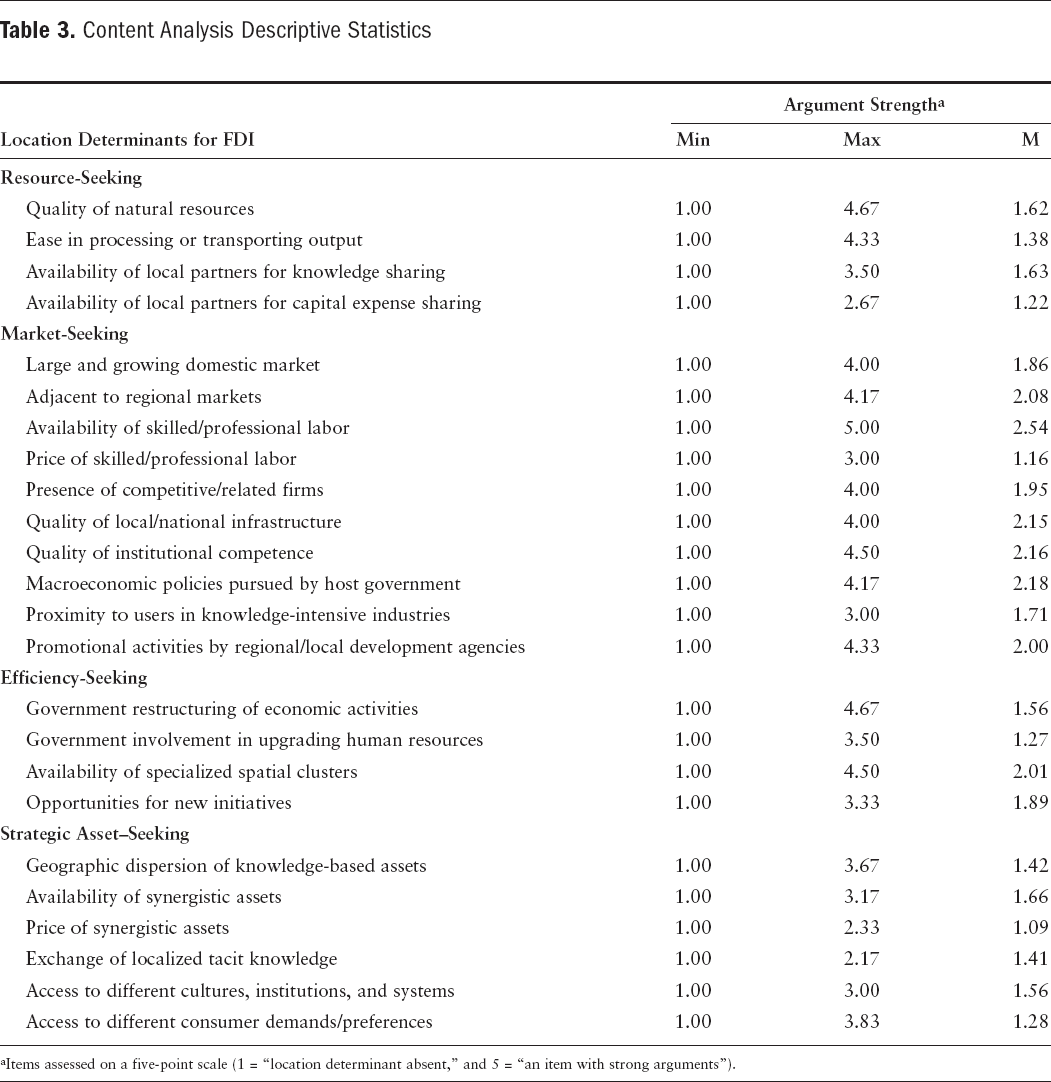
Items assessed on a five-point scale (1 = “location determinant absent,” and 5 = “an item with strong arguments”).
Overall, the content analysis reveals clear examples of each of the location items and variance regarding argument strength across advertisements. In response to the first research question, this provides evidence that Dunning's location items are reflected in the content of FDI advertising. Table 4 provides examples of strong and weak arguments for each of the four Dunning location factors. The Turkish and Georgian advertisements in Figures 2 and 3 also incorporate two examples of strong arguments in context (i.e., the market-seeking item “size of market” and the efficiency-seeking item “government restructuring of economic activities”).

Strong Arguments for Market-Seeking (Turkey)

Strong Arguments for Efficiency-Seeking (Georgia)
Examples of Dunning's Constructs in Advertising
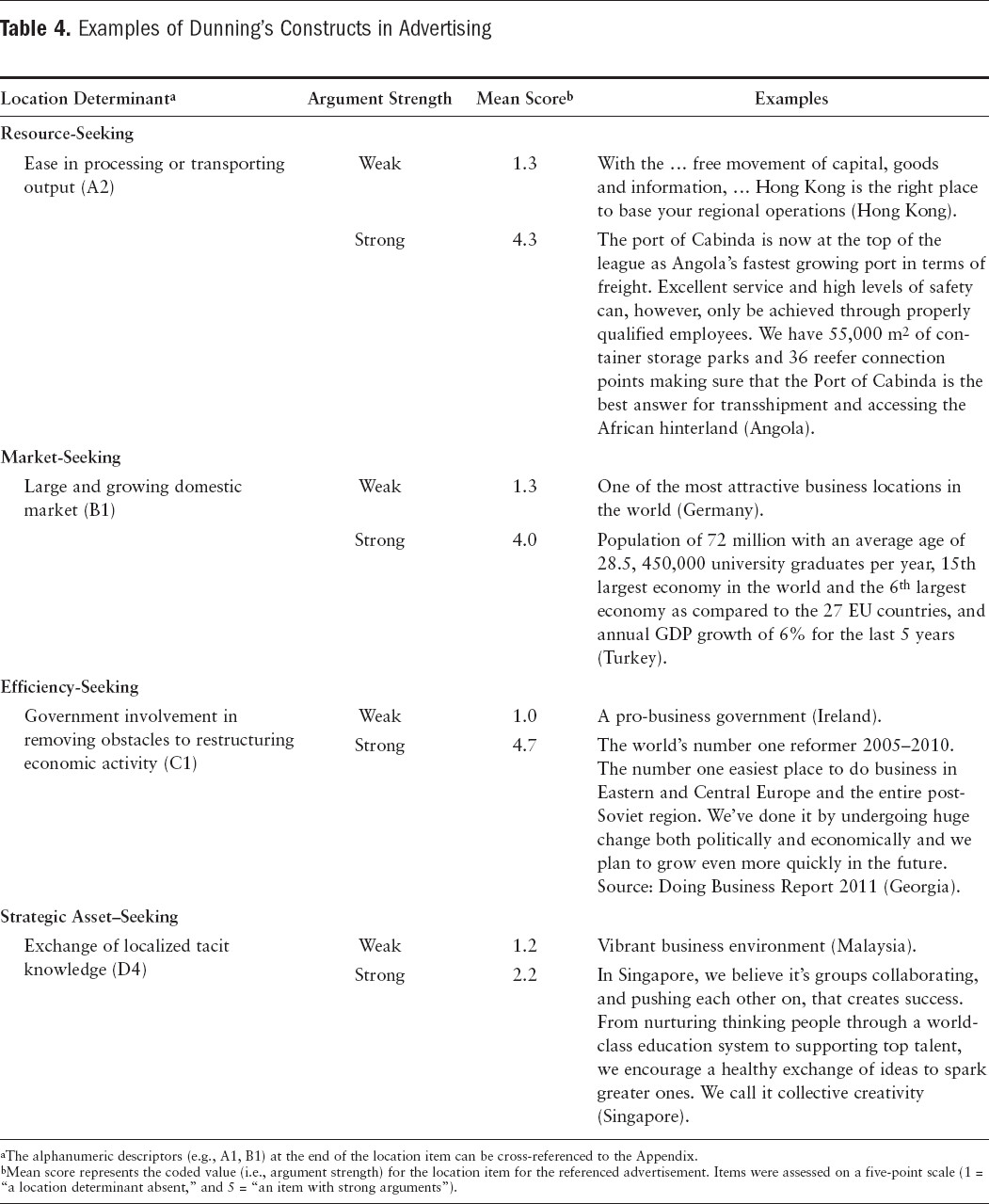
The alphanumeric descriptors (e.g., A1, B1) at the end of the location item can be cross-referenced to the Appendix.
Mean score represents the coded value (i.e., argument strength) for the location item for the referenced advertisement. Items were assessed on a five-point scale (1 = “a location determinant absent,” and 5 = “an item with strong arguments”).
Exploratory Factor Analysis
The results of the first research question demonstrate that Dunning's location advantages framework is a valid lens through which to view FDI advertising. The framework identifies 24 relevant content variables. Of note, Dunning's framework organizes these location advantages into four factors from the perspective of the MNE. In other words, the theoretical framing represents MNE managers’ motivations when allocating their business operations internationally. In contrast, the purpose of the current research is to aid in the understanding of how country and IPA managers view their location advantages and how this is reflected in advertising. Consequently, we conducted an exploratory factor analysis (EFA) to identify any underlying commonalities that better explain how countries portray location advantages in advertising.
In the factor analysis, we employed a Varimax rotation in SPSS. A review of the Kaiser-Meyer-Olkin (KMO) measure of sampling adequacy indicated that the sample was appropriate for factor analysis (KMO = .811) with its measure being meritorious (Kaiser 1974). Bartlett's test of sphericity indicated sufficient common variance and that correlations were present (χ2 = 1949.38, d.f. = 276, p < .000). The EFA produced six factors with eigenvalues greater than 1.0, and these factors explained 68.2% of the total variance (see Table 5). All factors were composed of at least two items, except the quality of natural resources, which loaded as a single item. One item did not load onto any factor (“availability of local partners for expense sharing”). The fifth factor (“government involvement in upgrading human resources and the price of skilled labor”) had a factor loading of less than .50, which is below the recommended level (Hair et al. 2005). Consequently, we dropped the items associated with the fifth factor as well as the nonloading factor, and we conducted the factor analysis a second time.
EFA Results

The results for the revised EFA showed improvement (KMO = .824; Bartlett's χ2 = 1812.09, d.f. = 210, p < .000). The factor analysis produced the same five factors, which explained 69.4% of the variance. All factor loadings were above the recommended level of .50 (Hair et al. 2005), as displayed in Table 5's summary of the results. We named the factors “knowledge resources,” “market attractiveness,” “economic governance,” “infrastructure,” and “natural resources.” We calculated Cronbach's alphas to check the reliability of the factors. All alphas for the multi-item measures were above the recommended level of .70 (Hair et al. 2005): knowledge resources = .879, market attractiveness = .726, economic governance = .846, and infrastructure = .707.
The knowledge factor comprised items related to the availability and superiority of knowledge assets, opportunities for partnerships, presence of agglomerative markets, and the availability of skilled labor. The market attractiveness factor refers to a country's size in terms of population, economic growth, and purchasing power as well as its ability to provide access to different consumer demands and preferences. The factor also takes into account the country's geographic location relative to other large markets in the region. Economic governance represents the promotions, policies, and structural changes made by the government to provide a safe, efficient, and cost-effective business environment. The quality of transportation, communication, and technology available for the manufacturing and general operations of business make up the infrastructure factor. Finally, natural resources refer to the quantity and quality of a country's natural resources.
Research Question 2
To explore the second research question, which involves how advertising content varies by country income group, we conducted ANOVA tests for the five factors. The results, which Table 6 presents, indicate that FDI advertising content varies in predictable ways by income group. The ANOVA results were significant for four of the five factors: knowledge resources (F = 6.60, p < .01), market attractiveness (F = 15.18, p < .001), economic governance (F = 15.05, p < .001), infrastructure (F = 3.30, p < .05), and natural resources (F = .78, p = .46).
ANOVA Results for Country Classification

p < .05.
p < .01.
p < .001.
Pairwise comparison significant at p < .001.
Pairwise comparison significant at p < .01.
Pairwise comparison significant at p < .10.
More specifically, the findings indicate that both high-income (1.87) and upper-middle-income (1.84) countries present stronger arguments regarding access to knowledge resources than lower-middle-income countries (1.41, p < .01). For market attractiveness, upper-middle-income countries (1.88) used stronger arguments for this factor than lower-middle-income (1.44, p < .01) and high-income (1.43, p < .001) countries. The arguments for economic governance were more strongly evident in lower-middle-income country advertising (2.55) than in high-income country advertising (1.80, p < .001).
A few differences between country income groups were not significant but did have p-values less than .1. Because this study is exploratory, a discussion of these results is in order. Lower-middle-income countries (2.55) presented stronger arguments for economic governance than upper-middle-income countries (2.18, p < .1), and arguments for infrastructure were greater for upper-middle-income country advertising (1.90) than for high-income country advertising (1.67, p < .1).
General Discussion
This exploratory analysis makes several contributions. First and foremost, it indicates that Dunning's framework is an effective lens through which to understand FDI advertising. Second, FDI advertising content varies in predictable ways when compared according to a country's income classification. These differences are based on four factors: knowledge resources, market attractiveness, economic governance, and infrastructure. Finally, countries differed in FDI advertising strategy such as ad size and the number of campaigns utilized.
Dunning's Framework
Strong evidence regarding Dunning's (1998) location advantages was revealed in the analysis of FDI advertising: We found 23 of 24 items present in some combination across the 145 advertisements. Although the overall strength of many of these items was not high, the average number of Dunning location items found in an advertisement was 13. Considering the size and type of advertisements studied and that more than 50% of Dunning's location advantages were present in an average advertisement, we conclude that this study provides strong support for using Dunning's framework as a theoretical guide for understanding FDI advertising content. Indeed, these results reinforce the notion that international business theories may be applied to international marketing issues such as advertising.
The analysis failed to recreate Dunning's framework, however, when factor analyzing the 24 items. Dunning organized his framework around four factors: resource-seeking, market-seeking, efficiency-seeking, and strategic asset–seeking. The EFA used in this study identified the presence of five factors: knowledge resources, market attractiveness, economic governance, infrastructure, and natural resources. The fact that this study produced a different set of factors than Dunning's factors is not entirely unexpected. Specifically, Dunning's location advantages framework is organized according to the motivations of MNE managers selecting locations for foreign business operations. This study addresses the other side of the FDI equation—namely, the location advantages that country and IPA managers promote in their efforts to attract MNEs. While the core content of MNE motivations and the advertised country advantages are the same, how they are viewed, and ultimately organized, are likely different, which is what the factor analysis revealed.
The knowledge resources factor identified in this study contained several items ranging from the availability of skilled workers to intellectual collaboration to the presence of agglomerative markets. Dunning's framework had parsed these items across his four factors according to the locational motivations of MNEs (e.g., market-seeking [skilled workers], efficiency-seeking [agglomerative markets], strategic asset–seeking [exchange of knowledge]). The EFA we conducted in this analysis grouped them under one factor.
However, the market attractiveness factor we identified comprised a smaller subset of items from Dunning's market-seeking factor even with the addition of items from the strategic asset–seeking factor. The market attractiveness factor we identified here seems to have a narrower emphasis on a country's physical geography and population characteristics.
Similarly, the economic governance factor revealed in the current study is primarily a subset of Dunning's market-seeking factor with an additional item from the efficiency-seeking factor. The economic governance factor focuses on items that are likely to lessen investor fears about the advertising country, such as the announcement of policy changes and economic incentives.
The final two factors comprise the fewest items from Dunning's framework. The natural resources factor is a single-item factor originating from Dunning's resource-seeking factor, and it represents perhaps the more traditional definition of resources. It refers to the quality and quantity of natural resources. The infrastructure factor we identified in this study contains one item each from Dunning's resource- and market-seeking factors. Infrastructure refers to the basic systems and services, such as power, transport, and communications, that ensure that a country's business environment operates effectively and efficiently.
Income Classification
Narula and Dunning (2000) suggest that differences in country attributes, and therefore how they promote these attributes, might be related to national levels of income. Acting on this suggestion, we divided the sample of FDI advertisements into three income groups using the World Bank's (2010) income classification scheme. When compared against the five location advantage factors, the findings indicate that advertising content varied significantly among the income groups. Differences were revealed in knowledge resources, market attractiveness, and economic governance. In addition, differences were approaching significance for the infrastructure factor. No differences were found for natural resources.
Table 6 indicates that economic governance is the only category of location advantages that differentiates lower-middle-income countries from other income groups. Lower-middle-income countries, such as Angola, Georgia, and India, are often characterized or perceived as having inconsistent or bureaucratic government and/or poor economic stability (Narula and Dunning 2000; Rodrik 1989). Not surprisingly, advertising from these countries more strongly presented content involving institutional competence. Perhaps to overcome their liabilities or negative perceptions, these countries were more apt to offer incentives to international firms (e.g., tax breaks, free utility connections) or to announce new economic policies or changes to existing economic policies. For example, India mentioned the creation of a “very high level empowered committee” to reduce red tape and aid in facilitating FDI in the semiconductor industry. Georgia cited research from the World Bank, International Monetary Fund, and Transparency International to suggest that it is “the world's number one in fighting corruption” and “the world's number one reformer.” In effect, lower-middle-income countries seem to be offering something to counter perceptions of more precarious economic and political circumstances.
Similar to economic governance and lower-middle-income countries, the knowledge resources category is the only one higher-income countries use to a greater extent in their advertising. Upper-middle-income countries also incorporate knowledge resources into their advertising to nearly the same degree as high-income countries. Knowledge is a created asset, which is typically only associated with high-income countries and, to a lesser extent, upper-middle-income countries. These countries tend to have sound infrastructure, stable and responsible macroeconomic policies, and large agglomerative markets (Burgess and Steenkamp 2006; Narula and Dunning 2000).
High-income countries, such as Ireland, Scotland, and South Korea, and some upper-middle income countries, such as Malaysia, Singapore, and Thailand, have an abundance of spatial clustering and network linkages that make knowledge resources highly accessible to MNEs. Scotland speaks of its “bold innovation and ingenious thinking” and links its past inventions to the future successes of MNEs. Thailand proclaims that the country is creating a “knowledge-based future with its value-creation movement,” while Singapore trade-marked the phrase “collective creativity” to emphasize its commitment to enabling the free movement of ideas and skilled workers. Consequently, it seems that only high-income and upper-middle-income countries have enough knowledge-created assets to successfully promote them through advertising without risking that the message be perceived as propaganda (Anholt 2007).
In the middle of these two extremes are upper-middle-income countries, such as Macedonia, South Africa, and Turkey. In many ways, these countries seem to be trying to communicate everything in their advertising. They mention not only knowledge resources at nearly the same intensity as high-income countries but also economic governance slightly more than the lower-middle-income countries. In addition, upper-middle-income countries were the only group to promote the attractiveness of their market at significantly greater levels than either of the other two groups. For example, Macedonia makes note of being the “fourth reformer” in the World Bank's “Doing Business Report”; calls attention to tax breaks, free utility connections, and land leases with “attractive concessionary rates”; and highlights its “free access” to 650 million customers within the European Union and to its abundant and competitive labor market.
It is possible that upper-middle-income countries are caught in the middle. On the one hand, they are attempting to alleviate investor fears associated with their lower-income status; on the other hand, they are promoting the quality of their created assets and improving agglomerative markets. The goal seems to be to differentiate from lower-middle-income countries while trying to emulate high-income countries. Indeed, the primary message in a South African advertisement was about its membership in the BRICS acronym (Brazil, Russia, India, China, and South Africa).
Finally, with respect to the income groups, even with this broad sample, there were no advertisements for countries in the World Bank's lowest-income classification (see Table 1). It appears that low-income countries either do not have the necessary budget for an advertising program or allocate their marketing dollars to other FDI promotion activities. Morisett and Andrews-Johnson (2004) find that advertising budgets for low-income countries tend to average approximately $550,000. Considering that one-page advertisements cost anywhere from $56,000 to $125,000 in the magazines used in this study (Nielsen Business Media 2011), the lack of low-income countries is not surprising.
There is an additional possibility that low-income countries are so strongly associated with poor governance, political instability, inconsistent regulation, and rudimentary infrastructure (Rodrik 1989) that advertising does not represent an effective method to change such strongly rooted perceptions (Anholt 2003, 2005; Morisett 2003). Rather, FDI advertising may be better suited for placing the advertising country in the investigating manager's evoked, or even consideration, set (Kotler, Haider, and Rein 1993; Papadopoulos and Heslop 2002; Wells and Wint 2000).
FDI Advertising Strategy
As Figure 1 demonstrates, most FDI advertising in the United States appears in the first and fourth quarters of the year and is nearly absent during the third quarter, especially during July and August. The sudden drop in third quarter advertising may have something to do with the summer vacation period, when many site selection managers are out of the office. Alternatively, it may stem from the budgetary processes at IPAs (e.g., expiring monies, newly received monies).
For the four magazines chosen for this study, 69% of the advertisements were from high-income countries. This is consistent with FDI promotional research, which suggests that high-income countries tend to spend the most on image-building activities such as advertising. Morisett and Andrews-Johnson (2004) indicate that high-income countries spend more than seven times the amount on image-building activities that middle-income countries spend.
Although this study does not examine the use of advertorials, it should be noted that high-income countries used this advertising format less frequently (49%) than traditional advertising (69%; see Table 1). In contrast, lower-middle-income countries used advertorials more frequently (17%) than traditional advertisements (8%). This may suggest that lower-income-country IPA managers believe that third-party, journalistic-style endorsement advertisements are more persuasive for their economic and political circumstances than traditional country branding advertisements.
With respect to ad size, half-page advertisements were used exclusively by high-income countries, and with one exception, all advertisements were smaller executions of full-page advertisements. This seems to suggest a more dedicated, and perhaps more sophisticated, approach to FDI advertising. Similarly, high-income countries used campaigns more frequently than other income groups. This is likely a function of the size of their advertising budgets or dedication to a country branding strategy. Figure 4 presents two examples of campaigns, from Bahrain and Ireland. The campaign from Bahrain contains nine separate advertisements that rely heavily on design simplicity and the color red, which is the primary color of its flag (for two of these advertisements, see Figure 4, Panels A and B). Each advertisement promotes a fact about Bahrain, which in some circumstances is supported by an independent body such as the World Economic Forum or an HSBC survey.

FDI Advertising Campaign Strategy
The advertisements from Ireland also rely heavily on simplicity and its national color, green (see Figure 4, Panels C and D). This campaign is the second one in the sample from Ireland to focus on the Irish mind and supports our previous finding that high-income countries promote their superiority in knowledge-created assets. Many of the campaigns in the study played into national stereotypes and images such as Scotland's tartan (plaid) pattern and Germany's flag colors.
These results offer potential implications for practitioners. The lack of advertisements in certain parts of the year may present the opportunity for additional attention or exposure for advertisements run during that time frame. Moreover, the country-level differences may reflect an important underlying strategy. For example, IPA managers should consider further emphasizing knowledge advantages for high-income countries and governance for lower-middle-income countries. The focus on countering a negative nation brand image for lower-middle-income countries should increase the effectiveness of FDI advertising. For upper-income countries, the implications for IPA managers are less clear. Being stuck in the middle, promotions for these countries should be strongly rooted in the unique brand image of that country. For some countries, governance may be more of a concern; for others, the focus may be on knowledge or on the attractiveness of their market.
Conclusion
This FDI advertising research addresses an under -researched topic in international marketing and uses a novel approach to explore this topic. The findings suggest that Dunning's (1993, 1998) list of location advantages are evident in the content of FDI advertising. The ability to find results not only validates the research method used but also offers an additional route for researchers to understand FDI advertising and FDI promotion in a larger context.
In addition to support for Dunning's framework in the content of FDI advertising, we find that FDI advertising varies significantly according to a country's income classification. Low-income countries did not produce FDI advertising, possibly because of limited advertising budgets along with more precarious economic and political situations. While having a larger economic base than low-income countries, lower-middle-income countries do not yet have sufficient knowledge resources and market-specific advantages to promote these components in their advertisements. Rather, these countries used advertising to announce policy changes and offer incentives. Advertising for upper-income countries appears to validate their emerging-country status by highlighting large and growing markets and an increasing share of the world's knowledge-based resources. Finally, high-income-country advertising concentrates more strongly on extensive knowledge resources, networking opportunities, and agglomerative markets.
Limitations and Further Research
This study has a few notable limitations. First, the sample was limited to half- and single-page advertisements in broad business publications. This limits the generaliza bility of the results and may have constrained our ability to effectively measure the tendency of developing countries to advertise for specific industries (Wells and Wint 2000). The generalizability of these results is also limited by the countries included in the analysis.
We offer a few opportunities for further research. First, international marketing researchers may consider using international business theories, such as Dunning's OLI theory, to better understand promotional phenomena. Such efforts push international marketing research forward and offer the ability to open up new areas for international marketing research. Second, other areas of FDI promotion, such as IPA websites, trade shows, or trade missions, could be analyzed to provide better understanding of their roles in the FDI site selection process. Third, this study reveals some potentially significant results regarding advertorials. Although they are fundamentally different from the advertisements sampled here, a further investigation of advertorial content may lead to important insights. Finally, this research could be replicated by content analyzing advertising appearing in industry or trade magazines rather than broad business publications. Alternatively, advertising appearing in magazines from outside the United States could be used to help ensure the robustness and boundary conditions of the results indicated here.