







Abstract
Drawing on the perspective of country of origin, this study provides evidence regarding how entry-mode choice and postentry branding strategy affect foreign product purchase intentions in an animosity context. The authors conduct two studies in two host country markets, one with high animosity (China) and the other with low animosity (Taiwan) toward a target country (Japan). The results of Study 1 reveal that in a high-animosity host country, consumers prefer the foreign products launched through an acquisition joint venture to those that are imports or the derivatives of full acquisition. The findings of Study 2 indicate that in a high-animosity host country, consumers prefer the foreign products launched through an acquisition joint venture mode that adopts a local brand or a local-foreign cobrand to one that adopts a foreign-local cobrand. In contrast, in a low-animosity host country, entry modes and postentry branding strategies have no effect on foreign product purchase intentions.
U.S.-based General Motors has recently formed an international joint venture (IJV) in China with FAW Group, China's second-largest automaker, to design, manufacture, and market products locally. In addition, the United States–China IJV will adopt a cobrand, FAW-GM, in the Chinese market.
Although this practice is typical in global markets when a foreign firm decides to launch products in a host market, the topic has not been explored in the animosity literature stream. Previous animosity research has studied cases in which foreign products are manufactured and imported from countries that are offensive to the focal host countries (e.g., Hong and Kang 2006; Jimέnez and Martín 2010; Klein 2002; Klein and Ettenson 1999; Klein, Ettenson, and Morris 1998; Leong et al. 2008; Russell and Russell 2006). However, this literature stream has ignored other entry modes that are widely used in international marketing practices—particularly those that occur through foreign direct investments (FDIs), such as IJVs with local firms and acquisitions of local targets. We find that the “foreign products” in FDI cases are significantly different from those studied in prior animosity research. Because FDIs have become an important international market entry and expansion strategy, ignorance of entry modes involving FDIs may limit our understanding of the effects of consumer animosity on international market success.
The current study addresses this unexplored issue by examining consumer responses toward varying entry modes and branding strategies in an animosity context. Drawing on the country-of-origin (COO) perspective, we suggest that a foreign firm's FDI subsidiary is associated with two COOs: those of its home and host countries. We posit that the different entry modes and branding strategies that a foreign entrant adopts will result in different perceived host and foreign identities for its subsidiary in the host country. The rationale for this research is that an animosity-evoking foreign firm can adjust its subsidiary's COO perceptions to mitigate negative consumer emotions and social pressures in the host country by adopting appropriate entry modes and branding strategies.
We conducted studies in two host country markets, one with significant animosity toward a particular country and the other with low animosity. Specifically, we investigate the following unexplored research questions: First, do consumers in one host country exhibit a higher average hostile attitude and lower average purchase intention toward products from the target country when compared with consumers in other host countries? Second, drawing on a cross-country study, we investigate whether the foreign products launched through FDI entry modes (full acquisitions and acquisition joint ventures [AJVs]) in a host country market with high animosity gain more consumer acceptance than imported products, which prior animosity research has typically studied. Third, in an animosity context, does an AJV product (i.e., a product launched through an AJV mode) that adopts a brand strategy with a more salient host identity (and a less salient foreign identity) win more consumer acceptance than one that adopts a branding strategy with a less salient host identity (and a more salient foreign identity)? We assume an identical consumer response among various entry modes and AJV branding strategies for the host market with lower animosity, which is the contrast group for this research.
Study Positioning: Animosity, Political Attitudes, and Country-Induced Biases
This study adopts a COO perspective to address the unexplored issue of entry mode choice in an animosity context. Because consumer animosity indicates the hostility of consumers toward the national origin of a product, it has been regarded as a COO-related construct (Jimέnez and San Martín 2010). Substantial research has documented the COO effect on consumer quality evaluations and purchase intentions (Koschate-Fischer, Diamantopoulos, and Oldenkotte 2012; Tse and Gorn 1993). In addition to contributing to cognitive rational evaluations of product quality, the COO is an affective and a normative mechanism that shapes consumer attitudes and behavior (Obermiller and Spangenberg 1989; Verlegh and Steenkamp 1999). The COO relates a product or brand to a national or ethnic identity with symbolic and emotional meaning to consumers (Herz and Diamantopoulos 2013; Verlegh and Steenkamp 1999). These non-quality-based effects of COO, identified as country-induced biases, may positively or negatively affect consumers’ purchase intentions of domestic and foreign products (Josiassen 2011). Researchers have indicated that consumer political attitudes are the critical factors that lead to these country-induced, non-quality-based biases (Balabanis et al. 2001). The international marketing literature stream has indicated two types of political attitudes to be determinants of consumer attitudes and behavior: (1) national in-group identification and favoritism and (2) a country's hostility toward another country. Although these political attitudes may be related, they have distinct causes, consequences, and marketing implications.
National identification, which refers to the feeling that people identify with their national group, plays a central role in the first type of political attitude (Verkuyten 2001). According to social identity theory, national in-group identification has strong implications for a person's self-concept and self-esteem; as such, it motivates the favorable distinctiveness of an in-group relative to an out-group (Tajfel and Turner 1986; Verkuyten 2001). Therefore, there is a positive correlation between national identification and national in-group favoritism (Brown et al. 1986). National identification can result in patriotism, which refers to feelings of attachment, belonging, and loyalty to one's own national in-group, without out-group evaluations (Balabanis et al. 2001; Mummendey, Klink, and Brown 2001). However, social identity theory argues that in-group favoritism may be accompanied by rejection of other groups (Verkuyten 2001; Verkuyten and Yildiz 2007). Specifically, national identification can take the form of nationalism or blind patriotism, which is the sense that one's national group is superior and should be dominant; it thus implies the derogation of other nations (Druckman 1994; Mummendey, Klink, and Brown 2001). In addition to nationalism and patriotism, internationalism refers to positive feelings for other nations and their peoples and is another independent dimension of nationalistic feeling (Balabanis et al. 2001). Prior research has suggested that internationalism can mitigate the effect of national identification (Rawwas, Rajendran, and Wuehrer 1996).
Political attitudes may translate into economic preferences (Balabanis et al. 2001). Researchers argue that nationalistic feeling can lead to consumer ethnocentrism, which in turn shapes consumers’ positive or negative dispositions toward domestic or foreign products (Balabanis et al. 2001; Ishii 2009). Ethnocentric tendencies play a critical role when consumers consider that imports threaten either their personal or their national well-being (Klein, Ettenson, and Morris 1998; Shimp and Sharma 1987). National identification, in the sense of either nationalism or patriotism, is positively associated with consumer ethnocentrism (Balabanis et al. 2001). In contrast, researchers have indicated that internationalism, which can reduce national identification, is negatively correlated with consumer ethnocentrism (Balabanis et al. 2001). For international marketers, consumer ethnocentrism represents the competitive disadvantage of foreign products when they compete with domestic ones.
Animosity represents the second type of political attitude. Consumer animosity has been defined as “remnants of antipathy related to previous or ongoing military, political, or economic events which affect consumer purchase behavior in the international marketplace” (Klein, Ettenson, and Morris 1998, p. 90). It differs from the aforementioned constructs in the following three ways. First, animosity is a bilateral, country-specific construct. In other words, people in one country hold hostile attitudes toward another country rather than to all foreign countries. Second, animosity is, in general, an event-specific construct. For example, the Nanjing Massacre led to Chinese animosity toward Japan (Klein, Ettenson, and Morris 1998), and the Japanese attack on Pearl Harbor caused the United States’ hostility toward Japan (Klein 2002). Third, animosity has no quality implications for domestic and foreign products. Unlike consumer ethnocentrism, which implies that the quality of the foreign product is inferior, consumer animosity refers to consumer resistance to the purchase of foreign products because of social pressures and fears of negative psychosocial consequences (Amine 2008; Klein, Ettenson, and Morris 1998).
Because of these distinct characteristics, animosity leads to more serious consequences than does ethnocentrism. As we have argued, international marketers may suffer from a competitive disadvantage when competing with their domestic counterparts in a host country with significant consumer ethnocentrism stemming from nationalism or patriotism. However, a firm from an animosity-evoking country suffers from competitive disadvantages when it competes with both domestic and other foreign competitors. In other words, consumer animosity becomes a country-specific disadvantage and an entry barrier for marketers from an offensive country; it also offers a significant marketing opportunity for other foreign marketers (Klein and Ettenson 1999). Therefore, a critical task for international marketers faced with animosity is to mitigate the negative impact of consumer animosity.
In the international marketing literature, prior research has mainly focused on the effect of animosity on consumer purchase decisions; the method that marketers use to cope with the negative impact of animosity remains unexplored. As such, this article's major contribution is its proposal of a strategy that international marketers can adopt to deal with animosity. Herein, we propose that the choice of an appropriate entry mode and branding strategy can reduce host country consumers’ hostile feelings and enhance their purchase intentions. Drawing on a COO perspective, we suggest that an entry mode and brand strategy that decrease the offensive country's identity (foreign identity) and increase the host country's identity (host identity) can mitigate consumer hostility and win better consumer responses. Therefore, our pioneering research on the strategy to adopt in an animosity context can have important theoretical and practical implications for international marketing.
Theoretical Background and Hypotheses
Consumer Animosity and COO
Animosity is a COO-related construct that emphasizes hostile consumer attitudes toward the national origin of a product or a brand (Jimέnez and San Martín 2010). Researchers have categorized consumer animosity into “situational” and “stable” (Amine, Chao, and Arnold 2005; Ang et al. 2004). Situational animosity arises from current economic and political events. When the impact of events is reduced, consumers’ hostile attitudes toward the offending country might decrease (Ang et al. 2004). In the present research, we focus on stable animosity because of its long-term impact on foreign market performance. Stable animosity is a result of difficult historical relations between two countries. Such a hostile attitude toward an offensive country can sustain from one generation to the next (Amine 2008; Ang et al. 2004) and become an affective mechanism of the COO. In other words, the hostility toward a particular country gains emotional value in the host country's society. This value may further affect consumers’ purchase intentions toward products from the offending country. That is, the COO reflects a normative mechanism in a host country society in which buying products from the offending country violates social norms. In the animosity context, social pressures and fears of psychosocial consequences may contribute to consumer reluctance to buy products from an offending country (Amine 2008). The social pressure may exceed consumer cognition that the offending country produces high-quality products (Amine 2008; Klein, Ettenson, and Morris 1998). We contend that compared with a typical host country with low animosity, in a host country with high animosity toward a particular offending country, consumers will exhibit greater reluctance to buy products from the target country, regardless of product quality judgments.
H1: Compared with consumers in a host country with low animosity, consumers in a host country with high animosity toward a particular country have lower intentions to buy products from the target country, irrespective of product quality judgment.
Consumer Animosity, National Identity, and Foreign Entry Mode
Researchers have studied consumer responses toward hybrid products, those associated with more than one country (Chao 2001). According to Chao (2001, p. 69), whenever two objects of judgment are paired, each product has a tendency to shift toward congruence with the evaluation of the other, with the magnitude of the shift being inversely proportional to the relative intensities of the interacting evaluations. We extend this argument to the COO identity of a foreign firm's postentry subsidiary, the company that launches products in a host country. A foreign FDI subsidiary can be associated with two COOs: that of the host country and that of the foreign firm's home country. We employ the national identity of a foreign subsidiary as a construct to measure the relative impacts of host and foreign country identities on the subsidiary and its products.
In this article, we define the host identity (vs. foreign identity) as the degree of association between a foreign firm's postentry subsidiary and the host country as reflected in the dimensions of ownership, the location of business activities (e.g., manufacture), and the subsidiary branding strategy. We suggest that the different entry modes and postentry branding strategies that a foreign entrant can adopt will result in varying degrees of host and foreign identities for its subsidiaries in the host country. The central argument is that a foreign firm from an animosity-evoking country may adopt entry mode and postentry branding strategies that can enhance host identity and mitigate the foreign identity associated with a hostile country to reduce the negative affective and normative COO effects on foreign product purchase.
Import and Acquisition Entry Modes
Prior animosity research has typically used importing as the entry mode because, in general, importing has a single national identity associated with a particular target country. The negative affective process stemming from a hostile national identity leads to a social norm of reluctance to purchase products imported from the target country. Prior research has provided ample evidence for this phenomenon (Riefler and Diamantopoulos 2007). However, entry modes involving FDIs in the host country may result in hybrid COOs that associate the host country and the home country of the foreign entrant. In this article, we focus on entry through acquisitions.
An acquisition entry refers to a foreign firm's entry into a host country market by acquiring the equity of an existing local target. Cross-border acquisition has become a major mode of entry for a foreign firm into a host country (Brouthers and Brouthers 2000; Harzing 2002). The acquisition entry mode enables a foreign entrant to access the necessary resources and capabilities of the local market that are difficult to develop internally and to accelerate its entry speed (Chen and Hennart 2004). In other words, compared with import, by acquiring the local target, the foreign entrant can redeploy the target's local business activities and assets, thus resulting in a higher degree of host identity. For example, the foreign acquirer can use the target's existing manufacturing utilities, employees, marketing channels, distribution systems, and, if necessary, its brand. Compared with import entry, acquisition entry perceived to have a higher degree of host identity may reduce the foreign entrant's home country identity. In an animosity context, this tactic can thus mitigate negative host country consumer emotions and social pressures to buy products from an animosity-evoking foreign firm. In contrast, consumers in a typical host country with low animosity toward the target country may be less concerned with the national identity of the foreign subsidiary and thus less affected by the entry modes associated with different host and foreign identities.
H2: Consumer animosity moderates the effect of import entry and acquisition entry on consumer purchase intentions toward the products of a foreign firm such that (a) in a host country with high animosity toward the foreign firm's home country, consumer purchase intentions are higher when the products of the foreign firm are launched through an acquisition (vs. import) entry mode, and (b) in a host country with low animosity toward the foreign firm's home country, consumer purchase intentions toward the firm's products are less affected by whether the products are launched through an import or an acquisition entry mode.
Full Acquisition and Partial Acquisition Entry Modes
A foreign firm may fully or partially acquire a local firm to enter the host country market. Full acquisition refers to acquiring 100% equity in a local firm, whereas partial acquisition entails acquiring less than 100% equity in a local firm. A partial acquisition can result in an AJV, which represents a co-ownership and cogovernance structure (Chen and Hennart 2004). In contrast, a full acquisition leads to a subsidiary that is wholly owned by a foreign firm. The degree of local ownership in the subsidiary can be an important indicator of host identity as perceived by local consumers.
The co-ownership structure of an AJV means that the foreign subsidiary is partially owned and controlled by a local partner. In an animosity context, consumers would have favorable attitudes toward an AJV in which the partial local ownership has diluted the hostile foreign identity. In contrast to a partial acquisition, the full acquisition subsidiary that is wholly owned by an animosity-evoking foreign entrant results in more negative consumer emotions, greater social pressures, and thus lower purchase intentions. In contrast, consumers in a typical host country with low animosity toward the target country may be less concerned with the ownership structure of the foreign subsidiary and thus may be less affected by the entry modes associated with different host and foreign identities.
H3: Consumer animosity moderates the effect of full acquisition and AJVs on consumer purchase intentions toward the products of foreign firms such that (a) in a host country with high animosity toward the foreign firm's home country, consumer purchase intentions are higher when the firm's products are launched through an AJV (vs. full acquisition) entry mode, and (b) in a host country with low animosity toward the foreign firm's home country, consumer purchase intentions toward the firm's products are less affected by whether the products are introduced through a full acquisition or an AJV entry mode.
Postentry Branding Strategy
We suggest that the country of brand (COB; i.e., the national origin of a brand) in a hostile host country can be affective and can provide normative cues for consumer attitudes and behavior. We consider the three most commonly used branding strategies that a foreign subsidiary may adopt after entering a host country: a local partner's brand (local brand), a local–foreign cobrand, and a foreign–local cobrand. Focusing on the partial acquisition context, we propose that various branding strategies are associated with different degrees of host and foreign identity. Signaling theory indicates that brand-related information, such as pricing, advertising, and brand partnering, sends signals to consumers about the quality, identity, and status of products (Erdem and Swait 1998). Drawing on signal theory, we suggest that the branding strategy of an alliance can be a signal indicating the relative impacts of partners on alliances (Li and He 2013). The greater the local partner's perceived impact on the AJV subsidiary, the higher the degree of the subsidiary's host identity.
The local brand strategy indicates that the subsidiary keeps the local firm's brand at the expense of the foreign firm's brand. A local brand strategy sends the signal to consumers that the local firm's managers hold higher relative standing in the subsidiary compared with the two cobrand strategies. In contrast, with the exclusion of the foreign brand in the AJV, consumers perceive the foreign firm as being passively involved in management practices. As such, we propose that consumers perceive a subsidiary that adopts a local brand to have the most salient host identity among the three branding strategies.
We further suggest that consumers associate local-foreign cobranding with more salient host identity than foreign-local cobranding. Li and He's results contend that the brand order of a brand alliance can signal the relative powers, responsibilities, and controls of partner brands over the brand alliance. More specifically, consumers perceive the brand in the first position as more dominant in and more responsible for the performance of the brand alliance. Li and He (2013) show that partner brand attitude has a stronger effect on consumer attitudes toward an international brand alliance when the partner brand appears first rather than second. Accordingly, an AJV with a local-foreign cobrand can lead to the perception that the local partner has more power in the AJV, thus creating a stronger host association.
The order effect can further be explained by the primacy effect, which suggests that the first piece of exposed information carries the most weight in the formation of an impression of the focal subject (Anderson 1965). This implies that the national identity of the first brand has greater weight when consumers process information about a cobranding AJV. Building on these arguments, we propose that unlike an AJV that adopts a foreign–local cobrand, people perceive an AJV that adopts a local–foreign cobrand to have a more salient host identity because of the local partner's stronger impact. We suggest that in a high-animosity host country market, the more salient the subsidiary's host identity, the higher the consumer product purchase intention. However, consumers in a typical host country with low animosity toward the target country may be less concerned with the foreign subsidiary's brand name and thus may be less affected by the branding strategy associated with different host and foreign identities.
H4: Consumer animosity moderates the effect of branding strategy on consumer purchase intentions toward a foreign firm's products such that (a) in a host country with high animosity toward the foreign firm's home country, consumer purchase intentions are higher when an AJV adopts a branding strategy with more salient host identity than when the brand has a less salient host identity (i.e., the preference sequence is local brand, local–foreign cobrand, foreign–local cobrand), and (b) in a host country with low animosity toward the foreign firm's home country, consumer purchase intentions toward the firm's products are less affected by branding strategy.
Study 1: Foreign Entry Mode
Overview
In Study 1, we chose a Japanese firm as the foreign entrant. Mainland China and Taiwan represent the host country markets with high and low animosity toward Japan, respectively. Mainland China and Taiwan share similar cultural backgrounds and languages but have different relationships with Japan. China endured a terrible occupation and massacre at the hands of the Japanese during World War II, which has led to a continuous nationwide hostile attitude toward Japan (e.g., Ishii 2009; Klein, Ettenson, and Morris 1998). The Japanese also ruled Taiwan for 50 years (1895–1945) as a result of the Treaty of Shimonoseki. However, in contrast to the case of China, Japan made efforts to improve the Taiwanese economy and infrastructure. Many older Taiwanese people still have a certain degree of nostalgia for Japanese colonial rule (e.g., Peng-Er 2004). Therefore, the relationships between Japan and mainland China and that between Japan and Taiwan provide an appropriate context for this theory.
Participants
In total, 284 students from mainland China and Taiwan participated in a pretest and the main study. The student sample used in this article should not cause serious generalizability problems. As ample research has suggested (e.g., Amine 2008; Ang et al. 2004; Riefler and Diamantopoulos 2007), consumer animosity can be viewed as a macro level sociological phenomenon that reflects the social norms and collective interpretations of consumers in a host country. In China, the government and educational institutions continuously remind citizens about the historical hostility between China and Japan. For example, Chinese textbooks recount the brutal Japanese occupation (1931–1945) and the Nanjing Massacre (1937). We suggest that college students, who are affected by families, schools, media, and government agents, can be representative of the general population. The use of student participants is also a common practice in previous consumer animosity and COO studies (e.g., Maheswaran and Chen 2006; Russell and Russell 2006) and has several research advantages when the primary goal is theory testing (Sternthal, Tybout, and Calder 1994, p. 18). This type of sampling can control many extraneous variables (e.g., age, education, experiences) because students are a more homogeneous group than are ordinary individuals.
Of the 196 students who participated in the main study, the Chinese sample consisted of 96 students (55 women and 41 men) from a large finance and economics university in Anhui, a province of mainland China. The Taiwanese sample included 100 students (34 women and 66 men) from a major university located in southern Taiwan. Participants in the pretests were drawn from the same pool as the main study. We developed the questionnaire in traditional Chinese for the Taiwanese participants and translated it into simplified Chinese for Chinese participants.
Pretest
A total of 88 students from China (28 women and 20 men) and Taiwan (18 women and 22 men) participated in the pretest. Participants were asked to indicate their agreement (on a seven-point scale, where 1 = “strongly disagree” and 7 = “strongly agree”) with statements regarding four general constructs: (1) product judgment; (2) willingness to buy; (3) consumer ethnocentrism; and (4) general, war, and economic animosity. We adopted the product judgment scale used in this study from previous studies (Josiassen 2011; Klein, Ettenson, and Morris 1998). We measured product judgment using six items; the Cronbach's alpha values for Chinese and Taiwanese participants were .72 and .71, respectively. Thus, we averaged items to form an index for that construct. We assessed willingness to buy with five items derived from previous studies (i.e., Josiassen 2011; Klein, Ettenson, and Morris 1998; Shoham et al. 2006). The Cronbach's alpha values for Chinese and Taiwanese participants were .84 and .79, respectively.
We measured consumer ethnocentrism with five items from the Consumer Ethnocentrism Tendencies scale (CETSCALE; Klein, Ettenson, and Morris 1998; Nijssen and Douglas 2008; Shimp and Sharma 1987). The Cronbach's alpha values for Chinese and Taiwanese participants were .81 and .76, respectively. We measured general, war, and economic animosity with items adopted from Klein, Ettenson, and Morris (1998). A single item, “I dislike Japanese,” measured general animosity. Three items measured war animosity (e.g., “I will never forgive Japan for the Nanjing Massacre” [Chinese questionnaires]/“for Japanese colonization” [Taiwanese questionnaires]), and the Cronbach's alpha values for Chinese and Taiwanese participants were .72 and .72, respectively. We measured economic animosity with five items (e.g., “Japan is taking advantage of Taiwan [China]”), and the Cronbach's alpha values for Chinese and Taiwanese animosity were .76 and .83, respectively. Finally, we collected demographic information. Upon completion, the participants were debriefed and thanked.
We compared Chinese and Taiwanese participants with regard to general animosity, war animosity, and economic animosity. As we expected, the Chinese students exhibited higher scores than the Taiwanese on general animosity (MChinese = 4.79 vs. MTaiwanese = 2.25; F(1, 85) = 47.04, p < .001), economic animosity (MChinese = 4.56 vs. MTaiwanese = 3.46; F(1, 85) = 17.40, p < .001), and war animosity (MChinese = 5.36 vs. MTaiwanese = 2.57; F(1, 85) = 103.48, p < .001). An analysis of variance revealed a significant effect from willingness to buy (F(1, 85) = 49.22, p < .001) and no significant effect from product quality judgment (p > .31). Consistent with H1, Chinese (vs. Taiwanese) participants showed significantly lower willingness to buy Japanese products (MChinese = 3.95 vs. MTaiwanese = 5.84), but there was no significant difference in Japanese product judgment between the two groups (MChinese = 4.94 vs. MTaiwanese = 5.10).
To further ensure that consumer responses toward Japanese products mainly derive from animosity rather than ethnocentrism, we compared Chinese and Taiwanese participants with regard to consumer ethnocentrism. No difference was evident in the mean scores of consumer ethnocentrism of the Chinese and Taiwanese participants (MChinese = 3.02 vs. MTaiwanese = 2.75; p > .18). Therefore, we attribute the difference between Chinese and Taiwanese participants on Japanese product judgment and willingness to buy to the extent of animosity toward Japan. Furthermore, our results for the Chinese student sample are similar to those obtained by Klein, Ettenson, and Morris (1998), who used general consumers as the research sample on general animosity (Mgeneral consumer = 5.07 vs. Mstudent consumer = 4.79), war animosity (Mgeneral consumer = 5.53 vs. Mstudent consumer = 5.36), economic animosity (Mgeneral consumer = 5.02 vs. Mstudent consumer = 4.56), and ethnocentrism (Mgeneral consumer = 2.89 vs. Mstudent consumer = 2.75).
Main Study
Design
We designed three foreign entry modes to clarify the roles of country of manufacture and country of ownership on foreign product purchase in a cross-country context. We used a 3 (foreign entry mode: import, full acquisition, AJV) × 2 (animosity toward target country: high [China], low [Taiwan]) between-subjects factorial design in this study. One hundred ninety-six students from China (55 women and 41 men) and Taiwan (34 women and 66 men) were randomly assigned to one of three entry mode conditions.
Stimulus Materials
For the experimental stimulus, we chose the laptop computer, which is a highly relevant and familiar product to the student participants and a high-involvement product for general consumers. Furthermore, because most laptop computer purchasers share the same information sources (e.g., websites), no significant differences should exist in the purchase evaluation processes of various consumer groups. Some may question the restraint of student income on purchase behavior, but both Chinese and Taiwanese parents typically provide financial support to their children at college by paying living and education expenses; thus, we suggest that the students’ purchasing power substantially reflects household incomes in both host markets, especially in China, where families are legally bound to have a maximum of only one child.
The study assumed that the laptop computer used in the experimental condition was of the same quality as the ones the participants were familiar with. Three versions (import, full acquisition, and AJV) of the questionnaire were prepared. The stimulus material comprised the profile of a hypothetical foreign (Japanese) firm and a hypothetical local (Chinese/Taiwanese) firm (for full acquisition and AJV versions), a description of the foreign entry mode, and a product description of the laptop computer.
Procedures and Measurement
The participants were asked to complete a questionnaire comprising five sections. The first section presented brief definitions of the importing, full acquisition, and AJV entry modes for the import, full acquisition, and AJV questionnaires, respectively. The import mode was defined as a foreign firm entering and launching its product in a host country through a local agent. Full acquisition was defined as a foreign firm entering and launching its products by acquiring a local firm with 100% equity. Acquisition joint venture was defined as a foreign firm entering and launching its products in a host country by acquiring a local firm with 60% equity. Participants were also informed that the companies were real but with disguised brand names. A disguised brand name avoids any potential confusion with actual brand names for which participants may have different prior experiences or evaluations (Keller 1987). This study used a disguised Japanese firm (SHIZU Corporation) and a disguised local firm (ATEK Corporation) in both host markets.
The second part of the questionnaire presents the profiles of the Japanese and local Chinese/Taiwanese firms that described the history and product lines and presented a mock-up of a newspaper article regarding a Japanese firm entering and launching its products (1) through a local commercial agent (for the import condition), (2) by acquiring a local firm's 100% equity (for full acquisition), or (3) by acquiring a local firm's 60% equity (for AJV) in the Chinese or Taiwanese market. The third part of the questionnaire presents an announcement of a new laptop computer product launched by the commercial agent/newly merged Japanese subsidiary in the Chinese/Taiwanese market. To control for price, the sales price was not included in the description of any of the products (Insch and McBride 2004). The participants then were asked to indicate their purchase intention toward the laptop computer after reading the new product description. We used three seven-point scales, anchored at “very likely/very unlikely,” “definitely would consider it/definitely would not consider it,” and “very probable/not very probable,” to assess this dependent measure (Singh and Cole 1993). Purchase intentions exhibited a high degree of reliability (α = .91). Thus, we averaged the items to form an index for that construct. The fourth part of the questionnaire specifically measured participants’ ethnocentrism and animosity toward Japan in general, regarding war, and regarding the economy. The last part of the questionnaire collected participants’ demographic data (including gender, age, department, residence, and monthly allowance). Responses to the ethnocentrism and monthly allowance measure (1 = “less than $167,” 2 = “$168 to $ 334,” 3 = “$335 to $500,” 4 = “$501 to $667,” 5 = “$668 to $833,” and 6 = “greater than $834”) were significant between the two countries (ethnocentrism: MChinese = 2.83 vs. MTaiwanese = 3.11; F(1, 190) = 3.35, p < .06; monthly allowance: MChinese = 1.29 vs. MTaiwanese = 1.86; F(1, 193) = 13.80, p < .001). Thus, we considered ethnocentrism and monthly allowance as covariates. The questionnaire took approximately 15 minutes to complete, after which the participants were debriefed and thanked.
Results
Manipulation Check
Our manipulation check indicated results as we expected. The Chinese participants exhibited higher scores than the Taiwanese on general animosity (MChinese = 4.86 vs. MTaiwanese = 2.50; F(1, 194) = 125.23, p < .001), war animosity (MChinese = 4.99 vs. MTaiwanese = 3.13; F(1, 194) = 97.80, p < .001), and economic animosity (MChinese = 4.55 vs. MTaiwanese = 3.26; F(1, 194) = 66.16, p < .001).
Import versus Full Acquisition Mode
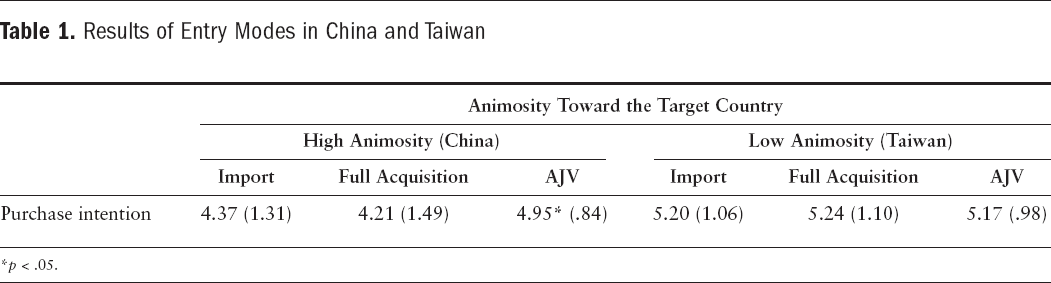
An analysis of covariance (ANCOVA) revealed no significant interaction for the effect of entry mode (import vs. full acquisition) and consumer animosity on purchase intentions (F(1, 121) = .00, p > .98; see Table 1). Monthly allowance as a covariate was not significant (F(1, 121) = .01, p > .55). Although ethnocentrism as a covariate was significant (F(1, 121) = 11.63, p < .001), its inclusion or exclusion did not alter the results. Inconsistent with H2a, the purchase intentions were not significantly higher when the entry mode was full acquisition (vs. import) for Chinese consumers (Mimport = 4.33 vs. Mfull acquisition = 4.21; p > .73). Consistent with H2b, purchase intentions did not differ for Taiwanese consumers regardless of whether the entry mode was import or full acquisition (Mimport = 5.20 vs. Mfull acquisition = 5.24; p > .87).
Results of Entry Modes in China and Taiwan
p < .05.
Import versus AJV Mode
An ANCOVA on purchase intentions yielded significant animosity by entry mode (import vs. AJV) interaction (F(1, 119) = 4.14, p < .04; see Figure 1). Monthly allowance as a covariate was not significant (F(1, 119) = 1.18, p > .28). Although ethnocentrism as a covariate was significant (F(1, 119) = 4.00, p < .05), its inclusion or exclusion did not alter the results. Consistent with H2a–b, purchase intentions were significantly higher when the entry mode was AJV (vs. import) for Chinese consumers (Mimport = 4.33 vs. MAJV = 4.95; F(1, 61) = 5.08, p < .03) but did not differ for Taiwanese consumers (Mimport = 5.20 vs. MAJV = 5.17; p > .91).

Moderating Effect of Consumer Animosity on the Effects of Foreign Entry Mode on Purchase Intention
Full Acquisition versus AJV Mode
An ANCOVA on purchase intentions revealed significant animosity by entry mode (full acquisition vs. AJV) interaction (F(1, 122) = 3.90, p < .05; see Figure 1). Monthly allowance as a covariate was not significant (F(1, 122) = 1.18, p > .28). Although ethnocentrism as a covariate was significant (F(1, 122) = 6.09, p < .02), its inclusion or exclusion did not alter the results. Consistent with H3a–b, purchase intentions were significantly higher when the entry mode was AJV (vs. full acquisition) for Chinese consumers (Mfull acquisition = 4.21 vs. MAJV = 4.94; F(1, 63) = 5.98, p < .02) but did not differ for Taiwanese consumers (Mfull acquisition = 5.24 vs. MAJV = 5.17; F(1, 66) = .08, p > .77).
Discussion of Study 1
The results of the pretest show that compared with consumers in Taiwan, those in mainland China exhibit a higher average hostile attitude toward Japan and a lower average purchase intention toward its products. However, consumers in both host countries showed no significant differences in their evaluations of Japanese product quality. Chinese consumers’ hostile attitude results in lower intentions to purchase Japanese products even though more than 60 years have passed since World War II.
The results of the main study demonstrate that Chinese participants were more influenced by the extent of host identity and local ownership in the entry mode. Chinese consumers exhibited higher purchase intentions when the foreign product was launched through an AJV entry mode than when it was introduced through a full acquisition or import entry mode. However, they exhibited no significant difference between import and full acquisition entry modes. A possible explanation is that consumers may believe that these two entry modes are associated with single ownership by a foreign firm. A full acquisition results in a wholly owned foreign subsidiary that consumers perceive to be strongly associated with the home country of the foreign firm. Consumers might regard the acquired company as foreign. In contrast, foreign entry modes did not influence the foreign product purchase intentions of Taiwanese participants.
Study 2: Postentry Branding Strategy
Design and Participants
In Study 2, we further investigate consumer responses toward products launched through a postentry subsidiary with various branding strategies. We restrict our attention to products launched through an AJV subsidiary. We designed three branding strategies to clarify the effect of COB on purchase intentions of foreign subsidiary products in a cross-country context. One hundred sixty-six students from China (48 women and 39 men) and Taiwan (34 women and 45 men) were randomly assigned to conditions in a 3 (AJV branding strategy: local brand, local-foreign cobrand, foreign-local cobrand) × 2 (consumer animosity: high [China], low [Taiwan]) between-subjects factorial design. The Chinese and Taiwanese participants were from the same schools as those who participated in Study 1. They also received course credit for their participation.
Procedures and Measurement
The experimental procedures and measures were identical to those in the AJV entry mode of Study 1 but with mention of the corporate brand name. The second part of the questionnaire provided information regarding whether the acquired Chinese/Taiwanese firm would keep its corporate name (for the local brand condition) or change its corporate name either to SHIZU-ATEK (for the foreign-local cobrand condition) or to ATEK-SHIZU (for the local-foreign cobrand condition) after acquisition. In addition, the third part of the questionnaire presented a mock-up advertisement of the new laptop computer with the corporate brand name.
Results
Manipulation Check
As we expected, the Chinese participants exhibited higher scores than the Taiwanese participants on general animosity (MChinese = 4.48 vs. MTaiwanese = 2.47; F(1, 163) = 68.52, p < .001), war animosity (MChinese = 4.89 vs. MTaiwanese = 2.53; F(1, 163) = 107.52, p < .001), and economic animosity (MChinese = 4.51 vs. MTaiwanese = 3.64; F(1, 163) = 17.34, p < .001).
Postentry Branding Strategy
An ANCOVA on purchase intentions (α = .92) yielded a significant main effect of animosity (F(1, 154) = 7.55, p < .01) and a significant animosity by postentry branding interaction (F(2, 154) = 4.15, p < .02; see Figure 2). Monthly allowance as a covariate was not significant (F(1, 154) = .13, p > .71). Although ethnocentrism as a covariate was significant (F(1, 154) = 11.59, p < .001), its inclusion or exclusion did not alter the results. In accordance with H4a, purchase intentions were significantly higher when the AJV adopted a local brand or a local–foreign (vs. foreign–local) cobrand (Mlocal = 4.77 vs. Mforeign-local = 4.03; F(1, 55) = 3.91, p < .05; local–foreign vs. foreign–local: Mlocal-foreign = 4.92, F(1, 57) = 4.65, p < .04) but were not significantly higher when the AJV adopted a local (vs. local–foreign) brand for Chinese participants (Mlocal = 4.77 vs. Mlocal-foreign = 4.92; F(1, 56) = .18, p > .67). Consistent with H4b, the Taiwanese consumers’ purchase intentions did not differ when the AJV products had a local, local–foreign, or foreign–local brand (Mlocal = 5.03 vs. Mlocal-foreign = 5.29 vs. Mforeign-local = 5.52; F(2, 76) = 1.43, p > .24) (see Table 2).
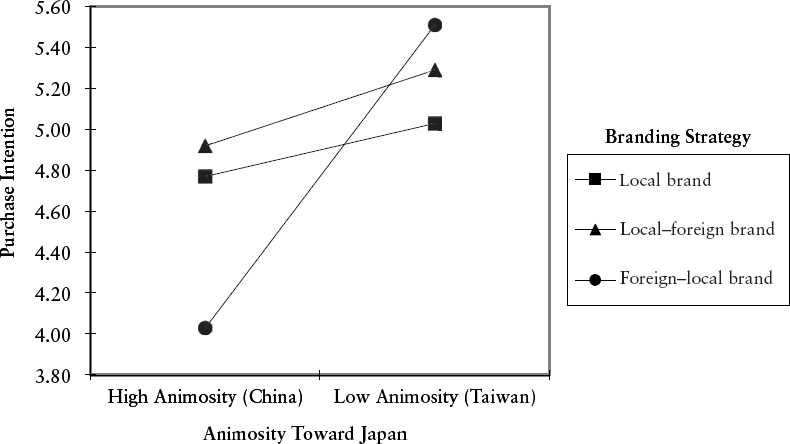
Moderating Effect of Consumer Animosity on the Effects of Branding Strategy on Purchase Intention
Results of AJV Branding Strategies in China and Taiwan

p < .05.
Notes: L = local; L-F = local–foreign; F-L = foreign–local.
Discussion of Study 2
Study 2's findings provide evidence that purchase intentions of foreign subsidiary products were differentially influenced by the use of branding information in two host countries. Although branding information did not influence the purchase intentions of Taiwanese participants, we found that Chinese participants’ purchase intentions for foreign subsidiary products augmented as the salience of the host identity of the corporate brand name increased. Chinese consumers preferred an AJV subsidiary that adopts a local brand or a local–foreign cobrand to one that espouses a foreign–local cobrand. However, we did not find a significant difference between an AJV subsidiary adopting a local brand and one adopting a local–foreign cobrand. A possible explanation is that Chinese participants may believe that both branding strategies represent the higher relative position and power of the local firm over the foreign subsidiary.
Conclusions and Implications
Political attitudes can lead to a country-induced bias, which affects consumer attitudes and purchase intentions. In an age of expanding globalization, these non-quality-based biases have significant performance implications for international marketers. Unlike other political attitudes (e.g., national identification, nationalism, patriotism), animosity is bilateral and can become a country-specific weakness and marketing barrier for international marketers from a particular offensive country. Therefore, the reduction of the negative impact of animosity becomes a critical task for marketers from an offensive country. At the same time, other foreign marketers can benefit from such a marketing opportunity. Our study proposes and empirically tests an appropriate entry mode and branding strategy that can mitigate host country consumers’ hostile feelings and enhance their purchase intentions.
Theoretical Implications
This study addresses the calls for more research on links between COO and animosity (e.g., Amine, Chao, and Arnold 2005). Our research distinguishes the cognitive mechanism, which uses COO as a quality cue, and non-quality mechanisms, which use COO to express consumers’ emotional value and social norms. In line with previous research, the present study shows that in an animosity context, the impact of the nonquality mechanism is much greater than that of the cognitive mechanism (Klein, Ettenson, and Morris 1998; Leong et al. 2008; Verlegh and Steenkamp 1999). The present study has important theoretical implications for the international marketing fields in several significant ways. First, we integrate entry mode choice into COO and animosity research. Whereas previous literature has provided ample evidence that entry mode decisions are a critical factor in shaping foreign market performance (e.g., Bradley and Gannon 2000; Burgel and Murray 2000), this topic has not been explored in COO and animosity research. This is a significant omission given that an important portion of international market entries are in the form of FDIs. To the best of our knowledge, this article covers new ground in exploring consumer responses to the products of an animosity-evoking foreign firm that adopts various FDI entry modes and branding strategies. In other words, we show that although the animosity between two countries is a political, diplomatic, and sociological precondition for international marketers, they are able to reduce the negative effect by employing an appropriate entry mode and postentry branding strategy. Our results support Amine, Chao, and Arnold's (2005) arguments that marketers from animosity-evoking countries can mitigate negative animosity impacts by using appropriate strategies.
Second, our study contributes to the consumer animosity and COO research streams by showing that FDI entry modes might lead to hybrid subsidiaries that are associated with two countries in a host market. An FDI subsidiary can be perceived as having a complex COO, such as country of ownership (e.g., a joint venture or a wholly owned subsidiary), country of manufacture (e.g., a locally made or imported product), and COB (e.g., cobrand). Consumer responses to the “foreign products” launched by such hybrid subsidiaries must again be examined. This research is the first effort to explore the effects of cross-country ownership and hybrid COBs and countries of manufacture on consumer responses in an animosity context. It provides international marketing researchers and practitioners with valuable insights into how a foreign firm can manipulate COO effects to mitigate host country consumer animosity.
In addition, the country-of-ownership issue, which in this research refers to the local–foreign ownership structure, is unexplored in current COO and animosity research streams. However, the results show that crosscountry ownership can be an important factor that shapes consumer perceptions of the COO of a foreign subsidiary. In particular, a foreign subsidiary with partial local ownership can significantly mitigate hostile feelings. Furthermore, prior COB research has examined consumer attitudes toward the country where a brand is perceived to originate (e.g., Fetscherin and Ton-car 2010). However, we propose that a cobranded product is essentially a hybrid with two COOs. A hybrid branding strategy leads to different consumer responses from a branding strategy with a single brand name. We propose that the branding strategy that can be used to manipulate COO perceptions should be an important issue in further COO and animosity research.
Managerial Implications
In general, consumer animosity is a given country-level condition for international marketers. However, our results suggest that marketers can make better entry-mode and branding decisions to mitigate negative consumer emotions and social pressures regarding products from an animosity-evoking foreign firm. Consumers exhibit more favorable responses toward AJV products than toward imported ones. The results demonstrate that for an international marketer from a home country that evokes hostility, FDI entry modes beyond import may represent better approaches for postentry success.
In addition, we observed that in a host market with high animosity, consumers prefer products that are launched by a foreign subsidiary with partial local ownership. This finding is in line with previous research indicating that foreign entrants can exchange their subsidiary ownership and technologies for market acceptance when facing social pressures in a host country (e.g., Chan and Makino 2007). However, this could be a difficult decision when opportunism is a critical concern, as transaction-cost economists suggest (e.g., Brouthers 2002). Entry-mode choice may become a trade-off between control and market acceptance in a hostile host country. We suggest that under such a circumstance, the foreign firm should consider administering market surveys to study the levels of negative effect of consumer animosity in selected target markets. These surveys could provide valuable information regarding how much the firm should compromise on its subsidiary ownership. Furthermore, when a local partner is less willing to relinquish partial ownership to a foreign entrant, forming a greenfield joint venture (a foreign company and a local company collaborating to form a new venture) could result in a similar outcome to that of an AJV.
Branding strategy is a critical decision for a marketer in a hostile host country. Consumers prefer an AJV product with a brand associated with a more salient host identity. Local and local-foreign cobranding lead to better consumer responses than does foreign-local cobranding. Although we consider only the branding strategy of an AJV, we suggest that it is also a critical decision for other entry modes that a marketer may adopt in an animosity context.
Our research demonstrates that entry modes and branding strategies associated with more salient host identity can reduce consumer animosity. Consequently, a foreign firm from an offending country can enhance the host identity of its subsidiary product by conducting other localization strategies in addition to those of entry mode and branding choice. We suggest that localization of key positions, such as general managers and/or spokespersons, could benefit a foreign subsidiary's host identity in a hostile host market. We further propose that increasing the proportion of local supplies may also enhance the host identity of a foreign subsidiary. In addition, it is important for animosity-evoking firms to increase opportunities to communicate with host country consumers regarding their localization efforts.
Limitations and Future Studies
The limitations inherent in this study present opportunities for further research. In this study, we use scenario experimentation and student samples to test our research hypotheses. Scenarios in the study can arouse past memories, either observed or self-experienced, and stimulate participants to respond to questions with genuine interest. However, the scenarios contain descriptions of limited circumstances, exclude details of the situation, and require respondents to fill in these gaps. Moreover, although the students in our samples were consumers of laptop computers, they may not be representative of other population groups in the two countries. Future studies could use other research methods and nonstudent samples to triangulate our findings. In addition to full acquisitions and AJVs, there are other entry mode choices for FDIs, such as greenfield investment. Further research should examine whether our findings are applicable in other entry modes. Finally, we studied the hypothesized effects using only one high-involvement product category (laptop computers), so future researchers could generalize our results by testing using other, low-involvement product categories.