







Abstract
This work examines contractual governance in international buyer–supplier relationships by investigating the linkages between contract specificity, contract violation, and relationship performance as well as the roles of contract monitoring and a country's institutional factors (i.e., country business risk and country globalization). The findings, based on a survey of international buyer–supplier relationships, provide new insights into a contract specificity → contract violation → relationship performance model. For example, the results indicate that contract specificity is not directly related to contract violation but, rather, that country-level factors moderate the effectiveness of contract specificity (i.e., contract specificity is more effective in suppressing an international buyer's contract violation if the buyer is from a country characterized by low business risk or high country globalization). The results also demonstrate that contract monitoring can mitigate the negative association between contract violation and relationship performance.
Keywords
We do not suggest that researchers have not focused on contractual governance in international buyer–supplier relationships at all (see, e.g., Cavusgil, Deligonul, and Zhang 2004); rather, we note that only recently have scholars begun to examine the specific design element of contract specificity (Mooi and Ghosh 2010). Contract specificity is a design feature of contractual agreements that denotes the level of explicitness, specification, and precision of the contract (Mooi and Ghosh 2010). It has been argued that specific contracts more clearly detail the roles and responsibilities of each party, diminishing contract violations and thereby enhancing relationship performance. However, prior research has revealed conflicting findings pertaining to the effectiveness of contracts in minimizing contract violation. For example, whereas Faems et al. (2008) find that contracts with high specificity serve as a control mechanism that reduces both the ability and willingness of partners to violate contracts, Cavusgil, Deligonul, and Zhang (2004) find that in certain contexts, formal contracts may actually signal distrust and create a breeding ground for opportunism. These somewhat conflicting findings suggest that the effect of contracts on contract violation may be contingent on other aspects of the relationship (e.g., country-level factors).
Furthermore, research in international buyer–supplier relationships has suggested that such relationships are exposed to increased risks and uncertainty because they involve partners from differing cultural, legal, economic, and social systems (Barnes et al. 2010; Cavusgil, Deligonul, and Zhang 2004; Katsikeas, Skarmeas, and Bello 2009; Seggie 2012). Research in institutional economics (e.g., North 1990) has suggested that a country's institutional environment defines the country's rules and norms of economic behavior and thus affects economic activities (interfirm relationships both within and across institutional environments) (e.g., Griffith 2010; Ju, Zhao, and Wang 2014). When considering international environmental effects, researchers have argued that country business risk (i.e., the volatility in a country's business environment; Erramilli and Rao 1993) and country globalization (Aulakh, Kotabe, and Sahay 1996) can have a profound influence on the governance of international relationships. For example, specific to contracting, country-related uncertainties can influence the legal protection for transactions, such as increasing difficulties in achieving litigation dissolution (Zhang, Griffith, and Cavusgil 2006), thereby exposing the buyer or supplier to enhanced exploitation (Seggie 2012). Although the extant literature recognizes the importance of environmental analysis for studying contractual governance, researchers have yet to offer an in-depth analysis of how specific country-level factors (e.g., country business risk, country globalization) influence the effectiveness of contract specificity in suppressing contract violation.
To address these shortcomings, this work makes two contributions. First, drawing on the contracting, institutional, and international marketing literature, we advance the international buyer–supplier relationship literature (e.g., Aulakh and Gençtürk 2008; Barnes et al. 2010; Buvik and Andersen 2002; Griffith et al. 2014; Ju, Zhao, and Wang 2014) by developing and testing a general model of contract specificity → contract violation → relationship performance in the international context. Our findings build on those of Cavusgil, Deligonul, and Zhang (2004), demonstrating that the relationship between contract specificity and contract violation is moderated by country-level factors. Specifically, we find that contract specificity is more effective in suppressing an international buyer's contract violation if the buyer is from a country characterized by low business risk or high country globalization. As such, this work extends the literature by bringing greater clarity to the general contractual governance model in an international context.
Second, this work contributes to the understanding of the management of exchange risks and uncertainties, such as the possible legal consequences of contract violation, which diminish relationship performance (e.g., Seggie 2012; Zhang, Griffith, and Cavusgil 2006). For example, Zhang, Griffith, and Cavusgil (2006) report that costly short- and long-term performance implications of contract violation can result in litigated relationship dissolution in international buyer–supplier relationships. Our results demonstrate not only that contract violations hamper relationship performance but also that contract monitoring (specifically, the time spent working to monitor compliance with the contractual features of the agreement) can reduce the negative influence of contract violation on relationship performance. As such, the current work extends knowledge of key governance mechanisms to employ in contractual governance for international buyer–supplier relationships.
We organize the remainder of the article as follows: First, we briefly review the literature in developing our conceptual framework (see Figure 1). We then present a series of hypotheses derived from the model. We test the hypotheses with a survey of U.S. exporters reporting on their relationship with their primary international buyer. We present the results, followed by a discussion of the theoretical contributions and managerial implications. Finally, we discuss the research limitations and suggest possible topics for further investigation.

Conceptual Model
THEORETICAL BACKGROUND
Contract Specificity and Its Relationship Outcomes
Contract specificity is defined as the level of explicitness, specification, and precision of a contract, such that a high level of contract specificity means that terms are more detailed and explicit relative to technical specifications of the product, implementation procedures, financial and legal considerations, and overall contract features (Mooi and Ghosh 2010). Contract specificity anchors on the degree of codification of contract elements and refers to the degree to which aspects of the contract are formulated to enhance clarification and verification (Mooi and Ghosh 2010). In an interfirm relationship governed by a contract, contract specificity helps clarify each party's roles and responsibilities, thus providing each party explicit detail regarding their duties and benefits.
Previous research has suggested that by specifying each party's roles and responsibilities to be performed, firms can reduce the chances or severity of contract violation (Mooi and Ghosh 2010). However, research has also demonstrated that a specific contract may actually increase contract violation (Jap and Ganesan 2000). The rationale underlying this argument is that specific contracts create rigidity, increasing the potential for maladaptation (i.e., an overspecified contract may become too rigid for both parties to respond to environmental changes). Without flexibility, the relationship is likely to become unstable and/or unprofitable (due to increased maladaptation costs). Furthermore, a highly specified contract may also signal distrust in the partnership (Jap and Ganesan 2000). Consistent with this notion, Malhotra and Murnighan (2002) argue that exchange parties may attribute their cooperation to the constraints imposed by the specific contract rather than to the individuals themselves, thus reducing the likelihood of the development of trust between parties to the exchange. By undermining flexibility and trust, contract specificity may encourage, rather than discourage, contract violation. Despite the conflicting argument regarding the effect of contract specificity on contract violation, limited research has uncovered the boundary conditions for whether contract specificity is effective or ineffective relative to contract violation.
Contractual Governance in International Environment
International buyer–supplier relationships operate across institutional environments and, as such, experience increased risks and uncertainty because they involve partners from differing cultural, legal, economic, and social systems (Barnes et al. 2010; Griffith 2010; Katsikeas, Skarmeas, and Bello 2009; Seggie 2012). To better understand the effectiveness of contractual governance, it is important to understand the institutional environmental factors that could influence governance aspects. We contend that two factors have particular influence on contractual governance: country business risk and country globalization.
Country business risk refers to the volatility in a country's business environment (Erramilli and Rao 1993). International markets are more volatile (Skarmeas, Katsikeas, and Schlegelmilch 2002) and have different sources of volatility than exchanges within domestic markets (Homburg et al. 2009; Raven, McCullough, and Tansuhaj 1994). Political instability, changes in economic policy, economic turbulence, and exchange rate volatility are all factors that lead to pronounced country business risk (Aulakh and Kotabe 1997; Zhang, Griffith, and Cavusgil 2006). For example, in 2015 political turbulence in Ukraine disrupted nearly every aspect of the Ukrainian economy, reducing the ability of some Ukrainian suppliers and buyers to fulfill their contractual responsibilities with their international partners. Similarly, due to high inflation in 2011, the Argentine government imposed import restrictions on 200 goods to protect its domestic industry, thereby forcing some Argentine buyers to break their contracts. These examples illustrate not only the effect of country business risk on firm operations but also how country business risk disrupts buyer–supplier contracts.
Country globalization has also been recognized as an important aspect of a country's institutional environment (Akhter 2004; Griffith 2010). Country globalization is defined as the intensification of economic, social, and political interaction across a country's national boundaries (Akhter 2004; Griffith 2010). An important indicator of country globalization is the level of cross-border integration of business, including the exchange of goods and services, the flow of capital and labor, the integration of business practices and culture, and the exchange of information and ideas. Country globalization captures the ability of a country's people and companies to interact with other parts of the world, obtain information, and diffuse their own activities globally (Berry, Guillέn, and Zhou 2010). In short, a globalized country is a globally connected and integrated country. Firms in more globalized countries are more adept at understanding the norms, procedures, and conventions of contemporary business. As such, one would expect that the effectiveness of contractual governance would be more enhanced in countries with higher levels of globalization than in those with lower levels of globalization (where firms may not be as familiar with contemporary business norms and standards).
HYPOTHESIS DEVELOPMENT
Contract Specificity and Contract Violation
We predict a negative association between contract specificity and contract violations in international buyer–supplier relationships. The logic underlying this prediction is that specificity reduces misunderstanding and misinterpretation between international exchange partners that are caused by differences in culture, language, and legal systems. Contract specificity is important in international buyer–supplier relationships for protecting relationship investments because exchange parties originate from different country market contexts and therefore differ in relation to legal, social, and political environments (Cavusgil, Deligonul, and Zhang 2004; Griffith 2010; Katsikeas, Skarmeas, and Bello 2009). When contracts are specific, coordination between partners toward collective goals is enhanced. Furthermore, contract specificity provides more guidelines for dispute resolution (Cavusgil, Deligonul, and Zhang 2004; Faems et al. 2008), thus ensuring a clear understanding of the processes by which contract violations will be handled, should they occur. More formally,
Contract specificity is negatively associated with contract violation.
The Influences of Country-Level Factors
Research findings have been inconsistent regarding the influence of contract elements on contract violations, which necessitates the investigation of boundary conditions to shed light on the effectiveness of contract specificity. Country-level factors in international relationships have profound influences on relationship governance and relationship outcomes (e.g., Cavusgil, Deligonul, and Zhang 2004; Griffith 2010; Ju, Zhao, and Wang 2014; Raven, McCullough, and Tansuhaj 1994; Skarmeas, Katsikeas, and Schlegelmilch 2002). We predict that the country-level factors of country business risk and country globalization influence the effectiveness of contract specificity in suppressing contract violation.
Country Business Risk
Country business risk creates an unpredictable environment for international buyer– supplier relationships, reducing both parties’ ability in controlling the relationship (Zhang, Cavusgil, and Roath 2003). As a country's business risk increases, the challenges of contract specificity as a mechanism to limit contract violation with an exchange partner from that country changes. We hypothesize that country business risk reduces the effectiveness of contract specificity in suppressing contract violation. The underlying logic is twofold. First, when country business environments change, either party may be unwilling or unable to fulfill its duties delineated in the contract. When economic conditions change, transaction parties might no longer gain benefits from the buyer–supplier relationship and therefore may be less willing to maintain the conditions of the contract. For example, a sudden increase in tariffs on coal imports can make a domestic coal producer a more attractive supplier than a foreign coal producer, thus stimulating the buyer to shirk its repurchase duties specified in the contract. In addition, when economic conditions change, transaction parties may lose the capability to abide by the specifically stated rules in the contract. For example, in May 2014, because of anti-China protests in Vietnam, some Vietnamese clothing and toy suppliers were unable to adhere to the contracted delivery terms of their contracts with their international buyers.
Second, specific contracts typically have limited ability to accommodate macroeconomic changes associated with unpredictable country environments (Choi, Lee, and Kim 1999). Carson, Madhok, and Wu (2006, p. 1061) suggest that as environmental volatility increases, the effectiveness of formal contracting decreases because “contracts are inflexible and must be undone and renegotiated to accommodate change, substantially weakening or eliminating their safeguarding capabilities.” Because of the difficulties in fulfilling specific duties in contracts and the rigidity created by contract specificity, we posit that the effectiveness of a contract's specificity to limit contract violation lessens as country business risk increases. More formally,
As country business risk decreases, the association of contract specificity and contract violation becomes increasingly negative.
Country Globalization
Country globalization has had a profound influence on relationship governance (Aulakh, Kotabe, and Sahay 1996). We contend that country globalization will strengthen the negative association of contract specificity with contract violation. In a highly globalized country, trading fairly and complying with both the letter and spirit of a contract is a highly valued behavior, not only because honoring the commitment in contracts has become a socially accepted norm but also because firms that violate contracts are not able to mask their identities in a highly globalized country (Clague et al. 1999). Due to the high degree of economic and social integration between a globalized country and other parts of the world, firms in more highly globalized countries have greater opportunities to learn codes of ethical business conduct that have been accepted as general social norms. Moreover, in a more globalized country, misfeasance or “foul play” in the focal buyer–supplier relationship can be easily observed by other international firms, which reinforces the principle of behaving in the spirit of the law as a social norm. The implicit constraint placed on the behavior of parties to an international buyer–supplier relationship thereby creates a social norm of compliance, suggestive of a moderation effect on the relationship between contract specificity and contract violation.
Country globalization not only increases the visibility of an exchange party's actions (thereby creating an environment conducive to enhanced cooperation) but also reduces the possibility of the misinterpretation of contract terms. Prior research has shown, for example, that suppliers in China and buyers in the United States have different interpretations of the delivery terms in a contract (Vernon-Wortzel, Wortzel, and Deng 1988). We argue that the possibility of misinterpretation declines with increased globalization (e.g., many argue that differences have diminished as China has become more globalized). Consistent with this notion, Griffith (2010) maintains that globalization of a country market brings convergence to business practices. Firms in globalized countries are exposed to international information regarding methods of manufacturing and modes of organization, marketing, and product design. Thus, these firms are able to encode and decode the meaning of contract clauses in similar ways. More formally,
As country globalization increases, the association of contract specificity and contract violation becomes increasingly negative.
Vulnerability of Relationship Performance and the Role of Contract Monitoring
Contract violation hampers the operation of buyer–supplier relationships (Seggie, Griffith, and Jap 2013; Wathne and Heide 2000). Contract violation can occur when one party engages in behaviors prohibited by the contract. For example, an international buyer can engage in contract violation by reselling imported products to unauthorized territories (Zhang, Griffith, and Cavusgil 2006). Similarly, contract violation also can occur when a transaction party fails to honor the agreement in the contract by withholding information and effort (Wathne and Heide 2000). Contract violations on the part of the buyer disrupt the implementation of the supplier's strategic plan and potentially exploit the supplier's strategic resources, ultimately harming the performance of the buyer–supplier relationship. More formally,
Contract violation is negatively associated with relationship performance.
Unfortunately, existing literature provides little theoretical guidance regarding what exchange parties can or should do to reduce the performance harming effects of contract violation. Drawing from the contracting literature, we theorize that contract monitoring may play a role in moderating the influence of contract violation on international buyer–supplier relationship performance. Contract monitoring is typically viewed as the governance process that oversees and assesses a partner's compliance with the contract (Bello, Katsikeas, and Robson 2010). Although previous research has investigated the direct relationship between contract monitoring and contract violation—suggesting that resources dedicated to monitoring may overcome information asymmetry problems, which can lead to contract violation (Wathne and Heide 2000)—there is no controlling mechanism that can eliminate the possibility of contract violation (Barnes et al. 2010). No matter how closely a firm is monitored, contracts may still be violated if the benefits of violating the contract exceed the costs of complying with the terms of the contract.
Taking a different perspective on contract monitoring, we posit that contract monitoring, conceptualized as the time spent working to monitor compliance with the contractual features of the agreement, moderates the negative association of contract violation with relationship performance. The logic underlying this theory is that by fostering timely detection of contract violation, accurate response strategies can be formulated and implemented, and the negative association between contract violation and relationship performance is weakened. International exchange partners who implement increased contract monitoring will be able to acquire more timely and accurate information regarding whether, when, why, and how contract violation occurs (Karunaratna and Johnson 1997). This information is particularly important for deciding on an appropriate response to contract violation. If contract violation is intentional, the wronged firm can utilize influence strategies (e.g., renegotiating, threatening) to correct behavior (Zhang, Griffith, and Cavusgil 2006). If contract violation occurs because of a party's incompetence, the wronged firm needs to understand its partner's difficulty in complying with the contract and work collaboratively to help its partner. If the contract violation occurs because of an unforeseen and external event (a “force majeure”), the buyer and supplier must renegotiate the contract and cope through cooperative action. More formally,
As contract monitoring increases, the association of contract violation and relationship performance becomes decreasingly negative.
RESEARCH METHOD
The empirical context for examining international buyer–supplier relationships is U.S. exporters and their primary foreign buyers. Before data collection, we tested the proposed survey in interviews with 12 U.S. export managers. Pretesting allowed for refinement of (1) the study's focus on issues relevant and substantive to U.S. export managers and (2) survey item meaningfulness and clarity before data collection. The interviews provided insight into the intricacies of contracting within the export context. Furthermore, the interviews suggested the importance of consistency in the measurement of contract aspects across specificity, monitoring and violations to enhance clarity and respondent understanding.
We collected data through an online survey method in participation with the research firm Research Now. Research Now maintains a national panel of managers and financially incentivizes respondents for their participation. We sent national panel members who were managers in firms that exported in the manufacturing sector an invitation to participate in the survey. Invitations noted that responses were requested pertaining to export management strategy and that only those involved with export management activities should participate. Panel members who indicated their willingness to participate (i.e., by clicking on the survey link in the invitation e-mail) were then asked a qualifying question about their active participation in export management activities. Only those managers indicating active engagement in export management activities were allowed to continue. To better control survey response rate, invitations were sent out in small batches on a rolling basis, allowing each respondent five days to complete the survey before inviting new export managers to participate. The export managers were asked to indicate their general perceptions of the specificity and violation of contracts as well as other key variables (e.g., relationship performance) with their primary foreign buyer.
The survey reached 707 managers. Of those respondents, 218 were qualified to complete the survey (based on the qualifying question). Of the 218 qualified respondents, 151 surveys were complete and usable, accounting for a 23.36% effective response rate. We excluded partially completed surveys (i.e., in which respondents did not answer any items related to the model constructs) from the analysis. Respondents averaged 45 years of age, with 11 years of experience in export management and 7.4 years of experience doing business with the primary foreign buyer, factors that collectively provide evidence for informant competency. On average, the respondent firms’ primary foreign buyer accounted for 24.9% of their annual dollar volume, and the contract the respondents reported on covered, on average, 52.1% of the business with the primary foreign buyer. With regard to nationality, the buyers in our sample represent 29 countries, including China (18.5%), Mexico (9.3%), Japan (8.6%), the United Kingdom (8.6%), Canada (6.6%), India (4.6%), Brazil (4%), and France (4%). Our sample also represents a variety of manufacturing industries, including automotive, electronics, plastics, food, lighting, fashion, and others.
We conducted nonresponse bias testing to ensure a representative sample by comparing the mean responses of early respondents with those of late respondents (based on days to complete the survey from initial invitation). We compared responses on the items composing the constructs within this study as well as key firm demographic characteristics of industry, sales revenue, and number of employees. We found no statistically significant differences in any of the items, indicating that the threat of nonresponse bias is minimal.
Measurement
Contract Specificity
We measured contract specificity using Mooi and Ghosh's (2010) four-item scale, which assesses contract specificity pertaining to (1) technical specifications, (2) implementation procedures, (3) financial and legal considerations, and (4) overall contract features. Composite reliability was .92.
Contract Monitoring
We measured contract monitoring by adapting Mooi and Ghosh's (2010) four-item contract specificity scale. Items pertained to (1) technical specifications, (2) implementation procedures, (3) financial and legal considerations, and (4) overall contract features. Composite reliability was .94.
Contract Violation
We captured contract violation by adapting Mooi and Ghosh's (2010) four-item contract specificity scale, which assesses contract violations involving (1) technical specifications, (2) implementation procedures, (3) financial and legal considerations, and (4) overall contract features. Composite reliability was .97.
Country Business Risk
We measured country risk with two items: country risk rating and business climate rating. Both ratings were acquired from Coface (www.coface.com), a firm that provides country ratings and business climate ratings for 160 countries based on macroeconomic, financial, and political data. The ratings provide an estimation of the “average credit risk on a country's businesses.” The country business risk is evaluated on seven levels: A1, A2, A3, A4, B, C, and D. To facilitate data analysis, we recoded the seven levels into 1 to 7, with 1 representing the lowest risk and 7 representing the highest risk.
Country Globalization
We measured country globalization with two items: DHL's global connectedness index and Ernst & Young's globalization index. DHL's global connectedness index captures the depth of global interaction, measuring “cross-border flows of people, information, trade, and capital” (Ghemawat and Altman 2014, p. 2). Developed by the Economist Intelligence Unit of E&Y (www.ey.com/globalization), the Ernst & Young globalization index measures a country's degree of global integration on the basis of five drivers for globalization: openness to trade, capital flows, exchange of technology and ideas, labor movements, and cultural integration. The index is a score relative to that country's gross domestic product (see Appendix A).
Relationship Performance
We measured relationship performance from the supplier's point of view with Zou, Taylor, and Osland's (1998) three-dimensional scale for measuring export performance, which measures financial export performance, strategic export performance, and satisfaction with export venture. To accommodate the multidimensional nature of export performance, we modeled export performance as a second-order construct, with financial export performance, strategic export performance, and satisfaction with the export venture as reflective indicators. Composite reliability was .96.
Control Variables
We controlled for the effects of demand uncertainty, transaction-specific investments, relationship duration, and relationship phase on contract violation. Demand uncertainty of the buyer may increase the likelihood of contract violation. When the buyer's preference or needs change while the international supplier cannot take precautions, it is likely that the buyer would breach the contract. We measured demand uncertainty using a four-item scale, evaluating the level of unpredictability of the buyer's demands and preferences. Transaction-specific investments are subject to higher transaction risks, which encourage violation of the contract (Williamson 1985). We modeled transaction-specific investments as a second-order construct with two first-order variables, specific asset investments and specific time investments, as its reflective indicators. We measured each first-order factor using multiple items adapted from Jap and Anderson (2007). Relationship duration and relationship phase may also influence contract violation. As a buyer–supplier relationship develops across different phases (exploration, buildup, maturity, and decline), the probability and frequency of contract violation may change. We measured relationship phase using the scale developed by Jap and Anderson (2007). We also controlled for the influence of country characteristics and percentage of business on relationship performance. Country risk and country globalization may influence the profitability of an international buyer–supplier relationship. Percentage of business indicates the importance of the transaction to the exporter. To measure it, we used a question asking the respondent to indicate how much of the exporter's total business was conducted with its primary foreign buyer. (For all measures, see Appendix B.)
Analytical Procedures
We used partial least squares (PLS) analysis to test the hypotheses. We chose PLS over covariance-based structural equation modeling because (1) the presence of interaction effects may not satisfy the requirement of normality in covariance-based structural equation modeling, while PLS does not require normality in the data, and (2) we have a small sample size but a relatively large model (Hulland, Ryan, and Rayner 2010). We used SmartPLS 2.0 (Ringle, Wende, and Will 2005) to estimate both the measurement and structural models simultaneously. We report and interpret the results of the two models sequentially.
Measurement Model
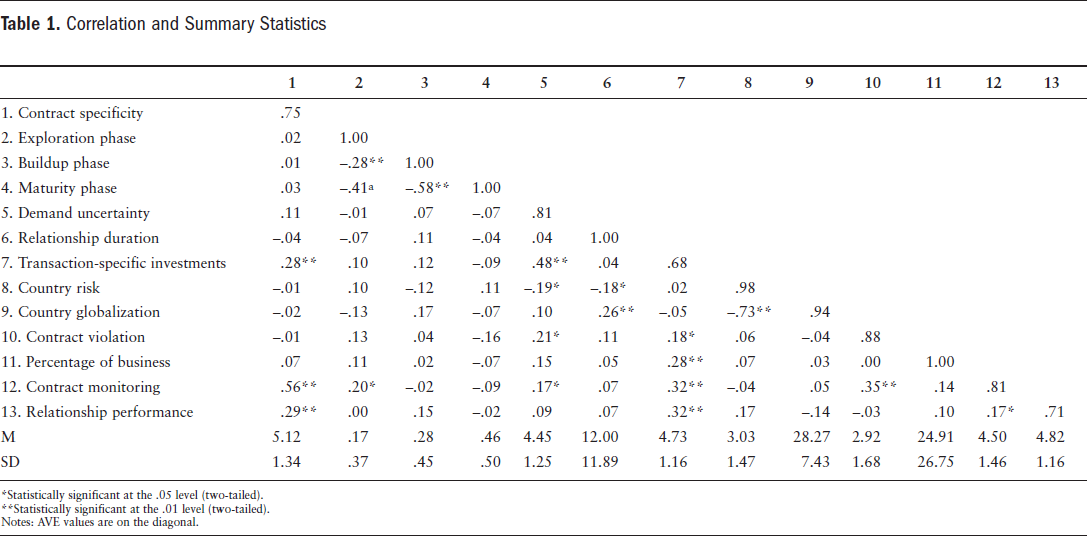
We assessed the adequacy of the measurement model through an examination of individual item reliability and the convergent and discriminant validity of all study variables (Fornell and Larcker 1981). The loadings of the items on their corresponding constructs all exceed .80, and all the factor loadings are significant (t > 1.96). Table 1 displays descriptive statistics, average variances extracted (AVEs), and intercorrelations for all study variables. The table shows that all constructs have an AVE higher than .50. These results establish the convergent validity of our measures. All measures also have discriminant validity, as AVE values exceed the squared correlations between all pairs of variables (Fornell and Larcker 1981), revealing that each construct shares more variance with its measures than with other constructs.
Correlation and Summary Statistics
Statistically significant at the .05 level (two-tailed).
Statistically significant at the .01 level (two-tailed).
Notes: AVE values are on the diagonal.
Furthermore, we worked to alleviate concerns about common method variance in two ways. First, as we have noted, we measured two variables in the structural model (i.e., country business risk and country globalization) using data obtained from secondary sources. Therefore, the model consists of mixed-source data. Second, following the procedure developed by Liang et al. (2007) for testing common method variance in PLS analysis, we included a common method factor in the PLS model. The results show that (1) most method factor loadings were not significant and (2) substantive variance far exceeds method variance (average indicators’ variance explained by substantial variables is .80; average indicators’ variance explained by the common method factor is less than .01; and the ratio of substantive variance to method variance is approximately 123:1). These tests suggest that the threat of common method bias is minimal.
Hypotheses Testing
We tested the hypothesized direct and interaction effects in the model. The interaction terms were presented using the product-indicator procedure developed by Chin, Marcolin, and Newsted (2003) for use in PLS. The indicators were first standardized and then multiplied to be the indicators of the interaction variables. Traditional tests for parametric significance are inappropriate in PLS analysis because it does not make distributional assumptions. Therefore, we used bootstrapping with replacement (n = 1,000) to calculate the significance level of the estimates. Table 2 presents the estimation and hypotheses testing results.
Estimation and Hypotheses Testing Results

Statistically significant at the .05 level (one-tailed).
Statistically significant at the .01 level (one-tailed).
H1 posits that contract specificity is negatively associated with contract violation. The results in Table 2 indicate an insignificant relationship between contract specificity and contract violation (β = -.26, p > .05). The lack of support for H1 was not completely surprising, given that we also expected moderation effects, which suggests that the association between contract specificity and contract violation is bounded by contextual factors.
H2 and H3 address the moderating influence of country-level factors on the relationship between contract specificity and contract violation. The results indicate a significant moderation effect of country business risk on the association between contract specificity and contract violation (β = .53, p < .05). We conducted simple slope analysis based on regression results to gain more information about the nature of the moderating effect. We calculated slopes at low (one standard deviation below the mean), medium (the mean), and high (one standard deviation above the mean) levels of country business risk. In support of H2, the results show that the effect of contract specificity on contract violation is not significant when country risk is high (β = .45, p > .05) and is significantly negative when country risk is medium (β = -.43, p < .05) and low (β = −1.31, p < .05). Figure 2, Panel A, illustrates the results of the simple slope analysis.
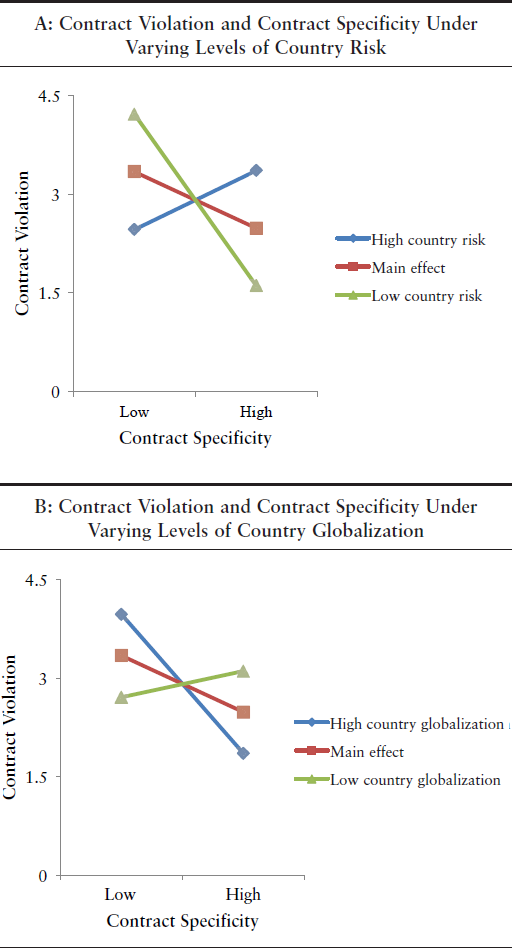
Graphic Illustration of Interaction Effects Between Contract Specificity and Country Characteristics
The results also indicate a significant moderation effect of country globalization on the association between contract specificity and contract violation (β = -.38, p < .05). We again conducted simple slope analysis to detect the changes in the relationship between contract specificity and contract violation across countries with different levels of globalization. Similarly, we calculated slopes at low, medium, and high levels of country globalization. The results, in support of H3, show that the effect of contract specificity on contract violation is not significant when country globalization is low (β = .20, p > .05) and is significantly negative when country globalization is medium (β = -.43, p < .05) and high (β = −1.06, p < .05). We illustrate the results of the simple slope analysis in Figure 2, Panel B.
H4 hypothesizes a negative association between contract violation and relationship performance. The results show that there was a negative association between contract violation and relationship performance (β = -.22, p < .05), in support of H4. H5 hypothesizes that the vulnerability of relationship performance to contract violation can be mitigated by contract monitoring. The results show that the negative association between contract violation and relationship performance is indeed mitigated by close contract monitoring (β = .26, p < .05). In support of H5, a simple slope analysis indicates that the effect of contract violation on relationship performance is not significant when contract monitoring is high (β = .03, p > .05) but is significantly negative when contract monitoring is medium (β = -.45, p < .05) and low (β = -.93, p < .05). We illustrate the pattern of the moderating effect (the stronger the contract monitoring, the weaker the negative association between contract violation and relationship performance) in Figure 3.
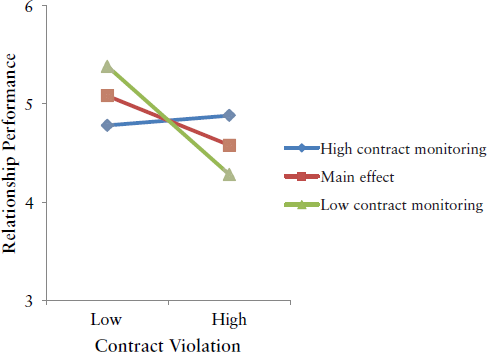
Graphic Illustraction of the Interaction Effect between Contractual Violation and Contract Monitoring
Additional Analysis
Although not hypothesized, we examined additional relationships within the model. The results indicate a positive relationship between country business risk and relationship performance (β = .26, p < .05) and a negative relationship between country globalization and relationship performance (β = -.26, p < .05). The findings suggest that the buyer–supplier relationship is more profitable if the buyer is from a country with higher risk (consistent with the risk–return paradigm) and is less profitable if it is from a country with higher globalization (consistent with the argument of increased competition in more globalized markets).
We estimated the model using PLS analysis. To increase confidence in our conceptual model and to provide evidence for the robustness of our findings, we performed ordinary least squares regression with clustered standard errors. The robust regression analysis relaxes the independence assumption and allows for intragroup correlations among errors (within-country correlated errors in this study). The results show that robust ordinary least squares regression generates identical estimation of the hypothesized effects, and the estimated robust standard errors do not change the significance of the effects as we observed in PLS results. The findings indicate that there is a significant interaction between contract specificity and country business risk (β = .54, p < .05) and a significant interaction between contract specificity and country globalization (β = -.38, p < .05) when considering contract violation. We also found the moderating effect of contract monitoring on the association of contract violation with relationship performance to be significant (β = .26, p < .05). In summary, the robustness check yields quantitatively similar findings, in support of our PLS results.
Discussion
The purpose of this research was to address a gap in the international marketing literature by increasing understanding of contractual governance in international buyer–supplier relationships (particularly related to contract specificity). As such, we worked to understand the contract specificity → contract violation → relationship performance linkage and investigated the role of contract monitoring and country-level factors (i.e., country risk and country globalization) in international transactions. The findings provide new insights into these relationships, advancing the international marketing literature and the practice of international marketing in several important ways.
Theoretical Implications
The results of this work reveal new insights about the important role of contractual governance within international buyer–supplier relationships. Our findings shed new light on the relationship between contract specificity and contract violation. Although we observe no direct effect between contract specificity and contract violation, we do find moderation effects of country-level factors (thereby demonstrating contextual effects). To date, the literature on the relationship between contract governance has tended to focus on microenvironmental uncertainty. However, scholars have noted a growing need to examine more specific institutional factors (e.g., Cavusgil, Deligonul, and Zhang 2004; Ju, Zhao, and Wang 2014; Steward et al. 2010). For example, there has been an increasing demand for empirical knowledge on governing business relationships in international buyer–supplier relationships, most notably regarding elements such as country business risk and globalization (e.g., Berry, Guillέn, and Zhou 2010; Buvik and Anderson 2002; Griffith 2010). Building on these calls, we examine and find that country-level factors moderate the effectiveness of contract specificity in controlling contract violation, thereby extending work on contract violations (e.g., Cavusgil, Deligonul, and Zhang 2004; Zhang, Griffith, and Cavusgil 2006) in the international marketing literature.
First, we find that the ability of contract specificity to reduce contract violation varies across levels of country business risk. The results indicate that if the international buyer is from a country with higher business risk, contract specificity is less effective in controlling contract violation. We suggest that this effect is due to the notion that although the contract may have greater specificity, its ability to offset the volatility in the international market is hampered. Indeed, these results suggest that less contract specificity, as country business risk increases, may be more advantageous because it provides for greater flexibility in turbulent international markets (thereby minimizing maladaptation costs). Importantly, we find that country globalization plays a pivotal role. We note that as country globalization increases, the association of contract specificity and contract violation becomes increasingly important. We theorize that this is due to a greater concern among transaction partners regarding reputation as well as less opportunity for misinterpretation of contract features in highly globalized countries. This work extends the theoretical arguments of Griffith (2010) in that the results suggest that movement of a country's institutional environment brings about convergence in business practices. As globalization in a country increases, firms are exposed to increased levels of international information regarding contemporary business practices and norms and thus are able to encode and decode the meaning of contract features in similar ways.
Second, the results extend the contractual governance literature by demonstrating that contract monitoring (specifically, the time spent working to monitor compliance with the contractual features of the agreement) can reduce the negative influence of contract violation on relationship performance in international buyer–supplier relationships. Internal uncertainty or performance ambiguity problems emerge when it is difficult or costly to evaluate a partner's behaviors (Wathne and Heide 2000; Williamson 1985). Performance ambiguity renders self-interest-seeking behavior partially or fully undetected, and this problem is exacerbated in international buyer–supplier relationships because each is unfamiliar with its partner's operations (Gençtürk and Aulakh 2007). As such, performance ambiguity increases an international supplier's vulnerability to hidden deceptive activities, exposing the firm to opportunistic exploitation (Katsikeas, Skarmeas, and Bello 2009). Although our results suggest that contract violation damages relationship performance, they also indicate that the vulnerability of relationship performance to contract violation can be reduced by increased contract monitoring. Although international marketing scholars have theorized processes for understanding contract violations (e.g., Zhang, Griffith, and Cavusgil 2006), this article extends the current understanding of monitoring (which is typically focused on the process of monitoring and, as such, is viewed as a direct suppressor of contract violation), reporting that in the international buyer–supplier context, the specific monitoring of a contract facilitates timely and accurate detection of, and responses to, contract violation and thus acts to protect the relationship's performance.
Third, this article extends the literature by identifying important direct effects of country-level factors within the contractual governance model developed. For example, we find that country business risk has a positive impact on relationship performance: a relationship with a buyer from a high-risk country is more profitable than that of a low-risk country. This finding is theoretically supportive of the risk–return paradigm. Furthermore, we also found a negative influence of country globalization on relationship performance. This could be explained by the fact that buyers from a more globalized country typically have access to a greater number of available international suppliers, which creates increased competition for the focal supplier.
Managerial Implications
Our study also has important implications for international marketing managers. First, this research provides some basic guidelines on how to structure a contract in an international buyer–supplier relationship. We raise a concern regarding contract specificity in noting that its effect in suppressing contract violation is contingent on country-level factors. This suggests that managers recognize that contract specificity is beneficial only for some international buyer–supplier relationships. If an international buyer is from a country characterized by lower business risk or higher country globalization, contract specificity will be more effective in controlling contract violation. These findings suggest that international marketing managers should evaluate a buyer's country risk and level of country globalization when designing a contract. The evaluation process should account for the economic, social, and political issues in the buyer's country (as well as the country's evolution over the time period of the contract). Furthermore, drawing from extant literature findings (e.g., Zhang, Cavusgil, and Roath 2003), we recommend that firms conducting business with partners from high-business-risk or low-globalization countries deploy other types of relationship governance mechanisms (e.g., relational governance, vertical integration and alliance) to complement contractual governance.
Second, the findings provide some suggestions related to market selection. Although country business risk reduces the effectiveness of contract specificity, it is not necessarily a negative attribute for international buyer–supplier relationships. Specifically, we find the buyer's country business risk to be positively associated with relationship performance. The findings suggest that exporters may want to seek buyers from a country with high business risk because country business risk can benefit a relationship's performance as long as the relationship can be effectively governed. Such a selection should only be considered as part of a larger market portfolio evaluation to ensure that managers appropriately understand how adding a partner with higher country business risk affects the firm's overall risk profile.
Third, the study places a spotlight on the important issue of contract monitoring as a mechanism for protecting relationship performance. The findings suggest that even though contract violation may not be avoidable, resources invested in contract monitoring are not wasted. Drawing our results to practice, we note that in March 2013, Hemlock Semiconductor Corporation, the largest U.S. provider of polysilicon, sued SolarWorld AG, the largest maker of solar panels in Germany, for not following the terms of “take or pay” in the supply agreement. In May 2013, another lawsuit was filed in the same industry. In this case, LDK Solar (China) alleged that Canadian Solar (Canada) breached “take or pay” terms in a three-year wafer supplier contract. From these cases, we observe that contract violations in international buyer–supplier relationships do happen. More importantly, the negative influence on relationship performance was the primary reason that Hemlock and LDK Solar filed lawsuits against their international buyers. As such, we recommend that due consideration be given to contract monitoring in relation to its role in reducing vulnerability of relationship performance to contract violation.
Limitations and Directions for Further Research
Although our study provides several contributions to international marketing research and practice, it is not without its limitations. First, we examined the influence of country-level factors on the effectiveness of contract design using a cross-sectional survey, which not only is subject to common method bias but also provides a static perspective on a dynamic phenomenon (i.e., the context of the environment). As Griffith (2010) notes, the economic, technological, and legal environments surrounding international exchanges are undergoing fast-paced changes. Convergence along multiple institutional environmental factors is happening simultaneously. We encourage future researchers to adopt a longitudinal perspective to examine how the effects of contract design in international relationships evolve over time. Such an examination provides not only the potential of moving to a dynamic perspective but also the opportunity of multiple time periods and respondents, thereby overcoming common method concerns.
Second, the results are limited to the sample of specific buyer country markets, thereby not allowing for a more detailed country-market examination. Although some of the buyers in our sample are from the same country (e.g., 28 buyers are from China), many are not. For example, for 13 countries (e.g., the Dominican Republic, Egypt, Indonesia, Iraq) we only have one buyer each. Therefore, we do not have a clustering or nesting structure in our sample. However, because country-level factors are moderators in our model, a multilevel analysis technique would provide greater detail into the complexity of specific country effects. Unfortunately, we could not employ multilevel analysis given the limitations of the data. To achieve sufficient power in detecting cross-level interactions, Maas and Hox (2004) suggest a minimum of 50 groups and 20 observations within each group. As such, we would encourage researchers to consider increasing the sample size of both the firm level and the country level to test the interactive effects of relationship characteristics and country characteristics.
Third, contract enforcement is a series of corrective actions, including legal action, aimed at remedying contract violation (Antia et al. 2006; Antia and Frazier 2001; Mooi and Gilliland 2013). When the international buyer breaches the contract, the supplier may choose either to tolerate the breach or to seek enforcement (Bergen, Heide, and Dutta 1998; Seggie, Griffith, and Jap 2013), which may have different performance implications for each party. Therefore, contract enforcement seems to be a missing link between contract violation and relationship performance. Further research can empirically test this relationship. Moreover, there has been debate concerning whether contract design influences contract enforceability or vice versa. On the one hand, contract specificity increases the enforceability of a contract because a specific contract provides clear guidelines on how to resolve conflicts and correct contract breaches. On the other hand, the transaction parties usually have expectations pertaining to whether a contract can be enforced, designing the contract accordingly. In this sense, contract enforceability influences contract design.
Fourth, although we examined two important country-level factors (i.e., country business risk and country globalization), the work is limited by both the proxy measurement of these constructs and the scope of proxies used. For example, in this article we employed a broad perspective on country business risk. Although this measure provided the breadth of context we worked to understand, one could also argue that we also could have incorporated a more specific measure of contract enforcement to provide a more detailed understanding of contract issues. Within this context, it would be worthwhile for future researchers to incorporate more specific proxy measures, such as the World Bank's ranking of countries based on enforcing contracts, the time required to enforce a contract (in days), or the number of procedures to enforce a contract. Similarly, a more nuanced understanding of cultural (dis)similarity could be gleaned by exploring individual cultural dimension effects through proxies such as Hofstede's index country scores (e.g., Lund, Scheer, and Kozlenkova 2013) or through the direct measure of perceived business and cultural distance (e.g., Evans, Mavondo, and Bridson 2008; Griffith and Dimitrova 2014).
Finally, researchers have argued for the examination of the management of international governance across relationships (e.g., Griffith and Myers 2005; Shoham et al. 2008). The current research focuses on contractual design related to specific buyer–supplier relationships, and not how international marketing managers engage in contractual design across relationships. We believe that a finer-grained understanding of how international marketing managers coordinate contractual governance across multiple relationships would shed more light on international relationship governance as well as add insight to the topic of process standardization/adaptation.
Footnotes
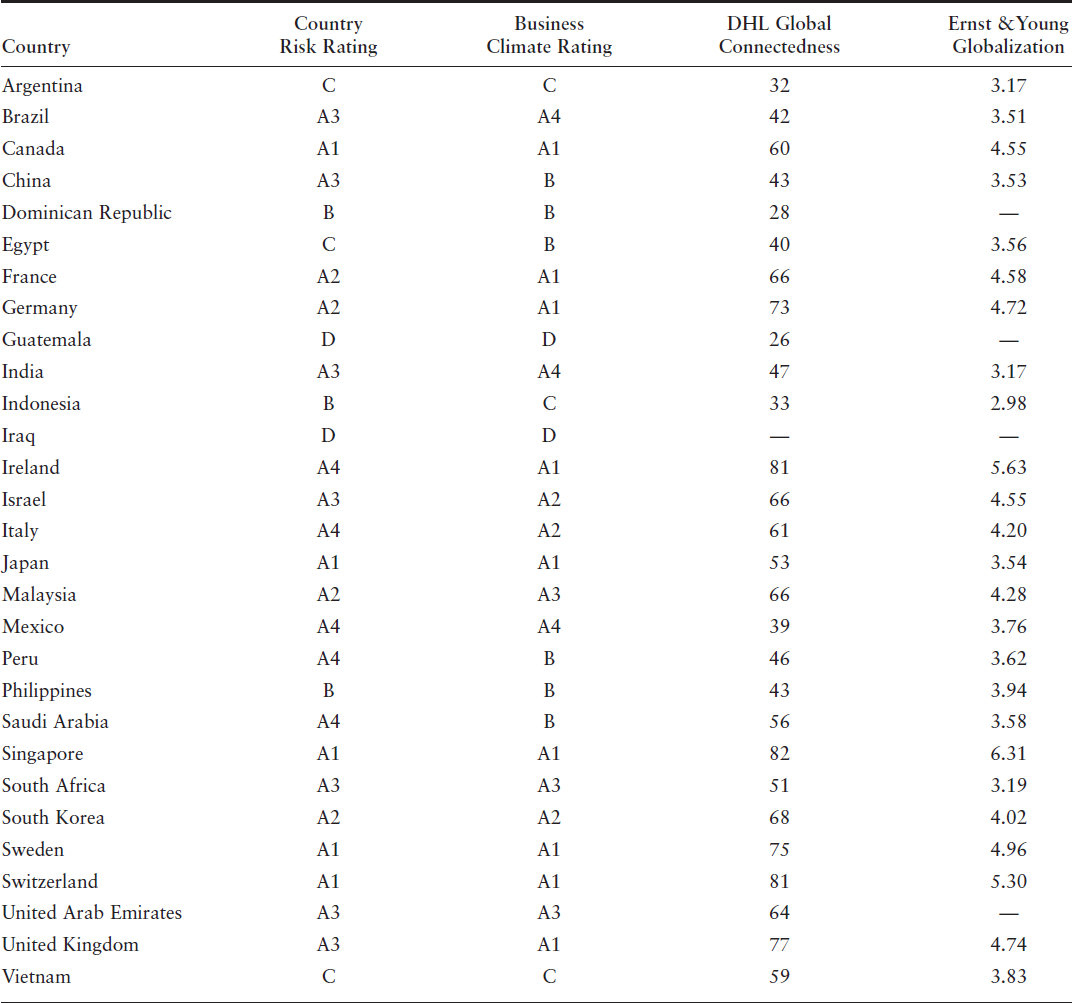
Importing Countries in the Sample and Their Risk and Globalization Index
| Country | Country Risk Rating | Business Climate Rating | DHL Global Connectedness | Ernst & Young Globalization |
|---|---|---|---|---|
| Argentina | C | C | 32 | 3.17 |
| Brazil | A3 | A4 | 42 | 3.51 |
| Canada | A1 | A1 | 60 | 4.55 |
| China | A3 | B | 43 | 3.53 |
| Dominican Republic | B | B | 28 | — |
| Egypt | C | B | 40 | 3.56 |
| France | A2 | A1 | 66 | 4.58 |
| Germany | A2 | A1 | 73 | 4.72 |
| Guatemala | D | D | 26 | — |
| India | A3 | A4 | 47 | 3.17 |
| Indonesia | B | C | 33 | 2.98 |
| Iraq | D | D | — | — |
| Ireland | A4 | A1 | 81 | 5.63 |
| Israel | A3 | A2 | 66 | 4.55 |
| Italy | A4 | A2 | 61 | 4.20 |
| Japan | A1 | A1 | 53 | 3.54 |
| Malaysia | A2 | A3 | 66 | 4.28 |
| Mexico | A4 | A4 | 39 | 3.76 |
| Peru | A4 | B | 46 | 3.62 |
| Philippines | B | B | 43 | 3.94 |
| Saudi Arabia | A4 | B | 56 | 3.58 |
| Singapore | A1 | A1 | 82 | 6.31 |
| South Africa | A3 | A3 | 51 | 3.19 |
| South Korea | A2 | A2 | 68 | 4.02 |
| Sweden | A1 | A1 | 75 | 4.96 |
| Switzerland | A1 | A1 | 81 | 5.30 |
| United Arab Emirates | A3 | A3 | 64 | — |
| United Kingdom | A3 | A1 | 77 | 4.74 |
| Vietnam | C | C | 59 | 3.83 |