







Abstract
The global competitiveness (GC) literature has proven to be a developing, yet critical element in international marketing research. Broadly, GC studies have become a part of the marketing, international business, and strategic management fields. In light of this far-reaching topic and to gain a unique understanding of the dynamics across the GC domain, this study examines the intellectual structure of GC research at two distinct levels of analysis: overall GC publications and marketing and international business GC articles. This review of the literature uses cocitation data to provide insight to the field and develop a research-based model for future consideration. A total of 48 journals are included, providing 1,819 articles with 115,462 citations for examination. Applying multidimensional scaling to analyze the data, the study introduces a GC-focused model and provides possible topics for research. The proposed organizing framework includes elements of a market-based perspective (offering development, market orientation, and process emphasis), strategy implementation (firm-related advantages, strategic approach, and international focus), and performance to advance the critical nature of the marketing function in the GC literature.
Keywords
In view of this challenging business environment, it is not surprising that researchers in various disciplines, including marketing, international business, and strategic management, have been interested in explaining the sources of global competitiveness (GC). Based on the notion that competitiveness relates to the skills and capabilities required for success, the GC topic refers to the firm's advantage in managing and marketing its goods and/or services in the global marketplace (Hult 2012). Over the years, research on GC themes has identified and examined several internal and external factors that play an important role in the competitiveness of the firm. These factors include firm resources (Barney 1991; Wernerfelt 1984), firm capabilities (Day 1994; Teece, Pisano, and Shuen 1997), market orientation (Kohli and Jaworski 1990; Narver and Slater 1990), competitive strategies (Porter 1980, 1985), industry characteristics (Porter 1980; Roquebert, Phillips, and Westfall 1996), and institutional forces (e.g., DiMaggio and Powell 1983).
Interestingly, while scholarly work on GC has made significant progress, it mostly has developed along disparate research traditions. The result has been fragmentation in the GC literature, with studies often concentrating on rather specific aspects of GC, such as a particular determinant of competitiveness. A possible explanation for this is the inherent complexity of the GC concept (Buckley, Pass, and Prescott 1988), which makes it challenging for researchers to capture all the components of competitiveness in a single study. Moreover, the interdisciplinary nature of the GC topic further compounds the lack of integration across the various areas of study within the domain. This general disconnect in the GC literature hinders the progression of the research area, as researchers may not have a complete understanding of the scope of GC and of how the different areas relate to each other. In this regard, international marketing (IM) research, with its emphasis on international and strategic marketing topics, is in a unique position to bridge the distinct issues within the GC literature into an overarching framework. At the same time, because of the domain's position within the IM literature, marketing's role in driving the competitiveness of the firm will become more evident. This is critical, given the ongoing discussion about marketing's influence within the enterprise (e.g., Homburg, Workman, and Krohmer 1999; Katsikeas et al. 2016; Verhoef and Leeflang 2009).
Against this backdrop, this study assesses the intellectual structure of the GC literature to gain a better understanding of the domain's nature. It subsequently develops an integrative framework and directs further GC research and managerial activities in IM. To this end, this study responds to calls in the literature to develop conceptual studies with the purpose of advancing future research, and it surveys the most frequently cited publications in the GC literature to evaluate the domain's past and present research streams (Kuhn 1996; MacInnis 2011; Yadav 2010). Used previously in internationally focused overviews (Hutzschenreuter, Pederson, and Volberda 2007; Samiee, Chabowski, and Hult 2015), this study's implementation is based on the fundamental bibliometric premise that the main topics in a literature domain can be better understood by examining citations and, more importantly, cocitation patterns to arrive at particular conclusions about the field (Burt 1983; Garfield 1979; McCain 1990; Ramos-Rodríguez and Ruíz-Navarro 2004). Specifically, 1,819 articles from 48 marketing, international business, and management journals were identified, with 115,462 total citations, to evaluate two levels of analysis—GC publications and marketing and international business GC articles—using multidimensional scaling (MDS). The results provide two unique network arrangements based on the citation data that was gathered and the cocitation data that was developed and analyzed. These results are synthesized in an organizing framework to assist in the development of future GC studies.
This study makes two key contributions to the GC domain and, more broadly, to the IM literature. First, drawing on the premise that potential opportunities result from past and present research (Kuhn 1996), this article offers specific directions for future GC knowledge. In particular, we develop an organizing framework to inform further GC examinations. This framework advances the GC literature by integrating the largely disconnected research base to date into a common foundation from which future IM research can draw. To overcome possible differences between established and emerging GC literature, we use recent, frequently cited articles to inform and supplement the framework established. By offering opportunities for future GC research that would extend the field, the relation of recent topics provides considerable applicability to the domain. Second, we identify a market-based perspective as instrumental to GC and explain the process by which this perspective facilitates the implementation of strategy and subsequently influences performance (Morgan, Katsikeas, and Vorhies 2012). By establishing a connection between IM elements, a market-based perspective, and GC, this study contends that IM is a driving force behind the domain. Specifically, by drawing on such traditions as exporting, market orientation, and marketing capabilities, this article is clearly positioned to indicate that the marketing function in an international context is critical to a company's development, strategic implementation, and performance. As a result, adopting this view makes a considerable contribution to studies emphasizing the marketing function's current and future influence within the firm (see Verhoef and Leeflang 2009).
The rest of the study is organized as follows. First, we provide an overview of the concept of GC, review various theoretical perspectives that seek to explain the domain, and make a case for the need to integrate the theoretical perspectives in GC research. We then describe the method used to conduct the analysis and present the results. Next, we provide a discussion and implications section in which we advance the proposed organizing framework, research contributions, managerial implications, and limitations and future opportunities. Finally, we present concluding remarks concerning the study.
THEORETICAL BACKGROUND
For many researchers in the fields of marketing, international business, and strategic management, competitiveness is equivalent to “the generation and maintenance of competitive advantages” (Buckley, Pass, and Prescott 1988, p. 177). As such, it is associated with the qualities needed for business success. Particularly in the marketing literature, the GC concept is defined as “a measure of an organization's advantage (or disadvantage) in marketing its goods and/or services in global markets” (Hult 2012, p. 195). In this respect, a limitation of prior work is that no consensus exists regarding the meaning of competitive advantage (e.g., Rumelt 2003). A common approach in the literature is to define it in terms of a firm's positional and performance superiority, which is based on the attainment of greater differentiation or lower relative costs (e.g., Spyropoulou et al. 2017), and the higher customer satisfaction, loyalty, market share, and profitability that ensue (e.g., Day and Wensley 1988).
Research on GC has mainly focused on explaining the reasons some firms are more competitive than others in the global marketplace. In particular, studies have identified and examined several factors that play an important role in the competitiveness of the firm. As these studies emphasize distinct aspects of GC, several theoretical perspectives have influenced and informed the GC domain. These include the resource-based view (RBV) of the firm, dynamic capabilities, market orientation, industrial organization (IO) theory, institutional theory, the eclectic (OLI) paradigm, transaction cost economics (TCE), and the internationalization process model. Table 1 summarizes the key arguments of these perspectives and provides key implications for GC research. The rest of this section briefly reviews these various theoretical perspectives within the context of this study.
Theoretical Perspectives and GC Implications

Resource-Based View of the Firm
The RBV of the firm focuses on the firm's portfolio of idiosyncratic resources as the main driver of competitive advantage (e.g., Wernerfelt 1984). Broadly, firm resources refer to the strengths of a firm (Wernerfelt 1984), including its assets, capabilities, knowledge, relationships, and organizational processes and routines (Barney 1991). To the extent that these resources are valuable, rare, difficult to imitate, and nonsubstitutable, they will contribute to a firm's competitive advantage by facilitating the implementation of unique, value-creating strategies. In the GC domain, this perspective has been used to gain a better understanding of the resources that serve as potential sources of competitiveness in foreign markets. Empirical studies that apply the RBV find that strategic resources and capabilities, such as innovation ambidexterity (Hughes et al. 2010), customer relationships (Luo et al. 2004), social capital (Luo et al. 2004), product development capabilities (Kaleka 2011; Zou, Fang, and Zhao 2003), and channel relationship capabilities (Kaleka 2011; Lages, Silva, and Styles 2009), can bring advantages to the firm in overseas markets and result in superior performance. However, despite its influence in the GC literature, the RBV is characterized as static (Priem and Butler 2001) and inadequate to explain why some firms are more competitive than others in turbulent environments (Teece, Pisano, and Shuen 1997).
Dynamic Capabilities Framework
The dynamic capabilities framework extends the RBV by proposing that in fast-moving markets, competitive advantage is driven by the possession and exploitation of unique dynamic capabilities that enable the firm to adapt to changes in the business environment (Teece, Pisano, and Shuen 1997). Dynamic capabilities are defined as the “firm's processes that use resources—specifically the processes to integrate, reconfigure, gain and release resources—to match and even create market change” (Eisenhardt and Martin 2000, p. 1107). Through such transformation of resources, dynamic capabilities serve to sense opportunities and threats, exploit prospects, and swiftly manage problems, which, in turn, can enhance firm competitiveness (e.g., Teece 2007). Given the complex, continuously changing environment that characterizes global competition, the dynamic capabilities framework has been applied in the GC area to investigate the dynamic capabilities–performance relationship. Empirical studies provide evidence of the positive relationship between dynamic capabilities and performance, particularly in the contexts of exporting (e.g., Morgan, Katsikeas, and Vorhies 2012), importing (e.g., Yalcinkaya, Calantone, and Griffith 2007), and international joint ventures (e.g., Fang and Zou 2009). For example, Morgan, Katsikeas, and Vorhies (2012) develop and test a model that links export marketing capabilities to export marketing strategy implementation effectiveness and export venture performance. Their findings indicate that these capabilities contribute to export venture performance outcomes by enabling the firm to develop and execute value-creating strategies. However, while the dynamic capabilities framework has been useful in explaining firm competitiveness in high-velocity global markets, its explanatory power seems to diminish in more stable environments with lower rates of market dynamism (Teece, Pisano, and Shuen 1997).
Market Orientation
Market orientation emphasizes the importance of identifying and meeting customer needs to achieve the firm's performance objectives (e.g., Kohli and Jaworski 1990). Although it is not considered a theory, it is among the most influential concepts within the marketing discipline and the competitiveness literature. For that reason, along with its widespread acceptance and applicability to global markets, its inclusion in this discussion is warranted. Market orientation refers to the organizational culture that encourages behaviors necessary for the continuous creation of greater customer value and, hence, lead to superior performance (Narver and Slater 1990). It consists of customer orientation (i.e., the sufficient understanding of the needs and wants of customers), competitor orientation (i.e., the sufficient understanding of competitors’ strengths, weaknesses, capabilities, and strategies), and interfunctional coordination (i.e., the coordinated use of firm resources in creating superior customer value). These behavioral components require the firm to generate market intelligence about customers’ needs and exogenous forces, disseminate market intelligence internally, and respond to it by taking marketing action (Kohli and Jaworski 1990). Given this emphasis on market intelligence, the concept of market orientation has been closely tied to the firm's learning processes (e.g., Hurley and Hult 1998; Slater and Narver 1995).
Market orientation research in the GC area largely has focused on examining the connection between market orientation and firm performance—including the investigation of mediating and moderating factors—across a variety of contexts. In general, these studies find that market orientation is an important determinant of business success in both developed and developing countries (e.g., Deshpandé and Farley 1999; Deshpandé, Farley, and Bowman 2004). In addition, it can give firms a competitive edge in export markets (e.g., Cadogan, Diamantopoulos, and Siguaw 2002), including small exporters (e.g., Kwon and Hu 2000), through marketing capabilities development (e.g., Murray, Gao, and Kotabe 2011). However, an important limitation of market orientation is its almost exclusive focus on customers as the primary stakeholder group, even though different stakeholder groups such as regulators, shareholders, suppliers, employees, and community members often influence firms, especially in global markets (Ferrell et al. 2010).
Industrial Organization
The IO theoretical perspective recognizes the role of the external environment in firm performance. The central argument of this perspective is that external forces, such as the structural characteristics of an industry, dictate the strategies that firms can implement, which, in turn, affect the competitiveness of firms (e.g., Porter 1980; Roquebert, Phillips, and Westfall 1996). In particular, the attainment of an appropriate fit between the firm's strategy and the environment has positive implications for firm performance (Venkatraman and Prescott 1990). This perspective is closely associated with Porter's (1980) competitive forces framework, which identifies five competitive forces—the entry of new competitors, the threat of substitutes, the bargaining power of buyers, the bargaining power of suppliers, and the rivalry among existing competitors—that collectively drive the intensity of industry competition and profit potential. To deal with these forces, and ultimately outperform rivals in the industry, firms can adopt at least one of three strategic applications: cost leadership, differentiation, and focus (Porter 1985). In the GC domain, IO theory has been employed to shed light on the influence of external factors on the firm's strategy and performance in the global marketplace. For example, Zou and Cavusgil (2002) find that when the global marketing strategy is congruent with the firm's external environment and internal characteristics, the global marketing strategy is a key driver of firm performance in the global market. Other studies’ findings also support the tenets of IO theory in the context of export market ventures (e.g., Cavusgil and Zou 1994) and environmental marketing in international markets (e.g., Leonidou et al. 2013). However, a key limitation of IO theory is that it neglects that idiosyncratic firm attributes can influence GC, given its assumption that firms within an industry are identical regarding the resources they possess and the strategies they adopt (e.g., Barney 1991). Consequently, this perspective fails to explain sustainable differences in performance levels among intraindustry firms.
Institutional Theory
Institutional theory explains how the external environment, through coercive, mimetic, and normative forces, shapes the structures, strategies, and practices of firms (e.g., DiMaggio and Powell 1983). Specifically, these isomorphic forces lead firms to copy others in their field—especially those that are perceived to be similar (e.g., McFarland, Bloodgood, and Payan 2008) or more legitimate or successful (e.g., Haveman 1993), or those with which they have boundary-spanning ties (e.g., Galaskiewicz and Wasserman 1989)—in an attempt to achieve and maintain legitimacy (e.g., DiMaggio and Powell 1983; Meyer and Rowan 1977). In this context, legitimacy—that is, the perception that the firm's actions conform to institutional rules and are thus appropriate (Suchman 1995)—contributes to the firm's success and survival by enabling the firm to gain the support and commitment of key stakeholders and access to important resources (e.g., DiMaggio and Powell 1983; Meyer and Rowan 1977). In the GC domain, institutional theory has been used to study the influence of the institutional environment on firms’ international corporate social responsibility (CSR) practices (e.g., Jean et al. 2016; Rathert 2016; Young and Makhija 2014), global marketing strategies (e.g., Rao-Nicholson and Khan 2017), and entry mode decisions (e.g., Davis, Desai, and Francis 2000). For example, in a study of firms’ motivations to engage in CSR, Young and Makhija (2014) find that regulatory and normative institutions shape CSR responsiveness. In turn, CSR practices are found to positively impact customer satisfaction (Jean et al. 2016). Nonetheless, like IO theory, institutional theory does not explain the maintenance of a competitive advantage. Instead, through its focus on legitimacy as the ultimate firm objective, it explicates the process by which firms within an industry become homogeneous over time (DiMaggio and Powell 1983).
Eclectic Paradigm
The OLI paradigm asserts that the configuration of three sets of advantages (i.e., ownership, location, and internalization) determines the extent, form, and pattern of international production undertaken by the firm (Dunning 1980, 1988). Ownership advantages refers to the competitive advantages that typically arise from the possession of superior firm-specific assets (e.g., Dunning 1988). To the extent that ownership advantages are greater than those of other firms, the company will be more likely to engage in international production (e.g., Dunning 2000). Location advantages refers to the attractiveness of alternative countries for carrying out value-added activities. The greater the location advantages stemming from a foreign country, the greater the likelihood that the firm will engage in international production (Dunning 1980). Internalization advantages refers to the advantages attained from internalizing firm-specific assets to produce goods in a foreign market (e.g., Dunning 1980). As the net benefits of internalization increase, the likelihood that the company will favor international production increases as well (Dunning 2000). In turn, international production can enhance the competitive position of the firm by facilitating the achievement of resource-, market-, efficiency-, and strategic asset–seeking objectives (e.g., Dunning 1988, 1998). In the GC domain, empirical studies have applied the OLI paradigm to examine foreign market entry mode. In general, these studies support the framework across different contexts in the United States and internationally (e.g., Agarwal and Ramaswami 1992; Brouthers, Brouthers, and Werner 1996, 1999). Brouthers, Brouthers, and Werner (1999) also find that entry mode selection based on the configuration of the three advantages can explain firm performance. More recently, in a conceptual study, Alcácer, Cantwell, and Piscitello (2016) demonstrate that the OLI framework is still relevant in today's information age. Specifically, they investigate recent trends in international business that have brought changes in the activities of companies, and they connect the competitive advantages that result from these activities to the OLI paradigm. However, a limitation of the paradigm is that it treats the three sets of advantages as independent, thereby ignoring the interdependencies that may exist among them (Dunning 2001).
Transaction Cost Economics
The TCE perspective is concerned with minimizing transaction costs through the selection of a governance structure—that is, market, hierarchy, or hybrid (Williamson 1975,1985). Transaction costs, which include the expenses incurred when negotiating contracts, monitoring agreements, and enforcing compliance, exist given the behavioral assumptions of bounded rationality, opportunism, and risk neutrality. The interplay between these assumptions and the various dimensions of transactions (asset specificity, behavioral uncertainty, environmental uncertainty, and transaction frequency) can lead to safeguarding, adaptation, and performance evaluation problems (e.g., Rindfleisch and Heide 1997). Dealing with these governance difficulties can be costly for the firm (Heide 1994). Accordingly, TCE proposes that if adaptation, performance evaluation, and safeguarding costs are low or nonexistent, market governance becomes efficient. On the other hand, if such costs are high, hierarchies and hybrids should be favored (e.g., Rindfleisch and Heide 1997). In the GC domain, TCE has been used to study foreign entry mode selection (e.g., Brouthers 2002) and international channel relationships (e.g., Gençtürk and Aulakh 2007). Notably, several studies provide empirical evidence showing that firms making entry mode choices based on the prescriptions of TCE perform significantly better than other firms (e.g., Brouthers 2002; Brouthers, Brouthers, and Werner 2003). However, a limitation of TCE is its focus on the individual transaction as the unit of analysis, which does not consider the temporal nature of interorganizational relationships (Rindfleisch and Heide 1997).
Internationalization Process Model
The internationalization process model explains the firm's internationalization as a dynamic process in which the firm progressively increases its international involvement based on the interplay between two state aspects (market knowledge and market commitment) and two change aspects (commitment decision and current activities) (Johanson and Vahlne 1977). Specifically, market knowledge—which can be acquired through experience and is essential to the learning process—is an important mechanism for reducing market uncertainty and identifying opportunities in a foreign market (e.g., Johanson and Vahlne 1990). Market commitment consists of the amount of resources committed to a market and the degree of commitment. Together, market knowledge and market commitment influence decisions to commit resources to foreign operations and the performance of current business activities (e.g., Johanson and Vahlne 2009). In turn, these elements lead to greater market knowledge and market commitment. The model assumes that through international expansion, firms seek to increase long-term profitability (i.e., growth). As such, the internationalization process continues as long as performance projections are positive (Johanson and Vahlne 2009). In the GC domain, this perspective has been employed to investigate the relationship between one of the drivers of internationalization—foreign market experiential knowledge—and firm performance (e.g., Brouthers et al. 2009; Luo 1999; Luo and Peng 1999). For example, in a study on learning to effectively compete in an emerging economy, Luo and Peng (1999) demonstrate that experience in a host country positively influences financial and market performance. However, despite the internationalization process model's popularity, it is limited in its ability to explain the existence of born-global firms, since these successfully expand into foreign markets from or near their founding (Knight and Cavusgil 2004).
An Integration Imperative
Our overview of the theoretical perspectives that inform the GC domain shows that the perspectives differ in the way they perceive that GC can be achieved. Some perspectives, such as the RBV, the dynamic capabilities framework, market orientation, and the internationalization process model, point to the importance of firms’ internal factors (i.e., resources, capabilities, organizational culture, and market knowledge) in explaining competitive advantage. In contrast, IO theory and institutional theory center on external factors as the driving GC forces. A commonality among these perspectives, however, is that they implicitly or explicitly emphasize the role of responsiveness in achieving competitiveness. For example, the RBV, the dynamic capabilities framework, and IO theory explain how certain factors facilitate strategy implementation and how this, in turn, impacts the competitive advantage of firms.
The OLI paradigm and TCE include additional dimensions to explain GC. Namely, the OLI paradigm proposes that international production can enhance the competitive position of the company (e.g., Dunning 1988, 1998). An important aspect of this explanation is the notion that firms can obtain advantages from internalizing firm-specific assets to produce goods abroad. Interestingly, according to TCE, this is not always the case. Instead, TCE suggests that internalization can lead to firm competitiveness only if, relative to other governance structures, it minimizes transaction costs (e.g., Rindfleisch and Heide 1997).
Our overview also demonstrates that while these theoretical perspectives have been instrumental in explaining GC, their limited commonality has led to fragmentation in the GC literature, with various research traditions evolving, for the most part, independently. This is unfortunate, since some perspectives and research streams can be used in combination to complement each other. More importantly, this general disconnect in the GC literature hinders the progression of the research area. By integrating aspects of the different theoretical perspectives, IM researchers can gain a more complete understanding of the scope of GC. Rooted in the idea that potential research opportunities result from established and current research (Kuhn 1996), the following sections examine the intellectual structure of GC research. Drawing on this assessment, and driven by the pressing need for integrative research in the GC domain, we then develop an organizing framework that synthesizes the largely disconnected research traditions to inform future GC studies.
Method
We began to link the topics related to our GC overview by establishing the database and keyword requirements for this study. The EBSCO Business Source Complete database was used to draw the relevant citation data required for our analysis (Hansen, Shrader, and Monllor 2011). In aiming to be as precise as possible, our search was guided by Harzing's (2015) list of marketing, international business, and management journals. Using this resource, we screened for journals that ranked as A or higher in the ABDC 2013 category, as this ranking system was most prevalent among the 17 different journal categorizations included. Following other cocitation analyses utilizing a minimal number of keywords with the purpose of maximizing the data gathered specifically to the topic under examination (Cornelius, Landström, and Persson 2006; Schildt, Zahra, and Sillanpää 2006), we used terms that referred to competition in global, international, export, and foreign market contexts 1 to search the Business Source Complete database and include the articles gathered for further analysis. 2 In all, articles from 48 journals were identified as qualifying for the topic focusing on “global competitiveness” as defined for this study. 3 In addition to a search of the publication title, abstract, author-supplied keywords, and subjects included, the aforementioned terms were also used to search the text of articles in the Business Source Complete database (Hansen, Shrader, and Monllor 2011). 4 Any marketing, international business, or management article in the sample containing this study's keywords was subsequently analyzed and verified for inclusion. In addition, indirect research articles (e.g., book reviews) were excluded so the study would have a clear understanding of the nature of direct GC research.
As a result, 1,819 articles from 1941 through 2016, with 115,462 total citations, were identified for evaluation in the next stage of our analysis. In fact, based on the keywords and process used to develop the database, the number of articles included constitutes a representative sample of the GC literature. Following typical procedure with citation data in bibliometrics, the information gathered was purified and coded for consistency. In other words, discrepancies were found in the citation patterns: some citations were incomplete or flawed and not exactly reflective of the particular publication cited due to the citing author's error. We examined these citations and determined whether to include or exclude them based on the exact citation made in the article. If a citation was determined for inclusion, it was changed in the original database of gathered information to reflect the correct citation code in the database for further examination.
However, rather than evaluating only the intellectual structure of the most-cited GC publications, we also sought to analyze the data in a dynamic and GC-specific environment as five books appeared in the overall data. As such, to be more precise to IM and indicate its relevance to the GC domain, we drew and evaluated the most frequently cited articles appearing in marketing and international business journals from the original database. In all, two distinct data sets were used based on the original Business Source Complete data gathered.
Once the citation data for the two analyses were prepared, cocitation matrices were developed for each condition. By using cocitation—rather than citation—data, this study examines the interrelationship and structure of frequently cited GC research (Ramos-Rodríguez and Ruíz-Navarro 2004). In other words, cocitations are aggregated for a certain number of publications so that a cocitation matrix can be developed for analysis. The cocitation matrix is the basis for the MDS analysis and reflects the relationships between the most frequently cited publications in a given domain. Stated differently, the structure of the most influential works in the GC literature in the MDS results indicates the underlying relational configuration that drives the domain's research. To evaluate these relational data, we used MDS, because its results reflect the network established in the cocitation patterns of the articles included in the study (Burt 1983; McCain 1990). Taken further, MDS allows the researcher to analyze the intellectual structure of the GC literature in a meaningful way (Hair et al. 1998). Because MDS is a widely used approach for evaluating cocitation data and producing visual representations of bibliometric data, we determined it was appropriate for this study. Its results include interpretable spatial structures, which are ideal for theory development (Alba and Moore 1983; Tsai and Wu 2010; Wasserman and Faust 1994). 5
Typically, about 25 publications are analyzed in MDS to create a fair or good model (Ramos-Rodríguez and Ruíz-Navarro 2004). Our study took this approach and included, for practicality purposes, 26 publications for the most-cited GC publication results and 25 publications in the most-cited marketing and international business GC articles structure. The cocitation data that resulted from the original citations were included to assess each model's stress value (goodness of fit). Including a similar amount of publications around the limit of 25 publications in the analysis typically results in a good (less than .10) or fair (between .10 and .20) stress value (Kruskal 1964; Ramos-Rodríguez and Ruíz-Navarro 2004). 6 To calculate the stress value as the difference between the data used and the specified model, MDS minimizes stress in the model. As such, this goodness of fit measure can be specified as follows:
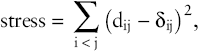
where dij is the distance between objects i and j and δij reflects the fitted distance between these two objects from the original data (Kruskal 1964; Ramos-Rodríguez and Ruíz-Navarro 2004). In our results, the overall GC model had a stress value of .11, while the marketing and international business model had a .09 stress value. Thus, each was determined to have either a highly fair or a good fit to the data.
To assemble the items in the MDS results into research groups, spatial distances are required to indicate the strong interrelationships of key publications (McCain 1986; Scott 2000; Small 1999). A standardized Euclidean distance of .25 or less was used to establish research groups that are meaningful and interpretable in both GC research models (Hair et al. 1998). From this, research groups and research cliques were identified. In contrast to a two-item research group, a research clique is an advanced form of research group that includes three or more publications in the MDS configurations of this study (Alba and Moore 1983; Wasserman and Faust 1994). The identification terms used to note each research group were determined by a panel of researchers knowledgeable on GC and were based on the nature of the cited publications as well as the cited articles included in the database. Because there may be connected as well as unconnected research groups, groups and/or cliques that have common publications in the intellectual structure and are connected in some fashion in the MDS results form a research chain. This becomes particularly noteworthy with three or more research groups forming research topics covering a broad range of related themes.
To examine new trends in the domain, recent frequently cited GC research was evaluated as well. This aspect of the study pursued the most pertinent trends in the GC literature based on the data collected. Thus, citation data were tabulated for articles published in recent years from the information available starting in 2011. Then, the most influential recent GC research was determined using the threshold of one citation per year in our sample for the 2011–2015 period (Chabowski, Samiee, and Hult 2013). This procedure resulted in a list of 13 articles emphasizing specific topics of current relevance in the GC domain. As a result, the evidence gathered from these sources provides a basis from which to supplement the organizing framework established.
Results
This study's findings indicate the differences between the two distinct levels of GC research under examination: overall GC publications and GC articles specific to marketing and international business. By presenting these two aspects of the overall GC literature, we show the fundamental, underlying structure resulting from the citation patterns of published articles that is driving this field of study in general and shows the specific relevance of the IM discipline in particular. In this section, we present the findings for both levels of the GC literature. As a result, this aspect of the study provides considerable information from which to base a discussion of future opportunities for GC research.
Intellectual Structure of GC Publications
As indicated in Figure 1, seven research groups were identified in the intellectual structure of the most-cited GC publications. These can be classified as four unconnected, disparate research groups of two influential publications each (Groups 1, 3, 4, and 7), one research clique of three publications (Group 2), and two connected groups of two publications each (Groups 5 and 6). Taken together, this configuration provides a view of the most influential books and articles in GC research.

Intellectual Structure of GC Publications
The emphasis on strategic assets and competitive advantage (Group 1) provides an indication of the first general orientation of the GC literature at this level. In fact, by examining the long-term sustainability of establishing a presence in the market and subsequently defending it, an emphasis on topics critical to SMEs and MNEs alike provides insight into the actions firms must take to maintain competitiveness (Amit and Schoemaker 1993; Dierickx and Cool 1989). The role of firm resources and dynamic capabilities (Group 2) continues this approach. As such, this research topic linking our understanding of the importance and development of skills and competencies is critical for a firm to advance its standing across markets in a global environment (Barney 1991; Teece, Pisano, and Shuen 1997; Wernerfelt 1984). Related to this, the role of knowledge, increasing commitment, and the internationalization process (Group 3) in the GC literature's intellectual structure shows the continued importance of firm development. In fact, the iterative process by which a firm's information about the market drives internal decisions and processes to establish particular market decisions is a dynamic approach for the firm to become more competitive in its international activities (Johanson and Vahlne 1977, 1990). Going further, the importance of knowledge, learning, and combinative capabilities (Group 7) indicates the relevance of these issues to continued firm growth. More closely, the underlying tenet of this facet of GC research emphasizes the importance of innovative activities in sustained competitiveness (Cohen and Levinthal 1990; Kogut and Zander 1992).
Focusing on general managerial competitiveness as the other main area of focus in the GC literature, the importance of foreignness and multinational management (Group 4) provides an indication of this alternative approach. More specifically, the ability of the firm to overcome the drawbacks of being considered an outsider is critical in activities across different markets (Bartlett and Ghoshal 1989; Zaheer 1995). Anchored by the paradox of innovative and imitative strategies in an industry (DiMaggio and Powell 1983), the two groups signify the relevance of research on industry and national competitive advantage (Group 5) as well as organization and industry competitiveness (Group 6). While one aspect of this research area focuses on the national conditions that form the competitiveness level of firms from a specific country (Porter 1990), the other facet deals with the approaches firms use to survive in circumstances of industrial similarity (Meyer and Rowan 1977).
Intellectual Structure of Marketing and International Business GC Articles
As shown in Figure 2, we identified 11 research groups as part of the intellectual structure of GC articles specific to marketing and international business. In all, there were four unconnected research groups (Groups 1, 2, 5, and 6), one set of a conjoined research group and clique (Groups 3 and 4), one set of two research groups (Groups 7 and 8), and a research chain of two research groups and a research clique (Groups 9–11).

Intellectual Structure of Marketing and International Business GC Articles
The focus on organizational capabilities and international new ventures (Group 1) indicates the need for smaller companies to take on a global focus to become more competitive. This is presented as prevalent in the focus specifically on born globals as a type of international organization that combines innovation and entrepreneur-ship to establish a position in the marketplace (Knight and Cavusgil 2004; Oviatt and McDougall 1994). An emphasis on the development of ties among firms is established with research related to marketing channel relationships (Group 2). This topic reflects the importance of examining the alliances that develop between manufacturers and distributors in their delivery of goods and services to the global market (Anderson and Narus 1990; Webster 1992). Centered on research emphasizing the managerial, departmental, and organizational facets of an orientation toward the market (Jaworski and Kohli 1993), the emergence of both market orientation and capabilities (Group 3) and market orientation and profitability (Group 4) highlights the importance of these relationships in the GC literature. With these themes, a focus on the antecedents, consequences, and environment of a market orientation, as well as an emphasis on knowledge and learning leading to advantage, is pivotal for overall success (Day 1994; Kohli and Jaworski 1990; Narver and Slater 1990). Another topic critical to GC research relates to international marketing strategy, standardization, and performance (Group 5). Specifically, the relevance of competitive market conditions such as customer needs and awareness, as well as organizational factors like product development and purchasing as they relate to standardization and adaptation levels, shows this topic's wide-ranging application in this domain (Jain 1989; Samiee and Roth 1992).
Additionally, focusing on a general theme in the GC literature emphasizing marketing and international business, the role of export marketing strategy and performance (Group 6) provides a starting point to present topics related to different forms of market entry and expansion. This subject highlights the relevance of managerial perceptions and commitment, as well as other internal and external forces that are influential (Aaby and Slater 1989; Cavusgil and Zou 1994). Anchored by research examining the market entry mode trade-offs between control and resource commitment costs (Anderson and Gatignon 1986), the two groups associated with this topic relate to firm knowledge and foreign entry mode (Group 7) and multinational factors and foreign entry mode (Group 8). In this portion of the GC literature's intellectual structure, a comparison is made between themes related to exporting, licensing, joint venture, and sole venture decisions and the level of tacit knowledge considered for transfer across national boundaries (Agarwal and Ramaswami 1992; Kogut and Zander 1993). A chain of research groups emphasizing international production and the internationalization process provides considerable insight as well. Centered on the topic of national culture and international production (Group 10), two themes extend this subject by focusing on ownership, location, and internalization in international production (Group 9) and entry mode, culture, and the internationalization process (Group 11). These issues emphasize the importance of the eclectic paradigm, national cultural values, knowledge development, and market commitment to measure the ability of a firm to become more competitive (Dunning 1980, 1988; Johanson and Vahlne 1977, 1990; Kogut and Singh 1988).
Discussion and Implications
In this section, we respond to calls in the literature for more conceptual development in the field of marketing at large (MacInnis 2011; Yadav 2010). Basing our approach on the premise that potential future research is driven by past and present research (Kuhn 1996), we propose an organizing framework to provide insights into GC research and advance the domain based on the findings of this study. We relate our discussion to the recent IM literature, which is most relevant to extant research and can provide insight into immediate trends and possible extensions in the field (Burrell 2003). As noted in Figure 3 and Table 2, two aspects of the framework are discussed and related to established as well as emergent GC topics. Possible research related to the relationship between a market-based perspective and strategy implementation is presented. Then, the potential for studies emphasizing the impact of strategy implementation on performance, within the context of the ideas introduced, is provided.
Recent Frequently Cited GC Research


A Proposed Organizing Framework for Future GC Research
GC Framework for Future Research
The proposed organizing framework introduced in Figure 3 is based on the critical aspects of the GC literature uncovered in this study's evaluation of the domain's intellectual structure. In fact, based on the theoretical perspective of a capabilities–implementation–performance relationship (Morgan, Katsikeas, and Vorhies 2012), we acknowledge the critical role of a market orientation in the establishment of resources and capabilities to implement strategy (Hultman, Katsikeas, and Robson 2011; Kemper, Engelen, and Brettel 2011; Leonidou, Palihawadana, and Theodosiou 2011). As a part of developing this market-based perspective, the role of learning is critical for organizational advancement and strategy execution (Slater and Narver 1995). Included in this approach is the notion that once implementation has begun, performance can be measured to derive the chosen strategy's relative success.
As it concerns GC research, a market-based perspective that includes offering development (product, promotion, distribution, or price), market orientation (customer orientation, competitor orientation, or interfunctional coordination), and a process emphasis (internal or external) should impact strategy implementation, which consists of firm-related advantages (ownership, location, or internalization), a strategic approach (cost, differentiation, or focus), and an international focus (localization, glocalization, or globalization) (Buckley and Ghauri 2004; Dunning 1980, 1988; Francis and Collins-Dodd 2004; Hsu 2011; Leonidou, Palihawadana, and Theodosiou 2011; Oladottir et al. 2012; Prime, Subrahmanyam, and Lin 2012). In turn, the joint impact developed by a specific strategy implementation should influence performance (e.g., satisfaction, loyalty, market share, sales increase, profitability, relationship value) (Asmussen 2009; Bonaglia, Goldstein, and Mathews 2007; Diamantopoulos et al. 2014; Magnusson et al. 2013; Pehrsson 2012; Talay, Townsend, and Yeniyurt 2015; Yeniyurt, Cavusgil, and Hult 2005; Zeriti et al. 2014).
The Influence of a Market-Based Perspective on Strategy Implementation
The topic of offering development has been related to strategy implementation. In fact, offering development issues have been linked to location-related topics. These themes can cover internal product and promotion development and adaptation as well as external foreign direct investment decisions based on the relative economic level of particular markets (Bahadir, Bharadwaj, and Srivastava 2015; Leonidou et al. 2013; Magnusson et al. 2013; Wilson and Baack 2012). One fruitful area of future research could expand on this idea and pursue the importance of a customer orientation, competitor orientation, or interfunctional coordination in developing firm-related advantages based on ownership, location, or internalization. Moreover, the link between the products offered by firms and their global or nonglobal focus has been established; related themes include the impact of multinational firms’ leveraging their product and promotion globalness while implementing strategy (Swoboda and Hirschmann 2016; Talay, Townsend, and Yeniyurt 2015; Westjohn et al. 2016).
Another potentially productive area of research could expand on these topics and grow the literature by examining the effectiveness and scope of cost, differentiation, or focus strategies. In addition, the importance of both internal and external emphasis has been proposed to drive not only strategy but also advantage (Yeniyurt, Cavusgil, and Hult 2005). Research in this area indicates that internal and external factors, such as knowledge development and learning, assist in determining the extent of globality and headquarters locations that can be implemented through subsidiaries and their positions in international markets (Hada, Grewal, and Chandrashekaran 2013; Ma, Delios, and Lau 2013; Najafi-Tavani et al. 2015; Zeriti et al. 2014). Future studies could explore the influence of internal and external knowledge and learning, as well as marketplace conditions, on the decision to embark on a cost, differentiation, or focus strategy. However, related to our results, scant research has integrated the distinct topics of a market-based perspective as related to strategy implementation in a comprehensive manner. Thus, a new avenue of GC research could examine the distinct opportunities evident in the proposed theory-based framework.
For instance, little research has examined the impact of offering development, market orientation, and process emphasis on the firm-related advantages that are created to assist in strategy implementation. Given the premise that offering development can be standardized or adapted (Bahadir, Bharadwaj, and Srivastava 2015; Leonidou et al. 2013; Magnusson et al. 2013), how does the risk related to establishing distribution channels influence the decision to develop ownership advantages? Noting that there are environmental and firm-specific conditions to consider (Boso et al. 2013), does the answer change depending on whether the process emphasis is internal? Relating to the prospect that partnerships are becoming more critical to developing firm-related advantages (Prime, Subrahmanyam, and Lin 2012), does an external process emphasis encourage the firm to instead engage in more alliances (vs. internally-focused companies) to develop ownership advantages?
Comparable research possibilities related to customer orientation could be pursued. As previous research has studied the influences of strategic orientations and the marketplace, are firms more likely to engage in a focus-strategic approach with an orientation on the customer and an external process emphasis (Theodosiou, Kehagias, and Katsikea 2012)? Is the firm more likely to change to a differentiation- or cost-based approach with an internal emphasis? Going further, the level of international focus could also be based on the market-based perspective of the company. Taking research in the direction that focuses on implementation differences according to a firm's region of origin (Swoboda, Pennemann, and Taube 2012), when possessing strong product development and interfunctional coordination, does an external emphasis lead to a glocalization focus, or is a customer orientation more critical than interfunctional coordination to attain this status? Given the notion that a firm's brands can have a local or global scope (Guo 2013; Özsomer 2012), does a lack of interfunctional coordination inhibit this process and force a firm to decide between localization in a few key markets or globalization on a much larger scale? There is limited GC research examining such comparisons. As Figure 3 indicates in detail, there are many possibilities for exploring the relationships between a market-based perspective and strategy implementation in future GC literature.
The Influence of Strategy Implementation on Performance
Many comparisons have been made between strategy implementation and performance vis-à-vis competitors in the GC literature in a general sense (e.g., Barnett and McKendrick 2004; Porter 1980, 1985). However, customer mindset metrics, such as satisfaction and loyalty, can provide additional insight concerning competitive standing because they emphasize the firm's operational success (Diamantopoulos et al. 2014; Katsikeas et al. 2016). In addition, as a common outcome variable in GC research, performance has been measured with product-market and accounting metrics such as new product success, market share, sales increase, margin, and profitability (Chang and Rhee 2011; Diamantopoulos et al. 2014; Katsikeas et al. 2016; Magnusson et al. 2013; Pehrsson 2012; Talay, Townsend, and Yeniyurt 2015; Zeriti et al. 2014). On the basis of the market-based literature, these variables have been forwarded as critical to measuring competitive advantage because they indicate operational performance but also focus on the achievements of the organization as a whole (Katsikeas et al. 2016). In addition, given recent developments concerning the relevance of alliances in global competition (Kemper, Engelen, and Brettel 2011; Samaha, Beck, and Palmatier 2014; Sheng, Zhou, and Li 2011; Yu, Subramaniam, and Cannella 2013), a measure such as relationship value (Barnes et al. 2015; Eng 2005; Skarmeas et al. 2016) could provide additional insight into performance as well, as it extends beyond the boundaries of the firm and introduces the notion of the firm as an entity in a much wider network of organizations (Johanson and Vahlne 2009).
However, a thorough examination of the influence of strategy implementation on performance, as indicated in Figure 3, has not yet been achieved. Thus, future research focusing on these relationships could lead to an increase in studies emphasizing competitiveness. For example, if a firm enacts a focused, localization strategy, which firm-related advantage adds the most to profitability (Magnusson et al. 2013; Zeriti et al. 2014)? If firm-related and strategic approach conditions are held constant, does a localization, glocalization, or globalization focus render the highest loyalty? Does deciding to locate facilities in a specific country with a differentiation approach and localization focus increase the value of channel relationships formed in-country (Barnes et al. 2015; Skarmeas et al. 2016)? Will the result hold true with a cost-based approach as well? Similar examinations in this context could be made in relation to other performance variables, such as satisfaction and market share, to provide a deeper understanding of the comparisons which could be made.
Going further, rather than examining performance as an amalgamation of different performance categories, GC researchers should consider explicitly defining their chosen constructs and providing justification for their use in the conceptual portions of future studies. In fact, multiple performance category variables should be applied separately (Katsikeas et al. 2016). Thus, operational performance (customer mindset, customer behavior, product-market performance, and customer-level performance) and organizational performance (accounting performance and financial-market performance) measures need to be specified independently according to their performance category. In other words, customer mindset variables, such as perceived quality and satisfaction, should be measured as a different construct than the product-market performance variables of revenue premium or new product success. A good example of this type of implementation can be found in a study on export segmentation effectiveness and performance (Diamantopoulos et al. 2014). In it, a customer mindset variable (customer satisfaction) is specified, as are product-market performance (strategic export performance) and accounting performance (financial export performance) constructs.
That stated, there are performance categories that have not been utilized widely in the GC literature: customer behavior and customer-level performance (Katsikeas et al. 2016). For instance, comparisons could be made about whether ownership, location, or internalization advantages, aligned with a cost approach and localization focus, would contribute most to customer retention or word of mouth. In addition, the trade-offs between a differentiation or focus-strategic approach, with ownership advantages and a globalization focus employed, could be examined concerning their distinct influences on customer-level profitability or customer lifetime value. In short, given the possibilities of evaluating performance outcomes specifically in IM, many different opportunities could be pursued beyond those stated in this study.
Research Contributions
With the perspective that possible opportunities result from established and current research (Kuhn 1996), this study's first contribution relates to a theory-driven organizing framework that is established to indicate potential future research directions. The originality of this research structure is based on the integration of disparate topics studied to date in the IM literature to provide a shared foundation from which to draw in continuing studies. Previous as well as recent research is used to provide potential research themes for future academics based on the proposed organizing framework. This study's second contribution introduces the market-based perspective as critical to the future development of the GC literature. By explaining that a market-based perspective drives strategy implementation and, subsequently, performance, the results and future research directions clearly indicate that IM is a vital aspect of this tradition. As such, with topics related to exporting, market orientation, and marketing capabilities unmistakably visible in the results, these components of GC research provide the basis upon which to clearly state that IM is imperative for the firm's long-term success. Further, when performance is measured using both operational and organizational metrics, a more complete understanding of SMEs and MNEs can result.
Managerial Implications
Possible managerial implications of this study relate to the proposed organizing framework. More specifically, the configuration of marketing capabilities is critical to the implementation and performance of a firm's strategy. Though the tactics used may be specific to particular regions or market types, the overall strategy should be market based and globally competitive. There may be variations in the development of the marketing mix depending on organizational culture and/or structure, due not only to an internal or external emphasis but also to whether the structure is centralized. As a result, strategic decisions and execution are critical for performance at the firm level. In fact, measuring performance using more than one metric is important to understanding the overall health of the firm. Thus, the use of both operational (customer-specific) and organizational (accounting and financial) performance criteria provides a more holistic view upon which to make managerial decisions. In addition, given the interconnected nature of firms, the value of channel relationships is much more prevalent. As a result, whether at middle- or upper-management levels, the consideration that firms operate in a transactional environment is obsolete. Instead, in global business conditions with firms competing on the basis of value network strength, maintaining relationships with channel partners is of the utmost importance for product delivery and retaining a lasting international position.
Limitations and Future Opportunities
One potential limitation resides in the types of journals chosen for inclusion in this study. Though we used a trusted source of journal rankings as the basis for our analysis (Harzing 2015), any approach used will be influenced by the subjectivity of scholars’ perceptions. As a result, such differences of opinion may result in discussions about which journals should be considered in a study of the GC literature's intellectual structure. However, we attempted to balance these issues by including journals that were ranked A or above in the ABDC 2013 category of Harzing (2015). We chose this ranking because of its scope and with the intent of being as inclusive as possible, yet still retaining sufficient rigor in our conclusions.
Another issue relates to the managerial application of the findings. While the emphasis of this study is primarily on the advancement of GC theory, our analysis could be heightened by the involvement of practitioners in the development of ideas related to the competitiveness of international firms. More specifically, with the inclusion of managers to discuss the findings and the major issues that emerged, a more practically enhanced analysis and discussion of future research possibilities could result.
In addition, an extension of this work could emphasize the chronological development of GC research over time. In fact, it could prove interesting to evaluate the intellectual structure of the literature across past and recent time periods. Extensions based on such an evaluation may provide additional insight into the international environment, new business concerns, or emergent theoretical viewpoints.
Based on the analysis conducted as a part of this study, two new perspectives may help explain the GC phenomenon and assist future research: the opportunity-based view and international relationship marketing. The opportunity-based view, introduced specifically in the rapid internationalization context, refers to the ability of a firm and its managers to identify and develop opportunities (Chandra, Styles, and Wilkinson 2012). Related to the notion that innovative and entrepreneurial activities matched to the competitive environment are critical to success (Boso et al. 2013; Jones, Coviello, and Tang 2011), one opportunity leads to more opportunities based on a constant process of learning and adaptation to new resource and network conditions. Also, international relationship marketing has emerged as a theoretical base that can provide research direction. Given the premise that firms interact to establish commitment and trust, there is considerable evidence that developing varied forms of relationships with a multitude of stakeholders is critical for success in an international marketplace (Barnes et al. 2015; Boso et al. 2013; Samaha, Beck, and Palmatier 2014; Sheng, Zhou, and Li 2011).
Recent research also has indicated that geographic and economic conditions have had a role in the GC phenomenon as well. For instance, there are studies that have established that a considerable amount of international competitiveness is regional in nature and not global (Rugman, Oh, and Lim 2012). Although it is based on the analysis of large MNCs from developed economies, the premise forwarded is that most business activity resides in a particular area, such as Europe, Asia, or North America. Another approach contrasts the developed economy perspective with one emphasizing the emerging market context (Sheth 2011). Some studies focus on this type of environment to extend existing theory (Sheng, Zhou, and Li 2011), while others emphasize a perspective that compares both emerging and developed markets (Kemper, Engelen, and Brettel 2011; Samaha, Beck, and Palmatier 2014). However, the market heterogeneity, sociopolitical governance structure, unbranded competition, resource shortage, and inadequate infrastructure of emerging economies make for differences in marketing theory, strategy, policy, and practice that have yet to be fully explored and could provide fruitful topics to pursue (Sheth 2011).
Conclusion
This study examines the GC literature with a bibliometric approach. By using cocitation analysis, we establish the intellectual structure of GC research across two levels of analysis (GC publications and marketing and international business GC articles) to provide indications of the GC topic's applicability to IM. To facilitate the development of research- and managerial-based contributions, we advance a theory-based organizing framework to assist in the development of future GC studies. By clearly linking a market-based perspective with strategy implementation and performance, this study takes an important step to advance the GC literature through theory-based suggestions that may continue to provide critical insights to the IM field and indicate the central position that IM should have in the future development of GC research.
Notes
The exact syntax used is available upon request from the authors.
The first article identified in our search of the Business Source Complete database was published in 1941. Because our study examines the GC literature through 2016, this bibliometric examination covers more than seven decades to establish the details of the domain's intellectual structure.
The journals identified with GC articles were Academy of Management Journal, Academy of Management Learning & Education, Academy of Management Review, Administrative Science Quarterly, American Business Review, Australian Journal of Management, British Journal of Management, Business & Society, California Management Review, (Columbia) Journal of World Business, European Journal of Marketing, Industrial Marketing Management, International Business Review, International Journal of Conflict Management, International Journal of Management Reviews, International Journal of Research in Marketing, International Marketing Review, Journal of Advertising, Journal of Advertising Research, Journal of Brand Management, Journal of Business, Journal of Business & Industrial Marketing, Journal of Business Research, Journal of Consumer Affairs, Journal of Consumer Research, Journal of Forecasting, Journal of International Business Studies, Journal of International Marketing, Journal of Macromarketing, Journal of Management Inquiry, Journal of Management Studies, Journal of Marketing, Journal of Marketing Management, Journal of Marketing Research, Journal of Public Policy & Marketing, Journal of Retailing, Journal of Services Marketing, Journal of Sport Management, Journal of Strategic Marketing, Journal of the Academy of Marketing Science, Long Range Planning, Management International Review, Management Learning, Marketing Letters, Marketing Science, Public Opinion Quarterly, Public Relations Review, and Strategic Management Journal.
The Web of Science database, published by Thomson Reuters, a widely applied resource in bibliometrics, also was used as a part of this research. In a comparison using identical keywords, there were considerable similarities between the results obtained from the Business Source Complete and the Web of Science databases.
Other approaches, such as factor analysis and cluster analysis, have been used in bibliometric research. However, MDS has proven more dynamic than factor analysis and cluster analysis and is particularly important for the suggestion of future research opportunities in the business discipline (Samiee and Chabowski 2012; Samiee, Chabowski, and Hult 2015).
This is another key distinction between MDS, factor analysis, and cluster analysis. By providing a goodness of fit measure, we can derive a more precise understanding of the statistical appropriateness of an MDS model that is lacking in factor analysis and cluster analysis.