







Abstract
Employing the resource-based view of the firm and the competitive forces perspective, the authors examine how brand equity (star power, director power, and brand extensions), financial resources, and competitive intensity serve both as antecedents to the length of global product rollout and as moderators of the effect of length of global product rollout on global product performance. The results, based on data from the motion picture industry, demonstrate that brand equity, financial resources, and competitive intensity result in shorter global product rollout and that shorter global product rollout enhances global product performance. They also find that brand equity and financial resources operate as moderators, magnifying the effect of length of global product rollout on global product performance. Implications for international marketing academics and practitioners are presented.
Keywords
In this study, we focus on length of global product rollout, defined as the number of days from when a product is introduced into an initial country market until it is introduced into its last country market. Length of global product rollout is an important new product decision because it has significant variation within and across industries and has substantial performance implications (Harvey and Griffith 2007; Kalish, Mahajan, and Muller 1995; Stremersch and Tellis 2004). As an illustration of variation, note that in 2006, The Da Vinci Code was released in 69 countries over 9 days, World Trade Center was released in 42 countries over 121 days, and Madea's Family Reunion was released in 3 countries over 287 days. Further, variations in length of global product rollout are particularly important to understand in short-life-cycle product categories, such as films, books, video games, and technology products, as these product categories are time sensitive, and length of rollout therefore has a heightened effect on global product performance.
The economic importance of the motion picture industry, its representativeness as a short-life-cycle product, and its competitiveness have resulted in a significant amount of research. For example, scholars have investigated a film's timing release to secondary channels (Ahmed and Sinha 2016; Hennig-Thurau et al. 2007) as well as the time lag of film introduction to country markets with varying cultural and economic factors (Elberse and Eliashberg 2003; Griffith, Yalcinkaya, and Rubera 2014; Moon et al. 2016). They havealsoexaminedculture-basedconsumerresponse(Craig, Greene, and Douglas 2005; Moon et al. 2016; Song et al. 2017) and product introductions to multiple markets (Verniers, Stremersch, and Croux 2011). While these and other studies provide new insights for decisions pertaining to short-life-cycle products, little if any empirical research has focused on length of global product rollout.
This is not to suggest that researchers have not investigated the topic. However, an assessment of the literature reveals several shortcomings. First, the literature is primarily conceptual, focusing on cost and coordination challenges associated with global product rollouts (e.g., Chryssochoidis and Wong 2000; Hultink et al. 2000; Kalish, Mahajan, and Muller 1995; Steenkamp 2014; Wong 2002). Second, most of the empirical work focuses on the time lag between domestic market introduction and a single lagged foreign market introduction (e.g., Elberse and Eliashberg 2003; Moon et al. 2016; Rubera, Griffith, and Yalcinkaya 2012; Song et al. 2017; Stremersch and Tellis 2004; Tellis, Stremersch, and Yin 2003). Third, only two exceptions to the observation that research is on a single lagged foreign market effect appear to exist. Chryssochoidis and Wong (1998) examine international rollout timeliness by looking at the delay between the scheduled and actual time taken to roll out new products across targeted markets; De Brentani, Kleinschmidt, and Salomo (2010) examine time-to-market issues and whether rollouts proceeded as scheduled. While the literature on global product rollouts recognizes the importance of the timing of the firm's products into new markets, and its effect on product performance, research does not specifically address length of global product rollout, its antecedents, or how length of global product rollout influences global product performance.
Given these limitations, this work contributes to the international marketing literature in two distinct ways. First, this work answers the call for employing the resource-based view (RBV) of the firm to delineate antecedents of the length of global product rollout (Griffith, Yalcinkaya, and Rubera 2014, p. 16). Consistent with prior RBV research in the context of the motion picture industry (e.g., Mannor, Shamsie, and Conlon 2016; Skilton 2014; Vandaie and Zaheer 2015), we view a firm's resource bundle as enabling strategies capable of resulting in above-average performance. We build a theoretically founded model, drawing from both the RBV and the competitive forces perspective (see Obadia 2013; Porter 1980, 1985; Zhou, Yim, and Tse 2005), specifying the influences of brand equity, financial resources, and competitive intensity on the length of global product rollout. Our findings indicate that higher levels of brand equity (star power, director power, and brand extensions), financial resources (production budget), and competitive intensity drive shorter global product rollouts.
Second, this study advances the international marketing literature (e.g., Craig, Greene, and Douglas 2005; Griffith, Yalcinkaya, and Rubera 2014; Moon et al. 2016) by demonstrating the importance of length of global product rollout as a construct, as well as its influence on global product performance. We find that not only does a shorter global product rollout positively influence global product performance, but length of global product rollout also serves as a mediator when we consider its antecedents and global product performance. This mediation demonstrates the importance of the construct of length of global product rollout when investigating global product rollout within a firm's competitive strategy. Furthermore, our findings demonstrate that brand equity (star power, director power, and brand extensions) and financial resources magnify the effect of the length of global product rollout on global product performance.
Background Literature
International Marketing Strategy and the Phenomenon of Global Product Rollouts
International marketing strategists have long considered a plethora of decisions related to the marketing mix as well as processes supporting the execution of the marketing mix (e.g., Chebbi, Yahiaoui, and Thrassou 2017; Jain 1989; Magnusson et al. 2013; Morgan, Katsikeas, and Vorhies 2012; Ryans, Griffith, and White 2003; Steenkamp 2014; Tang 2017; Zou and Cavusgil 2002). The introduction of new products has been of particular interest to scholars (e.g., Eisend, Evanschitzky, and Calantone 2016; Griffith and Lee 2016; Jin, Zhou, and Wang 2016), most notably in the motion picture industry (e.g., Griffith, Yalcinkaya, and Rubera, 2014; Moon et al. 2016; Song et al. 2017; Stremersch and Tellis 2004; Tellis, Stremersch, and Yin 2003). This interest has increased as the proportion of a new product's total revenue earned in nondomestic markets has grown. For example, consider that the 2016 release of Bridget Jones's Baby recorded 88.6% of its total box office revenue from international markets. The growing importance of non-domestic markets has increased interest in understanding several decisions related to new product launch. One strategy decision of interest relates to the length of global product rollout, its antecedents, and its effect on global product performance.
Firms make strategic decisions about how long they will take to introduce new products to their intended markets (i.e., global product rollout). A firm can roll out a new product simultaneously into all markets at once, or it can spread the product's introduction over days, months, or years. Interestingly, the length of global product rollout has significant variation both within and across industries for short-life-cycle products. For instance, in 2009 in the motion picture industry, Angels & Demons was released in 57 countries over 16 days, Knowing was released in 46 countries over 203 days, and Two Lovers was released in 21 countries over 373 days. In the book industry, Sylvia Day's final Crossfire series novel One with You was released on April 5, 2016, in the United States and the United Kingdom, and then rolled out in 29 other countries over 390 days.
Generally speaking, in the video game industry, less variation of length global product rollout is observed than in the motion picture and book industries. For example, Crysis 2 was released in North America on March 22, 2011, in Australia two days later, and then in Europe on March 25. However, in this industry, alpha and beta testing often occur, extending the effective rollout timing (e.g., Final Fantasy 14 engaged in alpha testing on March 11, 2010, moved into beta testing on September 2, and then was finally released globally on September 30). The within- and across-category variations in length of global product rollout raise questions about what drives these differences and what effect such variation has on global product performance.
The decision pertaining to length of global product rollout is driven, to some degree, by the firm's resources that it invests in a specific product. In the film industry, it can be argued that studios consider factors such as the brand equity and financial resources invested in a project as determinants for the length of global product rollout decision. For instance, new films featuring high-brand-equity actors (e.g., Jennifer Lawrence, Tom Hanks, George Clooney), directors (e.g., Steven Spielberg, Martin Scorsese), or brands (e.g., Bridget Jones, Toy Story, The Fast and the Furious) have heightened visibility. As such, upon launch, the firm can quickly and efficiently enter new markets, thereby capturing greater revenue.
Similarly, the firm's financial investment in the product influences the length of global product rollout. Consider that studio investments in a film's production budget (e.g., cost of film development, preproduction, production, post-production, distribution) can vary widely. For example, a studio can make a large (e.g., $200 million for Toy Story 3, $125 million for Angels & Demons) or small (e.g., $50 million for Knowing, $12 million for Two Lovers) investment. A larger investment, like greater brand equity, increases the visibility of the project in the marketplace (e.g., greater prerelease press coverage and promotional and distribution activities). Greater visibility eases market entry (as consumers in lagged markets are more aware of the product) allowing the film to quickly enter new markets, garnering greater revenue. While firm investments are important, firms must also consider the competitive environment.
For instance, a studio must focus not only on the length of a product's rollout across its global markets but also on what rivals are doing. Consider that research from the Motion Picture Association of America (MPAA) (2016) indicates that frequent moviegoers, who account for 48% of all tickets sold in the United States and Canada and are the primary driver of the industry, go to the cinema once a month or more. Further, note that this research indicates that the key 18- to 24-year-old demographic, the most active segment, went to the movies an average of 6.5 times in 2016. This suggests the highly competitive nature of the industry, where multiple films are competing for limited consumer demand around key release periods (e.g., holidays). As such, it is not surprising that studios try to avoid releasing a film around the same time as a potential rival film. For instance, significant controversy arose when two George Clooney movies, Overture's The Men Who Stare at Goats and Paramount's Up in the Air, opened on November 6 and 13, 2009, respectively (DiOrio 2009). Generally, studios work to avoid competition the week before and the week after a film's planned opening. In fact, the initial release date is so important that it is common practice to announce a prime release date over a year in advance to diminish competition in the weeks around a film's opening date.
While brand equity, financial resources, and the competitive environment affect the length of product rollout, these factors can also influence the ability of the firm's global product rollout to drive the product's global performance. Take, for instance, the 2009 release of Angels & Demons. This film had high brand equity (e.g., Tom Hanks as actor, Ron Howard as director, and positioning as a sequel to the 2006 release The Da Vinci Code) and a large production budget ($125 million). The film, released in the United States on May 15, met with limited competition that weekend but did face significant competition from Star Trek: The Future Begins (opening on May 7) and Terminator Salvation (opening on May 21). These firm resources and competitive forces not only stimulated a shorter global product rollout but also may have influenced the relationship between the length of global product rollout and the film's global performance (almost $486 million in global box office revenue). To gain greater insight into this complex phenomenon, we draw upon both the RBV and the competitive forces perspective.
Theoretical Background and Conceptual Model
The RBV contends that competitive advantage arises particularly from resources that are valuable, rare, inimitable, and nonsubstitutable (Barney 1991; Grant 1991; Peteraf 1993; Wernerfelt 1984). A collection of tangible and intangible resources is idiosyncratic when no two firms have the same resources in the same competitive context at a single point in time. In addition, exploiting resources that are valuable but not rare will not create a competitive advantage for a firm, as each competitor has the capability to exploit resources in the same way. Thus, the extent to which resources are valuable and become sources of competitive advantage depends on the resource's rarity, in the context of other firm resources (Amit and Schoemaker 1993; Barney 1991) and the competitive environment (Porter 1980; Zhou, Yim, and Tse 2005). Bringing these notions of value, rarity, imitability, and substitutability together helps managers to understand the return potential associated with exploiting any of a firm's resources. Given the explanatory nature of RBV, is not surprising that it has become widely adopted by researchers working to understand firm performance (e.g., Cui and Lui 2005; Lee et al. 2008; Luo et al. 2004), or, more of note, performance within the motion picture industry (e.g., Mannor, Shamsie, and Conlon 2016; Miller and Shamsie 1996; Skilton 2014; Vandaie and Zaheer 2015).
This study applies the RBV and, given the competitive context of the RBV, also employs the competitive forces perspective (Obadia 2013; Porter 1980, 1985; Zhou, Yim, and Tse 2005). The competitive forces perspective contends that competitive advantage resides in a firm's positioning in a market (Porter 1985) depending on the relative influence of the market forces that the firm encounters (Porter 1980). Building from these perspectives, we develop theoretical links between the factors determining the length of global product rollout and its global product performance implications. We build our model on prior studies of the motion picture industry employing the RBV (e.g., Hadida 2009; Mannor, Shamsie, and Conlon 2016; Miller and Shamsie 1996; Vandaie and Zaheer 2015), as well as the broader marketing literature focused on short-life-cycle product categories (e.g., Basuroy, Chatterjee, and Ravid 2003; Hadida 2009; Griffith, Yalcinkaya, and Rubera 2014; Steenkamp 2014).
The RBV and competitive forces perspectives are relevant to this context for several reasons. First, product rollouts across global markets require significant resources (Chryssochoidis and Wong 2000; Harvey and Griffith 2007). Due to the resource limitations all firms face, variations across firms in relation to resource endowments become critical for the establishment of competitive advantage. Second, researchers indicate that performance differences derive from firm ownership of unique resources and distinctive capabilities within the motion picture industry (e.g., Hadida 2009; Mannor, Shamsie, and Conlon 2016; Miller and Shamsie 1996; Skilton 2014; Vandaie and Zaheer 2015). Thus, global product performance variations can be theoretically explained by differences driven by resource endowment, as evidenced by the firm's strategic decisions founded on resources, such as the length of global product rollout, within the competitive context (Obadia 2013; Porter 1980, 1985; Zhou, Yim, and Tse 2005). Third, considering that product rollouts change the landscape of the product space, potentially engendering competitive reactions (Greve 1998), the competitive forces perspective can be employed to develop the research hypotheses.
The model presented in Figure 1 is not intended to represent a complete causal nexus of the antecedents and consequences of the length of global product rollout. Rather, the purpose is to present a parsimonious, theoretically founded explanation for not only the length of global product rollout but also how a set of antecedents can correspondingly moderate the relationship between length of global product rollout and global product performance. Drawing from the literature, we present a series of hypotheses and their underlying theoretical logic specifying the influence of the brand equity resident in actor and director power and brand extensions (sequel), financial resources (production budget), and competitive intensity (number of similar movies introduced into the market around the time of initial release) on length of global product rollout, and how these factors moderate the effect of length of global product rollout on global product performance.
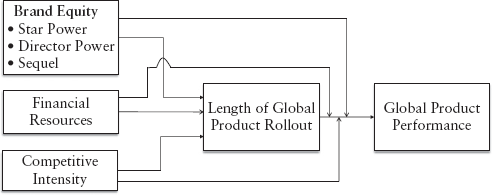
Model
Hypothesis Development
Antecedents to Length of Global Product Rollout
Brand Resources: Brand Equity
A firm's brands, and its brand extensions, are recognized as a firm resource (Aaker and Keller 1990; Keller 2008; Keller and Aaker 1992; Mannor, Shamsie, and Conlon 2016; Steenkamp 2014). Brand equity refers to the ability of a brand to create differences in consumer preference between products, serving as a basis for differentiation (Aaker 1991; Mannor, Shamsie, and Conlon 2016; Steenkamp 2014), evidencing that brand equity is imperfectly imitable and nonsubstitutable (Barney 1991). Furthermore, research finds, consistent with the tenets of RBV, that brands with higher equity generate enhanced returns (Slotegraaf and Pauwels 2008; Steenkamp 2014). For example, Slotegraaf and Pauwels (2008) find that brand equity significantly influenced a firm's ability to draw price premiums and market share.
In the context of the motion picture industry, we contend that three elements of brand equity relevant to length of global product rollout are the brand equity of the lead actor(s) and director(s) associated with a film, and brand equity of the film's name, leveraged via a brand extension (i.e., sequel). First, lead actor(s) and director(s) have their own brand equity and therefore help to differentiate a film from similar offerings in the market (Basuroy, Chatterjee, and Ravid 2003; Griffith, Yalcinkaya, and Rubera 2014; Hadida 2009). Although actors and directors are not “owned” by studios, they are resources in that a studio owns property rights to their specific performance, and therefore these performances cannot be legally imitated by rivals (Miller and Shamsie 1996). Research has found that the value of a film increases as the brand equity of its actors and director(s) increases (Basuroy, Chatterjee, and Ravid 2003; Hennig-Thurau, Houston, and Heitjans 2009; Yalcinkaya and Aktekin 2015). We contend that the brand equity of actors and directors also influences the decision of the length of global product rollout. Specifically, brand equity of the film's actors and directors generates greater visibility of the motion picture as well as reduces consumer adoption costs (i.e., reduces consumer risk associated with product purchase). Such visibility can be leveraged by the firm to increase sales in the film's initial markets (Elberse 2007; Hennig-Thurau et al. 2007), as well as lagged markets, thus allowing it to be introduced into later markets in a shorter period. Alternatively, films with low-brand-equity actors or directors have lower visibility, necessitating a longer rollout to build product awareness.
Second, a brand extension, that is, the use of an existing brand name (i.e., parent brand) on a new product, leverages the parent brand by increasing customer attention, reducing marketing costs during introduction due to familiarity, and also minimizes consumer adoption costs (Keller and Aaker 1992; Steenkamp 2014). Brand extensions also require lower new product launch expenses (Keller 2008; Moon, Bergey, and Iacobucci 2010; Steenkamp 2014). In the motion picture industry, brand extensions in the form of sequels are commonly used to leverage the strength of a parent brand (Ahmed and Sinha 2016; Hadida 2009; Hennig-Thurau, Houston, and Heitjans 2009; Mannor, Shamsie, and Conlon 2016; Sood and Drèze 2006). Under the RBV, Mannor, Shamsie and Conlon (2016) argue that brand extensions are a valuable resource to the firm that cannot be imitated by competitors. Brand extensions increase consumer confidence to try a film (Ahmed and Sinha 2016). For example, a consumer's experience with the 2013 release of Despicable Me 2 (not to mention the 2010 release of Despicable Me) influences consumer confidence related to the 2017 release of Despicable Me 3. Leveraging of brand extensions allows firms to introduce the product into lagged markets more quickly. This is consistent with the arguments of Kerin, Kalyanaram, and Howard (1996), who contend that a brand with strong associations benefits from early market entry timing compared with new brands, since firms can capitalize on the reputation of the established brands. Alternatively, a longer global product rollout will occur for nonsequels, as firms work to build visibility for global expansion and decrease consumer adoption costs. More formally:
H1: Global product rollout is shorter with increased levels of (a) star power, (b) director power, and (c) brand extension (a sequel).
Financial Resources: Production Budget
The RBV suggests that firms with greater resources will be able to initiate and implement unique strategies that rivals will find difficult to emulate (Barney 1991). Firms with more financial resources will have a greater ability to expend resources to introduce products into multiple markets than firms with fewer resources (Lee and Chen 2009). Research also suggests that firms with greater financial resources can enter a larger number of foreign markets (Agarwal and Ramaswami 1992; Lee and Chen 2009) because they are less vulnerable to financial losses and are thus less sensitive to market uncertainty (Lee and Chen 2009).
Mannor, Shamsie, and Conlon (2016) argue, under the RBV, that financial resources in the motion picture industry are best captured at the product level, through the film's production budget. They contend that the production budget reflects the unique financial resources that the firm devotes to the product. Relatedly, research notes that a higher production budget increases box office revenue (Basuroy, Chatterjee, and Ravid 2003), reflects higher quality and greater box office popularity (Litman 1983), and serves as insurance for film studios (Ravid and Basuroy 2004). Building on Mannor, Shamsie, and Conlon (2016), we contend that a higher production budget provides not only the financial resources to introduce a film across global markets in a shorter period, but also greater visibility to the new product, thereby allowing the product to capitalize on advantages of economies of scale and scope. Alternatively, having restricted financial resources lengthens the global product rollout, to allow for building the financial resources and visibility necessary for expansion to new country markets. More formally:
H2: Global product rollout is shorter with increased levels of financial resources.
Competitive Intensity
Competitive intensity refers to the level of competition a firm faces in a given industry (Jaworski and Kohli 1993; Obadia 2013; Porter 1980). The competitive forces perspective argues that a competitive advantage resides in a firm's, and by extension its product's, positioning in a market (Porter 1985), depending on the relative influence of the market forces that the firm encounters (Porter 1980). Consistent with this perspective, it is argued that in highly competitive environments firms need to generate positive consumer awareness to increases revenue, which can then be used to generate awareness in new segments (Lampel and Shamsie 2000), thereby defending against competitors (Porter 1980; Zhou, Yim, and Tse 2005). Moreover, particularly in markets with diverse consumer preferences and a high level of competition (consistent with the motion picture industry), managing a product rollout is a strategically complex decision, requiring managerial choices on timing, cannibalization, and resource planning (Adner and Levinthal 2001). Consequently, it can be argued that the availability of substitutable products in the market largely determines the timing of product launch (Calantone et al. 2010; Krider and Weinberg 1998).
In the motion picture industry, we contend that concurrently released films can be used as a foundation for understanding competitive intensity. Consistent with the prior illustration of The Men Who Stare at Goats and Up in the Air, which were released one week apart, we define competitive intensity as the number of movies introduced in the two-week window of a movie's initial introduction, beginning seven days before the movie is introduced and ending seven days after introduction. We contend that higher levels of competitive intensity at the time of a film's initial launch will result in shorter global product rollout. This is founded on the logic that in initial markets characterized by intense competition, firms seek to aggressively engage in the foreign market entry to capture as much revenue as possible from the larger global market. For example, under the competitive forces perspective, Porter (1985) argues that firms can nullify competitor strengths by serving different customers (Porter 1985). Applied to this context, we suggest that firms facing intense competitive pressure move to new country markets, thereby serving different customers. Alternatively, when competitive intensity is lower, the firm is not motivated to expand into new markets initially but allows its resources and its product's visibility in the initial marketplace to build, lengthening its global product rollout. More formally:
H3: Global product rollout is shorter as competitive intensity increases.
The Influence of Length of Global Product Rollout on Global Product Performance
Competitive advantage is attributable to how likely rivals are to acquire similar resources or develop a substitute bundle of resources (Barney 1991). We contend that a shorter global product rollout provides a competitive advantage in the marketplace, allowing a firm to increase global product performance. The logic underlying this relationship is twofold. First, international markets account for a substantial portion of total revenue (Lang 2017; Scott 2002). As such, revenue is maximized by leveraging momentum gained in early markets, exploiting economies of scale by introducing the product across global markets over a shorter period. This logic builds on the single market effects of Elberse and Eliashberg (2003) and others, who find that a shorter delay in a product's foreign release (after its domestic release) positively influences the product's foreign market performance. Second, rolling out a product across markets over a shorter period minimizes piracy or other market distortions, a factor becoming increasingly of concern in short-life-cycle products, such as those in the motion picture industry (Danaher and Waldfogel 2012; De Vany and Walls 2007). More formally:
H4: Global product performance increases as length of global product rollout shortens.
The Moderating Effects of Brand Equity, Financial Resources, and Competitive Intensity
We argue that as global product rollout shortens, global product performance increases. While this relationship serves as a foundation, we believe it to be more complex. Specifically, we contend that the antecedents to the length of global product rollout will serve as moderators of the relationship between the length of global product rollout and global product performance.
We argue that brand equity, established through actors, directors, and brand extension, will magnify the relationship between length of global product rollout and global product performance. As noted previously, consumers rely on brand equity when making purchase decisions. A high level of brand equity reduces consumer information search (Biswas 1992; Hoch and Deighton 1989), and increases consumer confidence and consumer trust, thereby enhancing product adoption (Ahmed and Sinha 2016; Chaudhari and Holbrook 2001; Rao and Monroe 1989). The literature also notes that consumers react more favorably toward a familiar product than an unfamiliar product (Alba and Hutchinson 1987; Keller 2008). Thus, as a product is rolled out globally over a shorter period, a firm can leverage the brand equity (actor power, director power, and sequel) associated with the product, enhancing momentum effects of market entry. The result of the joint effect of brand equity and the momentum effect will result in enhanced global product performance. More formally:
H5: The effect of a shorter global product rollout on increased global product performance is magnified with increased (a) star power, (b) director power, and (c) use of a brand extension (i.e., a sequel).
Further, we argue that greater financial resources of the product (i.e., the production budget) will magnify the effect of length of global product rollout on global product performance. Greater financial resources allow a firm to provide greater support to a new product at introduction, both providing for increased initial visibility and allowing the firm to introduce products into multiple markets over a shorter period (Agarwal and Ramaswami 1992; Lee and Chen 2009). Furthermore, films with greater production budgets have more flexibility to devote resources to various strategic activities than those with smaller budgets (Koufteros et al. 2007). The joint effect of the increased visibility brought forth by heightened financial resources and the momentum brought forth by a shorter global product rollout will be enhanced global product performance. More formally:
H6: The effect of a shorter global product rollout on increased global product performance is magnified as financial resources increase.
In addition, we contend that competitive intensity will dampen the relationship between length of global product rollout and global product performance. Competitive actions taken by rivals influence performance (Auh and Menguc 2005; Porter 1980; Zhou, Yim, and Tse 2005). As competitive intensity increases, consumers have a greater number of choices. Although increased choice within the marketplace may slightly increase overall market revenue, the portion of total revenue that any one product captures decreases. Thus, a firm that engages in a shorter product rollout strategy for a new product is likely to be disadvantaged relative to firms that employ a longer product rollout, because firms that engage in a slower rollout are able to slowly build visibility and resources that can be leveraged when entering later markets. More formally:
H7: The effect of shorter global product rollout on increased global product performance is dampened as competitive intensity increases.
Empirical Model
Sample
To test our hypotheses, we selected data on movies released in the United States in 1990–2009. This time period allowed a broad examination of the topic of study, namely, length of global product rollout, and minimized censoring issues that could bias the results (i.e., we allow ample time for new products to be introduced across all markets; e.g., the longest global product rollout for a single product in the data was six years). As briefly discussed previously, several unique characteristics make the motion picture industry an ideal context for this research's empirical application, such as a short life cycle and the importance of the product's non-domestic performance relative to its domestic performance. Furthermore, considerable academic literature exists on the motion picture industry (Elberse and Eliashberg 2003; Hadida 2009; Hennig-Thurau, Houston, and Heitjans 2009; Moon et al. 2016; Song et al. 2017), serving as a useful foundation for studying the length of global product rollout construct.
Data gathered for this study are derived from multiple sources. The Numbers (the-numbers.com) reports release date, distributor, budget, and worldwide box office revenue. IMDb and IMDbPro report information about genre (e.g., comedy, drama), MPAA ratings (e.g., PG, R, G), time lag (i.e., the difference between release dates of each movie in different countries, based on U.S. release and first country release), and number of countries released. Box Office Mojo (boxofficemojo.com) reports data on the worldwide number of screens for each movie. The final database contains a total of 1,088 movies.
Measures
Global product performance was conceptualized as the product's relative global sales compared with those of same-genre movies released in the same year. Dollar sales collected from The Numbers were captured as worldwide box office gross for each movie. Our performance measure, consistent with the theoretical perspective of performance under RBV, captures relative product performance. More of note, because competition in the movie industry is generally genre based, we employ the temporal referent approach, that is, capturing performance in relation to same-genre movies within the same year, consistent with the performance measurement guidance of Katsikeas et al. (2016). We computed the average global performance for all movies introduced in the same year as the focal movie and belonging to the same genre, because film performance levels differ across genres. We then computed the difference between the focal movie's global performance and the average movie performance. To increase interpretability, we divided the difference by 1,000.
Length of global product rollout was calculated in days from initial market introduction to market introduction in the last country entered. We only consider the general release date in any given country and exclude premieres. The maximum number of countries in which a single movie was released was 80. Market release timing was gathered from IMDb.
Brand equity was measured by star power, director power, and brand extension. To operationalize star and director power, we followed the method suggested by Hennig-Thurau, Houston, and Walsh (2006). As in their study, we used actors/actresses and directors listed on a movie's theatrical poster. First, we drew the average gross for each star and director associated with each movie. Because the movies used in the study span years, and in order to more accurately capture star and director power associated with each movie, we collected the average movie gross for each star and director prior to each movie's release date (i.e., this accounts for changes in star and director power over time within the period examined). These data were collected from The Numbers and validated for accuracy with IMDbPro. For each movie, we only considered stars who received first, second, or third billing. Next, when multiple actors (or directors) were listed, an overall star (or director) power index was calculated by weighting the average gross value of the first name on the list by .50, that of the second by .35, and that of the third by .15, then summing the products. Brand extension was operationalized as a dummy variable indicating whether the movie was a sequel (1 = sequel, and 0 = nonsequel). Our operationalization is consistent with prior research (e.g., Basuroy and Chatterjee 2008; Hennig-Thurau, Houston, and Heitjans 2009; Sood and Drèze 2006). Sequels account for 22.79% of all movies in our data set. Sequels were identified from Movieinsider.com.
Financial resources, consistent with Mannor, Shamsie, and Conlon (2016), were captured at the product level as the film's production budget. The production budget was drawn from The Numbers.
Competitive intensity was calculated as the number of movies introduced in the two-week window of a movie's initial introduction, beginning seven days before the movie was introduced and ending seven days after the introduction. This is consistent with our prior argumentation as well as prior research (e.g., Ho, Dhar, and Weinberg 2009; Jedidi, Krider, and Weinberg 1998). Data were gathered from The Numbers. As a robustness check, we also used the number of movies with the same genre introduced in the two-week window of a movie's initial introduction as an alternative proxy for competitive intensity. In the interest of brevity and given the substantial consistency of results, we report only the results obtained using the first proxy of competitive intensity. 1
All monetary data (e.g., box office grosses, production budgets) were adjusted for inflation to 2009 dollars. Adjustments were made using Consumer Price Index (CPI; all urban consumers, all items, 1982–1984 = 100) data from the Bureau of Labor Statistics to ensure comparability across years (Prag and Casavant 1994; Van den Bulte 2000).
To minimize spuriousness of results, we included several control variables identified as important to the motion picture industry. Distribution intensity was measured by the number of screens on which the movie was released globally. The maximum number of screens on which a single movie was released was 5,050. The data on number of screens was drawn from Box Office Mojo. Consistent with prior works (e.g., Ainslie, Drèze, and Zufryden 2005; Prag and Casavant 1994), MPAA ratings were included. A film's MPAA rating was drawn from The Numbers and covers six possible rating categories: G (general audiences), PG (possibly unsuitable for children), R (restricted), NC-17 (no one under 17 admitted), NR (not rated), and open; PG-13 is the reference category. The genre was also included, given its influence on movie segmentation (Neelamegham and Chintagunta 1999). Film genre is a categorical variable classifying the film as thriller, action, horror, drama, adventure, western, musical, romantic comedy, or comedy; documentary is the reference category. The genre for each movie was obtained from The Numbers. For the few movies that were not listed on The Numbers, the genre was obtained from IMDb. Critics’ ratings, drawn from Rotten Tomatoes, were included because of their potential to influence product performance (Basuroy, Chatterjee, and Ravid 2003; Eliashberg and Shugan 1997; Marchand, Henning-Thurau, and Wiertz 2017; Moon, Bergey, and Iacobucci 2010). We also control for the effect of specific distributors on length of global product rollout through fixed effects, because different distributors may be inherently more likely to adopt faster (shorter) global product rollouts for their movies. Further, we control for the effect of the number of countries in which a movie was introduced on the length of global product rollout and global product performance. Finally, we control for the effect of whether the movie was introduced before or after the Internet's capability for large file transfer (necessary for mass pirating) on global product performance, with a dummy variable that takes value 0 if the movie was introduced in the “pre-pirating” era (i.e., before 2001) and 1 otherwise. All nonbinary variables were log-transformed to address skewness. Because global product performance takes on both positive and negative values, we first rescaled it between 1 and 101 and then took the logarithm.
Analysis
We use a two-stage instrumental variable method to test our hypotheses. First, we estimate the following equation in order to investigate the antecedents to length of global product rollout:

where β terms are the parameters to be estimated, the subscripts i represent movies, and ε1 is the error term. Results for Equation 1 are reported in Model 1 in Table 3. Then, we estimate the following equation to investigate the influence of length of global product rollout on global product performance:
Descriptive Statistics

In thousands of dollars.
Correlation Matrix

p < .05.
Antecedents to Length of Global Product Rollout
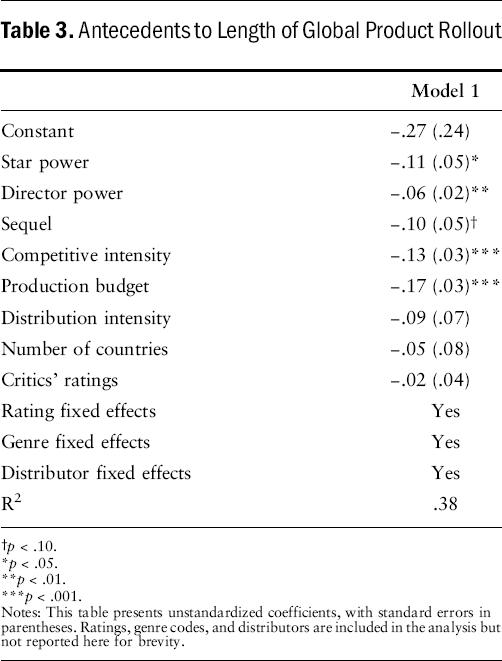
p < .10.
p < .05.
p < .01.
p < .001.
Notes: This table presents unstandardized coefficients, with standard errors in parentheses. Ratings, genre codes, and distributors are included in the analysis but not reported here for brevity.
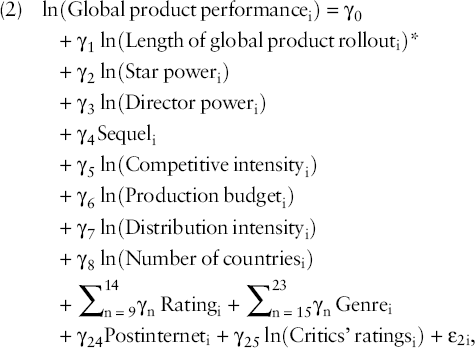
where γ terms are the parameters to be estimated, the subscripts i represent movies, ε2 is the error terms, and ln (Length of global product rollouti)* is the predicted values from Equation 1. This approach lessens both endogeneity (because the length of global product rollout is both an independent and a dependent variable) and inefficient estimates concerns (because the error terms of different equations can be correlated, which might lead to inefficient estimates).
Using the predicted values from Equation 1 in Equation 2 leads to consistent coefficients (γ * ), but the standard errors (s * ) can be biased toward zero, therefore leading to a possible overrejection of the null hypotheses (Greene 2003). Following Maddala (1992, p. 376), we correct the standard errors in Equation 2 by multiplying them by an inflation factor φ.
We obtain φ as φ = σu/σw, where σw is the standard deviation of residuals (ε2i * ) from Equation 2 and σu is the standard deviation of pseudoresiduals given by

That is, the pseudoresiduals are obtained by using the estimated coefficients from Equation 2 (γ * ) combined with the actual variables, Length of global product rollouti included. In our empirical estimation, we find that the inflation factor is .99. We report results of our estimation in Model 3 in Table 4. The reported standard errors are already corrected by φ.
Consequences of Length of Global Product Rollout

p < .10.
p < .05.
p < .01.
p < .001.
Notes: This table presents unstandardized coefficients, with standard errors in parentheses. Ratings and genre codes are included in the analysis but not reported here for brevity.
Next, we investigated the moderating roles of star power, director power, sequel, financial resources, and competitive intensity as moderators of the effect of length of global product rollout on global product performance. This is modeled as follows:

where δ terms are the parameters to be estimated, the subscripts i represent movies, and ε3 is the error term. Also, in this case, we use the predicted values of the length of global product rollout and follow Maddala (1992, p. 376) to correct the standard errors in Equation 4. The inflation factor is 1.05. We report results of our estimation in Model 4 in Table 4. The reported standard errors are already corrected by φ.
Given the chosen methodology, all the nonbinary variables were centered at the grand mean throughout our analyses. Finally, because each movie i is nested in distributor j, we allowed standard errors to be correlated across movies belonging to the same distributor. Our database is made up of 54 distributors, including, among others, Columbia Pictures, Walt Disney Pictures, Warner Bros., and Buena Vista. Given the nested structure of the data, we tested for the necessity of a hierarchical linear model and found that variation in the dependent variable across distributors is close to 0, therefore not justifying the use of hierarchical linear modeling.
Results
The descriptive statistics of the variables in the study are presented in Table 1. The correlations are presented in Table 2. Table 3 presents the results for the effects of the antecedents on the length of global product rollout.
H1 argues that brand equity of actors (H1a), directors (H1b), and brand extensions (H1c) would shorten global product rollout. The results when star power serves as the proxy for brand equity are supportive of H1a (b = -.11, p < .05). Similarly, the results when director power serves as the proxy for brand equity are supportive of H1b (b = -.06, p < .01). Finally, the results when sequel serves as the proxy for brand equity are supportive of H1c (b = -.10, p < .10).
H2 argues that financial resources would shorten global product rollout. The results are supportive of H2 (b = -.17, p < .001).
H3 argues that competitive intensity would shorten global product rollout. The effect of competitive intensity on the length of global product rollout is negative and significant. Thus, the results are supportive of H3 (b = -.13, p < .001).
H4 argues that global product performance would increase as the length of global product rollout shortens. The results, presented in Model 3 in Table 4, are supportive of this hypothesis (b = -.12, p < .01). Examination of the control variables also indicates that movies launched in more countries have greater global product performance (b = .17, p < .001). Similarly, movies with better ratings from critics experience greater global product performance (b = .11, p < .001).
Model 4 in Table 4 reports the results for the moderating roles of star power, director power, sequel, financial resources, and competition intensity on the influence of length of global product rollout on global product performance. H5 argues that brand equity of actors (H5a) and directors (H5b) as well as a brand extension (H5c) would magnify the negative influence of length of global product rollout on global product performance. The results when star power serves as the proxy for brand equity are supportive of H5a (b = -.18, p < .001). The results when director power serves as the proxy for brand equity are supportive of H5b (b = -.04, p < .05). The results when sequel serves as a proxy for brand extension are supportive of H5c (b = -.08, p < .10).
H6 argues that production budget would magnify the influence of length of global product rollout on global product performance. The results are supportive of H6 (b = -.04, p < .05).
H7 argues that competitive intensity would dampen the influence of length of global product rollout on global product performance. The results are not supportive of H6 (b = .04, p > .1).
Mediation Analysis
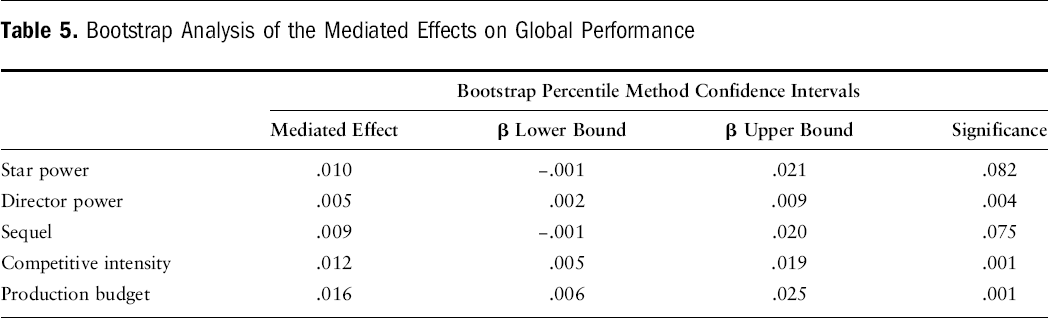
Given the structure of the model, we conducted testing for mediation. In particular, we checked the significance of the indirect effects through a bootstrapping procedure with 200 samples (Preacher and Hayes 2004). We report the results in Table 5. Star power, director power, sequel, competitive intensity, and production budget all have a significant indirect effect on global product performance via the length of global product rollout.
Bootstrap Analysis of the Mediated Effects on Global Performance
Testing for mediation has four requirements: (1) the initial variable should be correlated with the outcome variable, (2) the initial variable should be correlated with the mediator, (3) the mediator should be related to the outcome when the initial variable is controlled for, and (4) the effect of the initial variable on the outcome once the mediator is taken into account should be nonsignificant if there is full mediation (Baron and Kenny 1986). If the effect is reduced but still significant, there is partial mediation.
Model 2 in Table 4 supports the first requirement of mediation, namely, the existence of a path from the antecedents to the length of global product rollout to global product performance. Star power (b = .16, p < .001), director power (b = .04, p < .001), sequel (b = .12, p < .001), competitive intensity (b = .03, p < .05), and production budget (b = .04, p < .05) all have a direct effect on global product performance. Results shown in Table 3 support the second requirement of mediation, namely, that star power, director power, sequel, competitive intensity, and production budget significantly influence the length of global product rollout. Model 3 in Table 4 indicates that length of global product rollout still has a significant effect on global product performance (b = -.12, p < .01), even when we control for the antecedents of the length of global product rollout, in support of the third requirement for mediation. Finally, we find that the effects of competitive intensity and production budget are no longer significant when the length of global product rollout enters the equation, thus indicating that length of global product rollout fully mediates the effects of these factors on global product performance. The effects of star power, director power, and sequel remain significant when the length of global product rollout enters the equation, but their significance levels are slightly reduced, therefore indicating partial mediation.
Discussion
The intent of this study is to contribute to the international marketing literature by examining the length of global product rollout. The results provide new insights to academics and practitioners interested in international marketing strategy decisions and their implications.
Theoretical Implications
This study works to increase understanding the determinants of the length of global product rollout. To do so, we build on research conducted in the motion picture industry using the RBV (e.g., Mannor, Shamsie, and Conlon 2016; Vandaie and Zaheer 2015), the international marketing literature (e.g., Craig, Greene, and Douglas 2005; Moon et al. 2016; Song et al. 2017), and the competitive forces literature (Porter 1980, 1985; Zhou, Yim, and Tse 2005). The results indicate that brand equity (star power, director power, and brand extensions), along with financial resources and competitive intensity, influenced the length of global product rollout. Specifically, we found that increased levels of these antecedents resulted in a shorter global product rollout. These results suggest that a firm works to leverage its resources to gain a positional advantage within the global competitive marketplace through the strategic decision of length of global product rollout.
More specifically, first, from a theoretical standpoint, we extend the literature that argues that firms with greater access to financial resources can enter a larger number of foreign markets (e.g., Agarwal and Ramaswami 1992). This work demonstrates that firms with greater resources (inclusive of brand equity and financial resources) introduce products into foreign markets over a shorter period (due to heightened visibility of the product and increased financial resources). Thus, this research extends our understanding of the effects of firm resources by incorporating a timing element and a broader perspective of firm resources. Furthermore, consistent with the competitive forces perspective (e.g., Obadia 2013; Porter 1980, 1985; Zhou, Yim, and Tse 2005), the results indicate that when firms are faced with greater competitive intensity in an initial market, they enter new markets in a shorter period. As such, this work suggests that a product's global rollout works to build momentum along the way as it garners additional visibility and sales from newly entered markets.
Second, we find that length of global product rollout was influential in the determination of global product performance. The extant literature has primarily focused on understanding how the lag between domestic market introduction and foreign market introduction influences sales (e.g., Elberse and Eliashberg 2003; Griffith, Yalcinkaya, and Rubera 2014; Moon et al. 2016. This study is the first, to our knowledge, to empirically establish the linkage between length of global product rollout and global product performance. As such, this study extends the literature by demonstrating that length of global rollout (i.e., the days elapsed between product introduction in the initial country market and final country market) has global performance implications. This perspective moves us from the often dichotomous debate of “sequential versus simultaneous” (Kalish, Mahajan, and Muller 1995; Stremersch and Tellis 2004) to reflecting on how a product's length of rollout across global markets influences performance. This new finding highlights the importance of studying length of global product rollout and its intricacies when looking to understand global product performance.
Possibly more of note, the findings of this study demonstrate the importance of length of global product rollout as a construct to be examined in the literature. The importance of the construct is highlighted by its role as a mediator of the effect of resources on global product performance (in contrasts with the extant literature, wherein a direct relationship has been generally theorized and tested between firm resources and performance). As such, the findings of this study not only identify that brand equity, financial resources, and competitive intensity are important antecedents of length of global product rollout, and that a shorter global product rollout allows a firm to enhance global product performance, but they also demonstrate that researchers need to theoretically incorporate the role of length of global product rollout when investigating global product performance. We believe this is an important contribution to the literature, most notably the motion picture literature (e.g., Elberse and Eliashberg 2003; Griffith, Yalcinkaya, and Rubera 2014; Moon et al. 2016), because it is through understanding the strategic managerial decisions related to a product's length of global rollout that a better understanding of the process elements of firm global product strategy can be gleaned.
Furthermore, the results demonstrate that the employment of firm resources may not only influence strategic decisions but may also influence their effectiveness in garnering competitive performance outcomes. Specifically, when brand equity (in relation to either star power, director power, or brand extension) or financial resources are higher, the influence of the length of global rollout on global performance is magnified (with competitive intensity not having a moderation effect). These findings, when considered in conjunction with the mediation of length of global rollout, demonstrate that strategic decisions about the introduction of a product across a firm's global markets are highly complex. As such, these results extend the current literature employing RBV within the motion picture industry (e.g., Hadida 2009; Mannor, Shamsie, and Conlon 2016; Miller and Shamsie 1996; Vandaie and Zaheer 2015), demonstrating how firm resources can influence the global performance of a new short-life-cycle product.
Managerial Implications
The findings present new insights for international marketing managers. First, the results demonstrate that while resources (i.e., brand equity and financial resources) and competitive intensity can play an important role in influencing the length of a product's global rollout, the effects are not equal. For example, our findings indicate that star power and production budget play a substantively more important role in the determination of the length of global rollout than director power. Due to the differential brand effects on the length of global rollout, managers should adjust their marketing strategies to facilitate maximum outcomes. At their core, the results suggest managers carefully consider each resource related to the new product, as well as how these may influence the effectiveness of the firm's rollout decision. Only through careful analysis can the firm truly appreciate the unique effects each resource will have on its length of global product rollout and, ultimately, global product performance.
Second, the findings suggest to managers that there is an identifiable relationship between the length of global product rollout and the product's global product success: namely, global product performance is maximized when a firm employs a shorter global product rollout. This implies that managers are best served by working to establish the appropriate antecedent conditions to allow for a more rapid global product rollout. Inherent in this result is the argument that there is a substantive opportunity cost of rolling a product out globally over a longer period. This effect may be due to the nature of the global competitive environment in that a longer global product rollout enables competitors to enter new markets with competitive products ahead of the focal firm, thereby capturing potential revenue, or that a longer global product rollout diminishes momentum built in prior markets. In either case, the result should serve as a caution to managers in their decision making related to the length of global product rollout.
Limitations and Future Research
Although the findings of this study provide new insights, it is important to realize that this work has several limitations that should be considered when interpreting the findings. First, the results are limited in both the scope of the model as well as being tested within only one industry. While the results indicate that our antecedents influence length of global product rollout, we do not intend to convey that these are the only antecedents. In our attempt to build a parsimonious and theoretically founded model, we specifically limited our investigation. Future work should build a broader, more inclusive model of the antecedents of length of global product rollout. Further, while the motion picture industry is a substantial financial component of the overall global economy and, as such, has generated considerable research interest (e.g., Craig, Greene, and Douglas 2005; Elberse and Eliashberg 2003; Griffith, Yalcinkaya, and Rubera 2014; Moon et al. 2016; Song et al. 2017), it represents a unique product category characterized by a short-life-cycle product. Although the findings of this study may be applicable to other similar industries, only empirical testing can demonstrate their generalizability (a note of caution relates to ensuring comparability in industry variation in length of global product rollout).
Second, there are several measurement-related limitations in this study that should be overcome in future work. For example, due to data limitations related to global product rollout encompassing up to 80 different country markets, the study does not include data on variables such as advertising budget, a variable that has been found in prior research to influence product performance (e.g., Elberse and Eliashberg 2003). Applied to the context of this work, it could be argued that advertising may generate additional momentum, leading to a shorter global product rollout and, ultimately, greater global product performance. In the future, it may be feasible to collect per-country information, thus developing a more comprehensive model.
Similarly, although our measure of competitive intensity captures competition at initial product launch, we did not conceptualize or measure individual country market competition during a film's global rollout. This is a significant limitation and could be a productive area for future research. For instance, in terms of competitive release, it is notable that studios often avoid going head to head at the box office with another film, even moving release dates to do so. For example, the movie Warcraft: The Beginning was originally scheduled to release in the United States in December 2015. However, Star Wars: The Force Awakens was then announced to release in the United States at the same time. The studio moved Warcraft's U.S. release date to March 2016 to avoid directly competing with Star Wars. Warcraft's U.S. release date was then again strategically pushed to June 10, 2016, to avoid directly competing with Batman v Superman: Dawn of Justice, which was scheduled to release in the United States in March 2016 (Lussier 2015). However, it is interesting to note that Warcraft released earlier in other markets, such as France on May 25 and Germany on May 26. Ironically, Warner Bros. studios originally set Batman v Superman: Dawn of Justice to open in the United States on May 6, 2016. Unfortunately, Marvel studios selected the same date for its movie Captain America: Civil War. To avoid competing directly, Warner Bros. moved its U.S. release to March 25, 2016 (Ebiri 2014). Understanding the effects of competitive release dates, both within and across country markets, as well as changes in release dates, on country-level and global box office revenues could serve as a significant area of future study.
Third, although this study works to understand how factors influence the length of global product rollout, it does not address issues related to coordination and costs associated with differing lengths of global product rollout. As noted previously, although research has identified several challenges in global product rollouts (e.g., coordination across markets, cost considerations, type of innovation) (Chryssochoidis and Wong 1998; Harvey and Griffith 2007; Rubera, Griffith, and Yalcinkaya 2012; Tellis, Stremersch, and Yin 2003), few researchers have engaged in detailed empirical examinations of such topics. Research working to empirically address coordination and cost issues in the context of length of global product rollout would substantively enhance our overall understanding of this issue.
Fourth, the study uses the CPI to adjust for inflation. This is a helpful index for converting monetary values into a standard unit of measurement to compare products introduced in different time periods. Although the CPI is used to calculate the inflation rate, because CPI figures are based on average change over time in the prices paid by urban consumers for a market basket of consumer goods or services, the index does not account for other factors that may influence a product's overall popularity and success. Such factors include, but are not limited to, increases or decreases in the population, the total number of competing products in the marketplace at a given time, economic conditions that may help or hurt the industry as a whole (e.g., war), the price of a product relative to other products in a given year, and so on. Future research might develop new measures to provide greater insight into the effects of price changes over time.
Fifth, the length of global product rollout will also depend on the cultural content of a product and consumers’ national cultural background. Consumers evaluate products according to the suitable match between the cultural content of the product and their dispositions and tastes (Craig, Greene, and Douglas 2005; Lee 2006; Moon et al. 2016; Song et al. 2017). As such, the acceptance of products depends heavily on their cultural content (O'Connor 2010). Understanding the effect of cultural content on the length of global product rollout is especially important for firms that produce entertainment products (e.g., motion pictures, books, video games, music) because these products are typically rich in cultural content. Future studies should explore the interaction between cultural compatibility and the length of global product rollout.
Building on this topic, the importance of the international markets has motivated studios to carefully craft the storytelling, casting, and global rollout of each project (Brook 2014). Consistent with much of the international marketing strategy adaptation/standardization research (e.g., Moon et al. 2016; Song et al. 2017; Zou and Cavusgil 2002), studios increasingly develop projects including universal ideas and themes, working to avoid potential cultural sensitivities. For example, the 2012 remake of Red Dawn differed from the 1984 original in that in the remake, the invading force originated from North Korea as opposed to China. Similarly, actors can be selected according to how well they will resonate with audiences in targeted global markets. By developing a film for the global market, studios also limit the time needed to adapt the film to local market tastes and country regulator councils, decreasing constraints on the decision about length of global rollout. Investigation of issues related to product development, such as those outlined here, would significantly advance our understanding of this area.
Finally, this work captures relative global product performance. While this approach is consistent with both RBV and the extant literature (e.g., Katsikeas et al. 2016), it provides a narrow perspective on product performance. To gain greater insight into the performance trade-offs associated with the role of the antecedent factors, researchers should consider using multiple performance measurement approaches.
Note
The only differences are (1) when competition across all genres is used, the effect of the sequel on the length of product rollout is negative and significant, whereas when within-genre competition is used, the effect of the sequel on the length of product rollout becomes nonsignificant; and (2) when competition across all genres is used, the effect of competitive intensity on global product performance is fully mediated by the length of product rollout, whereas when within-genre competition is used, the effect of competitive intensity on global product performance is partially mediated by the length of product rollout.