






Abstract
The author aims to answer two questions related to brand globalization: (1) whether the pattern of brand image dimensionality is similar across international markets and (2) how cohesive a brand image perception is in a global market. Results from a 20-country, 70-region study provide concrete evidence that supports the applicability of the proposed benefit-based multidimensional image structure that corresponds to consumers’ sensory, utilitarian, and symbolic and economic need at both the global and the national level. On the basis of the identified image dimensions, the author proposes an alternative approach to measuring the degree of global brand image cohesiveness as an indicator of brand globalization. Global brand image cohesiveness is calculated on the basis of the summation of Euclidean distances between the column score of image dimensions of the home country (i.e., initial market) and that of foreign countries. Furthermore, nations are clustered on the basis of these column scores, and the resultant clusters correspond approximately to groups of countries that share similar levels of economic development, cultural dimension, or geographic distance, which suggests that national characteristics affect brand image perceptions. The findings provide implications for the practice of global brand image management.
As globalization has accelerated (e.g., Levitt 1983; Szymanski, Bharadwaj, and Varadarajan 1993; Yip 1989), consumers everywhere can choose from a large number of brands, both foreign and domestic. According to Advertising Age, consumer agencies around the world landed 136 global or regional branding assignments in 1997 (DeSimon 1998). Such a large number of brands across nations evokes issues of whether consumers from different markets perceive brands differently and, consequently, how the brand image perception affects consumers’ purchasing behavior across nations. Therefore, a business competing in or contemplating competing in multiple national markets should first develop an understanding of the brand's position in those markets and identify the national characteristics that could affect the brand. In so doing, the marketer could then determine whether the same brand strategy should be applied across markets (Motameni and Shahrokhi 1998). The belief that groups of citizens with political, ethnic, or geographic unity also share other important traits is long-standing, and I therefore suggest that regionalization (e.g., on the basis of economic, cultural, and geographic similarities), as opposed to overall globalization, is a plausible strategy (Roth 1992, 1995b). Following this belief, I posit that a brand's position may be affected by national characteristics on the basis of economic, cultural, and geographic similarities (Roth 1992, 1995a, b).
In an attempt to understand how brands are different across nations, existing research has used firms’ brand image strategy (Roth 1995a), advertising content (Duncan and Ramaprasad 1995), or media usage (Kapferer 1991) to address the issue of brand globalization. However, the question, “How global are global brands?” has remained unanswered (Kapferer 1991), because there has been no agreement regarding the way the degree of brand globalization should be measured. The purpose of this study is to obtain a quantifiable summary of the degree of brand globalization based on the developed multidimensional measures of brand image perceptions. Brand image has been considered a vital part of a firm's marketing program, not only because it serves as a foundation for tactical marketing-mix issues but also because it plays an integral role in building long-term brand equity (Aaker and Keller 1990; Keller 1993; Park, Milberg, and Lawson 1991). Brand image perception, which is built on the consumer's brand associations and attitude, has been considered an integral component of brand equity and has been widely employed in brand equity frameworks (e.g., Aaker 1996; Agarwal and Rao 1996; Feldwick 1996; Keller 1993; Park and Srinivasan 1994; Srivastava and Shocker 1991). With its emphasis on brand meanings, brand image perception provides more valuable managerial implications in marketing strategy development. Therefore, I argue that the extent to which a brand image is perceived similarly across nations could be considered a pertinent indicator in measuring the degree of brand globalization.
The next two sections provide background on associative networks, in which brand image research is rooted, and the national factors that might influence consumers’ brand image perceptions. The discussion of brand image dimensionality and proposed method in measuring the degree of brand globalization follows. Then, the characteristics of the data set employed are described. Results are reported, and their implications are discussed. Finally, limitations and extensions for further research are suggested.
Literature Review
In emphasizing the structure of a set of associations, brand image research is often based on the associative network model (Farquhar and Herr 1993), in which a person's memory is made up of links and nodes: Links represent relationships (positive or negative, weak or strong), and nodes represent concepts (e.g., brand associations) and objects (e.g., brands). Two structural properties of beliefs, namely, abstraction and complexity, must be taken into account in assessments of the structure of brand associations.
First, the role of abstraction level in classifying associations can be evident from means–end chain theory, which reflects the memory linkages among attributes (i.e., means), consequences, and attitude (i.e., end) (Gutman 1982) on the basis of the notion that the product and the consumer's sense of self may be hierarchically linked through an interconnected set of cognitive elements along with different levels of abstraction. Other typologies of brand associations have also been classified on the basis of level of abstraction by several authors. For example, Keller (1993) categorizes brand associations as attributes, benefits, and evaluative attitudes of a specific brand along the dimension of level of abstraction.
One of the implications of the level of abstraction is the amount of information summarized or subsumed in types of association, in which the same amount of information is contained in fewer higher-level attributes as is contained in many lower-level attributes. The other implication is the level of relevance in type of attributes, in which the higher the level of abstraction, the stronger and more direct is the relationship between the attribute and the self. Therefore, Wu, Day, and Mackay (1988) argue that brand associations at a higher level, such as the benefit-related associations, contain a larger amount of information and have a more immediate impact on subsequent purchasing behavior than do associations at a lower level of abstraction, such as product attributes. As such, in the case in which a parsimonious model is required, I argue that only associations at a higher abstraction level should be incorporated, even though, at the conceptual level, brand image should encompass all types of associations at different levels (Friedmann and Lessig 1987; Kirmani and Zeithaml 1991).
Second, according to Eagly and Chaiken (1993, p. 103), “The complexity of beliefs associated with [an] attitude object is typically defined as the dimensionality of the beliefs that a person holds about an attitude object, i.e., the number of dimensions needed to describe the space utilized by the belief ascribed to the attitude.” To the extent that an economy is market driven, the dimensionality of beliefs could be determined on the basis of their meanings corresponding to the needs, wants, and interests of consumers (Medina and Duffy 1998). Specifically, in satisfying consumers’ diverse needs, Park, Jaworski, and MacInnis (1986) propose three brand concepts, which are defined as brand-unique abstract meanings (Park, Milberg, and Lawson 1991), in their normative framework: symbolic benefits, experiential benefits, and functional benefits.
However, assuming that the product classes under investigation tend to be frequently purchased consumer goods and that consumers make purchasing decisions simply to solve problems of consumption, the majority of empirical studies concentrate on the role of utilitarian associations in forming a single utilitarian image construct (e.g., Mackenzie and Lutz 1989). I argue that the utilitarian difference between many brands is at best marginal and that the nonutilitarian meanings are often far more differentiated (Biel 1991) because they are less constrained by the physical attributes of products and because technological progress is so rapid that any physical advantage could be short-lived. The preceding discussions rationalize the attempt to develop a multidimensional image construct.
From the perspective of international consumer research, consumer behavior in the marketplace is critically reflective of patterns of persistent personality traits, described as national characteristics, that are found among the populations of nations (Clark 1990; Roth 1995b); variation of consumers’ behaviors that are driven by national characteristics may limit the success of a marketer's global campaign. The national characteristics that could influence consumers’ brand image perceptions are discussed subsequently.
The analysis based on the stages of a consumerization perspective helps explain consumer responses to marketing activities across national boundaries. In less consumerized markets, brand is used as a reference whose role is centered on the product difference (i.e., utilitarian related). In markets that are more consumerized, advertising literacy tends to be more emotional and symbolic as the market becomes more competitive and the consumers become more discriminating (Goodyear 1993). The development of consumerization follows the macroeconomic environmental change, in which developing countries are expected to fall mostly within earlier stages, whereas developed countries fall within the later stage (Darley and Johnson 1993). In addition, the level of infrastructure development in exchanging marketing information, consumers’ intellectual level in receiving communication messages, and economic afford-ability in consumption are heavily influenced by a country's economic development status.
Brand image perceptions may also differ according to trading blocs under the assumption that values regarding and cultural influences on consumption differ across geographic areas (e.g., Kahle 1986; Takada and Jain 1991). Also, according to the theory of diffusion, geographic distance is one of the key factors influencing the effectiveness of diffusion. An ethnogeographic trade area often is considered the boundary within which managers should draw a business strategy, as many barriers to trade between certain markets have already been eliminated through agreement (Schott 1991). Trading agreements will result in foreign product availability, which in turn influences the level of consumers’ awareness of and familiarity with the brands.
Finally, cultural factors are argued to be excellent grounds for segmenting global markets because they are the prime determinants of the consumers’ attitude, behavior, and lifestyle and the needs consumers satisfy through the use of goods and services (Jain 1989). Belk (1996) suggests that cultures transform global meanings into unique local meanings; accordingly, in each country, there are differences in the meaning invested in brands, and it is likely that consumers consequently hold different brand beliefs (Cheng and Schweitzer 1996; Steenkamp, ter Hofstede, and Wedel 1999). Moreover, a culture's heterogeneity, which is reviewed as a main barrier to the emergence of one global market, is much more resilient and enduring than other environmental characteristics (Malhotra, Agarwal, and Baalbaki 1998).
Exploring Image Dimensionality and Measuring the Degree of Global Brand Image Cohesiveness
In this article, an associative network perspective on the memory representation is applied to conceptualize the brand image construct. Image dimensions, which correspond to consumers’ various needs, are represented as members of the higher-order category, which underlies brand associations. In associative networks, what differentiates one brand from another in memory are brand image dimensions and the strength and uniqueness of associations that constitute image dimensions.
Statistically, the determinants of the dimensionality and strength of brand associations are equivalent to the criteria for extracting factors from a factor analysis, namely, discriminant validity, reliability, and convergent validity. Discriminant validity is the degree to which extracted factors (e.g., image dimensions) are discriminated from one another, reliability is the extent to which the multiple correlations (R2) in the observed variables (e.g., brand associations) are accounted for by factors, and convergent validity is measured by the value of correlation coefficients between observed variables and their corresponding factors (e.g., image dimension). The larger the coefficients, the stronger is the evidence that the measured items represent the underlying constructs.
A correspondence analysis (CA) approach was employed to explore the possible dimensionality in a preliminary way, because nominal scales were used for data collection (Hill 1974). The confirmatory factory analysis, which provides a powerful tool for examining the validity and the reliability of image dimensionality, was then performed to confirm the dimensionality explored by CA. Two technical aspects need to be addressed regarding the categorical nature of the data set employed. First, the tetrachoric correlation matrix for LISREL analysis is used, because the tetrachoric correlation coefficient produces essentially unbiased parameter estimates (Jöreskog and Sörbom 1996) when the observed variables are all of dichotomous type. Second, weighted least squares, which is asymptotically distribution free, is used for model tests because it appears to work the best with the tetrachoric correlation coefficient.
After image dimensions are identified, an assessment of the degree of global brand image cohesiveness based on the differences of brand image perceptions between the initial and the foreign nation is then processed. The Euclidean distances (i.e., differences) can be calculated by means of aggregate information of nations’ column scores of image dimensions, which represent the spatial location of nations against each image dimension derived from CA. The greater the extent of a brand's globalization, the more likely it is that its image will be perceived similarly across markets, which suggests that a lesser magnitude of summation will be found for brands that have more coherent global brand images.
Three steps were necessary to develop an image-cohesiveness measure for each brand. First, the column scores of each image dimension for each nation, representing the spatial location of nations on the perceptual map, were generated from CA; nation served as the row point, and brand association served as the column point. This score represents a country's relative position vis-à-vis the image dimensions. Second, the Euclidean distance—in terms of the difference of column scores between the initial nation where the brand is originating and a foreign nation—was calculated and summed across five image dimensions. This score represents the Euclidean distance between consumers’ brand image perceptions in the initial market and those in the foreign market. Third, the score generated from the second step was summed across international markets for each brand to represent the extent to which the brand image is cohesive among the international markets. As a result, the lower the summed score derived from the third step, the higher is the degree of cohesiveness of global brand image perception.
It is pertinent to use the brand image perceived in the initial market as the “benchmark image” and treat the differences between benchmark image and foreign markets as the variation of global image. As Kapferer (1991) points out, a brand does not become global all at once but goes through a progressive piecemeal process starting with the market in which it is originated (initiated). I also suggest that brand globalization is a revolutionary process, and the idea of brand globalization is to reduce brand customization as much as possible through the incorporation of attribute-standards from around the world (Medina and Duffy 1998).
An Empirical Application
I present the results by applying the proposed methods to automobile brands for two reasons. First, the study involves an exploration of image dimensions for a product for which both utilitarian and nonutilitarian motives play an important role in decision making. Lienert (1998, p. 53) best highlights the compound nature of automotive brand appeals: “autos are one of the most highly engineered and complicated products, like Boeing; are full with emotional connection with image and fashion, like make-up; and provide experiential satisfaction, like movies.” Second, an industry in which the majority of brands have a well-established image in the international markets is best suited to the study. Automobile marketers spend a large amount on advertising to reconfirm the links between associations and brands in the minds of consumers (Kirmani and Zeithaml 1991).
Description of the Existing Data Set Employed
To neutralize the domination of a small comparative set in a cross-national study, an existing data set owned by MORPACE International Inc., a multinational research firm, is employed in this study. The data cover the top 20 automobile markets, consisting of 4320 eligible car owners evaluating 53 brands each during September to October 1997, which provides a good representation of global markets. Countries covered and their relative market sizes appear in Table 1. In the consideration of heterogeneity within countries (e.g., Hassan and Katsanis 1994), only metropolitan areas were selected; 70 metropolitan areas were identified. A list of brands used as stimuli for brand recognition, on the basis of which brand associations were measured, is summarized in Table 2.
Countries/Metropolitan Areas Surveyed

Notes: Market size is based on the proportion of new vehicle sales across countries in 1996.
Brands Used as Stimuli

Notes: Brand names were read out by the interviewers on the basis of rotating sequence, and only brands the respondent was aware of were measured for brand associations.
A multistage sampling procedure was adopted. In the initial stage, sample size in each country was determined arbitrarily: Samples of 200 were used for each country, with the exception of Japan (300) and the United States (370) because of the large sales volume in these two countries. In subsequent stages, the sample size assigned in each country was divided into mutually exclusive and collectively exhaustive subgroups on the basis of the proportion of population in each metropolitan area within a country. In each area, the sample size within a given category was then determined according to the proportion of automobile sales volume in terms of makes and segments. In the final stage, instead of being drawn on probability, individual samples were recruited through the intercept method, which gives them the benefit of being easily accessed, given that accessing a complete sampling frame is not feasible. The interviews were conducted by trained interviewers in the major commercial centers, using brand names of automobiles as the stimuli in activating brand associations (Sullivan 1998).
Before the main survey, exploratory research employing focus group discussions, which used qualitative techniques such as free association tasks and projective approaches, was conducted to offset the limitation of the free-elicitation method that generates low quantities of elicited thoughts (Fishbein and Ajzen 1972). Participants indicated the desirability and importance of various attributes, and the 14 benefit-oriented associations that were mentioned by the majority were selected as salient beliefs about automobiles and as the ones that had the same attitudinal meaning for all respondents in this stage of association-generation. Fourteen associations were selected: exciting, fun to drive, good acceleration and speed, good dealer services, good fuel economy, good styling, latest technology, luxury features, made to last, prestigious, reliable, safe in accidents, sporty, and perceived as high quality.
Results of the Empirical Analysis
The first step in CA is to determine the number of key dimensions. This usually involves a trade-off between explanatory power and interpretability. Whereas the interpretability of dimensions is subjective, the explanatory power can be judged by the cumulative inertia explained and the quality (i.e., the relative contribution of dimensions to the points) (Greenacre 1984) of the categories and variables. The dimensionality of brand image was explored through a global sample, comprising respondents from 20 countries who evaluated brands they were aware of, each of which had 14 attributes. A five-dimension solution was executed, in which the first five dimensions explain, cumulatively, more than 95% of the variance. Furthermore, numerical results of CA provide additional aids in deciding the number of dimensions extracted. As illustrated in Table 3, there are three major first-order image dimensions underlying brand associations: (1) the economic–symbolic dimension (including good fuel economy, good dealer service, prestigious, and luxury features), (2) the sensory dimension (including exciting, good acceleration and speed, fun to drive, and sporty), and (3) the utilitarian dimension (including reliable, made to last, and safe in accidents). Note that the resulting identical mass indicates that the influence of each attribute is the same, suggesting that each attribute is used evenly (to describe automobile brands).
Numerical Results of a CA
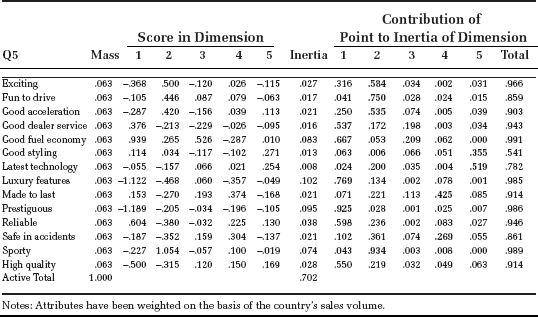
Notes: Attributes have been weighted on the basis of the country's sales volume.
Before testing the dimensionality extracted from CA, note that two attributes, perceived high quality and the latest technology, were eliminated from the model for dimensionality testing. Perceived quality was eliminated because the role of quality as a first-order attribute is in question. Because perceived quality can be defined as the consumer's judgment about a product's overall excellence or superiority (Dean 1999), perceived quality is considered an attribute with a higher abstraction level (Kirmani and Zeithaml 1991). In other words, perceived quality can be the aggregated product of lower-level attributes constituting the sensory, utilitarian, and/or symbolic dimensions. The interpretability of the dimension (dimension 5) consisting of latest technology and good styling is in question because the linkage between styling and latest technology is obscure. Because styling could satisfy consumers’ visual sensational needs, the good styling attribute is combined with the sensory dimension for a further dimensionality test. Dimension 5—where only a single attribute, the latest technology, was left—was then eliminated from further testing, because that single-indicator construct ignores the reliability of measurement (Bollen 1989). The omission of latest technology is also supported by its inertial. As is shown in Table 3, latest technology has the smallest inertia (.008), which suggests its trivial contribution in explaining variance.
To confirm the dimensionality explored from CA, confirmatory factor analysis is thus processed with 12 attributes. In addition to the three-dimensional model generated from CA, a four-dimensional model in which the economic–symbolic factor was separated into two image dimensions, economic and symbolic, was proposed as an alternative confirmative model on the basis of model comparison strategy (Jöreskog and Sörbom 1993), given that these two appeals were often used independently to target different audiences. A pair of confirmatory factor models, with the correlation matrix as input, was then estimated through LISREL VIII (Jöreskog and Sörbom 1996).
The data were then fitted to the LISREL models, and the statistical estimates are summarized in Table 4, which indicates that the four-factor model is better fitted than the three-factor models. First, the magnitude of correlations (loadings) between an indicator and its specified constructs is more substantial in the four-factor model, suggesting a better model fit in terms of convergent validity. Second, the estimated χ2 statistic is significantly smaller in the four-factor model (χ2 diff = 3298.86, degrees of freedom [d.f.] = 51, ρ = .0000; χ2diff = 2585.68, d.f. = 48, ρ = .0000), suggesting a better discriminant validity (Bagozzi and Philips 1982). Although the estimated χ2 statistics for these two models are both significant, indicating an unacceptable fit, note that χ2 is sensitive to sample size and departure from multivariate normality (Bollen 1989). Accordingly, other fit indices are more reliable, because the sample size of the global sample exceeds 100,000 (53 brands x 4320 respondents). Again, the data–model fit indices modestly favor the four-factor measurement model.
Properties of Brand Image Measures

Notes: NA = not available.
The results show that all factors—namely, the utilitarian, sensory, symbolic, and economic dimensions—derived from CA are retained, yet the LISREL measurement model attains a more statistically interpretable set. The parameter estimates corresponding to the empirical four-factor model appear in Table 5. Each measure is significantly (on the basis of t-value) related to its underlying factor, though lambda x loadings for the styling indicator is lower. With respect to the R2 for the observed variables (indicator), the 12 measures indicate a modest satisfactory reliability of the measurement model; styling has the lowest R2 value, .03, which suggests a poor measure and a lack of internal consistency.
Parameter Estimates of the Measurement Model

Degree of Brand Image Cohesiveness in the Global Market
On the basis of the column scores of each dimension derived from CA, the results of global image cohesiveness are shown in Table 6, in which inherent brand characteristics seem to play an essential role in determining the degree of globalization in terms of global image cohesiveness. First, a brand that has a high degree of globalization, such as Mercedes, BMW, Jaguar, Lexus, Audi, and so forth, is more likely to have its primary focus on the luxury segment. Second, as far as country of origin is concerned, U.S. brands tend to have a lower global cohesive brand image overall, which may be attributed to heavy dependence on the United States’ fertile domestic market. Third, a significant, positive relationship (R2 = .395) between global brand image coherence and awareness, which is operationalized as brand recognition based on the global sample, is found. This finding supports the notion that awareness reflects the salience of the brand in the consumers’ minds and that awareness relates positively to the strength of brand image (Keller 1993).
Extent of Brand Image Cohesiveness

Notes: Volvo and SAAB are excluded because the brands’ originating country (Sweden) is not one of the survey countries. Acura, Holden, Saturn, and Talbot were excluded because of low awareness across the majority of countries.
The detailed information, using BMW, Vauxhall, Fiat, Kia, and Chevrolet as examples, is presented in Table 7, which computes the distance between countries. The Euclidean distances based on the column scores of image dimensions between brand-originated country and that of each country are calculated and summed across image dimensions. The results reveal the progress of brand globalization in each nation. As Table 7 shows, respondents from countries that are geographically close to the country where the brand originated tend to perceive brand image similarly to respondents from the home country (where the brand originates). For example, Chevrolet (originating from the United States) has a brand image closer to that in the originating country in Canada and Brazil than it does in other countries. Similarly, Italians perceive Mercedes-Benz similarly to the way Germans do.
Euclidean Distance Between Countries

Notes: Although GM has bought Vauxhall, Vauxhall's initial market is Britain. Therefore, we use Britain as the benchmark for Vauxhall.
Segmenting Global Markets in Terms of Brand Image Perceptions at the National Level
After image dimensions are identified, the focus is the potential impact of national characteristics on shaping brand image perception. In an attempt to identify clusters of nations sharing similar brand image perceptions, nations were clustered using the column score of image dimensions derived from CA, with nation serving as the row point and brand association serving as the column point.
The multination context of this research provides an opportunity to identify the underlying national characteristics that lead to the observed similarity of brand image perception. Presumably, nation clusters based on image score should be reflective of nation clusters based on national characteristics. For the detection of the influence of national characteristics, survey countries were clustered by means of Ward's grouping method on the basis of the indictors related to (1) trading blocs, (2) level of economic development, and (3) cultural dimensions. Countries were grouped into four clusters according to major trading blocs: (1) North American countries (2) South American countries, (3) member countries of the European Union, and (4) Asia-Pacific countries. As no agreement has so far been reached as to what constitutes economic development, multiple indicators related to consumers’ purchasing behaviors, usage (gross national product per capita and penetration of vehicle), and information diffusion (penetration of mass media) were used. Finally, with respect to culture dimensions, given the quantitative rigor and the intuitive appeal of Hofstede's (1980, 1991) work (Kale and Barnes 1992), three dimensions of his five-dimensional cultural framework—namely, power distance, individualism, and uncertainty avoidance related to consumer behavior—were used as the input to process cluster analysis. On the basis of the result of cluster analysis, countries were clustered into three economic development groups and five cultural groups based on the smallest centroid distance (Table 8).
A Summary of Nation Clusters

The resulting country clusters,1 based on brand image perceptions such that countries having similar brand image perceptions for a specific brand were clustered together, approximately reflect the clusters made a priori on the basis of national characteristics (Table 8). Detailed information regarding country clusters on a brand-by-brand basis, using Volkswagen, Ford, Chrysler, Peugeot, Toyota, and Fiat as examples, is presented in Table 9.
Examples of Country Cluster Based on Brand Image Perceptions Measured by Image Scores

Notes: AUS = Australia, BEL = Belgium, BRA = Brazil, CAN = Canada, FRA = France, GRB = Great Britain, GRM = Germany, IND = India, ITA = Italy, JAP = Japan, MEX = Mexico, NET = Netherlands, RUS = Russia, SK = South Korea, TAI = Taiwan, THA = Thailand, US = United States. Boxed entries indicate country of origin. Parentheses indicate nation clusters corresponding to Table 8.
As Table 9 shows, countries clustered on the basis of level of economic development (E1–E3) better reflect country clusters that have similar brand images. In other words, brand image is more likely to be perceived differently across nations in different levels of economic development. It is also shown that segments on a different basis can be found for a specific brand, which suggests that segments based on national characteristics can be supplementary to one another. Although the resulting matched clusters demonstrate the important role of national characteristics in segmenting markets, stronger statistical evidence reveals that significant effects from interactive terms (national characteristic x brand image dimension) are desired.
Implications
The benefits derived from developing a global brand have increasingly been recognized. From the firm's perspective, there are benefits such as economies of scale and effort and ease of establishing worldwide identity (Jain 1989). From the consumer's perspective, globally positioned brands are likely to provide special credibility and authority (Alden, Steenkamp, and Batra 1999), value and power (Duncan 1992), and the feeling of belonging to a specific global segment (Friedman 1990). As the global marketplace becomes more integrated and marketers develop an international focus, it becomes increasingly important to develop useful constructs applied to global segments (e.g., Hassan and Katsanis 1994) in monitoring the progress of brand globalization. Firms’ brand image strategy (Roth 1995a), advertising content (Duncan and Ramaprasad 1995), and media usage (Kapferer 1991) have been employed in investigating brand globalization. With its valuable implications in marketing strategy development, brand image perceptions from consumers’ perspectives are used as the construct in measuring the degree of brand globalization in this study.
The proposed benefit-oriented multidimensional brand image construct was tested by means of an existing data set covering 20 nations. The results not only improve the comprehension of the brand image dimensionality but also provide a rigorous test of the generalization of brand image dimensionality. The findings generate relevant insights that are more directly applicable by marketing managers, because the benefit-oriented associations provide guidelines at the strategic marketing level. Building brand image based on the identified benefit-based image dimensions that consist of a set of benefit brand associations helps consumers understand with clarity what a brand can do for them—symbolically, economically, sensorily, or as a utility. Furthermore, the present study, based on well-established CA techniques, provides an explicit approach to measuring the degree of brand globalization in terms of brand image cohesiveness. The holistic picture reveals the extent to which brands are perceived differently across international markets, and knowing which markets have different perceptions enables the global or regional marketing manager to monitor the brand's competitive position and develop global branding strategy.
It is important to identify the potential obstacles such as national characteristics in the process of developing a global brand. This study identifies country clusters that share similar brand image perceptions, and the findings support the notion that brand image perceptions generalize across national markets that are similar on the basis of national characteristics (Morrison and Roth 1992; Roth 1995a, b), including level of economic development, cultural dimensions, and geographic-based trading blocs. Effective brand image perceptions that are identified from a specific market could be used as a principle for brand managers in selecting a specific image focus for a brand at the time of its introduction in a new market that has similar national characteristics.
Limitations and Extensions
As does any empirical study, this research inevitably has several limitations that present opportunities for further research: (1) extensions of the present framework to other product categories, (2) extensions of national factors, (3) extensions of the brand associations, and (4) tracking studies.
First, because much of the brand image research pertains to consumer goods (e.g., Aaker and Keller 1990; Park and Srinivasan 1994), industrial goods and services would be interesting areas for extension. Second, further research could investigate other typologies of national cultural dimensions, such as the one developed by Schwartz (1994), or could extend the current framework by the inclusion of the Confucian dynamic dimension (Hofstede 1991). In addition to cultural dimensions, automobile import regulations, the general predisposition of the population toward imported brands at the national level, the length of time the brand has been in the market, competitive conditions in which brands are operating, and the advertising and marketing expenditure variables at the brand level are worthy of consideration. All these could be considered to achieve universal validity of global brand image research. Broadening the scope of information used to assess national variations would afford better insight into key cross-market differences, therefore ensuring the selection of the most appropriate brand image strategy. Third, the set of brand associations could be expanded to include users’ imagery, given that brands could be used to express consumers’ personalities and characteristics that also have distinct meanings to the consumers. The interrelationships among these extensive image dimensions represent various associations that could shed some light on the complexity of brand image structure. Finally, because globalization is a progressive process, the degree of brand globalization and the differences among nations should be examined periodically so that marketers can adjust their strategies to create and maintain a clear image. Socioeconomic and/or cultural shifts occur over time as a market's level of modernity and the exchange of information across boundaries increases. The prevalence of Internet usage is especially likely to increase the incidence of cross-national exposure to a brand's marketing program and communication message. Failure to achieve brand image consistency may, in the long run, cause confusion about the brand's position in the marketplace, which in turn will inevitably affect long-term brand equity.
Footnotes
1.
Because of space limitations, the detailed information of the cluster analysis on a brand-by-brand basis is provided on request.
Acknowledgments
The author acknowledges the contribution of MORPACE International Inc. in providing the data set for analysis.