






Abstract
Using the structure–conduct–performance paradigm along with Porter's international factor conditions, the authors propose and empirically test a conceptual framework to explain the antecedents and consequences of a firm's brand-name standardization/adaptation strategy. Survey research and structural equation modeling results show that firms adapt (vary) their brand names when market structure factors measured by competitive, buyer, and distribution intensity increase. Furthermore, the authors find that the more standardized the brand name worldwide, the higher are the firm's cost savings and the higher is the product's sales volume as perceived by marketing executives.
The issue of standardization versus adaptation in marketing activities has been prominent in the international literature since the publication of Levitt's (1983) article on the globalization of markets. Levitt proposes that the global corporation can serve the world more economically through large-scale production if it views the world as a small number of standardized markets rather than a large number of customized markets. Winram (1984) suggests that successful marketers are those that treat market segments as global entities, not local ones. Winram claims that cultural convergence will proceed at an accelerated rate, because the development of television satellites and increased cable penetration will enable viewers access to multiple international perspectives and cultures.
Contrary to this view, Wind (1986) argues that no powerful empirical evidence exists to show that the world is becoming more homogeneous or consumers universally more price conscious. He offers examples of global products that are fairly expensive and questions the desirability of focusing on a low-price strategy, because customers who base their purchases on price tend to be brand switchers, ever seeking lower-priced brands. Brands targeting multiple market segments may increase revenue by adapting to the specific needs of each segment while maintaining or increasing price. This debate on standardization/adaptation has triggered several recent marketing studies (Aaker 1991; Barwise and Robertson 1992; Chan 1990; Jain 1989; Onkvisit and Shaw 1989; Roth 1995; Samiee and Roth 1992; Szymanski, Bharadwaj, and Varadarajan 1993; Wills, Samli, and Jacobs 1991). Most recently, Quelch (1999) has claimed that global brands are more important than ever.
Concurrent with the standardization/adaptation debate, marketers have recognized the importance of branding and brand names in marketing. A brand name can be a valuable asset to the firm. It differentiates the firm, signifies the main source of ownership, communicates consistent quality, helps consumers make rapid purchase decisions, and acts as a symbolic device for consumers’ self-perceptions (de Chernatony and McWilliam 1989). Dawar and Parker's (1994) findings show that consumers rely more heavily on brand-name signals than on price or physical appearance in judging product quality. Zaltman and Wallendorf (1979) suggest that the brand may account for more than 40% of a product's success or failure.
Branding has received increased attention over the past decade as firms seek to establish brand names that will drive corporate growth. Philip Morris invested more than $18 billion to acquire General Foods in 1985 and Kraft in 1988, four times the value of the actual or tangible assets, largely because of the strength of the firms’ established brand names (Sandler and Shani 1992). Brand equity was also an important factor in Grand Metropolitan's $5.5 billion purchase of Pillsbury, Nestlé's $4.5 billion purchase of Rowntree, and KKR's $25.4 billion leveraged buyout of RJR Nabisco (Maxwell 1989). One reason for such high valuation is that these brands were judged capable of delivering superior levels of profit over the long run (Arnold 1992). Aaker (1991) suggests that brand names are one of the most important assets of a firm.
This study combines these two important marketing research streams by exploring the international strategy issue of brand-name standardization/adaptation. Specifically, we (1) propose a conceptual framework incorporating antecedents and consequences of international brand-name standardization/adaptation, (2) develop hypotheses pertaining to the relationships between brand-name standardization/adaptation and its antecedents and consequences, (3) test these hypotheses empirically using a survey method, and (4) discuss implications for marketers.
Theoretical Background and Hypotheses
The proposed framework for explaining brand-name standardization/adaptation is based on the structure–conduct–performance (SCP) paradigm in the economics literature. Caves (1972) and Scherer (1980) argue that the performance of markets depends on the conduct or behavior of firms pertaining to matters such as product and pricing strategy. Firms’ conduct depends on the structure of the market, which includes features that characterize the relevant market such as the number of buyers and sellers and the intensity of distribution. The SCP model proposes a relationship involving a causal flow from market structure to conduct to performance.
As Lusch and Laczniak (1989) point out, the SCP paradigm is well developed in the industrial economics literature but has received relatively little attention in marketing. Lusch and Laczniak use the SCP model to explain how market structure influences firms’ marketing strategies. Their findings show that market structure affects firms’ nonprice strategies mediated by the competitive rivalry of the market. However, their findings indicate no significant effect of nonprice strategy on business performance. Lusch and Laczniak (1989, p. 292) propose that “over the long pull, the best thought-out plans and strategies may be destroyed by supposedly random events.” Lusch and Laczniak conclude that continued empirical work is needed in this area, especially in expanding the set of environmental factors.
Porter (1990) augments the SCP model by adding an international component. He argues that firms’ conduct is also influenced by factor conditions such as the level of education, technology, and the economy of a country. Porter proposes that corporate global strategies can make use of these factor conditions to increase performance.
We propose the revised SCP model as a framework to describe the antecedents and consequences of brand-name standardization/adaptation strategy. As shown in Figure 1, the antecedent factors of market structure and factor conditions affect brand-name strategy, which in turn has consequences for corporate performance. In the model, market structure characteristics defined by Caves (1972) and Scherer (1980) are represented by market structure. Factor conditions defined by Porter (1990) are represented by environmental factors. Conduct is represented by the focal theme of interest, brand-name strategy. And performance is represented by sales volume and cost savings, which are discussed subsequently. The following sections summarize the antecedents and consequences of brand-name standardization/adaptation strategy.

Antecedents and Consequences of Brand-Name Strategy
Environmental Factors
Environmental factors are external conditions beyond the control of the firm. They include social, economic, and political factors, which are dynamic, interactive, and culturally contingent and often affect marketing strategy. Previous marketing research suggests that at least five environmental factors may influence brand-name standardization/adaptation strategy: religion, language, education, technology, and the economy.
Religion
Many international blunders are the result of religious insensitivity (Wind 1986). Religion can make certain items in a society taboo. Products with names that buyers believe connote these taboos may be unacceptable, and sales may lag. For example, in many Islamic countries, alcohol is forbidden. Selling food with the Budweiser name, even though the food contains no alcohol, may be unacceptable when a firm targets a devout population in these countries. Another example is Nike, who in ancient Greece was the goddess of victory. In Saudi Arabia, any reference to a god other than in a religious context is frowned on. Consequently, some Saudi Arabian consumers have boycotted Nike products.
Language
The number of different languages a firm encounters when internationalizing a brand name may influence the degree of variation. One aspect of language is pronunciation. Brand names that are hard to pronounce are hard to remember. If buyers have difficulty pronouncing the product name, they may be less likely to ask for the product by name, less likely to discuss the product with others, and less likely to purchase the product. In Chile, people had trouble pronouncing “Schweppes ginger ale,” which forced the company to initiate an advertising campaign to teach consumers how to say it (Hill and Still 1984a). Korea's Hyundai had difficulty teaching U.S. consumers to pronounce its name correctly (Marconi 1993).
Another aspect of language has to do with meaning or translation. Attempting to obtain the same meaning, Hunt-Wesson originally translated its “Big John” brand into the French Canadian “Gros Jos,” a French colloquial expression meaning “woman with large breasts” (Ricks 1983). Pillsbury's Jolly Green Giant was originally translated literally as “intimidating green ogre” in Saudi Arabia (Hill and Still 1984a).
The phonetic sound of a brand may cause difficulties also. Goodyear's Servitekar tire stores, when pronounced in Japanese, means “rusty car” (BusinessWeek 1988). Unilever discovered that its Le Sancy soap sounds phonetically like “death to you” in certain Asian local dialects (Macrae 1991). In Asian-Pacific markets, a choice is sometimes made between the sound and the meaning of a brand name translation to avoid misinterpretation or a negative connotation or to gain a desirable “lucky” name (Schmitt and Pan 1994).
If a firm decides to market in host countries that speak the same language as that of the home country where the brand name originated, chances are the brand name will have the same meaning in these countries and will be comprehended in a similar way. However, if internationalization includes entry into countries with different languages, there is a greater chance that the brand name may mean or connote something different in these other languages, and this likelihood increases as the number of languages increases.
Education
The inability to read may affect brand-name comprehension and retention. Illiteracy can reduce the visual recognition and comprehension of the brand name, which may affect attitude toward the brand. Because of consumer illiteracy, many advertising messages have been ineffective (Killough 1978), and this, in turn, causes branding problems.
The Economy
Jain (1989) suggests that standardization is more practical in markets that are economically alike. For example, Michell (1979), studying the effects of differences in economic development between home and host countries, finds that exports of British products have higher standardization in developed countries and higher variation in less developed countries. Boddewyn's (1981) results indicate that large income differences among European consumers discourage standardization. The economic level of a country may limit the market segments that can afford a given brand. Poor economic means may prevent people in many countries from buying some brands. Firms that market in developing countries may develop cheaper, lower-quality products that the local consumers can better afford. In these cases, firms may choose not to put their high-quality brand name on their lower-quality line.
Technology
Cross-national technological differences can be vast. But Sandler and Shani (1992) suggest that the increasing availability of technology will result in more homogeneous countries, which will lead to more standardization. For example, similar availability of communication media in both home and host countries will help communicate standardized brand names. Television availability is a critical element in the communication media when standardization of brand names is considered. Television enables consumers to both see and hear the brand name, which makes it easier for them to remember and pronounce standardized brand names. For example, Renault launched a television commercial in the United States to teach people how to pronounce and recognize its standardized brand name. In countries where televisions are less available, fewer people have the benefit of both seeing and hearing the brand name. Therefore, firms with brand names that are difficult to pronounce or read may consider adapting their brand names, especially when the availability of television commercials is limited.
On the basis of this discussion of environmental factors, we propose that
The greater the differences between home and host country environmental factors, the less standardized is the brand name.
Market Structure
Scherer (1980) and Porter (1979, 1980a, b) argue that market structure influences firm conduct. The authors propose that market structure includes the intensity of sellers (competition), buyers, and distribution channels.
Intensity of Competition
When firms in a market are numerous, they are prone to fight one another and frequently change their strategies in an attempt to gain market share. When the market is highly concentrated and dominated by a few firms, the leader or leaders can impose discipline on the market through a consistent, long-term strategy (Porter 1980a).
In many markets, international firms should consider host country firms when shaping an international strategy. International firms may face some disadvantages in host countries when local firms are well suited to perceive and adapt to the various needs of the local market. The pressure to adapt to local needs can depend on the intensity of local competition. If the intensity is high, international firms will develop competitive strategies to meet the challenges of local markets.
Boddewyn, Soehl, and Picard (1986) report that firms perceive competition as the most important obstacle in standardizing the marketing mix. Similarly, Cavusgil, Zou, and Naidu (1993) find that the most important consideration in a packaging/labeling adaptation decision is the intensity of competition in the overseas market. In the absence of competition in an overseas market, a firm may standardize its marketing mix. However, the presence of competition may necessitate adaptation for a firm to gain an advantage over competitors by providing a brand that more closely matches local demand (Jain 1989).
Intensity of Buyers
This concept refers to the number of buyers in a market. Scherer (1980) and Porter (1979) suggest that the intensity of buyers affects the conduct of firms. Consumer markets are usually characterized by larger numbers of buyers than are industrial markets (Kotler 1997). Several researchers argue that industrial markets are more suitable for standardization than consumer markets, because industrial markets typically have a small number of buyers whose needs do not vary as greatly from one country to another (Boddewyn, Soehl, and Picard 1986; Cavusgil, Zou, and Naidu 1993; Jain 1989). In contrast, consumer markets typically have larger numbers of buyers, which may mean more segments with a variety of needs than in industrial markets. In the face of such heterogeneity, brand image customization may be appropriate (Roth 1995). Global firms in consumer markets may be able and willing to provide host markets with a wide range of choices to satisfy the needs of several segments. However, such firms may try to avoid having the same brand name across the different choices, because such a strategy may negatively affect the firm's or product's image. Therefore, when the intensity of buyers is high, the tendency is toward less standardization.
Intensity of Distribution
This refers to the number and different levels of distribution channels for a product in a market. Some markets are characterized by complicated channels of distribution (e.g., the food industry); others are characterized by selective channels of distribution (e.g., automobiles). Products that are intensively distributed usually are aimed at more market segments than are those that are exclusively distributed. Convenience products are more often intensively distributed than, say, specialty goods. Still and Hill's (1984) findings indicate that in developing countries, cosmetics and pharmaceuticals are distributed more exclusively than food and drink products and their brand names tend to be less modified. The more intense (i.e., widespread) the distribution, the less homogeneous the market segments are across countries and the less standardized the brand name is.
This discussion indicates that intensity of market structure factors affects brand-name standardization/adaptation. Complexity stemming from multiple competitors, consumers, and channels strengthens the argument for brand adaptation. Therefore, we hypothesize that
The greater the intensity of market structure factors, the less standardized is the brand name.
Consequences of Brand-Name Strategy
It is important to study the impact of brand-name strategy (conduct) on brand performance. A concern for financial performance has led researchers to stress one marketing decision area over another for standardization/adaptation (Jain 1989). To date, there is limited empirical evidence about the relationship between standardization/adaptation and firm performance. Lusch and Laczniak's (1989) results indicate that executives project no significant linkages between nonprice marketing strategy and firm performance. Most arguments regarding the economic payoff of standardization center on cost savings. Although cost savings are important, they are only one part of the profit maximization picture. As with home country operations, firms pursue international opportunities to make a profit. Firms can maximize profits not only by decreasing total costs but also by increasing total revenue.
Cost Savings
Several researchers argue that standardization of marketing activities is often a question of economic efficiencies. Producing a standard product targeted for several international markets can result in cost savings through economies of scale. As more product modifications are needed to meet the imperfections of local markets, production costs rise (Buzzell 1968; Keegan, Still, and Hill 1987; Levitt 1983; Sandler and Shani 1992; Szymanski, Bharadwaj, and Varadarajan 1993). As an example, Pepsi estimates that global standardization saves the corporation more than $8 million a year in production expenses (Keegan, Still, and Hill 1987). Buzzell (1968) argues that even if cost savings from standardization are attained at the expense of lower sales in some markets, the net effect on profits may be positive. Onkvisit and Shaw (1989) conclude that standardized brands offer more market efficiency by reducing advertising and inventory costs.
Brand-name standardization can mean economies of scale that translate into cost savings in areas such as promotion, distribution, and packaging, whereas brand-name adaptation will result in less cost savings in these areas. Therefore, the following hypothesis is proposed:
The less standardized the brand name, the less are the cost savings of the brand.
Sales Volume
The issue of whether variations in marketing activities will result in an increase (or decrease) in international sales volume is more difficult to explain than the effect of adaptation on cost savings. There are two contradictory viewpoints regarding the relationship between sales volume and brand-name strategy. The first viewpoint argues that because of competition and buyer attitudes in host countries, standardized brands may be viewed more negatively than adapted brands, which may result in purchasing behavior that decreases market share, total revenue, and overall profitability of the standardized brand. The second viewpoint contends that total revenue (brand sales) can increase under brand-name standardization because local customers may have a more positive attitude toward the global foreign brand and international travelers may recognize the brand and buy the product (O'Shaughnessy 1987). To resolve the controversy regarding the effect of brand-name strategy on brand sales, we test the following hypothesis:
The less standardized the brand name, the greater is the sales volume for the brand.
Method
Instrument Development
Multiple items were developed for each construct in the model. Prior literature in marketing and organizational management formed the basis for these measures. Scales from previous research or modified versions of these scales were employed in the survey.
Evaluations of the constructs were made in terms of one product marketed internationally. Respondents were asked to focus on one product in their company that is marketed internationally to answer the questionnaire. This approach has been applied by Akaah (1991).
We conducted a pretest of the instrument by sending a questionnaire to 16 U.S. companies, using Ward's Business Directory of U.S. Private and Public Companies, The Directory of Multinationals, and Companies and Their Brands (Gale Research 1994a, b, c). We received six completed responses from these companies. On the basis of these responses, we revised the final questionnaire.
Measures
All measures used in this study are shown in Figure 2 (and included in the survey questionnaire shown in the Appendix).
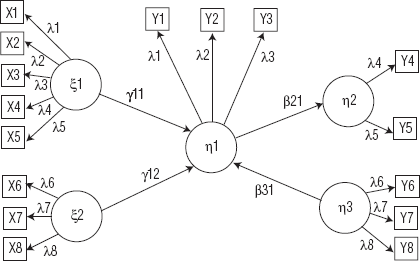
The LISREL Model
Measures of Brand-Name Standardization/Adaptation
Several researchers suggest that standardization versus adaptation may be considered a continuum, in which a company's marketing activities fall between the two extremes (Daniels 1987; Jain 1989). Rosen, Boddewyn, and Louis (1989) criticize previous research in brand standardization, because most international survey research has left it to the respondent to define standardization or adaptation. For example, previous empirical studies of corporate standardization practice have focused on asking executives if their firms generally made changes in branding.
To achieve a better definition, we developed three measures representing the standardization/adaptation continuum. These measures focus on the number of brand name variations a firm uses throughout the world. A completely standardized brand has one name that is used in all countries and therefore has one variation. An adapted brand name may have a few or many variations throughout the world.
The measures are an expansion of those used by Akaah (1991), Cavusgil and Zou (1994), Cavusgil, Zou, and Naidu (1993), Ozsomer, Bodur, and Cavusgil (1991), Rosen, Boddewyn, and Louis (1989), and Sorenson and Wiechmann (1975). These measures are as follows:
The number of different brand names (or brand-name variations) across international markets that was used for the selected product (Y1). Respondents were asked to indicate whether the number of different brand names was 1, 2, 3, 4, or 5 or more (the greater the number, the less standardized was the brand name). Approximately 60.9% of the respondents indicated that their firms used only one brand name for the focal product across markets. Conversely, approximately 39.1% of respondents indicated that their companies used more than one brand name (or brand-name variation) when the product was marketed across countries.
Respondents were asked to list the brand names their firms used in each country (if applicable) where the product had the highest sales volume in each of seven major regions of the world (Y2). These regions were defined as Africa, Asia, Europe, Far East and Pacific Rim, Middle East, North America, and South America. The number of different brand names listed was summed (the greater the number, the less standardized was the brand name). For example, if a respondent listed the same brand name for the product sold in Egypt, France, and Brazil (the countries with the highest sales of the product in Africa, Europe, and South America, respectively), 1 was coded. If two of the three brand names were the same but the third one was different, 2 was coded. If all three brand names listed were different, 3 was coded.
Respondents were asked to select one of four categories that best represented their company's international branding strategy for the chosen product (Y3). The categories identify four degrees of variation (1 = “use same name in all markets”; 2 = “use variations of the same name, e.g., translation of the brand into local language, across markets”; 3 = “use a completely different name in some markets”; 4 = “use a completely different name in every market”). Thus, the greater the number, the less standardized was the brand name, and the more variations there were.
Environmental Factors
One measure was developed for each of the five environmental factors of religion, language, education, technology, and the economy. Respondents were asked to list the host country with the highest sales volume for the focal product in each of seven major regions of the world (i.e., Africa, Asia, Europe, Far East and Pacific Rim, Middle East, North America, and South America). The five environmental forces were then measured for each country listed by the respondents. All the environmental factors were measured through secondary sources such as European Marketing Data and Statistics (Euromonitor 1995) and the United Nations’ (1994) Statistical Yearbook.
We coded religion (X1) by counting the number of different religions of the host countries beyond the home country's religion. Terpstra and David (1991) indicate that the major religions of the world include Buddhism, Christianity, Hinduism, Islam, Judaism, and Shinto. In this research, we considered these six religions for the analysis. We assigned one religion to each listed host country on the basis of the religion of the majority of its people (Euromonitor 1995; United Nations 1994). We summed the numbers of different religions of the countries beyond the home country religion. For example, if a respondent listed Egypt, France, and Brazil as the countries with the highest sales volume for the product, then the religion of the majority of people in each country was Islam, Christianity, and Christianity, respectively. Therefore, the total number of religions beyond that of the home country of the United States was one, because the major religion of the United States is Christianity.
We coded language (X2) by counting the number of different languages of the host countries listed by the respondent compared with that of the home country. We assigned each listed host country one language that was spoken by the majority of its people (Euromonitor 1995; United Nations 1994). We summed the numbers of languages of the host countries beyond the home country. For example, if a respondent listed Egypt, France, and Brazil as the countries with the highest sales volume for the focal product, the language of the majority of people in each country is Arabic, French, and Portuguese, respectively. Therefore, the total number of different languages if the home country was the United States was 3, because the major language of the United States is English.
Education (X3) was based on the literacy rate in the host country compared with the rate in the home country (Killough 1978). Three levels of literacy were used (United Nations 1994): greater than 90%, 70% to 90%, and less than 70%. Using the United States as the home country, the literacy rate was coded 0 if all the countries in which the respondent firm markets had a literacy rate greater than 90%, which is the U.S. rate. The literacy rate was coded 1 if at least one country where the product was marketed had a literacy rate of 70% to 90% and no other host country marketed to had a rate less than 70%. The rate was coded 2 if at least one country had a literacy rate less than 70%. For example, if a respondent listed Egypt, France, and Brazil as the host countries with the highest sales volume for the product, the literacy rate for each country was recorded as 51%, 99%, and 78%, respectively. In this case, the extreme country literacy rate was Egypt and therefore was coded 2.
The economy (X4) was based on the per capita income (PCI) in the host countries compared with the PCI in the home country. Three levels of PCI were used (United Nations 1994): greater than $15,000, $5,000 to $15,000, and less than $5,000. The United States, with a PCI greater than $15,000, was used as the home country, so the PCI was coded 0 if all countries in which the respondent firm marketed had a PCI greater than $15,000. The PCI was coded 1 if at least one country marketed in had a PCI of $5,000 to $15,000 and no other host country marketed in had a PCI less than $5,000. The PCI was coded 2 if at least one country had a PCI less than $5,000. For example, if the listed host countries were Egypt, France, and Brazil, the PCI for each country was recorded as $614, $21,053, and $2,646, respectively. The PCI value was coded 2, because at least one country had a PCI less than $5,000.
Technology (X5) was based on the number of available televisions in the host countries compared with the number in the home country. Television availability was chosen because television advertising stimulates buyer perceptions that may affect international branding strategy, as discussed previously. Three levels of the number of available televisions (per 1000 inhabitants) were used (United Nations 1994): greater than 600, 200 to 600, and less than 200. The United States, where the number of televisions per 1000 inhabitants is greater than 600, was used as the home country, so the number of available televisions was coded 0 if all countries in which the respondent firm markets have a number of televisions greater than 600. The number of televisions was coded 1 if at least one country marketed in had 200 to 600 televisions per 1000 inhabitants and no other host country marketed in had a number less than 200. The number of televisions was coded 2 if at least one country had less than 200 televisions. For example, if the listed host countries were Egypt, France, and Brazil, the number of available televisions (per 1000 inhabitants) for each country was 116, 407, and 207, respectively. Here, the extreme country was Egypt. Therefore, technology was coded 2.
Market Structure Factors
The market structure factors are those that have an impact on the conduct of a firm's strategy. Scherer (1980) and Porter (1979, 1980a, b) indicate that the market structure includes intensity of buyers, sellers, and distribution channels, as discussed previously.
We measured intensity of buyers (X6) by asking respondents to indicate whether the focal product was an industrial or consumer product (Akaah 1991). As discussed previously, the number of buyers is usually higher in consumer markets than in industrial markets. An industrial product was coded 0, and a consumer product was coded 1.
We measured intensity of competition (X7) by asking respondents how much competition their product faces in international markets. We used a seven-point scale ranging from 1 = “little competition” to 7 = “intense competition” (Nohria and Ghoshal 1994).
We measured intensity of distribution (X8) by asking respondents to choose one of five categories that best described the number of distributors or outlets available for the focal product in their typical international market (1 = “one distributor or outlet for the country,” 2 = “one distributor or outlet per region within the country,” 3 = “one distributor or outlet per major city,” 4 = “two to ten distributors or outlets per city,” 5 = “more than ten distributors or outlets per city”). The scale of the measure was similar to the one used by Boulding and Staelin (1990).
Performance
For brand-name strategy consequences, we measured performance using respondent perceptions of costs and sales volume. Lusch and Laczniak (1989) cite advantages and disadvantages associated with using executive perceptions to test the SCP model. In particular, Lusch and Laczniak (1989, p. 292) note that “the weight of research supports the relationship between executive perceptions of the strategic situation and subsequent organizational actions.” Other marketers who have used executive perceptions in this manner include Bucklin and Sengupta (1993), Cavusgil and Zou (1994), Grant (1987), Powell (1992), and Samiee and Roth (1992).
For cost savings, respondents were asked to indicate the effect their company's branding strategy has had on manufacturing and marketing costs (Sorenson and Wiechmann 1975). The item included a 7-point scale, where 1 = “greatly lowered costs” and 7 = “greatly increased costs” (Y4). In addition, respondents were asked to determine the relative performance of the product to the company's goal of cost savings (Cavusgil and Zou 1994). This was an 11-point scale measure, where −5 = “far below goals” and +5 = “far above goals” (Y5).
For sales volume, respondents were asked to indicate the effect the company's brand-naming strategy has had on international sales volume (Y6) and the market share (Y7) of the product. These measures used 7-point scales, where 1 = “strong negative effect” and 7 = “strong positive effect” (Bucklin and Sengupta 1993; Grant 1987; Powell 1992; Samiee and Roth 1992). In addition, respondents were asked to indicate the international performance (in terms of sales volume) of the product compared with the company's goals (Cavusgil and Zou 1994). The measure contained an 11-point scale, where −5 = “far below goals” and +5 = “far above goals” (Y8).
Sample
We employed a survey method to collect data for testing the hypotheses. We sent a questionnaire to 680 U.S. corporate marketing executives who represent a variety of product categories (e.g., industrial and consumer, durable and nondurable products). The selection of the companies was random. However, to increase the chance that selected companies have international operations, we chose only companies with sales volume greater than $10 million a year. We used Directory of Corporate Affiliations (National Register Publishing 1995) and Ward's Business Directory of U.S. Private and Public Companies (Gale Research 1994c) to select the companies and obtain their addresses. We enclosed a cover letter describing the nature of the study and a stamped, addressed return envelope with the questionnaire.
After three weeks, another wave of questionnaires along with reminder cover letters was sent to the selected executives. Of the 680 questionnaires mailed, 249 were returned, resulting in a 37% response rate. This is a relatively high response rate compared with the rates in many prior industrial research studies (Rosen, Boddewyn, and Louis 1989). Of the respondents, 55 indicated that their companies did not market their products internationally. Of the remaining, 177 respondents provided usable questionnaires. The respondents, on average, had worked 13.7 years for their current companies and had held their current positions 4.1 years. Most respondents were vice presidents of marketing and sales.
We assessed nonresponse bias by randomly selecting a sample of two groups. The first group consisted of a random sample of 123 nonrespondent firms. The second group consisted of a random sample of 66 respondent firms. We then compared these two groups on the basis of three variables: sales volume, number of employees, and the number of years since each firm initiated operations. The t-values of the differences in the means for the two groups in the chosen variables were 1.03, 1.14, and .78, respectively. Thus, no significant differences between the two groups were found.
Analysis and Results
The conceptual model in Figure 1 was evaluated by means of LISREL 8.0 (Jöreskog and Sörbom 1993). A schematic representation of the LISREL model is shown in Figure 2.
Measurement Model Results
The estimated values between the observed variables and their respective latent constructs in the model are all acceptable. The correlation matrix for all measures is shown in Table 1. The parameter estimates in the measurement model were generally high, as is indicated by the t-values in Table 2. Evidence of convergent validity is indicated by all lambdas being significant.
Correlation Matrix of All Measures Used

Model Parameter Estimates

All λ estimates are significant at the p < .01 level except X7 (competition, p = .08).
A discriminant validity criterion developed by Fornell and Larcker (1981) was applied. According to the criterion, the average variance extracted of manifest variables by constructs should be greater than the variance shared between a construct and other constructs in the model (i.e., the squared correlation between two constructs). Table 3 shows the correlation matrix among the constructs. Adequate discriminant validity is evident for the strategy, sales, and environmental constructs, because their diagonal elements are greater than the off-diagonal elements in their corresponding rows and columns. Market structure and cost savings constructs did not meet this criterion. However, these two constructs were kept in the model because their theoretical bases and convergent validity were satisfactory. A similar approach was applied by Green, Barclay, and Ryans (1995).
Correlation Between Constructs
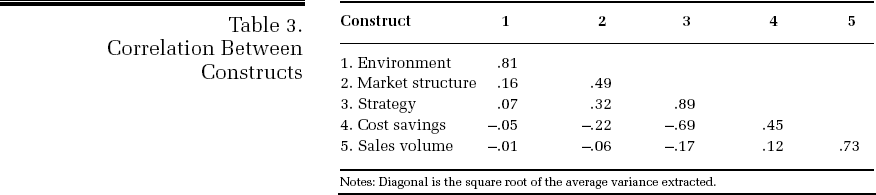
Notes: Diagonal is the square root of the average variance extracted.
The results of the reliability estimates given by Cronbach's alpha suggest that there is sufficient internal consistency among the measures, with the exception of market structure and cost measures. A low coefficient alpha was reported in previous marketing studies (e.g., Bucklin and Sengupta 1993; Ganesan 1994).
Structural Model Results
The results of the structural model are presented in Table 4. The model chi-square (with 90 degrees of freedom) is 166.75 (p < .01). The goodness-of-fit index (GFI), adjusted goodness-of-fit index (AGFI), root mean square residual (RMSR), and comparative fit index (CFI) are .90, .84, .09, and .95, respectively. Although there is little agreement on indices of model fit, the CFI is commonly reported in current marketing studies (Ping 1995). Several researchers propose that a CFI value greater than .90 indicates a significant fit (e.g., Bagozzi and Heatherton 1994; Bentler and Bonett 1980). Furthermore, examination of the modification indices for our model did not suggest the inclusion of additional paths that would improve the fit of the model and could be substantively interpreted.
Parameter Estimates for the Structural Model

The results show that market structure factors significantly influenced brand-name strategy (t = 2.86, p < .01), but environmental factors do not. Thus, H2 is supported but H1 is not. Furthermore, brand-name strategy significantly affects cost savings (t = 2.57, p < .01). Thus, H3 is supported. Brand-name strategies also significantly affected sales volume (t = 2.04, p < .05), which does not support H4. That is, less standardization leads to lower sales volume.
A Rival Model
An emerging consensus in structural equation modeling is that researchers should compare rival models, not just test the proposed model (Bollen and Long 1992). One type of rival model allows no indirect effects between antecedents and consequences of a focal research construct (Morgan and Hunt 1994). Here, the direct relationships between environmental differences, market intensity factors, and brand-name strategy were tested with each of the two consequences (cost savings and sales volume). Figure 3 shows the goodness-of-fit indices of the rival model and indicates that the rival model does not provide a better fit than the proposed model. Therefore, including the firm's conduct (i.e., branding strategy) as a mediator between the antecedents and the consequences improves the fit of the model.
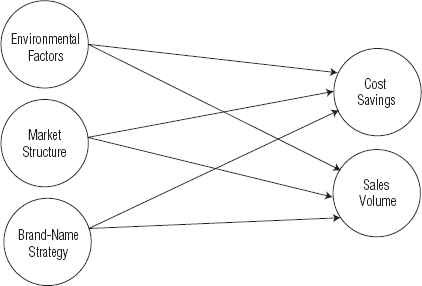
The Rival Model
Discussion and Conclusions
The literature on branding in an international context is somewhat sparse. This study represents an effort to test several major hypotheses related to the branding strategy of standardization/adaptation. The results are discussed in three parts: (1) the relation between environmental factors and branding strategy, (2) the relation between market structure and branding strategy, and (3) the impact of branding strategy on cost savings and sales volume.
The results did not support H1, that environmental differences between home and host countries have an impact on the branding strategy. The majority of firms do not seem to incorporate environmental factors when deciding whether to standardize their brand names or adapt them to the environmental conditions of the host countries.
There are several possible interpretations of this nonsignificant finding. These include compensation for environmental differences by global technology and telecommunications; ethnocentric use of a standardization strategy while the differences are ignored; the targeting of urban markets where fewer differences exist; and the product types referenced in this study, which were not culturally bound.
First, firms may believe that, as some scholars claim (e.g., Winram 1984), technological advances have overcome the barriers of the environmental differences (such as culture) among countries and therefore environmental factors become less important when firms determine branding strategies. Satellite communications provide access to global news and entertainment networks in every country. Broadcasting infrastructure is ubiquitous (unlike Internet access and personal computer ownership), and the manufacturers of telecommunications services and products are themselves transnational organizations. The use of televisions in this study is the most appropriate indicator of technology available and is a valid proxy for (popular and affordable) technology.
A second justification for not considering the environmental factors is that firms may have an ethnocentric orientation toward international markets. Adoption of an ethnocentric approach generally implies that environmental factors in overseas markets are not typically investigated by the firm (Wind, Douglas, and Perlmutter 1973) or that the firm searches out markets that are similar to the home country and markets primarily to them.
A third justification is that many products may be targeted to urban markets and not rural markets in host countries. Hill and Still (1984b) find that there is less adaptation of products targeted to urban markets than of those targeted to rural markets because urban markets are less grounded in the local host country's culture than rural markets. In addition, urban centers are usually the destinations of both business and tourism travelers. Firms may want to keep the same brand name when marketing in cities and airports across multiple countries (regardless of the environmental differences between them) to increase purchase by international travelers.
Finally, certain types of products may be more susceptible to environmental influence than others. Quelch and Hoff (1986) propose that consumer products used in the home (e.g., food) may be more environmentally bound than products used outside the home (e.g., automobiles). Firms that participated in this study market products used mainly outside the home, which are not as greatly influenced by environmental differences.
As the results indicate, the firms considered market structure factors when choosing their international branding strategies. The greater the intensity of competition, buyers, and distribution, the less standardized (the more varied) is the brand name across markets (H2). Firms may proactively or reactively adapt their brand names to improve their competitive standing (Cavusgil, Zou, and Naidu 1993; Jain 1989).
The results imply that when firms face an intense number of buyers, they tend to avoid having the same brand name for the product. Companies may believe that having the same brand name for a large number of buyers may negatively affect the brand. A high intensity of buyers may mean that a firm must provide choices of different quality levels at different price ranges to satisfy several market segments across countries. One brand, in these circumstances, may result in a dilution of a high-quality and/or high-price brand-name image. Therefore, firms may react to many buyers by providing a variation in the brand name for each quality and price level offered.
Similarly, the results indicate that products that are intensively distributed tend to have less standardized brand names (greater brand-name variation). This may be attributed to the argument that the more intense the distribution of a product, the less homogeneous are the market segments. Accordingly, firms may tend to offer variations of the brand name for different market segments.
As expected, the results show that the less standardized the brand name, the less are the cost savings (H3). One of the main rationales in favor of standardization is cost savings, and our findings support this notion. A brand-name standardization strategy can offer many cost advantages to the firm through economies of scale. Variations in brand names lead to an increase in the costs of promotion, distribution, and packaging.
The study results also indicate that firms appear to have lower sales volume if they use a modified name rather than a standardized brand name. Thus, H4 is not supported. One reason for this result may be the growing number of business and tourism travelers across countries, which creates an incentive for firms to standardize brand names—specifically, in urban areas, airports, and gift shops. Accordingly, a higher sales volume will result as international travelers recognize and purchase products with global names.
Product type and the importance of the brand-name image may also play a role in determining the increase or decrease in sales volume of a standardized brand. A global brand can be particularly important for expensive products (e.g., cars, computers), for which there are risks that the product may be technologically surpassed by a competitor. For example, companies such as Sony and Canon, which operate in markets where technology and product quality are important, have benefited financially from a globally standardized brand name (Aaker 1991). Thus, standardization of brand names for these products may increase their sales volume.
Implications and Future Directions
Several guidelines can be drawn from this study to formulate international branding strategies. We identify a group of market structure factors that firms should consider when developing brand names. When there is a large number of buyers and sellers in a market, firms may want to offer a modified brand name. Brand-name adaptation also should be studied when the available distribution channels for the product are intensively coordinated. Furthermore, because of the significant impact of market structure factors on branding strategy, they should be considered early in the branding process.
Firms should seek to standardize brand names wherever possible, because standardization leads to cost savings. Brand-name standardization also appears to increase sales volume, which has the potential to increase revenue. However, sales volume increases may also be due to the product type and the chosen target market segments—conditions that were not directly studied in this research. Standardization of brand names may be financially successful in some product categories and across some market segments (e.g., people in urban areas) but not in others.
The environmental factors that were studied did not influence branding strategy. This finding may be a result of firms currently targeting similar market segments across countries, such as cities, airports, and gift shops, plus marketing products that are less influenced by culture and other environmental factors (e.g., electronic products). Environmental forces may be more influential as firms move into the rural areas of host countries and market products that are more culturally bound (e.g., food).
To date, literature studying the topic of standardization/ adaptation has been largely descriptive. To enhance the understanding of the nature of branding strategy, more empirical research is needed. Further research should be conducted to determine which of the market structure factors (i.e., intensity of buyers, sellers, and distribution) is more important for firms to consider in the branding decision. Such knowledge will help firms incorporate the most important factors early in the brand-name development process.
We find that special attention should be paid to the development of the variables being measured. The low internal consistency among the measures for market intensity and cost savings suggests a need for better measures for these constructs. Furthermore, this study relied largely on executives’ perceptions to operationalize many of the variables. Although it has been shown that this approach to data collection is generally reliable and valid, the findings can be strengthened through alternative measurement approaches.
The SCP model may be useful in other marketing research areas. In particular, this model appears to be successful in explaining marketing phenomena across industries and/or across countries.
Finally, an important direction for further research is to replicate this study in different countries. Respondent firms in this study were U.S. companies, and it will be of particular interest to study firms headquartered in other countries. The use of U.S.-based managers served many purposes: to reduce the administrative costs of the survey, to reduce language and translation problems, to identify executives of one type for consistency and comparability, and to use one nation as a common denominator from which to measure differences. Further research would benefit from a multicountry, multi-company sample.
Footnotes
Appendix. Survey Questionnaire
We are interested in learning how companies use brand names in international markets. In answering the following questions, please think of one product marketed internationally under your own company's brand name(s). Please think of your company's branded marketing efforts; do not include efforts where your company's products sell under another company's brand name.
Part I: Brand Information
Part II: Market Information
Part III: Branding Strategy
Part IV: Background Information