






Abstract
Although the United States has been one of the leading actors in international trade, limited evidence exists as to individual U.S. company relationships with overseas customers. On the basis of a sample of 201 U.S. exporting manufacturers, the authors draw a comparison between harmonious and problematic foreign business relationships. The findings reveal that, as opposed to problematic cases, firms with harmonious relationships are more experienced, employ more people, and exhibit more active behavior toward conducting their foreign business. Such firms sell to a greater number of export markets, deal with more foreign customers, and obtain more orders. The study also shows that harmonious relationships with overseas customers are distinguished by greater dependence, trust, understanding, commitment, communication, and cooperation but less distance, uncertainty, and conflict between the parties. The article provides export management with a set of guidelines for establishing, developing, and sustaining successful export business relationships.
Recent decades have witnessed an enormous expansion of world merchandise trade, from $1.9 trillion in 1980 to more than $5.5 trillion in 2000 (World Bank 2001). This has given rise to global linkages of markets, technology, and living standards that were previously unknown and unanticipated. The contribution of the United States to this phenomenon has been pivotal, largely attributable to the generous economic assistance provided after World War II through the Marshall Plan to other nations (Cateora and Graham 2002). This has helped the United States achieve a dominant position in international trade throughout almost the entire postwar period, averaging approximately 17% of world merchandise exports (U.S. Department of Commerce 2000). 1 Despite this apparent success, the United States has repeatedly been accused of being one of the most indifferent export nations in the world (Onkvisit and Shaw 1997).
Although at times several parties have been blamed for this situation, including academia, labor, the public, and the government, a large part of the responsibility can be attributed to the prevailing myopia among U.S. managers, who regard exporting, compared with domestic business, as characterized by (1) fiercer and manifold competition, (2) greater business risks and costs, (3) marginal financial benefits, (4) complex bureaucratic procedures, (5) limited growth opportunities, and (6) severe environmental constraints (Moini 1997; Rao 1990). This attitude is more endemic in small and medium-sized enterprises (SMEs), which suffer from limited financial, human, and allied resources (Miesenböck 1988). Only one-third of these companies are engaged in foreign operations, contributing to only one-third of U.S.-manufactured exports (World Bank 2001).
Although this negative predisposition appears to exist in the majority of U.S. firms, the question arises why some exporters are doing particularly well in foreign markets and are able to continue to do so, while others are running into difficulties and appear doomed to fail. The economists’ answer to this question stresses the cost-efficiency aspects of the exporter–importer transaction, as opposed to the behaviorists’ explanation, which hinges on the way the relationship between the two parties is managed (Håkansson 1982). Indeed, evidence has shown that a clear understanding of how to initiate, develop, and sustain sound manufacturer–customer relationships in international markets is critical to successful export involvement and expansion (Evangelista 1994; Leonidou and Kaleka 1998; Rosson and Ford 1982; Styles and Ambler 1994). Although researchers have spent considerable effort investigating the economic approach, the behavioral perspective has been virtually neglected.
We espouse such behavioral positions by drawing a comparison between U.S. exporters with harmonious foreign working relationships and those experiencing problematic relationships. The emphasis is on the identification of differences and/or similarities between these two groups of firms regarding company characteristics, export involvement, foreign operations, and particularly the atmosphere in which the relationship has developed. Our ultimate aim is to isolate the organizational, internationalization, and atmosphere factors that lead to satisfactory, enduring business relationships in export markets. Before expanding on these central issues, we explain the specific methodology used to conduct the study among U.S. exporters. The article concludes with the implications of the study and a set of managerial guidelines for building successful export customer relationships.
Details about the Study
The target population was indigenous manufacturing concerns based in the United States. We identified these from the American Export Register (Thomas Publishing Company 1999), which includes more than 42,000 companies classified by industrial activity. Using a stratified random procedure, we selected a sample of 1500 firms and subsequently contacted them by mail. We needed the stratification to solicit participation from firms across several industries and geographic locations. We addressed the cover letter to the person responsible for a firm's export activities. To ensure that an appropriate individual filled out the questionnaire, several questions at the end of the instrument requested the respondent's name, job title, and exporting duties. Furthermore, another set of questions evaluated the informant's knowledge regarding the firm's dealings with overseas customers, involvement with these customers, and confidence in answering the questionnaire (Kumar, Stern, and Anderson 1993).
The survey instrument addressed issues pertaining to corporate activities, working relationships, and company demographics. Some of the questions referring to corporate activities and company demographics were open-ended, and others were precoded. Working relationships were assessed through a battery of statements, and seven-point scales were used to capture responses (see the Appendix). Before the launch of the full-scale study, both the questionnaire and the survey procedures were pretested on a small sample of exporters; this pretest suggested only minor changes. After two mailings, 215 responses were received from the companies contacted. Of these, 201 adequately completed the questionnaire and satisfied our informant quality requirements. 2 This represents an effective usable response rate of 13.4%. The questionnaire was personally administered by the president/general manager (26%), export/marketing officer (62%), or other company executive (12%). Random follow-up personal telephone interviews were conducted with approximately 10% of the respondents, which provided greater insight into the nature of interactions between exporters and their foreign customers.
Participating companies originated from 36 states and exported to as many as 83 foreign market destinations. Three-quarters of the participant firms were producers of industrial goods, mainly machine tools, supplies, and materials, and the remainder were engaged in the manufacture of such consumer products as household durables, foodstuffs, and beverages. Most of the companies were young (22 years, on average), with relatively short export experience (9 years, on average). The overwhelming majority of the participants were SMEs employing an average of 136 persons, of whom only 12 were directly engaged in exporting. The average value of company assets amounted to $14.7 million, but only one-fifth of this figure was used in export-related operations. Company sales turnover averaged $16.4 million, of which the contribution made by exports was relatively low (approximately 14%).
For analytical purposes, respondents were divided into two major clusters: those having harmonious relationships with foreign customers and those experiencing problematic situations. The harmonious/problematic classification was based on the degree of satisfaction enjoyed from the relationship with foreign customers in general. To ensure a clear distinction between the two groups of firms, exporters with harmonious relationships composed the upper third of the sample in terms of satisfaction measurement, and exporters with problematic relationships constituted the lower third. This was based on a summated scale, which represented the average of the mean scores received by the five items operationalizing satisfaction with the relationship. 3 Comparisons between the two groups of firms on company characteristics, export involvement, foreign operations, and relationship atmosphere were conducted through a series of t-tests and chi-square tests for two independent samples. 4
Company Characteristics
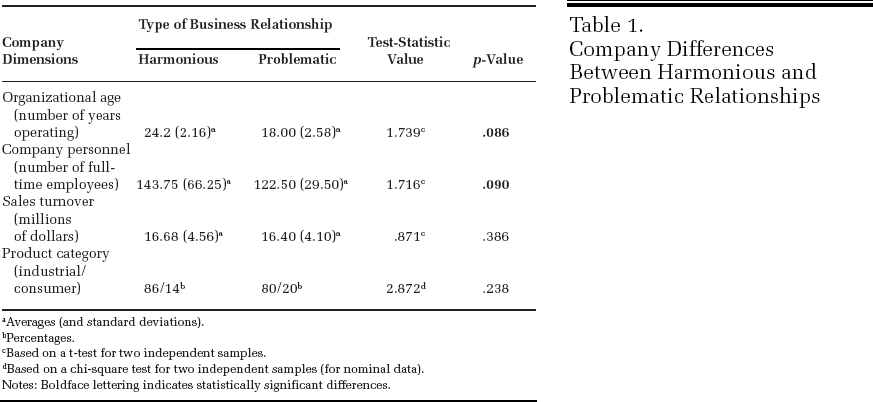
Certain company characteristics play an important role in shaping the form and outcome of seller–buyer relationships (see Table 1). With regard to organizational age, the evidence cited here reveals that firms with harmonious relationships are significantly older than their counterparts with problematic export business associations. This implies that established firms, with a long presence in the home market, can handle their relationships with foreign customers more effectively. It should be remembered, therefore, that the accumulation of sufficient experience and development of adequate skills in the domestic market could be transferred to dealings with foreign customers.
Company Differences Between Harmonious and Problematic Relationships
Averages (and standard deviations).
Percentages.
Based on a t-test for two independent samples.
Based on a chi-square test for two independent samples (for nominal data).
Notes: Boldface lettering indicates statistically significant differences.
Significant differences between the two groups of firms were also observed regarding company personnel. Specifically, companies exhibiting harmonious relationships employed more people on a full-time basis than did those experiencing problems. It might be suggested that achievement of employee size advantages should enhance the firm's ability to cultivate sound foreign business relationships. Firms may attain this through assigning more people to accommodate overseas customer requirements, possessing more collective experience in effective customer relationship management, selecting people who are better suited to foreign business negotiations, and offering export management training and development programs.
Sales turnover, a reflection of the firm's efforts in both domestic and foreign sales, did not seriously differ between the two exporter categories. This is due, in part, to the limited contribution made by exports to total corporate sales, which masks the potential positive effect of relationship quality on export sales. Another explanation lies in the possibility that the behavioral handling of the working relationship is more closely related to nonfinancial than financial aspects of performance. Furthermore, it is likely that U.S. manufacturers, because of their tendency to be inward looking, deliberately pay less attention to their relationships with foreign customers.
The nature of the products exported, whether industrial or consumer, appears not to affect the degree of satisfaction derived from the working relationship. The vast majority of exporters in both relationship categories were producers of industrial goods, and a small proportion of firms included exporting manufacturers of consumer products in each group. This evidence is in line with the highly industrialized profile of the U.S. economy and indicates that the development and sustenance of harmonious trading relationships with overseas customers is an equally challenging task in both industrial and consumer markets.
Export Involvement
Although prior research has identified a strong association between the firm's export involvement and its foreign business relationships (Leonidou and Kaleka 1998), our study provides minimal support for this connection (see Table 2). In terms of export experience, both firms with harmonious relationships and those with problematic ones initiated their overseas operations at approximately the same time period, which suggests that this is not an important factor in building sound foreign business relationships. This finding might be attributed to the relatively short period of involvement in export operations (approximately ten years), which prevents the accumulation of sufficient experience with foreign customers.
Export Involvement Differences Between Harmonious and Problematic Relationships

Averages (and standard deviations).
Percentages.
Based on a t-test for two independent samples.
Based on a chi-square test for two independent samples (for nominal data).
Notes: Boldface lettering indicates statistically significant differences.
Similarly, no significant differences were revealed between the two exporter groups regarding the proportion of corporate sales accounting for exports, though exporters with harmonious relationships reported a somewhat higher export sales intensity ratio. This conforms to the previous finding on corporate sales, which likewise did not show any significant variation between the two clusters of firms. It is worth noting that, irrespective of the type of business relationship, the involvement of U.S. manufacturers in international operations is relatively limited—an issue of major concern for public policymakers. 5
With regard to export regularity, participant firms were more or less equally divided between those engaged in sporadic exporting and those adopting a systematic approach to foreign markets. However, although the former pattern would be expected to be more applicable in the case of firms with problematic foreign relationships and the latter to be more characteristic of companies enjoying harmonious relations, no major differences were found between the two groups. That the export activities of U.S. manufacturers are neither entirely regular nor entirely sporadic indicates a relatively half-hearted approach to overseas markets, an issue that warrants consideration in national export policy.
Significant differences were identified regarding the export approach to foreign markets. Firms with harmonious relationships tend to be more active in export business than their counterparts that encounter problematic situations. Notwithstanding these differences, the overall picture of U.S. exporters in terms of actively seeking foreign business opportunities could be described as poor, giving support to their characterization as the world's most indifferent exporters (Holm, Eriksson, and Johanson 1996; Johnson, Sakano, and Onzo 1990). Export management should find advantage in pursuing an active export approach, as this is more likely to enhance satisfaction with foreign customer relationship outcomes.
Foreign Operations
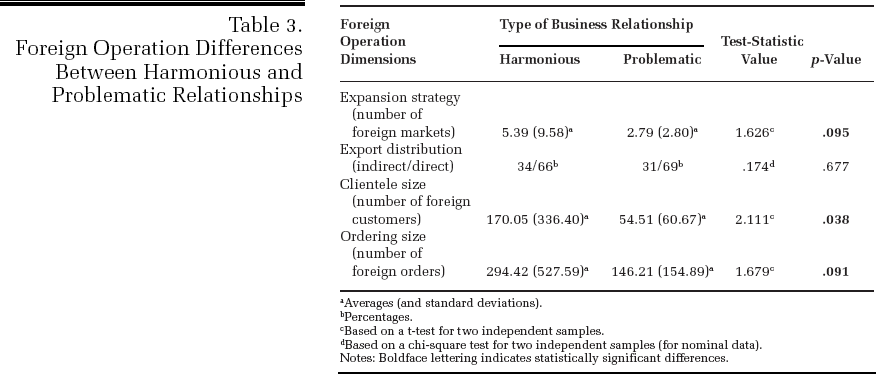
In contrast to export involvement, our study shows differences in foreign operations between the two exporter categories (see Table 3). Specifically, firms with harmonious relationships tend to sell to a greater number of countries (on average 5.39) than do those confronting problems. 6 To some extent, differences in expansion strategy can be explained by the positive feeling generated by firms’ relationships with customers in one country, which acts as a motivating force in initiating relationships with buyers in other countries. However, compared with competitors from other countries, U.S. manufacturers’ foreign market coverage is relatively concentrated, thus increasing their exposure to market dependence–related risks. Although there might be a limit to the number of export markets that a firm is able to serve at a certain time, it appears that U.S. exporters could benefit from expansion into new foreign markets.
Foreign Operation Differences Between Harmonious and Problematic Relationships
Averages (and standard deviations).
Percentages.
Based on a t-test for two independent samples.
Based on a chi-square test for two independent samples (for nominal data).
Notes: Boldface lettering indicates statistically significant differences.
With respect to export distribution, both groups of companies sell their products abroad using mainly direct methods, though many firms in each group also employ indirect distribution, such as foreign buying offices, export management companies, and piggyback exporting. A slightly higher tendency to employ direct distribution methods was observed among firms experiencing problematic relationships, but this was not significantly different from that of firms enjoying harmonious relationships.
Significant variations between companies with harmonious and those with problematic relationships were observed with respect to clientele size. The number of customers was three times greater in the former group. In line with our previous discussion on export market expansion, the satisfaction gained from one harmonious relationship provides the impetus to establish further associations with additional foreign customers. Most exporters reported that satisfied customers overseas tend to remain loyal to the exporter, repeat their purchases at regular intervals, and make positive comments to potential customers in the foreign market.
The number of orders also differed between the two groups. Compared with firms having problematic relationships, a higher frequency of receiving orders was found for firms having harmonious business associations. Given that both corporate and export sales were approximately the same between the two groups, it can be inferred that there are also differences in order size such that firms experiencing harmonious relationships handle smaller orders. Exporters may find it prudent to assess their capacity to handle foreign customer orders effectively, because excessive order size can pose problems in the relationship and its outcomes.
Relationship Atmosphere
Exchange processes between selling and buying companies do not exist in a vacuum but within an emotional context or “atmosphere.” This is complex, diverse, and dynamic, determining to a large extent the developmental pattern and operating mode of the working relationship. The nature of this atmosphere becomes even more critical in the case of international business activities, whereby interaction takes place among people with different backgrounds, cultures, and expectations (Hallén and Sandström 1991). For analytical purposes, we can distinguish between latent and manifest atmosphere; the former focuses on feelings about the relationship (i.e., trust, understanding, dependence, uncertainty, and distance), and the latter emphasizes actions taken within the relationship (i.e., adaptation, communication, commitment, conflict, and cooperation).
Latent Atmosphere
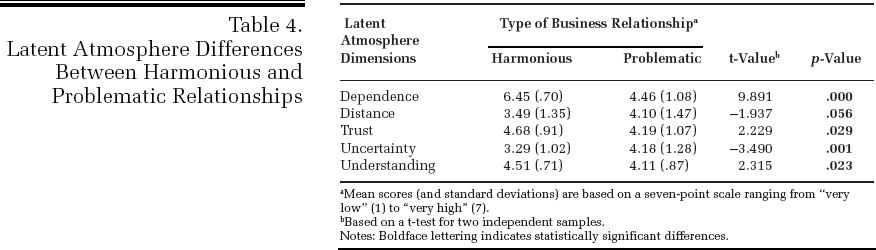
U.S. manufacturers’ dependence on foreign customers appears to vary in accordance with the status of the working relationship. The degree of dependence appears to be higher in harmonious than in problematic relationships (see Table 4). Managers in the former group believe that overseas buyers (1) provide a reliable and steady source of income for their business; (2) help them achieve some of their basic corporate goals, including growth, profitability, and even survival; and (3) offer valuable technological, marketing, and other input, which is critical for their domestic business. The existence of high dependence levels makes U.S. manufacturers particularly susceptible to influence strategies exercised by their overseas customers, especially because many of the respondents consider the substitution of their customers with others to be a cumbersome task.
Latent Atmosphere Differences Between Harmonious and Problematic Relationships
Mean scores (and standard deviations) are based on a seven-point scale ranging from “very low” (1) to “very high” (7).
Based on a t-test for two independent samples.
Notes: Boldface lettering indicates statistically significant differences.
Distance, that is, the degree of unfamiliarity with the working relationship with foreign customers, was found to be higher among exporters in the problematic category. Notably, distance differences between harmonious and problematic relationships were more evident in environmental (e.g., economic, political, legal) and cultural (e.g., norms, values, attitudes) than in structural (e.g., organizational structure, products, technologies) and procedural (e.g., working methods, operating processes) aspects. This reveals an inherent weakness among U.S. firms regarding a lack of good understanding of the highly volatile environmental factors surrounding international business operations. In turn, this can be attributed to the limited hands-on experience of U.S. firms with foreign markets.
Trust, the belief by one party in a working relationship that the behavior of the other is honest, sincere, and fair, was significantly higher in harmonious than in problematic relationships. Apart from the existence of an overall frankness characterizing their business transactions, exporters with harmonious relationships also stressed that foreign customers are generally reliable in keeping trade secrets regarding the venture, transparent in their dealings and transactions with their suppliers, and careful to make correct and substantiated claims. Maintaining high levels of trust is important in a business relationship because on the one hand, it leads to actions that will have positive outcomes, and on the other hand, it prevents behavior that will produce negative results.
Another latent atmosphere difference pertains to uncertainty. This dimension involves the degree to which the future status, direction, and outcomes of the working relationship can be predicted. In the present study, the level of uncertainty was higher in the case of problematic relationships. This can be attributed to various factors, such as inadequate information, substandard control mechanisms, and limited exposure to foreign markets. Conversely, exporters with harmonious relationships reported a much less uncertain atmosphere, and most of them were confident of their ability to make future decisions regarding various aspects of the working relationship.
Significant variations also occurred with regard to the level of understanding developed between the exporter and the importer. This was more evident for harmonious than problematic relationships, usually taking the form of firms (1) recognizing the rights and obligations of each party in the venture, (2) appreciating any difficulties associated with the working relationship, (3) sympathizing with any problems that may arise from the relational exchange, and (4) comprehending the conditions under which the relationship operates. Understanding can be harnessed when openness in communication, acceptance of a partner's idiosyncrasies, and forbearance in the face of occasional failures in the working relationship are encouraged. The aforementioned issues are critical in international business relationships because of educational, attitudinal, and value dissimilarities between the parties involved.
Manifest Atmosphere
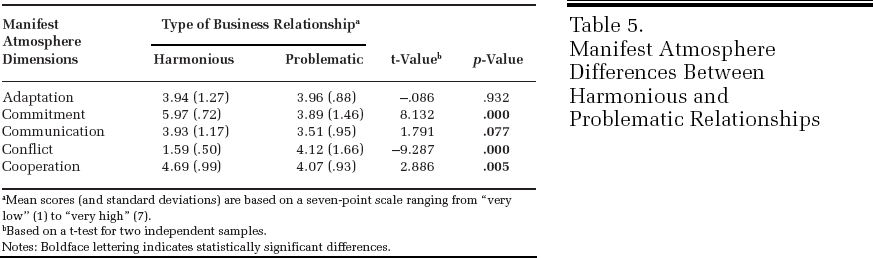
Although adaptation is an essential element in strengthening and prolonging collaboration with foreign customers, U.S. manufacturers appear to adapt only moderately, irrespective of the harmonious or problematic status of the relationship (see Table 5). This picture was evident on a wide range of issues pertaining to strategic, structural, and procedural aspects of the exporter's organization, indicating a relative reluctance to adjust to foreign buyer requirements. This finding can be ascribed to the low emphasis given by U.S. manufacturers to the international side of their business, as well as to the high costs involved in making organizational adjustments. However, many exporters experiencing harmonious relationships, as opposed to those facing problems, showed flexibility and promptness in responding to the demands of their customers.
Manifest Atmosphere Differences Between Harmonious and Problematic Relationships
Mean scores (and standard deviations) are based on a seven-point scale ranging from “very low” (1) to “very high” (7).
Based on a t-test for two independent samples.
Notes: Boldface lettering indicates statistically significant differences.
Commitment, an indication of a long-term undertaking to fulfill the requirements or common goals of the relationship, was significantly higher in harmonious than in problematic relationships. Many exporters in the former category explicitly stated that they were willing to preserve a long-lasting relationship with their foreign customers to obtain mutual benefits. For this reason, they indicated that they would accept any bonding or restrictions that would safeguard positive results in the future. Commitment was expressed not only in terms of company resources necessary to develop the business further but also with respect to allocating adequate managerial time and effort to sustain the working relationship. The low commitment levels demonstrated in problematic cases, though not necessarily reflecting a passive attitude toward the relationship, signify a short-term and opportunistic export behavior.
Differences between the two clusters of firms also existed with regard to communication aspects of the relationship; harmonious relationships were characterized by clearer, open, and systematic exchange of information. This was true both for tactical and strategic issues pertaining to the venture, as well as for the performance expected from this collaboration. However, even in the case of harmonious relationships, communication levels were still insufficient (below the mean), probably because of the presence of considerable geographic, cultural, and technological distances separating U.S. exporters from their overseas customers. Some of the firms admitted that they do not have adequate communication procedures and programs to coordinate their foreign working relationships.
As opposed to harmonious relationships, in which conflict was virtually nonexistent, exporters experiencing problematic cases suffered from a moderate degree of tension, friction, and frustration. This conflict resulted from disagreements with their foreign buyers caused by (1) incompatible goals, ill-defined roles, and attitudinal differences; (2) different perceptions of critical issues regarding the relationship; and (3) antithetical expectations regarding future courses of action. This situation might be attributed to the idiosyncratic effect of cultural and motivational factors, which in many cases are both unknown and unpredictable when firms are dealing with buyers in foreign countries.
Significant variations were also observed in the case of cooperation, which is the degree of joint effort, team spirit, and collaboration between the parties involved in the working relationship toward achieving both intra- and interorganizational goals. Harmonious relationships were found to be more cooperative than problematic ones. This was partly associated with the existence of more compatible goals, clearer responsibility areas, and better perceptual clarity. Most exporters also stressed their preparedness to understand and assist their foreign customers in the fields of marketing, purchasing, and technology, and vice versa. The ultimate aim was to have a balanced, reciprocal, and mutual relational exchange that would prove beneficial for both parties, while improving efficiency in the relationship.
Concluding Remarks
The main conclusion of this study is that building healthy, enduring export business relationships does not happen accidentally but requires the supporting, coordinating, and synergistic effect of organizational, involvement, operational, and relational parameters that need to be taken into account by both corporate and public policymakers. In terms of organizational aspects, the results suggest that exporters enjoying harmonious foreign business relationships are more experienced and employ more people than do those facing problematic situations. Exporters should therefore pay attention to developing experiential knowledge related to cross-cultural business relationship building. This knowledge can be acquired not only through exposure to real business situations, simulation training methods, and counseling from external experts but also through the appointment of experienced executives. In addition, an attempt should be made to select from the existing pool of managers those who are most capable of handling relationships with foreign customers. Such people should have an open, sociable, and cosmopolitan character and be in a position to understand foreign attitudes, customs, and values.
With respect to company involvement in exporting, the study reveals that in comparison with others, exporters with harmonious business relationships are more active in conducting their foreign business. It is therefore important that U.S. manufacturers develop greater interest in the international side of their business; divert more financial, human, and other resources to their export business; and adopt a more proactive, deliberate, and systematic approach toward serving overseas markets. 7 They should realize that nationalistic buyer behaviors, inexhaustible domestic opportunities, and government protectionist policies belong to the past and that the contemporary business scene consists of demanding global customers, radical market changes, and stiff international competition.
Regarding operational characteristics, the study discloses that, as opposed to exporters with problematic relationships, firms enjoying harmonious foreign trading associations sell to more markets and deal with more overseas customers (from whom they obtain more orders). Here, the focus should be on minimizing any psychological damage caused by unsatisfactory relationships through the design and implementation of special public policy programs. Particular attention should be devoted to firms in the early stages of internationalization, which are characterized by limited involvement in exporting to a relatively small number of psychologically close countries, because problems experienced at this juncture may lead to passive export behavior or even cause withdrawal from exporting. Within the context of these efforts, it is essential to suggest ways to overcome any relational problems that may arise when the firms deal with overseas customers and to illustrate the financial, strategic, and allied benefits derived from effective foreign customer relationship management.
The most striking finding of this research is that, in contrast with problematic foreign customer relationships, harmonious export business associations are distinguished by high levels of dependence, trust, understanding, commitment, communication, and cooperation but lower levels of distance, uncertainty, and conflict between the parties. From a relational perspective, this implies that exporting firms should appreciate that building optimal cross-border business relationships requires both the existence of certain positive elements (e.g., trust, commitment, cooperation) and the absence of others with negative impact (e.g., distance, uncertainty, conflict) that need to be monitored and manipulated constantly. Exporters should therefore recognize the importance of relationship management in achieving superior export performance (Leonidou and Kaleka 1998). In an era of increasing globalization of markets and intensifying competition worldwide, the challenge facing exporting firms is to establish, develop, and sustain a healthy pattern of interactions in their foreign customer relationships.
Export Management Guidelines
The evidence cited here helps isolate several essential factors that export management must consider in the endeavor to build sound relationships with foreign customers. 8 These include the following:
Treat Exporting as a Bundle of Business Relationships
Export managers should treat exporting as a portfolio of behavioral interactions with their foreign customers and not just as a series of financial transactions. These interactions are not static; rather, they may develop in different directions: Some are problematic and need elimination, others are inert and require improvement, and still others are healthy and demand close attention (Ford and Rosson 1982). Therefore, managers must set up a monitoring mechanism with a view to obtaining the appropriate mix of foreign business relationships, which will eventually help the company expand successfully abroad. Each relationship should be treated both as a separate case and in conjunction with other relationships in the company's portfolio.
Appoint People who are Suitable for Managing Relationships
Initiating, developing, and sustaining international business relationships require the recruitment of capable, specialized personnel. Apart from adequate skills in relationship management, cross-cultural sensitivity and language proficiency are important parameters in the proper handling of relationships with foreign customers (Cullen, Johnson, and Sakano 2000). Existing company staff members should also develop their relationship management thinking through proper direction, training, and motivation. In this respect, the hands-on knowledge of experienced in-house managers and/or external consultants is important to the development of successful relationships with overseas customers.
Adopt a More Formidable Approach to Exporting
Exporting should be viewed as one of the strategic options open to the firm, similar to that of developing an innovative product or entering a new market segment. If it is considered viable to pursue this option in terms of financial, technological, and other gains, the entire organization should direct its efforts toward making it as much of a success as possible (Leonidou and Katsikeas 1996). In this case, it is important for firms to adopt an active foreign business perspective in the form of in-depth analysis of market data, close watch of competitors’ actions, intensive interactions with foreign customers, cross-functional coordination within the organization, and systematic appraisal of relationship performance.
Get Closer to the Foreign Customer
The large geographic and psychological distances separating buyers from sellers in international markets, apart from increasing the level of complexity, constitute major barriers to export business development. To reduce distance, exporters (as well as their overseas customers) need to undergo rigorous cross-cultural training centering on factual (e.g., area briefings, lectures, books), analytical (e.g., case studies, culture assimilators, sensitivity training), and experiential (e.g., field trips, role plays, simulation) issues (Black and Mendenhall 1991). Spending some time with employees in the foreign customer's organization and vice versa will enhance closeness in the relationship.
Build and Sustain Trust in the Relationship
Foreign customer relationship building should be based on the development of trust between the parties. Trust serves as a bond that helps keep both parties in the relationship together. However, there must be an understanding that trust is not achieved overnight; instead, it takes time to develop, often amidst problems arising in the relationship. Gaining the trust of the foreign customer is critical in certain cultural settings (e.g., Japan, Russia, Saudi Arabia), where business is conducted not only on the basis of the best price or product but also with the organization or person deemed most trustworthy (Czinkota and Ronkainen 2001).
Reduce Foreign Business Uncertainty
Exporters usually operate in foreign environments that are insecure because of high diversity, complexity, and volatility. Operating in such environments may hamper the development of business relationships, unless uncertainty is reduced to acceptable levels (Welch and Luostarinen 1993). This can be achieved through the acquisition and dissemination of a satisfactory quantity and quality of information focusing, inter alia, on environmental trends, organizational developments, and managerial expectations. The availability of such information is more crucial during the early phases of a relationship because of the limited experiential knowledge of the foreign partner and its operating environment (Leonidou and Kaleka 1998).
Cultivate a Spirit of Mutual Understanding
Business relationships are often exposed to environmental uncertainties, unexpected events, and sudden actions. This situation is most pronounced in the case of foreign business interactions, which often create problems for the parties involved. In these difficult moments, it is important for the export manager to understand and assist the foreign customer, if the intention is to develop a promising long-lasting business relationship. In appreciation of this gesture, the foreign customer could be expected to offer reciprocal benefits to the manufacturer, when the latter experiences problems in another phase of the relationship.
Demonstrate Greater Interfirm Commitment
Accepting short-term sacrifices, costs, or restrictions required to produce and enjoy common benefits with the other party is essential in guaranteeing long-term prosperity of the relationship. As does trust, commitment takes time to develop and requires the continuous support of management in allocating adequate human, financial, and allied resources to the relationship. However, there must be a fair exchange of commitment in the relationship; otherwise, one of the parties will believe that it is only giving, without taking anything in return.
Invest in Direct and Open Communication
To overcome problems associated with national, organizational, and personal differences, there is a need to establish proper communication procedures that will improve the frequency, clarity, and type of the information exchanged. Participation in cross-cultural training programs is one way to improve the communication process, especially if it involves a personal presence in foreign markets by company officials at any hierarchical level. Communication can also be facilitated through the use of interactive online computer technology, which allows for a cheap, fast, and constant flow of information.
Keep Conflict at Manageable Levels
Some conflict is healthy for the relationship; otherwise, it will become passive, noninnovative, and eventually unreliable (Stern and El-Ansary 1988). Nonetheless, export managers should ensure that conflict is (1) functional, contributing to the long-term viability of the relationship; (2) overt, making all members of the relationship aware of its existence; and (3) controllable, allowing its resolution in an amicable way between the parties involved. Exporters should also take various preemptive measures that would help keep conflict with their overseas customers at manageable levels, such as defining clear-cut roles, sharing common expectations, and promoting joint decision making.
Enhance Interfirm Cooperation
A business relationship cannot operate without sustained cooperation in which each party knows exactly what to expect from the other. However, our study revealed relatively moderate levels of cooperation, which may impede the overall efficiency and future prosperity of the exporter–importer relationship. Therefore, firms need to improve cooperation by seeking, for example, greater goal congruency, better information availability, and more equitable exchanges with foreign customers. It should be appreciated that sound working relationships with international customers can be built through joint effort, team spirit, and collaborative gestures.
Footnotes
1.
Export contribution of the United States to world trade should be viewed within the context of the following three realities: (1) the production of services now accounts for more than two-thirds of the U.S. economy, (2) the United States has a stronger consumption than production orientation, and (3) U.S. multinationals make substantial exports through their manufacturing facilities in other countries (Cateora and Graham 2002; World Bank 2001).
2.
No significant problems were revealed by nonresponse tests that followed a three-stage procedure: (1) comparison of early versus late respondents across the salient constructs, (2) comparison between respondents and nonrespondents on firm characteristics, and (3) comparison of the respondent firm characteristics to the original sampling frame.
3.
The five items operationalizing satisfaction were the following: (1) “Deciding to work with these customers was definitely a terrible mistake on the part of our company” (R); (2) “On the whole, our company is satisfied with the working relationship that we have with these customers”; (3) “If my company could do it over again, I would definitely not choose these customers to work with” (R); (4) “We hope our working relationship with these customers lasts for a long time”; and (5) “The working relationship of our company with these customers has been an unhappy one” (R).
4.
Given the moderate size of the study sample for analysis purposes, and because the statistical significance of between-group differences depends on sample sizes, the p < .10 level was used as the criterion for isolating significant differences between the two exporter groups in this research.
5.
The governments at both the federal and the state level play an important role in stimulating firms’ involvement in and commitment to exporting activities. Broadly, national export promotion activities consist of (1) service programs, including export counseling, seminars, and financing, and (2) market development programs, such as participation in overseas trade exhibitions, provision of market research data, and dissemination of sales leads to indigenous firms (Kotabe and Czinkota 1992).
6.
The most common export destinations of the sample firms were Canada (32.8%), Mexico (31.3%), United Kingdom (22.4%), Germany (11.9%), France (10.9%), and Japan (10.4%), which basically reflect their relative contributions to the current U.S. export trade structure (World Bank 2001).
7.
Follow-up interviews with exporters suggested that committing adequate human and capital resources to export ventures is an investment in raising trust and confidence in the minds of their foreign clients. Cultivating long-term relationships with foreign customers by adapting and catering to their individualized needs and specifications was often cited as a fundamental element of success. In contrast, exporters embroiled in unsuccessful export relationships made an ill-timed discovery and admission. That is, exporting cannot be done half-heartedly. Foreign customers deserve as much attention and customer service as their domestic counterparts do.
8.
Although these guidelines provide general principles in export business relationship development, the details of how these principles are implemented with specific structures (e.g., appointing export personnel, designing the relationship management department, profiling relationship managers), processes (e.g., training export managers, assessing foreign markets, selecting and adding value to the customer), and plans (e.g., creating a portfolio of foreign customers, developing joint marketing plans, designing strategic business plans) could be the basis for further, qualitative investigation.
Appendix. Operationalization of Atmosphere Constructs

|
|
|
| • Continuation of relationship with foreign customers is important to our company. | 5.72 |
| • Termination of working relationship with foreign customers will bring a significant loss. | 4.62 |
| • Relative ease substitution of foreign customers by others. (R) | 2.39 |
| • Foreign customers are crucial for company's future business performance. | 5.75 |
| • Foreign customers make a significant contribution to company sales/profits. | 5.70 |
|
|
|
| • Not very close relations of company people with foreign customers’ individuals. | 4.47 |
| • Unfamiliarity with the foreign customer's business environment. | 3.38 |
| • Familiarity with the organizational culture, values, and attitudes of foreign customers. (R) | 4.50 |
| • Not aware of many things about organizational structure of foreign customers. | 3.82 |
| • Familiarity with working methods and processes followed by foreign customers. (R) | 4.21 |
|
|
|
| • Foreign customers have so far been very frank in dealing with our company. | 4.70 |
| • Foreign customers always keep a trade secret concerning our business venture. | 2.93 |
| • Several times foreign customers were caught making false claims. (R) | 2.64 |
| • Foreign customers are engaged in behavior characterized by deceit and fraud. (R) | 1.77 |
| • Foreign customers are honest about problems caused by them in the working relationship. | 4.09 |
|
|
|
| • Relationship with foreign customers is characterized by a great degree of uncertainty. | 3.61 |
| • Adequacy of information for making future decisions regarding working relationship. (R) | 3.63 |
| • Difficulty in monitoring trends in the working relationship with foreign customers. | 4.15 |
| • Confidence in making future decisions regarding aspects of the working relationship. (R) | 4.81 |
| • Inaccurate anticipation of how foreign customers will act in the working relationship. | 4.33 |
|
|
|
| • Existence of an understanding by both parties on any issue affecting the relationship. | 4.46 |
| • Customers are very sympathetic about problems that might arise in the relationship. | 3.74 |
| • Mutual understanding about each other's rights and obligations in the relationship. | 4.39 |
| • Customers have difficulties in understanding conditions of operation of relationship. (R) | 3.17 |
| • Foreign customers appreciate difficulties that might arise in the working relationship. | 3.99 |
|
|
|
| • Change of corporate objectives/strategies/policies to accommodate foreign customers. | 3.41 |
| • Adjustment of procedures when unforeseen disturbances arise in the working relationship. | 4.34 |
| • Structural changes in the organization to align with setup of foreign customers. | 3.89 |
| • Flexibility in responding to demands put on the working relationship by foreign customers. | 4.97 |
| • Adjustment in the type/quality of company's work according to needs of foreign customers. | 4.11 |
|
|
|
| • Feeling of very little loyalty and commitment to foreign customers. (R) | 3.18 |
| • Preserving a long-lasting working relationship with foreign customers. | 5.78 |
| • Investing a lot of time in learning the “ins and outs” of foreign customers. | 4.67 |
| • Willingness to make any effort in the well-functioning of the working relationship. | 4.85 |
| • Dedication of whatever people/resources are necessary to develop the working relationship. | 5.11 |
|
|
|
| • Relationship with foreign customers suffers from inadequate communication procedures. (R) | 4.95 |
| • Existence of communication failures between company and foreign customers. (R) | 3.68 |
| • Foreign customers often do not inform early enough about critical problems. (R) | 4.07 |
| • Foreign customers keep company informed about tactical/strategic issues of the relationship. | 3.38 |
| • Foreign customers communicate their expectations of company's performance. | 3.88 |
|
|
|
| • Roles of company and foreign customers are not performed as required in the relationship. | 2.21 |
| • Foreign customers come up with unreasonable demands, causing a lot of frustration. | 2.99 |
| • Working relationship with foreign customers is very stressful and anxious, leading to tension. | 2.50 |
| • Existence of disagreements with foreign customers on issues concerning their relationship. | 1.90 |
| • Working relationship with foreign customers is characterized by a high degree of conflict. | 2.22 |
|
|
|
| • Customers are conscientious and responsive about maintaining a cooperative relationship. | 4.78 |
| • Customers are willing to collaborate with the firm regarding the smooth operation of the relationship. | 5.19 |
| • Foreign customers always act in ways that promote mutual interests and welfare. | 3.83 |
| • Foreign customers are interested in assisting the company to achieve business goals/objectives. | 3.01 |
| • Existence of team spirit in the working relationship in tackling common problems. | 5.00 |
Notes: Mean scores are based on a seven-point scale ranging from “very low” (1) to “very high” (7).