







Abstract
This study addresses how managers’ perceived familiarity with local markets develops during a period of entry or expansion. The authors derive different predictions of how foreign-market familiarity changes during periods of entry from the internationalization process literature. They then subject the predictions to an empirical examination, using a data set that covers foreign business operations as reported by managers of international firms from small, open economies (Denmark, Sweden, and New Zealand). In addition to addressing these predictions, the empirical study gives insight into the incidence and character of “shock effects” in foreign-market entries. The effects are evident in managers’ inclination to underestimate differences between the home and host countries in terms of business environments. The data support the supposition that, in general, managers of entrant firms experience these shock effects. For example, the authors find the lowest level of market familiarity among managers of entrant firms that are in the eighth year after entry or initiation of foreign-market expansion. The company data indicate that, in general, managers of entrant firms experience shock effects in relation to entry into adjacent but not into distant countries. Thus, the hypothesis of the psychic-distance paradox that the authors put forward is supported. Entrant firms also experience shock effects with respect to the acquisition of tacit rather than explicit knowledge; furthermore, the data suggest that shock effects befall producers of customized products but not producers of standardized products.
When firms enter a foreign market, they usually are disadvantaged in relation to indigenous firms in terms of familiarity with the local business environment. The foreign firm's unfamiliarity, which is often denoted “liability of foreign-ness” (Zaheer 1995), creates high levels of uncertainty that impede effective decision making and leads to difficulties in dealing with local governments and partners. Diverse local preferences, cultures, and business systems increase the odds that foreign firms will make costly errors, encounter substantial delays, or otherwise struggle with their attempts to establish operations abroad. At the root of many of these difficulties is the foreign firm's lack of local-market knowledge (Johanson and Vahlne 1977), or knowledge about the host country's language, culture, politics, society, and economy. The acquisition of local-market knowledge is critical for successful planning and implementation of entry (Lord and Ranft 2000).
How entrant firms perceive their liability of foreignness has implications for both their resource commitment to the foreign market and their performance of business activities. All else being equal, the more uncertain the management of an entrant firm is about how it should conduct business in a foreign market, the less inclined that management will be to undertake high-commitment operation modes (Johanson and Vahlne 1977; Johanson and Wiedersheim-Paul 1975). Furthermore, if management misjudges the liability of foreignness with respect to a foreign market, the chances diminish that the entrant firm will perform well. Needless to say, an underestimation of business environment differences between the home and host markets is more detrimental to performance than is overestimation. Thus, an understanding of how managers of entrant firms perceive their lack of knowledge about a foreign market is essential to the development of both positive and normative theories of internationalization processes. It is our aim to contribute to such an understanding.
Controversy about the evolution of entrant firms’ foreign-market familiarity abounds, particularly from the perspective of the (management of the) entrant firm itself. Thus, several questions arise about perceived familiarity and how firms learn about local markets. First, is it true, as mainstream internationalization theory (Johanson and Vahlne 1977) concedes, that familiarization with the local business environments mainly occurs after market entry? Are (some) firms capable of engaging in extensive preentry learning (e.g., using knowledge from similar, existing markets; conducting market research; making preentry visits) that remedies their inadequacies with respect to local business knowledge? If the latter were true, we would expect to observe managers who perceive a persistently high level of familiarity with the local business conditions during the period following a foreign-market entry. Second, do managers make realistic assessments about how knowledgeable they are in terms of doing business in the targeted foreign markets? Do managers of entrant firms tend to overestimate their preparedness to conduct business in the foreign market? In the case of overestimation, managers of entrant firms will experience a “shock effect” in the period following foreign-market entry. Third, little is known about the time span of foreign-market unfamiliarity. When managers of entrant firms perceive their own lack of local-market knowledge, how long does it take to remedy the situation? In particular, how long does it take to overcome a shock?
To address these questions, we introduce an empirical study of how a manager's perceived familiarity with foreign markets evolves. The empirical study is based on data obtained from current foreign operations as reported by managers of international firms in Denmark, Sweden, and New Zealand. The next section provides an overview of previous literature about entrant firms’ familiarization process, which enables us to derive several hypotheses. We then account for the data compilation and sample characteristics and provide the statistical model and construct operationalization. We subsequently report and discuss the results and conclusions.
Previous Studies and Hypotheses Development
In this section, we derive several hypotheses from the literature about the evolution of managers’ perceptions of their familiarity with foreign business environments. First, we compare managers’ postentry and preentry familiarization (H1 and H2, respectively). Second, we hypothesize that if managers of entrant firms familiarize after entry, they do so only after an initial and temporary downturn in their perceived familiarity with the local business environment. In other words, managers experience a shock effect (H3). Third, we elaborate on the nature of a possible shock effect (H4–H6).
Postentry Familiarization
The internationalization process theorists (Bilkey and Tesar 1977; Cavusgil 1984; Forsgren and Johanson 1992; Johanson and Vahlne 1977; Johanson and Wiedersheim-Paul 1975; Luostarinen 1979) argue that managers of entrant firms defer high-resource commitments, such as subsidiaries, until their perceived familiarity with the local business environment has reached a minimum tolerable level. The same theorists further predict that managers of entrant firms lack knowledge when they enter foreign markets and that this local business knowledge can only be acquired following the initial entry.
The influential scholars among the internationalization process theorists belong to the Uppsala school of internationalization (Carlson 1975; Johanson and Vahlne 1977; Johanson and Wiedersheim-Paul 1975). They have advanced the idea that primarily people who work in a specific foreign market discover the problems and opportunities intrinsic to that market. The experiential and context-specific character of local-market knowledge implies that most learning needs to take place postentry, and opportunities for preentry learning are correspondingly low.
In accordance with this view, we derive the following hypothesis about the postentry learning pattern of entrant firms:
H1: Entrant firms’ perceived market familiarity increases over the time of operations in the particular foreign market.
Preentry Familiarization
Even though (some) internationalization process theorists emphasize postentry learning, they do not completely rule out the possibility of preentry learning. On the contrary, the Uppsala school theorists implicitly suggest that preentry learning takes place to some extent. The Uppsala internationalization process model (Carlson 1975; Johanson and Wiedersheim-Paul 1975) predicts that firms enter foreign markets that are of successively greater psychic distance from the home market. Thus, foreign markets in which a firm already operates function as stepping stones to new markets. This stepwise geographical expansion enhances foreign-market familiarity before entry into an individual foreign market, because managers of entrant firms have acquired valuable knowledge through previous operations in similar foreign markets.
The spillover effects of learning are not quite concordant with the important role that the Uppsala scholars Johanson and Vahlne (1977) ascribe to market-specific knowledge in the internationalization process. However, Johanson and Vahlne (1990) have suggested a relaxation of their original emphasis on market-specific knowledge as pivotal in firms’ international expansion. They reiterate the general rule that resource commitment to foreign markets is made in small steps because of a long-winded accumulation of experiential knowledge. However, some exceptions to the incremental expansion are conceivable, for example, when managers have considerable experience from markets with similar conditions. It may be possible to apply this experience to the foreign market entered most recently (Johanson and Vahlne 1990, p. 12). In other words, preentry learning is conceivable. More recent work by other Uppsala scholars (Eriksson et al. 1997) points out that organizations can gain access to the knowledge of other firms through their business network without having to follow exactly the same experiences as the firms.
Internationalization theorists unaffiliated with the Uppsala school have also pointed to the possibility of preentry learning. Casson (1994) has stated that it is difficult to conceive psychic-distance patterns of firms without assuming some sort of learning about foreign-market environments. In a similar vein, Barkema, Bell, and Pennings (1996) conclude that centrifugal expansion patterns are more successful than random, diversified expansion routes. They identify a “locational path of learning” with respect to firms’ engagement in foreign operations. The firms that followed this path of learning not only benefited substantially from their previous experience in the same country but also, though to a lesser extent, benefited from previous expansion in culturally adjacent countries. Firms benefited the least from previous operations in culturally distant countries.
The Uppsala scholars’ original emphasis on postentry learning has been associated with the limited role assigned to objective knowledge. If the assumption about experiential knowledge's key role in the international expansion of firms is eliminated, international market research appears to be an obvious instrument for preentry learning. Many different market research techniques are available to managers contemplating foreign-market entry (for an overview, see Papadopoulos and Denis 1988).
On the basis of the previous discussion, we conjecture a second competing hypothesis and propose that substantial preentry learning takes place in adjacent foreign markets:
H2: Because of comprehensive preentry learning, entrant firms’ perceived market familiarity does not change (increase) over the time of operations in the particular foreign market.
The hypothesis envisions a rather extreme case in which managers of entrant firms have benefited from preentry learning to the extent that from the first day in the foreign market, they are confident with the local business environment. Moreover, this (high) level of local-market familiarity persists throughout the postentry period. Entrant firms do not need to spend precious time to catch up with the local competitors because they already have accumulated knowledge.
Postentry Shock Effect
The Uppsala internationalization process theory assumes that entrant firms’ acquisition of foreign-market knowledge reduces the perceived uncertainty, which in turn induces firms to commit more resources to these markets. However, this simple, monotonically increasing proportionality between knowledge accumulation and resource commitment can be questioned for at least two reasons.
First, firms may learn that the local-market conditions are harsher than expected, and thus the acquisition of local-market knowledge induces them to consider market exit or a lower commitment to the market. Welch and Wiedersheim-Paul (1980) indicate that in some firms, managers perceive higher levels of risk and uncertainty as internationalization proceeds in response to increased information and knowledge. Erramilli's (1991) research on U.S. service firms shows that the desire for foreign operation control (and thus the resource commitment to the foreign market) does not necessarily increase when firms acquire more knowledge about the foreign market. Instead of a monotonically increasing proportionality between knowledge accumulation and resource commitment, as international process theorists postulate, Erramilli suggests that there is a U-shaped relationship between learning and the inclination of entrant-firm managers to engage in resource-demanding foreign operation modes.
Second, the Uppsala theory assumes that managers are basically risk averse in their decisions about resource commitment. However, other scholars have presented firms’ internationalization as an innovation process, in which the managers are considered entrepreneurs (Andersen 1993; Andersson 2000). In the stream of literature that addresses the phenomenon of accelerated internationalization, or “born-global” firms (Knight and Cavusgil 1996) and “international new ventures” (Oviatt and McDougall 1994), it is even more obvious that the risk profile of entrepreneurs is one of risk taking rather than risk aversion. The firms of accelerated internationalization are characterized by “international proactiveness,” a “culture for exploring opportunities,” and “boldness in decision making” (Moen and Servais 2002). With respect to these firms, it is relatively easy to conceive of entrepreneurial-type managers who decide to enter foreign markets on a more or less deliberately weak information base. These managers follow a “contingency strategy” (Lawrence and Lorsch 1967) in which they are prepared to make ad hoc solutions to the (unexpected) contingencies that may occur in the local market. Furthermore, it is conceivable that such managers are exposed to shock effects, in terms of both poor performance and unexpected knowledge gaps, during the initial postentry period. In time, these managers may well learn that the knowledge gap is greater than they anticipated at the time of entry: At the outset, some entrepreneurial-type managers may believe that they know what they do not know about the local market but realize later that their ignorance is more serious than expected.
Thus, in our context, the term “shock effect” designates the phenomenon that entrant-firm managers’ perceived local-market familiarity decreases during the first period in the foreign market. Even though the managers become more knowledgeable about the local market, the realized need for knowledge increases even more during the initial postentry period. In other words, the perceived knowledge gap only begins to shrink after a while.
H3: Entrant firms’ perceived market familiarity increases over the time of operations in the particular foreign market but only after a temporary decline (shock effect).
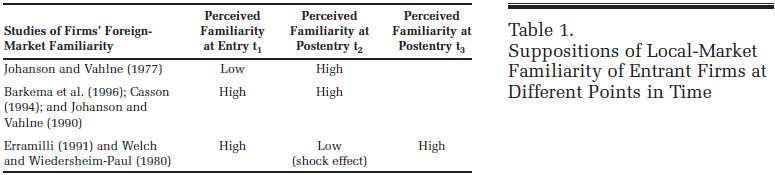
The studies on the evolution of firms’ familiarity with foreign markets (underpinning H1–H3) are summarized in Table 1.
Suppositions of Local-Market Familiarity of Entrant Firms at Different Points in Time
The Psychic-Distance Paradox
Internationalization process theory posits that firms target foreign markets (as outlets for their products) in a sequence determined by the managers’ psychic distance to the individual market. Because managers expect their firm to perform/ sell better in foreign countries associated with little psychic distance, the firms enter these markets before markets that are more culturally distant. Countries of little psychic distance can also be defined as foreign markets about which managers believe they are knowledgeable or familiar with local business conditions. For managers of entrant firms, neighboring countries usually qualify as markets of little psychic distance. However, as O'Grady and Lane (1996) point out, managers may overestimate similarities between neighboring countries. Even countries that share language, historical, and legal traditions often have different institutions that do not allow for the simple transfer of business practices and attitudes across borders. O'Grady and Lane provide many examples of Canadian retailers that performed poorly in the United States because of significant differences in the operating environment between the countries. Many of the examples presented show that the differences in the business environment between Canada and the United States were more profound than the managers had expected. From these observations, O'Grady and Lane coined the term “the psychic-distance paradox.”
Moreover, the growing literature on the survival of firms in foreign countries suggests that investment into close countries often fails (for an overview, see Mitchell, Shaver, and Yeung 1994). Managers of entrant firms may take more precautions when entering distant markets and may spend more time on planning because they are fully aware of the significant psychic distance; however, they may fail to take these precautions in countries that they perceive as having a close psychic distance. From this, we derive the following hypothesis on a possible shock effect (i.e., the occurrence of a decrease preceding an increase of managers’ perceived market familiarity) with respect to the firm's entry into countries of little psychic distance:
H4: Entrant firms experience a shock effect when entering adjacent markets but not when entering distant markets.
Knowledge Characteristics
As we mentioned previously, many difficulties that entrant firms face arise from not knowing how business is done in the foreign country. Some of the rules, customs, and practices are explicit and relatively easy to comprehend and adopt. At a deeper level, how the game is played is influenced by the values of the foreign country and by its basic cultural assumptions. These differences tend to be implicit and more difficult to uncover. They are also socially imprinted on people; thus, foreigners find differences in values and cultural assumptions much more difficult to accept than differences in practices (Schein 1985). Reflecting these different characteristics, the Uppsala internationalization process theorists (Forsgren and Johanson 1992; Johanson and Vahlne 1977) distinguish between two broad categories of knowledge that entrant firms need: knowledge that can be acquired quickly and with relative ease because it is explicit (e.g., market statistics, competition laws, product approval requirements, technical standards, import regulations) and knowledge that is characterized by its tacitness and therefore can be acquired through learning by doing. Because the acquisition of the latter type of knowledge is the most indispensable and critical in the internationalization process (according to the Uppsala theorists), the improvement of local-market familiarity is contingent on the extent to which the firms accumulate knowledge through ongoing activities: “International expansion is inhibited by the lack of knowledge about markets, and such knowledge can mainly be acquired through experience from practical operations abroad” (Forsgren and Johanson 1992, p. 10).
The vital requisite knowledge about the local business environment is inherently experiential and specific to the individual foreign market. Opportunities for preentry learning are accordingly low for this experiential or tacit knowledge. In contrast, we expect entrant firms to acquire the necessary objective/explicit market knowledge (in contrast to tacit knowledge) either before entry takes place or immediately after entry.
Furthermore, this would only be for tacit knowledge for the shock effect, not for perceived lack of explicit knowledge. Accordingly, we submit the following shock effect hypothesis about knowledge characteristics:
H5: Entrant firms experience a shock effect only in relation to lack of tacit knowledge, not in relation to explicit knowledge.
Product Characteristics
Two dimensions usually describe a firm's internationalization pattern: the geographical spread of the firm's international activities and the commitment of resources to the individual foreign market. Welch and Luostarinen (1988) argue that product characteristics constitute a third dimension. All else being equal, the export of commodity goods is associated with a low degree of internationalization. Complex products, such as turnkey projects, require a great deal of customization. Thus, some firms may operate in industries in which international product standards are widespread and little or no product modification is needed for foreign-market operations. In contrast, other industries are characterized by products that require extensive product modification to comply with the needs and preferences of the individual customer in the foreign market. Services typically, but not exclusively, belong to the latter category of complex and customized products, whereas it is difficult to generalize about goods.
We expect that the knowledge requirements of entrant firms differ significantly with product characteristics (i.e., customized versus standardized). More specifically, we expect that producers/vendors of customized products are involved in more sophisticated learning processes than are producers/ vendors of standardized products. Conversely, we expect that little or no foreign-market knowledge is required for internationally standardized products, and if some knowledge is needed, it may be acquired before entry.
Furthermore, the shock effect is only experienced by producers or vendors of customized products, not by standard product manufacturers or sellers. Accordingly, we submit the following shock-effect hypothesis about knowledge characteristics:
H6: Only producers/vendors of customized products, not producers/vendors of standardized products, experience a shock effect.
Data Compilation and Sample Characteristics
We gathered the data for this study through a mail survey that was part of the large, international research project “Learning in the Internationalization Process.” The project included researchers from Denmark, Finland, New Zealand, South Korea, and Sweden. Because the sample definition varied somewhat from country to country, we considered only the data for Denmark, Sweden, and New Zealand consistent and therefore usable for this particular study (and the data for Sweden and New Zealand were only usable for part of this study). A pilot study was conducted in 1997 in which ten Swedish managers were asked to answer the questionnaire in an interview situation. We used local databases in Denmark, New Zealand, and Sweden to identify companies with (1) more than 20 employees and (2) international operations, including export and foreign direct investment. In 1998, the questionnaires were sent to identifiable informants, primarily managing directors. A managing director or other top executive completed most questionnaires. A reminder was sent one month after the initial mailing. After the follow-up procedure, the number of usable replies reached 201, 168, and 116, from Denmark, Sweden, and New Zealand, respectively. This corresponds to net response rates of 27%, 35%, and 20%, respectively. We conducted a test to check the sample for possible nonresponse bias. We found no statistically significant differences between respondents and nonrespondents in terms of size and number of foreign subsidiaries.
An average profile of the firms in the sample is shown in Table 2. All three countries are relatively small in terms of population. As a consequence of limited home markets, most firms in these countries are forced to engage in international operations at an early stage of their development. For all the three country samples, the average firm is highly internationalized and presumably possesses considerable experience in conducting foreign operations. One-sixth of personnel are employed outside the home country (13.9%–18.4%) and more than one-third of the average turnover originates from overseas activities (36.6%–42.9%). The profiles of the firms from Denmark and Sweden are similar in terms of size and level of internationalization, but the Swedish firms typically have longer export experience (30.3 years) than do the Danish firms (20.9 years). The firms from New Zealand are larger in terms of both turnover and employees, and they have less international experience (in terms of years) and operate in fewer countries. However, in regard to the proportion of sales abroad and employees outside the home country, the New Zealand sample firms are similar to the Danish and Swedish firms.
Characteristics of the Sample (N = 485)

The total sample of 485 companies includes a unique sample of internationalized firms that vary on several dimensions (e.g., the targeted foreign markets). However, the common denominator is that the firms, based in three small countries, are exposed to international activities early in their development and thus supposedly struggle with liability of foreignness issues when entering foreign markets.
Operationalization of Variables
Respondents were asked to select one recent or ongoing foreign business venture/operation (e.g., entering a new market, undertaking a considerable expansion of an existing business in a foreign market). The operation was to be important to the firm and its international expansion. Furthermore, the operation was preferably well underway in the foreign location. The elapsed time of the business operations reported in the query was, on average for all 485 firms, 3.07 years, ranging from 1 to 36 years. The standard deviation was 3.81 years.
We measured unfamiliarity in foreign markets as the perceived lack of knowledge about the particular foreign business operation. More specifically, respondents were asked to indicate the extent to which a lack in certain kinds of local-market knowledge constituted an obstacle to the accomplishment of the particular foreign business operation. As in the work of Eriksson and colleagues (1997), the required foreign-market knowledge was of two different kinds: institutional knowledge and business knowledge. Institutional knowledge consists of knowledge of the institutional framework, rules, norms, and values in the particular market. Business knowledge includes knowledge about counterparts (customers, suppliers, distributors, and competitors) in the host country, including knowledge about local business cultures.
Respondents were then asked to indicate the extent to which the lack of various types of knowledge was an obstacle to the completion of the foreign business operation on a seven-point Likert scale (1 = “no obstacle” and 7 = “serious obstacle”) that measured knowledge about the following: business law and rules of the foreign market, financial practice of the foreign market, local business culture, products of customers in the foreign market, products of suppliers in the foreign market, and products of competitors in the foreign market. The average score of the six items varied from 3.8 (knowledge of competitors) to 4.9 (knowledge of suppliers). Cronbach's alpha for all six items was .78. Therefore, we created a composite index of liability of foreignness in which we included all six items.
We measured the elapsed time of operation in the particular foreign market as the number of months and years since the particular international business operation commenced. In principle, the value of the variable can vary from one month to infinite. To increase the readability of the results, we indicated elapsed time in terms of years (e.g., 30 months = 2.5 years).
We measured the experiential or objective knowledge characteristics by asking respondents (in the Danish sample only) to indicate the extent to which the previously mentioned six knowledge items were acquired through their own experiential activities or purchased from external expert sources on a seven-point Likert scale (1 = “acquired through purchase from external sources” [objective knowledge] and 7 = “acquired through a learning-by-doing process” [experiential knowledge]). Cronbach's alpha for all six items was .70. Therefore, we created a composite index of the characteristics of knowledge in which we included all six items. The mean value of the composite index is 3.1. We then divided the sample into two categories: those that mainly purchased the local-market knowledge from external expertise sources (1 ≥ values < 3) and those that mainly acquired the knowledge by their own experiential activities (3 ≥ values ≥ 7).
We also measured the psychic distance to the particular market as a perceptual measure. The respondents (in the Danish sample only) were asked to indicate the extent to which the particular market of the foreign operation differs from existing, well-known markets on a seven-point Likert scale (1 = “well-known market” and 7 = “market very different”). We then divided the sample into two categories: business operations of markets with little psychic distance (original values of 1–3) and business operations carried out in markets with great psychic distance (original values of 4–7).
We measured the level of customization of the product perceptually on a seven-point Likert scale. The respondents (in the Danish sample only) indicated the extent to which the main products/services associated with the foreign operation were customized or standardized (the mean value on the scale is 3.6). We then divided the sample into two categories: those with customized products/services (values of 1–3) and those with standardized products (values of 4–7).
Control Variables
In addition to the hypotheses about market, knowledge, and product characteristics, we checked the sample (including the firms in Sweden and New Zealand) for several factors that may have affected perceived market familiarity. With more international experience, firms can improve their ability to make correct assessments of the knowledge gap with respect to foreign markets. To the extent that international experience is embedded in people rather than organizations, it is also relevant to examine this factor on the respondent level. A strategy of local adaptation (in contrast to a strategy of global standardization) may be associated with an alertness about knowledge gaps, thereby avoiding fatal underestimations of local-knowledge requirements. Similarly, newness of foreign customers may prompt entrant firms to anticipate a significant need for local business knowledge. We subsequently discuss how we operationalized the control variables.
International experience captures the extent to which the firms have accumulated general knowledge about how to conduct business in an international environment, including handling uncertainty attached to foreign markets. We measured firms’ exposure to international activities and their ability to manage in unknown territory in the foreign markets. We measured international experience as the number of years in which the company had conducted international activities.
We included the number of years that the particular respondent had been dealing with international business tasks to control for the respondents’ personal experience. We thereby controlled for personal experience and received a more accurate measure of the organizational perception of the unfamiliarity, which is the focus of this study.
Local adaptation is a perceptual variable that we measured by asking respondents the extent to which the firms made adaptations to the local market. In the questionnaire, they were asked to indicate on a seven-point Likert scale the degree to which they adapted to the local market in terms of the product, the production process, and the business routines scale (1 = “no adaptations” and 7 = “substantial adaptation”). Cronbach's alpha for the three items was .89. The high value enabled us to create a composite index of local adaptation in which we summed all three items.
In the same vein, we measured newness of foreign customers associated with the foreign operation on a five-point Likert scale that compared the customers in the particular foreign market with the existing customer relationships (1 = “well-known customers” and 5 = “completely new customers”).
Operationalization of Shock Effect
To test H1–H3 on the interrelationship between elapsed time of business operations in the foreign market and managers’ perceptions of their local-market knowledge (familiarity), we conducted a regression analysis and applied the following regression model:
Local-market knowledge of entrant firms = f [elapsed time,(elapsed time)2, control variables].
Because we hypothesize (H3) that the relationship between perceived market familiarity and elapsed time is nonlinear, we needed to test for this nonlinearity. We expected that the nonlinearity had the form in which for small values of elapsed time, it decreases, and for higher values of elapsed time, it increases (i.e., a U-shaped curve function). A way to determine whether the data constitute a U-shaped curve function is to examine the relationship between the perceived market familiarity and the first- and second-order effect of elapsed time. The coefficient (parameter) of the first-order effect reflects the relationship for low values of elapsed time, and the coefficient for the second-order effect reflects the relationship for high values of elapsed time. A negative sign of the first-order coefficient simply indicates that the perceived local-market familiarity of the managers of the sample firms decreases for low values of elapsed time, and a positive second-order coefficient sign indicates that the perceived local-market familiarity of the managers increases for high values of elapsed time. This nonlinear, U-shaped relationship is shown in Figure 1.

Changes in Managers’ Perceptions of Local-Market Familiarity as a Function of Elapsed Time of Operation
Given that H1 predicts a linear, positive relationship between elapsed time and perceived market familiarity, we expect that the first-order coefficient of elapsed time is significantly positive and that the second-order coefficient is not significant. Our expectation for H2, which proposes a linear/horizontal relationship, is that both the first- and the second-order coefficients of elapsed time are not significant. Predictions of the expected coefficients for H1–H6 are summarized in Table 3.
Summary of the Predictions That Follow the Hypotheses
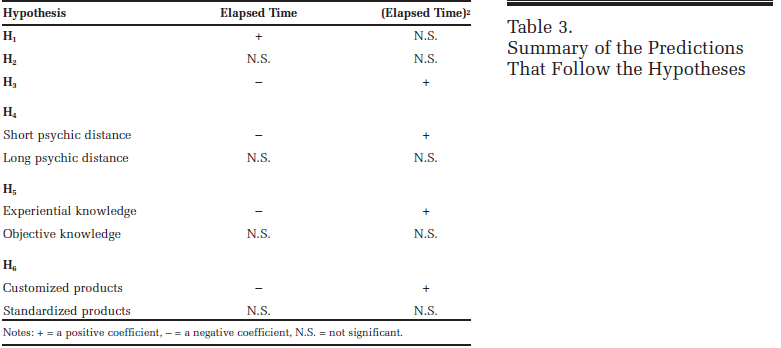
Notes: + = a positive coefficient, – = a negative coefficient, N.S. = not significant.
Regression Analysis of the Hypothesized Model 1

p < .10.
p < .05.
p < .01.
Notes: Entries represent (standardized) regression coefficients; standard errors are in parentheses.
Results and Discussion
Table 4 shows the results of the regression models (including the four control variables) for Model 1, in which we tested H1–H3. In Model 1, local-market familiarity is expressed as a function of elapsed time and the four control variables. Neither H1 nor H2 is confirmed, because the signs of the first-order coefficient in Model 1 are significant and negative. However, H3 is supported by the significant, negative sign of the first-order coefficient and the significant, positive sign of the second-order coefficient of elapsed time. The signs are significant for all three samples together (right-hand column) and for the individual samples of firms in Denmark, Sweden, and New Zealand. The results indicate that managers tend to overestimate their knowledge about the foreign market before entry. It is likely that on entry, managers realize their inadequacy in terms of local-market knowledge and consequently spend several years familiarizing themselves with local-market conditions.
The typical pattern, as is shown in Figure 1, is a curve derived from the coefficients estimated in Model 1. As is shown in Figure 1, the average shock effect of foreign-market entry lasts for approximately 8 years. During the first 8 years after entry, managers perceive a downturn in their local-market familiarity, after which they are able to reduce their market uncertainty. It may take approximately 16 years for entrant-firm managers to reach the level of local-market familiarity perceived at the time of entry.
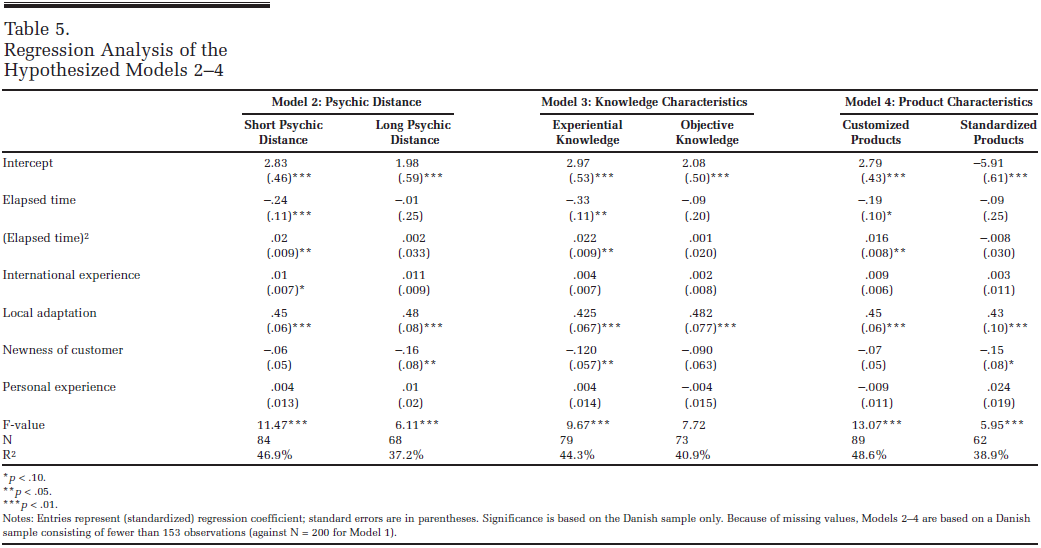
We tested H4 in Model 2 (Table 5). For adjacent markets of little psychic distance, the first-order coefficient of elapsed time has a significant, negative sign, and the second-order coefficient has a significant, positive sign. This indicates a U-shaped curve in terms of the evolution of managers’ familiarity with adjacent markets (i.e., a shock effect), as we expected. For distant markets of great psychic distance, neither the first-order nor the second-order coefficient is significant.
We tested H5 in Model 3 (Table 5). As we expected, a lack of tacit/experiential internationalization knowledge is associated with a significant, negative sign of the first-order coefficient of elapsed time and a significant, positive sign of the second-order coefficient. For a lack of explicit/objective knowledge, neither the first-order nor the second-order coefficient is significant. Thus, the data suggest that a shock effect appears for tacit internationalization knowledge but not explicit internationalization knowledge.
We tested H6 in Model 4 (Table 5). This hypothesis is also supported, though at a modest 10% level of significance. For producers/vendors of customized products, the first-order coefficient of elapsed time of operations has a significant, negative sign and a significant, positive sign of the second-order coefficient, indicating a shock effect. Both first- and second-order coefficients are not significant in terms of producers/vendors of standardized products.
Regression Analysis of the Hypothesized Models 2-4
p < .10.
p < .05.
p < .01.
Notes: Entries represent (standardized) regression coefficient; standard errors are in parentheses. Significance is based on the Danish sample only. Because of missing values, Models 2–4 are based on a Danish sample consisting of fewer than 153 observations (against N = 200 for Model 1).
The control variable local adaptation is significant (and positive) in all four models, whereas the control variable newness of customers is significant in Model 1 and in relation to distant markets (Model 2), experiential knowledge acquisition (Model 3), and producers/vendors of standardized products (Model 4). The control variable personal experience is not significant in any of the models.
Limitations of the Study
The empirical research we have reported, as with all other such research, has limitations. We have some specific reservations as to the robustness and validity of our findings. Our first reservation pertains to the cross-sectional and static nature of the study, which is a serious limitation inasmuch as we want to explore a time-varying factor, namely the change in managers’ perceived market familiarity. Presumably, an ultimate proof of a shock effect can be provided only through large-scale longitudinal studies. However, the question is whether a second-best research design is acceptable in the absence of resource-demanding, large-scale, longitudinal studies.
A second reservation pertains to our hypothesis testing on the basis of nonsignificant results; nonsignificant results indicate that no increase or decrease of perceived market familiarity took place. Nonsignificant results may suggest many things, not the least of which is the need for better measures, and should be used with care in making definitive statements. By taking insignificant coefficients as an indication of support of the hypothesized cause-and-effect relationship, we are at risk of making a Type I error (i.e., rejecting a true hypothesis).
Third, we compiled the data from companies in Denmark, Sweden, and New Zealand. As such, the extent to which perceptual/subjective measures of companies from small, open economies can be generalized to firms from large economies, such as the United States, might be questioned. Thus, in general, it is accepted that, ceteris paribus, firms from small, open economies tend to demonstrate a higher propensity to internationalize their operations than do firms from larger home economies (Bellak and Cantwell 1998). As a result of an urgent need for export, market-seeking companies from small, open economies may have less time and fewer resources to prepare their foreign-market entries. Consequently, in general, these firms may experience more shock effects than international firms from large economies.
Finally, in our study, the U-shaped curve occurs if we observed a curve (indicating perceived market familiarity) that in the initial time interval had a significantly downward slope and subsequently an upward slope. This is an “either–or” measurement. However, degrees are possible, and a U-shaped curve may be flat or steep; we would have liked to use a standard mathematical index to express the flatness of the U-shape. Indeed, it is difficult to establish whether the shock effect, as measured in our study, is moderate or substantial.
Conclusions and Further Research
In this article, we identify three different and competing predictions of how entrant-firm managers’ perceptions of familiarity with the local business environment evolve after market entry. We formulated hypotheses for each of the three predictions and tested the hypotheses on a unique set of primary data of foreign operations as reported by managers of Danish, Swedish, and New Zealand international firms. The observed behavior of the sample firms fits with the shock effect prediction: the phenomenon that managers of entrant firms are inclined to underestimate differences between home and host countries in terms of the business environment. The data indicate that the local-market familiarity, as perceived by the entrant-firm manager, declines for an average of eight years after entry. The data (based on the Danish firm sample only) suggest that, in general, entrant-firm managers experience the shock effect during entry into adjacent, not distant, countries. Thus, the psychic-distance paradox is supported. The data also suggest that the shock effect befalls producers of customized products but not producers of standardized products; furthermore, entrant firms experience the shock effect during acquisition of tacit rather than explicit knowledge.
Our study is mainly descriptive. To develop a more management-oriented internationalization theory, further research should provide explanations of managers’ perceptions of knowledge gaps with respect to foreign markets. From a management perspective, it is particularly important to establish the extent to which knowledge gaps are subject to managerial discretion and what the performance implications are. Do shock effects result from inadequate preentry preparedness (Welch and Wiedersheim-Paul 1980)? If so, is this unpreparedness of firms more or less intended? Our framing of shock effects pertains to a traditional internationalization theory that emphasizes learning and assumes that there are risk-averse decision makers (Johanson and Vahlne 1997). However, preentry unpreparedness and the resultant underestimation of knowledge gaps may be explained by managers’ risk-taking approach to international expansion (Andersson 2000; Moen and Servais 2002), or preentry unpreparedness may reflect a subordinate role of market knowledge in the internationalization process of firms in industries characterized by strong, competitive pressure (Vahlne and Nordström 1994) or by an imperative need to follow the customers/clients abroad (Erramilli 1990). In addition, as we mentioned previously, because of a limited home market, firms in small, open economies tend to undertake rapid internationalization to achieve scale economies, and the immanent cost pressure may overshadow any knowledge-gap concerns. Recently, internationalization theorists (Contractor, Sumit, and Chin-Chun 2003; Petersen, Welch, and Liesch 2002) have suggested that the e-business hype “entices” managers into rash internationalization in the belief that the borderless marketspace has made international market research a diminutive exercise on the Internet. Finally, insights from learning and innovation literature may prove useful in an attempt to explain knowledge gaps. The presentation of firms’ internationalization process as an innovation (Andersen 1993) may undramatize the phenomenon of perceived knowledge gaps as a deliberate expansion of the cognitive scope within which the organization searches for new knowledge of foreign markets.