







Abstract
This article examines the knowledge-creating role of the Internet in international business activities of Vietnamese firms. The authors find that both the collection and the transformation of information from the Internet by a firm affect its foreign sales intensity. In addition, market and learning orientations facilitate this process.
Knowledge is an important factor that affects a firm's international expansion. This has been widely documented in the literature on international business (e.g., Cavusgil 1985; Foss and Pedersen 2004; Johanson and Vahlne 1977; Liesch and Knight 1999; Ling-yee 2004; Luo and Peng 1999; Toften and Olsen 2003). For example, the literature on internationalization posits that firms adopt an evolutionary series of sequential stages in international expansion because of a lack of knowledge about foreign markets and their marketing environments (Johanson and Vahlne 1977). In addition, the differences in cultural, national, economic, political, legal, social, and other environmental influences have made it more complex and difficult to conduct research in international markets (e.g., Craig and Douglas 2000). As a result, these firms are confronted with greater risks than they face in their home markets. These difficulties are more severe for firms in transitional economies, such as Vietnam, than for advanced economies because of their limited resources and international research experiences (Nguyen and Nguyen 2001).
The inception of the Internet, a global network of interlinked computers operating on a standard protocol that allows information to be exchanged, offers several commercial applications for firms around the world (Hamill 1997). Many domestic and multinational firms in both developed countries and developing and transitional economies (e.g., China, Vietnam) are establishing their presence on the Internet (Asia Today International 2000). For these firms, the Internet may provide different ways of conducting international business. For example, the Internet's low-cost communication may enable a firm with limited capital to become a global marketer at an early stage of its development (Quelch and Klein 1996). The Internet becomes a powerful tool for supporting networks both internal and external to the firm (Hamill 1997; Reedy and Schullo 2004), and an Internet connection can substantially improve communications with existing foreign customers, suppliers, agents, and distributors. The Internet can also assist the firm in identifying new customers and distributors and in generating a wealth of information about market trends and about the latest technology and research and technical development (Hamill 1997). The Internet also provides a new and efficient medium for conducting market research. Firms can search for information about foreign markets through various Internet tools (by communicating with foreign customers, distributors, suppliers, and other firms and business-related organizations; by using search engines; and by conducting online surveys). This source of information is promising because it is cost effective and quick (e.g., Reedy and Schullo 2004; Weible and Wallace 2001).
Although the Internet offers a useful medium for firms to obtain information and communicate with foreign markets—we call this the “knowledge-creating role of the Internet”—little research has been conducted to explore its potential for firms’ international business activities, especially in the developing world (e.g., Sørensen and Buatsi 2002). In addition, researchers expect the Internet to be a useful tool for international business (e.g., Hamill 1997; Quench and Klein 1996), but this assumption has received little empirical testing. Some researchers have also questioned the contribution of the Internet in exporting (e.g., Samiee 1998). In an attempt to bridge this gap, we develop and test a model that incorporates the knowledge-creating role of the Internet in international business activities of firms in a transitional market, namely, Vietnam. Specifically, we investigate (1) the impact on foreign sales intensity of firms’ use of the Internet to obtain information about foreign markets and the transformation of this information into a higher level of knowledge and (2) the role of market and learning orientations in Internet utilization and knowledge transformation.
In the next section, we review the literature and present hypotheses. Then, we discuss the method and the data analysis and present the results. This is followed by a discussion of the results and their managerial implications. Finally, we note the limitations of the study and identify possibilities for further research.
Literature Review and Models
We depict a conceptual model of the knowledge-creating role of the Internet in international business (denoted as KRI) in Figure 1. Firms use the Internet to collect information about foreign markets and then assess the relevance of the information to their international business activities. These firms are likely to transform this information into a higher level of knowledge for making international business decisions. This may lead to higher levels of foreign sales. In turn, when foreign sales increase, firms could be expected to need more information about and communication with foreign markets. Therefore, firms are likely to use the Internet more frequently. It is also argued that market and learning orientations are antecedents of both Internet utilization and knowledge internalization.

Model of the Knowledge-Creating Role of the Internet (KRI)
Internet Utilization and International Business Activities
There is a wide range of information about foreign markets available on the Internet. The Internet operates as a “virtual library” that can be accessed by users everywhere around the world (Ghose and Dou 2001; Weible and Wallace 2001). In accessing the Internet, firms may find various types of information to be useful for international business activities, including information about the environment, market characteristics, and the marketing mix (Bennett 1997; Weible and Wallace 2001). The level of usefulness of information obtained from the Internet can be conceptualized as “Internet information relevance” (or simply “information relevance”), which is defined as the degree to which firms perceive information they obtain from the Internet as relevant to making international business decisions. Thus,
The greater the degree of a firm's Internet utilization, the greater is the degree of perceived information relevance.
The literature on international expansion (e.g., Johanson and Vahlne 1977; Liesch and Knight 1999; Luo and Peng 2004) addresses the importance of firms’ experiential or tacit knowledge in international business activities. Experiential knowledge is a fundamental resource, and traditionally, it is believed to be acquired through international operations (Johanson and Vahlne 1977). The dynamic theory of knowledge creation, especially the internalization process (Nonaka 1994), offers an explanation for how firms obtain information and then transform it into knowledge. Internalization is “the process of searching for, acquiring, and absorbing both tacit and explicit information and translating it into knowledge which is then applied to some purpose” (Liesch and Knight 1999, p. 385). Two key components of knowledge internalization are (1) comparison and interpretation and (2) use of information for making decisions (Davenport and Prusak 2000; Liesch and Knight 1999). In the context of this research, we define “Internet-based knowledge internalization” (or simply “knowledge internalization”) as the process in which information obtained from the Internet is compared with other sources, interpreted collectively, and used for making international business decisions.
The knowledge barrier for international business activities of firms in transitional markets may push these firms to find alternative ways of acquiring knowledge. Access to the Internet is one such alternative (e.g., Sørensen and Buatsi 2002). As we discussed, knowledge, not data or information per se, is a significant factor that affects international behavior. However, it can be argued that as firms begin to use the Internet as an alternative source of information, they need knowledge about foreign markets. The acquisition and assessment of information is an antecedent to knowledge internalization (Liesch and Knight 1999). Therefore, in acquiring relevant information from the Internet, firms are likely to transform it into higher levels of knowledge to satisfy their knowledge need for international business activities. Moreover, “a knowledge creating firm does not operate in a closed-system but in an open system in which knowledge is constantly exchanged with the outside environment” (Nonaka and Takeuchi 1995, p. 84). This means that firm interactions are not only with sources of existing tacit and explicit knowledge within the firm but also with those of the environment. Information from external sources, such as collaborating firms, competitors, and customers, can be obtained from the Internet (e.g., Nicovich and Cornwell 2001; Sharma and Sheth 2004). Such information may trigger and hasten the transformation process in firms, resulting in more knowledge being both created and owned. Thus,
The greater the degree of information relevance perceived by a firm, the greater is the degree of its knowledge internalization.
Internet Utilization, Knowledge Internalization, and International Expansion
Firms pursue knowledge internalization to facilitate international business activities through a reduction of uncertainty (Liesch and Knight 1999). The traditional internalization theory of foreign direct investment (FDI) explains FDI expansion as the internalization of tangible assets (Buckley and Casson 1976). Knowledge internalization is the process of internalizing information about foreign markets, and it is an intangible asset. This asset is by no means of less value than a tangible one (Liesch and Knight 1999). Knowledge internalization is not a static process; it is a dynamic process (Nonaka and Takeuchi 1995). As a result, internalized knowledge about external markets is created. Research has shown that acquisition of appropriate knowledge about foreign markets helps firms create positive attitudes toward international expansion and reduce the perception of international risks, leading to an increase in international performance (e.g., Barrett 1986; Eriksson et al. 1997; Johanson and Vahlne 1977; Stump, Athaide, and Axinn 1998). Thus,
The greater the degree of a firm's knowledge internalization, the greater is the degree of its foreign sales.
The Internet may serve as an alternative information source for firms in transitional markets, whose resources are limited, in their international expansion. Accordingly, when firms are able to solve the problem of lacking knowledge about foreign markets by using the Internet, they tend to increase their commitment to foreign markets (Johanson and Vahlne 1977; Ling-yee 2004). In turn, when firms have a greater degree of commitment to foreign markets, they are inclined to use more frequently an innovation that makes them compatible with their international partners and competitors. Moreover, firms also need a more effective communication means and more information about foreign markets to facilitate their international business activities (Hamill 1997; Sørensen and Buatsi 2002). Therefore, firms are likely to use the Internet to a greater degree. Thus,
The greater the degree of a firm's foreign sales, the greater is the degree of its Internet utilization.
Market and Learning Orientations
Information technology (IT) implementation research indicates that organizational use of IT applications depends not only on organizations’ beliefs, attitudes, and intentions but also on their strategies, policies, and actions (Bhattacherjee 1998). To address this issue, the current research attempts to examine the effects of two organizational factors—market orientation and learning orientation—on the utilization of the Internet and knowledge internalization.
The importance of a market-oriented business culture is crucial to both managers and scholars (Hult and Ketchen 2001; Narver and Slater 1990). Market orientation entails an external focus in which both customers and competitors are a core focus. In addition, market orientation values responsiveness to customers (Jaworski and Kohli 1996). Slater and Narver (1995, p. 63) argue that “[a] market orientation is valuable because it focuses the organization on (1) continuously collecting information about target-customers’ needs and competitors’ capabilities and (2) using this information to create continuously superior customer value.” Market orientation comprises three behavioral components: customer orientation, competitor orientation, and interfunctional coordination. Each of these components plays a role in intelligence generation, dissemination, and responsiveness to the collected information (Narver and Slater 1990). Furthermore, Kohli and Jaworski (1990) contend that market orientation may be viewed as a form of innovative behavior (i.e., an antecedent to innovation). This is because a market orientation essentially involves doing something new or different in response to market conditions. Han, Kim, and Srivastava (1998) find that market orientation facilitates organizations’ innovativeness. These findings imply that market-oriented firms are likely to gather more information about foreign markets in response to their international business partners and customers and are more likely to search for innovations. Consequently, such firms may discover the usefulness of the knowledge-creating role of the Internet, which assists them in achieving their international goal. Thus,
The greater the degree of a firm's market orientation, the greater is the degree of its Internet utilization.
Learning orientation is another organizational factor that influences a firm's propensity to create and use knowledge. Learning orientation comprises three components: commitment to learning, open-mindedness, and shared vision (Sinkula, Baker, and Noordewier 1997). Commitment to learning reflects the fundamental value that an organization holds toward learning, which influences whether an organization is likely to promote a learning culture. Organizations that are committed to learning value the need to understand the cause and effects of their actions. Open-mindedness is linked to the notion of “unlearning,” which refers to the process through which organizations eliminate knowledge. Open-mindedness advocates that firms reassess their long-held routines, assumptions, and beliefs. It is “an organizational value that may be necessary for unlearning efforts to transpire” (Sinkula, Baker, and Noordewier 1997, p. 309). Shared vision “provides a focus for learning that fosters energy, commitment, and purpose among organizational members” (p. 309). Whereas commitment to learning and open-mindedness influence the intensity of learning, shared vision influences the direction of learning. Learning-oriented firms create and encourage a learning environment. This gives rise to the ability to adopt and implement new ideas, processes, and products, that is, to produce a capacity for innovation (Hurley and Hult 1998). Such firms continuously promote the organizational learning process, that is, information acquisition, information dissemination, and shared interpretation (Sinkula 1994). These firms continuously create and use new knowledge that has the potential to influence their behavior (Sinkula, Baker, and Noordewier 1997; Slater and Narver 1995). Consequently, these firms may be more comfortable in dealing with innovations. Therefore, they are more likely to be aware of the Internet and find it useful and easy to use, resulting in the adoption and effective and efficient utilization of the Internet for obtaining information about foreign markets. Thus,
The greater the degree of a firm's learning orientation, the greater is the degree of its Internet utilization.
Learning orientation can help foster a firm's market-oriented thought and behavior (Jaworski and Kohli 1996). A superior learning environment leverages the use of all resources, including the behaviors that accompany a market orientation (Baker and Sinkula 1999). Learning-oriented organizations have the ability to engage in adaptive and generative learning (Argyris and Schön 1978; Hult 1998). Generative learning, in which existing values are questioned, implies how organizations acquire, process, and subsequently use market intelligence, that is, their market orientation (Jaworski and Kohli 1996). Moreover, in a transitional market, such as Vietnam (in which business values are embedded in a centrally planned system), learning-oriented firms are likely to withdraw from their routine ways of conducting business and to adopt a new way of understanding the market; this involves a market-oriented approach. Market- and learning-oriented behaviors advocate the organizational learning process and continuously encourage the creation, sharing, and use of newer and deeper knowledge (Baker and Sinkula 1999; Slater and Narver 1995). Firms with high market and learning orientations are never satisfied with their existing level of knowledge (Hurley and Hult 1998; Slater and Narver 1995). Such firms are more likely to create a learning culture that can initiate, support, and maximize their transformation of knowledge. In turn, this leads to the need for acquisition and transformation of knowledge from all accessible sources, including the Internet. Thus,
The greater the degree of a firm's learning orientation, the greater is the degree of its market orientation.
The greater the degree of a firm's market orientation, the greater is the degree of its knowledge internalization.
The greater the degree of a firm's learning orientation, the greater is the degree of its knowledge internalization.
Competing Models
Competing models play an important role in theory construction. Bagozzi (1984, p. 16) argues, “It is important to stress that tests of rival hypotheses should not be reserved for separate studies but should be performed whenever possible within the context of an on-going study. In this way, because subjects, settings, instruments, etc., are held constant, we will have greater confidence in the internal validity of the rival hypotheses.” Accordingly, we propose and test two competing models in conjunction with the theoretical model.
First, as specified in the IT literature (e.g., Bhattacherjee 1998), firms decide to use or not to use an IT application on the basis of the perception of whether the IT application helps them improve their performance. This means that market-oriented firms will not increase their Internet utilization if they do not perceive the Internet as useful to them. Consequently, it can be argued that market orientation has no direct effect on Internet utilization. Thus, we propose a competing model (KRIc) that hypothesizes no direct relationship between market orientation and Internet utilization.
Second, an important aspect of market orientation and learning orientation is that these two organizational factors facilitate firms’ innovativeness (Hurley and Hult 1998). Consequently, market- and learning-oriented firms are likely to seek opportunities in foreign markets, a business practice traditionally viewed as an innovation adoption process (e.g., Cavusgil 1980). Therefore, it can be argued that market and learning orientations have direct effects on foreign sales intensity. Accordingly, we propose another competing model (KRIu) that hypothesizes positive, direct relationships between market and learning orientations and foreign sales intensity.
Method
Measurement
Market Orientation
We measured market orientation using the scale that Narver and Slater (1990) developed, in which 17 items (MO_1–MO_17) are used to measured three components of market orientation (for a complete description of these and the following measures, see Appendix A). We measured customer orientation (mcus) using 8 items that cover various aspects of the ways firms create value for their customers. We measured competitor orientation (mcom) using 4 items that asked respondents about their understanding of and reaction to competitors’ actions. Finally, we measured interfunctional coordination (mcoo) using 5 items that capture the coordinated utilization of firms’ resources in creating superior value for their target customers.
Learning Orientation
We measured the three components of learning orientation (i.e., commitment to learning, shared vision, and open-mindedness) using 11 items (LO_1–LO_11). Sinkula, Baker, and Noordewier (1997) developed this scale. We measured commitment to learning (lcom) using 4 items that reflect the degree to which firms are willing to commit to learning (i.e., to promote and nourish a learning culture within the firm). We measured shared vision (lsv) using 4 items that embody firms’ focus on learning that fosters energy, commitment, and purpose among every member of the firm. Finally, we measured open-mindedness (lop) using 3 items that mirror firms’ unlearning processes.
Internet Utilization
We used two indicators to measure Internet utilization. The first indicator (insea) is a measure of time spent searching the Internet; specifically, this measure asked respondents how many hours per week their firm uses the Internet to search for information about foreign markets (e.g., use search engines; visits to Web sites of foreign distributors, competitors, suppliers, and customers). The second indicator (inem) is the frequency of e-mail use for international business purposes. We measured this by asking respondents how many times per week their firm receives and sends e-mails related to international business activities. Although the electronic survey is an important tool for research on the Internet (e.g., Weible and Wallace 2001), a discussion with managers of a research firm in the market revealed that these tools had not yet been widely used in the market. Therefore, we included the electronic survey in the measure of Internet utilization as part of the e-mail tool. We based these measures on the results of a qualitative pilot study (focus group discussion). Managers participating in the group agreed that the Internet tools most commonly used for their international business activities were e-mails (the most effective tool) and search engines.
Information Relevance
We used 14 items to measure the three components of information relevance. We measured market feasibility information (infea) using 3 items (IR_1–IR_3) that cover information about potential distributors, buyers, and suppliers in foreign markets. We measured adaptation information (inad) using 5 items (IR_4–IR_8) that address information about characteristics of markets, such as buyers’ preferences, competition, market size, and growth. Finally, we measured background information (inbak) using 6 items (IR_9–IR_14) that cover general information, such as socioeconomic information, legal issues, political forces, and infrastructure. We adapted these items from Hart, Webb, and Jones's (1994) scale, making modifications to suit the current study setting (i.e., we made modifications on the basis of the types of usable information about foreign markets that firms can obtain from the Internet).
Knowledge Internalization
We measured two components of knowledge internalization—information transformation and information use—using 10 items. We measured information transformation (intra) using 5 items (KI_1–KI_5) that address the process of comparing, relating, and fusing information obtained from the Internet with information and knowledge obtained from other sources, including firm members’ experiences (Davenport and Prusak 2000; Nonaka and Takeuchi 1995). We measured information use (inuse) using 5 items (KI_6 to KI_10) based on a scale that Diamantopoulos and Souchon (1999) developed. The literature on information utilization conceptualizes three forms of information use: instrumental use, conceptual use, and symbolic use (e.g., Menon and Varadarajan 1992). Instrumental use of information is related to the direct application of information obtained to solve a marketing problem. Conceptual use refers to the use of information to develop a managerial knowledge base (i.e., indirect use of information). Symbolic use is the use of information mainly for supporting an opinion or justifying a decision rather than using it in a manner consistent with the firm's intended purpose (Menon and Varadarajan 1992). Among the three types of information use, only instrumental and conceptual uses are important for knowledge internalization because these types of information use help firms generate knowledge. Research has found that these two types of information use are unidimensional (Diamantopoulos and Souchon 1999).
Foreign Sales Intensity
We used foreign sales as a percentage of total sales (fsts) to measure foreign sales intensity (Moini 1995). We measured foreign sales as a percentage of total sales (fsts) on a ten-point scale (1 = ≥10%, 2 = 11%–20%, …, 10 = 91%–100%). We measured Internet utilization at the ratio level. We measured all other items using a five-point rating scale (1 = “strongly disagree,” and 5 = “strongly agree”).
Measurement Refinement
We conducted a focus group with six managers who were responsible for international business activities of firms that used the Internet for their international business activities. Although most of the scales have been used widely in the past, this step is important because of the difference in the research setting (i.e., in the context of a transitional market). We followed this with a quantitative pilot survey to refine the measures. We conducted this survey in face-to-face interviews with 89 firms in Ho Chi Minh City, Vietnam.
Except for foreign sales intensity and Internet utilization, which we assessed using one and two indicators, respectively, we assessed the scales using Cronbach's alpha and exploratory factor analysis (principal axis factoring with Promax rotation). The reliability assessment resulted in the deletion of item MO_5 because of its low item–total correlations (<.30; Nunnally and Burnstein 1994). The exploratory factor analysis resulted in the deletion of one more item, MO_14, because of its low factor loading (<.50). We used the remaining items for the main survey to test the models.
The Sample
To test the models, we surveyed a sample of 306 firms in Ho Chi Minh City, the major business center of Vietnam. We based this sample size on the rule of at least five observations per one free parameter estimated (Bollen 1989). The highest number of free parameters in the model was 38 (KRIu). Therefore, the minimum sample size should be 190 (38 × 5) when the data are normal. Therefore, we decided on a sample size of 300 because of uncertainty about the normality of the data. To obtain this size, we distributed 400 questionnaires. The sampling frame, which we based on Ho Chi Minh City's business directories, consisted of approximately 5000 firms in all industries that were engaged in international business activities and used the Internet. We used the systematic sampling technique with a sampling interval of 12 (5000/400). We randomly selected the initial firm in the sample from the first interval (12 firms). Note also that state-owned enterprises are the dominant ownership type (>50%) in Vietnam because of the absence of a private sector until relatively recently.
We used the single key informant approach, which is the most commonly used method in organizational research (Kumar, Stern, and Anderson 1993). Respondents were senior executives of the firms. However, we instructed the interviewers to reach relevant people in the organization to request specific information, such as Internet usage, which might not be available to or known by senior managers. We formulated the original questionnaire in English. This English version was then translated into Vietnamese because English is not well understood by managers in this market, and then it was back translated to ensure the equivalence of meanings. We used partial self-administered surveys, in which questionnaires are mailed to the target respondents and then collected by interviewers. We also used follow-up telephone calls to remind respondents to complete the questionnaires before collection.
As we mentioned previously, to obtain a sample size of approximately 300, we distributed 400 questionnaires to firms in the chosen sample. We collected 327 completed questionnaires, yielding a response rate of 82%. Among these completed questionnaires, 21 were invalid because of nonqualified respondents (e.g., respondents were not top managers responsible for international business activities). Consequently, the remaining 306 valid questionnaires constituted the sample for this research. The characteristics of the sample appear in Table 1.
Sample Characteristics

Data Analysis and Results
Measurement Models
We used confirmatory factor analysis (CFA) to assess the measures. Except for foreign sales intensity, which we measured with one item, we validated other scales separately and then incorporated them into the final measurement model. The screening process shows that the data exhibited slight deviations from normality. Nonetheless, all the univariate kurtoses were not significant, and all the skewnesses were within the range of [–1, 1]. Therefore, we used maximum likelihood estimation (Muthen and Kaplan 1985). The CFA results indicate that all the measurement models fit the data well. In addition, the factor loadings of all items were high and substantial (average loadings were equal to or greater than .70, and all were significant at p < .001), and all the average variances extracted were equal to or greater than .50. These findings indicate that the set of items measuring each dimension of the scales was unidimensional (Fornell and Larcker 1981), and there was convergent validity (within method; Steenkamp and Van Trijp 1991; see Appendix B, Panel B1). The correlations between the components of each construct and their standard errors indicate that these correlations were significantly less than unity (p < .001), in support of within-construct discriminant validity (Steenkamp and Van Trijp 1991; see Appendix B, Panel B2).
Structural Models
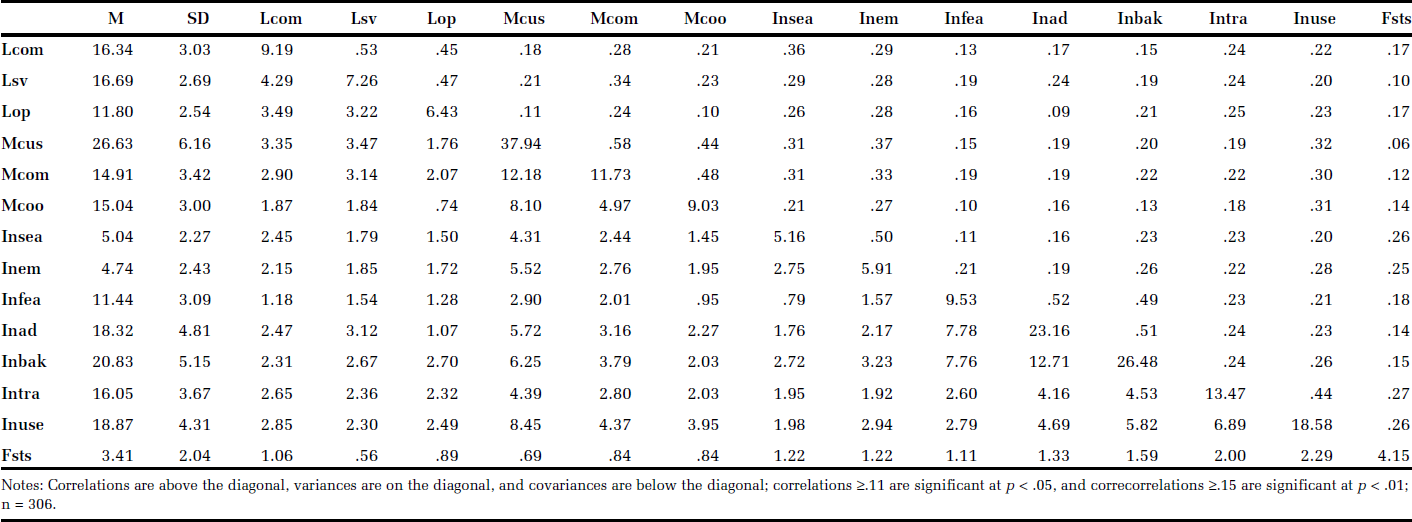
Because the measures of the components of the constructs were unidimensional, we used summates to test the structural models. The use of summates helps decrease the number of free parameters considerably, which makes the estimation reliable without increasing the sample size (Bagozzi and Edwards 1998). Consequently, we formed three summates (indicators) for information relevance (infea, inad, and inbak), two for knowledge internalization (intra and inuse), three for market orientation (mcus, mcom, and mcoo), and three for learning orientation (lcom, lsv, and lop). Finally, we measured foreign sales intensity with one item (fsts); therefore, it was assumed to have a reliability of .85 (Jöreskog and Sörbom 1982). A test of normality of summates also reveals that all the kurtoses were nonsignificantly different from zero, and all the skewnesses varied within the range of [–1,+1]. Consequently, we again used maximum likelihood estimation (for the covariance/correlation matrix of these summates, see Appendix C).
To test the proposed theoretical model against its two competitors, we investigated a system of five nested models: the theoretical model (KRI), the two competing models (KRIc and KRIu), the saturated model (KRIs; in which we estimated all parameters, relating the constructs to one another), and the null model (KRIn; in which we included no relationships between any pair of constructs in the model; Anderson and Gerbing 1988). The chi-square statistic values, degrees of freedom, and p values of these models appear in Table 2. The fit to the data of the saturated model (KRIs) and the correlations between constructs accompanying their standard errors indicate that these correlations were significantly less than unity (p < .001). Therefore, we found across-construct discriminant validity (Steenkamp and Van Trijp 1991; see Appendix B, Panel B3). In addition, the shared variance between pairs of constructs was always less than the corresponding average variance extracted, providing additional evidence of discriminant validity (Fornell and Larcker 1981). Note that we found no improper solution in any of the CFA or structural models. Heywood cases were absent, all the variances of the error terms were significant, and all the standardized residuals were less than |2.58|.
Degrees of Freedom and Chi-Square Statistics of the Models

We first used a pseudo-chi-square test to explore the possibility of model fit. The null model (KRIn) had 78 degrees of freedom, and the saturated model (KRIs) had a chi-square statistic of 65.89, indicating a nonsignificant pseudo-chi-square (p = .834). This shows that there should be a model that can have a possible fit to the data (Anderson and Gerbing 1988). Accordingly, we compared KRI with its two competing models (KRIc and KRIu) using sequential chi-square difference tests. The comparison of KRI and KRIs was not significant (p = .317). Therefore, we compared KRIc and KRI. The comparison of KRIc and KRI was significant (p = .000), resulting in the selection of KRI over KRIc. Consequently, we compared KRI and KRIu to choose the final model. This comparison was not significant (p = .470), resulting in the selection of KRI over KRIu because allowing two parameters to be free did not contribute to a better overall model fit but rather consumed two degrees of freedom (see Table 2; Anderson and Gerbing 1988).
The results also reveal that the relationship between market orientation and Internet utilization, set to be zero in KRIc, was significant in KRI. In addition, the relationships between market and learning orientations and foreign sales intensity, set to be zero in KRI, were not significant in KRIu (see Table 3). Furthermore, the existence of a feedback loop (formed by Internet utilization, information relevance, knowledge internalization, and foreign sales intensity) in KRI (a nonrecursive model) can cause the system to become unstable. The results show that the stability index of KRI was .101, falling within the range of (–1, +1), indicating that the model was stable (Bentler and Freeman 1983). In addition, we found support for all the hypotheses. The standardized structural results of the proposed model (KRI) appear in Figure 2. In conclusion, the findings support the choice of the proposed theoretical model (KRI) over its two competing models (KRIc and KRIu); that is, among the three models we tested, KRI gave the most reasonable explanation of the construct covariances estimated based on the sample covariances. These findings also indicate that we obtained the nomological validity of the measures of the constructs (Steenkamp and Van Trijp 1991).

Standardized Structural Results of KRI
Unstandardized Structural Coefficients of KRIc, KRI, and KRIu

Fixed at 0.
Discussion
The Internet offers a wealth of data for international business activities; however, little research has examined how firms transform information obtained from the Internet into a higher level of knowledge for international business activities. More important, most research in this area has been conducted in advanced countries. Little research has been undertaken in less-developed countries, especially in transitional economies. The model we developed and tested in this study can serve as a starting point for further investigation of the roles of the Internet in firms’ international business activities.
The theory of knowledge in international expansion posits that knowledge for firms’ international expansion is mainly experiential or tacit, which can be obtained during international operations (e.g., Johanson and Vahlne 1977). However, it does not explain how firms develop knowledge. Models of knowledge creation help explain how firms develop knowledge, but they are largely conceptual (e.g., Davenport and Prusak 2000; Nonaka 1994). By applying this prior research to the context of firms using the Internet to obtain information about foreign markets and then internalizing it for international business activities, the current study further advances this body of knowledge both conceptually and empirically. Significant relationships among Internet utilization, information relevance, knowledge internalization, and foreign sales intensity found in this study suggest several implications. Some researchers (e.g., Bennett 1997; Sørensen and Buatsi 2002) have recognized and discussed the role of the Internet in providing a variety of information that is useful for international business activities. If firms are aware of the potential of this source and use it, they can obtain a considerable amount of usable information (i.e., information relevance). Moreover, when firms have a propensity to use the Internet as a source of information about foreign markets with the aim to mitigate the uncertainty of conducting business in foreign markets, they are more likely to internalize this type of information. The internalization process assists firms in obtaining a higher level of knowledge about foreign markets. This results in a greater level of commitment to foreign markets. In turn, with a higher commitment to foreign markets, firms require more information and increased communication, which stimulates them to use the Internet to an even greater degree. This dynamic process enhances and extends firms’ knowledge about foreign markets. Thus, the information barriers to international expansion that several researchers have addressed might be considerably lessened by Internet use (Bennett 1997).
Note that the relationship between Internet utilization and foreign sales intensity is indirect. Perceived information relevance and knowledge internalization play a critical role in linking the information obtained from the Internet to firms’ foreign sales intensities. This finding is consistent with the literature on international expansion; that is, experiential or tacit knowledge is more meaningful in explaining firms’ international behavior (e.g., Johanson and Valne 1977). Moreover, it is also consistent with the theory of knowledge creation—that is, it is possible to transform knowledge from a lower level to a higher one (e.g., Davenport and Prusak 2000; Nonaka 1991)—and of knowledge use within the firm (e.g., Gherardi and Nicolini 2003). The finding demonstrates the relationship between two distinct levels of knowledge: information, or explicit knowledge, and tacit knowledge. However, an enhancement has also been made. Whereas experiential or tacit knowledge is of importance for international expansion, direct experience is not the only means. Internalization has been demonstrated as another means. The findings also provide support for the argument that sustainable competitive advantage is not derived solely from access to the Internet (Samiee 1998). Every firm can access the Internet to obtain information; nevertheless, competitive advantage in the form of knowledge resources cannot be obtained equally by every firm. Only firms that are able to use the Internet effectively and efficiently (i.e., those that are able to obtain useful information from the Internet) and are able to internalize information and transform it into a more useful level can gain this source of advantage.
Finally, previous research has provided strong evidence of the influence of market and learning orientations on organizational attitudes and behavior (e.g., Baker and Sinkula 1999; Han, Kim, and Srivastava 1998; Slater and Narver 1995). In keeping with these previous studies, the current study further enhances the understanding of the roles of market and learning orientations by investigating how these factors affect firms’ knowledge-creating processes. The findings provide evidence of the role of market and learning orientations in Internet utilization and knowledge internalization. As researchers have argued in the context of IT applications, organizational factors affect the acceptance and usage of IT applications (e.g., Leonard-Barton and Deschamps 1988). The process of adoption and utilization of the Internet can be considered an innovation diffusion process. Both market and learning orientations facilitate innovation (e.g., Han, Kim, and Srivastava 1998; Hurley and Hult 1998; Sinkula, Baker, and Noordewier 1997). Moreover, they are directly related to the process of information acquisition, processing, and use (i.e., knowledge creation within the firm). As a result, they are predictors not only of Internet utilization but also of knowledge internalization. The findings also make a clear distinction between market orientation and learning orientation in the context of the Vietnamese transitional market. Adopting a market orientation approach in conducting business can also be considered an innovation in the market. Learning-oriented firms are more likely to adopt a market orientation approach. In other words, these firms are inclined to accept the value of unlearning by reassessing their long-held practices and routines, and they are more willing to adopt new approaches to conducting business. This latter aspect is of importance to firms because knowledge is purported to be a crucial source of competitive advantage (e.g., Liesch and Knight 1999; Nonaka 1991). It is also more significant in international business activities of firms for which knowledge about foreign markets is much more difficult and costly to acquire than knowledge obtained in the domestic business context.
Managerial Implications
Senior managers and managers who are responsible for international business activities in transitional markets are likely to benefit from this study. These managers frequently face high levels of uncertainty in making international business decisions because of the lack of knowledge about foreign markets. The model of the knowledge-creating role of the Internet in international business enables managers to recognize and/or further understand the role of the Internet as a promising source of knowledge about foreign markets. Moreover, the model helps managers further understand the role of information obtained from the Internet and the role of knowledge internalization in international business activities. This means that firms are able to obtain necessary information about foreign markets from the Internet and that it is possible to transform this information into a more useful level of knowledge. In addition, direct personal experience is not the only way to obtain tacit knowledge. The results of this research encourage managers to use this possibility to increase their level of knowledge about foreign markets. In addition, the model specifies two key organizational characteristics that facilitate Internet utilization and knowledge internalization, namely, market and learning orientations. This would stimulate not only senior managers but also lower-level managers to adopt a new way of thinking and conducting business. It also facilitates the design of an appropriate program for more effective and efficient utilization of the Internet and for knowledge creation and transformation. Finally, although our study primarily examined managers of firms in the Vietnamese transitional market, we expect that the implications of our results could be of value to managers in other transitional markets and to small and medium-sized firms around the world. This is because managers in such firms are also confronted with the problem of a lack of knowledge about foreign markets.
Limitations and Directions for Further Research
This study suffers from several limitations. First, the initial test of our model was conducted in a major business center of Vietnam, and though the results are encouraging, much work remains to be done. The model needs further replication, extension, and critical evaluation in similar and/or different markets. There might be differences in other transitional markets, especially those that have different economic and cultural backgrounds. For example, transitional markets in China and Vietnam might exhibit some differences compared with those in Eastern Europe. Replication and cross-national research conducted in other transitional markets could provide more generalizability to the model. In addition, replication research in advanced countries could provide useful insights.
Second, the Internet is a relatively recent innovation, and its potential as an effective and efficient source of information about international markets has not been fully exploited in Vietnam, where the Internet infrastructure is still underdeveloped. Several Internet tools, such as electronic surveys and online distribution, have not yet been used by firms. Consequently, the measure of Internet utilization is probably less meaningful than it potentially could be. Further research should focus on other Internet tools that can help create knowledge for firms. This type of research is helpful not only in transitional markets but in advanced markets as well. Findings on the relationship between firms’ use of information about foreign markets obtained from online surveys and their international performance are likely to be a valuable contribution to the area.
Third, this study focused mainly on information obtained from the Internet for international business in general. Future studies should compare the role of information obtained from the Internet with other sources of information about international markets, such as information obtained from traditional international marketing research activities, government export assistance programs, and so forth.
Finally, this study examined the use of the Internet to collect information about foreign markets for all forms of international business activities. It did not explore any specific types of international business, such as indirect and direct exporting and FDI. A comparison between firms that use the Internet for different types of international business is worth investigating in further research.
Footnotes
Acknowledgments
The authors are grateful for the insightful comments and suggestions from the anonymous JIM reviewers, Gerald S. Albaum, S. Tamer Cavusgil, Richard Fletcher, Kenneth E. Miller, and David T. Wilson.
The Scales
Measurement Validation

| B1: CFA Results of the Measurement Models |
|||||
|---|---|---|---|---|---|
| Construct | Dimension | Composite Reliability | Average Item Loading | Average Variance Extracted (%) | Fit Indexes |
| Foreign sales intensity | Fsts | .85 a | n.a. | n.a. | |
| Information relevance | Infea | .80 | .81 | 65 | χ2(74) = 90.49, p = .093; CFI = .994; GFI = .956; and RMSEA = .027 |
| Inad | .93 | .87 | 76 | ||
| Inbak | .87 | .77 | 59 | ||
| Knowledge internalization | Intra | .83 | .70 | 50 | χ2(34) = 38.51, p = .273; CFI = .996; GFI = .955; and RMSEA = .021 |
| Inuse | .87 | .76 | 58 | ||
| Internet utilization | .67 | .71 | 50 | ||
| Market orientation | Mcus | .91 | .77 | 60 | χ2(87) = 97.80, p = .201; CFI = .995; GFI = .959; and RMSEA = .020 |
| Mcom | .82 | .73 | 53 | ||
| Mcoo | .82 | .72 | 52 | ||
| Learning orientation | Lom | .84 | .76 | 57 | χ2(41) = 49.52, p =. 170; CFI = .994; GFI = .954; RMSEA = .026 |
| Lsv | .82 | .73 | 54 | ||
| Lop | .81 | .77 | 60 | ||
| B2: Correlation Between Components of Constructs |
||||||
|---|---|---|---|---|---|---|
| Constructs | Dimension | Correlation (r) | Estimate | SE | 1 – r | t-Value (1 – r) |
| Information relevance | Infea | Infea ↔ inad | .58 | .078 | .42 | 5.38 |
| Inad | Inad ↔ inbak | .55 | .079 | .45 | 5.70 | |
| Inbak | Inbak ↔ infea | .55 | .083 | .45 | 5.42 | |
| Knowledge internalization | Intra Inuse | Intra ↔ inuse | .51 | .085 | .49 | 5.76 |
| Market orientation | Mcus | Mucus ↔ mcom | .67 | .096 | .33 | 3.44 |
| Mcom | Mcom ↔ mcoo | .59 | .097 | .41 | 4.23 | |
| Mcoo | Mcoo ↔ mcus | .51 | .084 | .49 | 5.83 | |
| Learning orientation | Lcom | Lcom ↔ lsv | .64 | .092 | .36 | 3.91 |
| Lsv | Lsv ↔ lop | .58 | .091 | .42 | 4.62 | |
| Lop | Lop ↔ lcom | .53 | .086 | .47 | 5.47 | |
| B3: Correlations Between Constructs |
||||
|---|---|---|---|---|
| Correlation (r) | Estimate | SE | 1 – r | t-Value (1 – r) |
| Learning orientation ↔ Internet utilization | .60 | .100 | .405 | 4.04 |
| Market orientation ↔ learning orientation | .45 | .088 | .554 | 6.31 |
| Market orientation ↔ Internet utilization | .60 | .099 | .396 | 3.99 |
| Internet utilization ↔ information relevance | .39 | .089 | .614 | 6.86 |
| Information relevance ↔ knowledge internalization | .49 | .102 | .507 | 4.98 |
| Internet utilization ↔ knowledge internalization | .50 | .106 | .499 | 4.70 |
| Market orientation ↔ knowledge internalization | .54 | .103 | .463 | 4.48 |
| Market orientation ↔ information relevance | .34 | .083 | .657 | 7.95 |
| Learning orientation ↔ information relevance | .34 | .084 | .658 | 7.84 |
| Learning orientation ↔ knowledge internalization | .48 | .101 | .517 | 5.09 |
| Foreign sales intensity ↔ knowledge internalization | .43 | .090 | .569 | 6.31 |
| Foreign sales intensity ↔ information relevance | .23 | .074 | .766 | 10.32 |
| Foreign sales intensity ↔ Internet utilization | .39 | .082 | .609 | 7.41 |
| Foreign sales intensity ↔ learning orientation | .22 | .074 | .776 | 10.45 |
| Foreign sales intensity ↔ market orientation | .15 | .072 | .850 | 11.87 |
This value is arbitrary. Because we measured foreign sales intensity with one item, we chose its reliability on the basis of the average of the reliabilities of other scales in the study. To make the model identified, we fixed the variance of the error term of this item at .623 ([1 – α]σ2[fsts]) (Jöreskog and Sörbom 1982).
Notes: n.a. = not applicable; CFI = comparative fit index, GFI = goodness-of-fit index, and RMSEA = root mean square error of approximation.
Covariance/Correlation Matrix of Summates
| M | SD | Lcom | Lsv | Lop | Mcus | Mcom | Mcoo | Insea | Inem | Infea | Inad | Inbak | Intra | Inuse | Fsts | |
|---|---|---|---|---|---|---|---|---|---|---|---|---|---|---|---|---|
|
|
16.34 | 3.03 | 9.19 | .53 | .45 | .18 | .28 | .21 | .36 | .29 | .13 | .17 | .15 | .24 | .22 | .17 |
|
|
16.69 | 2.69 | 4.29 | 7.26 | .47 | .21 | .34 | .23 | .29 | .28 | .19 | .24 | .19 | .24 | .20 | .10 |
|
|
11.80 | 2.54 | 3.49 | 3.22 | 6.43 | .11 | .24 | .10 | .26 | .28 | .16 | .09 | .21 | .25 | .23 | .17 |
|
|
26.63 | 6.16 | 3.35 | 3.47 | 1.76 | 37.94 | .58 | .44 | .31 | .37 | .15 | .19 | .20 | .19 | .32 | .06 |
|
|
14.91 | 3.42 | 2.90 | 3.14 | 2.07 | 12.18 | 11.73 | .48 | .31 | .33 | .19 | .19 | .22 | .22 | .30 | .12 |
|
|
15.04 | 3.00 | 1.87 | 1.84 | .74 | 8.10 | 4.97 | 9.03 | .21 | .27 | .10 | .16 | .13 | .18 | .31 | .14 |
|
|
5.04 | 2.27 | 2.45 | 1.79 | 1.50 | 4.31 | 2.44 | 1.45 | 5.16 | .50 | .11 | .16 | .23 | .23 | .20 | .26 |
|
|
4.74 | 2.43 | 2.15 | 1.85 | 1.72 | 5.52 | 2.76 | 1.95 | 2.75 | 5.91 | .21 | .19 | .26 | .22 | .28 | .25 |
|
|
11.44 | 3.09 | 1.18 | 1.54 | 1.28 | 2.90 | 2.01 | .95 | .79 | 1.57 | 9.53 | .52 | .49 | .23 | .21 | .18 |
|
|
18.32 | 4.81 | 2.47 | 3.12 | 1.07 | 5.72 | 3.16 | 2.27 | 1.76 | 2.17 | 7.78 | 23.16 | .51 | .24 | .23 | .14 |
|
|
20.83 | 5.15 | 2.31 | 2.67 | 2.70 | 6.25 | 3.79 | 2.03 | 2.72 | 3.23 | 7.76 | 12.71 | 26.48 | .24 | .26 | .15 |
|
|
16.05 | 3.67 | 2.65 | 2.36 | 2.32 | 4.39 | 2.80 | 2.03 | 1.95 | 1.92 | 2.60 | 4.16 | 4.53 | 13.47 | .44 | .27 |
|
|
18.87 | 4.31 | 2.85 | 2.30 | 2.49 | 8.45 | 4.37 | 3.95 | 1.98 | 2.94 | 2.79 | 4.69 | 5.82 | 6.89 | 18.58 | .26 |
|
|
3.41 | 2.04 | 1.06 | .56 | .89 | .69 | .84 | .84 | 1.22 | 1.22 | 1.11 | 1.33 | 1.59 | 2.00 | 2.29 | 4.15 |
Notes: Correlations are above the diagonal, variances are on the diagonal, and covariances are below the diagonal; correlations ≥.11 are significant at p < .05, and correcorrelations ≥.15 are significant at p < .01; n = 306.