






Abstract
“Buy domestic” promotions in various countries often urge citizens to help domestic workers whose jobs are threatened by imports. To explain why purchasers might engage in buy domestic purchase activities, the authors develop and test a model that features six explanatory constructs drawn from previous behavioral research about why people help distressed victims. The authors use multiple-group structural equation analysis of survey data from Portugal and the United States to test the model. The results strongly support the model and are quite consistent for both nations. In both nations, supportive purchase-related behavior increases as purchasers feel competent to help; believe that the threat from imports is salient; perceive social influences that support helping; hold values that derogate foreigners but support domestic citizens; and, for the United States only, perceive lower personal costs of helping. These findings suggest implications for buy domestic promotions.
Increasing globalization of the marketplace has given buyers of most nations an unprecedented opportunity to choose from both domestic and imported sources of certain products. Although the increasing openness of international trade has been widely applauded, many politicians, businesses, and ordinary citizens around the world have questioned the wisdom of allowing foreigners easy access to their domestic marketplaces. Many opponents of freer trade have responded vigorously to the perceived threat from foreign products, often by employing promotional campaigns designed to persuade consumers to buy domestic products rather than imports (Hirsch and Milbank 1992; Sternquist and Phillips 1991).
Marketers have mounted buy domestic campaigns in various countries, including the United States, Portugal, Japan, France, Canada, and Mexico. These promotions have generally employed emotion-based appeals—for example, showing domestic workers who have lost their jobs and consequently their homes because of imports. The motivational premise of such an appeal holds that helpful people will purchase domestic products to rescue their fellow citizens. The continued use of these campaigns means that marketers who operate in the international marketplace need to understand, for both offensive and defensive reasons, what motivates a positive response from buyers. Also, despite the use of these promotions in various nations, it is not known whether unique cultural factors in each nation cause a buy domestic response to be country specific.
In this study, we investigate this motivational process to provide information useful to marketing managers charged with promoting buy domestic behavior. We first summarize the findings of previous country-of-origin (CoO) studies reported in the marketing literature. Then we draw from the considerable literature of helping behavior to characterize buy domestic behavior as support for workers whose jobs are threatened by imports. Next, we develop a single model that is proposed to generalize the helping process across national boundaries. To permit a meaningful empirical test of the model and its cross-national validity, we analyze data collected in two different countries, Portugal and the United States. Finally, we interpret the findings by drawing implications for marketers who seek to promote the buy domestic theme, giving special attention to the needs of marketers who operate in the international marketplace.
Lessons from Previous Research Involving the Purchase of Domestic versus Imported Products
Buy domestic campaigns attempt to persuade purchasers to choose products that originate in their own country. Many previous CoO studies have investigated what motivates purchasers to select domestic versus foreign products. This previous research has shown the value of using various perceptions (i.e., information received) to explain buyers’ attitudes and purchasing behavior (Bilkey and Nes 1982). Of note, the economic threat buyers perceive from imported products influences their choice of domestic versus foreign products (Sharma, Shimp, and Shin 1995). Buyers’ choices also reflect the perceived attributes of products. Research in CoO has found the quality attribute to be a particularly important influence on product choice (Lang and Crown 1993; Thakor and Katsanis 1997). In addition, it appears that the choice of domestic versus foreign products reflects what buyers expect to gain or lose from their selection; for example, the risk of loss they associate with the products from various countries (Bilkey and Nes 1982; Cordell 1991).
Previous CoO research has also used personal characteristics to explain buyers’ evaluations and choices (Cordell 1991). Pertinent to the present study, research has demonstrated the explanatory value of social norms (Johansson and Nebenzahl 1987) and deep-seated beliefs often associated with a prejudicial disposition, such as conservatism (Kaynak and Cavusgil 1983), ethnonational affinity (Waheeduzzaman and Marks 1989), and ethnocentrism (Sharma, Shimp, and Shin 1995). In summary, the CoO literature demonstrates that individual-oriented behavioral constructs, prominently including perceptions, norms, and prejudicial beliefs, are useful for explaining buy domestic behavior. Consequently, our model features individual-oriented constructs of these types that we adapted from the considerable research into helping behavior, as discussed subsequently.
We also note that most previous studies in this literature have relied on data collected from buyers operating within a single national marketplace, typically, the United States, and they often suffer from selection bias by using samples of students to represent the more general market. Few previous researchers have attempted to validate the generalizability of their findings in the international marketplace by conducting a rigorous empirical comparison across national markets. Yet scholarly research that demonstrates the existence of a common motivational process will give marketers a basis for using essentially the same buy domestic strategy in multiple nations. Simply put, scholarly research can tell marketers whether they should employ standardization or adaptation in designing their transnational promotions (Jeannet and Hennessey 1998).
Conceptualization of a Helping Model for Explaining Purchase
As reported previously, prior CoO studies support the explanatory power of perceptions, norms, and prejudicial beliefs. However, our choice of specific constructs was based on the contributions of previous research into helping behavior. This research has shown that helping can be explained in various ways—most important, by using the characteristics of potential helpers, the influences they perceive, and their perception of the distressing situation (Eisenberg 1986; Piliavin et al. 1981). As stated, marketers who are fighting imports have promoted buy domestic behavior by condemning foreign products as a threat to the jobs of home-country workers who produce the domestic alternatives. Thus, the domestic workers whose livelihood is threatened by imports become victims who need help from their fellow citizens to retain their jobs. The purchase-related behavior (for brevity, purchase) of potentially helpful citizens is the criterion construct for this study. We conceive purchase in terms of certain activities that buyers perform to find and select domestic products.
In Figure 1 we present our model of the motivational process leading to purchase. It features six constructs we propose to influence buyers’ efforts to find domestic products and thus help the threatened workers who are victimized by imported products. The process runs from the two exogenous constructs of ethnocentrism and nationalism, through the endogenous constructs of social norms, salience, ability, and costs, to purchase as the criterion construct. We now treat each of these constructs in turn.
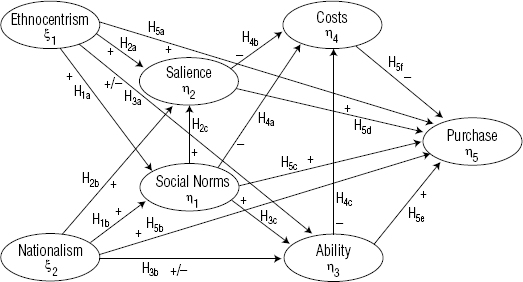
The Proposed Influence of Ethnocentrism, Nationalism, Social Norms, Salience, Ability, and Costs on Buy Domestic Purchase Behavior
The helping literature demonstrates that helpers’ personal values play an important part in the process of influence on helping behavior (e.g., Eisenberg 1986; Schwartz 1977). Ethnocentrism is a value that is particularly pertinent for this study. It is a deep-seated, prejudicial belief that reflects the social categorization that divides people in stereotypical fashion into “we” versus “them” (Hogg 1987). Ethnocentrists hold stereotyped negative opinions and hostile attitudes toward members of cultural out-groups and positive opinions and uncritically supportive attitudes toward cultural in-groups (Hewstone 1986). If they cannot identify with a group, ethnocentrists must oppose it, often disliking its members, whom they have categorized as different, and responding to them in hostile fashion (Ray and Lovejoy 1986).
Nationalism is a similarly deep-seated, prejudicial belief, a value that views the home nation as distinctive and superior to other nations. Nationalism places the home country and its status first—for example, by endorsing a strong national defense; reduced international involvement; restricted immigration into the country; and preferential treatment for the nation's dominant race, religion, and/or workforce (Curti 1946). Because nationalists identify closely with their supposedly superior national in-group, they consequently distinguish foreigners as members of out-groups. People who are more ethnocentric and nationalistic should therefore reject foreigners as members of the generalized out-group and identify with the victimized domestic workers, who are members of their in-group.
Norms are standards or ideals by which events are judged and subsequently approved or disapproved (Rushton 1981). Social norms reflect what significant other persons consider appropriate behavior. In this study, social norms represent purchasers’ beliefs about how strongly significant others want them to purchase domestic products. Because social norms exist to preserve the integrity or enhance the welfare of the collectivities to which people belong (Schwartz 1977), stronger identification with the in-group by the recipients of social norms accentuates the norms’ influence. Here, such group identity is represented by the social categorization that is embodied in ethnocentrism and nationalism. Therefore, social norms supportive of threatened workers who belong to the same in-group as their helpers should be linked positively with ethnocentrism and nationalism.
Stronger social norms results from (a) greater ethnocentrism and (b) greater nationalism.
Salience represents potential helpers’ perception that the circumstances are sufficiently distressing to arouse their concern. Here, salience is purchasers’ perception that imports injure the domestic economy and its workers. Helpers’ arousal increases when the victims’ needs are clearer and more prominent in the environment (Bar-Tal 1976; Schwartz 1977). Helpers’ arousal should thus be greater to the extent that they identify with victims who clearly need their help. On this basis, the model proposes that greater recognition of “we” versus “them” increases salience, because purchasers will be more attuned to the needs of the threatened in-group workers and will consequently perceive these victims to be more deserving of their help. Taken together, this evidence suggests that the group identification inherent in ethnocentrism and nationalism will increase salience.
In addition, the reinforcing effect of social norms communicated by significant other persons, who are likely to be members of the same in-group, can strengthen helpers’ belief that the situation is distressful, thus making the situation seem more legitimate, urgent, and obvious to them (Piliavin et al. 1981). Social norms should therefore serve to make the threat from imports more salient. Therefore,
Greater salience results from (a) greater ethnocentrism, (b) greater nationalism, and (c) stronger social norms.
Ability reflects helpers’ belief that they are competent to alleviate the victims’ distress by providing the assistance they need (Eisenberg 1986; Schwartz 1977). Here, ability is buyers’ perception that they can help domestic workers by purchasing domestic products. Two opposing rationales link ethnocentrism and nationalism with ability. One rationale holds that people's positive identification with a cultural group enhances their self-esteem (Abe, Bagozzi, and Sadarangani 1996), an important component of which is their perceived ability (Feather 1991). Ethnocentrism and nationalism as heightened identification with an in-group should therefore exert a positive influence on people's self-esteem and therefore on their perceived ability. A contrary rationale holds that ethnocentrism and nationalism lead people to recognize themselves as members of a large group.
They perceive themselves as but a trivial element of this much larger whole, which consequently makes them feel too insignificant to combat the challenge of imports. Given these two opposing arguments, we propose that ethnocentrism and nationalism influence ability, but we do not specify a direction for this relationship.
Social norms affect ability because they reinforce internalized values and self-expectations for performance (Schwartz and Howard 1981); obversely, one way for people to justify ignoring social norms that support helping is by denying their own ability. On this basis, stronger social norms should heighten people's involvement in the situation and accentuate their felt obligation to help, making it more difficult for them to deny their ability (Schwartz 1977). Therefore, to the extent that significant others provide psychological support for helping, social norms will reinforce helpers’ self-perception of their competence to help.
Greater ability results from (a) ethnocentrism, without a predicted sign; (b) nationalism, without a predicted sign; and (c) stronger social norms.
Costs represents buyers’ expected losses from helping. Helping research has identified many costs of helping—for example, the out-of-pocket and opportunity costs that helpers incur because of the time, money, and effort they spend; their psychological distress; and the social sanctions they suffer (Eisenberg 1986; Piliavin et al. 1981). Drawing from the CoO literature, we conceive costs as buyers’ expected loss of quality from purchasing domestic rather than foreign products. Previous research shows that high perceived costs of helping discourage people from assisting victims (Bleda et al. 1976; Schwartz and Howard 1981).
Supportive social norms can heighten helpers’ perception that they share a common external threat with the in-group victims (Dovidio and Morris 1975; Piliavin et al. 1981). Consequently, this form of identification with the workers should heighten buyers’ emotional arousal, creating cues that lead them to downplay obstacles to helping (Schwartz 1977; Schwartz and Howard 1981). As a result, supportive social norms should lead buyers to perceive lower costs of helping victimized workers.
Regarding salience, helpers are aroused by situations they consider serious. Specifically, helping research shows that salience increases when helpers learn that victims need help and depend on them for this help (Krebs 1975), which then stimulates a felt obligation to help that reduces the perceived moral, social, and psychological costs of helping. Greater salience should therefore reduce perceived costs. Furthermore, cognitive reasoning should lead helpers who believe they are competent to help to expect greater success and correspondingly smaller losses of time, effort, and so forth from helping (Piliavin et al. 1981; Schwartz 1977; Shotland and Stebbins 1983). Thus, greater perceived ability should lead to lower costs. In short,
Higher costs result from (a) weaker social norms, (b) lesser salience, and (c) lesser ability.
The criterion construct for this study is purchase. Here, we consider purchase in terms of buyers’ reports of (1) seeking products of domestic branding and of domestic manufacture, (2) looking at labels to identify these products, and (3) shopping at retail stores that stock them. Helpers’ ethnocentrism and nationalism should increase their tendency to identify with domestic workers as members of their own in-group, consequently sensitizing them to these victims’ distress (Dovidio and Morris 1975; Piliavin et al. 1981) and motivating them to help these victims (Kramer and Brewer 1984). Thus, greater ethnocentrism and nationalism should positively influence purchase.
Regarding social norms, Schwartz (1977) argues that helpers act in a way that is consistent with social influences so that they can preserve their sense of self-esteem. Indeed, social norms that clearly communicate support from significant other persons encourage helping behavior (Piliavin et al. 1981). Therefore, stronger supportive social norms should increase purchase. In turn, salience affects helping because helpers’ clear perception of a distressful situation stimulates their felt personal responsibility to help. We note that many helping studies support a positive link between helping and salience in such various forms as severity (Staub 1974), perceived need (Piliavin et al. 1981; Shotland and Stebbins 1983), and seriousness (Schwartz 1977). Therefore, greater salience should increase purchase.
Pertaining to ability, people prefer tasks they believe they can accomplish (Piliavin et al. 1981). Helping consequently increases with both specific and general perceived competence (Eisenberg 1986). Thus, greater perceived ability to assist victims should increase purchase. Regarding costs, many helping studies demonstrate that people who face the choice of helping or not helping usually select the least costly course of action (Bleda et al. 1976; Krebs 1975; Piliavin et al. 1981), which suggests that higher costs will lead to lesser purchase. We therefore propose the following:
Greater purchase results from (a) greater ethnocentrism, (b) greater nationalism, (c) stronger social norms, (d) greater salience, (e) greater ability, and (f) lower costs.
These constructs and the relationships proposed to connect them constitute our model. Should we expect the strength of these relationships to differ across nations? The disparities that exist from one nation to another regarding their culture, economic development, religion, and so forth suggest that the motivational process at issue may indeed vary across nations. Yet Farley and Lehmann (1994) challenge the notion that national boundaries necessarily delineate market segments with different response characteristics. They call for more cross-national comparisons based on the null hypothesis of no difference in relevant parameters across nations. Certainly, empirical support for the notion of no cross-national differences in the flow of influence on purchase will bolster marketers’ confidence that they can employ the same buy domestic strategies in various countries. Therefore, this study investigates whether nations differ regarding the strength of the structural relationships stated in H1 through H5.
Method
Data Collection
To provide an appropriate multination test of the model, we collected data in Portugal and the United States. The national characteristics of Portugal differ from those of the United States, where much of the research in CoO and helping studies such as those cited previously has been conducted. Portugal has a longer history of international trade and colonization, a greater ratio of foreign trade to gross national product, a more favorable balance of trade, a smaller physical size, fewer automobiles per capita, fewer kilometers of roadways per capita, a different dominant religion, and lower gross domestic product per capita. In addition, Hofstede (1983) reports strong differences between the two nations regarding individualism/collectivism and uncertainty avoidance, as well as moderate differences regarding power distance and masculinity/femininity.
Portuguese data were provided by 253 adults in a major coastal metropolitan area, Lisbon, and U.S. data were provided by 314 adults in a major Western metropolitan area, Salt Lake City, Utah. For both countries, a quota sampling plan was designed to match the characteristics of the sample to the most recent census of the area with respect to sex and six age categories (women 18–24, 25–34, …, men 65 and older). Sampling difficulties resulted in collecting a Portuguese sample that was slightly skewed toward more men and younger respondents. The respondents were contacted in their homes and in public places; interviews took part in all sections of the geographical areas sampled to seek an appropriate mix of socioeconomic characteristics. Interviewees responded to a printed, self-completion questionnaire, which thereby presented a constant set of stimuli to all respondents. University marketing students and business school employees conducted the in-person interviews. By using this method, the interviewers could motivate respondents to cooperate, answer respondents’ questions about the survey, and monitor respondents’ compliance with the instructions. Because of the somewhat lengthy instrument, interviews normally required 20–30 minutes.
Measurement
The English form of the instrument was created first. The instrument measured each of the seven constructs by using multiple items and a six-point Likert format. We developed these items by drawing from what we learned from five earlier, single-nation studies we conducted (Granzin, Brazell, and Painter 1997; Granzin and Olsen 1998; Olsen and Granzin 1995; Olsen, Granzin, and Biswas 1993; Pullman, Granzin, and Olsen 1997) and taking measures from other relevant studies reported in the literature. Working with an expanded number of items, we pretested the initial version of the instrument with 196 U.S. subjects. We submitted these data to exploratory factor analysis and reliability analysis to determine the best sets of items to retain for this study, as well as their appropriate wording. Of note, we conceived purchase-related behavior as buyers’ broad-based, relatively general participation in buy domestic behavior. We therefore asked respondents to report their involvement in activities associated with buying domestic brands and products and patronizing stores that emphasize domestic offerings. The Appendix presents the items used for this study.
In creating the Portuguese form of the instrument, the wording of the items was translated by a procedure of back-translation (Brislin 1970) by committee that used eight college graduates whose primary language was Portuguese and whose high Test of English as a Foreign Language scores showed them to be proficient in English as well. The procedure involved having (1) four translators independently convert the English version into Portuguese, (2) four different translators independently convert one of the Portuguese versions back into English, and (3) the group of translators consider one item at a time to reconcile any differences that arose. The consensus Portuguese version thus created was tested with 15 respondents, and the results suggested a few minor editorial changes for the final Portuguese instrument.
The Measurement Model
To test the model, we used LISREL 8 to conduct a structural equation analysis (SEA). Our analysis followed the two-stage procedure recommended by Anderson and Gerbing (1988): First, we specified the appropriate measurement model; second, we used the indicators thus obtained to test the hypothesized relationships. At the first stage, we conducted exploratory factor analyses on the Portuguese, U.S., and combined data sets, which led us to omit several items. Then, we conducted confirmatory factor analyses of the covariance matrices of the individual items for Portugal and the United States (Anderson and Gerbing 1988; Herting and Costner 1985).
Although the 31 indicators that remained produced highly significant loadings, experience has shown that such a large number of indicators can be unwieldy. As a remedy, we used parceling, which provides a smaller, more manageable, and more reliable set of parcel–indicators (Kishton and Widaman 1994). Parceling combines the measures for each of the constructs in summative fashion to create a smaller number of parcels than original items; that is, items are added using equal weights to create a given parcel. Assigning items to parcels requires judgment on the part of the analyst; we used the criterion suggested by MacCallum, Roznowski, and Necowitz (1992, p. 494), wherein “[i]tems for a particular indicator parcel were chosen so as to balance content as well as psychometric characteristics of the items across indicators.” Taking the set of multiple items for each construct separately, we factor analyzed these items, forcing two (or, in the case of purchase, three) factors for each of the seven constructs. Next, to balance the content and psychometric characteristics of the parcels, we assigned items to parcels to represent as evenly as possible what the factor analysis revealed to be the artificial subdimensions of the construct. (For other explanations of parceling, see Abe, Bagozzi, and Sadarangani 1996; Hull, Lehn, and Tedlie 1991; MacCallum, Roznowski, and Necowitz 1992; Marsh, Antill, and Cunningham 1989.) The Appendix indicates which items were assigned to which parcels.
We conducted a confirmatory factor analysis of the resulting 15 parcel–indicators, specifying independence between all corresponding pattern coefficients (thus, factor loadings) for the two nations. The goodness-of-fit index (GFI) of .966 for the Portuguese data and the GFI of .957 for the U.S. data supported the use of these parcel–indicators in the second stage of the SEA, in which we tested the relationships between constructs proposed by the model (Anderson and Gerbing 1988).
SEA
At the second stage of analysis, we conducted a multiple-group SEA, which required that we examine a sequence of alternative models. The objective here is to find a joint model that specifies invariance (equality) between corresponding parameter estimates for the two nations when justified by the data while allowing noninvariance (inequality) when necessary. With a complex model, finding equality between all pairs of parameters for Portugal and the United States is unlikely because of differences in measurement, in the structural process leading to purchase, or in both. Fortunately, in the case in which complete invariance for the proposed model is rejected in some respects by a multiple-group analysis, important lessons can be learned from which parameter estimates cannot be fixed to be equal for all groups.
To develop a procedure for sequential SEA appropriate to this study, we adapted certain elements of the procedures suggested by various authors (e.g., Abe, Bagozzi, and Sadarangani 1996; Bollen 1989; Byrne 1995; Vandenberg and Scarpello 1990). We began by establishing a baseline model against which to test, in sequential fashion, the assumption of invariance for a set of increasingly restrictive, alternative models. Our baseline model (M0) allows all parameter estimates—those of both the measurement and the structural model—to be free to vary across the two groups. That is, this initial model assumes complete independence between all corresponding parameters for the two nations. Because this least restrictive model frees all parameter estimates from invariance, it therefore sets the upper bound for overall goodness of fit. All of the more restrictive models created during the sequential SEA must necessarily provide a lesser fit between model and data because of the constraints they invoke.
Then, as outlined in Table 1, we conducted a sequence of additional analyses wherein we fixed previously free parameter estimates to be invariant (equal) for the two groups. We began this procedure by first requiring invariance for the nonstructural linkages, those of the measurement model. Next, we also constrained the elements of the structural model to be invariant, first setting the elements of the B matrix to equality and then similarly fixing the elements of the Γ matrix.
A Comparison of Models

Differences are computed in comparison with the immediately preceding model. A significant Δχ2 indicates that this model improves the previous model.
Differences are computed in comparison with the baseline model.
We took the conservative approach of using two separate criteria to decide when it was inappropriate to assume equality of parameters across nations at a given step. First, we employed χ2 difference tests for pairs of models that were adjacent to each other in the sequence of models formed during the analysis. If the χ2 increase from one model to the next model is not significant, the latter model offers an acceptable alternative to its less restrictive predecessor. If the χ2 increase is significant, one or more corresponding pairs of parameter estimates have been falsely constrained to equality. In the latter case, the analyst must find the offending elements of the second model and free them from equality, one at a time, until no further significant sequential improvements in χ2 can be achieved. Second, the acceptable model should not differ significantly from the baseline model. If it does differ, additional parameter estimates must be freed from invariance, because the model in question is overly constrained. When the sequential SEA procedure produces a model that is acceptable by both criteria, the findings can be interpreted. Table 1 presents the pertinent statistics for each step in our sequential SEA.
Table 1 shows the results of the sequential SEA, which involved a sequence of comparisons that began with baseline model M0 and subsequently proceeded through six alternative models: M1, an alternative wherein the measurement model is fixed by restricting the 15 λs (pattern coefficients) and 3 ϕs (the variances and covariance for ethnocentrism and nationalism) to be equal for the two nations but leaves the 17 γs and βs (structural coefficients) free to vary between nations; M2, a model that also fixes equality for the elements of the B matrix of structural coefficients, the nine links emanating from the endogenous constructs; M3, a model that also specifies invariance for the elements of the Γ matrix, the eight links issuing from the exogenous constructs; M4, a model that then relaxes invariance for only γ1,2; M5, a model that additionally relaxes invariance for γ5,2; and M6, a model that additionally frees β5,4.
Model M6 provides a significantly better fit than M5 (p = .016), but no further improvement can be achieved by freeing additional parameter estimates. In addition, M6 does not differ significantly from the baseline model M0. Thus, M6 meets both criteria for appropriateness. In summary, model M6 acknowledges only three deviations from invariance, two involving the influence of nationalism and one the influence of costs. Given this support, we next used model M6 to examine the empirical support given by the data for each of the 17 hypothesized structural linkages.
Results
Support for the Measurement Model
As stated previously and reported in Table 2, the data provide strong support for the (invariant) measurement model portion of M6. As shown in Table 2, we fixed the largest pattern coefficient for each latent construct at 1.0 to establish the scale for that latent construct. On the basis of their critical ratios or z-values (Bollen 1989), the remaining, smaller, free coefficients are all highly significant. The reliabilities for 28 of the 30 parcel–indicators lie above .5, and the construct reliabilities range from .673 to .839 (Md = .776) for Portugal and from .767 to .904 (Md = .797) for the United States. The average variances extracted range from .508 to .722 (Md = .615) for Portugal and from .623 to .825 (Md = .665) for the United States. Thus, these indicators represent the constructs well (Bagozzi and Yi 1988); both the Portuguese and U.S. respondents interpreted the items in similar fashion, the difference in language notwithstanding.
Pattern Coefficients, z Statistics, and Reliabilities for the Invariant Measurement Model
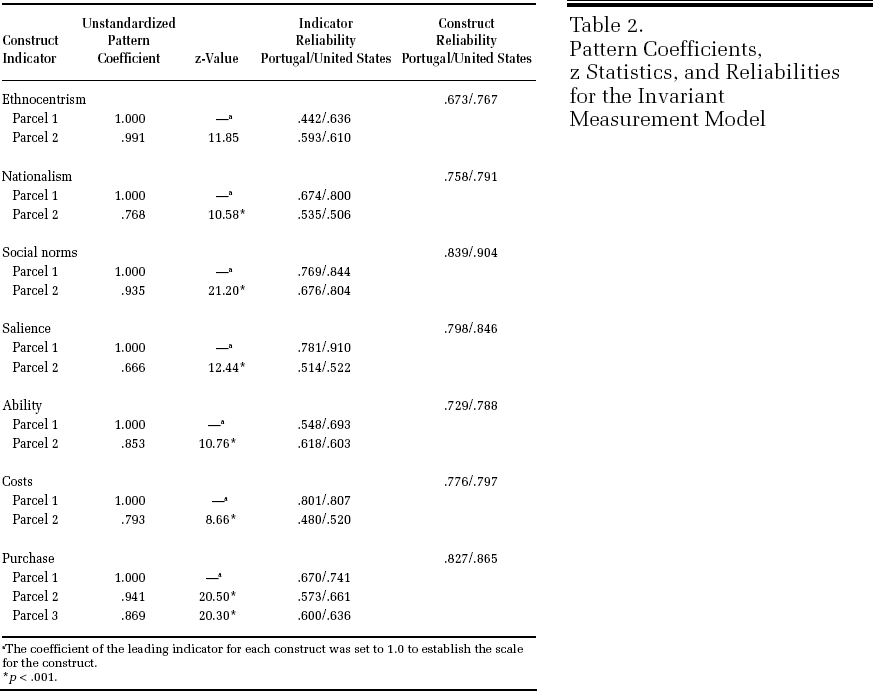
The coefficient of the leading indicator for each construct was set to 1.0 to establish the scale for the construct.
p < .001.
Support for the Structural Model
Turning to the complete structural equation model M6, which consists of both the measurement model and the structural linkages, the overall GFI is .950, the comparative fit index is .982, the incremental fit index is .982, the normed fit index is .936, the nonnormed fit index is .977, and the standardized root mean square residual is .055. The χ2 value for the complete model is 231.66 (degrees of freedom [d.f.] = 169, p = .000). Although this value is expectedly significant for such a large data set, it gives a ratio of χ2 to d.f. of 1.37:1, which is well within the frequently cited acceptable upper limit of 2:1 (Byrne 1989). The contributions to χ2 are 43.81% and 56.19% of the total for the Portugal and U.S. variants of model M6, respectively. The R2s for purchase are .46 and .66 for Portugal and the United States, which demonstrates that the set of constructs hypothesized to explain purchase performs quite well. Thus, purchase is better explained for the United States, whereas the entire set of five endogenous variables is better explained for Portugal. Taken together, these summary measures provide solid support for the structural model M6 (Bagozzi and Yi 1988; Byrne 1995).
Impact of the Direct Effects
Table 3 presents the (unstandardized) structural coefficients that portray the individual links among constructs proposed by the model. We employed one-tailed or two-tailed tests as appropriate to test the direct effects, those paths having no intervening constructs between the pair of constructs in question (Bollen 1989). Of the 17 hypothesized relationships, 12 are significant (p < .05) for Portugal and 13 are significant for the United States. Of the links proposed to influence purchase (H5), all six direct effects are significant for the United States and four are significant for Portugal. For the United States, purchase reflects a positive, direct influence from ethnocentrism, nationalism, social norms, salience, and ability and a negative, direct influence from costs. For Portugal, purchase reflects all these proposed influences except those from nationalism and costs.
Magnitude and Significance of Hypothesized Structural Relationships

p < .05 using a one-tailed test to reflect the hypothesized direction for the direct effect.
p < .05 using a two-tailed test to reflect no hypothesis of direction for the direct effect.
p < .05 using a two-tailed test to reflect no hypothesis of direction for the total effect, which had no proposed direct effect.
Moving backward in the flow of influence, the findings show that for both nations, costs is negatively influenced by salience and ability (H4b,c) but not by social norms (H4a) as was hypothesized. Ability is positively influenced by social norms (H3c) and negatively by ethnocentrism (H3a), but the hypothesized link from nationalism (H3b) is nonsignificant. Salience is positively influenced by nationalism and social norms (H2b,c) but not by ethnocentrism (H2a). Social norms is positively influenced by ethnocentrism (H1a) for both nations but by nationalism (H1b) only for Portugal. In summary, the data provide substantial statistical support for the majority of the hypothesized direct links in the model.
Impact of the Total Effects
We then examined the total effects, which combine the direct effect for a pair of constructs with any indirect effects that operate through intervening constructs. Total effects thus give a more comprehensive indication of how one construct affects another than do direct effects (Bollen 1989). Here, for both Portugal and the United States, the total effects show that 15 of the 17 links proposed by the model are significant. In addition, of the two possible links that were not proposed by the model, those leading from ethnocentrism and nationalism to costs, the latter link is significant for Portugal, but neither is significant for the United States. Specifically, this additional evidence gained by considering the total effects supports positive links for both nations from ethnocentrism to salience, negative links for both nations from social norms to costs, and a negative link for Portugal only from nationalism to costs. In addition, Portugal now gains a positive link from nationalism to purchase. Thus, the significant total effects provide solid evidence for the clear majority of the links for both nations.
Discussion
The empirical findings provide strong support for the proposed pattern of influence, which was based on the literature of helping behavior. Specifically, for both Portugal and the United States, supportive purchase behavior increases with purchasers’ greater perceived ability to help the threatened workers, greater recognition that the issue is salient, stronger belief that social norms support helping, and greater propensity to engage in both ethnocentric and nationalistic social categorization. For the United States, supportive behavior also increases with the perception of lower personal costs of helping. Given the high R2 values for purchase-related behavior in the two nations, the empirical findings indicate that buy domestic promotions based on the subsequent implications can succeed in the global marketplace.
Originally, it seemed possible that an empirical test in Portugal and the United States, two countries separated by thousands of miles, by language, and by many other sociocultural differences, would show sizable differences in the complex patterns of influence on purchase-related activities. However, the analysis of two sets of data collected using instruments couched in two different languages produced only minor differences in the empirical support for the proposed transnational model. This consistent support across nations is a major contribution of this research. The findings demonstrate (1) that the proposed general model is viable and (2) that it applies to at least two nations that differ in their physical, economic, and cultural environments for conducting international trade. This cross-national consistency in the findings supports the general notion that certain standardized marketing strategies can be used across nations. The findings also suggest many more-specific implications for marketers who seek to promote buy domestic (or, conversely, buy foreign) behavior.
Implications of Influences on Purchase
We now draw implications to assist managers by considering the significant total effects on purchase, which was conceived as purchasers’ buy domestic support for threatened workers. Marketers who seek to promote buy domestic themes in their own marketplace should consider collecting local empirical support for relevant relationships before they employ these suggestions. We stress that the promotion element is the primary focus of buy domestic strategies; therefore, in keeping with the purpose of this study, the following implications deal with promotion.
First, the positive influence of ethnocentrism indicates that many buyers will cognitively categorize products and brands of foreign firms as either acceptable or unacceptable because of their origin. Keeping political correctness in mind, a buy domestic positioning strategy could benefit from this social categorization. Promotions might emphasize that domestic workers are members of a major reference group for purchasers, their own society. A campaign might state that the workers from this same society are fully capable of providing for the needs of their people; thus, buyers have no need to buy from “outsider” suppliers that are not members of their domestic in-group. Hitting harder, the campaign might portray imports as a form of invasion from other lands. The positive influence of nationalism on purchase reinforces this implication.
Second, the strong, positive influence of social norms on purchase bolsters previous research in marketing that has shown that interpersonal influences affect buyers’ decisions. This finding indicates the value of capitalizing on a two-stage flow of influence, whereby word of mouth can help promote a buy domestic message to purchasers. For example, one strategy might use a message that features a generic form of “trusted friend” or even a national leader or respected celebrity, who picks the domestic alternative. Another message might urge the target audience to tell friends and family to mimic them in selecting domestic products and services.
Third, the positive influence of salience indicates that a strategy might seek to inform buyers who are unaware of the issue and persuade those who are already aware that imports pose a serious threat to the welfare of their fellow citizens. This campaign might take either a rational or an emotional approach. The rational approach could follow the lead of the infomercials of U.S. presidential candidates Bill Clinton and H. Ross Perot, using flip-charts, graphs, and figures to demonstrate the threat imports pose to the economy and national employment. The emotional approach could play on many citizens’ fears about the loss of jobs in their society. The message would seek to heighten their concern that the jobs of domestic workers are being “exported” abroad, depriving them of the standard of living they deserve.
Fourth, the positive impact of ability indicates that promotions might convince citizens that their small, apparently insignificant contributions can indeed make a difference. Here, the promotional task is similar to that faced by activists who seek to increase citizens’ participation in elections and environmental causes. One message might suggest that just one person's purchases can make the difference between whether a store remains open or closes or whether a manufacturer continues domestic operations or moves its operations abroad. More graphically, a message might state that a small, positive increase in a company's profit-and-loss statement can make such a difference. Alternatively, marketers can report the success of previous buy domestic campaigns to convince purchasers they are competent to help.
Fifth, in the United States, the negative influence from costs suggests that promotions might demonstrate that the costs of helping are lower than they seem, perhaps because shoppers have overlooked such benefits as the quality, convenience, value, and trustworthiness of domestic products. Promotions can also claim that the costs of not helping are high, stating that a flood of imports will cause a slower rate of growth for the nation's economy, retard improvement in the standard of living, and raise citizens’ taxes. In summary, a buy domestic strategy could usefully demonstrate that buy domestic activities benefit not just threatened workers but every citizen.
Implications of Influences on Antecedent Constructs
The four endogenous constructs that lie antecedent to purchase are influenced by most of their own antecedents. The resulting pattern of influence also holds implications for marketing strategies to influence purchase. Regarding costs, in both nations, managers can reduce perceived barriers to helping by persuading customers that the issue is important and that they are capable of helping threatened workers. Purchasers can be urged to join the two-step flow of communication, either as transmitters or receivers. In Portugal, promotions can tap nationalistic feelings to reduce the perception that helping is costly, perhaps by featuring the colors of the Portuguese flag.
For ability, marketers can boost buyers’ perceived competence to help by convincing them that important other people support their helping the workers. Respected reference groups and spokespeople can be used to tell buyers that their small effort really does matter in the larger struggle to compete and win in a competitive global marketplace. These spokespeople might be individuals known to have overcome daunting obstacles themselves, such as stars of the Olympics or national soccer squads. Note, however, that nationalism's lack of influence on ability and ethnocentrism's negative impact indicate that appeals to these two deep-seated beliefs will be, respectively, fruitless and counterproductive in this regard. Perhaps citizens who are reluctant to derogate the people of other nations recognize themselves as but one person among billions in the world, which makes them too insignificant to matter.
Regarding salience, we suggest two ways to stress the importance of the issue. The first way would enhance citizens’ group identity with either their culture or their country; the latter entry point may be more widely accessible. For example, appeals to citizens’ nationalistic tendencies might remind them that domestic products are produced by their “very own” industries, which means that the profits will “stay at home” to benefit citizens’ own society. The second approach might communicate that significant others hold the view that threatened domestic workers share values, beliefs, attitudes, and interests similar to those of the citizens who constitute the target audience.
Social norms can be strengthened by appealing to buyers’ ethnocentrism in both nations and to their nationalistic tendencies in Portugal. Thus, a strategy to heighten perceived interpersonal influence for the Portuguese can use broadly based appeals that tap their tendency to place their own country and its people over others. For U.S. consumers, a campaign could appeal more narrowly to their tendency to favor their own people.
Implications for Marketers of Foreign Products
The findings have obverse implications for marketers of imported, as opposed to domestic, products. The major market for imports comprises people who are more open to other peoples and nations. Because these purchasers are less ethnocentric and nationalistic, they are less prone to view foreign firms as outsiders. They can be attracted by a campaign that emphasizes the allure of foreign countries and cultures while downplaying the economic threat of imports. They will respond favorably to appeals that support norms of personal independence and an acceptance of what is different (e.g., the successful U.S. Subaru campaign that features Australian actor Paul Hogan). Promotions can follow the campaign used to support the North American Free Trade Agreement in the United States by stressing the overriding, large-scale, long-term benefits for the nation and its consumers. These benefits result from a larger, more varied selection of higher-quality products in the marketplace (e.g., the higher quality and better trade-in value of a Mercedes-Benz automobile).
Implications for Further Research
For future research, the usefulness of the basic concepts of prejudicial beliefs and social categorization indicates that these concepts deserve further investigation. Further research can jointly investigate (1) which prejudicial beliefs are most useful in a model such as the one used here and (2) the most effective way to consider social categorization. For example, additional research could compare the relative impact of ethnocentrism, nationalism, patriotism, prejudice, conservatism, and xenophobia. However, the somewhat different impact of ethnocentrism and nationalism across the two countries suggests that researchers should learn how citizens of various nations differ in their relevant social categorizations.
In addition, researchers should learn more about how people organize their relevant beliefs. Studies might compare the relative impact on purchase from more abstract constructs (e.g., values) with that from more concrete constructs (e.g., perceived barriers to helping). Also, it is possible that the elements of perceived cost may interact; for example, price may interact with perceived (lower) quality (Chang and Wildt 1994). It might therefore be useful to design a study that uses conjoint analysis to identify the influence of the individual elements of the cost construct. Furthermore, because helpers select the behavior they expect to bring the greatest subjective utility (Eisenberg 1986; Latane, Nida, and Wilson 1981), further research might also investigate the influence of the benefits of buying domestic products, which is the obverse of the costs of buying them.
It would also be useful to assess the relative value of this particular model by comparing its explanatory power with that of other conceptual schemes for explaining motivation to act—for example, (1) Maslow's (1970) need hierarchy, which holds that people seek to progress to a desired state of self-actualization, one that realizes their innate potential; (2) Vroom's (1964) expectancy-value model, which suggests that people will select the alternative course of action they believe is the most likely means to achieving valued end states; and (3) the concept of altruism as selfless assistance to others that stems from empathic identification with their distress (Batson, Shaw, and Slingsby 1991). Finally, claims that the model is broadly generalizable must await successful repetition of this study in additional countries.
Conclusions
The empirical support for the conceptualization is strong; the data support all the proposed linkages except those from nationalism to social norms for the United States, from nationalism to ability for both nations, and from costs to purchase for Portugal. The findings and their interpretation suggest four main contributions: First, this study advances the scholarly understanding of the motivational process of influence leading to buy domestic purchase-related behavior. Second, this study both supports and extends many of the previous studies that provided the rationale for our model; it therefore increases our confidence in the conclusions of those studies. Additional evidence relevant to our own findings would be welcome; although replication in behavioral research is frequently recommended, it is infrequently pursued. Third, by using data from two nations and producing findings that show strong consistency across national boundaries, this research supports Farley and Lehmann's (1994) conclusion that nations differ little in their response characteristics. Fourth, the findings relate to marketing management in clear fashion; they suggest several cross-national implications for marketing strategy.
Footnotes
Indicators for Seven Constructs in the Model

| Construct | Parcel | Item from the Questionnaire a |
|---|---|---|
| Ethnocentrism | 1 | Most foreigners can't be trusted. |
| 1 | I find it difficult to feel close to people from other countries. | |
| 2 | Most foreigners are bad-mannered. | |
| 2 | Most foreigners carry around all kinds of unpleasant smells. | |
| Nationalism | 1 | Generally, the more influence the U.S. has on other nations, the better off they are. |
| 1 | In view of the superiority of this country, the U.S. should try to influence the policies of other nations. | |
| 2 | The U.S. should try to help other countries to be more like this country. | |
| 2 | This nation sets a good example for other nations to follow. | |
| Social norms | 1 | Other people tell me I should not buy foreign products. |
| 1 | Most people who are important to me think I should not purchase foreign products. | |
| 2 | Other people I know say I should not purchase imports. | |
| 2 | My friends and relatives think I should not buy imports. | |
| Salience | 1 | Imports of products are really taking American worker's jobs. |
| 1 | The flood of imported products means today's workers will be tomorrow's unemployed. | |
| 2 | Foreign competitors are causing severe damage to our American industries. | |
| 2 | Competition from foreign products is hurting our economy. | |
| 2 | I doubt that many American workers will be hurt by foreign imports. (Reversed) | |
| Ability | 1 | I don't think I can make a difference by trying to help the threatened workers. (Reversed) |
| 1 | One person alone can't make even a small difference in helping threatened workers. (Reversed) | |
| 2 | My small contribution can't help the American workers. (Reversed) | |
| 2 | There isn't much that one person like me can do to solve this problem of imported products. (Reversed) | |
| 2 | My purchases are so small they can't help the threatened workers. (Reversed) | |
| Costs | 1 | I would have to sacrifice style or quality if I only bought products made in the U.S. |
| 1 | Buying only American products means getting lower quality. | |
| 2 | I would have to settle for lower quality if I only bought products made in the U.S. | |
| 2 | I give up too much if I only buy American-made products. | |
| Purchase | 1 | I take the time to look on labels so I can buy more brands of American companies. |
| 1 | I take the time to look on labels so I can buy more American-made products. | |
| 2 | I prefer to shop at retail stores that make a special effort to sell brands of American companies. | |
| 3 | Mostly, I try to buy brands of American companies. | |
| 3 | Mostly, I try to buy American-made products. |
The words “Portuguese” and “American” and “Portugal” and “U.S.” were used as was appropriate on the alternative versions of the instrument.
Acknowledgments
The authors acknowledge the financial support given to this research by a grant from the University of Utah/Brigham Young University Center for International Business Education and Research. They also acknowledge the conceptual assistance given to their work by Janeen E. Olsen.