







Abstract
This article examines the impact of new product development (NPD) “make/buy” choices on product quality using data from the automobile industry. Although the business press has lamented that NPD outsourcing compromises product quality, there is no systematic evidence to support or refute this assertion. Against this backdrop, this study tests a contingency model of the impact of NPD make/buy decisions on immediate and future product quality. The hypotheses are tested using data on NPD make/buy choices of 173 models of 12 automobile firms in the United States between 2007 and 2014. The authors find that whereas NPD buy has a more positive impact on immediate product quality, NPD make has a more positive impact on future product quality. Furthermore, the immediate product quality impact of NPD buy is stronger when (1) technologies are more complex and (2) firm NPD capability is higher. In contrast, the future product quality impact of NPD make is stronger when (1) there is postlaunch adverse feedback and (2) firm NPD capability is higher. The study highlights the complex trade-offs associated with NPD make/buy decisions and offers valuable insights on how firms could manage these decisions.
Although outsourcing decisions are generally driven by considerations of labor cost savings (Raassens, Wuyts, and Geyskens 2012), product complexity should favor organizing NPD internally. Firms’ practice of routinely outsourcing the NPD of complex components raises important questions: When does NPD buy influence product quality? When does NPD make influence product quality? New product development “make” refers to performing product design and manufacturing within the firm, whereas “buy” refers to contracting with external entities to perform product design and manufacturing processes. 1 The conclusions about the product quality consequences of NPD make/buy decisions are deeply mixed, if not contradictory. On the one hand, NPD buy decisions could hurt product quality because firms might be unable to adapt to unexpected contingencies. On the other hand, NPD buy decisions could improve product quality because they allow for earlier access to cutting-edge technologies from vendors. The possibility that vendors could learn from product development projects across multiple customers suggests that they might have a distinct advantage of being further along the learning curve. This advantage offers instant product quality benefits to firms. Likewise, NPD make decisions enable firms to exercise greater control and authority over internal product development teams and should therefore be better suited for improving product quality. However, NPD make could also be disadvantageous because firms may not possess the necessary expertise early in the product development life cycle. To fully understand the product quality impact of NPD make/buy choices, one needs to explicitly test the trade-offs at different points in the product development cycle (at and after launch).
We use the terms “NPD make” and “vertical integration” interchangeably and the terms “NPD outsourcing” and “NPD buy” interchangeably.
Our study makes three contributions to marketing theory and practice. First, our study is one of the first to test the impact of NPD make/buy decisions on product quality. A small but emerging body of literature in marketing has investigated issues related to firm–supplier relationships in an outsourced NPD environment. For instance, researchers have examined whether it is desirable for firms to give up control of suppliers in an outsourced NPD environment if the task involves a certain degree of creativity (Carson 2007). Raassens, Wuyts, and Geyskens (2012) examine the performance implications of NPD outsourcing using the event study methodology, and they test the moderating impact of minority equity and prior ties in influencing this relationship. However, to the best of our knowledge, no study has examined the product quality effects of both NPD modes (i.e., make/buy) in a product development context. Table 1 provides an overview of prior research on NPD make/buy choices, highlights the gaps in the literature, and explains how our study contributes to this stream of research.
An Overview of Previous Research on Make/Buy Choices and Performance Effects

Listed in chronological order.
Notes: X = not present in study; ✓ = present in study.
Second, our study tests the impact of NPD make/buy choices on immediate and future product quality and contributes to prior research in important ways. Previous research on NPD outsourcing has examined factors such as ease of evaluating the partner's performance (Anderson 2008; Raassens, Wuyts, and Geyskens 2012) and the firm's general knowledge levels (Stremersch et al. 2003) in explaining the variation in performance outcomes at a given point in time. Moorman and Day (2016) note that the emphasis in prior research has been on understanding factors that enhance the effectiveness of NPD buy decisions, and they call for more research on this topic. Our study responds to this call. We distinguish between immediate and future product quality in an effort to provide a more complete picture of the consequences of NPD make/buy choices. The results point to differential quality effects for NPD make/buy choices. Whereas NPD buy choices have greater positive impact on immediate product quality, NPD make choices have greater positive impact on future product quality.
Third, our study contributes to conversations in prior research about the trade-offs inherent in the NPD make/buy choices. New product development outsourcing involves a trade-off between the benefit of gaining faster access to complex technologies versus the disadvantage of poor adaptation. Previous research has noted that although firms are likely to outsource NPD for complex technologies (Singh 1997), increases in transaction costs could diminish product performance (Argyres and Mayer 2007). Our study contributes to this stream of research by showing that NPD outsourcing has a significant advantage (over NPD make) in boosting immediate product quality for complex technologies. However, this initial quality advantage (for NPD buy) diminishes in later years of the product development cycle. Similarly, while prior research has recognized adaptation problems when NPD is outsourced (Ghosh and John 1999; Tadelis 2007), our study explicitly tests the relevance of these concerns for immediate and future product quality. We find that adaptation concerns are not severe enough before product launch to adversely affect product quality from NPD outsourcing. However, NPD make has a significant advantage (over NPD buy) for adjusting and improving product quality when problems emerge after product launch.
Notably, we find that NPD capability is a valuable resource for improving product quality of both NPD make and buy choices. Although firms tend to vertically integrate in domains in which they possess superior NPD capabilities (Argyres 1996; Leiblein and Miller 2003), they outsource in domains in which they have merely adequate capabilities. Our study helps shed light on this paradox. We find that NPD capability is a valuable governance resource in outsourced NPD environments (Argyres and Mayer 2007; Wuyts and Geyskens 2005) and a learning resource for vertically integrated NPD. The results indicate that NPD capability improves immediate product quality for NPD buy and future product quality for NPD make. The implication is that NPD outsourcing is not a panacea for lack of NPD capabilities.
We test the research hypotheses in the U.S. automobile industry using a novel data set assembled from numerous secondary sources. Our data feature NPD make/buy choices for transmission systems of 173 models by 25 makes of 12 major automobile firms (i.e., BMW, Chrysler, Ford, General Motors, Honda, Mazda, Mitsubishi, Nissan, Suzuki, Subaru, Toyota, and Volkswagen) between 2007 and 2014. The unit of analysis is model-year (we elaborate on the rationale for this choice in the “Data” section). In the automotive industry, the NPD contracting mode for vehicle transmission systems does not change frequently. This feature of the automobile industry is well-suited to empirically test the performance effects of a transmission make/buy decision over time. The empirical methodology we employ for hypothesis testing is rigorous and accounts for the endogeneity of NPD make/buy choices. We also account for unobserved model, firm, and temporal heterogeneity and cross-sectional dependence in the data.
Theory and Research Hypotheses
Boundary choice decisions are fundamental to the disciplines of marketing, strategy, and economics. There are two streams of research pertinent to understanding the product quality effects of NPD make/buy choices. Transaction cost economics (TCE), a dominant theoretical lens, focuses on transaction as the unit of analysis and argues that transactional attributes play a crucial role in the firm's make/buy decisions (Williamson 1985). Whereas an extensive body of literature has focused on investigating the drivers of make/buy choices (for reviews, see Geyskens, Steenkamp, and Kumar 2006; Rindfleisch and Heide 1997), studies testing the performance effects of make/buy choices are less common (for an exception, see Raassens, Wuyts, and Geyskens 2012). As noted previously, the key challenge in testing the performance effects of the make/buy decision is the difficulty in observing performance at the transaction level. The relatively limited research on the performance effects of NPD make/buy (as evidenced in Table 1) is surprising given that NPD is a core business process for firms (Hauser, Tellis, and Griffin 2006; Srivastava, Shervani, and Fahey 1998) and understanding heterogeneity in performance is central to marketing strategy research.
Using insights from TCE and organizational learning, we develop a conceptual framework that delineates the determinants of NPD make/buy choices and their impact on immediate and future product quality. Figure 1 depicts the conceptual framework for the study. The model depicts the impact of NPD buy on immediate product quality as moderated by (1) technological complexity and (2) firm NPD capability. The impact of NPD buy on future product quality is posited to be moderated by (1) postlaunch adverse feedback (PLAF) and (2) firm NPD capability. The choice of examining these moderating variables is guided by the observation that NPD make/buy decisions involve a fundamental trade-off between access to novel technologies and greater learning and control. These moderating variables bring into sharp focus the conditions that strengthen or exacerbate the benefits and challenges accompanying NPD make/buy decisions.

Conceptual Model of NPD Make/Buy Choices and Product Quality Outcomes
Previous research has noted two critical advantages of NPD make: the ability to exert control and authority and the ability to adapt to unforeseen contingencies (Williamson 1985). In the case of product development of a complex component, NPD make enables firms to maintain control of internal product development teams through hierarchy. Contract theory, a stream of research related to TCE, contends that internal NPD is a superior mechanism because firms can use subjective performance criteria and motivate product development teams to exert greater effort (Gibbons 1998). The reason is that internal product development teams are long-term employees and can be incentivized to put in effort beyond a single NPD project. This benefit is crucial in the case of NPD of complex components because of the greater need for adaptation or adjustment after product launch. In contrast, NPD buy offers the benefit of using incentives to extract greater performance from vendors (Anderson, Glenn, and Sedatole 2000; Poppo and Zenger 1998; Williamson 2008). However, incorporating numerous contingencies in contracts is costly and difficult to enforce. The implication is that adaptation and adjustment after product launch for NPD buy is relatively more difficult.
The second relevant stream of research for understanding the product quality effects of NPD make/buy choices is the organizational learning literature. A key insight from this stream of literature is that vertical integration or “make” is inherently a superior mode for learning (Levin 2000; Miner, Bassof, and Moorman 2001) compared with external parties or “markets.” Product quality improvement often takes the form of a learning curve. Our conceptualization of learning mirrors the behavioral view of the theory of the firm. Here, learning is represented as emanating from the organization's experience in a path-dependent way and becoming encoded in routines (e.g., rules, standard operating procedures; Cyert and March 1963; March 1991). Typically, learning in organizations is characterized by the institutionalization of routines and is punctuated by external disruptions. In this tradition, learning occurs when there is a noticeable change in behavior. In the context of product development, improvement in product quality is an indicant of learning (Levin 2000).
Why does NPD make offer superior learning benefits over NPD buy? The logic is related to how firms notice issues of poor quality and solve problems. In the case of product development, most of the improvements in product quality occur after the product is launched (Levin 2000). Internal product development teams should be better equipped to coordinate and engage in trial-and-error learning after product launch. In contrast, improving product quality over time is relatively more difficult with vendors because of the lack of incentives. This learning advantage over time is critical for complex components that require interdependent problem solving (Sorenson 2003).
Research Hypotheses
The preceding arguments highlight the trade-offs associated with NPD make/buy decisions. At the time of product development, NPD buy has a distinct advantage over NPD make because vendors have greater expertise or an “early start” with respect to a particular application or technology. Furthermore, firms could use pay-for-performance contracts to realize significantly higher product quality at the time of product launch (Anderson, Glenn, and Sedatole 2000). Therefore, NPD buy should offer higher immediate product quality compared with NPD make. In contrast, NPD make is superior to NPD buy for future product quality because it allows for greater ability to adjust to contingencies that arise after product launch. New product development buy is not a suitable mode when such contingencies arise because of the difficulty in anticipating these issues and enforcing them through a contract. Furthermore, relative to vendors, firms’ product development teams are motivated to respond to subjective performance criteria. It is difficult to enforce subjective performance criteria when contracting with vendors. Finally, NPD make enables better coordination with employees within firms and helps improve quality over time (Levin 2000; Sorenson 2003). These control, adaptation, and learning benefits of the NPD make mode translate to higher quality after product launch and overcome the quality disadvantage the firm experiences at the time of product launch. Drawing on these arguments, we advance the following baseline hypotheses:
NPD buy has a more positive impact on immediate product quality than NPD make.
NPD make has a more positive impact on future product quality than NPD buy.
NPD Make/Buy Decisions and Immediate Product Quality: The Moderating Impact of Technological Complexity
An attribute that creates a dilemma for firms when selecting the NPD contracting mode is technological complexity. Technological complexity refers to the design and manufacturing challenges faced when implementing a technology to produce a component (Singh 1997). Although technological complexity increases coordination costs for NPD buy and favors NPD make, firms may not have the expertise to implement complex technologies. Therefore, firms might be less inclined to invest in complex technologies and might prefer to wait and see how the technology fares in the market (Balakrishnan and Wernerfelt 1986). A key benefit of NPD outsourcing is that it provides early access to newer technologies. Therefore, firms might be motivated to outsource NPD and leverage the skills of suppliers in such technological areas. Meta-analytic evidence on make/ buy choices supports this view and suggests that technological complexity offers greater product quality advantages under market governance compared with hierarchical governance (Geyskens, Steenkamp, and Kumar 2006). The rationale is that vendors are likely to be better equipped than firms in ensuring product quality for complex technologies because they have acquired knowledge across multiple projects and customers. In contrast, when technologies are less complex, the immediate product quality advantage of NPD buy over NPD make is likely to be suppressed. Given these arguments, we expect the positive relationship between NPD buy choice and immediate product quality to be stronger when the technologies involved are complex.
The positive impact of NPD buy on immediate product quality is stronger when technological complexity is higher.
NPD Make/Buy Decisions and Immediate Product Quality: The Moderating Impact of NPD Capability
NPD capability refers to the ability of firms to generate innovative outcomes efficiently using the resources at their disposal. Firms with superior product development capabilities related to a particular component are able to produce the component or system more efficiently than firms without these capabilities because they possess the appropriate personnel, equipment, and knowledge (Lieberman and Dhawan 2005; Srinivasan, Lilien, and Rangaswamy 2002). Although NPD capabilities are known to be a valuable and inimitable resource, we argue that higher NPD capabilities enable firms to manage risks associated with NPD outsourcing in the short run better than firms with lower NPD capabilities (Argyres and Mayer 2007).
In an outsourced NPD environment, the presence of contractual hazards could limit performance gains. As we have noted, the advantage of outsourcing lies in the firm's ability to motivate suppliers with incentives, whereas the benefits of vertical integration lie in learning and minimizing the risks associated in dealing with markets (Bajari and Tadelis 2001). The ability to write superior contracts could be a distinct source of advantage for firms (Argyres and Mayer 2007; Wuyts and Geyskens 2005). Firms with strong NPD capabilities have greater ability to specify appropriate incentives, project milestones and deliverables, and extract greater effort from suppliers. Greater effort in the context of product development could imply dedicating appropriate resources to the task (e.g., personnel). Previous research has found that firms with greater capabilities/knowledge in a domain are able to have better outcome control in an outsourced environment (Tiwana and Keil 2007). However, there are limits to the benefits of NPD capability. Anticipating and incorporating unforeseen contingencies is not feasible even if firms possess higher NPD capability. In contrast, the effect of NPD buy on immediate product quality is likely to be suppressed for firms with lower NPD capabilities. Firms with weaker NPD capabilities would be unable to extract similar effort from suppliers because they lack the requisite skills to link incentives to appropriate project milestones. Therefore, we expect that the impact of NPD buy on immediate product quality will be positively moderated by NPD capability of the firm.
The positive effect of NPD buy on immediate product quality is stronger when firms have higher NPD capability.
NPD Make/Buy Decisions and Future Product Quality: The Moderating Impact of PLAF
Postlaunch adverse feedback refers to feedback after product launch from the market about potential problems. As noted previously, many NPD projects involve quality improvements over multiple time periods. Such projects are characterized by unforeseen contingencies; consequently, contracts between firms and suppliers are inherently incomplete. New product development outsourcing contracts primarily focus on technical and cost objectives that are observable prior to market introduction. Although firms that outsource NPD could potentially include penalties for performance under certain thresholds, such penalties are difficult to enforce if suppliers disagree about the root cause of problems. In other words, problems that emerge after product launch often necessitate costly adjustments and adaptation. In contrast, vertically integrated NPD should be better suited to handle unforeseen contingencies given the firm's authority and control over internal product development teams (Forbes and Lederman 2009). The rationale for this argument is that internal product development teams (vs. outsourced vendors) are likely to respond better to incentives based on subjective performance criteria. Drawing on these arguments, we hypothesize:
The positive impact of NPD make on future product quality is stronger when there is PLAF.
NPD Make/Buy Decisions and Future Product Quality: The Moderating Impact of NPD Capability
The future quality impact of NPD make rests on the firm's ability to learn through trial and error and adapt over the product development life cycle. However, this benefit of NPD make is unlikely to be uniform across firms. We argue that firm NPD capability is an important boundary condition for this relationship. Specifically, we expect that NPD capability serves as a learning resource in the long run (Argyres and Mayer 2007). The benefit of NPD capability originates from deeper and insightful learning because firms already possess the baseline knowledge and understanding in a domain. Firms are therefore likely to be able to more effectively interpret knowledge generated and engage in problem solving under NPD make because of their existing capabilities (Cohen and Levinthal 1990). New product development capability reflects the firm's knowledge and experience with previous technological generations, and this capability perhaps evolves through previous NPD make decisions (Jacobides and Winter 2005). The marginal benefit of NPD make over time should be contingent on the level of in-house NPD capabilities because learning over a product development cycle is path dependent. In contrast, when firm NPD capability is lower, the learning curve for product quality under NPD make is steeper and, as a result, quality improvements over the life cycle are likely to be suppressed. From these arguments, we hypothesize:
The positive impact of NPD make on future product quality is greater when firms have higher NPD capability.
Research Methodology
Empirical Setting: The Automobile Industry
We test our research hypotheses on firms’ NPD make/buy choices for transmission systems in the automobile industry. The automobile industry has three features well-suited for testing the research hypotheses. First, new product launches in the U.S. automobile industry follow a schedule that is not synchronous with the calendar year. Figure 2 illustrates the typical sequence of events before and after product launch. The launch of new models for model-year t typically occurs between the summer of calendar year t – 1 and the beginning of calendar year t. The production for new models commences two to three months prior to launch, and NPD make/ buy choices are made well in advance of the production schedule. J.D. Power and Associates (JDPA) reports product quality scores in the month of June of calendar year t. This quality score corresponds to the performance of systems for models introduced in that calendar period. Given that JDPA reports product quality scores for systems every year, we are able to track the product quality of a system over time.
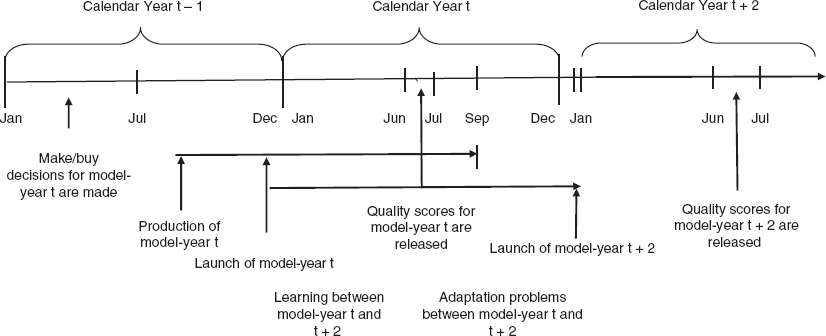
Timeline of Product Development in the Automobile Industry
Second, in the automobile industry, once firms choose a NPD contracting mode for systems/components, they do not change the contracting mode within a short period. In our data, the NPD contracting mode for transmissions remains unchanged for four years for several models. For example, if firms outsource NPD for a transmission system in a model in 2008, NPD contracting mode remains NPD buy for transmissions incorporated in models in 2009, 2010, and 2011. This feature enables us to test the product quality impact of NPD make/buy choices for four years.
Third, another benefit of the automobile industry is that there is a learning curve for product quality (for reviews, see Levin 2000). In the automobile industry, firms perform quality audits during production runs to identify defects and make necessary changes to improve quality. These quality audits are crucial in minimizing the manufacturer's liability in the market (e.g., warranty claims, petitions, recalls, fines). Note that although firms are unable to alter design before a new model or redesigned model is launched, ongoing quality checks help in identifying and fixing defects before the vehicle rolls out to dealerships. Thus, automakers experience an immediate product quality that corresponds to the initial product development efforts and a future product quality that corresponds to quality improvements after product launch. Finally, the automobile industry enables us to link NPD make/buy choices to product quality at the transmission system level across models and years.
Data
We assembled the data set from numerous sources. We obtained data on NPD make/buy choices of automobile firms for vehicle transmission systems from MarkLines, a leading vendor that tracks the automobile industry in North America, Europe, and Asia. Whereas NPD make decisions imply that the automaker designs and manufactures transmission systems in-house, NPD buy decisions imply that the vendor designs and manufactures transmission systems.
The data feature NPD make/buy choices for 25 makes (i.e., Acura, Audi, BMW, Buick, Cadillac, Chevrolet, Chrysler, Dodge, Ford, GMC, Honda, Infiniti, Jeep, Lexus, Lincoln, Mazda, Mercury, Mitsubishi, Nissan, Pontiac, Scion, Subaru, Suzuki, Toyota, and Volkswagen) and 173 models of the 12 largest automobile firms (i.e., BMW, Ford, General Motors, Chrysler, Honda, Mazda, Mitsubishi, Nissan, Subaru, Suzuki, Toyota, and Volkswagen) in United States between 2007 and 2014. These 12 automobile firms accounted for approximately 90% of the vehicles sold in United States. The data set comprises NPD make/buy choices of 173 models tracked for four years (166 models for four years and 7 models for eight years). The final data set for empirical analyses features 180 NPD make/buy choices for transmission systems between 2007 and 2014. Note that these 180 NPD make/buy choices correspond to 173 models (i.e., 166 + [7 × 2] NPD make/buy choices). 2
The data include 7 models that switched NPD contracting modes after four years (Buick Regal, Chevrolet Equinox, Ford Fusion, Lincoln Navigator, Mazda 6, Toyota Camry, and Toyota Highlander). We track these seven models for eight years. We exclude 11 models from the data either because these models switched NPD contracting modes within four years or because the NPD contracting mode was available for less than four years.
We collected data on product quality of transmission systems for makes and models between 2007 and 2014 from JDPA. The product quality measure in our study is akin to quality in use. We collected data on several transactional and firm characteristics. For transactional characteristics, we collected data on the transmission speed (e.g., four-speed, five-speed), type of transmission system (front-wheel drive, rear-wheel drive, and all-wheel drive) and weight of the transmission. Finally, we collected data on the size and the labor efficiency of the transmission plants. With regard to firm characteristics, we collected data on model sales from Ward's Automotive Yearbook and research and development (R&D) expenditures from Compustat and annual company reports and filings. We also collected data on the breadth of product line (i.e., number of different trims offered for a given model in a given year). Finally, we also collected data on the dry weight (i.e., without transmission fluid) of transmission systems from MarkLines.
Measures
Immediate and future product quality
We operationalized product quality in terms of the number of problems experienced by vehicles for transmission systems. J.D. Power and Associates administers detailed surveys from verified owners about the quality of the product or service. Using these measurements, JDPA constructs power circle ratings whereby the product with the highest quality rating is designated a 5 (i.e., “among the best”) and the product with the lowest quality is designated a 2 (i.e., “the rest”), indicating that consumers rate them lower than other companies or models in the survey. Immediate product quality is operationalized as product quality in the first two years of product launch (t and t + 1).
Future product quality is operationalized as product quality of transmission systems of a vehicle model in the third and fourth years after product launch. For example, if a model with a new transmission system is introduced in year t, future product quality refers to the product quality of transmission systems for models produced in years t + 2 and t + 3. The choice of examining years t + 2 and t + 3 after product launch for future product quality is consistent with our goal of examining quality improvement over the product development cycle. For instance, problems emerging after product launch in year t + 1 will require adaptation and learning in subsequent models. If changes need to be incorporated, one could reasonably expect that these changes would have a greater opportunity to be incorporated in years t + 2 and t + 3. Consistent with this logic, we expect immediate product quality—that is, product quality of transmission systems for models produced in years t and t + 1—to reflect initial product development efforts because of the relatively smaller window of opportunity to learn and adapt (for alternate measures for immediate and future product quality, see the “Validation Analyses” subsection).
Technological complexity
Technological complexity in transmission systems arises because firms try to maintain a balance between weight, fuel efficiency, and space constraints. We operationalized technological complexity using three indicants: (1) the number of gears in the transmission system; (2) whether the transmission is a front-wheel drive, rear-wheel drive, or all-wheel drive; and (3) weight of the transmission. The first indicant is operationalized as the count of the number of gears in the system. For instance, the technology underlying an eight-speed transmission system is more complex than a five-speed transmission system. More ratios require more shifting elements, and these add weight, complexity, and drag to the transmission (Colwell 2013). According to industry reports, the technology for all-wheel transmission systems is the most complex, followed by rear-wheel drives and front-wheel drives (O'Dell 2014). Front-wheel drives (transverse mounted engines) are less complex than rear-wheel drives and all-wheel drives because power needs to be delivered only to the front wheels, and there is enough room under the hood to accommodate this design. For rear-wheel drives, the engine is mounted longitudinally, and transmission sits at the back in the form of a rear transaxle for superior traction. The space constraints for this transmission makes the technological design more complex. Finally, all-wheel drives introduce greater complexity to the drive system because they feed power to all four wheels and introduce more power losses (O'Dell 2014). Therefore, we operationalized this indicant by coding front-wheel drives as 1, rear-wheel drives as 2, and all-wheel drives as 3. Finally, we use weight of the transmission system as the third indicant of complexity because greater weight imposes design constraints and increases the degree of difficulty in maintaining the vehicle's fuel efficiency. Using these indicants, we create a composite measure of technological complexity by extracting principal components. Note that the indicants are standardized before principal components analysis and are therefore not sensitive to different scales for the indicants. The extracted component accounts for 81% of the variation in the three indicants.
NPD capability
We operationalize NPD capability as the efficiency with which firms are able to convert relevant technological resources into valuable technological output. We use an input–output approach to derive NPD capabilities using a NPD transformation function. We reverse-code NPD inefficiency to generate the measure of NPD capability (Dutta, Narasimhan, and Rajiv 2005). We operationalize technological output (TECHOUTPUT) in terms of the number of citation-weighted patents firms receive for vehicle transmission systems. The rationale for using citation-weighted patents as the measure for technological output is that more cited patents are likely to be more innovative. Given the possibility of learning-curve effects in high-technology industries, we expect R&D expenditures (RDEXP) to enable firms to achieve their technological output.
3
Similarly, the base of past technological output is likely to be the platform on which firms generate new and innovative technologies. Therefore, we use technological output base (TECHBASE) from previous years as an input in the NPD capability function. Technological base refers to the cumulative citation-weighted patent output from the previous three years after adjusting for decay rates.
4
Finally, because technological output is likely to be shaped by the voice of the customer, we include marketing capability (MKCAP) as an input in the NPD transformation function. In summary, we specify technological output that firms seek to maximize, and we specify R&D expenditures, base of technological output, and marketing capability as inputs such that:

Although it would have been ideal to include R&D expenditures of transmissions as an input in the NPD capability transformation function, disaggregate data on R&D spending in different domains is not available (for an alternate measure for NPD capability, see the “Validation Analyses” subsection.).
Technological base is computed as TECHBASEkt = χTECHOUTPUTkt-1 + χ2TECHOUTPUTkt-2 + χ3TECHOUTPUTkt-3. χ is the decay rate or weight assigned to past innovative output.
where k = firm, t = year, εkt is the random error component, ηkt is the time-varying inefficiency term, and μs are the response parameters of inputs in the NPD transformation function. The random error component captures the purely stochastic variation in the firm's output, while the inefficiency term captures the deterministic component of the firm's ability to efficiently transform its inputs to outputs. We compute the firm's NPD capabilities as 1 - ηkt (i.e., NPDCAPkt = 1 - ηkt). Following prior research, we estimate the NPD transformation function using stochastic frontier estimation. The NPDCAP score from this approach serves as the measure for firm NPD capability in Equations 2 and 3.
To estimate marketing capability (MKCAP), consistent with previous research, we again use the input–output approach (Dutta, Narasimhan, and Rajiv 1999; Kalaignanam et al. 2013). We specify sales as the output that firms try to maximize and specify investment in marketing (MKTGSTOCK) and customer relationships (ICR) as inputs:

PLAF
We operationalize PLAF in terms of a dummy variable that reflects whether complaints pertaining transmission systems of various model-years are received by the National Highway and Traffic Safety Administration (NHTSA). The NHTSA is a federally governed organization established under the Highway Safety Act of 1970 to enhance and monitor highway and motor vehicle safety. It is enforced by the U.S. Department of Transportation with the goal of establishing and governing safety standards for motor vehicles. The NHTSA passes on these complaints to automobile manufacturers for potential action or remedy. Specifically, we examine whether a model launched in year t received complaints from consumers in year t + 1. As noted previously, we examine future product quality in years t + 2 and t + 3. This temporal separation is consistent with our goal of examining adaptation problems after launch and how firms adjust to this feedback. We coded PLAF as 1 if complaints were received for transmission systems of a given model-year, and 0 otherwise.
A potential concern with the PLAF measure is that it may be correlated with immediate product quality. 5 To circumvent this problem, we developed a PLAF measure that is orthogonal to immediate product quality. To do so, we use probit specification to model the impact of initial product quality from year t on PLAF in year t + 1. From this model, we estimate the residuals for the probability of PLAF in years t + 1 (i.e., difference in predicted probabilities and actual outcomes of PLAF). If this difference is greater than .5, PLAFRESIDUAL takes a value of 1, and 0 otherwise. Table 2 summarizes the variables in the study, their operational measures, and descriptive statistics.
Variable Operationalization and Descriptive Statistics

Notes: N.A. = not applicable; USPTO = U.S. Patent and Trademark Office; SG&A = selling, general, and administrative expenses.
We thank an anonymous reviewer for this insight.
Data Setup
A rigorous test of our hypotheses requires a close alignment of the theory, measures, and empirical model. We followed three steps to achieve this. First, we model the determinants of NPD make/buy choices on a cross-section data set of 173 models. This choice is consistent with the fact that NPD make/buy choices do not vary over time. Second, we test the impact of NPD make/buy choices (year t) on immediate product quality (years t and t + 1) using 360 model-years (173 models tracked in the first two years of product launch). Third, we test the impact of NPD make/buy choices (year t) on future product quality (years t + 2 and t + 3) using 360 model-years (173 models tracked in years 3 and 4 after product launch).
Model Specification
Endogeneity of NPD make/buy choices
Firms are likely to be aware of the performance frontiers of the make/buy decision and would rationally select the NPD contracting mode that offers higher product quality. If so, examining the product quality outcomes of NPD contracting modes without correcting for this endogeneity would yield biased coefficients and possibly erroneous conclusions. To account for this problem, we model the determinants of the NPD make/buy choice and use predicted NPD make/buy choices in the subsequent product quality equations.
We model a firm k's (e.g., Ford Motor Company, Toyota Motor Corporation) NPD make/buy choice for technology m (e.g., six-speed, front-wheel drive, 135 pounds) for model i (e.g., Navigator, LS460) of make j (e.g., Lincoln, Lexus) as a function of both transactional and firm characteristics. Consistent with previous research, we include technological complexity, volume uncertainty, sunk costs, and production cost advantage as drivers of the NPD make/buy choice. First, greater technological complexity (TECHCOMPm) is likely to increase the cost of coordination with the vendor, and therefore firms may choose to pursue NPD make. An alternate argument is that firms may not have the requisite expertise for a given technology and may rely on NPD outsourcing to gain earlier access to complex technologies. Second, when volume uncertainty (VOLUNCERTi) is high, firms may not be able to predict demand for a component and therefore may be exposed to costly renegotiations with the supplier (Walker and Weber 1984). Because this uncertainty could increase transaction costs, we expect volume uncertainty to result in firms opting to perform NPD in-house. Third, firms with higher sunk costs, such as capital investments in plants, are more likely to make rather than buy NPD (Lieberman 1991). We include size (in millions of square feet) of the firm's transmission plants as a measure of sunk costs (SCOSTk). Fourth, firms with a greater production cost advantage (PRODCOSTADVk) are more likely to perform NPD in-house. We include the inverse of the number of hours required to build a transmission assembly as a measure of production cost advantage.
We also include firm characteristics such as product variety, market performance, and availability of resources as determinants of the NPD make/buy choice. Firms offering greater product variety need to contain development costs (Bayus and Putsis 1999) and are likely to organize NPD internally. To account for this possibility, we include product line breadth (PLBRDTHj) as a covariate. Next, when market performance (PERFi) is higher, firms may pursue NPD make to exercise greater control. We also expect availability of resources to influence the ability or motivation of firms to make or buy. We include R&D intensity to control for the resource base of a firm: R&D intensity (RDINTENk) is operationalized as R&D expenditures as a percentage of sales. Finally, it is likely that NPD capability may drive firms to organize NPD internally. Accordingly, we include NPD capability (NPDCAPkt) as a driver of the NPD make/buy choice. We utilize the following probit specification to model the determinants of NPD make/buy choices.

NPD make/buy choice → immediate product quality
To test the immediate product quality impact of NPD make/buy choices, we estimate a linear model that links the hypothesized variables to immediate product quality. We use the following specification:

NPD make/buy choice → future product quality
Next, we test the impact of NPD make/buy choice on future product quality using the following specification:
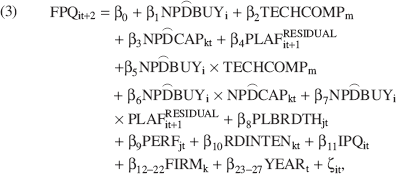
There are a few econometric issues pertaining to the error structure in Equations 2 and 3 that need to be accounted for. Cameron and Trivedi (2005, p.702) suggest that “NT correlated observations have less information than NT independent observations.” Thus, ignoring the error correlation between cross-sectional units could lead to erroneous conclusions. Firms market vehicles under numerous makes that, in turn, offer several models. This structure leads to clustering of observations and possibly contemporaneous correlation between cross-sectional units. We tested for the presence of cross-sectional dependence and find that the null hypothesis of no spatial dependence is rejected for both the immediate (χ2(8) = 94.73, p < .01) and future (χ2(11) = 104.29, p < .01) product quality model. As suggested by Creel and Farell (1996), we use feasible generalized least square estimation (XTGLS in STATA 13) to estimate Equations 2 and 3 with cross-sectional dependence and heteroskedasticity.
Results
Our unit of analysis is model-year (e.g., Acura TSX 2007). 7 This choice is related to the fact that we observe considerable variation in the NPD make/buy choices for transmissions across models. Table 3 provides a list of all makes and models in our sample and the corresponding model-years. For example, whereas the NPD buy mean for Toyota is 46, the NPD buy mean of Lexus is .85. In other instances, such as Honda, the NPD contracting mode does not vary across makes (Honda, Acura) and models. It is worth noting that NPD make/buy choice varies at the model level for approximately 65% of the models and is invariant across the remaining 35% of models. Decisions for NPD make/buy do not appear to be made at the make/brand level. We choose model-year as the unit of analysis because this choice is consistent with 65% of the models and because doing so theoretically allows choices to vary at the model level. However, in 35% of the data, the NPD contracting mode is invariant across models of the same firm, and we account for this by including firm-specific or manufacturer-specific fixed effects (e.g., the manufacturer Honda vertically integrates NPD for all makes and models); we also account for cross-sectional dependence (correlation across models) in the immediate and future product quality models.
Make-Specific Descriptive Statistics

In this example, make refers to “Acura,” model refers to “TSX,” year refers to “2007,” and firm refers to “Honda Motors.”
Determinants of NPD Make/Buy Choice
Table 4 presents the correlation between the key variables in the study. The correlations between the independent variables are within prescribed limits (variance inflation factors < 10, condition indices < 20), suggesting that multicollinearity is not a serious threat in this study.
Correlation Matrix of Key Variables
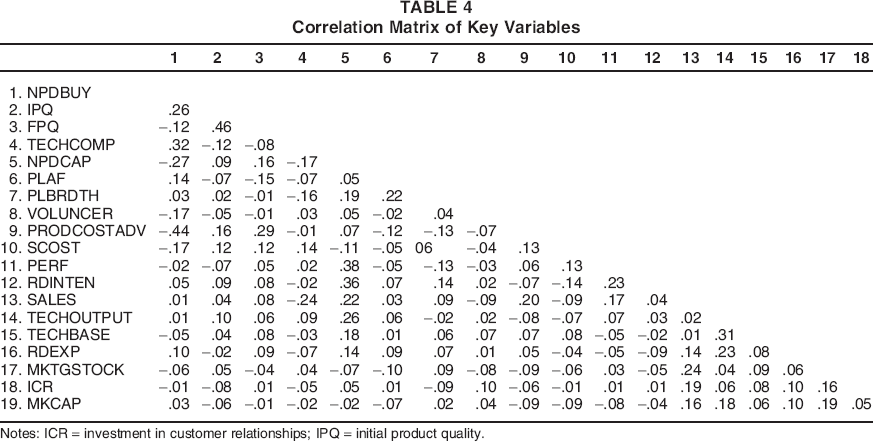
Notes: ICR = investment in customer relationships; IPQ = initial product quality.
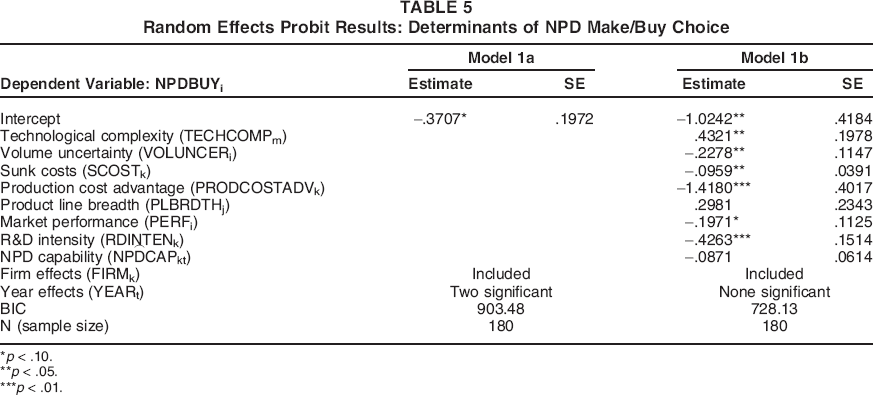
The results of the determinants of NPD make/buy choices appear in Table 5. To evaluate whether transactional and firm characteristics predict NPD make/buy choices, we estimated two nested models: (1) Model 1a, the base model that includes only intercept, firm-specific, and year-specific effects and (2) Model lb, the full model that includes all variables. A comparison of BIC statistics shows that the fall model (Model lb) has a BIC of 728.13 and the base model (Model 1a) has a BIC of 903.48. Model lb has a significantly better fit for the NPD make/buy choice data. We find that technological complexity is positively related to NPD buy (.4321, p < .05). Therefore, firms are likely to outsource NPD when technological complexity is higher. Consistent with expectations, we find that volume uncertainty is negatively related to NPD buy (-.2278, p < .05). Similarly, we find that sunk costs are negatively related to NPD buy (-.0959, p < .05). As we expected, the results show that production cost advantage is negatively associated with NPD buy (-1.4180, p < .01). With regard to firm characteristics, R&D intensity (-.4263, p < .01) is negatively related to NPD buy.
Random Effects Probit Results: Determinants of NPD Make/Buy Choice
p < .10.
p < .05.
p < .01.
We do not find the impact of NPD capability on NPD buy to be statistically significant (-.0871, p > .10). This insignificant finding is perhaps because NPD capability varies at the firm level, whereas NPD make/buy choice varies within firms (i.e., firms use both make and buy modes across models). Furthermore, it is plausible that R&D intensity captures some of the effects of NPD capability especially because NPD capability is also correlated with R&D intensity. We find the impact of market performance on NPD buy to be negative (-.1971, p < .10). Finally, we do not find product line breadth to be significantly related to NPD buy.
NPD Make/Buy Choices and Product Quality: Main-Effect Results
The results for the effects of NPD make/buy choices on immediate and future product quality appear in Table 6. Model 2 corresponds to results for immediate product quality. Model 3 corresponds to results for future product quality.
Results: The Impact of NPD Make/Buy on Immediate and Future Product Quality

p < .10.
p < .05.
p < .01.
Notes: Standard errors are robust.
The results in Models 2 and 3 suggest that the impact of NPD buy on immediate product quality is positive and significant (α1 = .4110, p < .01), while that on future product quality is negative and significant (β1 = -.6627, p < .05). This finding indicates that when firms outsource NPD, the impact on immediate product quality is more positive than that from NPD make. However, the impact of NPD make on future product quality is more positive than that from NPD buy. Thus, at average values of the moderating variables, both NPD make and buy decisions have a positive impact on product quality, but the impact manifests differently over time. The baseline hypotheses H1 and H2 are supported.
NPD Make/Buy Choices and Immediate Product Quality: Moderator Results
Next, we examine how technological complexity and NPD capability moderates the relationship between NPD make/buy and immediate product quality. The results from Model 2 suggest that the direct impact of technological complexity on immediate product quality is negative (α2 = -.4686, p < .05). This finding implies that technologically complex transmissions have lower quality than those that are less complex. The interaction of NPD buy and technological complexity on immediate product quality is positive and significant (α4 = .6954, p < .05). H1a is supported.
To gain better insight into the nature of the interaction, we performed spotlight analyses by setting low and high values of technological complexity at two standard deviations below (low) and above (high) the mean, respectively. The spotlight analyses appear in Figure 3, Panel A. Note that we account for uncertainty in the parameter estimates by drawing 1,000 bootstrap samples from the two-standard-deviation asymptotic interval of the main and interaction coefficients. The numbers reported in Figure 3 are the mean predicted values across the 1,000 bootstrapped samples. As we show in Figure 3, Panel A, when technological complexity is high (two standard deviations above the mean), NPD buy is associated with higher immediate product quality compared with NPD make (3.45 > 1.49, p < .10). However, when technological complexity is low (two standard deviations below the mean), we find no significant difference between immediate product quality for NPD make/buy choices (2.53 ≍ 3.66). The difference-in-differences (DDbuy_make = 3.09, p < .05) is significant and suggests that as technological complexity increases, NPD buy choices result in greater immediate product quality compared with NPD make choices.

Spotlight Analyses for the Effect of NPD Make/Buy Choices on Immediate and Future Product Quality
We find a similar pattern of results for the moderating impact of firm NPD capability. The direct impact of NPD capability on immediate product quality is positive (α3 = .0030, p < .05). That is, firms with higher NPD capability experience greater immediate product quality compared with counterparts with lower NPD capability. The interaction between NPD buy and NPD capability on immediate product quality is positive and significant (α5 = .0248, p < .10). Thus, H1b is partially supported.
The spotlight analysis in Figure 3, Panel A, suggests that when a firm's NPD capability is high, NPD buy is associated with superior immediate product quality compared with NPD make (4.03 > 2.69, p < .10). However, when NPD capability is low, we find no significant difference between immediate product quality experienced for NPD make/buy choices (1.95 ≍ 2.46). The difference in differences (DDbuy _ make = 1.85, p < .10) is significant and suggests that as firm NPD capability increases, NPD buy choices lead to greater immediate product quality compared with NPD make choices. Collectively, the results of H1, H1a, and H1b suggest that NPD buy (vs. NPD make) is associated with greater immediate product quality, and this initial advantage is greater for (1) technologically complex transmissions and (2) firms with superior NPD capability.
NPD Make/Buy Choices and Future Product Quality: Moderator Results
We next examine the moderator results for the impact of NPD make/buy choices on future product quality. The results from Model 3 suggest that the direct impact of PLAF on future product quality is negative (β4 = -.1561, p < .10). Consistent with H2a, we find that the interaction between NPD buy and PLAF on future product quality is negative and significant (β7 = -.8823, p < .05). As we show in Figure 3, Panel B, in the presence of PLAF, NPD make is associated with higher future product quality compared with NPD buy (2.42 > .87, p < .05). However, in the absence of PLAF, the impact of NPD make/ buy on future product quality is not significantly different (2.58 ≍ 1.90). The difference-in-differences (DDmake_buy = .88, p < .10) is significant and suggests that if a firm choosing NPD make experiences PLAF, it is in a better position to adapt to negative feedback and improve product quality. However, NPD buy is ill-suited to adapt to negative feedback and improve future product quality because of the difficulty of coordinating with vendors.
Finally, we examine the moderating impact of NPD capability on the NPD buy–future product quality relationship. We find that the direct impact of NPD capability on future product quality is positive (β3 = .0247, p < .05). Therefore, firms with higher NPD capability also experience higher future product quality. Notably, the impact of NPD capability on future product quality is larger than its impact on immediate product quality (β3 = .0247 > α3 = .0030, p < .05). Consistent with H2b, the interaction between NPD buy and NPD capability is negative (β6 = -.0316, p < .05).
Figure 3, Panel B, suggests that when a firm's NPD capability is high, NPD make is associated with higher future product quality compared with NPD buy (3.53 > 1.66, p < .05). However, when NPD capability is low, we find no significant difference between future product quality associated with NPD make/buy choices (1.63 ≍ 2.18). The difference-in-differences (DDmake _ buy = 2.42, p < .05) is significant and suggests that as NPD capability increases, NPD make leads to higher future quality compared with NPD buy. Thus, the results of H1b and H2b show a differential moderating effect of NPD capability: higher NPD capability strengthens the NPD buy–immediate product quality relationship as well as the relationship between NPD make and future product quality. Collectively, the results of H2, H2a, and H2b suggest that NPD make (vs. NPD buy) decisions are associated with higher future product quality, and this impact is greater when (1) there is adverse feedback after product launch and (2) firms have higher NPD capability.
The results for the control variables are in the expected direction. Consistent with evidence on the firm performance and organizational change relationship (Greve 1998), we find that models with higher sales experience inferior immediate product quality outcomes (-.1216, p < .05). We note that these results account for firm-specific and year-specific heterogeneity. With regard to firm-specific effects, we find that the immediate product quality of Ford, Toyota, BMW, and Volkswagen is significantly higher (relative to Chrysler), whereas the future product quality of Toyota is significantly higher (relative to Chrysler). Consistent with expectations, we also find that higher levels of investments in R&D is positively related to immediate product quality (.1558, p < .05). We also find that immediate product quality has a positive impact on future product quality (.3029, p < .10).
Validation Analyses
We performed additional analyses to check the robustness of the study's main findings. Specifically, we examined the stability of the results (1) to two alternate measures of NPD capability, (2) when dropping NPD make/buy choices that do not vary by model, and (3) to an alternate measure of immediate and future product quality. We discuss the analyses with two alternate measures of NPD capability here and the others (2 and 3) in the Web Appendix.
As noted previously, we used the input–output transformation function to estimate NPD capability. The inputs used in the NPD capability transformation function are (1) R&D expenditures, (2) technological base, and (3) marketing capability. A potential concern is that the use of overall R&D expenditures (as opposed to R&D expenditures of transmission systems) in this function could over- or underestimate NPD capabilities. While it would be ideal to have R&D expenditures for transmissions, these data are unfortunately not available. To check the robustness of the results, we reestimated NPD capabilities after dropping R&D expenditures as an input from the transformation function. Following this, we estimated the immediate and future product quality models with this new measure. The results from this analyses appear in the Web Appendix. We find that the substantive conclusions are unchanged with this alternative NPD capability measure.
Second, although the use of a transformation function and stochastic frontier estimation for NPD capabilities is consistent with previous research in marketing and strategic management (Dutta, Narasimhan, and Rajiv 1999; Mahmood, Zhu, and Zajac 2011), the measure is based on the efficiency of the transformation function (i.e., inputs used to generate outputs). As such, one might wonder whether efficiency is the most important dimension of NPD capability. We performed additional analyses to test the sensitivity of the results by employing an alternate measure that does not rely on the efficiency view of capabilities. 8 We used citation-weighted patent scores (adjusted for the number of patents) as a proxy for NPD capability. The results using this alternate measure of NPD capability appear in the Web Appendix. We find that although the main effect of NPD capability on future product quality is significant at p < .10, the interaction effects are robust and the substantive conclusions hold. Thus, the results of the study are not sensitive to the choice of an efficiency view of NPD capability.
We thank an anonymous reviewer for this suggestion.
Discussion
New product development outsourcing of complex components/ systems is rapidly emerging as a business reality for firms. Although researchers in marketing have often advocated for more research on NPD issues and, more specifically, on how firms should organize NPD activities (Hauser, Tellis, and Griffin 2006; Moorman and Day 2016; Rindfleisch and Moorman 2001), empirical evidence on the performance effects of alternate NPD contracting modes is limited. We respond to calls for more research in this domain by investigating the product quality consequences of both NPD make/buy choices. Next, we discuss the study's research implications and outline the managerial significance of our findings.
Research Implications
Our study offers valuable implications for marketing research and theory. Although previous studies in marketing and economics have highlighted challenges and benefits associated with make/buy decisions in other settings, such as manufacturing/ production (Geyskens, Steenkamp, and Kumar 2006; Rindfleisch and Heide 1997), virtually no empirical research has compared the performance effects of NPD make/buy decisions. Raassens, Wuyts, and Geyskens (2012) examine stock market reactions to NPD outsourcing announcements across a broad cross section of industries. They find that overall reactions to NPD outsourcing is positive, although there is wide variation in the magnitude and direction of abnormal returns. Furthermore, they show that governance mechanisms such as minority stake in the vendor and prior ties are positively related to abnormal returns following NPD outsourcing. Carson (2007) examines the degree of control firms should exert on vendors when the outsourced task involves some degree of creativity. However, neither study investigates the effects of NPD make decisions or tests product quality outcomes.
Our study empirically tests the trade-offs associated with NPD make/buy decisions by focusing on immediate and future product quality. The results reveal that NPD make/buy decisions differentially affect immediate and future product quality. Whereas NPD buy (vs. NPD make) has a positive impact on immediate product quality, NPD make (vs. NPD buy) has a positive impact on future product quality. The implication is that both NPD contracting modes offer benefits (and pose challenges) at different points in the product development cycle. Therefore, research investigating the consequences of NPD make/buy choices by examining product quality outcomes at a single point in time might over- or underestimate the normative value of these choices.
Technological complexity creates a fundamental dilemma for firms. Although complex technologies are likely to be better handled through internal product development, firms in high-technology industries are at a relative disadvantage compared with outsourced vendors with respect to their pace of developing competence in complex technological domains. We find support for this early-stage difference between NPD contracting modes for complex technologies. The results indicate that immediate product quality is higher for NPD buy when technologies are complex. However, this advantage does not carry over to future product quality. In fact, we find that the interaction of technological complexity and NPD make/buy is not statistically significant for future product quality.
Our findings also highlight positive contingency role of NPD capability for NPD buy and immediate product development outcomes and for NPD make and future product development outcomes. We argue that the positive immediate benefit of NPD capability in the context of NPD buy is traceable to the firm's ability to design effective contracts using appropriate incentives (Argyres and Mayer 2007; Zenger and Lazzarini 2004). However, NPD capability is not effective for NPD buy for improving future product quality because of its limited ability to counter other adaptation challenges that emerge after product launch. In contrast, the positive future benefit of NPD capability in the context of NPD make is traceable to the benefit of providing a baseline stock of product development knowledge and foster path dependent learning (Cohen and Levinthal 1990; Levin 2000). More broadly, our findings are consistent with extant research that has documented the learning advantages and governance mitigation opportunities afforded by NPD capability (Argyres and Mayer 2007; Tiwana and Keil 2007).
We further explored whether governance mechanisms such as percentage of equity in the vendor (Raassens, Wuyts, and Geyskens 2012) are as effective as firm NPD capability in countering the immediate risks of NPD outsourcing. To do this, we tested the main effect of percentage equity stake on immediate and future product quality on a subset of NPD buy choices (after accounting for the strategic nature of the NPD make/buy choice). 9 The analysis was restricted to NPD buy choices because percentage equity stake in the vendor is not relevant for NPD make choices. We do not find the main effect of percentage equity stake to be significant in either the immediate or future product quality model (p > .10).
The results are available from the authors on request.
The results also suggest that when problems emerge after product launch, NPD make is a superior mode for improving future product quality compared with NPD buy. This finding is similar in spirit to previous research that has documented a positive relationship between current product recalls and product quality in future time periods (Kalaignanam, Kushwaha, and Eilert 2013). However, we show that NPD make can adapt to unforeseen contingencies better than NPD buy. Again, we tested whether percentage equity stake in the vendor could help the firm in adapting better to adverse feedback. To do this, we tested the interaction of PLAF and percentage equity stake on future product quality for a subset of NPD buy choices. This analysis reveals that percentage equity stake positively moderates the effect of PLAF and future product quality (.14, p < .05). However, because this analysis is limited to NPD buy choices, we are unable to empirically ascertain whether this effect is stronger than the adaptation benefits of NPD make choices. One could speculate that the adaptation benefits of percentage equity stake should lie between those of NPD make and NPD buy choices.
Managerial Implications
The study offers several valuable managerial insights. The results suggest that NPD make/buy choices have differential impact on immediate and future product quality. Specifically, NPD buy has a positive significant impact on immediate product quality, whereas NPD make has a positive significant impact on future product quality. Is the impact of NPD make on future product quality greater than the impact of NPD buy on immediate product quality? To understand this important managerial question, we performed univariate t-tests comparing the estimates of NPD make/buy on immediate and future product quality, respectively. The results indicate that the estimates are not significantly different (p > .10). The managerial insight is that NPD make/buy decisions involve clear trade-offs that influence product quality differently over time.
Of greater managerial relevance are our findings that the impact of NPD make/buy choices on immediate and future product quality is moderated by transactional as well as firm characteristics. The results reveal that when technologies involved in NPD are complex, the positive impact of NPD buy on immediate product quality is stronger. However, the instant product quality advantage that the NPD buy offers over NPD make for complex technologies disappears for future product quality. Instead, we find that NPD make can overcome the immediate product quality disadvantage with respect to complex technologies and catch up with markets two years after product launch. To quantify the economic benefit of these results, we performed additional analyses (see Table 7).
Post Hoc Analyses on the Economic Significance of NPD Make/Buy Choices

The low and high values of the moderators are set at 2 SD above and below the mean.
The mean of predicted values from 1,000 draws from the 2 SD asymptotic confidence interval of estimates.
90% confidence interval of predicted values from 1,000 draws.
Because PLAF = 0 and make = 0, there is only intercept adjustment and, thus, no observable range.
We created high and low levels of technological complexity by setting them at two standard deviations above and below the variable mean. Next, we computed the impact of NPD make/ buy on immediate product quality for high and low levels of technological complexity. The difference in predicted product quality (immediate) for NPD make between high and low levels of technological complexity is −2.17 (see Table 7). Likewise, the difference in predicted product quality (immediate) for NPD buy between high and low levels of technological complexity is .92. Therefore, the net positive impact of NPD buy on immediate product quality at low and high levels of technological complexity (relative to an NPD make decision) is 3.09.
Next, we compute the impact of change in product quality on change in shareholder value. To compute the economic gains/losses, we turn to previous research finding that product quality lowers future product recalls, which in turn prevents shareholder value from eroding. Kalaignanam, Kushwaha, and Eilert (2013) report that the impact of change in product quality on change in future product recall frequency is -.077. This estimate is appropriate for this analyses because the product quality measure and the empirical setting in Kalaignanam, Kushwaha, and Eilert are the same as in our study. Using this result, we compute that an increase in product quality of 3.09 corresponds to a decrease of .24 in recall frequency. Finally, we computed the dollar impact of change in product recall frequency using the financial loss figures reported in previous research. Barber and Darrough (1996) report that the financial loss in 1990 for a recall event for an automaker is $72.99 million. The 2016 adjusted financial loss for a recall event is approximately S130 million. Accordingly, we estimate that the economic gains associated with NPD buy choices for complex technologies is $30.88 million (relative to NPD make choices). This figure is economically significant given that these dollar gains correspond to a NPD contracting choice of a single vehicle system and model.
We also find that NPD buy has a more positive impact on immediate product quality when firm NPD capability is higher. The implication is that NPD capability acts a valuable buffer against contractual risks when firms outsource NPD. Managers should therefore bear in mind that although NPD buy provides immediate product quality advantages, these advantages are not necessarily a substitute for lack of NPD capabilities. Firms are likely to experience higher immediate product quality from NPD buy if they possess greater NPD capabilities. To quantify the moderating impact of NPD capability, we performed additional analyses. As Table 7 shows, the difference in immediate product quality for NPD buy at high and low levels of NPD capability is 1.85 (relative to NPD make decisions). Following the same procedures as before, we find that economic gains accruing from NPD buy for firms with higher NPD capabilities are $18.49 million (relative to NPD make decisions).
Our results suggest that NPD make (vs. NPD buy) has a more positive impact on future product quality in the presence of adverse feedback after product launch. This finding underscores the downside of NPD buy when problems emerge after product launch. Firms find it relatively easier to shore up product quality when working with internal product development teams than with third-party vendors. The post hoc analyses reveal that the differential product quality impact of NPD make on future product quality in the presence of PLAF is .88 (relative to NPD buy decisions). The dollar impact of NPD make on future product quality in the presence of PLAF is $8.79 million (relative to NPD buy).
We also find that the positive impact of NPD make on future product quality is stronger when firms have higher NPD capability. This finding highlights that NPD capability is also a valuable resource for NPD make over time because of the path-dependent nature of learning during complex product development. The post hoc analyses indicate that the difference in product quality outcomes for NPD make at high and low levels of firm NPD capability is 2.42 (relative to NPD buy decisions). The corresponding dollar value for the interaction effect of NPD make and firm NPD capability is $24.18 million (relative to NPD buy). Collectively, our findings related to the positive moderating role of firm NPD capability for immediate and future product quality imply that managers need to invest in NPD capabilities for both NPD make and buy.
Our study has certain limitations that warrant caution in interpreting the results. We focus on NPD make/buy choices in the automobile industry because our interest was in boosting the internal validity of the study. More research is needed on the product quality effects of NPD make/buy choices in other industries for deriving empirical generalizations. Second, although our article relied on theoretical ideas such as learning and adaptation to motivate the hypotheses, these effects are not directly estimated in the study. The challenge in explicitly measuring learning and adaptation is that there are no reasonable proxies for these constructs. Therefore, it may not be appropriate to directly attribute the study's findings to reduction to these mechanisms. Third, we treated the NPD make/buy choice as a binary variable to compare the product quality outcomes of these modes. In some situations, it is plausible that the NPD contracting mode is more complex (e.g., codevelopment). Understanding the benefits of such hybrid NPD contracting modes is a fertile area for empirical research. Finally, the product quality measures provided by JDPA rely on consumer surveys for identifying system defects. Although these measures are well-regarded in the automotive industry, it is possible that consumers are not always accurate about identifying problems. If these misattributions are significant, the product quality in use measure may not correspond well with internal measures of product quality. The findings should be interpreted with this caveat in mind.
References
Supplementary Material
Please find the following supplemental material available below.
For Open Access articles published under a Creative Commons License, all supplemental material carries the same license as the article it is associated with.
For non-Open Access articles published, all supplemental material carries a non-exclusive license, and permission requests for re-use of supplemental material or any part of supplemental material shall be sent directly to the copyright owner as specified in the copyright notice associated with the article.
