







Abstract
The role of coworkers’ customer orientation (CO) in influencing an employee's CO has received sparse attention in the literature. This research serves two purposes. First, the study draws on person–group fit theory to develop and test a model of a frontline employee's CO relative to that of his or her coworkers as well as the effects of CO (mis)fit on job satisfaction and service performance through coworker relationship quality. Second, the authors propose three work-group characteristics—group size, service climate strength, and leader‒member exchange differentiation—that they expect to mitigate the (negative) positive effect of employee‒coworker CO (mis)fit on coworker relationship quality. Data collected in a multirespondent (i.e., frontline employees and supervisors) longitudinal research design indicate that as group size increases, service climate becomes stronger, and group leaders develop different exchange relationships with employees, the inherently (negative) positive role of employee–coworker CO (mis)fit in influencing coworker relationship quality diminishes. Furthermore, coworker relationship quality fully mediates the associations of employee–coworker CO (mis)fit with job satisfaction and service performance. The authors close with a discussion of the theoretical and practical implications of the boundary conditions of CO (mis)fit.
We define CO at the individual level as an employee work value that captures the degree to which employees enjoy meeting customer needs and are committed to customers’ interests and well-being (Zablah et al. 2012). Although extant research on CO's relationships with employee job satisfaction and employee performance has contributed to marketing theory and practice (e.g., Brown et al. 2002; Donavan, Brown, and Mowen 2004; Zablah et al. 2012), an important but overlooked issue serves as a platform for the execution of this study. Recent research has paid little (if any) attention to the fact that individual FLEs function in work groups. As such, coworkers’ attitudes and behaviors toward customers may affect individual FLEs’ attitudes and performance (e.g., Grizzle et al. 2009). The social context in which individual FLEs operate should thus be considered in investigations of CO and its attitudinal and behavioral outcomes (Chiaburu and Harrison 2008). Although it would be ideal for all employees to exhibit high levels of CO, it is unrealistic to expect that they will all be equally customer oriented in their interactions with customers (Grizzle et al. 2009; Liao and Chuang 2004).
This research attempts to unravel the complexity associated with CO processes and contingencies and extend the literature by considering the group influences on individual FLEs’ CO that are embedded in the social context in which FLEs work and interact (Chiaburu and Harrison 2008). To this end, we introduce the concept of CO (mis)fit, defined as the level of (in)consistency between an employee's CO and that of his or her coworkers. This study is novel in that, in addition to an FLE's own degree of CO, it considers the existence and level of (mis)fit between an employee's CO and that of his or her coworkers. Although the organizational psychology literature has investigated the relationship between (mis)fit and work attitudes and/or performance (e.g., Edwards and Cable 2009; Greguras and Diefendorff 2009; Kristof-Brown and Stevens 2001), with the exception of a very few studies (e.g., Ostroff, Shin, and Kinicki 2005), sparse research exists concerning the conditions under which (mis)fit might have stronger or weaker effects on workplace attitudes and outcomes. We attribute this dearth of research in large part to the widely held belief that fit is always good and misfit is always harmful.
By grounding our conceptual model in person–group (P‒G) fit theory (Kristof 1996; Kristof-Brown, Zimmerman, and Johnson 2005), a lens through which the focus is on the alignment between an employee and the group (or coworkers) to which (s)he belongs, we contribute to the literature on CO and its attitudinal and behavioral outcomes in two important ways. First, we articulate the underlying process by which CO (mis)fit leads to job satisfaction and service performance. Marketing research has paid limited attention to modeling the processes underpinning the satisfaction- and performance-enhancing mechanisms of CO (mis)fit. We propose coworker relationship quality, defined as the quality of social exchange and interactions between an FLE and his or her coworkers, as a unique mediating factor that explains the effect of CO (mis)fit on FLE job satisfaction and service performance.
Second, we investigate how work-group characteristics influence the effect of CO (mis)fit on coworker relationship quality. Although the literature has highlighted the crucial role of work-group environment in facilitating or inhibiting group processes, member interactions, and outcomes (e.g., Campion, Papper, and Medsker 1996), little research has explicitly modeled the boundary conditions of the CO (mis)fit‒coworker relationship quality association. Drawing from the work-group literature and from field interviews with managers and employees, we identify three particularly relevant group characteristics for this study: group size (the number of FLEs in a work-group setting); service climate strength (the variability of employees’ agreement with service climate attributes; e.g., Schneider, Salvaggio, and Subirats 2002); and leader–member exchange (LMX) differentiation, which pertains to the degree of variation in the relationship quality between a leader and his or her individual employees (e.g., Erdogan and Bauer 2010).
Findings from our model indicate that coworker relationship quality fully mediates the impacts of CO (mis)fit between an FLE and coworkers on job satisfaction and service performance. Interaction effects suggest that the positive (negative) effect of CO fit (misfit) on coworker relationship quality is weakened when groups are larger, have a stronger service climate, and have higher LMX differentiation. This implies that the impact of CO fit and misfit will be more readily realized in groups that are smaller, have a weaker service climate, and have lower LMX differentiation.
Next, we propose the conceptual framework and develop the hypotheses. We test the proposed model using a multirespondent (i.e., FLEs and their managers) data collection procedure and measure CO and its consequences (i.e., coworker relationship quality, job satisfaction, and service performance) at two points in time. We use polynomial modeling to analyze data collected from car dealerships in a survey of FLEs and managers. We follow this with a presentation of the hypothesis results. Finally, we discuss the theoretical and managerial implications of the findings and consider limitations and directions for future studies.
Conceptual Framework
Our conceptual model (see Figure 1) underscores that CO is embedded in the social context (Chiaburu and Harrison 2008; Grizzle et al. 2009). Individual-level CO studies have focused on the absolute level of CO—that is, an individual employee's predisposed degree of CO, irrespective of his or her coworkers’ CO levels (e.g., Brown et al. 2002; Donavan, Brown, and Mowen 2004; Zablah et al. 2012). However, in a typical work setting, FLEs with different levels of CO coexist and interact with one another as they perform their jobs. Our model captures individual employees’ CO relative to that of their coworkers’ through CO (mis)fit and examines how CO (mis)fit affects job satisfaction and service performance channeled through coworker relationship quality. In addition, the model identifies and tests moderators that operate as contingency factors on the outcome of CO (mis)fit. 1

Conceptual Model
P‒G Fit Theory
The core tenet of person–environment (P‒E) fit theory, grounded in the reasoning that human behavior is an outcome of both person and environment, suggests that people hold a positive attitude and perform successfully when their individual attributes match their environment (Pervin 1968). The impact of P‒E fit across disciplines has been profound. Schneider (2001, p. 141) asserts, “Of all the issues in psychology that have fascinated scholars and practitioners alike, none has been more pervasive than the one concerning the fit of person and environment.” Person‒environment fit theory has implications for our study because an FLE's work attitude (i.e., coworker relationship quality and job satisfaction) is influenced not only by his or her own level of CO but also by how his or her CO compares with that of coworkers. Implicit in P‒E fit theory is the comparison between an FLE and a referent (e.g., coworkers), which is in line with social comparison theory (Festinger 1954). The social environment affects how people evaluate themselves because self-evaluation is done not in a vacuum but in a social context through comparison with others (Buunk and Gibbons 2007).
We focus on P‒G fit, defined as the congruence between an FLE's CO and that of his or her coworkers, as our overarching theoretical framework. As Kristof-Brown, Zimmerman, and Johnson (2005, p. 286) articulate, “Of all types of fit, person–group fit research is the most nascent.” Our study thus contributes to the increasing literature on P–G fit and the contextual conditions that moderate the consequences of P‒G (mis)fit. Our focus on P‒G fit is consistent with the notion of supplementary fit, which suggests that fit is present when an individual and a group (i.e., coworkers) possess similar or matching values (Cable and Edwards 2004; Kristof 1996). In this regard, this research examines the supplementary fit of a work value (i.e., CO) within a P‒G fit context in the presence of work-group moderators.
Customer Orientation
The level of analysis at which CO is examined has received extensive scholarly attention, particularly at the firm level (e.g., Deshpandé, Farley, and Webster 1993; Narver and Slater 1990) and the individual employee level (e.g., Brown et al. 2002; Donavan, Brown, and Mowen 2004; Homburg, Müller, and Klarmann 2011; Saxe and Weitz 1982; Zablah et al. 2012). At the firm level, the market orientation literature has positioned CO as a dimension of market orientation (Narver and Slater 1990). At the individual employee level, CO studies have focused on the behavioral perspective, which centers on the implementation of the marketing concept (e.g., Kelley 1992; Saxe and Weitz 1982), and the psychological perspective, which views CO as a surface trait and work value (Brown et al. 2002; Donavan, Brown, and Mowen 2004; Zablah et al. 2012).
According to the psychological perspective, CO is “an employee's tendency or predisposition to meet customer needs in an on-the-job context” (Brown et al. 2002, p. 111) or “a work value that captures the extent to which employees’ job perceptions, attitudes, and behaviors are guided by an enduring belief in the importance of customer satisfaction” (Zablah et al. 2012, p. 4). The key theoretical basis for this distinction rests on CO's position in a nomological net of relationships (Donavan, Brown, and Mowen 2004; Zablah et al. 2012). Whereas the behavioral viewpoint positions CO as a work-attitude outcome (e.g., job satisfaction) (Hoffman and Ingram 1991), the work-value standpoint (Donavan, Brown, and Mowen 2004; Siguaw, Brown, and Widing 1994; Zablah et al. 2012) models CO as a driver of work engagement (e.g., job satisfaction, commitment). We adopt the psychological perspective and define CO at the employee level as an employee work value that represents the extent to which employees enjoy satisfying customer needs and are committed to customers’ interests and well-being (Zablah et al. 2012).
Although studies such as Donavan, Brown, and Mowen (2004) and Zablah et al. (2012) have provided initial attempts to examine fit issues and how CO influences performance through employee engagement, two important gaps are still left unexplored, which our model is able to address. No studies, including those of Brown et al. (2002), Donavan, Brown, and Mowen (2004), and Zablah et al. (2012), have approached CO from a relativity or dissimilarity (i.e., [mis]alignment in CO among employees) perspective and addressed the role of moderators that can shape the consequences of CO (mis)fit.
Coworker Relationship Quality
Drawing on the team–member exchange literature (Seers 1989), we define coworker relationship quality as an employee's perception of the social exchanges (s)he has with coworkers with regard to the reciprocal contribution of ideas, feedback, and assistance (Seers 1989). The essence of relationship quality rests on social exchanges and interactions with other team members, which capture “the effectiveness of the member's working relationship to the peer group” (Seers 1989, p. 119). Because horizontal relationships with colleagues are an important facet of job satisfaction and performance in a team environment, coworker relationship quality qualifies as a key process variable between CO (mis)fit and job satisfaction and service performance. An employee perceives high coworker relationship quality when (s)he experiences not only task-related support but also social and psychological support from coworkers (Seers, Petty, and Cashman 1995). According to value congruence (Cable and Edwards 2004) and the similarity-attraction paradigm (Byrne 1971), employees are expected to perceive higher coworker relationship quality when they share common values and goals because there will be more social integration. High coworker relationship quality reflects greater collaboration, coordination, and trust among coworkers, which leads to higher job satisfaction and organizational commitment (e.g., Liden, Wayne, and Sparrowe 2000).
Moderators that Shape Impact of CO (Mis)Fit
Whereas previous studies in organizational behavior (e.g., Cable and Edwards 2004; Edwards and Cable 2009; Kristof 1996; Kristof-Brown, Zimmerman, and Johnson 2005) have examined the importance and consequences of (mis)fit, studies that identify the boundary conditions of value (in)congruence are surprisingly lacking. Although Ostroff, Shin, and Kinicki (2005) examine whether various forms of value congruence affect employee attitude depending on the type of value (e.g., rational goal, human relations), they do not investigate how workplace attributes (e.g., structural and contextual elements) can condition the relationship between value (in)congruence and employee attitude.
Drawing on the work-group literature (e.g., Guzzo and Shea 1992) and exploratory interviews with managers and employees, we identify group size, LMX differentiation, and service climate strength (Campion et al. 1996) as particularly germane work characteristics that are well suited to capture the intricacies of CO (mis)fit within a dealership environment. More specifically, group size is important because larger groups are vulnerable to relational loss and involve weaker social structures and interpersonal connections (Steiner 1972), all of which can dampen the impact of CO fit. Likewise, service climate strength is of particular relevance to this study's context because a unified and consensual perception concerning the importance of customer service and service quality may make up for a lack of CO fit among employees. Furthermore, LMX differentiation is an important conditioning factor in this research in part because of the social comparisons that can occur when leaders do not form uniform relationships with employees, thereby attenuating the effect of CO fit.
Hypothesis Development
Coworker Relationship Quality as a Mediator
Whereas some studies have reported a positive link between P‒G fit's relationships with job satisfaction and job performance (e.g., Kristof-Brown, Zimmerman, and Johnson 2005), others have found no relationship (e.g., Greguras and Diefendorff 2009). Such conflicting evidence indicates that there may be a missing link that scholars should consider when examining the relationships of P‒G fit with job satisfaction and job performance. In one of the few studies investigating the process through which P‒G fit affects job satisfaction, Greguras and Diefendorff (2009) find no support for the mediating role of need for relatedness, which suggests that need for relatedness may be too distal from job satisfaction.
Alternatively, we propose coworker relationship quality as a mediator between CO fit and job satisfaction. Unlike need for relatedness, which centers mostly on “relational aspects,” coworker relationship quality focuses not only on relational but also on task-oriented and functional elements with coworkers. Building on this distinction, research has shown that P–G fit has a strong effect on coworker satisfaction, which in turn plays a central role in determining job satisfaction (Kristof-Brown, Zimmerman, and Johnson 2005). As Greguras and Diefendorff (2009, p. 15) state, “Coworkers are an important source of job satisfaction because employees often depend on and interact with coworkers as part of their jobs.” Therefore, coworkers are the conduit through which CO fit affects job satisfaction because the relationships that employees develop with coworkers are the link between CO fit and job satisfaction.
Regarding coworker relationship quality's role as a mediator between CO (mis)fit and service performance, we posit that the higher the CO (mis)fit, the (more) less employees need to be concerned about potential communication impediments, tension, ambiguity, and unpredictability in coworkers’ behaviors. As Cable and Edwards (2004, p. 823) note, “An individual who shares the values of other employees also enjoys improved communication and increased predictability in social interactions.” Therefore, under conditions of (mis)fit, an employee will be (less) more willing and motivated to devote attentional resources (Kanfer and Ackerman 1989) toward providing service excellence. In the presence of CO (mis)fit, there will be (more) less distraction and interference in serving customers because attentional resources will be taxed and depleted (more) less, (disabling) enabling an employee to conserve resources to serve customers (Carnevale and Probst 1998). Thus, we advance the following hypothesis:
H1: Coworker relationship quality mediates the effects of CO (mis)fit between an FLE and his or her coworkers on (a) job satisfaction and (b) service performance.
Moderating Effects on the CO (Mis)Fit‒Coworker Relationship Quality Relationship
Group size
According to process loss literature (e.g., Steiner1972), as groups become larger, processes become less efficient and result in relational losses such as diminished motivation and coordination, straining employee productivity and performance. Relational loss is a type of process loss whereby people perceive that coworkers will provide less support (e.g., emotional, informational, instrumental) as the group size increases (Mueller 2012). In larger groups, group members may have more difficulty fully understanding each other's work problems and recognizing their coworkers’ contribution and potential. Therefore, the benefits that accrue from CO fit—such as improved communication, enhanced interpersonal relationships, predictability, and trust, all of which contribute to positive coworker relationship quality—are likely to be dampened from a greater sense of relational loss. That is, we expect an increase in group size to weaken the positive effect of CO fit on coworker relationship quality because employees will perceive coworkers as being less helpful and supportive in times of need, despite sharing similar levels of CO.
We also offer a social-structural view based on an interpersonal-connections perspective. As group size increases, the network of working relations and the social structuring of interactions within the group becomes more complex, potentially impairing interpersonal communication, task coordination, mutual support, and social ties among group members (Hoegl 2005). This occurs because, in terms of group network effects, a larger group size is likely to result in greater structural formality and bureaucracy, thereby rendering the group member interactions nurtured by CO fit less effective (Robson, Katsikeas, and Bello 2008). In larger groups, CO fit is subject to opposing structural forces on individual connections. Although CO fit allows for closer and denser interpersonal ties between an employee and coworkers, greater formality and bureaucracy accompanied by size may create barriers that disconnect individual employees from coworkers, thereby weakening CO fit's positive effect on coworker relationship quality.
Although we expect the positive effect of CO fit on coworker relationship quality to be mitigated as group size increases, we also submit that the negative effect of CO misfit on coworker relationship quality will be diminished in larger groups because of the social structuring of interactions. In larger groups, the consequences of CO misfit will be diluted and may even go unnoticed because the social structuring of relationships and interactions will not be as close, connected, and dense as in smaller groups. Thus, we propose the following:
H2a: The positive effect of CO fit on coworker relationship quality is mitigated as group size increases. H2b: The negative effect of CO misfit on coworker relationship quality is mitigated as group size increases.
Service climate strength
Service climate strength is a group-level construct (Chan 1998) that captures the degree of consensus among FLEs on service climate perceptions (e.g., Schneider et al. 2002). A strong service climate is indicative of low variance in employees’ perceptions of climate attributes. The literature has emphasized the significance of service climate strength from a theoretical perspective (e.g., Bowen and Schneider 2014). Schneider et al. (2002, p. 227) note that “more systematic research is clearly needed regarding the role that within-group variability plays in organizational theories”; moreover, they believe they “may have overlooked potentially important insights into when and under what circumstances such variability plays an important role in our understanding of … organizations.”
Service climate strength is conceptually similar to Mischel's (1976) notion of situational strength. Just as a strong situation evokes uniform perceptions, interpretations, and, accordingly, similar behavioral responses, a strong service climate implies that employees have little disparity in their perceptions of service climate attributes. According to situational strength theory, strong situations (i.e., strong service climates) restrict the latitude of personalities and values that people can employ to affect attitude and behavior, whereas weak situations (i.e., weak service climates) allow people's idiosyncrasies (e.g., personalities, values) to play a more active role in affecting attitudes and behaviors (Mischel 1976; Schneider et al. 2002). Therefore, we assert that when little variability in service climate attribute perceptions exists (i.e., strong service climates), CO fit's impact on coworker relationship quality will be weakened because coworker relationship quality will be less dependent on work value alignment such as CO fit. When employees widely agree that management takes customer service seriously, this uniform perception will supersede the role of CO fit and constrain its impact on coworker relationship quality.
Regarding CO misfit, coworker relationship quality will be less affected by CO misfit under a strong service climate because of the presence of shared perceptions of the customer service policies, practices, and procedures that are expected, rewarded, and supported. When a unifying perception of the importance of service quality exists, this can unite employees’ views of customers, neutralizing the impact of fragmented individual differences of CO on coworker relationship quality. Therefore, we propose the following:
H3a: The positive effect of CO fit on coworker relationship quality diminishes as service climate strength increases. H3b: The negative effect of CO misfit on coworker relationship quality diminishes as service climate strength increases.
LMX differentiation
Leader–member exchange differentiation is also a dispersion construct (similar to service climate strength; Chan 1998) because it is concerned with the degree of within-group variability in the social exchange relationships that a supervisor holds with different employees (Erdogan and Bauer 2010). One of the distinct benefits of studying LMX differentiation is its ability to capture social comparisons that occur in relationships among employees. In line with social comparison theory (Festinger 1954), when employees realize that supervisors do not form uniform relationships with employees, they interpret this treatment as biased and use it as a lens through which to draw conclusions about the workplace, including relationships with coworkers (Buunk and Gibbons 2007; Erdogan and Bauer 2010). We argue that LMX differentiation generates social disintegration and relational fractions among coworkers such that the advantages (e.g., interpersonal relationships, communication, collaboration) that accrue from CO fit will be dampened and therefore will have limited impact on coworker relationship quality (Hooper and Martin 2008). This is because the social comparison process that occurs as a consequence of LMX differentiation will lead to less unity and support among coworkers, potentially resulting in the formation of an in-group versus an out-group and thereby offsetting the positive influence of CO fit.
With respect to the effect of CO misfit, when there is low LMX differentiation, coworker relationship quality will be affected mostly by consequences that are associated with CO misfit, such as lack of communication, compatibility, and coordination. Conversely, when there is high LMX differentiation, the negative impact of CO misfit on coworker relationship quality will be limited because perceptions of social disintegration, unfair treatment, and the resulting division among employees—elements that originate from high LMX differentiation—will suppress the impact of CO misfit. That is, the horizontal issues associated with CO misfit will become less salient in the presence of LMX differentiation and will constrain the negative impact of CO misfit on coworker relationship quality. Therefore, we submit the following:
H4a: The positive effect of CO fit on coworker relationship quality is weaker as LMX differentiation increases. H4b: The negative effect of CO misfit on coworker relationship quality is weaker as LMX differentiation increases.
Research Methods
Research Setting
The research settings were dealerships of the largest South Korean auto manufacturing company. Unlike auto dealers in the United States, a large portion of car dealerships in South Korea are company owned, and automakers are committed to using dealerships as retail space to provide service excellence in personal interactions with customers. Customer orientation among FLEs is a strategic priority because the South Korean automobile market has become increasingly competitive as a result of global automakers penetrating the domestic market. The company's ever-increasing emphasis on customer-driven cultures is a reflection of the significance dealerships place on customer orientation. Frontline employees are hired on the basis of their degree of customer orientation, and it is not uncommon for them to visit a potential customer's workplace to provide information and negotiate a deal.
Sample and Data Collection Procedure
We collected the data with the assistance of a market research firm to allow for easier and wider access to the dealerships. The market research firm contacted the dealerships in the Seoul metropolitan area, and 65 dealerships agreed to participate. We employed a multirespondent longitudinal data collection procedure to minimize the possibility of common method bias and reverse causality. Thus, data were collected from the FLEs and their immediate supervisors at two points in time.
We prepared the surveys in English and used validated and reliable scales available in the literature. Bilingual translators translated the English versions into Korean using translation/back-translation procedures (Brislin, Lonner, and Thorndike 1973). Both surveys were accompanied by a cover letter explaining the importance and purpose of the study, which provided assurance of confidentiality and the voluntary nature of participation. We coded both surveys to match FLE and supervisor responses for data analysis purposes. Representatives of the market research firm visited the dealers during business hours to distribute the surveys. Completed surveys were handed to the representatives in sealed envelopes.
At time 1, we conducted the first phase of the survey to obtain FLE data on CO, LMX, service climate, and demographics. We received 484 usable surveys (response rate of 98%). Three months later (time 2), we conducted the second phase of the FLE and supervisor surveys. The FLEs that participated at time 1 were requested to rate their coworker relationship quality, job satisfaction, self-efficacy, and organizational identification. Supervisors evaluated each FLE's service performance. At time 2, we obtained responses from 484 FLEs and 65 supervisors, each of whom evaluated an average of 10 FLEs. Next, we matched the FLE surveys with those of the supervisors in each dealership. The final sample consisted of 484 FLE–supervisor matched pairs from 65 dealers. The respondent demographics are as follows: FLEs: male = 96%, college degree = 71%, average age = 42 years, average tenure with the supervisor = 9.4 years; supervisors: male = 97%, college degree = 73%, average age = 47 years, average tenure with the company = 18.5 years.
Measures
We measured all multi-item scales (see the Appendix) using a five-point Likert-scale format (1 = “strongly disagree,” and 5 = “strongly agree”). We detail the variables in the following subsections.
FLE-level variables
We measured customer orientation, LMX, self-efficacy, and organizational (or dealer) identification at time 1. Frontline employees rated their level of CO using a two-dimensional scale (i.e., need and enjoyment; Brown et al. 2002). 2 We measured the need dimension of CO with a five-item scale from Thomas, Soutar, and Ryan (2001) and the enjoyment dimension of CO with a six-item scale from Brown et al. (2002). In calculating the CO score for coworkers, we excluded the FLE's CO to compute an average coworker CO score for each FLE in a given dealership. Thus, coworker CO is specific to each FLE and is modeled at the FLE level (Kraus et al. 2012).
We measured LMX with a seven-item scale originally developed by Scandura and Graen (1984). This scale, also known as LMX7 (Graen and Ulh-Bien 1995), was later modified and reworded by Liden, Wayne, and Stilwell (1993) and Bauer and Green (1996) so that the Likert-scale format (“strongly disagree/strongly agree”) could be used. Consequently, the scale we employed to measure LMX is a slightly reworded version of the scale advanced by Liden, Wayne, and Stilwell (1993) and Bauer and Green (1996). The same scale has also been used by other researchers in a variety of cultural contexts, such as in the United States, Turkey, and China (e.g., Bauer and Green 1996; Erdogan and Bauer 2010; Liao, Liu, and Loi 2010; Tangirala, Green, and Ramanujam 2007). We measured self-efficacy with a three-item scale borrowed from Spreitzer (1995) and organizational identification using a six-item scale (Mael and Ashforth 1992).
We measured FLE–coworker relationship quality, job satisfaction, and service performance at time 2. Because we were interested in the social and task relationships between an FLE and his or her coworkers, we sourced relevant items for the scale of FLE–coworker relationship quality by taking Sherony and Green's (2002) approach. That is, we adapted the items of the LMX scale to measure FLE–coworker relationship quality by changing the word “supervisor” to “coworkers” to fit the scale items to our research context. Thus, FLEs used a seven-item scale to rate the quality of their relationships with coworkers within the same dealership. We measured job satisfaction using a three-item scale borrowed from Speier and Venkatesh (2002), which is an adapted and extended version of O'Reilly and Caldwell's (1981) scale.
We asked supervisors to assess each FLE's service performance. We measured service performance employing a six-item Likert scale borrowed from Salanova, Agut, and Peiró (2005). The original scale is a composite of two dimensions: empathy and excellence in job performance. Salanova, Agut, and Peiró composed the scale using three items from the SERVQUAL Empathy Scale (Parasuraman, Zeithaml, and Berry 1988) and three items from the Service Provider Performance Scale (Price, Arnould, and Tierney 1995). 3 Whereas Salanova, Agut, and Peiró used the scale within the context of restaurants and hotel front desks, it also has external validity in our context because customer empathy and excellence in service are also expected from dealership FLEs.
Group-level variables
At time 1, we asked each FLE to assess service climate on a four-item scale taken from Salanova, Agut, and Peiró (2005). Because we operationalized service climate as a group-level variable, we aggregated FLEs’ perceptions of service climate to the group level. We calculated the value of within-group agreement (i.e., median rwg), the between-unit variability (i.e., intraclass correlation coefficient [ICC][1]), and the reliability of unit-level means (i.e., ICC[2]) to justify data aggregation. The median rwg value of .96, ICC(1) value of .35, and ICC(2) value of .80 provided support for aggregation (LeBreton and Senter 2008).
We derived additional group-level variables from the measures to which the FLEs responded, which we employed as either moderating (i.e., LMX differentiation and service climate strength) or control variables (i.e., group-level LMX and CO diversity). Specifically, we aggregated FLE responses on the LMX scale to create group-level LMX scores (e.g., Chan 1998). The median rwg value of .97, ICC(1) value of .50, and ICC(2) value of .88 provided support for aggregation. We calculated within-group variance to operationalize LMX differentiation (e.g., Erdogan and Bauer 2010). Service climate strength was operationalized as the standard deviation in FLEs’ perceptions of service climate. Methodologically, because a high value of standard deviation reflects a low level of agreement among FLEs on service climate (i.e., weak service climate), we multiplied the standard deviation values by −1 so that the transformed values would reflect a high level of agreement on service climate (i.e., strong service climate) (Schneider et al. 2002). We computed CO diversity as the standard deviation of aggregated FLE responses on the CO scale (Harrison and Klein 2007).
Control variables
We included several control variables to minimize model misspecification and to rule out alternative explanations in estimating models that predict coworker relationship quality, job satisfaction, and service performance. 4 In line with the existing literature on P–E fit and meta-analyses on CO and performance (e.g., Adkins, Ravlin, and Meglino 1996; Judge and Bono 2001; Zablah et al. 2012), we considered control variables at two different levels: the FLE level and the group level. The FLE-level controls were self-efficacy and organizational identification. The group-level controls were FLE–LMX, group (mean)-level LMX, group (mean)-level service climate, and CO diversity. We also controlled for size (number of full-time FLEs) when estimating the models of job satisfaction and service performance.
Measure Validation
We assessed the validity and reliability of the multi-item scales from the FLEs and supervisors separately using confirmatory factor analysis. The seven-factor (FLE) model showed good fit to the data (χ2 = 1,508.4, d.f. = 758; goodness-of-fit index = .88; Tucker–Lewis index = .94; comparative fit index = .94; root mean square error of approximation = .05). As we report in the Appendix, all factor loadings were statistically significant, reliabilities were above .70, and the average variance extracted (AVE) values were above .50, satisfying the necessary conditions for convergent validity (Bagozzi and Yi 1988). The AVEs for all pairs of constructs were greater than the constructs’ respective squared correlations (Fornell and Larcker 1981), and the chi-square differences between the constrained and unconstrained models for all pairs of constructs were statistically significant (Anderson and Gerbing 1988; see the Appendix and Table 1), which supports discriminant validity. The service performance model also indicated good fit to the data (χ2 = 17.3, d.f. = 9; goodness-of-fit index = .90; Tucker–Lewis index = .91; comparative fit index = .95; root mean square error of approximation = .04). The reliability coefficients and the AVEs were above the thresholds, which also supports convergent validity.
Descriptive Statistics and Intercorrelations
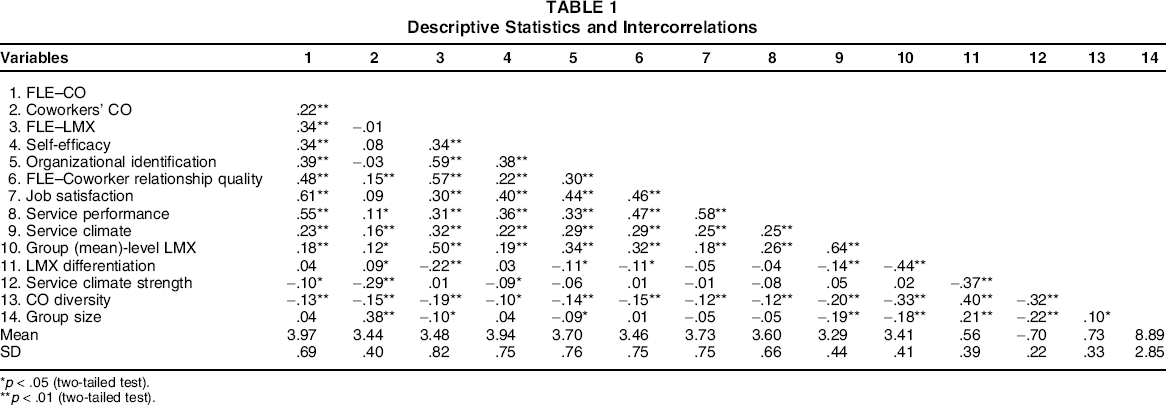
p < .05 (two-tailed test).
p < .01 (two-tailed test).
Analytical Approach
Prior research has used difference scores to calculate (mis)fit (e.g., Siguaw et al. 1994); however, this approach has been widely criticized for the conceptual and methodological problems it creates in the areas of reliability, discriminant validity, spurious correlation, and variance restriction (Edwards 2002; Peter, Churchill, and Brown 1993). Edwards and Parry (1993) recommend the polynomial technique as an effective alternative that can avoid the limitations of the difference score approach. An increasing number of studies have used the polynomial technique to explore such topics as perceptual differences, (mis)fit, and value congruence (e.g., Edwards and Cable 2009; Jansen and Kristof-Brown 2005). Because our treatment of CO (mis)fit takes into consideration both an FLE's CO and that of his or her coworkers, we apply a polynomial modeling technique to our model (Edwards and Parry 1993), which we detail next.
In polynomial modeling, the dependent variable is estimated by entering five polynomial terms into the equation. We estimated the dependent variables against an FLE's CO (F), coworkers’ CO (C), and the three higher-order effects (i.e., F2, C2, and F × C) that are created as product terms of F and C after scale-centering (e.g., Edwards and Cable 2009). When the three higher-order effects jointly increase model fit, it is appropriate to carry on with polynomial analysis (Edwards and Parry 1993). Yet the estimated coefficients that relate to the effect of each polynomial term on the dependent variable individually are not directly employed to test any hypothesis. Rather, the estimated coefficient for each polynomial term is used to compute the slope and curvature along the fit and misfit lines, which is also known as response surface analysis (Edwards and Parry 1993). Using Edwards and Parry's (1993) formula, we computed the slopes and curvatures along the fit (F = C) and misfit (F = −C) lines as fit slope (F + C) and fit curvature (F2 + F × C + C2) and misfit slope (F − C) and misfit curvature (F2 − F × C + C2).
For the mediation hypothesis (H1), we employ the block-variable approach (Edwards and Cable 2009). Zhao, Lynch, and Chen (2010, p. 198) suggest that (1) “there should be only one requirement to establish mediation, that the indirect effect … be significant,” and (2) “the strength of mediation should be measured by the size of the indirect effect, not by the lack of the direct effect.” In our model, because CO (mis)fit (i.e., independent variable) is a composite of five polynomial terms, the indirect effect of CO (mis)fit cannot be observed directly by assessing the five polynomial terms. Therefore, a composite (or block) variable is necessary to estimate the indirect effect of CO fit on the two dependent variables (i.e., job satisfaction and service performance). We multiplied the polynomial coefficients by the raw data to compute the block variable as a weighted composite score (Lambert et al. 2012). After we formed the block variable, we reran the polynomial model to estimate the standardized regression coefficient for the block variable as the path coefficient, which we used for mediation analysis (Edwards and Cable 2009). We computed the indirect effects by multiplying the path from the block variable to coworker relationship quality by each of the paths from coworker relationship quality to job satisfaction and service performance (Lambert et al. 2012). Because the indirect effect is not normally distributed, we used a bootstrapping technique (10,000 samples) to compute the bias-corrected confidence intervals (CIs) and test the significance of the indirect effects (e.g., Bauer, Preacher, and Gil 2006).
To test the interaction hypotheses (H2–H4), we followed the principles of moderated regression (e.g., Aiken and West 1991) in polynomial analyses as outlined by Vogel, Rodell, and Lynch (2015). For example, we tested the polynomial moderation hypothesis by adding group size (i.e., moderator) and the interaction of group size with each polynomial term. After estimating the interaction effects model, we computed two equations for coworker relationship quality as the dependent variable: one for large group size (i.e., substituting values one standard deviation above the mean) and the other for small group size (i.e., substituting values one standard deviation below the mean). We repeated this technique for the other two moderators (i.e., service climate strength and LMX differentiation) and tested the interaction hypotheses by computing the slope and curvature along the fit and misfit lines, as stated previously.
We note that because of the nested nature of our data (i.e., multiple FLE responses from each dealer), we took a multilevel, random coefficients approach to the polynomial modeling technique (e.g., Jansen and Kristof-Brown 2005). As a result, we employed multilevel path analysis in Mplus 7.0 (Muthén and Muthén 2012) to estimate the model's proposed relationships simultaneously. 5
Results
Preliminary findings
Table 2 reports the estimated coefficients of model fit. Before reporting the results of our hypothesis tests, we establish that (1) the polynomial technique is appropriate for our study and (2) CO fit relates to FLE–coworker relationship quality. First, Model 1 (i.e., the baseline model) indicates that FLE–CO and coworkers’ CO are positively and significantly related to coworker relationship quality. Adding polynomial effects to Model 1 (i.e., Model 2) results in better model fit than Model 1, as indicated by the smaller Akaike information criterion (AIC) and Bayesian information criterion (BIC) values. This finding suggests that the polynomial terms are jointly significant and that the polynomial technique is appropriate for this study. Second, we used the estimated coefficient for each polynomial term in Model 2 to compute the slope and curvature along the fit and misfit lines, 6 which appear in Table 3. With these points in mind, we next report the results of our hypothesis tests.
Model Fit Results

p < .05 (two-tailed test).
p < .01 (two-tailed test).
Slope and Curvature for Fit and Misfit Lines (Dependent Variable = FLE–Coworker Relationship Quality)
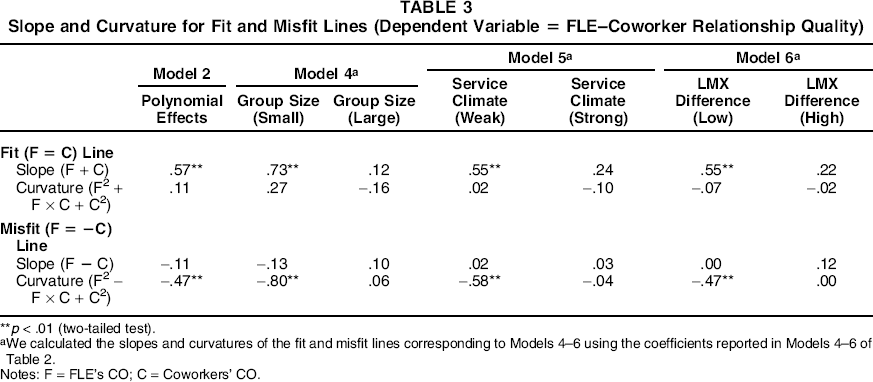
p < .01 (two-tailed test).
We calculated the slopes and curvatures of the fit and misfit lines corresponding to Models 4–6 using the coefficients reported in Models 4–6 of Table 2.
Notes: F = FLE's CO; C = Coworkers' CO.
Mediated effects
The block variable for CO fit is positively related to coworker relationship quality (.53, p < .01). In addition, coworker relationship quality is positively related to job satisfaction (.15, p < .01) and service performance (.18, p < .01), and the effect of the block variable on job satisfaction and service performance is not significant when coworker relationship quality is taken into account (i.e., full mediation). Bias-corrected bootstrapped confidence intervals of the indirect effect of CO fit on job satisfaction (.080; 95% CI = [.028, .216]) and service performance (.094; 95% CI = [.047, .227]) exclude zero. Overall, these findings lend support for H1 such that coworker relationship quality (fully) mediates the effects of CO fit between an FLE and his or her coworkers on job satisfaction and service performance.
Moderating effects
Table 2 indicates that Models 4, 5, and 6 (i.e., interaction-effects models) result in smaller and BIC values than Model 2, which suggests that the interaction-effects models are appropriate. We used the estimated coefficients from Models 4–6 in Table 2 to compute the slopes and curvatures at high and low levels of the moderators, which we then used to test H2–H4.
As Table 3 shows, in smaller groups, the slope along the fit line is positive and significant (.73, p < .01), whereas the curvature along the misfit line is negative and significant (−.80, p < .01) (Model 4). However, in larger groups, neither the slope along the fit line nor the curvature along the misfit line is significant (Model 4). As Figure 2, Panel A, shows, the effect of CO fit on FLE–coworker relationship quality is positive in smaller groups but nonexistent in larger groups. Similarly, as Figure 2, Panel B, shows, CO misfit has a negative effect on FLE–coworker relationship quality in smaller groups, but the same effect disappears in larger groups. Overall, these findings lend support to H2a–b.

Response Surface
When service climate is weaker, the slope along the fit line is positive and significant (.55, p < .01), whereas the curvature along the misfit line is negative and significant (−.58, p < .01; Model 5). However, when service climate becomes stronger, neither the slope along the fit line nor the curvature along the misfit line is significant (Model 5). As Figure 2, Panel C, shows, the effect of CO fit on FLE–coworker relationship quality is positive in a weaker service climate but nonexistent in a stronger service climate. In addition, Figure 2, Panel D, illustrates that CO misfit has a negative effect on FLE–coworker relationship quality when service climate is weaker, but the same effect disappears when service climate is stronger. These findings support H3a–b such that the positive effect of CO fit and the negative effect of CO misfit on coworker relationship quality are weaker as service climate becomes stronger.
Finally, when LMX differentiation is lower, the slope along the fit line is positive and significant (.55, p < .01), whereas the curvature along the misfit line is negative and significant (−.47, p < .01; Model 6). However, when LMX differentiation is higher, neither the slope along the fit line nor the curvature along the misfit line is significant (Model 6). Figure 2, Panel E, indicates that when LMX differentiation is low, the effect of CO fit on FLE–coworker relationship quality is positive, but this effect is lost when LMX differentiation is high. Figure 2, Panel F, shows that CO misfit has a negative effect on FLE–coworker relationship quality when LMX differentiation is low, but there is no effect when LMX differentiation is high. Thus, H4a–b are supported such that the positive effect of CO fit and the negative effect of CO misfit on coworker relationship quality are weaker at higher levels of LMX differentiation.
The effects of moderating and control variables on dependent variables
As Table 2 shows, no moderators had any significant effects on the dependent variables. Across all models, we found that service climate was positively related to coworker relationship quality and job satisfaction, LMX (FLE level) was positively related to coworker relationship quality but negatively related to job satisfaction, self-efficacy was positively related to job satisfaction and service performance, and organizational identification was positively related to job satisfaction and service performance. No other control variables were significantly related to any of the dependent variables.
Discussion
Theoretical Contributions
Our findings highlight the notion that coworkers not only can “make the place” (Schneider 1987, p. 437) but also can “break the place.” Prior work has focused on CO from either an absolute-level (e.g., Brown et al. 2002; Donavan, Brown, and Mowen 2004) or a group-level (e.g., Grizzle et al. 2009) perspective. Researchers thus far have studied CO from an absolute perspective, without consideration of the social context (i.e., relative view) in which employees interact with coworkers (Chiaburu and Harrison 2008). To corroborate the social aspect of CO research, we developed a process interaction model grounded in P–G fit theory and tested the model using polynomial regression and response surface methodology. Our study demonstrates how CO models can better inform researchers by introducing the notion of (mis)fit between a focal employee's CO and that of his or her coworkers and the work-group characteristics under which CO (mis)fit has limited negative and positive effects on coworker relationship quality.
Group size
The negative moderating effect of group size on the CO fit–coworker relationship quality link is in line with the process and relational loss literature, which has asserted that larger groups come with greater tension, greater competition, and less cohesion, thereby dampening the benefits of congruence in CO (Mueller 2012; Steiner 1972). Increase in group size breeds complexity, which leads to bureaucratic and formalized group structures that impede emotional, informational, and instrumental support from coworkers. Larger groups neutralize the benefits of CO fit that lead to higher coworker relationship quality. Our findings also show that coworker relationship quality suffers more from CO misfit in smaller groups than in larger groups (see Figure 2, Panel B). This seems to suggest that avoiding CO misfit is more critical in smaller groups. Together, the CO fit and misfit effects on coworker relationship quality imply that CO fit is rewarded, whereas misfit is penalized, in smaller groups.
Our findings also contribute to the social network literature in relationship marketing (e.g., Gonzalez, Claro, and Palmatier 2014) by showing that group size weakens interpersonal connections and interactions, thereby leading to a diminished impact of CO fit on coworker relationship quality (Morrison 2002). Our study also expands the P–G fit literature by being one of the first to show the moderating role of group size on the consequences of (mis)fit on workplace attitude. Therefore, caution should be exercised when interpreting the negative and positive impacts of P–G (mis)fit on work attitudes without due consideration of the influence of group size.
Service climate strength
Our results imply that compatibility in CO becomes less relevant as a determinant of coworker relationship quality when FLEs share the perception that service excellence is important. The negative interaction between CO fit and service climate strength shows that in a strong service climate, the influence of CO fit is constrained and limited because coworker relationship quality may not be as dependent on CO fit as when service climate is weak. In addition, as Figure 2, Panel D, shows, the effect of CO misfit on coworker relationship quality is insignificant when service climate is strong. This suggests that despite CO misfit, as long as there is a strong service climate, minimal harm is inflicted on coworker relationship quality. It is also noteworthy that under a weak service climate, the CO misfit on coworker relationship quality resembles an inverted U-shape (Figure 2, Panel D), which suggests that as long as there is misfit in either direction (i.e., an FLE who has higher or lower CO than his or her coworkers), coworker relationship quality is negatively affected.
Drawing on situational strength theory to enhance the understanding of how climate strength moderates fit is a promising area for further research because the extant fit theory literature has focused on congruence in personalities (e.g., Zhang, Wang, and Shi 2012), goals (e.g., Kristof-Brown and Stevens 2001), and values (e.g., Cable and Edwards 2004), elements that all tend to vary according to individual differences in a work group. Our study contributes to the integration of two literature streams that have progressed in parallel: climate strength and P–G fit.
LMX differentiation
Consistent with the dark side of leadership theory, Erdogan and Bauer (2010) find that LMX differentiation is detrimental to satisfaction with and helping behavior toward coworkers when justice climate is low. Our results add to extant knowledge concerning the negative aspect of leadership by suggesting that unless there is perceived uniform supervisor support, CO fit is limited in improving coworker relationship quality (see Figure 2, Panel E). Leader–member exchange differentiation constrains the impact of CO fit on coworker relationship quality by functioning as an obstacle that filters the benefits associated with CO fit. This finding sheds light on an important but largely overlooked issue in the literature: that coworker relationship quality depends not only on the dynamics between employees but also on variabilities in the relationship between a leader and his or her employees (Sherony and Green 2002). In short, our results underscore the significance of maintaining healthy vertical relationships and how the lack of such relationships can adversely influence horizontal relationships despite alignment in CO.
Mediating process
Edwards and Cable (2009) acknowledge that the literature on the mechanisms that explain the outcome of value congruence is speculative and piecemeal and lacks an integrative and coherent framework. Our study fills this void by revealing that coworker relationship quality, a more proximal construct to satisfaction and performance than need for relatedness (Greguras and Diefendorff 2009), fully mediates the effects of CO fit on job satisfaction and service performance. This result is consistent with Edwards and Cable, who assert that communication and trust, elements that mirror high relationship quality, mediate the value congruence–job satisfaction link.
Finally, our use of a temporal interval reinforces the theoretical substance and nomological validity of CO as a work value that plays an important role in driving (as opposed to being a consequence of) job satisfaction, coworker relationship quality, and service performance (Zablah et al. 2012). This approach serves as an important addition to the cross-sectional design typically employed in the CO literature and enhances confidence in our findings by reducing the potential impact of common method bias and ruling out alternative causal explanations.
Practical Implications
Look beyond CO fit to achieve job satisfaction and service performance
Managers should not assume that FLE job satisfaction and service performance will be automatically achieved when there is CO fit, because coworker relationship quality explicates the hidden process that underlies how CO fit affects job satisfaction and service performance. Furthermore, given coworker relationship quality's critical intervening role, managers need to be aware of workplace characteristics that can undermine the positive effect of CO fit on coworker relationship quality. In addition, it is critical for managers to understand that the same characteristics that reduce the positive impact of CO fit can also weaken its negative effect on coworker relationship quality. In the following subsections, we propose to managers that the effects of CO fit and misfit will be more readily pronounced in a smaller, weaker service climate and in groups with lower LMX differentiation.
Managers are rewarded for CO fit and penalized for misfit in small rather than large groups
Neither CO fit nor misfit affects coworker relationship quality in larger groups. It is only in smaller groups that CO (mis)fit has a (negative) positive effect on coworker relationship quality; therefore, managers are compensated for CO fit and penalized for misfit in smaller groups. In larger groups, managers may need to reconsider investing resources to obtain CO fit and prevent misfit because neither fit nor misfit has any effect on coworker relationship quality. Our findings inform managers that to reap the rewards of CO fit, it may pay off to increase the number of groups and keep them relatively small in size rather than to maintain the number of groups and increase membership per group as more employees are hired. In addition, small startups, branches, or teams should be especially mindful of the consequences of CO fit and misfit.
Achieve CO fit and avoid misfit under a weak versus strong service climate
Under a strong service climate, managers may be able to invest less in fostering CO in employees and hiring employees with high CO because CO fit has limited influence on coworker relationship quality in such settings. Conversely, managers who work in organizations with weak service climates need to promote CO fit and prevent misfit because the former benefits, whereas the latter hurts, coworker relationship quality in these organizations. This suggests that firms such as Zappos.com, Ritz-Carlton, and Nordstrom, known for their strong service climates, may not jeopardize employee job satisfaction and service performance despite hiring miscues that result in CO misfit, because coworker relationship quality is less likely to be compromised. In contrast, traditional manufacturing- and engineering-oriented firms that focus less on service climate need to realize that the effects of CO fit and misfit on job satisfaction and service performance will be especially pronounced.
Seek CO fit and avert misfit when managers form equal relationships with employees
A manager who develops uniform relationships with employees needs to ensure that CO fit is obtained and misfit avoided because his or her relationships with coworkers will depend on whether they share similar customer-centric values. However, when a manager does not form uniform relationships with employees, it is important to realize that there will be neither a reward for CO fit nor a penalty for CO misfit. This suggests that when a manager takes over a group in which there is CO fit, it is crucial to establish impartial relationships with employees to ensure that relationships among coworkers are not compromised despite CO fit because of variability in relationships between a leader and employees.
Limitations and Future Research Directions
Our findings should be interpreted in light of certain limitations. Retail contexts such as auto dealerships involve high customer contact. Thus, our results may be limited to retail environments in which CO is a critical element of an organization's marketing strategy. Future studies should examine whether our model can be replicated and extended to manufacturing settings (e.g., assembly plants) or service firms’ back offices, both of which are characterized by lower customer contact.
Our investigation of (mis)fit is confined to one of many possible types of (mis)fit (e.g., person–job [mis]fit, person–supervisor [mis]fit) that can exist within a group setting. An examination of whether other types of (mis)fit are also subject to interaction effects under similar circumstances would provide a more holistic picture of the boundary conditions of alignment. Furthermore, if the target of comparison is not value but ability, skill, or any other competency that employees possess, misfit rather than fit may positively affect job satisfaction and performance, albeit through a different mediating mechanism. For example, an FLE's superior customer relationship management skills or adaptive selling capabilities relative to coworkers may yield high self-efficacy that in turn can strengthen the employee's work attitude and performance. The implication is that either fit or misfit can positively affect attitude and behavior depending on the target of comparison (e.g., value vs. skill) and that the chosen comparative reference influences the type of mediator at work.
Because we examined CO through a social-context lens, the unique cultural dimension of the South Korean market may have influenced our findings. However, given that CO (mis)fit was a derived as opposed to a direct measure, respondents were not aware of their being asked about how their CO compared with that of coworkers, which limited the possibility that the results were biased as a result of collective thinking. Nonetheless, we encourage future studies to replicate and extend our study in Western markets to increase the generalizability of the findings. Finally, we employ group size as a proxy for intragroup cohesion and/or teamwork quality. Future studies should test the contingency role of group cohesion (social and task) and/or teamwork quality on the relationship between CO (mis)fit and work attitudes/behaviors by employing well-established scales available in the literature.
Footnotes
Appendix
Measures

| FLE Responses | Factor Loading |
|---|---|
| I try to figure out a customer's needs. | .761 |
| I have the customer's best interests in mind. | .805 |
| I take a problem-solving approach when selling products to customers. | .741 |
| I recommend products that are best suited to solving customers' problems. | .759 |
| I try to find out which kinds of products would be most helpful to customers. | .777 |
| I find it easy to smile at each of my customers. | .775 |
| I enjoy remembering my customers' names. | .742 |
| It comes naturally to have empathy for my customers. | .766 |
| I enjoy responding quickly to my customers' requests. | .799 |
| I get satisfaction from making my customers happy. | .774 |
| I really enjoy serving my customers. | .769 |
| I know where I stand with my supervisor. | .701 |
| My supervisor understands my work problems and needs. | .742 |
| My supervisor recognizes my potential. | .860 |
| My supervisor would use his/her power to solve my work problems. | .823 |
| I can count on my supervisor to “bail me out” when I really need it. | .694 |
| I defend my supervisor's decisions, even when (s)he is not around. | .880 |
| My working relationship with my supervisor is effective. | .717 |
| My job is well within my scope of my abilities. | .750 |
| I am confident about my ability to do my job. | .834 |
| I have mastered the skills to do my job. | .707 |
| When someone praises this dealer, I consider it a personal accomplishment. | .741 |
| When I talk about my dealer, I usually say “we” rather than “they.” | .758 |
| I am very interested in what others think about this dealer. | .768 |
| This dealer's successes are my successes. | .786 |
| When someone criticizes this dealer, I take it as a personal insult. | .775 |
| If the media criticizes this dealer, I feel embarrassed. | .763 |
| We have knowledge of the job and the skills to deliver superior quality work and service. |
|
| We receive recognition and rewards for the delivery of superior work and service. | .812 |
| The overall quality of service provided by us to customers is excellent. | .798 |
| We are provided with necessary resources to support the delivery of quality work and service. | .808 |
| I know where I stand with my coworkers. | .713 |
| My coworkers understand my work problems and needs. | .760 |
| My coworkers recognize my potential. | .793 |
| My coworkers would use their power to solve my work problems. | .683 |
| I can count on my coworkers to “bail me out” when I really need it. | .764 |
| I defend my coworkers' decisions, even when they are not around. | .787 |
| My working relationship with my coworkers is effective. | .797 |
| Overall, I am satisfied with my job. | .826 |
| I would prefer another, more ideal job. (Reverse scored) | .519 |
| I am satisfied with the important aspects of my job. | .849 |
|
|
|
| This frontline employee… | |
| • …understands specific needs of customers. | .809 |
| • …is able to put himself/herself in the customers' place. | .792 |
| • …is able to tune in to each specific customer. | .819 |
| • …surprises customers with their excellent service. | .813 |
| • …does more than usual for customers. | .839 |
| • …delivers an excellent service quality that is difficult to find in other dealers. | .880 |
Notes: α = Cronbach's alpha; CR = composite reliability. All factor loadings are significant at p < .01.
1
We focus on the interactions between CO (mis)fit and moderators because, although the marketing literature has not studied the consequences of CO (mis)fit per se, the management literature has extensively covered the implications of value congruence (i.e., direct effects of CO [mis]fit). Therefore, this study explores the more novel topic of the boundary conditions of CO (mis)fit effects, which have received scant attention in the marketing and management literature streams. Although we do not report in detail the direct effects of CO (mis)fit, our study finds that FLE–coworker relationship quality is enhanced under CO fit (as opposed to CO misfit) as well as CO fit at high (vs. low) levels between an employee and his or her coworkers.
2
We performed an exploratory factor analysis for the items of the need and enjoyment subscales combined. The results revealed a one-factor solution with an eigenvalue of 6.93, which explained 63% of the total variance. Thus, we operationalized CO as a unidimensional construct by combining the need and enjoyment subscales.
3
We conducted an exploratory factor analysis for all six items that composed the empathy and service provider performance subscales. The results were in agreement with Salanova, Agut, and Peiró's (2005) study: only one component emerged with an eigenvalue of 2.89, an average factor loading of .79, and explained variance of 66.4%. In addition, there was high correlation between the two subscales (r = .82). Drawing on these findings, we combined the two subscales to form the service performance construct.
4
Control variables that are not chosen on the basis of their theoretical relevance and significant zero-order correlations with the focal constructs might reduce the statistical power of the model and also suppress otherwise significant effects ( ). We do not control for demographic variables, because they are not significantly correlated with coworker relationship quality, job satisfaction, or service performance.
5
We ran null models (i.e., no predictors) for FLE–coworker relationship quality, job satisfaction, and service performance as dependent variables. The ICC(1) values and corresponding chi-square test results are as follows: coworker relationship quality = .32, χ2(64) = 98.0, p < .01; job satisfaction = .25, χ2(64) = 86.47, p < .05; service performance = .34, χ2(64) = 101.80, p < .01. A significant ICC(1) value and chi-square indicate that there is both sufficient and necessary evidence for between-dealer (group) variance. Thus, the use of multilevel modeling is appropriate for this study (e.g., ).
6
Along the misfit line (F = −C), the curvature (−.47, p < .01) is negative and statistically significant (i.e., an inverted U-shape), which suggests that when an FLE's CO is aligned (misaligned) with that of coworkers, coworker relationship quality is higher (lower). Along the fit line (F = C), the slope (.57, p < .01) is positive and significant; thus, the absolute level of CO fit matters because a high–high CO fit leads to a higher level of coworker relationship quality than a low–low CO fit.