







Abstract
In this article, the authors develop a conceptual framework for customer relationship management (CRM) that helps broaden the understanding of CRM and its role in enhancing customer value and, as a result, shareholder value. The authors explore definitional aspects of CRM, and they identify three alternative perspectives of CRM. The authors emphasize the need for a cross-functional, process-oriented approach that positions CRM at a strategic level. They identify five key cross-functional CRM processes: a strategy development process, a value creation process, a multichannel integration process, an information management process, and a performance assessment process. They develop a new conceptual framework based on these processes and explore the role and function of each element in the framework. The synthesis of the diverse concepts within the literature on CRM and relationship marketing into a single, process-based framework should provide deeper insight into achieving success with CRM strategy and implementation.
To identify alternative perspectives of CRM,
To emphasize the importance of a strategic approach to CRM within a holistic organizational context,
To propose five key generic cross-functional processes that organizations can use to develop and deliver an effective CRM strategy, and
To develop a process-based conceptual framework for CRM strategy development and to review the role and components of each process.
We organize this article in three main parts. First, we explore the role of CRM and identify three alternative perspectives of CRM. Second, we consider the need for a cross-functional process-based approach to CRM. We develop criteria for process selection and identify five key CRM processes. Third, we propose a strategic conceptual framework that is constructed of these five processes and examine the components of each process.
The development of this framework is a response to a challenge by Reinartz, Krafft, and Hoyer (2004), who criticize the severe lack of CRM research that takes a broader, more strategic focus. The article does not explore people issues related to CRM implementation. Customer relationship management can fail when a limited number of employees are committed to the initiative; thus, employee engagement and change management are essential issues in CRM implementation. In our discussion, we emphasize such implementation and people issues as a priority area for further research.
CRM Perspectives and Definition
The term “customer relationship management” emerged in the information technology (IT) vendor community and practitioner community in the mid-1990s. It is often used to describe technology-based customer solutions, such as sales force automation (SFA). In the academic community, the terms “relationship marketing” and CRM are often used interchangeably (Parvatiyar and Sheth 2001). However, CRM is more commonly used in the context of technology solutions and has been described as “information-enabled relationship marketing” (Ryals and Payne 2001, p. 3). Zablah, Beuenger, and Johnston (2003, p. 116) suggest that CRM is “a philosophically-related offspring to relationship marketing which is for the most part neglected in the literature,” and they conclude that “further exploration of CRM and its related phenomena is not only warranted but also desperately needed.”
A significant problem that many organizations deciding to adopt CRM face stems from the great deal of confusion about what constitutes CRM. In interviews with executives, which formed part of our research process (we describe this process subsequently), we found a wide range of views about what CRM means. To some, it meant direct mail, a loyalty card scheme, or a database, whereas others envisioned it as a help desk or a call center. Some said that it was about populating a data warehouse or undertaking data mining; others considered CRM an e-commerce solution, such as the use of a personalization engine on the Internet or a relational database for SFA. This lack of a widely accepted and appropriate definition of CRM can contribute to the failure of a CRM project when an organization views CRM from a limited technology perspective or undertakes CRM on a fragmented basis.
The definitions and descriptions of CRM that different authors and authorities use vary considerably, signifying a variety of CRM viewpoints. To identify alternative perspectives of CRM, we considered definitions and descriptions of CRM from a range of sources, which we summarize in the Appendix. We excluded other, similar definitions from this list.
An important aspect of the CRM definition that we wanted to examine was its association with technology. This is important because CRM technology is often incorrectly equated with CRM (Reinartz, Krafft, and Hoyer 2004), and a key reason for CRM failure is viewing CRM as a technology initiative (Kale 2004). For this reason, we review the definitions in the Appendix with special attention to their emphasis on technology. This review suggests that CRM can be defined from at least three perspectives: narrowly and tactically as a particular technology solution, wide-ranging technology, and customer centric. These perspectives can be portrayed as a continuum (see Figure 1).
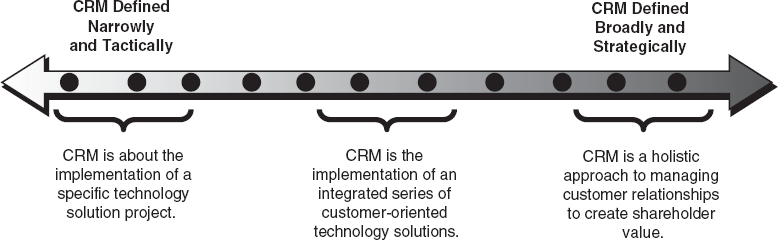
The CRM Continuum
One organization we interviewed, which spent more than $30 million on IT solutions and systems integration, described CRM solely in terms of its SFA project. At this extreme, CRM is defined narrowly and tactically as a particular technology solution (e.g., Khanna 2001). We call this CRM “Perspective 1.” Other definitions, such as that of Kutner and Cripps (1997), though somewhat broader, also fall into this category.
In another organization that we interviewed, the term CRM was used to refer to a wide range of customer-oriented IT and Internet solutions, reflecting Stone and Woodcock's (2001) definition. This represented CRM “Perspective 2,” a point near the middle of the continuum.
“Perspective 3” reflects a more strategic and holistic approach to CRM that emphasizes the selective management of customer relationships to create shareholder value. This reflects elements of several previously noted definitions of CRM, including those of Buttle (2001), Glazer (1997), Singh and Agrawal (2003), and Swift (2000). Following this phase of our work, we identified Zablah, Beuenger, and Johnston's (2003) research, which supported our view of these perspectives.
The importance of how CRM is defined is not merely semantic. Its definition significantly affects the way an entire organization accepts and practices CRM. From a strategic viewpoint, CRM is not simply an IT solution that is used to acquire and grow a customer base; it involves a profound synthesis of strategic vision; a corporate understanding of the nature of customer value in a multichannel environment; the utilization of the appropriate information management and CRM applications; and high-quality operations, fulfillment, and service. Thus, we propose that in any organization, CRM should be positioned in the broad strategic context of Perspective 3.
Swift (2000) argues, and we concur, that organizations will benefit from adopting a relevant strategic CRM definition for their firm and ensuring its consistent use throughout their organization. Thus, we developed a definition of CRM that reflected Perspective 3. We examined the CRM literature, synthesized aspects of the various definitions into a draft definition, and then tested it with practicing managers. As our research progressed, we went through several iterations. The result is the following definition, which we use for the purposes of this study:
CRM is a strategic approach that is concerned with creating improved shareholder value through the development of appropriate relationships with key customers and customer segments. CRM unites the potential of relationship marketing strategies and IT to create profitable, long-term relationships with customers and other key stakeholders. CRM provides enhanced opportunities to use data and information to both understand customers and cocreate value with them. This requires a cross-functional integration of processes, people, operations, and marketing capabilities that is enabled through information, technology, and applications.
This definition provided guidance for our subsequent research considerations and the strategic and cross-functional emphasis of the conceptual framework we developed.
Processes: A Strategic Perspective
Gartner (2001) calls for a fresh approach to business processes in CRM that involves both rethinking how these processes appear to the customer and reengineering them to be more customer centric. Kale (2004) supports this view and argues that a critical aspect of CRM involves identifying all strategic processes that take place between an enterprise and its customers. To address this challenge of adopting a fresh approach to CRM processes, we aimed to identify the key generic processes relevant to CRM.
We examined the literature to identify appropriate criteria for process selection but found little work in this area, with the exception of the contribution by Srivastava, Shervani, and Fahey (1999), who establish four process selection criteria for marketing and business processes. We chose their work as a starting point for the identification of process selection criteria for CRM. The criteria these authors propose are as follows: First, the processes should comprise a small set that addresses tasks critical to the achievement of an organization's goals. Second, each process should contribute to the value creation process. Third, each process should be at a strategic or macro level. Fourth, the processes need to manifest clear interrelationships.
As part of our research, we conducted a workshop with a panel of 34 highly experienced CRM practitioners, all of whom had extensive experience in the CRM and IT sectors. The director of a leading research and management institute specializing in the CRM and IT sectors selected the panel. Participants were selected on the basis of the following attributes to ensure that they were knowledgeable about CRM, its implementation, and its operation: substantial management and industrial experience (average of 17.2 years), maturity (average age of 40.2 years), international representation and international experience (managers from nine countries attended; most of them had international experience), and academic qualifications (degree or equivalent). In the first part of the workshop, which involved small group sessions, the panel reviewed and subsequently unanimously agreed that these four criteria were fully appropriate for selecting CRM processes. However, they also proposed two further criteria: First, each process should be cross-functional in nature, and second, each process would be considered by experienced practitioners as being both logical and beneficial to understanding and developing strategic CRM activities. We used these six criteria to select key generic CRM processes.
A Conceptual Framework for CRM
Grabner-Kraeuter and Moedritscher (2002) suggest that the absence of a strategic framework for CRM from which to define success is one reason for the disappointing results of many CRM initiatives. This view was supported both by the senior executives we interviewed during our research and by Gartner's (2001) research. Our next challenges were to identify key generic CRM processes using the previously described selection criteria and to develop them into a conceptual framework for CRM strategy development.
Our literature review found that few CRM frameworks exist; those that did were not based on a process-oriented cross-functional conceptualization of CRM. For example, Sue and Morin (2001, p. 6) outline a framework for CRM based on initiatives, expected results, and contributions, but this is not process based, and “many initiatives are not explicitly identified in the framework.” Winer (2001, p. 91) develops a “basic model, which contains a set of 7 basic components: a database of customer activity; analyses of the database; given the analyses, decisions about which customers to target; tools for targeting the customers; how to build relationships with the targeted customers; privacy issues; and metrics for measuring the success of the CRM program.” Again, this model, though useful, is not a cross-functional process-based conceptualization. This gap in the literature suggests that there is a need for a new systematic process-based CRM strategy framework. Synthesis of the diverse concepts in the literature on CRM and relationship marketing into a single, process-based framework should provide practical insights to help companies achieve greater success with CRM strategy development and implementation.
Interaction Research
Conceptual frameworks and theory are typically based on combining previous literature, common sense, and experience (Eisenhardt 1989). In this research, we integrated a synthesis of the literature with learning from field-based interactions with executives to develop and refine the CRM strategy framework. In this approach, we used what Gummesson (2002a) terms “interaction research.” This form of research originates from his view that “interaction and communication play a crucial role” in the stages of research and that testing concepts, ideas, and results through interaction with different target groups is “an integral part of the whole research process” (p. 345). The sources for these field-based insights, which include executives primarily from large enterprises in the business-to-business and business-to-consumer sectors, included the following:
An expert panel of 34 highly experienced executives;
Interviews with 20 executives working in CRM, marketing, and IT roles in companies in the financial services sector;
Interviews with six executives from large CRM vendors and with five executives from three CRM and strategy consultancies;
Individual and group discussions with CRM, marketing, and IT managers at workshops with 18 CRM vendors, analysts, and their clients, including Accenture, Baan, BroadVision, Chordiant, EDS, E.piphany, Hewlett-Packard, IBM, Gartner, NCR Teradata, Peoplesoft, Oracle, SAP, SAS Institute, Siebel, Sybase, and Unisys;
Piloting the framework as a planning tool in the financial services and automotive sectors; and
Using the framework as a planning tool in two companies: global telecommunications and global logistics. Six workshops were held in each company.
Process Identification and the CRM Framework
We began by identifying possible generic CRM processes from the CRM and related business literature. We then discussed these tentative processes interactively with the groups of executives. The outcome of this work was a short list of seven processes. We then used the expert panel of experienced CRM executives who had assisted in the development of the process selection schema to nominate the CRM processes that they considered important and to agree on those that were the most relevant and generic. After an initial group workshop, each panel member independently completed a list representing his or her view of the key generic processes that met the six previously agreed-on process criteria. The data were fed back to this group, and a detailed discussion followed to help confirm our understanding of the process categories.
As a result of this interactive method, five CRM processes that met the selection criteria were identified; all five were agreed on as important generic processes by more than two-thirds of the group in the first iteration. Subsequently, we received strong confirmation of these as key generic CRM processes by several of the other groups of managers. The resultant five generic processes were (1) the strategy development process, (2) the value creation process, (3) the multichannel integration process, (4) the information management process, and (5) the performance assessment process.
We then incorporated these five key generic CRM processes into a preliminary conceptual framework. This initial framework and the development of subsequent versions were both informed by and further refined by our interactions with two primary executive groups: mangers from the previously noted companies and executives from three CRM consulting firms. Participants at several academic conferences on CRM and relationship marketing also assisted with comments and criticisms of previous versions. With evolving versions of the framework, we combined a synthesis of relevant literature with field-based interactions involving the groups. The framework went through a considerable number of major iterations and minor revisions; the final version appears in Figure 2.
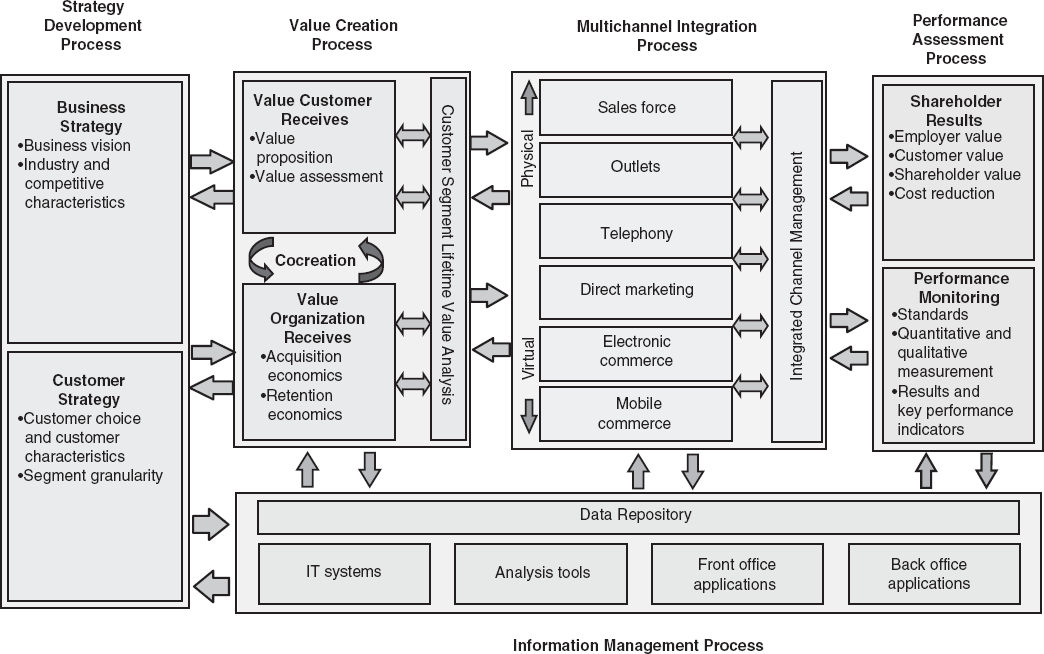
A Conceptual Framework for CRM Strategy
This conceptual framework illustrates the interactive set of strategic processes that commences with a detailed review of an organization's strategy (the strategy development process) and concludes with an improvement in business results and increased share value (the performance assessment process). The concept that competitive advantage stems from the creation of value for the customer and for the business and associated cocreation activities (the value creation process) is well developed in the marketing literature. For large companies, CRM activity will involve collecting and intelligently using customer and other relevant data (the information process) to build a consistently superior customer experience and enduring customer relationships (the multichannel integration process). The iterative nature of CRM strategy development is highlighted by the arrows between the processes in both directions in Figure 2; they represent interaction and feedback loops between the different processes. The circular arrows in the value creation process reflect the cocreation process. We now examine the key components we identified in each process. As with our prior work, we used the interaction research method in the identification of these process components.
Strategy Development Process
This process requires a dual focus on the organization's business strategy and its customer strategy. How well the two interrelate fundamentally affects the success of its CRM strategy.
Business Strategy
The business strategy must be considered first to determine how the customer strategy should be developed and how it should evolve over time. The business strategy process can commence with a review or articulation of a company's vision, especially as it relates to CRM (e.g., Davidson 2002). Next, the industry and competitive environment should be reviewed. Traditional industry analysis (e.g., Porter 1980) should be augmented by more contemporary approaches (e.g., Christensen 2001; Slater and Olson 2002) to include co-opetition (Brandenburger and Nalebuff 1997), networks and deeper environmental analysis (Achrol 1997), and the impact of disruptive technologies (Christensen and Overdorf 2000).
Customer Strategy
Whereas business strategy is usually the responsibility of the chief executive officer, the board, and the strategy director, customer strategy is typically the responsibility of the marketing department. Although CRM requires a cross-functional approach, it is often vested in functionally based roles, including IT and marketing. When different departments are involved in the two areas of strategy development, special emphasis should be placed on the alignment and integration of business strategy.
Customer strategy involves examining the existing and potential customer base and identifying which forms of segmentation are most appropriate. As part of this process, the organization needs to consider the level of subdivision for customer segments, or segment granularity. This involves decisions about whether a macro, micro, or one-to-one segmentation approach is appropriate (Rubin 1997).
Several authors emphasize the potential for shifting from a mass market to an individualized, or one-to-one, marketing environment. Exploiting e-commerce opportunities and the fundamental economic characteristics of the Internet can enable a much deeper level of segmentation granularity than is affordable in most other channels (e.g., Peppers and Rogers 1993, 1997). In summary, the strategy development process involves a detailed assessment of business strategy and the development of an appropriate customer strategy. This should provide the enterprise with a clearer platform on which to develop and implement its CRM activities.
Value Creation Process
The value creation process transforms the outputs of the strategy development process into programs that both extract and deliver value. The three key elements of the value creation process are (1) determining what value the company can provide to its customer; (2) determining what value the company can receives from its customers; and (3) by successfully managing this value exchange, which involves a process of cocreation or coproduction, maximizing the lifetime value of desirable customer segments.
The Value the Customer Receives
The value the customer receives from the organization draws on the concept of the benefits that enhance the customer offer (Levitt 1969; Lovelock 1995). However, there is now a logic, which has evolved from earlier thinking in business-to-business and services marketing, that views the customer as a cocreator and coproducer (Bendapudi and Leone 2003; Prahalad and Ramaswamy 2004; Vargo and Lusch 2004). These benefits can be integrated in the form of a value proposition (e.g., Lanning and Michaels 1988; Lanning and Phillips 1991) that explains the relationship among the performance of the product, the fulfillment of the customer's needs, and the total cost to the customer over the customer relationship life cycle (Lanning and Michaels 1988). Lanning's (1998) later work on value propositions reflects the cocreation perspective. However, a more detailed synthesis of work in this area is needed in further research.
To determine whether the value proposition is likely to result in a superior customer experience, a company should undertake a value assessment to quantify the relative importance that customers place on the various attributes of a product. Analytical tools such as conjoint analysis can be used to identify customers that share common preferences in terms of product attributes. Such tools may also reveal substantial market segments with service needs that are not fully catered to by the attributes of existing offers.
The Value the Organization Receives and Lifetime Value
From this perspective, customer value is the outcome of the coproduction of value, the deployment of improved acquisition and retention strategies, and the utilization of effective channel management. Fundamental to this concept of customer value are two key elements that require further research. First, it is necessary to determine how existing and potential customer profitability varies across different customers and customer segments. Second, the economics of customer acquisition and customer retention and opportunities for cross-selling, up-selling, and building customer advocacy must be understood. How these elements contribute to increasing customer lifetime value is integral to value creation.
Customer retention represents a significant part of the research on value creation. For example, Reichheld and Sasser (1990) identify the net present value profit improvement of retaining customers, and Rust and Zahorik (1993) and Rust, Zahorik, and Keiningham (1995) outline procedures for assessing the impact of satisfaction and quality improvement efforts on customer retention and market share. More recently, research has emphasized customer equity (e.g., Blattberg and Deighton 1996; Hogan, Lemon, and Rust 2002; Rust, Lemon, and Zeithaml 2004). Calculating the customer lifetime value of different segments enables organizations to focus on the most profitable customers and customer segments. The value creation process is a crucial component of CRM because it translates business and customer strategies into specific value proposition statements that demonstrate what value is to be delivered to customers, and thus, it explains what value is to be received by the organization, including the potential for cocreation.
Multichannel Integration Process
The multichannel integration process is arguably one of the most important processes in CRM because it takes the outputs of the business strategy and value creation processes and translates them into value-adding activities with customers. However, there is only a small amount of published work on the multichannel integration in CRM (e.g., Friedman and Furey 1999; Funk 2002; Kraft 2000; Sudharshan and Sanchez 1998; Wagner 2000). The multichannel integration process focuses on decisions about what the most appropriate combinations of channels to use are; how to ensure that the customer experiences highly positive interactions within those channels; and when a customer interacts with more than one channel, how to create and present a single unified view of the customer.
Channel Options
Today, many companies enter the market through a hybrid channel model (Friedman and Furey 1999; Moriarty and Moran 1990) that involves multiple channels, such as field sales forces, Internet, direct mail, business partners, and telephony. There are a growing number of channels by which a company can interact with its customers. Through an iterative process, we categorized the many channel options into six categories broadly based on the balance of physical or virtual contact (see Figure 2). These include (1) sales force, including field account management, service, and personal representation; (2) outlets, including retail branches, stores, depots, and kiosks; (3) telephony, including traditional telephone, facsimile, telex, and call center contact; (4) direct marketing, including direct mail, radio, and traditional television (but excluding e-commerce); (5) e-commerce, including e-mail, the Internet, and interactive digital television; and (6) m-commerce, including mobile telephony, short message service and text messaging, wireless application protocol, and 3G mobile services. Some channels are now being used in combination to maximize commercial exposure and return; for example, there is collaborative browsing and Internet relay chat, used by companies such as Lands End, and voice over IP (Internet protocol), which integrates both telephony and the Internet.
Integrated Channel Management
Managing integrated channels relies on the ability to uphold the same high standards across multiple, different channels. Having established a set of standards for each channel that defines an outstanding customer experience for that channel, the organization can then work to integrate the channels. The concept of the “perfect customer experience,” which must be affordable for the company in the context of the segments in which it operates and its competition, is a relatively new concept. This concept is now being embraced in industry by companies such as TNT, Toyota's Lexus, Oce, and Guinness Breweries, but it has yet to receive much attention in the academic literature. Therefore, multichannel integration is a critical process in CRM because it represents the point of cocreation of customer value. However, a company's ability to execute multichannel integration successfully is heavily dependent on the organization's ability to gather and deploy customer information from all channels and to integrate it with other relevant information.
Information Management Process
The information management process is concerned with the collection, collation, and use of customer data and information from all customer contact points to generate customer insight and appropriate marketing responses. The key material elements of the information management process are the data repository, which provides a corporate memory of customers; IT systems, which include the organization's computer hardware, software, and middleware; analysis tools; and front office and back office applications, which support the many activities involved in interfacing directly with customers and managing internal operations, administration, and supplier relationships (Greenberg 2001).
Data Repository
The data repository provides a powerful corporate memory of customers, an integrated enterprisewide data store that is capable of relevant data analyses. In larger organizations, it may comprise a data warehouse (Agosta 1999; Swift 2000) and related data marts and databases. There are two forms of data warehouse, the conventional data warehouse and the operational data store. The latter stores only the information necessary to provide a single identity for all customers. An enterprise data model is used to manage this data conversion process to minimize data duplication and to resolve any inconsistencies between databases.
IT Systems
Information technology systems refer to the computer hardware and the related software and middleware used in the organization. Often, technology integration is required before databases can be integrated into a data warehouse and user access can be provided across the company. However, the historical separation between marketing and IT sometimes presents integration issues at the organizational level (Glazer 1997). The organization's capacity to scale existing systems or to plan for the migration to larger systems without disrupting business operations is critical.
Analytical Tools
The analytical tools that enable effective use of the data warehouse can be found in general data-mining packages and in specific software application packages. Data mining enables the analysis of large quantities of data to discover meaningful patterns and relationships (e.g., Groth 2000; Peacock 1998). More specific software application packages include analytical tools that focus on such tasks as campaign management analysis, credit scoring, and customer profiling.
Front Office and Back Office Applications
Front office applications are the technologies a company uses to support all those activities that involve direct interface with customers, including SFA and call center management. Back office applications support internal administration activities and supplier relationships, including human resources, procurement, warehouse management, logistics software, and some financial processes. A key concern about the front and back office systems offered by CRM vendors is that they are sufficiently connected and cocoordinated to improve customer relationships and workflow.
CRM Technology Market Participants
Gartner segments vendors of CRM applications and CRM service providers into specific categories (Radcliffe and Kirkby 2002), and Greenberg (2001) and Jacobsen (1999) provide detailed reviews of CRM vendors' products. The key segments for CRM applications are Integrated CRM and Enterprise Resource Planning Suite (e.g., Oracle, PeopleSoft, SAP), CRM Suite (e.g., E.piphany, Siebel), CRM Framework (e.g., Chordiant), CRM Best of Breed (e.g., NCR Teradata; Broadvision), and “Build it Yourself” (e.g., IBM, Oracle, Sun). The CRM service providers and consultants that offer implementation support specialize in the following areas: corporate strategy (e.g., McKinsey, Bain); CRM strategy (e.g., Peppers & Rogers, Vectia); change management, organization design, training, human resources, and so forth (e.g., Accenture); business transformation (e.g., IBM); infrastructure building and systems integration (e.g., Siemens, Unisys); infrastructure outsourcing (e.g., EDS, CSC); business insight, research, and so forth (e.g., SAS); and business process outsourcing (e.g., Acxiom). The need for comprehensive and scalable options has created scope for many new products from CRM vendors. However, despite their claim to be “complete CRM solution providers,” few software vendors can provide the full range of functionality that a complete CRM business strategy requires.
The information management process provides a means of sharing relevant customer and other information throughout the enterprise and “replicating the mind of the customer.” To ensure that technology solutions support CRM, it is important to conduct IT planning from a perspective of providing a seamless customer service rather than planning for functional or product-centered departments and activities. Furthermore, data analysis tools should measure business activities. This kind of analysis provides the basis for the performance assessment process.
Performance Assessment Process
The performance assessment process covers the essential task of ensuring that the organization's strategic aims in terms of CRM are being delivered to an appropriate and acceptable standard and that a basis for future improvement is established. This process can be viewed as having two main components: shareholder results, which provide a macro view of the overall relationships that drive performance, and performance monitoring, which provides a more detailed, micro view of metrics and key performance indicators.
Shareholder Results
To achieve the ultimate objective of CRM, the delivery of shareholder results, the organization should consider how to build employee value, customer value, and shareholder value and how to reduce costs. Recent research on relationships among employees, customers, and shareholders has emphasized the need to adopt a more informed and integrated approach to exploiting the linkages among them. The service profit chain model and related research focuses on establishing the relationships among employee satisfaction, customer loyalty, profitability, and shareholder value (e.g., Heskett et al. 1994; Loveman 1998). Organizations also need to focus on cost reduction opportunities. Two means of cost reduction are especially relevant to CRM: deployment of technologies ranging from automated telephony services to Web services and the use of new electronic channels such as online, self-service facilities. The development of models such as the service profit chain has been important in enabling companies to consider the effectiveness of CRM at a strategic level in terms of improving shareholder results.
Performance Monitoring
Despite a growing call for companies to be more customer oriented, there is concern that, in general, the metrics used by companies to measure and monitor their CRM performance are not well developed or well communicated. Ambler's (2002) research findings raise particular concern; he finds that key aspects of CRM, such as customer satisfaction and customer retention, only reach the board in 36% and 51% of companies, respectively. Even when these metrics reach the board level, it is not clear how deeply they are understood and how much time is spent on them. Traditional performance measurement systems, which tend to be functionally driven, may be inappropriate for cross-functional CRM.
Recent efforts to provide cross-functional measures, such as the balanced scorecard (Kaplan and Norton 1996), are a useful advance. The format of the balanced scorecard enables a wide range of metrics designs. Indicators that can reveal future financial results, not just historical results, need to be considered as part of this process. Standards, metrics, and key performance indicators for CRM should reflect the performance standards necessary across the five major processes to ensure that CRM activities are planned and practiced effectively and that a feedback loop exists to maximize performance improvement and organizational learning. A consideration of “return on relationships” (Gummesson 2004) will assist in identifying further metrics that are relevant to the enterprise.
Discussion
In this article, we develop a cross-functional, process-based CRM strategy framework that aims to help companies avoid the potential problems associated with a narrow technological definition of CRM and realize strategic benefits. Our research was based on large industrial companies because the size and complexity of such enterprises is likely to present the greatest CRM challenges. We did not examine issues related to small or medium-sized companies and nonprofit organizations in this work.
This study contributes to the marketing literature in several ways. First, our work extends a managerial perspective that stresses the importance of cross-functional processes in CRM strategy and contributes to the positioning of the poorly defined CRM concept within the marketing literature. Second, it provides a process-based conceptual framework for strategic CRM and identifies key elements within each process. Third, it makes a contribution to the limited literature on interaction research. Finally, the research represents a grounded contribution that offers managers insight into the development and implementation of CRM strategies. To date, this framework has been used by companies to address several issues, including surfacing problematic CRM issues, planning the key components of a CRM strategy, identifying which process components of CRM should receive priority, creating a platform for change, and benchmarking other companies' CRM activities.
Much research remains to be done in the exploration of the multifaceted nature of CRM. Sheth (1996) notes that for an emerging management discipline, it is important to have an acceptable definition that encompasses all facets to focus understanding and growth of knowledge in the discipline. He proposes a multistage process for achieving this that begins with delimiting the domain, agreeing on a definition, developing performance measures, and developing explanatory theory. The framework we propose in this article offers a potentially useful starting point for the development of improved insight into these aspects of CRM theory. The task of delimiting the domain, agreeing on a definition for CRM, and building a research agenda will be an evolving process in this nascent area. We do not attempt to build such a research agenda in the current work; however, we emphasize the importance of CRM implementation and related people issues as an area in which further research is urgently needed. Initial work by Ebner and colleagues (2002), Gummesson (2002b, c), Henneberg (2003), Pettit (2002), and Rigby, Reichheld, and Schefter (2002) provides a useful platform from which to develop this important research area.