






Abstract
New product quality has been found to have a major influence on the market success and profitability of a new product. Firms are increasingly using cross-functional teams for product development in hopes of improving product quality, yet researchers know little about how such teams affect quality. The author proposes and tests a series of hypotheses regarding how new product quality is affected by team characteristics (functional diversity and information integration) and contextual influences (time pressure, product innovativeness from the firm's perspective, customers’ influence on the product development process, and quality orientation in the firm). The findings reveal that quality is positively related to information integration in the team, customers’ influence on the product development process, and quality orientation in the firm. New product quality is negatively influenced by the innovativeness of the new product from the firm's perspective. However, information integration mitigates the negative effect of innovativeness on quality. Quality orientation weakens the relationship between information integration and quality. Time pressure and functional diversity do not have any effect on product quality.
A key message of the total quality approach is that an effective way of enhancing new product quality is to use cross-functional product development teams (Garvin 1988; Hackman and Wageman 1995). Consequently, an increasing number of firms are entrusting the product development task to teams composed of individuals from a variety of functional areas, such as marketing, research and development (R&D), manufacturing, and purchasing. Although the virtues of cross-functional product development teams have been widely extolled, few would argue that the mere formation of such teams is sufficient to enhance new product quality meaningfully (Bounds et al. 1994; Wheelwright and Clark 1992). However, despite the critical role of quality in influencing the success of a new product and the growing popularity of cross-functional product development teams, there has been little research on how these teams affect new product quality (Menon, Jaworski, and Kohli 1997).
Although much has been written about quality in the last two decades, most of it is either descriptive or prescriptive in nature and relies heavily on anecdotes rather than on appropriate research designs (Hackman and Wageman 1995). There exists some recent firm-level research on the determinants of product quality (Clark and Fujimoto 1991; Menon, Jaworski, and Kohli 1997; Morgan and Piercy 1998; Song, Souder, and Dyer 1997). However, these studies have mainly concentrated on the effects of macro-or firm-level variables (such as structural and cultural factors) rather than on the influence of micro-or team-level factors on new product quality. Also, firm-level research has usually focused on aggregate outcomes (e.g., the quality of a firm's products in general) instead of on how the quality of a new product is affected by the team. The knowledge generated by these firm-level studies, though certainly useful, may not be effective in explaining variations in team-level outcomes.
Similarly, there exists some research on product development teams, and it has provided valuable insights on the effects of teams on outcomes such as market performance of the new product, cycle time, and efficiency in developing innovations (Ancona and Caldwell 1992; Barczak and Wilemon 1992; Eisenhardt and Tabrizi 1995; Thamhain 1990). However, such insights may not directly apply to how teams influence a different outcome, such as new product quality. As is discussed subsequently, team-related factors that help one type of product outcome may not necessarily facilitate other outcomes and may even harm them. Therefore, this study explores how various aspects of cross-functional teams enhance or diminish new product quality.
Literature in the areas of quality management, group psychology, and innovation can help in the development of a framework for studying the effect of cross-functional teams on new product quality. On the basis of this literature, it can be suggested that the emergence of a quality outcome can be affected by two sets of factors—the characteristics of the team and contextual influences on the team. Accordingly, I consider variables related to these two sets of factors. Regarding team characteristics, I focus on a critical team process (integration of information of various functional areas) and on the “physical” composition of the team (functional diversity). Regarding contextual influences on the team, I study the effects of time pressure, the innovativeness of the product, customers’ influence on the product development process, and quality orientation in the firm.
Studying the extent to which these team-related factors affect new product quality makes several contributions to both marketing practice and theory. From a practical standpoint, I focus on understanding factors that affect an important underlying explanation for new product success and profitability (i.e., new product quality). Even though this study is somewhat exploratory in nature, because I consider variables that can be influenced by managers, the findings of the study should provide useful recommendations for enhancing new product quality and, in turn, improving success and profitability. There are reasons to expect that some of these variables, which managers usually consider while forming product development teams, may have adverse effects on quality. Therefore, it is particularly useful to see if popular team-formation heuristics enhance or undermine new product quality.
In terms of theory, an important contribution of this study is its extension of the existing research on quality, which so far has focused primarily on organizational-level antecedents, to the team level. Unlike the existing firm-level research on quality that basically draws on concepts from sociology or organization theory, a team-level study must rely more on group research. Here, I develop such a team-level framework. Relatedly, another major contribution of this study is its examination of how some apparently conflicting demands that are placed on product development teams affect a critical outcome such as new product quality. For example, in search of innovative outcomes, product development teams might venture into new areas that are unrelated to their existing operations, which may lead to compromises in the quality of the new product. By focusing on the effects of such seemingly conflicting demands, this study helps clarify possible trade-offs associated with various expectations that managers have about the new product.
New Product Quality
Quality has been defined as perceived superiority or excellence in a product as compared with competing alternatives from the perspective of the marketplace (Garvin 1988; Zeithaml 1988). However, because this a general definition, it is important to understand along what specific dimensions the superiority of a product should be evaluated. Garvin (1988) and Juran and Gryna (1989) have suggested several dimensions of product quality. Four of these dimensions can be useful in developing a definition of product quality that is applicable to both durable and nondurable consumer products. These dimensions are aesthetics, performance, life, and workmanship. 1 Aesthetics is the extent to which the new product is attractive in appearance. Performance refers to how well the product performs its intended function. Life is the duration for which the product remains usable before it needs to be disposed of. Finally, workmanship refers to how well manufactured the product appears to be. In addition, there is a need to consider one more dimension of quality—that is, safety—which is often overlooked in discussions on quality. An unsafe product cannot be considered a quality product. As such, I define new product quality as the extent to which a new product is superior to competing products in aesthetics, performance, life, workmanship, and safety.
The actual dimension suggested by Garvin (1988) is conformance, which refers to whether the product meets specifications during its manufacturing. However, conformance can be evaluated mainly on the production line. From the standpoint of perceived quality, it is more appropriate to replace conformance with perceived workmanship.
Theory and Hypotheses
Because of the nature of the problem being examined in this study, the conceptual base for the hypotheses is drawn from three streams of literature: quality management, group psychology, and innovation. This literature suggests that the emergence of a quality outcome can be affected by two sets of factors—the characteristics of the team and contextual influences on the team (See Figure 1).
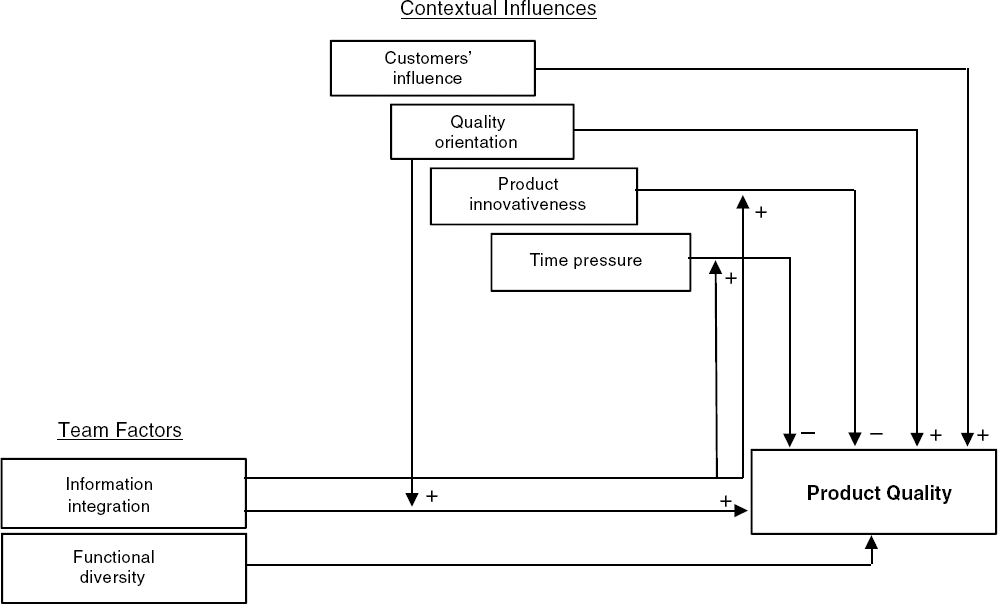
Team-Level Factors Affecting New Product Quality
Team Characteristics and New Product Quality
The two important team characteristics I consider are (1) team process and (2) physical composition. Regarding the former, I focus on integration of information across functional areas. Information integration refers to the degree to which members of the team share, pay attention to, and challenge one another's information and perspectives to generate new insights about the product. This conceptualization of information integration in a team can be viewed as a special case of the general concept of integration, which essentially captures joint working (i.e., interaction and collaboration) between functional areas at the firm level (Griffin and Hauser 1996; Gupta, Raj, and Wilemon 1986; Kahn 1996; Ruekert and Walker 1987). I focus on information integration in particular because the specific processes that are considered conducive to the emergence of high quality are more akin to information integration than mere joint working between functional areas (Clark and Fujimoto 1991; Garvin 1988; Hauser and Clausing 1988).
Regarding physical composition, the variable I focus on is functional diversity within the team. In the quality literature, for the emergence of a superior or high-quality outcome, it is considered crucial to involve several functional areas, which can bring diverse input to the decision-making process (Bounds et al. 1994; Clark and Fujimoto 1991; Garvin 1988).
Effect of information integration
Because members in a team with high information integration share information more effectively, carefully attend to one another's perspectives, and freely question and challenge these perspectives and their underlying assumptions, they are more likely to achieve a common understanding among themselves and consistency across various decisions made by the team. Developing a common understanding about the product and achieving consistency among decisions made throughout the product development process are considered critical for the development of a quality product (Clark and Fujimoto 1991; Garvin 1988; Menon, Jaworski, and Kohli 1997). Because individuals from various functional areas often have different ideas about the product (Dougherty 1992; Garvin 1988), without effective information integration, these individuals generally pull the project in different directions and thereby adversely affect the quality of the new product.
Relatedly, effective information integration is expected to help in bringing functional knowledge and expertise together while important project-related decisions are being made. When diverse knowledge is brought together, it can help the team discover superior ways to satisfy customer needs; for example, R&D can get design ideas from marketing for enhancing product performance and from manufacturing for making the product more reliable (Clark and Fujimoto 1991; Menon, Jaworski, and Kohli 1997). Better satisfaction of customer needs related to aesthetics, performance, life, workmanship, and safety is the essence of high quality.
More important, a good-quality product synergistically builds on a firm's accumulated experience with the existing product technology and manufacturing process (Clark and Fujimoto 1991). It generally takes a great deal of time and resources to stabilize a product design and achieve a balance between the product technology and the manufacturing process. Such a balance helps reduce variation in production. If the new product causes a major disturbance in the existing balance, it can have an adverse effect on the quality of the product, at least until the balance is restored (Clark and Fujimoto 1991). To be able to maintain this balance and synergistically build on the firm's existing technology and processes, individuals in the team must effectively integrate the information and perspectives of various functional areas. Therefore,
The level of information integration in a cross-functional product development team is positively related to new product quality.
Effect of functional diversity
Cross-functional diversity refers to the number of functional areas represented on the team whose members are fully involved in the project. As the number of functional areas represented on the team increases, it is expected to ensure the availability of crucial functional input during the process of making important product-related decisions. Availability of various functional input helps in creating consistency among various decisions, generating ideas for satisfying customer needs in a superior manner, and building synergistically on the firm's existing technology and manufacturing process, which in turn facilitates the development of a high-quality product. Beyond a certain point, however, a diversity of ideas and perspectives can create problems such as increased decision complexity and confusion. To handle such problems, it is not uncommon to find teams resorting to simplifying heuristics, ignoring several alternatives, or avoiding in-depth processing of alternatives (Keller and Staelin 1987; Weick 1995). Inadequate information processing during new product development can have an adverse effect on the quality of the new product (Clark and Fujimoto 1991; Hauser and Clausing 1988; Imai 1986).
In summary, as functional diversity increases from a low to a moderate level, the quality of the new product is expected to increase. However, as functional diversity goes beyond the moderate level, the quality is likely to decline. Therefore,
New product quality will be highest when functional diversity in a cross-functional team is moderate.
Contextual Influences and New Product Quality
Although the team characteristics discussed previously may be able to influence new product quality positively, by themselves they may not be sufficient to maximize the benefits of teams. The ability of a team to produce a high-quality outcome can be helped or harmed by contextual influences on the team (Bounds et al. 1994). Therefore, in addition to focusing on the effect of these team factors, it is necessary to understand how various contextual influences affect new product quality. The four contextual influences I consider in this study are (1) time pressure, (2) product innovativeness from the perspective of the firm, (3) customers’ influence, and (4) quality orientation in the firm.
Effect of time pressure
A minimum level of time pressure is considered useful in spurring individuals to strive for a superior outcome (Karau and Kelly 1992). Beyond a certain point, however, individuals are less likely to search for additional information and are expected to do restricted processing of available information, because time pressure creates a need for cognitive closure (Karau and Kelly 1992). Therefore, high time pressure can make it difficult for team members to develop a common understanding about the product and build synergistically on the firm's existing technology and manufacturing processes. In addition, because of time pressure, team members may be forced to consider a narrow range of decision alternatives and may not be able to think deeply about the various ways to build superiority into the product (Karau and Kelly 1992). As such, the team's ability to develop a quality product may be adversely affected by high time pressure.
The previous discussion suggests a nonlinear relationship between time pressure and product quality. However, interviews at the outset of this study indicated that new product development teams with low levels of time pressure are rare (senior managers increasingly demand shorter cycle times). Therefore, it is expected that time pressure will be beyond the range of positive effects such that,
Beyond a moderate level, time pressure has a negative effect on new product quality.
Effect of product innovativeness
If a new product is novel for a firm, it can hinder the emergence of a quality outcome. This negative effect of innovativeness can be explained from both an operational point of view and an organizational learning perspective. First, operationally, a very innovative product can require major changes in the existing technology and manufacturing process and thereby disturb the balance among the product, technology, and manufacturing systems (Clark and Fujimoto 1991). As noted previously, such a balance helps the firm improve quality by bringing the variation in production under control. Because team members who work on a novel product are likely to be overwhelmed with a large diversity of unfamiliar issues, they may not have the necessary frame of mind and the time to work in a focused manner on the process of continuous improvement and to attain a fine balance between the new technology and the manufacturing process (Imai 1986). Consequently, high product innovativeness can lead to a higher variation in production or lower product quality.
Second, the negative relationship between innovativeness and product quality can also exist because different types of learning competencies are needed for the development of a very innovative product compared with a high-quality product. For example, highly innovative products require higher-order, or generative, learning (Argyris and Schon 1978; Slater and Narver 1995), also referred to as exploration (Kyriakopoulos and Moorman 1998; March 1991). The higher-order learning takes place when individuals or firms question the basic assumptions or frameworks within which they have been operating and acquire a different way of looking at the world. This type of learning is more akin to reorientation in the deep structure or durable underlying order in beliefs, thoughts, and processes (Gersick 1991). In contrast, incremental efforts that are involved in continuous improvement of the quality of existing products and processes are consistent with lower-order or adaptive learning (Slater and Narver 1995), also referred to as exploitation of old certainties (Kyriakopoulos and Moorman 1998; March 1991). Lower-order learning occurs when individuals or firms operate within a set of recognized and unrecognized constraints and incrementally learn to improve their performance according to changing circumstances (Argyris and Schon 1978; Slater and Narver 1995) without making any changes in the deep structure (Gersick 1991).
Not only do these two types of learning require different frames of mind, but there is also generally a great deal of inertia that hinders individuals or firms from moving from one state to another (Argyris and Schon 1978; Gersick 1991). Therefore, it is difficult for individuals who are more focused on the generative learning mode to carry out (or quickly switch to) adaptive learning simultaneously, and vice versa. In other words, individuals who are driven to develop highly innovative products might not be able to stick to the regimen required for incremental or continuous improvements in quality. Therefore,
The innovativeness of a new product is negatively related to product quality.
Effect of customers’ influence on the product development process
As used in this study, customers’ influence refers to the extent to which input from customers is used for making important decisions during the initial stages of product development, during which the foundation for product quality is usually laid. For the development of a superior product, it is important to expose members of the product development team to customer needs and the consumption context (Bounds et al. 1994; Clark and Fujimoto 1991; Hauser and Clausing 1988). Moreover, it is useful to seek customer feedback about the team's ideas and plans (e.g., the product concept). This feedback serves as a reality check and ensures that the superiority the team has incorporated into the product is considered meaningful by customers.
However, certain experts doubt whether information from customers can be of much help, because customers can define their requirements mainly in terms of existing products and services that may be low in quality (Deming 1993; Hayes and Abernathy 1980). Accordingly, these experts believe that firms that rely heavily on what customers say they require may risk achieving quality standards far below what their engineers and managers are capable of attaining (Hackman and Wageman 1995). Certainly, such a situation can arise if firms passively accept and develop just what customers say they want in the new product. However, firms deal with customer involvement in the product development process in several different ways. For example, in some situations, firms might proactively apply their own knowledge and expertise about the product and usage situation to help customers discover and articulate their requirements, particularly when customers seem unable to identify meaningful requirements on their own. Sometimes firms ask their lead or expert customers to suggest modifications that can enhance the quality of the product (von Hipple 1988). The insights so obtained (or the new product concept and the design that emerge from these insights) are then evaluated for quality by a wide variety of customers. In other words, even if customers are unable to provide meaningful insights on their own, firms have several ways of obtaining useful input and feedback for improving new product quality. As such,
The extent of customers’ influence on the product development process is positively related to new product quality.
Effect of quality orientation
I define quality orientation as the extent to which a firm lays emphasis on quality, creates a commitment to quality among its employees, and practices total quality management. A strong quality orientation in the firm should generally spur the members of a product development team to strive for higher quality outcomes (Bounds et al. 1994; Garvin 1988). Conversely, without a commitment to quality on the part of various functional areas in the firm, a team may not be able to develop a quality product. The resources and facilities of functional areas that lack a commitment to quality are also expected to be relatively low in quality. Because to a large extent teams are dependent on these functional resources and facilities to accomplish their tasks, a lack of quality culture among these functional areas may hinder teams’ ability to translate their ideas for improving quality into high-quality products.
Moreover, individuals in a firm with a strong quality orientation are likely to be more attuned to pursuing the path of continuous improvement to achieve higher quality (Bounds et al. 1994; Imai 1986). These individuals are expected to be particularly aware that a new product needs to be built on the firm's existing technology and manufacturing processes or else there may be high variation, and quality may turn out to be low. Thus, team members who operate in a highly quality-oriented firm are more likely to build synergistically on the firm's technology and manufacturing processes. Therefore,
The extent of quality orientation in a firm is positively related to the quality of the new product developed by a team.
Information Integration as a Moderator of the Relationship between Contextual Influences and Quality
As discussed previously, both product innovativeness from the firm's perspective and time pressure are expected to affect adversely the team's ability to build the new product synergistically on the firm's existing technology and manufacturing processes. Considering that firms are constantly advised to develop innovative products and teams are increasingly coming under pressure to shorten the product cycle time, product quality is expected to be compromised under such circumstances. Therefore, it is important to investigate what factors can minimize the adverse effect of product innovativeness and time pressure on quality. In this study, I examine one such factor: information integration in the team.
Moderating the effect of time pressure
As information integration in a team increases, its members are in a better position to reduce the adverse effect of high time pressure on quality. Because members of a high–information integration team communicate effectively, they can find time for essential activities, even under conditions of high time pressure, by setting task priorities, doing parallel work on different aspects of the project, and avoiding unnecessary backtracking of the development job between functional areas because of the common understanding they develop about the project (Clark and Fujimoto 1991; Smith and Reinertsen 1991; Takeuchi and Nonaka 1986). The time thus saved by a team with high information integration can be used to study carefully the input of various functional areas, search for superior ways to satisfy customer needs, and keep variation in the production of the new product to a minimum. In contrast, teams with low information integration may not be able to work effectively in a parallel mode and avoid backtracking of the development job. Therefore, teams with low information integration may not be able to reduce the negative effect of high time pressure on quality effectively. Therefore,
The negative effect of time pressure on new product quality will be reduced as information integration in the team increases.
Moderating the effect of product innovativeness
High information integration in a team is likely to reduce the adverse effect of product innovativeness on quality. A team in which members work in a highly integrated manner might be able to minimize the disturbance in the operational balance among the product, technology, and manufacturing processes that an innovative new product creates (Clark and Fujimoto 1991). Members in such a team are likely to be in a better position to handle a large diversity of unfamiliar issues to which a highly innovative product can give rise. Thus, when dealing with the operational imbalance created by the innovative product, members in a team with high information integration may still be able to help control variation in production. In contrast, teams with low information integration may not be able to work effectively to minimize the disturbance between the technology and manufacturing processes that an innovative new product causes. Therefore, teams with low information integration may find it difficult to reduce the negative effect of high innovativeness on quality effectively.
As discussed previously, from a learning perspective, two different types of competencies are needed for the development of a very innovative versus a high-quality product, and it is difficult for firms to develop simultaneously high levels of both types of competencies. Although a team with high information integration may be able to overcome the operational imbalance created by an innovative product, if the firm's basic competence lies in developing innovative new products rather than in continuously improving quality, even an integrated team may not be able to compensate for the firm's lack of competence in producing quality products. Yet considering that integrated teams can effectively take care of the operational imbalance, information integration may, to some extent, offset the negative effect of innovativeness on quality.
The negative effect of product innovativeness on product quality will be reduced as information integration in the team increases.
Contextual Influences as Moderators of the Information Integration–Quality Relationship
Among popular managerial publications, integration of information across functional areas is considered important for the successful operation of a team. Given the importance managers place on information integration and its expected positive effect on new product quality, it is useful to examine conditions that may elevate the information integration–quality relationship. Here I consider one such factor: quality orientation.
Moderating effect of quality orientation
Although a team with high information integration has the potential to develop a quality product, this potential can be better realized only if other individuals in the organization are driven to develop quality products and have resources and facilities suitable for producing quality outcomes (because teams are greatly dependent on the resources and facilities of many others in the organization). As quality orientation in a firm increases, teams with high information integration are expected to produce a higher-quality product. A team with high information integration is likely to have a better and clearer understanding and plan for the development of a quality product and thus is in a better position to avail of other employees’ commitment to quality and the superior facilities that a firm with high-quality orientation generally has. In contrast, the benefit of increase in firmwide quality may not be as effectively availed of by a team with low information integration, because its members may not have such a clear, common understanding among themselves about developing a quality product. Thus,
The positive effect of information integration on new product quality will be enhanced as quality orientation in the firm increases.
Covariates
Two covariates are included in this study. First, interdepartmental connectedness in a firm (i.e., the extent of communication and contact across functional areas) has been considered a covariate because it can enhance the availability of diverse functional perspectives and facilitate responsiveness to customers and thereby positively influence new product quality (Menon, Jaworski, and Kohli 1997). Second, the consumer durable goods industry in the United States was an early adopter of the total quality approach, as it was one of the first industries to be hit hard by competition from Japanese goods in the 1970s and 1980s. Considering that this early adoption of the total quality approach by the consumer durable goods industry compared with the consumer nondurable goods industry might have had a positive effect on the quality of durable goods, the type of industry is also a covariate of interest in this study.
Methodology
Data Collection
The hypotheses were tested using data collected through a mail survey from key informants in cross-functional teams involved in recent major new product initiatives. To identify candidate projects and related key informants, a list of consumer product manufacturing firms that had introduced new products within two years preceding the start of this survey was created.
Following similar key informant research (e.g., Cini, Moreland, and Levine 1993), the goal was to identify the person on each team who would be highly knowledgeable about team events and practices. In the present study, this person was the project manager who primarily manages or coordinates a cross-functional product development effort. Project managers can belong to various functional areas, but I decided to focus only on those projects that had project managers from the marketing area, because in consumer product companies (the focus of our study) many new product development projects are coordinated by marketing managers. Also, I discovered during the pretest that it was difficult to identify project managers from nonmarketing functional areas (e.g., because of the highly sensitive nature of R&D projects, many firms were reluctant to provide access to key contacts in that area).
The short-listed firms were contacted by telephone to identify managers from the marketing area who had coordinated new product development projects. These individuals then were screened to confirm that they had recently managed new product development initiatives and that such initiatives used a cross-functional team. Project managers who met these criteria were asked to complete questionnaires that were mailed to them immediately after the screening.
Descriptive Statistics, Reliabilities, and Intercorrelations Among Refined Measures

*Significant at p < .01.
**Significant at p < .001.
In completing the questionnaire, respondents were asked to focus on their most recently completed new product development project. I expected that project managers would have a better memory of projects in which they were most recently involved. Also, by asking them to focus on the most recent projects, I wanted to minimize the social desirability bias in the selection of projects; that is, many respondents might otherwise choose to focus on their more successful projects. 2 Questionnaires were sent to 240 project managers. A reminder with another copy of the questionnaire was sent to managers who had not responded after three weeks. I received 141 usable responses, which yielded a 58.75% response rate. The industries represented in the sample consisted of appliances, lawn care equipment, office supplies, toys, processed food products, health and beauty aids, and household products. On an average these projects had been completed 7.8 months before data collection.
There was a concern that even though project managers were asked to focus on their most recent projects, many of them might instead have chosen to report about their very successful projects. To address this concern, I examined the distribution of market performance of these projects (which was measured using a three-item, seven-point scale that asked project managers to rate the performance of the new product compared with their planned objectives in terms of sales, market share, and profitability). The distribution has a good deal of variability (standard deviation = 1.34, mean = 4.67 on a seven-point scale). Of all the projects that were launched, 23% performed below expectation (or were disappointments), and 15% performed just at the firm's planned objectives for the new product. Thus, there is no concern that a majority of managers chose to report about their very successful projects.
To assess the degree of nonresponse bias, responses were divided into two categories—the responses received before reminders and those received after reminders. To examine the possible difference between groups, t-tests were conducted with mean responses to each of the variables included in the model. These calculations were made under the assumption that those who responded late were similar to nonrespondents (Armstrong and Overton 1977). There were no significant differences between groups. Therefore, it was inferred that project managers who responded were not very different from those who did not respond.
Measures
Whenever possible, existing measures of the constructs were used. All measures were pretested on 30 managers who completed them for the cross-functional teams in which they had participated. On the basis of the pretest, measures were refined. All constructs were further tested with 7 managers of product development projects who completed the measures for cross-functional product development teams in which they had participated and who also commented on their understanding of the items. Detailed interviews were held with these managers and, on the basis of their feedback, the questionnaire was further revised and administered to the full sample (for scales, see the Appendix).
After data collection, each measure was examined for low item-to-total correlations (Churchill 1979). No scale item was deleted at this stage. Descriptive statistics and reliability for each measure are included in Table 1. Exploratory factor analysis indicates that all the major variables in the study were unidimensional scales.
New product quality was measured as the extent to which a new product is perceived to be superior to other competing products in aesthetics, performance, life, workmanship, and safety. This measure is based on the work of Garvin (1988) and Juran and Gryna (1989). The quality scale is a new five-item, seven-point semantic differential scale that taps the previous dimensions of quality.
The use of project managers as a source of data on new product quality gives rise to a possible concern that the judgment of the responding managers about new product quality may not reflect that of consumers. To examine the extent to which the ratings of product quality by the managers and customers agree with each other, additional data were obtained from consumers (see Andrews and Smith 1996). Specifically, some of the respondents revealed the brand names of their products. From these, I focused on 23 products that could be evaluated by customers for quality because they were commonly available products.
For each of these 23 products, a product concept sheet was prepared that included a picture and a brief written description of the product. After reading a product concept sheet, consumers responded to the quality of the product on the same scale used by managers. Consumer respondents were screened to ensure that only those who had used the product were asked to evaluate the product. A total of 316 responses was collected from 190 respondents. To determine the extent to which consumers’ assessments agreed with those of project managers, I examined the correlation between the average of consumers’ ratings for a particular product and the corresponding manager's rating (n = 23). The correlation (r = .73, p < .01) suggests a high match between the two groups and supports the use of managers’ ratings of new product quality.
Information integration was operationalized as the degree to which members of a cross-functional team share, pay attention to, and challenge one another's information and perspectives to discover new ideas about the product. This measure is based on the conceptualization of integration suggested by Gupta, Raj, and Wilemon (1986) and the measure of market information use suggested by Deshpandέ and Zaltman (1982). The information integration scale is a four-item, seven-point Likert-type scale.
Functional diversity was operationalized as the number of functional areas represented on the team whose members were fully involved in the project (rather than being ad hoc specialists or consultants who were engaged only for a limited time). The average number of functional areas represented in the product development teams studied was six per team, which suggests that teams had considerable diversity.
Time pressure refers to the extent to which team members believed that they experienced shortage of time during the development of the product in question. A new three-item, seven-point Likert-type scale was developed to measure time pressure.
Product innovativeness was measured as how novel the product was for the firm. The product newness scale was a four-item scale derived from Booz, Allen & Hamilton's (1982) taxonomy of new products. A score of one on this scale means that innovativeness is low and the new product is an improvement or modification of an existing product of the firm, and a score of four indicates that innovativeness is high and the product is novel for the firm and the industry.
Customers’ influence on the development process was operationalized as the extent to which input and feedback from end customers was relied on in the development of the product concept and design. The reliance on customer input scale is a new three-item, seven-point Likert-type scale.
Quality orientation was measured as the extent to which a firm emphasizes quality, creates a commitment to quality among its employees, and practices total quality management. The quality orientation scale is a new three-item, seven-point Likert-type scale.
Covariates
The first covariate, interdepartmental connectedness, was operationalized as the extent of formal and informal communication and contact among employees across functional areas in a firm (Jaworski and Kohli 1993). The scale for this variable is a four-item, seven-point Likert-type scale (Jaworski and Kohli 1993). The second covariate, the type of industry, refers to whether the new product was a consumer durable or nondurable.
Results
Hypothesis Testing
Hypotheses were tested using moderated regression analysis as suggested by Aiken and West (1991) and Jaccard, Wan, and Turrisi (1990). Significant interactions in the model were examined through the simple slope analysis, a technique that overcomes the need to create subgroups from continuous independent variables (Aiken and West 1991). 3 An examination of correlations among independent variables showed that correlations ranged from 0 to .15 (see Table 1). To minimize multicollinearity among interaction terms and their constituent terms in the regression model, all independent variables were mean centered (Aiken and West 1991; Jaccard, Wan, and Turrisi 1990). To test for multi-collinearity, the eigenvalue spectrum multicollinearity diagnostic (Myers 1986) was used. For this purpose, the condition number, that is, the ratio between the highest and the lowest eigenvalues in the model, was calculated. In the model, this ratio was 12.4. As Myers (1986) suggests, researchers should be concerned about multicollinearity if the condition number is greater than 1000.
The simple slope analysis technique involves rearranging a regression of the dependent variable at various levels of a moderator variable. For example, to examine the interaction Y = α + βindXind + βmodXmod + βinterXindXmod (ind = independent term, mod = moderator term, inter = interaction term), the equation is rearranged as Y = α + Xind(βind + βinterXmod) + (βmodXmod). After substituting the values of relevant unstandardized regression coefficients from the full regression model, the equation is solved for Xind at different values of Xmod such as (
As can be seen in Table 2, the terms in the model accounted for 35% of the variance in new product quality, and the F statistic was 7.46 (p < .001). The F-test for difference in R-squares between the models with interaction terms and without interaction terms (Jaccard, Wan, and Turrisi 1990) is significant (F = 5.38, p < .01), which suggests the existence of interaction effects. Results of the simple slope analysis appear in Table 3.
Main Effects of Team and Contextual Influences on New Product Quality
As was expected, information integration was positively related to new product quality (b = .15, t = 2.38, p < .01). H1 is supported. To examine further if information integration influences some dimensions of quality more than others, these dimensions were correlated with information integration. The analysis suggested that except for life (r = .14, p = .12), the other four dimensions (i.e., aesthetics, performance, safety, and workmanship) were significantly correlated with information integration (raesthetics–integration = .23, rperformance–integration = .33, rsafety–integration = .23, rworkmanship–integration = .31, p < .01). Considering that the three important product development stages, namely, concept development, design, and manufacturing preparation, have some type of role in influencing at least a few of these four dimensions of quality, it seems that information integration is indeed critical almost throughout the product development process.
Unstandardized Regression Coefficients

*Significant at p < .05.
**Significant at p < .01.
***Significant at p < .001.
Results of Simple Slope Analysis for Significant Interactions
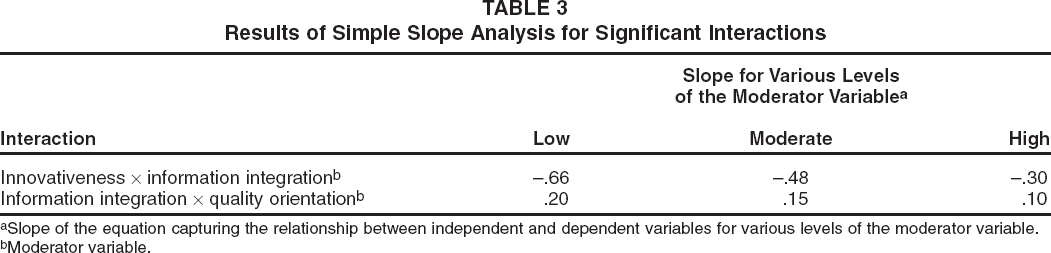
aSlope of the equation capturing the relationship between independent and dependent variables for various levels of the moderator variable.
bModerator variable.
The results did not support the nonlinear relationship between functional diversity and quality proposed in H2. Coefficients for both the linear term (β = .02, t = .12, p = .46) and the quadratic term (β = -.01, t = -.18, p = .43) of functional diversity were not significant. Time pressure was predicted to have a negative effect on quality, but contrary to expectations, time pressure was not related to quality (b = -.01, t = -.09, p = .47). H3 is not supported. However, innovativeness from the firm's perspective was negatively related to product quality as was suggested in H4 (b = -.48, t = −1.85, p < .05).
Consistent with expectations, customers’ influence on the product development process was positively related to new product quality (b = .18, t = 2.89, p < .01); thus H5 is supported. To explore further if customers’ influence on new product quality differed during the idea/concept development stage and design stage, I combined the first two items of the scale that relate to idea generation and concept development/testing and left the third item about customers’ influence during the design stage as it was. I then correlated product quality with customers’ influence during the idea/concept development stage and the design stage. Customers’ influence during the idea/concept development stage seems to have a stronger relationship to product quality (r = .18, p < .05) than does customers’ influence during the product design stage (r = .08, p = .38).
Furthermore, it was hypothesized that quality orientation would have a positive effect on quality (H6). This prediction is also supported (b = .25, t = 3.63, p < .001).
Interaction between Team Factors and Contextual Influences
It was predicted that information integration would mitigate the negative effect of time pressure on new product quality (H7). The interaction between time pressure and information integration was not significant (b = .01, t = .76, p = .23). H7 is not supported.
Similarly, according to H8, information integration was expected to reduce the negative effect of product innovativeness on quality. The interaction between product innovativeness and information integration was significant (b = .15, t = 2.70, p < .01). Simple slope analysis (Aiken and West 1991) suggests that as information integration increases from low to high, the slopes of equations capturing the negative effect of product innovativeness on quality progressively decrease (Table 3). Therefore, H8 is supported.
Quality orientation was expected to strengthen the effect of information integration on new product quality (H9). The interaction between quality orientation and information integration was significant, but the sign of the coefficient was negative (b = -.04, t = −2.76, p < .01). As is indicated by simple slope analysis, when quality orientation increases from low to high, the slopes of equations capturing the positive effect of information integration on quality become progressively less positive (Table 3). H8 is not supported. This finding is treated in more detail in the discussion section.
Covariates
The covariate interdepartmental connectedness was found to have a weak positive effect on new product quality (b = .09, t = 1.29, p < .10). The dummy variable for durable products also had a significant effect on quality (b = 2.10, t = 3.51, p < .001), which confirms the contention that the early adoption of the total quality approach by the durable goods industry has a positive effect on the quality of new durable goods.
Conclusions and Discussion
This research examines how certain team characteristics and contextual influences affect new product quality. The results show that quality is positively influenced by information integration in the team, customers’ influence on the product development process, and quality orientation in the firm. However, product innovativeness has a negative effect on quality. Functional diversity and time pressure have no effect on new product quality. The relationship between information integration and new product quality is weakened by quality orientation in the firm. Information integration mitigates the negative effect of product innovativeness on quality.
Some hypotheses were not confirmed. First, there was no effect of time pressure on quality. The absence of the main effect of time pressure seems to confirm the belief by certain experts in the product development area that teams have the ability to perform well even under conditions of limited time (Smith and Reinertsen 1991; Takeuchi and Nonaka 1986). Possibly, as Eisenhardt and Tabrizi (1995) suggest, because the steps required for cycle time reduction are quite predictable in stable industries, such as consumer durable and nondurable goods, teams are able to deal easily with time pressure through various well-known strategies, including supplier involvement and simultaneous product development with overlapping stages. Considering that products in the sample were from stable industries (and thus were not radical new products), it is possible that product development teams were able to overcome the adverse effect of time pressure. Relatedly, it seems that because there was no negative main effect of time pressure on quality that could be mitigated, no moderating effect of information integration on the time pressure–quality relationship could be detected. Further research should examine whether the negative effect of time pressure on quality is more likely to be found in less stable industries (such as high-tech industries) and whether integration plays any role in mitigating the negative effect of time pressure in such industries. It will also be interesting to examine whether different sources of time pressure have differential effects on quality. (For example, time pressure created by some arbitrary deadlines imposed on the project may have a different effect than time pressure experienced by a team when it is in a race to reach the market earlier than a competitor.)
Second, an unexpected result in this study is the negative moderating effect of quality orientation on the relationship between information integration and new product quality. I hypothesized a positive moderating effect, expecting that quality orientation will help a team with high information integration more than a team with low information integration. However, as the findings suggest, the reverse seems to be true. Possibly, because employees in firms with high-quality orientation are more committed to developing quality products and the facilities of the firm are generally of better quality, even a low information integration team is able to develop a high-quality product in such an environment. Conversely, considering that high information integration by itself is quite effective in enabling the team to build the new product synergistically and find new ways to enhance superiority, high firmwide quality orientation in such a situation may not lead to any substantial increase in new product quality. In other words, in a firm with high-quality orientation, the relationship between information integration and new product quality may not be as strong, or information integration plays a less significant role in influencing new product quality. 4 More research is needed to understand fully the process through which quality orientation in the firm affects the ability of teams to influence new product quality.
Alternatively, it can be suggested that in firms with strong quality orientation, the extent of information exchange or integration between functional areas at the firm level is expected to be high as a matter of course. Thus, individuals in high–information integration teams in such firms are likely to be faced with extremely large amounts of information that can create information overload. This overload can lead to inefficient decision making and harm the quality of the new product.
Finally, no relationship was found between functional diversity and new product quality. However, at the same time, information integration among members from different functional areas has a strong effect on quality. One interpretation of these findings could be that merely having a functionally diverse team is not sufficient for the emergence of quality. Instead, product quality seems to depend on how effectively members from different functional areas integrate information and perspectives. Alternatively, perhaps no effect of functional diversity on quality was found because there seems to be a critical threshold beyond which increased functional diversity does not contribute to quality, and with the average number of functional areas at six, the teams in the sample may have been beyond this threshold. Further research may be able to identify teams with a wider range of functional diversity to understand how this variable affects quality.
Limitations of the Study
There are three primary limitations to this study. First, the dependent and several independent measures in the study are perceptual in nature, which could have led to common method bias. It is encouraging, however, to note a high degree of agreement between the project managers’ ratings of quality and an outside assessment of quality by consumers. This suggests that common method bias should not be a serious cause for concern. Future studies, however, might consider more objective quality ratings of new products from an independent source, such as Consumer Reports. Because such quality ratings are not available for all new products, researchers might want first to select products for which quality ratings have already been published and then work backward to find the project teams that developed these products.
Second, this study deals with relatively stable and mature consumer products for which the product development process is fairly predictable and consists of well-understood steps. Such products require a deliberate development process that emphasizes extensive planning. Conversely, for products in an uncertain industry, experiential tactics involving frequent iterations of design are more appropriate (Eisenhardt and Tabrizi 1995). For these reasons, the findings of this research may not be generalizable to firms that operate in more uncertain environments.
Third, it is possible that projects that are coordinated by marketing managers (as was the case with projects in this study) rather than by managers from R&D or manufacturing may involve less technical complexity and relatively less collaboration among technical areas such as R&D and manufacturing. Therefore, some caution must be exercised in applying the findings of this study to technically complex projects that involve intense collaboration among technical areas.
Managerial Implications
Although this study is exploratory in nature, it still provides some guidelines to managers for improving product quality. For example, the findings alert managers to the trade-off between product innovativeness and quality. As was noted previously, the problem can arise because of the operational imbalance between the technology and manufacturing processes created by a novel product or because of differences in competencies required for developing a highly novel product compared with a high-quality product. Although the results indicate that the problem of operational imbalance can be offset, to some extent, by the use of teams with high information integration, as noted previously, it would generally be difficult for firms to have both types of competencies or pursue high innovativeness and quality simultaneously. One possible solution is to create a separate division for working on innovative new products and let the existing divisions focus more on quality improvements.
Considering the potential conflict between focusing on continuous improvement in quality and seeking novel products, it is crucial to understand which is more important for organizational performance. The first important factor that needs to be taken into account in this regard is the strategic posture of the firm. For example, whereas prospector firms might focus more appropriately on developing more innovative products, defender firms may be better off putting more emphasis on quality improvements. However, if a prospector firm starts focusing too much on continuous improvement in quality, though it might be able to strengthen competencies that promote efficient continuous improvement, it can end up neglecting and weakening competencies that generate innovative products (see Kyriakopoulos and Moorman 1998; March 1991). Thus, a prospector firm that places excessive emphasis on quality improvement runs the risk of being left behind in the long run by competitors that continue to emphasize innovation.
The second factor that can influence whether to emphasize innovativeness or quality is the life cycle stage of the product category. If the new product is in the initial stages of its life cycle, focusing more on innovative outcomes might be important, but as the product category starts to mature, it may be more appropriate to emphasize quality improvement. Finally, the technical sophistication of the product category can also affect whether to focus on innovativeness or quality. In high-tech areas, in which technology is rapidly evolving, firms might want to focus more on innovativeness rather than overemphasize continuous improvement in quality.
Furthermore, although it has been suggested that seeking information from customers can only be of limited use because customers can define their requirements mainly in terms of existing products and services that may be low in quality (Deming 1993; Hayes and Abernathy 1980), this research suggests that teams that seek more input from customers during the initial phases of the product development process end up developing better-quality products. Results indicate that customer input during the idea/concept development stage is more effective in enhancing quality than in a subsequent stage, such as product design. Considering the evidence from previous research that many product development teams tend to cut short the process of obtaining information from customers—particularly during the initial stages of product development (Cooper 1993)—it is important to impress on teams that they need to stay in touch with customers during new product development.
Finally, although the drive toward shorter cycle time in the business world is believed to have negative consequences for new products (Crawford 1992), the results suggest otherwise. It appears that product development teams have the ability to handle time pressure effectively, at least in industries with a stable environment in which the product development process is quite predictable (as was the case with this sample).
Implications for Theory and Research
This study extends research on new product quality, which has so far mainly focused on organizational antecedents and broad aggregate outcomes (e.g., the quality of a firm's new products in general), to the team-level determinants of new product quality. It has also examined two apparent trade-offs involved in new product development, namely, the trade-offs between quality and innovativeness and between quality and time pressure. In the new product development area, research has usually been done under the belief that it is possible to achieve high quality, high innovativeness, and shorter cycle time simultaneously (some exceptions are studies by Crawford [1992] and Griffin [1997]). More research is needed on such trade-offs. Particularly, it will be interesting to explore how certain team, senior management, or firm factors can help resolve these trade-offs. For example, as this research has suggested, information integration in the team can somewhat mitigate the adverse effect of innovativeness on quality.
Similarly, researchers rarely have questioned the popular notion that autonomous cross-functional teams are always good for product development and have assumed that there are no downsides or costs of the use of cross-functional teams for a firm as well as for individuals who are involved in these teams (an exception is a study by Olson, Walker, and Ruekert [1995]). For example, firms need to create special evaluation, monitoring, and reward systems for such teams. Functional chiefs can feel threatened by the loss of power and control over such autonomous projects. Similarly, team members can be separated from their functional areas for a long time and may face adjustment problems when they try to rejoin their respective areas after the completion of projects. Therefore, more research is needed on how firms can improve new product outcomes such as quality and still minimize the costs associated with autonomous teams. For example, as the results of this study suggest, in a firm with high-quality orientation, information integration plays a less significant role in influencing quality.
Furthermore, whereas this study covers the entire product development process, it would be informative to examine the effects of different aspects of cross-functional teams at various stages of the new product development process. For example, a certain type of team composition may be more effective at some product development stages than at others. If a team has more representatives from marketing and design than manufacturing, it might be more effective in building superiority into the product at the concept development and design stages than during manufacturing preparation. However, to make such stagewise analysis more meaningful, researchers may have to find a way of measuring superiority or quality built into the product at different stages of the product development process (e.g., concept quality, design quality, manufacturing quality).
Finally, although I have relied on the organizational learning literature to examine the trade-off between quality and innovativeness, the effect of factors related to organizational knowledge on new product quality can be studied in further research. For example, a team's absorptive capacity (Cohen and Levinthal 1991), which refers to its ability to recognize and assimilate external knowledge, can affect whether the team will be able to recognize customer needs and identify the appropriate technology for satisfying these needs effectively. Similarly, the richness and accessibility of organizational memory (Moorman and Miner 1997; Walsh and Ungston 1991) can also influence the degree to which a team can synergistically build the new product on the firm's existing store of expertise.