






Abstract
It is widely held that a customer-oriented firm is more likely to deliver exceptional service quality and create satisfied customers. However, little research has addressed the question of how the orientation can be disseminated among employees throughout the firm. This dissemination is especially important in service firms in which frontline, customer contact employees are responsible for translating a customer-oriented strategy into quality service. The authors propose a structural model that explains how service firms can disseminate their customer-oriented strategy by aligning the strategy with specific management- and employee-initiated control mechanisms (i.e., formalization, empowerment, behavior-based employee evaluation, and work group socialization) that lead to increased commitment and shared values on the part of customer contact employees. The findings indicate that there are three “corridors of influence” between customer-oriented strategy and shared employee values. The dominant corridor, which focuses on dual (management- and employee-initiated) control, emphasizes the importance of work group socialization and organizational commitment in the dissemination of customer-oriented strategy. A secondary corridor focuses on two management-initiated control mechanisms: formalization and behavior-based evaluation. The final corridor, which focuses on the empowerment of customer contact employees, has a more limited impact than originally hypothesized. The authors discuss implications for the implementation of customer-oriented strategy and the management of customer contact employees, along with several directions for further research.
One method of creating a customer-focused work environment is through customer orientation (Jaworski and Kohli 1993; Kohli and Jaworski 1990). Consistent with Deshpandέ, Farley, and Webster (1993, p. 27), this study defines customer orientation as “the set of beliefs that puts the customer's interest first, while not excluding those of all other stakeholders such as owners, managers, and employees, in order to develop a long-term profitable enterprise.” In this context, customer orientation is used interchangeably with market orientation, which pertains to “the organization culture that most effectively and efficiently creates the necessary behaviors for the creation of superior value for buyers and, thus, continuous superior performance for the business” (Deshpandέ, Farley, and Webster 1993, p. 26).
Kelley (1992) argues that customer orientation plays a more important role in service firms than in other firms because of the intangibility, heterogeneity, and inseparability of services (Parasuraman, Zeithaml, and Berry 1985). These characteristics are likely to make the service process (i.e., customer service) an important determinant of customers’ quality perceptions (Kelley 1992). Customer-oriented firms also tend to enjoy better performance (measured in profitability or service quality) than do firms employing other orientations. Specifically, Narver and Slater (1990) find that market-oriented firms (defined as those that use a combination of customer orientation, competitor orientation, and interfunctional coordination) experience the highest return on assets, customer retention rate, and human resource management skills. Kelley (1992) further asserts that a customer focus can result in mutually advantageous, long-term relationships with customers.
Despite these advantages, some researchers point out that customer orientation can be effective only when the firm designs the necessary structures, processes, and incentives to operationalize the firm's customer-oriented values (Deshpandέ, Farley, and Webster 1993; Slater and Narver 1995). For service firms, this effort hinges on finding methods of disseminating the firm's customer-oriented values and beliefs in a way that inspires customer contact employees to be customer focused (Kelley 1992). Very little research, however, describes how service managers can encourage customer contact employees to carry out a customer-oriented strategy. Understanding how a customer-oriented strategy can be effectively disseminated is important because managers are forced to rely on their employees to implement the strategy and ensure customer satisfaction. The purpose of this study, therefore, is to investigate how service firms disseminate their customer-oriented strategy to their employees so that the employees share the customer-oriented values of the firm and are inspired to carry out the strategy. We first review the foundation literature for the study. We then propose hypotheses and describe a structural model of customer-oriented strategy dissemination. Finally, we discuss the results and offer both managerial implications and avenues for further research.
Marketing Control as a Framework for Strategy Dissemination
Our proposed model of customer-oriented strategy dissemination is shown in Figure 1. The firm's customer-oriented strategy is modeled as an exogenous variable in the model. This is appropriate because the purpose of this study is to model how this strategy can be disseminated to customer contact service employees so they share this strategic orientation with the firm. When a customer-oriented strategy is adopted, several structural and procedural mechanisms within the firm must come into alignment before effective dissemination can occur. Marketing control theory is an appropriate backdrop for the hypothesized model relationships and helps clarify how management-initiated and employee-initiated control mechanisms can be employed effectively to inspire customer contact employees to perform in accordance with a customer-oriented strategy.
Marketing control refers to management's attempts to influence the behavior and activities of marketing personnel to achieve desired outcomes (Jaworski 1988; Jaworski, Stathakopoulos, and Krishnan 1993). Marketing controls are posited to affect individual actions first and then affect organizational outcomes. From this perspective, marketing control theory plays a vital role in explaining how marketing personnel are encouraged to carry out a customer-oriented marketing strategy. Jaworski's (1988) theory of marketing control identifies two primary control types: formal and informal.
Formal controls are defined as written, management-initiated mechanisms that strive to influence employee behavior and thus positively affect organizational objectives (Jaworski, Stathakopoulos, and Krishnan 1993). Formal controls may be further divided (by management intervention time sequence) into input, output, and process controls. Input controls refer to those controls instituted before performing an activity. A customer service training program, for example, may be used as an input control mechanism to help ensure the implementation of a customer-oriented strategy. Output controls refer to those initiatives that set performance standards and actively monitor and evaluate employee compliance with these standards (e.g., revenue, sales quotas). Process controls refer to mechanisms that strive to influence the means by which performance standards are pursued. Rather than reward outcomes (e.g., number of customers served), process controls attempt to reward employee behaviors that are consistent with organizational goals.

Hypothesized Model of Customer-Oriented Strategy Dissemination
Informal controls are defined as unwritten, worker-initiated directives that purposefully strive to influence customer contact employees’ behavior (Jaworski 1988). Jaworski identifies three types of informal control that differ on the basis of the level of aggregation within the firm: self-control (individual), professional/social control (work group), and cultural control (organization). Self-control refers to situations in which employees self-regulate their behavior by setting and monitoring personal goals or objectives. Professional/social control refers to a more aggregated type of control focused on marketing work groups. In particular, employees may set informal controls that guide both work and social behavior within the work group. For example, contact employees may establish and monitor professional controls such as dress codes, productivity levels, and supervisor relationships. Professional/social controls may play an important role in determining the extent to which a work group strives toward mutual goals and upholds similar values. Cultural control is a broadly defined control type—instituted at the organizational level—that attempts to guide employee behavior across all departments. Thus, cultural controls are more abstract than professional/social controls, as they focus on the organization as a whole. Cultural controls often stem from the accumulation of norms, rituals, and stories that guide organizational behavior (Jaworski 1988). Informal controls may prove dominant in firms in which employees perform a diverse set of nonroutine and highly customized tasks (e.g., customer contact employees) (Mills 1985). As such, it may be difficult for managers to set and measure formal output controls objectively because of the lack of task standardization. Managers may instead choose to rely on informal controls that inspire employees to perform in accordance with organizational values and objectives.
Formal and informal controls are likely to be used simultaneously (Jaworski, Stathakopoulos, and Krishnan 1993). The key to organizational effectiveness, however, may depend on the degree to which management- and employee-initiated controls are employed. That is, various control combinations are likely to yield different performance levels. Jaworski, Stathakopoulos, and Krishnan develop a control combination typology—based on low and high levels of management-initiated and employee-initiated controls—that depicts four control states. It follows that managers must strive to choose and implement the best control combination for their firm. We suggest that both highly management-initiated and highly employee-initiated controls are optimal for effective customer orientation. Jaworski, Stathakopoulos, and Krishnan term this control combination a “high control system.” Highly employee-initiated controls are necessary to inspire employees to carry out a customer-oriented strategy. That is, employees must first buy into the professional/social and cultural controls consistent with a customer-oriented strategy before they will actively pursue such a strategy. In addition, the firm's customer-oriented values must be consistent with employees’ self-controls and values before employees will commit to the strategy. From this stance, it seems reasonable that highly employee-initiated controls can assist managers in the dissemination of a customer-oriented strategy.
These controls may not be sufficient for effective dissemination to occur, however. Although employee-initiated controls may help inspire employees, they do little to hold employees accountable for their performance. Employees may not perform well despite their motivation and desire. Therefore, highly management-initiated controls are also necessary to implement a customer-oriented strategy effectively. Management-initiated controls provide standards by which managers can rate employees’ marketing-oriented performance (at the individual, work group, or organizational level). Therefore, management-initiated controls provide the firm with a more objective measure to account for and reward customer-oriented behaviors. Firms can arguably achieve customer orientation more effectively by employing high levels of both management- and employee-initiated controls.
Proposed Model and Hypotheses
Our proposed model begins with customer-oriented strategy as the exogenous variable. The model hypothesizes that organizational structure (i.e., formalization), empowerment, behavior-based employee evaluation, socialization, and organizational commitment play important roles in disseminating a customer-oriented strategy in a manner that yields shared organizational values. As is shown in Figure 1, our model includes constructs based on both manager and employee perceptions. This feature enables us to examine the hypothesized relationships in three different groups: (1) relationships among managerial perceptions, (2) relationships between managerial and employee perceptions, and (3) relationships among employee perceptions. The following sections discuss the model's constructs and relevant hypotheses in each group. As we discuss in the Research Method section, another feature of our study is that the level of analysis is the service unit itself (i.e., one manager and several employees in the same work group). As a result, our model attempts to explain variation in responses across service units in the same industry.
Setting the Stage: Aligning Control Mechanisms with Strategy
When a customer-oriented strategy has been adopted by the service firm, several structural and procedural mechanisms must come into alignment to disseminate the strategy effectively to customer contact employees. We examine three management-initiated controls that help set the stage for effective dissemination: formalization, empowerment, and behavior-based evaluation. The hypotheses in this section address relationships among managers’ perceptions of these structural and procedural mechanisms.
Organizational structure
Organizational structure refers to the composition of decision-making processes within a firm. In particular, we are concerned with formalization, which is defined here as the degree to which decisions and working relationships are governed by rigid rules and standard policies and procedures (Ruekert, Walker, and Roering 1985). In this highly structured environment, employees perform standardized tasks that are regulated by strict rules and operating procedures (Zeithaml, Berry, and Parasuraman 1988). Such organizations tend to be highly efficient but often cannot adapt to changing conditions (Ruekert, Walker, and Roering 1985). In this vein, formalization diminishes employees’ creativity, as well as their ability to adapt to nonstandardized and nonroutine task environments (Kelley, Longfellow, and Malehorn 1996).
As an element of organizational structure, formalization is a management-initiated input control mechanism (Jaworski 1988). In our model, we posit that the adoption of a customer-oriented strategy requires less reliance on rigid rules and procedures. In a customer-oriented service firm, customer contact employees must be able to adapt and respond quickly to customer needs. For this to occur, it is appropriate for service firms to reduce their reliance on rigid rules and foster an environment in which contact employees believe they are not constantly watched. Because a highly structured environment suppresses the ability of contact employees to respond to customer concerns, formalization is not consistent with the adoption or dissemination of a customer-oriented strategy. Accordingly, we propose the following:
H1: The adoption of a customer-oriented strategy is associated with less reliance on formalization in the organizational structure.
Empowerment
Empowerment can be defined as the process of enabling employees by giving them the power and autonomy to exercise control over job-related situations and decisions (Conger and Kanungo 1988). Empowered employees often feel more confident in their ability to contribute to the firm's success, a result that fosters creative thinking and problem solving (Kelley, Longfellow, and Malehorn 1996). Bowen and Lawler (1992) point out several advantages that empowerment brings to service firms. Among these advantages are faster response to customer needs and problems, more-satisfied employees, enthusiastic and warm customer interactions, innovative new ideas, and loyal customers. Empowered employees are also more likely to exhibit customer-oriented behaviors, because they become more flexible and adaptive in the face of changing customer needs (see Scott and Bruce 1994).
On the basis of this perspective, we view empowerment—in the present study—primarily as a management-initiated process control mechanism. Managers can use empowerment during strategy implementation as a means of increasing employee discretion so that customers are better served. Empowerment can also have a positive effect with respect to employee-initiated control, as it has been associated with pride in workmanship (self-control), teamwork (professional/social control), and shared organizational values (cultural controls) (Bowen and Lawler 1992). We posit that empowerment aids in the dissemination of a customer-oriented strategy by bringing the service firm closer to its customers through increased employee flexibility and adaptation and the reduction of decision lag time. The end result is that empowered customer contact employees can more effectively meet customers’ needs.
H2: The adoption of a customer-oriented strategy is associated with greater reliance on the use of empowerment.
For empowerment to work effectively, a service firm must also reduce its reliance on standardized rules and procedures (i.e., formalization) (Bowen and Lawler 1992). Rigid rules can inhibit the ability of customer contact employees to exercise their empowered authority to respond to customer needs on the spot. High formalization generally dictates that employees must first seek the input of management before acting on customer concerns or requests. Such bureaucracy is undesirable in customer-oriented service firms, because it slows and stifles employees’ responses to customers. Thus, we propose the following:
H3: Increased formalization in the organizational structure is associated with a decrease in the use of empowerment.
Behavior-based employee evaluation
In general, employees can be evaluated on the basis of their work-related outcomes or behaviors. Behavior-based evaluation is particularly suited to customer contact employees in that their performance in serving customers’ needs is directly related to customer-oriented behaviors (e.g., courtesy, friendliness, problem solving) rather than specific work-related outcomes (e.g., quota, sales volume). Employee behaviors can become important in service settings, because service customers often weigh the service process heavily in their quality evaluations (Parasuraman, Zeithaml, and Berry 1985). Research on learning theory suggests that a focus on behavioral criteria in employee evaluations is ideally suited to reinforcing desirable employee behaviors (see Bolles 1979).
Previous studies have found a strong relationship between the use of behavior-based evaluation and customer-oriented employee behaviors. For example, behavior-based evaluation has been linked to increases in employee competence (Cravens et al. 1993), confidence (Gist and Mitchell 1992), job satisfaction (Oliver and Anderson 1994), and adaptability (Scott and Bruce 1994). These findings are consistent with the work of Zeithaml, Berry, and Parasuraman (1988), who argue that behavior-based evaluation encourages employee performance that is consistent with customer expectations of quality service. Service firms that adopt customer-oriented strategies are particularly interested in encouraging customer-oriented behaviors among customer contact employees. Service firms are able to implement a customer-oriented strategy more effectively by evaluating their employees on behavioral rather than outcome-based criteria. Accordingly, we propose the following:
H4: The adoption of a customer-oriented strategy is associated with greater reliance on the use of behavior-based employee evaluation.
In H2, we hypothesize that the use of empowerment is consistent with the adoption of a customer-oriented strategy. By its very nature, empowerment is also consistent with the use of behavior-based evaluation (Conger and Kanungo 1988). Empowered employees are likely to make mistakes. As a result, firms that evaluate employees on the basis of outcome-based criteria will eventually penalize employees for their mistakes. Behavior-based evaluation focuses on performance criteria that are consistent with the behavioral requirements of empowerment (e.g., making decisions, exercising authority, serving customers’ needs). Service firms that empower customer contact employees are better served when behavioral criteria are emphasized in employee evaluations. This reasoning leads to the following:
H5: The use of empowerment is associated with an increase in the use of behavior-based employee evaluation.
Behavior-based evaluation systems are extremely difficult to implement (Oliver and Anderson 1994). The highly subjective nature of such systems makes it difficult for managers to know which behaviors to emphasize in the evaluation process. As a result, managers are forced to monitor employee performance more closely and provide considerable direction to employees’ efforts (Cravens et al. 1993). Because of the close nature of supervision required by behavior-based evaluation, a service firm may be more likely to use standardized rules or procedures to provide guidance and structure to an otherwise complex and subjective evaluation system. Service firms that possess rigid organizational structures may be more likely to use behavior-based evaluation in an effort to provide a standardized set of procedures to assist managers in their evaluations of employee behaviors. On the basis of this logic, we offer the following:
H6: Increased formalization in the organizational structure is associated with an increase in the use of behavior-based employee evaluation.
Corridors of Influence between Managers and Customer Contact Employees
The alignment of management-initiated controls with the customer-oriented strategy has several important effects on employee-initiated controls. In this section, we examine two employee-initiated controls that serve as corridors of influence between managers and customer contact employees: work group socialization (a form of social control) and employees’ organizational commitment (a form of self-control). The hypotheses in this section are all dyadic in nature, in that they address relationships between manager perceptions and employee perceptions of the different types of controls in use. These relationships are critical to our model in that they examine directly the dissemination of customer-oriented strategy between managerial actions and employee responses.
Work group socialization
Organizational socialization is defined as the process by which a person acquires the social knowledge and organizational skills necessary to assume an organizational role (Van Maanen and Schein 1979). Along with this acquisition of knowledge and skills, socialization also includes social interaction among organizational members. Organizational socialization is a critical component in the dissemination of a customer-oriented strategy to customer contact employees (Hartline and Ferrell 1993). Kelley (1992) declares that it is essential to provide consistent and accurate socialization to employees in implementing a customer-oriented strategy.
Van Maanen and Schein (1979) conceptualize six dimensions of socialization. Our study focuses on the two dimensions that constitute work group socialization: investiture socialization and serial socialization. We did not examine the four remaining dimensions, because they deal more with the structure and timing of the training process itself rather than the interpersonal aspects of socialization. Because the investiture and serial socialization dimensions deal exclusively with work group socialization, they represent an important combination of professional/social marketing control and social exchange (see Blau 1964).
Investiture socialization stems from the perspective that employees come to the firm with certain skills, strengths, and characteristics that are valued by the organization (Van Maanen and Schein 1979). After an employee is on board, the investiture socialization process attempts to take advantage of and build on an employee's characteristics by substantiating and enhancing the employee's own view of self. Because of its ability to build employee confidence, investiture socialization is effective in socializing employees to adopt customer-oriented behaviors, as it makes employees feel more comfortable with their work environment and their ability to respond effectively to customers’ needs.
Serial socialization occurs when experienced employees socialize newer employees, such as in a mentoring relationship (Van Maanen and Schein 1979). We contend that mentors are an important element in socializing customer contact employees to be more customer oriented. Serial socialization is consistent with both social exchange theory and the enforcement of work group norms through professional/social controls. Social learning theory (Bandura 1977) states that behavior development is greatly affected by mentors. Other research suggests that employees will learn faster and comprehend better when they are socialized by mentors (Fullagar et al. 1995). It seems imperative for service firms to incorporate role models in the training process to optimize customer service. This necessity is due, in part, to the wide variety of problems that can occur when the production and consumption of a product are inseparable (Parasuraman, Zeithaml, and Berry 1985). Thus, it is likely that modeling senior customer contact employees helps newer employees quickly learn the aspects of a customer-oriented strategy and the skills necessary to be customer oriented.
Work group socialization has potentially important implications for service firms. Previous studies have found that work group socialization increases the likelihood that employees will adopt the role orientation and behaviors prescribed by the firm (Allen and Meyer 1990b; Jones 1986). Service firms could employ work group socialization to teach customer contact employees the norms and behaviors that are consistent with a customer-oriented strategy. Customer contact employees who work in an atmosphere of customer orientation are more likely to engage in and enforce the professional/social controls that stem from work group socialization. Accordingly, we offer the following:
H7: The adoption of a customer-oriented strategy is associated with greater reliance on the use of work group socialization.
Although the adoption of a customer-oriented strategy is associated with less reliance on the use of formalization (H1), the work group socialization process is likely to prove most effective under this type of rigid structure. That is, standardized rules and procedures can help managers and mentors perform their roles as socialization agents more effectively and efficiently by acting as guides or rules of thumb in the how-to aspects of investiture and serial socialization (see Van Maanen and Schein 1979). Because of the complexity of work group socialization, rigid organizational structures can provide boundaries that direct and focus the efforts of socialization agents. Therefore, we propose the following:
H8: Increased formalization in the organizational structure is associated with an increase in the use of work group socialization.
Previous research also indicates that work group socialization is associated with behavior-based evaluation. The customer-oriented attitudes and behaviors that are promulgated in the work group socialization process must be reinforced before learning can take place (Bolles 1979). Customer contact employees are most likely to adopt these socialization-driven behaviors when they know that their performance evaluations are based on the same behavioral criteria (see Stonich 1981). Thus, it follows that service firms must complement the work group socialization process—and the customer-oriented behaviors that are developed during socialization—through the use of behavior-based evaluation. This reasoning leads to the following:
H9: The use of work group socialization is associated with an increase in the use of behavior-based employee evaluation.
Organizational commitment
Organizational commitment is defined as “the relative strength of an individual's identification with and involvement in a particular organization” (Steers 1977, p. 46). This definition is consistent with the concept of affective commitment—an employee's affective or emotional attachment to an organization (Allen and Meyer 1990a). This attachment to the organization makes commitment vital to the process of instilling shared values between the organization and its employees (Kelley 1992). As a form of employee-initiated self-control (Jaworski 1988), commitment causes employees to believe more strongly in the goals and values of the organization (Kelley 1992). As a result, employees who are committed to the organization are more likely to buy into its value system and exert effort toward achieving the organization's goals (Steers 1977).
Our model hypothesizes three relationships between management-initiated controls and the affective commitment of customer contact employees. First, bureaucratic organizational characteristics, such as formalization, have been shown to decrease employees’ commitment to the organization (Mathieu and Zajac 1990). The use of rigid rules and procedures, whereby employees are constantly watched to ensure their adherence to the rules, may cause employees to lose interest in their jobs (Agarwal and Ramaswami 1993). Consequently, the level of employees’ affective commitment declines. On the basis of these previous studies, we propose the following:
H10: Increased formalization in the organizational structure is associated with a decrease in employees’ organizational commitment.
A second antecedent to employees’ commitment is the use of empowerment. Research has shown consistently that employees who have more control and autonomy in their jobs exhibit higher levels of affective organizational commitment (Agarwal and Ramaswami 1993; Mathieu and Zajac 1990). Because empowered contact employees gain more control over their work environment, they take more ownership of the job and perceive that they personally contribute to the firm's overall success. Consequently, these employees are more likely to identify with and become committed to the empowering firm. Therefore, we offer the following:
H11: The use of empowerment is associated with an increase in employees’ organizational commitment.
A third antecedent, behavior-based evaluation, has also been shown to increase employees’ affective organizational commitment (Waldersee and Luthans 1994). Unlike outcome-based evaluation systems, behavior-based systems give employees more direct control over the criteria used to evaluate their performance (Cravens et al. 1993; Oliver and Anderson 1994). This control over performance (granted to employees in a behavior-based system) is important for service firms. Whereas outcome-based performance can be affected by several outside influences, behavior-based performance is directly influenced by the behaviors that customer contact employees exhibit on the job. Oliver and Anderson (1994) find a strong positive association between behavioral control and organizational commitment in a sales force context. The following hypothesis extends previous research by examining the behavioral evaluation–organizational commitment relationship in a services context:
H12: The use of behavior-based employee evaluation is associated with an increase in employees’ organizational commitment.
Customer Contact Employee Responses: Commitment and Shared Values
When both the management-initiated and employee-initiated controls are aligned with the firm's customer-oriented strategy, customer contact employees are more likely to exhibit the sought-after responses of commitment and shared values. In this section, we examine three hypotheses that address relationships among employee perceptions of work group socialization, organizational commitment, and shared customer-oriented values.
Organizational commitment
One of the primary antecedents of employees’ affective commitment is work group socialization. Previous research provides convincing theoretical and empirical evidence that work group socialization influences organizational commitment significantly. Theoretically, work group socialization increases commitment because of the positive social support provided by investiture socialization and the mentoring relationship that is fostered during serial socialization (Van Maanen and Schein 1979). In empirical studies, work group socialization has been shown to increase employees’ organizational commitment significantly (Allen and Meyer 1990b; Jones 1986). Overall, work group socialization stimulates employee cohesiveness, which often causes employees to identify more strongly with the organization and become more committed to the firm (Mathieu and Zajac 1990). On the basis of this reasoning, we propose the following:
H13: The use of work group socialization is associated with an increase in employees’ organizational commitment.
Shared customer-oriented values
Shared organizational values are one component of an organization's overall culture. Deshpandέ and Webster (1989) define organizational culture as the pattern of shared values and beliefs that helps people understand organizational functioning and thus provides norms for appropriate organizational behavior. Prior research has argued strongly for the important role of shared values in the implementation of a firm's strategy. In a sales management context, for example, Siguaw, Brown, and Widing (1994, p. 106) argue that “in deciding the strategy of choice, an important aspect of implementation is to influence salespeople to adopt the chosen orientation in their selling efforts.” Some authors further suggest that shared values among a firm's employees can facilitate greatly the implementation of marketing strategy and enhance a firm's performance (see Badovick and Beatty 1987).
Shared values may prove even more important in service firms, because customer contact employees are often inseparable from the product and directly responsible for delivering quality service (Parasuraman, Zeithaml, and Berry 1985). Customer contact employees are often the only representation of the service firm that is visible to the customer. To this extent, contact employees who share the customer-oriented values of the firm are more likely to exhibit behaviors that are consistent with those values and the firm's strategy. When contact employees share the firm's customer-oriented values, the firm's customer-oriented strategy is more likely to be implemented effectively. This reasoning is consistent with the findings of many researchers who assert that when employees share the values of the firm, they will exert considerable effort to uphold those values (see Meglino, Ravlin, and Adkins 1989).
Research indicates that one of the most influential determinants of shared values between employees and the organization is work group socialization. Work group socialization produces a custodial orientation among employees, whereby they adopt organizationally derived norms, customs, and values (Van Maanen and Schein 1979). Some researchers provide empirical support for this reasoning (Allen and Meyer 1990b; Jones 1986). This effect is especially pronounced with respect to the mentoring component of work group socialization. The subjective nature of work group mentoring may cause employees to adopt and internalize the firm's value system more fully (Jones 1986). By instilling confidence in employees and using effective role models, work group socialization can enhance the dissemination of customer-oriented strategy and values to customer contact employees. Therefore, we propose the following:
H14: The use of work group socialization is associated with an increase in shared customer-oriented values between employees and the firm.
From a theoretical perspective, researchers have argued that employees who are affectively committed to the organization are more likely to buy into or share the organization's value system (Ouchi 1981; Steers 1977). In empirical studies, researchers consistently have found a positive relationship between organizational commitment and shared values (Meglino, Ravlin, and Adkins 1989). On the basis of this theoretical and empirical support, we offer the following:
H15: An increase in employees’ organizational commitment is associated with an increase in shared customer-oriented values between employees and the firm.
Research Method
Sample
We selected hotels as our sampling frame because the delivery of hotel services involves ample opportunity for contact with customers. Hotels also represent environments in which managers work alongside customer contact employees, which thereby gives managers the opportunity to observe and influence employee behaviors. To initiate a sample, we contacted the marketing managers of nine hotel chains. Three chains, each offering services in the middle-to-high price/quality range, agreed to participate by providing a complete mailing list of general managers’ names and hotel addresses. This procedure resulted in a pool of 444 hotel units, all of which were sampled. The corporate marketing managers of the three chains mailed a letter to each general manager that explained the research and asked for their support. Approximately two weeks later, questionnaire packets were mailed to each general manager. Each packet contained one manager survey, five employee surveys, a page of instructions, and postage-paid return envelopes. Each respondent group was surveyed regarding the issues for which it would be most knowledgeable. Hotel managers were asked about their emphasis on customer-oriented strategy, the organizational structure of their unit, their use of empowerment, and their emphasis on behavioral criteria in employee evaluations. Customer contact employees were asked about their work group socialization experiences, their level of organizational commitment, and the extent to which they shared the customer-oriented values of the organization.
Constraints imposed by the participating hotel chains prohibited us from directly contacting the employees. As a result, we relied on the general managers to distribute the employee surveys. The general managers were instructed to distribute the employee surveys across a broad range of customer contact positions (e.g., front desk, food service, housekeeping, bellstaff). Two months after the initial mailing, a second wave of the same materials was mailed. All questionnaires were returned directly to the researchers.
Of the total sample, 279 different hotel units responded (62.8% unit response rate) by returning at least one questionnaire from a hotel manager or employee. Of the 1003 questionnaires that were returned, all the manager surveys and all but 24 of the employee surveys were usable. Usable questionnaires were returned by 236 hotel managers (53.2% response rate) and 743 employees (33.5% response rate). Because 165 hotels failed to return any type of questionnaire, we tested for nonresponse bias using a time-trend extrapolation test (Armstrong and Overton 1977). We found no differences between early and late employee or manager respondents on demographic characteristics or any construct examined in this study.
The demographic characteristics of employees and general managers are typical of the hotel industry. Most of the employees are 20 to 30 years of age (63.8%), have some college education (43.3%), and work in front desk or customer service positions (53.7%). Most of the general managers are 31 to 40 years of age (46.6%), have a college degree (46.4%), and have 5 to 15 years of experience in the hotel industry (52.3%). We screened employee respondents to ensure that their jobs involved customer contact by asking them to report their job position on the questionnaire. Customer contact positions were confirmed through discussions with corporate managers. The 182 employees who did not meet this criterion were dropped before the measures and the hypothesized model were tested.
Measures
To remain consistent with previous research, we adapted the measures from previous studies in marketing, management, and psychology (see Table 1). We subjected all measures to confirmatory factor analysis to assess their psychometric properties and unidimensionality. Because of sample size restrictions associated with the large number of measures used in the study, we performed separate analyses for each sample group using two complete (nonaggregated) data sets. After we accounted for missing data, the sample sizes were 236 responses for managers and 561 responses for contact employees. To assess discriminant validity across both samples, the employee responses were aggregated (averaged) and matched with the manager responses to create a single data set in which the cases represent hotel units rather than individuals. Hotel units that did not provide at least three responses from customer contact employees were dropped. These procedures resulted in a final sample of 176 hotel units, and each unit consisted of the matched responses from one general manager and an average of 3.37 customer contact employees. The details and results of our measure validation procedures are provided in the Appendix.
Analysis and Results
Before estimating the hypothesized model, we computed the variance inflation factor (VIF) for each variable to assess multicollinearity. The VIF, the inverse of (1 - R2), should be close to 1.00, which indicates little or no multicollinearity. Hair and colleagues (1995) suggest a cutoff value of 10.00 as an acceptable VIF. Among the variables in our study, the highest VIF occurs for shared customer-oriented values (VIF = 2.34, R2 = .57), which indicates that the effect of multicollinearity among the variables is negligible.
Measures Used in the Study

aα = coefficient (Cronbach's) alpha; CR = construct reliability (Jöreskog 1971).
bMathieu and Zajac (1990) find that Mowday, Steers, and Porter's (1979) 15-item commitment scale contained two dimensions: affective commitment and desire to remain with the organization. We measured commitment using a subset of 8 items from the original scale that assess affective commitment.
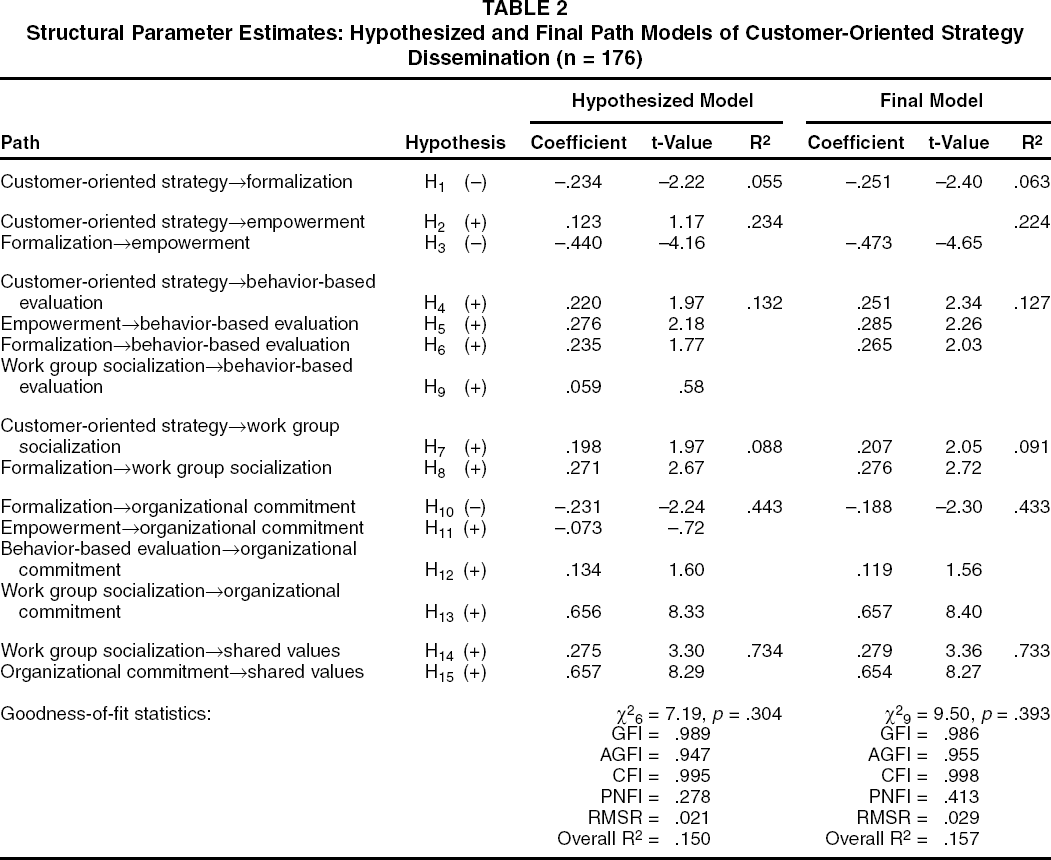
We tested the hypothesized model using LISREL 8 (Jöreskog and Sörbom 1993). We accomplished hypothesis testing by examining the completely standardized parameter estimates and their t-values. Estimating the hypothesized model produced the following statistics: χ26 = 7.19 (p = .304), goodness-of-fit index (GFI) = .989, adjusted goodness-of-fit index (AGFI) = .947, comparative fit index (CFI) = .995, and parsimony normed fit index (PNFI) = .278. The structural parameter estimates from the hypothesized model are reported in Table 2. One-tailed tests of significance were used to determine the significance of each path coefficient. Because three hypothesized paths were not significant, we dropped them to create a more parsimonious model. Model trimming is appropriate in exploratory research if it is not used as a substitute for a priori hypothesis development (Anderson and Gerbing 1988). Estimating the final trimmed model produced the following statistics: χ29 = 9.50 (p = .393), GFI = .986, AGFI = .955, CFI = .998, and PNFI = .413. The structural estimates from the trimmed model are reported in Table 2. A comparison of the fit statistics from both models indicates that the final model is more parsimonious and fits somewhat better than the hypothesized model. The final path model is shown in Figure 2.
Our results indicate that the adoption of a customer-oriented strategy is associated with the alignment of several organizational mechanisms and processes to accommodate the strategy. The adoption of a customer-oriented strategy is associated with less reliance on formalization, in support of H1. Contrary to H2, the adoption of a customer-oriented strategy does not have a significant effect on the use of empowerment. H3 is supported, however, because formalization exerts a strong negative effect on the use of empowerment. The results also indicate that the adoption of a customer-oriented strategy and the use of empowerment are both associated with increases in behavior-based evaluation, in support of H4 and H5. Finally, H6 is supported, because formalization is associated with an increase in the use of behavior-based evaluation. Overall, the alignment of these management-initiated controls with the customer-oriented strategy is as expected. However, contrary to expectations, the use of empowerment seems to depend more on the alignment between customer-oriented strategy and formalization than on the alignment between customer-oriented strategy and empowerment.
Structural Parameter Estimates: Hypothesized and Final Path Models of Customer-Oriented Strategy Dissemination (n = 176)

Corridors of Influence Between Managers and Employees in Customer-Oriented Strategy Dissemination
Among the corridors of influence between managers and customer contact employees, H7 is supported, because customer-oriented strategy is associated with greater reliance on the use of work group socialization. Likewise, in support of H8, formalization has a positive effect on the use of work group socialization. H9, however, was not supported, because the effect of work group socialization on the use of behavior-based evaluation is not significant. With respect to the corridors of influence on employee commitment, both H10 and H12 are supported. Formalization has a negative effect on employees’ organizational commitment, whereas behavior-based evaluation has a positive effect on commitment. The relationship between empowerment and employee commitment (H11) is not significant.
Finally, all three hypotheses with respect to the relationships among the employee response constructs are significant. The use of work group socialization has a positive effect on employees’ commitment, in support of H13. Likewise, both H14 and H15 are supported, because work group socialization and organizational commitment have strong, positive effects on employees’ shared values. In terms of these employee outcomes, work group socialization has the most prominent effect on organizational commitment, and organizational commitment has the most prominent effect on employees’ shared values. Overall, these results seem to underscore the role of employee-initiated control in developing congruence between the organization's strategy and employees’ values.
Discussion
The purpose of this study was to test a proposed model of customer orientation dissemination using matched response data from managers and employees. The dyadic nature of the study enables us to generalize the results to work group settings in which managers and employees work together closely in serving customers’ needs. These types of settings are common in consumer service and retail firms in which managers are able to observe and influence employee behaviors in ways that promote the implementation of customer-oriented strategy. The dissemination of the customer-oriented strategy to employees is our focus. That is, when managers align the structural and procedural mechanisms of the firm with the strategy, how can they disseminate the strategy to their employees in a manner that makes the employees buy into the strategy?
To answer this question, we worked backward through the final model to examine the strength of the structural relationships and note the major determinants of each construct (e.g., What are the major determinants of shared values? What are the major determinants of work group socialization?). This process identified three corridors of influence between customer-oriented strategy and shared customer-oriented values. As we show in Figure 2, the dominant corridor is one characterized by dual control initiated by both managers and employees (i.e., a high-control system) (see Jaworski, Stathakopoulos, and Krishnan 1993). This corridor is highly dyadic in nature in that managers create the necessary alignment between strategy and structure and then rely on work group socialization to disseminate the strategy to employees. Contact employees then respond with increased organizational commitment and shared values.
Two additional corridors center on management-initiated control. The secondary corridor relies on the alignment of strategy, structure, and behavior-based evaluation to increase the commitment of customer contact employees. Similar to the dominant corridor, this corridor is also dyadic in that management-initiated controls have a direct impact on employee-based control responses (e.g., commitment). The tertiary corridor relies on the alignment of structure with empowerment. This corridor, which deals only with management-initiated controls, is more limited than originally hypothesized.
Dual Control: The Dominant Corridor of Influence
The results of our study suggest that dual (manager- and employee-initiated) control is more effective at disseminating customer orientation than are manager or employee controls in isolation. The dominant corridor for the dissemination of customer orientation seems to hinge on work group socialization's impact on organizational commitment, which has a subsequent impact on employees’ shared values. Work group socialization elevates the employee–organization relationship beyond simple economic exchange to social exchange. Whereas economic exchange is contractual, social exchange is based on a sense of common purpose (Blau 1964; Morrison 1996). As Morrison (1996, p. 505) notes, company-organized programs that enable employees to learn about the organization and its members implicitly communicate to employees “that the organization is committed to building a social-exchange relationship.” Such company-organized socialization programs also offer employees an opportunity to form stronger interpersonal attachments, which have been shown to lead to heightened commitment to the organization as a whole (Yoon, Baker, and Ko 1994).
There is also evidence supporting the hypothesis that the socialization process conveys organizational values directly (Morrison 1996; Van Maanen and Schein 1979). This is consistent with the argument that the indoctrination elements of the socialization process—officially presenting the organizational goals and values to employees—can increase employees’ identification with those goals and values (Van Maanen and Schein 1979).
The dominant corridor is also dyadic in that the adoption of a customer-oriented strategy and formalization both affect socialization directly. An interesting note is that though customer orientation requires a less rigid work environment, work group socialization is most effective when rules or procedures exist to assist socialization agents. To disseminate the customer-oriented strategy, managers must rely on work group socialization. However, managers must also offer direction to their socialization agents to ensure that work group socialization is conducive to the organization's goals (Allen and Meyer 1990b; Van Maanen and Schein 1979).
Management-Initiated Control and Corridors of Influence
Similar to the dominant corridor, the secondary corridor of influence contains dyadic elements. However, this corridor is dominated more by management-initiated controls than by employee-initiated controls. For example, our results indicate that the reduction in formalization spurred by the adoption of a customer-oriented strategy has a direct impact on employee commitment (i.e., the indirect effect of strategy on commitment through formalization is positive). This is consistent with the thinking that the variability of service requirements, the uncertainty associated with direct customer involvement, and the intangibility of services create an environment in which formalization is less applicable (Argote 1982; Bowen, Siehl, and Schneider 1989). Furthermore, the results indicate that the alignment of customer-oriented strategy with behavior-based evaluation has a positive effect on employee commitment (i.e., the indirect effect of strategy on commitment through behavior-based evaluation is positive). Behavior-based evaluation gives employees control over their performance evaluations. This is consistent with research that shows positive relationships between employees’ control over their jobs and their commitment toward their organizations (Spector 1986).
Some of the results in the tertiary corridor of influence are not as we hypothesized. The lack of a direct association between strategy and empowerment in H2 suggests that this relationship depends on the alignment of strategy with formalization. That is, employees cannot be empowered until the organization takes the necessary steps to relax its structure. This is entirely consistent with the work of Bowen and Lawler (1992), who argue that empowerment cannot be effective unless the organization reduces its reliance on standardized rules and procedures.
The lack of a direct relationship between empowerment and employee commitment in H11 suggests that this relationship is mediated by behavior-based evaluation and that empowerment cannot be effective without an emphasis on behavioral criteria in employee evaluations (see Conger and Kanungo 1988). However, this result could stem from the way we measured empowerment. We measured empowerment from the manager's perspective, because the decision to empower or not to empower employees is a control issue for managers. This approach essentially measures intended empowerment, as it assesses the extent to which managers empower their employees as a part of the overall control system. There is ample evidence from previous research, however, of a relationship between employee-perceived empowerment and employees’ organizational commitment. Mathieu and Zajac (1990) find a positive relationship between job autonomy (which is strongly related to empowerment) and organizational commitment. Likewise, in a meta-analysis of 101 samples from 88 studies, Spector (1986) finds that employees’ perceived control (empowerment) is related to organizational commitment, involvement, job satisfaction, and motivation.
Alternatively, it can be argued from a social exchange standpoint that empowerment may generate commitment to the supervisor rather than to the organization (Keller and Dansereau 1995). This argument is consistent with the leader–member exchange literature, which suggests that when superiors provide subordinates with latitude and accompanying feelings of self-worth, subordinates reciprocate by behaving consistently with the superior's preferences (Keller and Dansereau 1995). Overall, our findings with respect to empowerment suggest that other factors may intervene between managers’ and employees’ perceptions about empowerment, which raises issues for further research in this area.
Managerial Implications
The results of this study do not present either/or choices for managers but instead reinforce the advantages of multiple modes of control. Our results do emphasize the importance of work group socialization as a pivotal variable in the dissemination of customer-oriented strategy. Socialization is important because of its direct effect on employees’ shared values, as well as its impact on organizational commitment. The latter is critical because commitment has a strong influence on shared values and other important outcomes not included in the present study. Another control mechanism that can be important is behavior-based employee evaluation, which is shown here to be related positively to employees’ organizational commitment. By articulating procedures and providing close supervision and feedback, behavior-based evaluation may help clarify the employees’ role and contribute to their organizational commitment (Snell 1992).
The negative consequences of formalization in a customer-oriented environment are also emphasized by the results of this study. Formalization has a dampening effect on employees’ commitment, which has already been shown to be a critical variable in determining important organizational outcomes. Furthermore, formalization is associated with reduced employee empowerment. Thus, it appears reason-able—from a managerial standpoint—that the more customer-oriented a firm's strategy, the less emphasis the firm should place on formalization in its organizational structure.
Managers should interpret the limited role of empowerment in this study with caution. Although customer-oriented strategy did not predict empowerment and empowerment did not predict employees’ organizational commitment, managers should keep in mind that this study uses mixed-respondent measures (e.g., manager's use of empowerment and employees’ perceptions of commitment). In addition, managers should be cautious about other consequences of low empowerment that are not specified in the present study. For example, several studies demonstrate a relationship between a lack of empowerment and poor job performance (see Guterman and Bargal 1996).
Limitations and Research Implications
The limitations of the present study, and some of its unexpected findings, suggest the need for further research in this area. First, our study is limited by its focus on a single industry setting (i.e., hotels). The usefulness of different control systems is thought by many scholars to be contingent on environmental factors such as whether employee behavior can be observed at a reasonable cost and whether the employee can reasonably affect performance outcomes (Kowtha 1997; Snell 1992). Kowtha (1997) recommends using behavioral controls if behavior can be readily observed. The hotel industry appears to fit within this domain. In contrast, Kowtha (1997) suggests the use of outcome controls when monitoring is costly and employees are skilled. This might be the situation in certain industries that employ a significant percentage of professional or technical workers, particularly if they are geographically decentralized. In this situation, the role of behavior-based employee evaluation might be different from that found in the present study. Thus, it would seem useful to test the model in industries selected on the basis of theoretically meaningful differences.
Second, the issues associated with measuring empowerment from the manager's perspective indicate the desirability of measuring constructs across both managers and employees. Although such a procedure would be useful for cross-validation, our concerns over questionnaire length prevented this type of data collection process. The issue of manager versus employee perceptions is an important one, especially with respect to empowerment and other forms of marketing control. Further research could address this issue to determine how manager and employee perceptions differ.
Third, because we were not allowed to contact hotel employees directly, we were forced to rely on hotel managers to distribute the employee surveys. We recognize that this procedure could introduce bias into our research design if the managers did not distribute the employee surveys randomly. Although we noted no bias in the distribution of the surveys, the possibility exists that managers gave the surveys to the best or most customer-oriented employees. However, because the managers did not know the aims of our study beforehand, they had no substantive reason to distribute the surveys in this manner. Because of the restrictions imposed by the participating hotels, we could not contact any of the nonrespondents to test for bias in the distribution of surveys. A time-trend extrapolation test (Armstrong and Overton 1977) with respect to the constructs used in our study indicated that the likelihood of this bias is remote.
Finally, our model's explanatory power is limited to its included constructs. Our model could be extended in further research by examining relationships between shared values and other relevant outcomes, such as organizational citizenship behaviors or the ability of employees to adapt during the service encounter. As Ouchi (1981) notes, when employees share organizational values, they tend to act instinctively in ways that benefit the organization. These unsupervised, extra-role behaviors are believed to be a strong force in differentiating a firm's service delivery. Similarly, the ability of employees to adapt service delivery to customer needs can have an important influence on customer satisfaction. The extension of our model to include these and other variables may help further clarify how service firms can best disseminate customer-oriented strategy and values to customer contact employees.