






Abstract
The authors examine three governance mechanisms according to how well they mitigate opportunism in marketing channels. Using the U.S. hotel industry as the research context, the authors investigate how opportunism is limited by (1) ownership, (2) investment in transaction-specific assets, and (3) norms of relational exchange. They also investigate how various combinations of these governance mechanisms affect opportunistic behavior in hotel channels. Overall, the results generally support emphasizing relational norms in managing opportunism in marketing channels. The results also indicate that opportunism can be exacerbated when ownership or investments in transaction-specific assets are accentuated as governance mechanisms.
A firm behaves opportunistically to increase its short-term, unilateral gains. As a result, opportunism by one party can erode the long-term gains potentially accruing to both parties in a dyadic channel relationship. For this reason, the restraint of opportunism is critical to enhancing both channel performance and channel member satisfaction (Gassenheimer, Baucus, and Baucus 1996).
Several mechanisms are available for managing opportunism in relationships among channel partners. For example, one mechanism is a firm's investment in idiosyncratic assets to support its trading relationship. Because an opportunistic firm risks losing this investment, its tendency to act opportunistically is inhibited (Anderson and Weitz 1992). Another mechanism is the development of relational exchange norms, which emphasizes shared social norms and values (Dwyer, Schurr, and Oh 1987; Macneil 1980). These shared norms and values engender a win–win exchange atmosphere, thereby mitigating opportunistic behavior within the channel (Heide and John 1992). An alternative to these mechanisms is ownership, by which firms may decide to own their sources of supply or factors of distribution as a means of forestalling opportunistic behaviors (Williamson 1985).
For some time now, researchers have recognized that a firm may employ multiple mechanisms for governing transactions (Bradach and Eccles 1989). In some cases, these mechanisms are functional substitutes for one another (Stump and Heide 1996). In others, multiple mechanisms are used simultaneously (Nevin 1995). Although previous research has examined multiple governance mechanisms (e.g., Anderson 1988; John 1984; Phillips 1982), we follow Rindfleisch and Heide's (1997) call to extend that work by specifically investigating how alternative mechanisms used concurrently supplement and reinforce one another in combination to limit opportunism in marketing channels.
In this research, we focus on three specific mechanisms for mitigating opportunism in marketing channels: (1) ownership, (2) investment in transaction-specific assets (TSAs), and (3) development of relational exchange norms. Our objective is to investigate the efficacy of each in managing opportunism. We also study how these three mechanisms interact to limit opportunistic behavior most effectively. Such knowledge will help us provide managers with a better understanding of which governance mechanisms to use and how to combine them with other mechanisms. With this understanding, managers can more effectively and efficiently manage opportunism in their channels and thereby reduce the costs of marketing their goods and services.
We begin with a brief discussion of opportunism in marketing channels and then describe three mechanisms for governing marketing channels. Inspired by both transaction cost analysis (Williamson 1975, 1985) and relational exchange theory (Dwyer, Schurr, and Oh 1987; Macneil 1980), we develop hypotheses that specify the impact of these governance mechanisms on opportunism. Next, we describe an empirical test of our hypotheses and then discuss the results of this study, emphasizing how these alternative governance mechanisms can be used for either preventing or restraining opportunism. We conclude by assessing the study's contributions to the understanding of marketing channel relations and proposing directions for further research.
Note that the hypotheses are tested in the context of vertical marketing systems in a service industry setting. The service sector accounts for approximately 75% of the U.S. gross national product and employs four of five workers (Rust, Zahorik, and Keiningham 1996, p. 4). Most studies on services concentrate on the firm–customer relationship (e.g., Berry 1995), but little research investigates marketing channels for services other than those for fast food. Therefore, the service sector represents a relatively large and untapped setting for marketing channels research. In this study, we focus on a single service industry context—the hotel industry. Specifically, we study channel relationships between hotels and their brand headquarters. Note that a hotel's brand headquarters is the organization that is primarily responsible for developing and maintaining the overall marketing program, including the brand identity, associated with a particular hotel property. The chief reason we chose this setting is that hotel chains use a variety of mechanisms to govern their hotels (e.g., Red Roof Inns’ corporate ownership of its hotels, Holiday Inn's franchised agreements with independently owned hotels). 1 Thus, this setting enables us to evaluate the efficacy of various governance mechanisms.
For fuller discussions of these and other mechanisms used to govern vertical relationships in the hotel industry, see Dev and Brown (1991, p. 25) and Lewis, Chambers, and Chacko (1995, pp. 650–80).
Opportunism
As noted previously, this research examines the efficacy of several governance mechanisms used in hotel marketing channels. Alternative governance mechanisms are used for various reasons (Bradach 1997). For example, some governance mechanisms (e.g., fast-food franchise systems) are well suited to ensuring a uniform market offering. Adapting to rapid market changes is a strength of other governance arrangements (e.g., market exchange among the independent channel institutions handling fresh produce). Achieving economies of scale and/or economies of scope is among the reasons that firms use common ownership (e.g., mass merchandisers that integrate the wholesaling function). It is also used to benchmark the performance of independent distributors (e.g., franchisors with company-owned stores). A central premise of transaction cost analysis provides another reason why governance mechanisms are used: to limit opportunistic behavior by the exchange partners (Williamson 1985, p. 48). We focus on this role of governance.
Opportunism “refers to a lack of candor or honesty in transactions, to include self-interest seeking with guile” (Williamson 1975, p. 9). For example, one important asset that a brand headquarters risks when hotels operate under its brand name is the equity it has built up in its brand (see Williamson 1996). Hotels operating under this brand name can engage in opportunism before the actual formation of the relationship (i.e., ex ante opportunism), or they can behave opportunistically after the relationship has been launched (i.e., ex post opportunism). Either form of opportunism can erode the value of the brand. However, in this study we focus on the ex post form of opportunism.
Ex post opportunism is the failure of an exchange partner to perform without guile (see John 1984; Williamson 1975). It includes withholding or distorting information to “mislead, distort, obfuscate, or otherwise confuse” (Williamson 1985, p. 47). It can also include shirking, which involves “not delivering the promised action and resources, and failing to do this on a fairly systematic and sustained basis” (Hardy and Magrath 1989, p. 123). Hotel chains protect themselves against ex post franchisee opportunism in several ways. Indeed, the goal of this research is to investigate how selected mechanisms for governing brand headquarters–hotel relationships mitigate the hotels’ ex post opportunistic behaviors.
Mechanisms for Mitigating Opportunism
Following Heide (1994, p. 72), we view governance as “a multidimensional phenomenon which encompasses the initiation, termination, and ongoing relationship maintenance between a set of parties.” Governance mechanisms are those tools that are used to establish and structure exchange relationships (see Heide 1994, p. 72, n. 2). And, as Williamson (1985, pp. 56–57) notes, “governance structures differ in their capacities to respond effectively to disturbances [i.e., opportunism].” Accordingly, we examine the efficacy of three different mechanisms for mitigating opportunism in hotel marketing channels: (1) brand headquarters’ ownership of the hotel, (2) idiosyncratic investments made by the hotel, and (3) relational exchange norms developed between the hotel and its brand headquarters.
Ownership
A central tenet of transaction cost analysis is that investments in TSAs are often better safeguarded through vertical integration (Anderson 1988; John and Weitz 1988; Williamson 1975, 1985). Ownership enables the hotel brand headquarters to manage its hotels’ opportunistic tendencies in two ways: (1) The rights of ownership offer the potential for a richer system of rewards and punishments, and (2) the organizational culture shared by the brand headquarters and its hotels provides common norms and values that more closely align their interests (Rindfleisch and Heide 1997, p. 32).
First, the rights of ownership under vertical integration, including the use of fiat, permit a firm to use more extensive monitoring and surveillance (Williamson 1975). For example, the rights of ownership in hotel channels enable brand headquarters to access whatever records, conduct whatever inspections, and request whatever reports it deems necessary to evaluate the behavior and outcomes of a particular hotel. Furthermore, a vertically integrated firm can use more subtle rewards (e.g., assignments to more desirable hotels) and more extensive sanctions (e.g., suspensions with or without pay) with employees than with independent channel partners (Anderson and Weitz 1986). In addition, the incentive to behave opportunistically weakens as the partners are no longer independent and therefore can no longer gain without hurting themselves (Williamson 1985). Thus, in hotel channels, chain ownership controls hotel opportunism through a fuller system of incentives and disincentives that makes opportunistic behavior less attractive (i.e., more costly and less rewarding).
Second, under common ownership, the brand headquarters and its hotels are more likely to share a similar organizational culture. This similarity in organizational culture results in the channel entities’ sharing a more consistent set of norms and values. Through this common set of norms and values, the hotels’ objectives become more closely aligned with those of the brand headquarters, and thus the hotels’ incentives to behave opportunistically are reduced. To act with opportunism would subvert their own goal achievements.
These two characteristics of brand headquarters’ hotel ownership lead to the same result: lowered hotel opportunism. Therefore, we believe that
The hotel's opportunism will be reduced if brand headquarters has full ownership of the hotel, as compared with situations in which the hotel is independently owned. 2
Firms can employ the ownership mechanism in two key ways: acquisition and expansion. With acquisition, a firm can bring more opportunistic units in-house, where they can be more closely monitored. In other words, the ownership mechanism can be implemented ex post. With expansion, the ownership mechanism is implemented ex ante. We do not explore this distinction further in this research.
TSAs
Transaction-specific assets are those assets that have little or no value outside the focal exchange relationship (Lohtia, Brooks, and Krapfel 1994, p. 265; Williamson 1985, p. 55). Transaction-specific assets include specialized equipment and facilities as well as specialized training and experience (Anderson and Weitz 1986). For example, in their channel relationships, hotels sometimes invest in specialized physical assets (e.g., furnishings, fixtures, supplies, signs) as well as idiosyncratic intangible assets (e.g., information systems, reservations systems, management procedures), which cannot be transferred easily to another chain.
Organizations invest in TSAs for at least three reasons. The first reason is that TSAs are more efficient and effective than generalized assets. For example, by investing in idiosyncratic physical assets (e.g., signs, computer equipment, software) as well as idiosyncratic human assets (e.g., specialized training), hotels can generate greater demand and realize lower costs than they can by using more generalized assets. The second reason firms invest in TSAs is to signal their honorable intentions with respect to their trading relationship (Mishra, Heide, and Cort 1998). In other words, firms
invest their own resources to ensure their continued participation in the relationship. In doing so, trade partners demonstrate that they can reliably count on one another to perform the functions essential to the relationship, that particular memberships in the relationship will continue, that conflicts will be resolved, and that they will abide by “supracontract norms” guaranteeing the rights of both parties. (Buchanan 1992, p. 67)
The third reason is that such investments may be required as a condition of exchange, beyond effectiveness and efficiency reasons. Transaction-specific asset investments can be required as performance bonds to be forfeited if the firm is detected as behaving opportunistically.
Common to all three motives for investing in TSAs, but explicit in the performance bonding motive, is the potential for economic loss. Thus, regardless of its motives for investing in TSAs, a firm can lose the TSAs’ full value (e.g., the value of a franchisee's building constructed on land leased from the franchisor), its nonsalvageable value (e.g., brand-specific knowledge that cannot be redeployed to other exchange relationships), and/or the future income stream generated by the TSAs (e.g., a hotel's traffic generated by its chain's reservation system) if the relationship is terminated (Rubin 1990). And because the firm's opportunistic behavior may be grounds for terminating the relationship, “engaging in opportunistic behavior and risking the dissolution of the relationship is contrary to the self-interest of the channel member that has made idiosyncratic investments” (Anderson and Weitz 1992, p. 21). In other words, the value of the TSA is substantially reduced if the relationship is terminated because of opportunism (Doney and Cannon 1997). Therefore, the risk of forfeiting these idiosyncratic investments restrains hotel malfeasance (Stump and Heide 1996), regardless of the hotel's motives for investing in TSAs. Consequently, we expect that
The hotel's opportunism will be reduced the more the hotel has invested in TSAs of its own.
Relational Exchange
Relationships among channel firms can be characterized by exchange norms such as role integrity, mutuality, solidarity, flexibility, bilateral information exchange, harmonious conflict resolution, and a long-term orientation (Dwyer, Schurr, and Oh 1987; Ganesan 1994; Kaufmann and Dant 1992; Kaufmann and Stern 1988; Macneil 1980). Relational exchange is indicative of those channels in which the norms of relationship preservation, role integrity, and harmonization of conflict are especially intensified (Macneil 1980, p. 65). These shared norms are characteristic of relational exchange, the final mechanism we investigate for managing opportunism in channels for lodging services.
Relationship preservation is the extent to which channel members (1) view their relationship as distinct from a series of discrete transactions, (2) consider the relationship important in and of itself, and (3) wish to preserve that relationship (Kaufmann and Stern 1988; Macneil 1980). Role integrity entails channel members’ expectations for needed future roles (Macneil 1980) and suggests that roles expand to “cover a multitude of issues not directly related to any particular transaction” (Kaufmann and Stern 1988, p. 536). This contractual norm ensures the stability necessary for exchange relationships to deepen (Dant and Schul 1992, p. 43; Kaufmann and Dant 1992). The norm of harmonization of relational conflict refers to the extent to which channel members achieve mutually satisfying resolution of their conflicts (Macneil 1980). Because exchange norms are indicative of a higher-order construct dubbed “relationalism” (Heide and John 1992; Noordewier, John, and Nevin 1990), we view the extent of relational exchange in a marketing channel as the degree to which the norms of role integrity, preservation of the relationship, and harmonization of relational conflict characterize that channel.
Relational exchange limits opportunism through the sharing of norms and values. With the relationship preservation norm, the exchange partners consider the relationship ongoing and mutually beneficial and therefore will refrain from any behaviors that might jeopardize it. Role integrity refers to a clear understanding of mutual expectations that often go beyond the buying and selling of products. This may include mutual expectations about the proactive sharing of information, multilevel interactions between the firms, mutual coordination, and conscientious and honest dealings with each other. Thus, opportunistic behaviors violate the integrity of the channel roles to which conscientious firms subscribe; that is, firms that behave opportunistically do not fulfill their channel roles. Firms that do fulfill their roles do not behave opportunistically. Therefore, the role integrity norm inhibits opportunism. Finally, firms that share the harmonization of conflict norm will attempt to resolve their disagreements in mutually satisfying ways. They are also more likely to engage in other behaviors that are mutually satisfying, including refraining from opportunism.
In summary, the norms engendered in relational exchange provide another way that channel members safeguard themselves from opportunistic behavior (Ganesan 1994; Goldberg 1980; Heide and John 1990; Joskow 1987). Relational norms “guide and regulate the standards of trade and conduct” (Gundlach, Achrol, and Mentzer 1995, p. 81) and, as empirically found by Gundlach, Achrol, and Mentzer, safeguard against opportunistic behaviors (Heide and John 1992).
On the basis of these arguments, we hypothesize the following:
The hotel's opportunism will be reduced the more the hotel perceives a relational exchange with its brand headquarters.
Simultaneous Use of Governance Mechanisms
Governance mechanisms are often used simultaneously to take advantage of their differential impacts (Bradach 1997; Weitz and Jap 1995). Multiple forms of governance “create built-in constructive tension to keep the organization receptive to new influences, yet in control” (Bradach 1997, p. 301). Indeed, to govern complex exchanges in the hotel industry, ownership, TSA investments, and relational exchange may be used simultaneously (see Nevin 1995, p. 329).
Through ownership, brand headquarters can develop a system of rewards and punishments implemented by more extensive monitoring of behavior and outcomes to limit hotel opportunism. In addition, ownership provides brand headquarters with the opportunity to develop an organizational culture that eschews opportunism by all the firm's units, including its hotels. Hotel investment in idiosyncratic assets, in contrast, curbs hotel opportunism through the risk of forfeiture—of the relationship itself, the assets themselves, or a part of the hotel's future income stream. This risk of forfeiture represents a potential sanction that hangs over the relationship.
When the hotel is fully owned by brand headquarters and is not operated as an autonomous unit, the hotel's TSAs are investments that brand headquarters makes in the hotel. Therefore, achieving efficiency and effectiveness, rather than governing the hotel's activities, appears to be the primary motive for the brand headquarters’ investments in these brand-specific assets. Therefore, idiosyncratic investments made on behalf of the hotel to support the brand seem to have limited usefulness in governing the hotel's activities.
However, the hotel's TSAs may be effective in limiting a company-owned hotel's opportunistic behavior. These investments are made to generate greater returns than are attainable from more generalized assets. If the hotel is producing satisfactory returns on these investments, brand headquarters may allow the hotel's management to reinvest those earnings in the hotel. In contrast, brand headquarters has the power to tax those returns if it perceives the hotel's management as behaving opportunistically. In other words, brand headquarters may sanction the hotel by recovering all or part of the earnings generated by the hotel. Note that brand headquarters could tax the hotel for reasons other than opportunism. For example, brand headquarters may consider the particular hotel property a cash cow that subsidizes the firm's other properties. Regardless, taxing the earnings generated by the hotel (including its brand-specific assets) is one way brand headquarters can sanction opportunistic behavior.
Given these arguments, we believe that the combination of hotel investment in TSAs and ownership is likely to be a potent governance combination. The sanctions inherent in TSA governance reinforce and supplement the rewards and punishments of ownership. Indeed, opportunistic behavior does not altogether disappear with common ownership, because it is impossible to align completely the interests of the individual managers with the firm (Williamson 1975, pp. 125–26). Thus, TSA governance may fill any governance gaps that ownership alone cannot address. In addition, the common norms and values that can be developed through ownership governance can fill governance gaps that exist when TSA governance is relied on solely. Thus, opportunism can be mitigated effectively by this combination that employs rewards, sanctions, and common values and norms. Therefore, we expect that
The hotel's opportunism will be reduced when it is owned by brand headquarters and makes increasing investments in TSAs.
The hallmark of relational exchange is channel members’ shared norms and values. These shared norms and values assure each party that the other will not behave opportunistically (see Bradach and Eccles 1989). Developing relational exchange is not cost free; it takes time and effort. However, when developed, relational exchange reduces the need for more elaborate safeguards (see Chiles and McMackin 1996). Thus, relational exchange enables firms to use less formal governance mechanisms and thereby reduce overall transaction costs (i.e., losses due to opportunism plus the costs of governance).
In addition to substituting for other mechanisms of governance, we expect relational exchange to intensify the effectiveness of other safeguards. For example, Palay (1984) finds that mutuality of interests (i.e., relational exchange) reinforces and enhances the effectiveness of the ownership governance mechanism in exchanges between shippers and rail carriers. This synergy between relational exchange and ownership is obtained as follows.
As noted previously, ownership does not guarantee that the firm's managers will share in company-wide goals and objectives. One reason is that the firm's culture may promote arm's-length transactions among its organizational units, which leads those units to attempt to advance their own interests, possibly at the expense of the firm's overall objectives. However, mutual knowledge and shared values can be developed by promoting norms of relational exchange among the firm's organizational units. For example, the relationship preservation norm shifts the unit's focus to the relationship as a whole rather than to its own narrow interests. As argued previously, this broader perspective inhibits opportunistic behavior. The norms of role integrity and conflict harmonization operate similarly. They elevate the interests of the relationship above those of the individual exchange partners. This subordination of individual interests leads firms to avoid opportunistic behavior. Thus, relational exchange can build common norms and values when common ownership does not encourage this, such as when a firm's vertical units are operated as individual profit centers.
Furthermore, relational exchange can offset the sanctions inherent in ownership. For example, the relational exchange norm of conflict harmonization attempts to resolve disagreements to the mutual satisfaction of both exchange partners. This relational exchange norm is less likely to produce reactive opportunism than is the use of fiat, an inherent right of ownership, to resolve conflict. Moreover, relational exchange can help cut through bureaucratic barriers within the vertically integrated organization, thereby facilitating the operation of the hotel–brand headquarters relationship.
Relational exchange and ownership used together better mesh the hotel's interests with those of its brand headquarters and facilitate exchange between them. The greater the commonality of these units’ interests and the more easily transactions can take place between them, the less likely the hotel will behave opportunistically. Therefore, we believe that
The hotel's opportunism will be reduced when the hotel is owned by brand headquarters and perceives an increasing level of relational exchange.
As noted previously, hotel investments in TSAs represent potential sanctions that hang over the relationship between brand headquarters and its hotels. This provides the hotels with an incentive not to behave opportunistically. Relational exchange, in contrast, emphasizes the building and sustaining of the brand headquarters–hotel relationship through behavioral norms rather than potential sanctions. Thus, relational exchange is a more positive form of governance. When used jointly, relational exchange enhances the effectiveness of TSA governance mechanisms by focusing on the benefits of the relationship rather than the potential damage to it from opportunism. Alternatively, TSA governance heightens the potency of relational exchange by providing a “stick” that reinforces the latter's “carrot” approach to governance. Therefore, we believe that
The hotel's opportunism will be reduced the more the hotel has invested in TSAs of its own and perceives higher levels of relational exchange.
We expect that all three governance mechanisms—ownership, TSA investments, and relational exchange—used in conjunction will reduce hotel opportunism. Ownership inhibits opportunism through (1) the rewards and sanctions inherent in ownership and (2) the shared norms and values developed through common ownership. Hotel investment in TSAs limits opportunism to the extent that the hotel's managers do not want to risk losing that investment or jeopardizing the relationship itself. Finally, the shared norms and values of relational exchange restrain opportunism.
All three governance mechanisms together supplement and reinforce one another. Ownership and TSA investments can limit opportunism through the threat of sanctions. Ownership and relational exchange can restrain opportunism through shared norms and values. Relational exchange and TSA investments can limit opportunism through voluntary actions, the former to preserve the relationship and the latter to preserve the idiosyncratic investments. Ownership can offer rewards for the appropriate behaviors. Therefore, we expect that
The hotel's opportunistic behavior will be reduced the more that ownership, TSA investment, and relational exchange are used jointly to govern the brand headquarters–hotel relationship.
Method
The Sample
We test these seven hypotheses in the context of vertical relationships within the hotel industry. In particular, we focus on the dyadic channel relationship between the hotel and its brand headquarters. The unit of analysis in our study is the relationship between two hotel companies (i.e., the brand headquarters) and their individual hotel properties (i.e., the hotels themselves) in North America. We selected these two companies because each uses both company-owned properties and franchised units, which provides some variance along the ownership dimension for both firms. In addition, because these are two of the larger hotel chains operating in North America, we expected them to provide large enough numbers of both types of hotels for a meaningful test of the hypotheses.
To gather the data necessary for testing the hypotheses, we conducted a mail survey of individual hotel general managers. Through extensive pretesting, we determined that the hotel's general manager was the most competent and qualified person in the hotel to report on the hotel's relationship with its brand headquarters. Names of general managers and their hotel addresses were provided by the two hotel companies. The questionnaire was sent to each general manager along with a business reply envelope for returning it.
To increase the survey response rate, several steps were undertaken. First, a cover letter supporting the research from the hotel company's chief operating officer was included with each questionnaire. Second, the participants were assured that all responses were confidential and that only aggregate results would be presented. Third, each participant in the survey was offered an executive summary of the study as an inducement to participate. Finally, follow-up letters were sent to participants who did not respond during the four weeks after the initial mailing.
The questionnaire was sent to 1736 hotel general managers (one per hotel). After adjusting for undeliverable mail and hotels that switched brand affiliation, 1650 eligible sample elements remained. Completed responses were received from 395 general managers (a 23.9% response rate).
We used several steps to check for nonresponse bias in our sample. First, using a systematic sampling of the original sampling frame, we placed telephone calls to 50 nonresponding hotel general managers. Each of these nonrespondents was asked a series of organizational demographic questions as well as a random selection of items from the original questionnaire covering each facet of the study. No significant differences on these questions (p > .10) were found between the original respondents and our sample of 50 nonresponding managers. Second, the nonresponding hotel sample profile closely matched the company-wide profiles provided by the two brands’ headquarters. Finally, the timing of the original responses was analyzed as a potential source of nonresponse bias (Armstrong and Overton 1977). No significant differences in the variable means between early responders and late responders were detected. On the basis of all of this evidence, we concluded that non-response did not appear to be a problem with the overall hotel sample.
Measurement
We measured our constructs using a structured questionnaire. To ensure the content validity of the measures, we thoroughly reviewed the relevant academic and practitioner literature to guide our questionnaire development. In addition, we conducted an extensive pretest with more than 30 hotel general managers who were enrolled in a university executive development program. Through debriefing these pretest informants, we were able to refine our questionnaire. As an additional step in developing our measures, senior managers in both hotel chains reviewed these questionnaires to ensure their relevance. Each measure is described next. 3
A complete listing of the questionnaire items that constitute the multiple-item scales are available to interested readers from the authors on request.
Opportunism
Opportunism refers to self-interest seeking with guile; therefore, any measure of that construct must reflect not only self-interest seeking but guile as well. We adapted ten items developed by previous researchers in investigations of opportunism (e.g., Anderson 1988; Dwyer and Oh 1987; John 1984; Provan and Skinner 1989). Hotel general managers rated each item, reflecting the extent to which the hotel engaged in opportunism with respect to its brand headquarters, on a seven-point Likert-type scale.
TSAs
As noted previously, TSAs are those assets that are devoted to the channel relationship and have little value outside that relationship. In the hotel industry, TSAs are primarily intangible (e.g., time and effort developing a customer base for the brand, systems and procedures tailored to the brand). For the most part, tangible assets (e.g., furnishings, fixtures, equipment, supplies) can be used in other channel relationships and therefore are not transaction specific (notable exceptions are signs and nondurables, such as pens and stationery). For this reason, our measures of TSAs center on intangible assets. On the basis of previous research (Heide and John 1988, 1990; Klein, Frazier, and Roth 1990), we developed six seven-point Likert-type items to measure the hotel's investment in idiosyncratic assets.
Relational exchange
As noted previously, we viewed this construct as reflected by preservation of the relationship, role integrity, and harmonization of conflict. Although not exhaustive, these are three key facets of the syndrome of relational exchange (Boyle et al. 1992). Accordingly, hotel general managers were asked to rate 15, seven-point Likert-type items based on those developed by Kaufmann and Dant (1992) for measuring these three aspects of channel relationships.
To evaluate the adequacy of these multi-item measures, we conducted a confirmatory factor analysis, hypothesizing that three factors (HOPPRT, hotel opportunism; HTSA, hotel investment in TSAs; and HRELATE, relational exchange) would adequately fit the data. After deleting items with negative loadings as well as excessively high standardized residuals (i.e., > |2.58|; see Jöreskog and Sörbom 1989, p. 32), we found that a three-factor measurement model fit the data acceptably. The chi-square goodness of fit (χ2(167) = 360.95; p < .01) was statistically significant, which indicates that the model was significantly different from the data. However, because large samples are likely to lead the chi-square statistic to reject valid models (Bagozzi and Yi 1988, pp. 77–78), we relied more heavily on the goodness-of-fit index (GFI) and the comparative fit index (CFI), as well as the nonnormed (NNFI) and the normed (NFI) incremental fit indices. All of these indices (.91, .95, .95, and .92, respectively) exceeded the usual .90 rule of thumb for adequate model fit.
All factor loadings were statistically significant and roughly equal in magnitude. The composite reliability coefficient for each of these three multi-item constructs exceeded the .60 threshold necessary for measurement reliability (Bagozzi and Yi 1988, p. 80). In addition, the average variance extracted for each construct surpassed the .50 threshold for adequate fit (Bagozzi and Yi 1988, p. 80). The largest between-factor correlation was .45, which was significantly less than unity; this finding provides evidence of the discriminant validity of these measures (Phillips 1981). All these tests, summarized in Table 1, give us confidence that behavioral measures are indeed reliable, unidimensional, and valid.
Across-Construct Measurement Validity Assessment
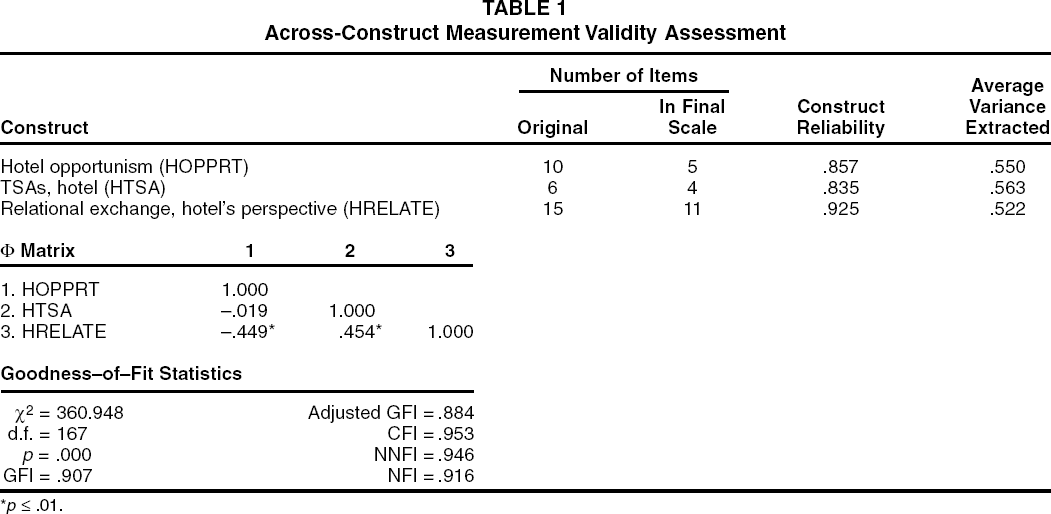
*p ≤ .01.
Ownership
One formal governance mechanism used in marketing channels for lodging services is ownership. In this study, we asked each hotel's general manager to indicate on a nominal scale whether the hotel was 100% chain (i.e., brand headquarters) owned, mostly chain owned with an independent minority owner, mostly independently owned with a chain minority owner, or 100% independently owned. Because of the small numbers in the partial ownership categories, we eliminated those responses so that our analysis included only hotels that were either 100% chain owned or 100% independently owned. This resulted in a group of 39 hotels that were fully owned by brand headquarters. We coded this group 1. The remaining 329 hotels were 100% independently owned and were coded 0. Thus, our measure of hotel ownership (OWNS) is a dummy variable, and the larger value represents hotels owned by the brand headquarters.
Compared with the complex behavioral constructs of this study, brand headquarters’ ownership of the hotel is relatively simple. It consists of a single facet: whether or not brand headquarters holds a full equity position in the hotel. Unlike the behavioral constructs, the accuracy of the hotel general manager's response to this measure can be verified easily by archival records. 4 For this reason, we used a single item to measure the ownership construct.
Unfortunately, the resources required to conduct such a validation were beyond our means.
Control variables
To anticipate the possibility that other variables might account for a substantial amount of the variance in hotel opportunism, two control variables were included in the study. Because the sample consisted of hotels representing two different brands in the lodging industry, differences in the operation of these chains might affect the degree of relational norms and the level of opportunism they experience. For this reason, each hotel in the sample was dummy coded according to which chain it represented. Thus, we had two dummy variables—labeled FIRM_A and FIRM_B—to represent the hotel chains under study. 5
To protect the confidentiality of the firms cooperating in this study, we have disguised the firm labels.
We also wanted to control for the size of the hotel, believing that larger hotels may experience different relationships with their brand headquarters than do smaller ones. Our measure of hotel size (TOTEMP) was the total number of employees (both part- and full-time) working for the hotel.
Analytical Procedure
Taken together, the hypotheses imply the following structural equation:

Equation 1 contains several interaction terms that reflect the simultaneous effect of the governance mechanisms on that relationship.
We estimated Equation 1 using the moderated regression approach detailed by Jaccard, Turrisi, and Wan (1990) and Aiken and West (1991). An important concern in using this approach is the possible multicollinearity between the interaction terms and their components (Jaccard, Turrisi, and Wan 1990). To mitigate the problems of multicollinearity, each scale constituting an interaction term was mean centered (i.e., the mean of each scale was subtracted from each observation) (Aiken and West 1991). In other words, we mean-centered the HTSA and HRELATE scales. Then we created the interaction terms by multiplying the relevant mean-centered scales. The OWNS variable was dummy coded (i.e., 0, 1) and therefore was not mean centered. Interaction terms incorporating OWNS were created by multiplying it by the relevant mean-centered scales. As a result of this mean-centering procedure, the largest zero-order correlation between the hypothesized predictors of Equation 1 was rOWNS x HTSA, OWNS x HRELATE = .392 (see Table 2). This indicates that only 15.4% of the variance in these variables is shared, evidence that multicollinearity is not a major issue in this research.
Results
In Table 3, we report the results of using ordinary least squares moderated regression to estimate Equation 1. The estimated equation explains 13.7% of the variation in hotel opportunism, an amount significantly greater than zero (adjusted R2 = .116; F = 6.324; d.f. = 9, 358; p = .000).
As noted previously, we believed that hotel opportunistic behavior might be affected by two control variables: the size of the hotel (TOTEMP) and its brand affiliation (FIRM_B). Table 3 shows that neither of these variables was statistically significant (b1 = -.000, p > .10; b2 = -.159, p > .10). Thus, hotel opportunistic behavior bears little relation to the size of the hotel or the brand with which it is affiliated.
Impact of Governance Mechanisms Used Singly
All the hypotheses focus on the relationship between hotel opportunism and the mechanisms used to govern the hotel–brand headquarters relationship. Because we include interaction terms to represent combinations of governance mechanisms, we must untangle these interaction effects. In other words, testing the hypotheses requires that the interaction effects be decomposed. This is done by differentiating Equation 1 with respect to each governance mechanism.
Equation 2 shows how changes in the hotel's opportunistic behavior vary according to whether the hotel is owned by its brand headquarters or is independently owned (see Jaccard, Turrisi, and Wan 1990):

The effects of TSA investments and relational exchange on the hotel's opportunistic behavior were derived similarly.
In concurrence with Jaccard, Turrisi, and Wan (1990, p. 41), Aiken and West (1991, p. 105) argue that “In cases in which there are are [sic] strong theoretical grounds for expecting an interaction, the interaction, even if nonsignificant, should be retained in the final regression equation.” Because we offered strong theoretical reasons for including each of the terms in Equation 1, we retained all the estimated coefficients of Equation 1, regardless of their statistical significance, in making our decompositions.
We argue in H1 that brand headquarters’ equity in the hotel will limit the hotel's opportunistic behavior; therefore, we expect ∂HOPPRT/∂OWNS to be negative.
Because we are investigating the sole effect of equity ownership, we assume that HTSA and HRELATE operate at low levels. 8 These variables are mean centered; therefore, a value of zero for, say, HTSA represents the mean or moderate level of hotel investment in TSAs. Following the usual practice in decomposing interaction terms (Jaccard, Turrisi, and Wan 1990), we set the low levels of these variables at one standard deviation below their mean values (in a parallel fashion, high levels are set to +1 standard deviation). After making these substitutions, ∂HOPPRT/∂OWNS becomes .070 - .021 (-1 × 1.406) + .296 (-1 × 1.015) + .174 (-1.406 × −1.015), or ∂HOPPRT/∂OWNS = .047.
With mean centering, “main effects” or “first-order effects,” as Aiken and West (1991, p. 38) term them, represent the conditional effects of an interaction component (e.g., OWNS) on the dependent variable (e.g., HOPPRT), given specific values of the other interaction components (e.g., HTSA, HRELATE) (Jaccard, Turrisi, and Wan 1990, p. 26). In contrast, main effects with uncentered data “are most typically defined as the constant effect of one variable across all values of another variable” (Aiken and West 1991, p. 38). Therefore, the first-order effects have substantive meaning, even though one of the interaction terms is statistically significant.
Because OWNS is dummy coded, ∂HOPPRT/∂OWNS is interpreted in the same fashion as dummy variable regression coefficients are. Thus, when brand headquarters owns the hotel, the hotel is slightly more likely to behave opportunistically. We test the statistical significance of this estimate by first computing its standard error (see Jaccard, Turrisi, and Wan 1990) and then dividing each estimate by its standard error. These calculations result in the t-value used to test the statistical significance of the estimate derived previously.
We calculated the standard error for ∂HOPPRT/∂OWNS as .334; the corresponding t-value was .140 (see Table 4, Part A). This result indicates that, contrary to H1, brand headquarters’ ownership of the hotel has no significant impact on hotel opportunism. Note that we assumed low levels of hotel TSAs and relational exchange.
In H2 we argue that the more the hotel has invested in TSAs of its own, the less likely it will engage in opportunistic behavior. We followed a procedure for testing this hypothesis similar to the one for evaluating H1. To observe the solo effect of HTSA as a governance mechanism, we assumed that the hotel would be independently owned (i.e., OWNS = 0) and that the extent of relational exchange between the hotel and its headquarters was minimal (i.e., HRELATE = −1 × its standard deviation = −1.015). As reported in Table 4, Part A, this analysis shows that ∂HOPPRT/∂HTSA = .188 and is statistically significant (p < .01). This implies that the more the hotel has invested in TSAs, the more it will behave opportunistically. In other words, the hotel's idiosyncratic assets exacerbate its opportunistic behavior, which leads us to reject H2.
In contrast, the use of relational exchange as the sole governance mechanism mitigates the hotel's opportunistic behavior (∂HOPPRT/∂HRELATE = -.315, p < .01) (see Table 4, Part A). Note that we arrived at this conclusion by assuming independent hotel ownership and low levels of hotel investment in idiosyncratic assets. These results are consistent with our prediction in H3.
Variable Intercorrelations, Means, and Standard Deviations *

*n = 368.

*R2 = .137; F = 6.324; d.f. = 9358; p < .01.
Impact of Governance Mechanisms Used Simultaneously: Transaction Cost Analysis Perspective
In examining the simultaneous impact of the three governance mechanisms, we follow the original premise of transaction cost analysis in assuming that ownership is the key governance alternative to the discipline of the marketplace (Rindfleisch and Heide 1997; Williamson 1975). Accordingly, we test H4, H5, and H7 by substituting values for HTSA and HRELATE in Equation 2; in other words, we assume that HTSA and HRELATE moderate the impact of OWNS on HOPPORT. Because the use of TSAs as a governance mechanism is also rooted in transaction cost analysis, though later than ownership (Rindfleisch and Heide 1997; Williamson 1985, 1996), we assume that HRELATE moderates the linkage between HTSA and HOPPORT.
In H4 we argue that the hotel's investment in TSAs coupled with headquarters’ ownership of the hotel will reduce hotel opportunism. Recall that when the level of hotel TSA investment (as well as relational exchange) was low, ∂HOPPRT/∂OWNS = .047. Table 4, Part B, indicates that if the hotel has made a moderate level of transaction-specific investments, its opportunistic behavior decreases, albeit not significantly, with brand headquarters’ ownership of the hotel (∂HOPPRT/∂OWNS = -.230, p > .10). Note that the level of relational exchange between the hotel and its brand headquarters has been held constant at a low level (i.e., −1 × its standard deviation = −1.406). With a high level of TSA investment, the hotel's opportunistic behavior decreases with headquarters’ ownership (∂HOPPRT/∂OWNS = -.507) but, again, not to a significant degree (p > .10). These results do not support H4.
Following Aiken and West (1991, pp. 19–21), we compared these effects statistically. We found that increasing the hotel's idiosyncratic investments from low to moderate levels (.047 versus -.230) significantly (p < .10) boosts the efficacy of headquarters’ ownership in limiting hotel opportunism. This efficacy can be further enhanced by raising the level of hotel TSA investment from moderate to high (-.230 versus -.507); this increase is statistically significant at the .01 level. Thus, hotel idiosyncratic investments significantly enhance the effectiveness of headquarters’ ownership of the hotel in limiting hotel opportunism. However, this result is tempered by the finding that the combination of these two governance mechanisms does not significantly mitigate hotel opportunism.
We argue in H5 that higher degrees of relational exchange will intensify the impact of headquarters’ ownership of the hotel in lessening the hotel's opportunistic behavior. To evaluate this hypothesis, we held the hotel's idiosyncratic investment constant at a low level (i.e., HTSA = −1 × 1.406). The coefficient for brand headquarters’ ownership of the hotel, given a moderate level of relational exchange (∂HOPPRT/∂OWNS), is .099 (p > .10). That same coefficient for a high level of relational exchange (∂HOPPRT/∂OWNS) is .152 (p > .10). Thus, increasing levels of relational exchange tend to heighten (.047 versus .099 versus .152), but not significantly, the exacerbating effect of brand headquarters’ ownership on hotel opportunism (Table 4, Part B). Note that the differences among these effects are themselves not statistically significant. For these reasons, we reject H5.
H6 states that the hotel will lessen its opportunistic behavior the more it has made idiosyncratic investments and the more it perceives relational exchange with its brand headquarters. Here we assume the hotel is independently owned. Table 4, Part B, shows that with low levels of relational exchange, ∂HOPPRT/∂HTSA = .188 (p < .01). With moderate levels of relational exchange, ∂HOPPRT/∂HTSA = .097 (p < .05), and ∂HOPPRT/∂HTSA = .006 (p > .10) with high levels of relational exchange. A statistical comparison of these effects indicates that increasing levels of relational exchange significantly (p < .01) weaken the positive impact of hotel TSA investment on hotel opportunism. Although this result is consistent with the spirit of H6, the positive coefficients for ∂HOPPRT/∂HTSA regardless of the level of relational exchange compel us to reject the hypothesis.
Finally, we argue in H7 that hotel opportunism will be lower when the hotel has made more TSA investments, when the hotel perceives more relational exchange with its headquarters, and when headquarters owns the hotel. Table 4, Part B, shows that for low levels of both hotel TSA investments and relational exchange, ∂HOPPRT/∂OWNS = .047 (p > .10). When both are at moderate levels, ∂HOPPRT/∂OWNS becomes .070 (p > .10), and it becomes .589 (p < .05) when they are both at high levels. Increasing both hotel TSA investment and relational exchange from low to moderate levels (.047 versus .070) has no significant (p > .10) impact on the effectiveness of brand headquarters’ ownership in limiting hotel opportunism. In contrast, increasing both hotel TSA investment and relational exchange from moderate to high levels (.070 versus .589) does have a significant (p > .01) impact on the efficacy of the ownership governance mechanism; it exacerbates rather than mitigates hotel opportunism. This result is not consistent with H7.
Impact of Governance Mechanisms on Hotel Opportunistic Behavior
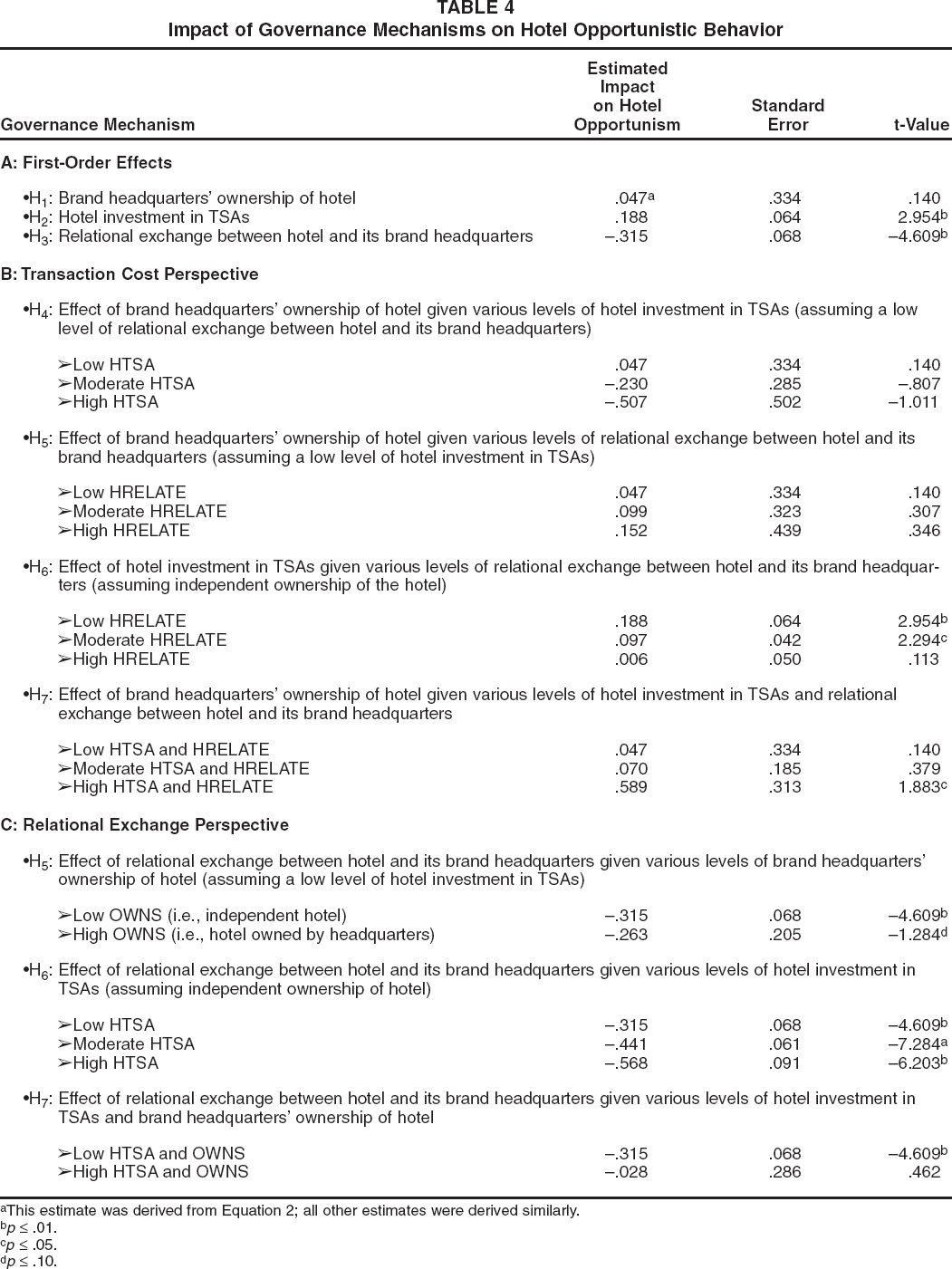
aThis estimate was derived from Equation 2; all other estimates were derived similarly.
bp ≤ .01.
cp ≤ .05.
dp ≤ .10.
Impact of Governance Mechanisms Used Simultaneously: Relational Exchange Perspective
In regression analysis with interaction terms, the choice of the moderator variable is based on theoretical rather than statistical considerations (Jaccard, Turrisi, and Wan 1990). Because transaction cost analysis has played a major role in the study of marketing channel governance (Rindfleisch and Heide 1997), we focused on the role of relational exchanging in moderating the effects of transaction cost governance mechanisms (i.e., ownership and idiosyncratic investments) on opportunistic behavior. In this section, we take an alternative perspective by examining how transaction cost governance mechanisms moderate the impact of relational exchange on hotel opportunism. The basic regression results of Table 3 do not change; however, instead of focusing on ∂HOPPRT/∂OWNS or ∂HOPPRT/∂HTSA, we now emphasize ∂HOPPRT/∂HRELATE. Note that H5, H6, and H7 remain the same even though our perspective has changed.
For H5, the coefficient reported in Table 4, Part C, for relational exchange, given brand headquarters’ ownership of the hotel, is statistically significant (∂HOPPRT/∂HRELATE = -.263, p ≤ .10). Note that here we are assuming the hotel's TSA investment is held constant at a low level (i.e., HTSA = −1 × its standard deviation = −1.406). This finding supports H5. However, as the hotel moves from independent to headquarters’ ownership, the negative effect of relational exchange on hotel opportunism weakens (-.315 versus -.263), but not to a significant (p > .10) degree.
Assuming independent hotel ownership, Table 4, Part C, shows that ∂HOPPRT/∂HRELATE becomes more negative as the hotel's TSA investment rises from low (-.315, p < .01) to moderate (-.441, p < .01) to high (-.568, p < .01) levels. These results are consistent with H6. Furthermore, the differences among these effects are statistically significant (p < .01), which suggests that increasing levels of idiosyncratic investments strengthen the efficacy of relational exchange in limiting hotel opportunism.
Finally, Table 4, Part C, shows that the ability of relational exchange to mitigate the hotel's opportunism is weakened when the hotel moves from independent ownership with a low level of TSA investment (-.315, p ≤ .10) to brand headquarters’ ownership with a high TSA investment (-.028, p > .10). This finding shows that high levels of all three governance mechanisms do not significantly affect hotel opportunism. Therefore, we cannot support our prediction in H7 with this result. Note that the erosion of the efficacy of relational exchange with increased levels of ownership and TSA investment is statistically significant (p < .10).
Ostensibly, our investigation of the impact of the simultaneous use of these governance mechanisms produced contradictory findings. Some of our results supported the hypotheses, whereas others did not. Although the transaction cost analysis perspective tended not to support the hypotheses, the relational exchange perspective did. When relational exchange is emphasized (either singly or in combination with idiosyncratic investments), hotel opportunism decreases. When either ownership or TSA investments are stressed, hotel opportunism increases. We explore possible reasons for these results in the following section.
Discussion
The overall objective of this research was to investigate the efficacy of three mechanisms for managing opportunism in hotel marketing channels. In particular, we were interested in determining how a hotel's opportunism toward its brand headquarters could be limited by using three governance mechanisms: (1) brand headquarters’ ownership of the hotel, (2) the hotel's investment in assets specific to its relationship with its brand headquarters, and (3) the development of norms and values shared by both the headquarters and its hotel (i.e., relational exchange). We studied the efficacy of these three mechanisms for limiting hotel opportunism both singly and in combination. Our findings have implications for both managers and researchers.
Managerial Implications
This research shows that managers should focus their efforts on building effective relational exchange with their channel partners. Only this governance mechanism by itself and in combination with the other governance mechanisms effectively limited hotel opportunism in our sample. Indeed, there is a synergistic effect when relational exchange is coupled with the hotel's investment in idiosyncratic assets. All three governance mechanisms used at once, with the focus on relational exchange, depress hotel opportunism, but not to a statistically significant degree.
In contrast, ownership used singly has no significant impact on hotel opportunism. It slightly weakened the effectiveness of relational exchange in limiting hotel opportunism. Moreover, when ownership is emphasized, the combination of ownership, hotel TSA investment, and relational exchange increases rather than limits hotel opportunism. Similarly, a hotel's TSA investment increases hotel opportunism when used singly. In combination with ownership or when emphasized with relational exchange, it has no significant impact on hotel opportunism.
These results suggest that if brand headquarters aggressively exerts its rights of ownership, especially when the levels of hotel TSA investment and relational exchange are high, it will exacerbate rather than limit opportunism. The reason is that ownership sanctions may “compromise an individual's proclivity to behave honestly” (Moschandreas 1997, p. 47), producing the very behavior they were intended to discourage. In other words, the existence of these sanctions may provoke the hotel's general managers to exert their independence (i.e., engaging in psychological reactance) (see Churchill, Ford, and Walker 1985). This can lead hotel management to engage in opportunistic behaviors, such as concealing important information or communicating invalid information (Ghoshal and Moran 1996; Ramaswami 1996). Similarly, if potential forfeiture is overemphasized when a hotel has invested in idiosyncratic assets, psychological reactance may again explain increased hotel opportunism, even though such behavior (if detected) is counter to the hotel's best interests. Finally, the extrinsic rewards available through ownership may crowd out the hotel's intrinsic motivation, especially if norms of relational exchange are prevalent (see Frey 1993, p. 666). This may shift the hotel's perspective of its brand headquarters from a relational orientation to a more calculative one, making opportunism more likely if the hotel sees an advantage in behaving with guile.
In contrast, the emphasis of relational exchange is on building common norms and values. This process leads to a sense of identification between the hotel and its brand headquarters—whatever harms brand headquarters damages the hotel, and vice versa. In other words, effective relational exchange builds commitment to the relationship, which in turn leads to less opportunistic behavior (Gundlach, Achrol, and Mentzer 1995). This effect persists even when relational exchange is used in conjunction with ownership or hotel TSA investment. The key, however, is that managers should emphasize relational exchange more than either ownership or hotel idiosyncratic investment in their approach to governance.
These results demonstrate that managerial emphasis is crucial for limiting hotel opportunism. When the emphasis is on building strong relationships, hotel opportunism declines. When the emphasis is on either ownership or hotel TSA investments, hotel opportunism is unaffected at best or exacerbated at worst.
Research Implications
The finding that brand headquarters’ ownership of the hotel does little to limit the hotel's opportunism is not consistent with transaction cost analysis. Apparently, other motives for company ownership are more salient here (e.g., potential scale economies, capturing the hotel's economic profits). In addition, ownership by itself does not appear potent enough in this context to offset any guileful self-interest seeking by hotel management.
The same can be said for investments in TSAs; indeed, by themselves, they seem to exacerbate hotel opportunism. Again, traditional economic arguments for these investments (i.e., they are made for efficiency and effectiveness reasons) appear to outweigh transaction cost arguments. One interpretation of the positive link between hotel TSA investment and hotel opportunism is that opportunistic behavior is one way the hotel can generate additional returns on these investments. Thus, in channels for lodging services, only when these governance mechanisms are coupled with relational exchange are they effective in reducing hotel opportunism. This suggests that motives other than governance drive the use of ownership and hotel investment in TSAs in lodging channels; that is, governance is a secondary reason for using these mechanisms.
One possible explanation for this is the critical role played by the hotel in maintaining and reinforcing the brand's image. As was noted previously, brand headquarters’ efforts to develop and promote a high-quality image can be undercut easily by a hotel's opportunistic behavior. In other words, the hotel can easily sabotage the brand if headquarters is too heavy handed in dealing with the hotel. Effective hotel chains seem to know this and strive to maintain good relations with their hotels. This is not only a desirable end but also an effective means for building brand equity. Thus, one possible explanation for these results is that the efficacy of various channel governance mechanisms depends on the role of the channel intermediary in differentiating the product/service (see Porter 1974). Further research is needed to determine whether this is indeed the case. More generally, because our sample was composed of company-owned and franchised hotels from two larger hotel firms, additional research is needed to test the boundaries of our findings.
Another possible explanation pertains to the way in which hotel investment in TSAs is implemented as a governance mechanism. In other words, this governance mechanism may have been ineffectively implemented in this setting. This governance mechanism relies on sanctions (i.e., potential economic forfeiture); sanctions only work when hotel opportunism is detected and appropriate punishments are imposed. When monitoring is ineffectual or when punishments are poorly implemented, the threat of economic losses rooted in the hotel's TSA investment has a limited ability to mitigate opportunism. Further research is needed to investigate the effectiveness with which brand headquarters monitors its hotels and sanctions them for opportunistic behavior.
Our research suggests several additional directions for further research. First, the role of ownership in managing opportunism has been assumed to be isomorphic. Our results suggest that it may not be. Two characteristics of ownership have been hypothesized in previous research to limit opportunism: (1) rewards and sanctions and (2) common norms and values (see Rindfleisch and Heide 1997). When coupled with an emphasis on relational exchange, ownership is associated with lower levels of opportunism. This suggests that the ownership characteristic of common norms and values mitigates opportunism. Similarly, TSA investment appears to mitigate ownership's effect of exacerbating opportunistic behavior. This suggests that TSA investment heightens the ownership characteristic of rewards and sanctions in limiting opportunism. Thus, ownership appears to be effective in limiting opportunistic behavior only when coupled with other governance mechanisms, and the operative characteristics of ownership seem to depend on the governance mechanism with which it is coupled. Further research is needed to resolve this issue. Second, we did not investigate how brand headquarters came to own company-owned hotels. Ownership by expansion suggests that the governance mechanism was in place ex ante, whereas ownership by acquisition implies ex post governance. Whether these alternative routes to company ownership produce differential responses in terms of hotel opportunism has, to our knowledge, not yet been explored. Next, previous empirical work has also considered transaction-specific investments isomorphic. However, investments in idiosyncratic assets can be offered voluntarily, required as a condition of exchange, made ex ante, or made ex post. 9 An unanswered research question is whether a firm's motives for making these investments, as well as their timing, differentially affect the firm's opportunistic behavior. Our regression equation explained less than 20% of the variation in hotel opportunistic behavior. This suggests that we have omitted several constructs that might explain such behavior. Therefore, we recommend that future studies of opportunism include constructs such as fairness (Kumar, Scheer, and Steenkamp 1995), conflict (Stern and Gorman 1969), exchange partner replaceability (Heide and John 1988), and exchange partner investment in idiosyncratic assets (Rindfleisch and Heide 1997). 10 Furthermore, we used statistical methods to untangle the relative emphasis of the three governance mechanisms. Further research might attempt to measure this relative emphasis directly. Finally, because these data were not longitudinal, we could not study properly the causal ordering of the constructs. For example, is the use of ownership a response to opportunism or is it used to limit such behavior proactively? In addition, does the temporal order of putting the governance mechanisms in place affect their efficacy in limiting opportunism? We leave the untangling of these effects for further research.
We thank an anonymous reviewer for challenging us to think more carefully about these distinctions.
In a previous version of this article, we found no significant statistical relationship between brand headquarters’ investment in TSAs (as reported by the brand headquarters’ field representatives) and hotel opportunism.