






Abstract
Recent research has documented how exchanges between buyers and sellers are frequently embedded in social relationships. An unresolved question, however, is the extent to which such relationships protect incumbent suppliers from new competitors and their marketing programs. The authors develop a conceptual framework of how relationship and marketing variables influence choice of supplier and test the framework empirically in the context of business-to-business services. The results show that interpersonal relationships between buyers and suppliers serve as a switching barrier but are considerably less important than both firm-level switching costs and marketing variables. Moreover, unlike switching costs, interpersonal relationships do not play the frequently mentioned role of a buffer against price and product competition. Finally, the authors show that buyers and suppliers hold systematically different views of the determinants of switching.
From a strategic standpoint, the implicit assumption in much of the relationship literature is that certain relationship properties serve defensive purposes by acting as switching barriers (e.g., Crosby, Evans, and Cowles 1990). In certain respects, this represents a different perspective from the one that underlies much of the marketing strategy literature. As Fornell and Wernerfelt (1987) note, this literature has emphasized offensive strategies designed to encourage customer switching on the basis of deliberate deployment of marketing-mix variables such as product and price.
Both intuition and anecdotal evidence suggest that economic actors are influenced by both marketing variables and relationship properties. Theoretically, this is consistent with Granovetter's (1985) thesis that economic transactions are “embedded” in social relationships. Unfortunately, although this thesis is difficult to refute, it is also conceptually vague (Uzzi 1996). An intriguing yet unanswered question is whether marketing and relationship variables differ in relative importance in the choice of exchange partner.
Some economists have shown skepticism toward the embeddedness thesis and downplayed the role of social relations (Baron and Hannan 1994). Similarly, Crosby and Stephens (1987, p. 411) caution against the implicit assumption in the relationship marketing literature that “relationships are entirely social” and instead emphasize the role that marketing variables play in a customer relationship. In contrast, others have downplayed the role of marketing variables and argued that focusing on them is “simplistic and restrictive” (Christopher, Payne, and Ballantyne 1991, p. 8). Given that both relationship-building and marketing variables involve investments of various kinds, knowledge about their relative effectiveness would represent important input of a firm's resource allocation decision.
In a similar vein, the extant literature does not offer much insight into whether these variables have interactive effects on buyer behavior. From a theoretical perspective, a case could be made that each set of variables represents a different source of utility and that the effect of one could be moderated by another (e.g., Burt 1992; Granovetter 1992). For example, the effect of a superior price offered by a new entrant may depend on whether the target customer has developed a strong relationship with an incumbent supplier. If the target customer has developed close personal relationships with the incumbent, switching means giving up utility from the preexisting relationship. Consequently, the positive effect of an entrant's superior price on customer switching might decrease as interpersonal relationships tied to the incumbent supplier increase. Unfortunately, such hypotheses are rarely found in the marketing literature, and empirical evidence is virtually nonexistent.
Finally, a largely unexplored question is whether buyers and suppliers within an ongoing relationship have convergent perceptions regarding the importance of marketing and relationship variables. Much of the prior research on relationships has been limited to exploring one party's perspective, typically that of a manufacturer or supplier. Moreover, to the extent that perceptual differences in a relationship have been recognized, they have often been viewed somewhat narrowly, as a source of measurement error (e.g., Phillips 1981; for an exception, see Steinman, Deshpandέ, and Farley 2000). We argue, however, that such differences have important strategic implications. For example, a supplier that overestimates the strength of the relationship with a particular buyer and its effect on the buyer's decisions may be vulnerable to competitive moves. Moreover, a supplier that assumes that relationship building is more important than developing new products or services may be misallocating marketing resources and over time may become locked in with customers that do not take a long-term perspective on the relationship. Therefore, we seek to shed light on the implicit assumption in much of the extant literature about the importance of close customer relationships.
In summary, we seek to make two main contributions to the literature. First, we examine whether and how buyers’ choices of suppliers in business-to-business services markets are influenced by the categories of variables mentioned previously, namely, a new supplier's marketing program elements and aspects of the relationship between the buyer and an incumbent supplier. In addition to examining the main effect of each set of variables, we assess the relative importance of the different variables in influencing supplier choice and examine whether interrelationships exist between the different variables, in the sense that the effect of one depends on the level of another. Second, by virtue of collecting data from both buyers and suppliers, we document whether systematic differences exist between parties regarding the effects of the focal variables.
The article is organized as follows: In the next section, we present our conceptual framework, including our research hypotheses. Then we describe our research design and the empirical tests. Finally, we discuss the implications of our findings, the study's limitations, and possible topics for further research.
Theory and Hypotheses
The general focus of this study is the determinants of supplier choice. Specifically, we examine whether a buyer that has a preexisting supplier relationship but is being approached by a new competitor will decide to remain with the incumbent supplier or switch to the new one. We explore whether (1) certain aspects of an incumbent relationship protect that particular supplier and (2) the tools that are available to a new supplier can undermine an existing relationship. Our focus is consistent with Keaveney's (1995, p. 71) call for “a theory of customer switching behavior, from the customer's perspective.”
Prior research provides considerable insight into the conditions that promote continuity in a given relationship, such as social and structural bonds (Berry 1995), relationship quality (Crosby, Evans, and Cowles 1990), satisfaction (Fornell 1992), and service quality (Ostrom and Iacobucci 1995). By virtue of promoting continuity, certain relationship properties are also assumed to constitute impediments to switching to a competing relationship. However, it has not always been clearly articulated why particular relationship characteristics represent switching barriers.
In the following sections, we focus on two particular aspects of a buyer's relationship with an incumbent supplier that we expect to be intimately linked with switching decisions. Specifically, we focus on the effects of interpersonal relationships (e.g., Granovetter 1992; Seabright, Levinthal, and Fichman 1992) and switching costs (e.g., Heide and Weiss 1995; Weiss and Anderson 1992). Both of these derive from previous investments in the supplier relationship. However, the specific nature of the investments differs. Whereas interpersonal relationships derive from individuals’ investments in social capital (e.g., Coleman 1990), switching costs arise from organizational-level investments in transaction-specific assets (e.g., Williamson 1985). Thus, each dimension exists at a different level, that is, interpersonal and interorganizational, respectively.
In the next sections, we specify how interpersonal relationships and switching costs protect an incumbent supplier. As we discuss, each one serves as a switching barrier due to the potential loss of an investment in case of relationship termination. Next, we predict how a potential new supplier may use price and product strategies to induce switching. Finally, we discuss the likely interactions among these variables.
Interpersonal Relationships
One of the cornerstones of the economic sociology literature on embedded markets (e.g., Granovetter 1985, 1992) is that economic transactions take place within the context of interpersonal relationships. Interpersonal relationships are conceptualized as the degree to which a close and personal relationship exists between boundary personnel in the transacting organizations (Baker 1990; Marsden and Campbell 1984; Uzzi 1997). Wilson (1995) notes that within the context of buyer–supplier relationships, interpersonal relationships evolve through social interaction between buyers and account managers. The extant literature has identified such relationships in a variety of industries, including apparel (Uzzi 1997), publishing (Coser, Kadushin, and Powell 1982), construction (Eccles 1981), advertising (Baker, Faulkner, and Fisher 1998), auditing (Seabright, Levinthal, and Fichman 1992), computer hardware (Larson 1992), life insurance (Crosby and Stephens 1987), and grocery retailing (Murry and Heide 1998).
The existing marketing literature acknowledges the importance of interpersonal relationships. For example, researchers in the relationship marketing area discuss the emotional bonding that transcends economic exchange (Sheth and Parvatiyar 1995). Implicitly or explicitly, the assumption is made in this literature that the presence of a close personal relationship protects an existing relationship from competition. The stronger the relationship, the lower is the likelihood of switching. For example, Jüttner and Wehrli (1995, p. 230) have argued that “the focal points for facilitating and maintaining relationships are the psychological and social factors of the individual actors” and that “affinity is the first consideration…[;] the ability to produce services is secondary.”
Although we acknowledge the potential role of interpersonal relationships, we believe that prior research has paid insufficient attention to the specific reasons that personal relationships prevent switching. The economic sociology literature mentioned previously provides one possible explanation. Specifically, within an exchange relationship, a party derives utility both from the attributes of a focal product or service and from interpersonal relationships (Frenzen and Davis 1990; Granovetter 1992). 1 Regarding the latter, Burt (1992) describes how close interpersonal relationships reflect social bonds that hold relationships together. These bonds arise from prior investments in social capital, whose return depends on the relationship's longevity. Social capital is broadly defined as an asset that inheres in social relationships (Coleman 1988), which over time accumulates in the form of a series of relationship-specific obligations and reciprocity expectations. Burt (1997) and Coleman (1990) describe this capital in terms of “credit slips” that a person can draw on in time of need.
In the economic sociology literature (e.g., Burt 1992), the utility a party derives from interpersonal relationships is of a noneconomic nature. However, as Williamson (1985, p. 62) notes, it is also possible that such relationships produce economic benefits—for example, in the form of communication economies.
Thus, the structure of a person's social relationship with an exchange partner will determine how potential new partners are viewed. The closer the preexisting interpersonal relationship, the greater are the prior investment in social capital and the likelihood that the relationship in question will be maintained. In Dwyer, Schurr, and Oh's (1987) terminology, a strong interpersonal relationship serves as a form of mobility barrier. A parallel argument can be derived from social exchange theory (Anderson and Narus 1990; Gassenheimer, Houston, and Davis 1998; Thibaut and Kelley 1959): The better the outcome from the interactions with a focal exchange partner, the less attractive other partners will be perceived to be. On the basis of this theoretical discussion, we propose the following hypothesis:
The closer the interpersonal relationships between the boundary personnel in the supplier and customer firms, the lower is the likelihood of customer switching.
Switching Costs
Switching costs refer to the buyer's perceived costs of switching from the existing to a new supplier (Heide and Weiss 1995; Weiss and Anderson 1992). Buyer switching costs arise as a result of prior partner-specific investments in physical assets, organizational procedures, and/or employee training. For example, buyers may develop procedures for dealing with a specific supplier that will need to be modified if a new relationship is established (Heide and John 1990).
Similar to interpersonal relationships, switching costs represent a disincentive to explore new suppliers (Anderson and Narus 1990; Morgan and Hunt 1994). To the extent that a buyer's investments are idiosyncratic to an individual supplier, switching means giving up future returns. The buyer may also incur direct search and evaluation costs, as well as opportunity costs due to lost synergies (Zajac and Olsen 1993). Thus, as with interpersonal relationships, the history of a particular buyer–supplier relationship has implications for its future course (Ford 1990; Håkansson 1982). We propose the following hypothesis:
The higher the level of supplier-related switching costs, the lower is the likelihood of customer switching.
Although the conditions mentioned in both H1 and H2 may serve as impediments to switching, two important differences between them should be pointed out. First, whereas the impediment to switching in the case of personal relationships originates from investments in social capital (e.g., Coleman 1990), the source of switching costs are investments in other forms of capital (including specific assets; Williamson 1985). Second, switching costs exist at the firm level, whereas interpersonal relationships exist at the individual level. In Wilson's (1995) terminology, these two factors are examples of structural and social bonds, respectively.
Our discussion so far has focused on the conditions that protect an incumbent supplier from new competitors. We consider next the tools available to a new supplier for penetrating an existing relationship.
Price
A new potential supplier that offers economic terms superior to those of the incumbent enables a buyer to realize immediate cost savings. Over time, these savings may become substantial (Kranton 1996). Therefore, intuition suggests that the lower the entrant's price relative to the incumbent, the greater is the economic payoff from switching and the higher is the likelihood that the customer will switch.
This intuition does not reflect the scope of extant theory on buyers’ responses to price. Two different streams of research are relevant here. First, prior research in the information-processing tradition (Monroe and Dodds 1988) suggests that buyers may associate a low price with low quality. As such, a lower price by a competing supplier need not represent an incentive to switch.
Second, offering a contrasting prediction, information economics suggests that a low price may serve as a signal of high quality. In Kirmani and Rao's (2000) terminology, a low introductory price is an example of a “sale-contingent, default-independent” signal. Specifically, high-quality suppliers may attempt to induce trial through a low price (Schmalensee 1978), because a high-quality offering will generate more repeat purchases and the focal supplier may be willing to sacrifice current profits for future revenues. In contrast, a low-quality supplier that will not enjoy repeat purchases would not be motivated to send such a signal. Therefore, a low price may convey credible quality information about some aspect of the supplier and provide an incentive for customers to switch.
As Kirmani and Rao (2000) note, the information economics perspective differs in important ways from the conventional information processing perspective. Whereas the latter perspective considers “lazy” consumers who use pricing information to make cognitive shortcuts, the information economics perspective assumes rational consumers who evaluate the implicit commitments that underlie various signals. We subscribe to the information economics perspective and offer the following prediction:
The lower the price offered by the new potential supplier relative to the incumbent, the higher is the likelihood of customer switching.
Product Breadth
Another means by which a new potential supplier can combat an incumbent is through a product strategy. For example, an entrant could try to attract a customer by differentiating the quality of its product and service offering from the incumbent supplier (Porter 1980). Note, however, that from the perspective of a new competitor that is trying to induce switching from an incumbent supplier, product quality is not always the most obvious candidate. In many industries (e.g., gasoline retailing, personal computers, retail banking), the core product is approaching commodity status and offers limited room for differentiation (Ovans 1997).
Increasingly, new competitors rely instead on product line breadth (or bundling) as an entry strategy. Specifically, new suppliers offer customers enhanced value though a product or service portfolio whose breadth (1) exceeds what is currently provided and (2) is capable of meeting future needs. There are at least four reasons for this trend.
First, from a buyer's perspective, there are search economies from having all required products or services available from the same source (Hoch, Bradlow, and Wansink 1999; Soyster 1997). For example, a single point-of-purchase and after-sale service (“one-stop shopping”) reduces the cost of qualifying suppliers. Moreover, because business customers’ purchase decisions are often made at a system rather than product level (Wilson, Weiss, and John 1990), savings in both search and operating costs can be substantial.
Second, bundling may offer buyers enhanced performance to the extent that a given supplier's products incorporate proprietary interfaces. For example, by designing each part with the other parts in mind, a supplier can build a “turnkey” system that enhances performance (Wilson, Weiss, and John 1990).
Third, many markets are characterized by considerable turbulence, as indicated by changing buyer preferences (Fisher 1997; Richardson 1996) and competitive moves (D'Aveni and Gunther 1995; Dickson 1992). From a buyer's standpoint, market turbulence makes it difficult to specify in advance the exact requirements from a supplier (Håkansson 1979; Ward and Webster 1991). Everything else being equal, market turbulence increases the value to customers of suppliers that possess a broad product and/or service portfolio. Specifically, from a customer's viewpoint, a decision to remain in a relationship with a supplier whose product line is more restricted than a competitor's involves substantial risk. The risk involves the current opportunity costs of being in a relationship with an inferior product offering and the future maladaptation costs if the firm's needs change (Balakrishnan and Wernerfelt 1986; Seabright, Levinthal, and Fichman 1992). For example, if the incumbent supplier's line is more restricted than the new entrant's, it may indicate that (1) it is misreading the customers’ (future) needs or (2) it is incapable of adapting to new market conditions. In any case, a failure to switch in the short run may require the buyer to incur search and renegotiation costs in the future in order to locate an appropriate supplier.
Fourth, given that product breadth is easily visible to a buyer and can be assessed without preexisting experience with the vendor in question (Guiltinan 1987), it constitutes an attractive entry strategy. Therefore, we propose the following hypothesis:
The broader the product range offered by the new potential supplier relative to the incumbent, the higher is the likelihood of customer switching.
Moderating Effects
In the preceding sections, we discuss how a buyer's decision to remain with an incumbent supplier or switch to a new one is influenced by (1) certain aspects of the preexisting relationship with the incumbent and (2) the new competitor's marketing program. We suggest that all these variables have potential effects on a buyer's decision, though the specific nature of the effects is hypothesized to vary.
So far, we have limited our focus to the independent effects of the focal variables. It may be useful to consider, however, whether some of these variables have modifying effects, in the sense that the effect of one depends on the level of another. The extant literature contains some accounts of such effects. For example, the literature on relationship marketing suggests that strong interpersonal relationships should serve as buffers against product and price competition. Thus, we would expect to see a diminishing effect of a competing supplier's marketing variables as interpersonal relationships and switching costs tied to an incumbent supplier increase.
Unfortunately, the extant relationship marketing literature generally has failed to specify the theoretical reasons such effects should be expected. We draw on economic sociology to propose two moderator effects. Granovetter (1992, p. 35, italics added) suggests the general contingency hypothesis that “the mere fact of attachment to others may modify economic action” and that attachments may cause a party to remain in a relationship “despite economic advantages elsewhere.” Why would this be the case? Theoretically, this may happen because parties recognize different forms of utility. Recall from our previous discussion that buyers receive utility from both attributes of a supplier's marketing program and aspects of the supplier relationship itself (e.g., Burt 1992; Frenzen and Davis 1990). A new potential supplier that offers a superior price may increase the buyer's utility if switching occurs. However, if the buyer in question has developed close personal relationships with the incumbent and/or faces high levels of partner-specific commitments, switching means giving up utility from the preexisting relationship. In turn, this makes switching to a new supplier less likely. If such assessments are made, the hypothesized positive effects of the entrant's superior price on customer switching should decrease as interpersonal relationships and switching costs tied to an incumbent supplier increase. 2 Stated formally,
In principle, it could be hypothesized that price and product breadth attenuate the effect of interpersonal relationships and switching costs. However, we treat switching costs and interpersonal relationships as moderator variables for two reasons. First, treating them as moderator variables is the test of Granovetter's (1992, p. 35) hypothesis that “attachments modify economic action.” Second, this treatment is consistent with our perspective of testing whether the efforts of an entrant (that deploys the marketing variables) are modified (technically, moderated) by a preexisting relationship.
The positive effect of a new potential supplier's superior price on the likelihood of customer switching will be negatively moderated by the presence of (a) close personal relationships and (b) high supplier-related switching costs.
A parallel effect is expected for the competing supplier's product line breadth. On the one hand, a broader product portfolio has the potential to increase the buyer's utility and therefore increase the probability of customer switching. On the other hand, if the buyer's representative has developed a close personal relationship with the incumbent and/or faces high switching costs, switching means giving up utility. Thus, the presence of close interpersonal relationships and high switching costs will decrease the positive effect of product breadth on customer switching. Stated formally,
The positive effect of a new potential supplier's superior product breadth on the likelihood of customer switching will be negatively moderated by the presence of (a) close personal relationships and (b) high supplier-related switching costs.
Research Method
A conjoint design was used to address the research questions presented in the preceding section. This particular design was chosen for several reasons. The nature of our research questions required a design that enabled us to examine how buyers develop preferences for alternatives (i.e., suppliers) that differed systematically on certain attributes (i.e., marketing and relationship variables). Specifically, a conjoint design enabled us to examine buyers’ evaluations of both an incumbent and a potential new supplier.
In our situation, a conjoint design had the additional benefit of requiring respondents to perform a realistic task. Customers in many markets are approached on a regular basis by new suppliers (e.g., Achrol 1997). Our conjoint task was designed to describe the situation faced by a buyer that has an existing relationship but is being approached by a potential new supplier and must make a choice on the basis of a joint consideration of relationship and marketing program attributes.
Before settling on the conjoint design, we also considered a retrospective survey approach. Although survey designs have been used frequently in prior studies of buyer–supplier relationships, we believed that a conjoint design approach possessed several distinct advantages, given the specific nature of our research questions. With a survey design, we would be required to obtain responses from customers that either had been approached by a competing supplier firm (and was in the process of evaluating the offer) or had recently completed such a process. As such, we were concerned that asking questions ex post about their behaviors might introduce retrospective biases because they did not remember the relevant factors and considerations clearly. More seriously, social desirability biases may be introduced (Mick 1996), to the extent that respondents would rationalize their actual choices. Conjoint analysis, which uses hypothetical scenarios, minimizes this problem.
The conjoint design also had an important advantage for estimating the relative importance of the marketing and relationship variables in influencing buyer behavior. Relying on a survey design to assess importance weights would require the respondents to make trade-offs on each of the independent variables directly. When asked directly about relative importance, respondents typically have difficulty making trade-offs (Fornell 1992). In our particular case, social desirability biases may again have been a concern, to the extent that respondents may have failed to give a truthful measure of the impact of interpersonal relationships. The “decompositional” nature of a conjoint task is highly beneficial in this respect, because it does not require the respondents to evaluate any given attribute directly (Murry and Heide 1998). Rather, this information is derived from the respondents’ global judgments of the different scenarios.
Research Context
The context for the study is relationships between commercial banks and corporate customers. These exchanges cover credit (e.g., line of credit) and noncredit (e.g., cash management) products. We chose this particular context for several reasons. First, deregulation, technological innovation, and mergers have increased competition both among traditional banks and between banks and nonbank suppliers (Mehra 1996). Thus, customers are frequently required to evaluate new supplier offerings and by implication their incumbent relationships.
Second, initial discussions with managers and reviews of both the academic and the trade literature suggested that our focal theoretical variables all manifest themselves in this setting to varying degrees. With respect to the marketing program variables, the recent mergers have enhanced many suppliers’ ability to compete on price. In addition, the merged firms frequently provide a broad range of financial services that are capable of meeting all the needs of individual customers (Hanes 1998). With respect to the relationship variables, some suppliers have implemented formal account management programs that facilitate the development of interpersonal relationships (Perrien, Paradis, and Banting 1995). Finally, switching costs arise because of buyer and supplier investments of various kinds. For example, suppliers sometimes adapt their cash management systems to meet the unique requirements of particular customers. In turn, customers may invest in training their personnel to use the systems and may purchase computer software and supplies that are supplier-specific in nature. Together, these observations convinced us that our focal theoretical variables could be studied in this context.
Development of Conjoint Scenarios
To develop the materials for our study, we initially consulted both the existing literature on buyer–supplier relationships and the trade press. Subsequently, we conducted several personal interviews with managers from both sides of the relationship dyad (two bank and key account managers from the supplier side and two business managers from the customer side). The interviews focused on the key decision criteria used in choosing a financial services supplier. We asked the managers to consider both positive and negative factors influencing choice. These interviews helped us (1) develop the conjoint scenarios, (2) identify key decision makers on both sides of the dyad, and (3) acquire the necessary industry terminology.
From these exploratory investigations, we developed 16 conjoint scenarios (four factors each with two levels), which we subsequently showed to one bank manager, one account manager, and two business managers. On the basis of the feedback received, we modified and revised the conjoint scenarios. Subsequently, we tested them in interviews with another business manager. This pretest revealed no major problems with any of the scenarios or the response format. In total, we devoted approximately 45 hours of personal interviews to developing the conjoint scenarios.
Measures
The four factors that constitute the conjoint task and the levels of each are as follows:
Interpersonal relationships
Terminate a relationship in which the account manager is unknown.
Terminate a relationship in which a close and personal relationship has been established with the account manager.
Switching costs
Minimal costs incurred by switching to a new bank.
Substantial costs incurred by switching to a new bank.
Price
Same economic terms as those provided by the existing bank.
15% better economic terms.
Product breadth
Access to the same set of services the firm is currently receiving.
Access to a wide range of financial services covering both current and possible future needs.
Our first factor, interpersonal relationships, refers to the existence of a close and personal relationship between the boundary personnel in a buyer and a seller firm (Seabright, Levinthal, and Fichman 1992) and varied according to whether the focal account manager was unknown to the buyer or a close and personal relationship existed. The second factor, switching costs, was defined as the buyer's perceived costs of switching from the existing to a new supplier (Heide and Weiss 1995; Weiss and Anderson 1992). The respondents were instructed to consider all the different switching costs that may apply. The factor levels were minimal and substantial switching costs, respectively.
The third factor, price, described the economic terms offered (e.g., interest and fees on the financial services provided by the supplier). For the first level of this factor, the terms offered by the rival supplier were the same as those received from the incumbent supplier. The second level described a rival supplier that offered a 15% premium. The 15% was decided on from our field interviews with bank and account managers. The fourth factor, product breadth, refers to the breadth of the portfolio of services offered by the supplier. This factor varied in terms of whether the rival supplier only offered the services currently provided by the incumbent or whether a wider range of services was offered that was capable of meeting the customer's future needs.
Sampling and Data Collection
Sampling frame
The initial sampling frame for the study was a list of buyers of corporate financial services provided by a commercial bank. We contacted all midsize customers in one region (a total of 443) personally by telephone to locate an appropriate key informant within each firm.
Key informant selection
Campbell's (1955) criteria of being (1) knowledgeable about the phenomenon under study and (2) able and willing to communicate with the researcher constituted our criteria for informant selection. From the telephone contacts, we identified 114 informants who met these criteria and who verbally agreed to participate in the study (25.7% of 443). The formal titles of the informants within the customer firms were either business manager or general manager. In the remainder of the 443 companies contacted, either an appropriate key informant could not be found within the time constraints imposed by the administration of the study or the relevant person refused to participate in the study. As an additional step toward minimizing informant bias, we included the following question in the survey materials: “What influence do you personally have on your company's decisions regarding choice of bank?” On a seven-point scale, the mean response was 5.8 (standard deviation = 1.4), providing evidence of the quality of our key informants.
To test whether systematic differences existed between buyers and the supplier regarding the hypothesized relationships, we contacted all (39) key account managers at corporate headquarters personally by telephone and asked them to participate in the survey. In total, these account managers were responsible for the 443 customer accounts. Of the 39 key account managers (95%), 37 agreed to participate in the study.
Nonresponse bias
To assess the possibility of nonresponse bias in our data, we compared the final sample with the other firms in the sampling frame with respect to sales volume. We found no significant differences, which suggested that nonresponse bias was not a problem.
Conjoint administration
For each informant who agreed to participate in the study, an appointment was made to conduct a personal interview. A professional marketing research company administered the conjoint experiment. All 114 customers and 37 key account managers who agreed to participate in the study completed the conjoint task.
A full-profile presentation method was chosen to add realism to the conjoint task (Carroll and Green 1995). The managers were asked to envision a situation in which their company had a preexisting banking relationship but was being approached by a new potential supplier. Each scenario described two aspects of an incumbent relationship that may protect the existing supplier and two marketing tools available to the new potential supplier for penetrating the existing relationship. For example, one scenario described a situation in which the buyer would (1) receive the same economic terms as those provided by the incumbent, (2) gain access to a wide range of bank and insurance services, (3) incur minimal switching costs, and (4) terminate a relationship with an unknown account manager. A full-factorial design was used to administer the scenarios.
Each of the 16 scenarios was presented to the managers with verbal descriptions written on cards. In addition to the 16 cards, the managers were given a short description of the decision-making situation and the four factors. The scenarios involved shifting the entire business volume to a new supplier, a so-called lost-for-good scenario (Jackson 1985). The managers first were asked to rank-order the conjoint scenarios by preference. Specifically, they were asked to rank each scenario from 1 to 16, where 1 was the scenario in which it would be most likely that their firm would decide to switch from the incumbent to a new supplier. Next, the managers were asked to rate each hypothetical relationship on a seven-point scale that indicated the likelihood of switching to a new suppler. The scale was anchored by “very unlikely to switch supplier” and “very likely to switch supplier.” The rating measure was used in the final analysis. The ranking task was used to facilitate and ensure variation on the rating measure (Alwin and Krosnick 1985; Murry and Heide 1998).
A parallel task was administered to the account managers on the supplier side. Managers were asked to evaluate the hypothetical conjoint scenarios as if they themselves represented a customer. As noted previously, our final sample from the supplier side consisted of 37 managers.
Test of Hypotheses
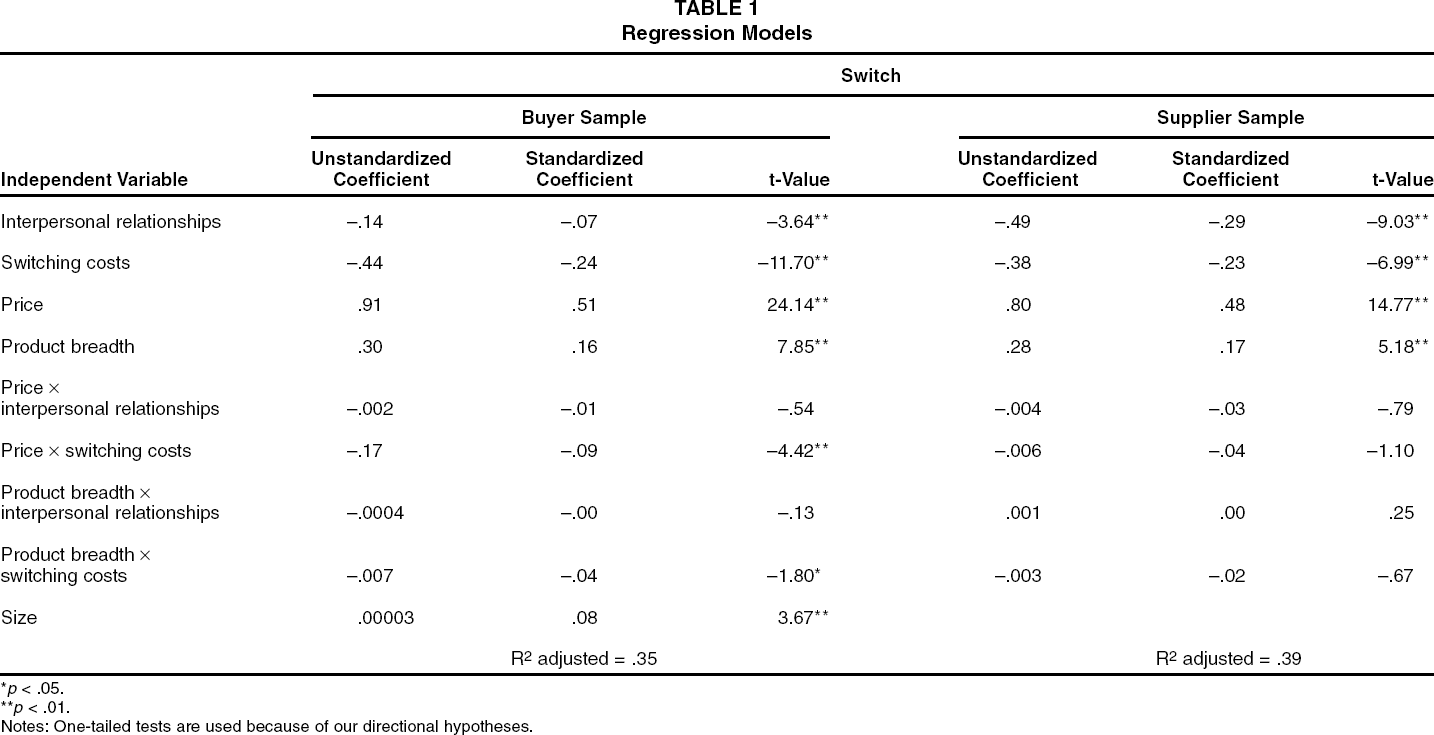
We tested the hypotheses by estimating two ordinary least squares regression models. We used an effects coding scheme (Cohen and Cohen 1983) to represent the different levels of the factors. Under such a scheme, the first level of each factor (e.g., low switching costs) is coded as −1, and the other (e.g., high switching costs) as +1. Interactions were defined by multiplicative cross-product terms between the relevant factors (Green and DeSarbo 1979). The statistical models involved estimating a buyer's tendency to switch from an incumbent to a new supplier (SWITCH) as a function of interpersonal relationships, switching costs, price, and product breadth. With one exception (discussed subsequently), we tested the same model in both the buyer and supplier samples. Table 1 shows the estimated coefficients (standardized and unstandardized) and associated t-statistics.
Both models explain a sufficient amount of variance to justify examining the individual coefficients (adjusted R2 = .35 and .39, respectively). The results show that interpersonal relationships between buyers and suppliers have a significant and negative effect on a buyer's tendency to switch (tbuyer = −3.64, tsupplier = −9.03). This result provides support for H1. Similarly, firm-level switching costs have a significant and negative effect on a buyer's tendency to switch in both samples (tbuyer = −11.70, tsupplier = −6.99), which provides support for H2.
Price has a significant and positive effect in both samples (tbuyer = 24.14, tsupplier = 14.77), consistent with H3. Also, as we predict in H4, product breadth has a significant and positive effect on the tendency to switch in both samples (tbuyer = 7.85, tsupplier = 5.18).
Consistent with H5b, the interaction between switching costs and price is significant and negative for the buyer sample (tbuyer = −4.42). A similar result was found for the interaction between switching costs and product breadth in this sample (tbuyer = −1.80), consistent with H6b. These findings provide support for our hypotheses that the positive effect of an entrant's price and product advantage on switching is attenuated by high levels of supplier-related switching costs. The parallel effects in the supplier sample were both negative, as we predicted, but not significant (tsupplier = −1.10 and −.67, respectively). None of the interactions involving interpersonal relationships was significant, in contrast with H5a and H6a.
As shown in Table 1, the model for the buyer sample includes an additional term, namely, firm size (operationalized by buyer sales volume). This variable, which was administered only to the buyers, was included in the model for control purposes. Note that because the respondents are evaluating hypothetical buying scenarios, it is impossible to introduce control variables that get at actual aspects of suppliers, markets, or buying situations. The only appropriate controls are ones that may influence the respondents’ completion of the conjoint task. Sales volume is a reasonable candidate in this respect, because firm size may be a proxy for professionalism and/or expertise and thus may affect the completion of the task. Here, however, the purpose of the control variable is to account for certain respondent-level characteristics that may influence the dependent variable. As is evident from Table 1, size has a significant and positive effect on a buyer's tendency to switch (tbuyer = 3.67).
Regression Models
p < .05.
p < .01.
Notes: One-tailed tests are used because of our directional hypotheses.
Relative Importance of Factors
From a managerial standpoint, the relative importance of the different factors studied would be of considerable interest. From the perspective of an incumbent supplier, knowledge about the extent to which an interpersonal relationship serves as a switching barrier, or is perceived by a buyer as more important than a new competitor's marketing program, would be of substantial value. Conversely, a new competitor that must decide whether to allocate resources to product development or relationship building would have an inherent interest in knowing which tool has the greater impact on the buyer.
Unfortunately, to the best of our knowledge, existing theory does not enable us to develop strong a priori theoretical predictions about relative effectiveness. It is noteworthy, however, that much competing conjecture exists. The literature on relationship marketing (e.g., Grönros 1987; Gummeson 1987) typically has put much less weight on marketing variables than on relationship features. In contrast, industry evidence often presents a different scenario. For example, a study presented in Forbes (Levine 1993, p. 232) reports that “banking customers couldn't care less about relationships. Just tell them what the loan will cost them or what the interest is.”
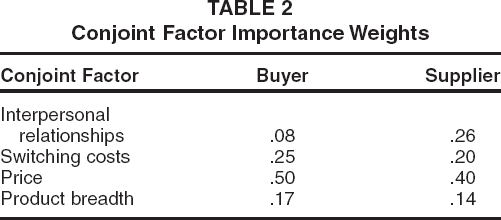
Although we do not offer a priori hypotheses about relative importance, the particular research design used (i.e., a conjoint task) enables us to undertake such comparisons ex post. Specifically, importance weights are computed by dividing each factor's part-worth range by the sum of all the part-worth ranges. The aggregated importance weights for the buyer and supplier sample are shown in Table 2. The importance weights show that systematically different views exist between buyers and suppliers regarding the determinants of switching. Both buyers and suppliers consider price the most important factor influencing the decision to switch (Wbuyer = .50, Wsupplier = .40). However, divergence exists regarding the second most important factor. Buyers place somewhat more weight on the existence of switching costs than suppliers do (Wbuyer = .25, Wsupplier = .20) and view this factor as the second most important one overall. In contrast, suppliers believe that buyers will place more weight on interpersonal relationships when making switching decisions. The derived weight for the interpersonal relationships variable in the buyer sample is only .08, in contrast with .26 in the supplier sample. As in all conjoint studies, these importance weights should be interpreted with some caution, because they depend on the specific factor levels included in the study.
Conjoint Factor Importance Weights
We report one final set of analyses because of the relatively small size of the supplier sample. Unfortunately, an agreement with a sponsoring organization that endorsed the survey gave us a limited window for data collection, which made it impossible to generate a larger supplier sample. Although the relative importance measures are unaffected by sample size, careful attention should be paid to the various significance tests, because a lack of hypothesis support may be attributable to a lack of statistical power. In this case, however, this may not be an issue because of our reliance on a conjoint design in which each respondent evaluated multiple supplier scenarios. Nevertheless, to explore whether the discrepancies between the buyer and supplier samples were likely to be caused by sample size differences, we drew a random sample of 37 from the buyer sample and reestimated the regression model in that subsample. The results of that model were almost identical to those for the full sample. Specifically, the two interactions involving switching costs, price × switching costs and product breadth × switching costs, remained significant (t = −2.83 and t = −1.79, respectively). This suggests that (1) the observed differences cannot be explained easily by sample size differences and (2) there are substantive differences between buyers and suppliers.
Discussion
Theoretical Implications
The main objective of this study was to examine the effects of marketing and relationship variables on customer behavior. Although the marketing strategy literature historically has emphasized offensive strategies based on deploying marketing-mix variables, some of the emergent literature on relationship marketing has downplayed the importance of marketing variables compared with dimensions of the relationship itself. To the best of our knowledge, this study represents the first attempt to compare these variables directly and document the effects of competition on an existing relationship.
Consistent with the relationship marketing literature, our results show that customers are influenced by the nature of their relationships with incumbent vendors. As such, relationship history matters, and new vendors do not start with a clean slate. However, our overall pattern of results paints a more complex picture than is currently expressed in the literature.
The customers in our study generally perceived the marketing variables to be more important determinants of switching intentions than the relationship dimensions (interpersonal relationship and switching costs). Specifically, price dominated all of the other factors, and the combined importance weight for price and product exceeded the total weight of the relationship dimensions.
Furthermore, our results showed that important differences existed between types of relationship properties. Specifically, customers attached considerably more weight to firm-level switching costs in deciding to remain with an incumbent vendor. Relatively speaking, the presence of interpersonal relationships did not seem to be an important disincentive to switch suppliers. This result is interesting, particularly in light of the emphasis placed on this factor in the relationship marketing literature.
Similarly, the presence of interpersonal relationships did not diminish the effect of a new competitor's price or product strategy, as often is assumed. Apparently, customers were not willing to make trade-offs between the utility from a marketing program and prior investments in social capital. However, we observed such an interaction for switching costs. Specifically, we showed that the positive effect of a new supplier's superior price or product breadth on switching decreased for higher levels of switching costs. These results suggest that buyers do make joint assessments of different sources of utility (e.g., marketing and relationship variables). They also confirm Dwyer, Schurr, and Oh's (1987) hypothesis that an incumbent relationship can be organized in such a way that it forecloses competing ones. However, our results also show that some relationship characteristics are more effective than others in protecting an incumbent supplier.
The limited effect of interpersonal relationships raises some interesting theoretical questions. Specifically, it may be useful to consider the specific reasons some customers were willing to switch to a new supplier and sacrifice existing social capital. We believe that one possible explanation is the different roles played by an individual within a relationship.
In Montgomery's (1998) terminology, the managers in the customer firms studied are both (1) businesspeople who are asked to maximize profits for their employer and (2) friends of the supplier's representative who may feel an obligation to cooperate by maintaining the relationship. Historically, the relationship marketing literature has emphasized the latter and implicitly assumed that the utility derived from interpersonal relationships is universally important. Recently, Montgomery (1998) challenged the common assumption of a “unitary actor” and argued that different situations evoke different roles. In our context, a customer's role as friend may assume less importance in the presence of explicit competitive offers. In general, our results suggest that claims about the importance of relationships should be made cautiously and on the basis of the specific roles and contextual factors at hand.
Finally, our study documents whether buyers and suppliers within an ongoing relationship have convergent perceptions regarding marketing and relationship variables. By administering the conjoint task to both sides of the buyer–supplier dyad, we were able to document that systematic differences existed between the two parties. Most important, suppliers seem to have inflated perceptions of the importance of interpersonal relationships compared with buyers.
Managerial Implications
Despite the general acceptance of the relationship marketing concept, there is considerable evidence that shows that efforts to establish long-term customer relationships often fail. In highly competitive markets, knowledge of why customers decide to dissolve a relationship is key to achieving a strategic advantage. By understanding the determinants of dissolution, a firm can identify the issues that must be addressed in order to prevent future defections. Our study identified large discrepancies between buyers and suppliers regarding the determinants of switching. This suggests that buyers and suppliers have different perceptions regarding the factors needed to maintain successful interfirm relationships.
Our results suggest that both existing and new suppliers must offer competitive terms to be considered possible partners. Although managers frequently believe that long-lasting relationships will reduce customers’ price sensitivity (Perrien, Paradis, and Banting 1995), it is also plausible that dealing with the same supplier for a long time may increase customers’ price expectations. Specifically, Kalwani and Narayandas (1995, p. 5) argue that “in long-term relationships, customers expect the few selected suppliers to pass on the benefits of lower costs in the form of price reductions over time.” Thus, when new competitors accommodate these expectations by offering lower prices, a customer's incentive to switch may be even larger than what the objective price difference between the competing suppliers should indicate.
We also showed that firm-level switching costs have a key influence on switching behavior. However, we add a few words of caution regarding strategies designed to increase such costs. A fear of dependence may discourage some customers from establishing a close relationship in the first place. For example, customers that need to make investments in supplier-specific assets face the risk of subsequent supplier opportunism in the form of price increases (e.g., Williamson 1996).
Deploying strategies based on customer switching costs may also create risk for a supplier, to the extent that it underestimates the actual switching barrier faced by a customer. For example, suppliers that use price cuts to attract customers in anticipation of future lock-in must have a clear picture of the ease with which the customer in question can locate alternative suppliers in the future (Shapiro and Varian 1999).
From a practical viewpoint, it may be surprising that customers attached the least importance to interpersonal relationships. Historically, both academicians and practicing managers have considered social rewards the glue that holds relationships together. However, from a resource allocation viewpoint, our results suggest that a supplier's best option may be to create switching costs at the firm level. At the same time, our results do not suggest that an incumbent supplier can refrain from providing competitive terms. Customers attach considerable weight to immediate price advantages. As such, price may be the strongest competitive tool available to a new entrant that wishes to undermine an existing relationship.
Limitations and Further Research
Some limitations of the current research should be noted. First, for theory-testing purposes, we decided to test our hypotheses in one particular (and homogeneous) context, namely, business-to-business services. Restricting our sample in this fashion served the dual purposes of (1) controlling extraneous sources of variation and (2) developing grounded measures. However, while this industry is both large and growing (Berry 1999), caution should be used in extrapolating our results to other contexts. For example, although recent studies (Petersen and Raghuram 1994; Uzzi 1997) indicate that interpersonal relationships play an important role in banking relationships, a promising avenue for further research would be to test the relative effect of these relationships in other nonservice industries.
Second, although the conjoint design used possesses several distinct advantages, it simplifies some of the focal phenomena. For example, we implicitly treated interpersonal relationships as a unidimensional concept, but other dimensions may also influence the tendency to switch suppliers, such as those the sociology literature identifies: sociability, approval, prestige, trust, reciprocity and power (e.g., Granovetter 1992). On a related note, it is possible that fundamentally different categories of relationships exist, which may have implications for customer switching. Recall that our current focus was the two extreme modes that are identified in the embeddedness literature, namely, relationships with no social content and relationships that are close and personal in nature. Conceivably, however, other constellations may also be observed, such as professional relationships that are not personal in nature. Further research could be directed usefully toward exploring how switching tendencies manifest themselves in such a scenario.
Furthermore, the nature of the conjoint task required us to limit our focus to one particular dependent variable, namely, switching behavior. A promising avenue for further research is to expand the current framework to include other aspects of buyer behavior. For example, concerns about switching may induce a buyer to renegotiate terms with the incumbent before making the final decision. As such, an interesting question is whether some of the variables in the present study influence a buyer's desire to renegotiate with an incumbent supplier or whether a given variable has similar effects on renegotiation and switching.
As an example, consider the possible effects of switching costs. Our results suggest that the existence of high firm-level switching costs represents a disincentive for supplier switching. Conceivably, in lieu of switching, buyers in such relationships may use a competing offer to renegotiate with the incumbent. Notice, however, that the presence of high switching costs places the buyer at a considerable bargaining disadvantage (Weiss and Anderson 1992; Williamson 1975). Under such conditions, switching may be a noncredible threat, and a buyer's renegotiation efforts may be constrained. 3
Finally, the observed differences between buyers and suppliers raise some intriguing questions. Although our present data do not enable us to identify unambiguously the specific sources of these differences, we believe that they are due in part to the parties’ different positions in the value chain. For example, Ring and Van de Ven (1994) describe how a firm's perception of a particular situation and/or exchange partner is a function of its own role in the relationship. Furthermore, because firms act on these perceptions, they ultimately determine the functioning of the relationship itself (Schuman 1982). An important question for further research is how firms’ role perceptions become aligned. Embeddedness (e.g., Granovetter 1985) and game theory (e.g., Axelrod 1984) suggest that the time dimension of a particular relationship may have an impact because of the ability of socialization processes and patterns of interaction to promote convergence. At the same time, participation in other relationships may have the opposite effect, to the extent that these relationships promote other roles. Documenting the specific sources of perceptual differences across a dyad is a promising area for further research.
Interpersonal relationships may also constitute a renegotiation barrier, though for different reasons. In Bonoma's (1976) terminology, a strong bond between boundary personnel reflects the presence of a so-called bilateral power system, in which the individual parties’ utility functions are replaced by a global utility function for the relationship as a whole. Such systems tend to be governed by particular norms, which promote relationship-oriented behaviors and discourage actions that advance the interests of the individual parties. Depending on the history of a particular relationship, or the manner in which past exchange “episodes” (Ford 1990) have been conducted, renegotiation may be an unlikely strategy.