






Abstract
The authors explore how a global firm's ability to foster successful relationships between its foreign subsidiaries’ and headquarters’ marketing operations can enhance the performance of products across markets. The results show that cooperative behaviors are positively associated with product performance in the subsidiaries’ markets. National culture in the foreign markets is also found to moderate the effect of trust on relational behaviors. In addition, the subsidiaries’ acquiescence becomes increasingly important as the firm attempts to standardize marketing programs.
Whether or not multinational corporations (MNCs) have a tendency toward standardizing or adapting global marketing strategies across foreign markets, cultivating effective relationships with the managers in the marketing operations at those locations is critical (Jain 1989; Quelch and Hoff 1986). According to Bartlett and Ghoshal (1991), a key change in strategy in MNCs is the building of multinational flexibility by relinquishing strategic roles to individual subsidiaries. As subsidiaries take on different strategic marketing roles, there is a greater need for effective management of the relationships between the headquarters’ and subsidiary's marketing operations. From a relationship perspective, key success factors in cultivating successful relationships include the subsidiary's trust in and dependence on the headquarters (Blau 1964; La Valle 1994; Makoba 1993; Morgan and Hunt 1994).
Research examining the interface between the headquarters’ and foreign subsidiary's marketing operations continues to suggest the importance of these relationships. Recent studies have focused more generally on the issues of power and control over foreign subsidiaries (see Nobel and Birkinshaw 1998; Nohria and Ghoshal 1994; O'Donnell 2000; Roth and Nigh 1992) and the management of knowledge flows across markets (Gupta and Govindarajan 2000). In addition, research focusing on other intrafirm relationships, such as those between functional units (see Ruekert and Walker 1987; Song, Montoya-Weiss, and Schmidt 1997; Song and Parry 1997) has tended to focus more directly on how the units differ in their perceptions of their roles and/or positions within the firm. Last, the literature on marketing relationships has largely addressed relationships in one national setting and has not considered the influence of national culture or the multinational firm context. We extend the findings from these different branches of literature by focusing more directly on the global marketing operation and by employing a relationship marketing framework to understand the factors driving successful relationships between the headquarters’ and subsidiary's marketing operations. Finally, by examining the influence of national culture on these relationships, we provide additional insights into managing relationships in an international context.
In this article, we explore the factors that contribute to firms’ abilities to successfully manage the marketing function globally, focusing on the perceptions of the headquarters–subsidiary relationships by the subsidiaries’ marketing managers. We argue that cooperative and acquiescent behaviors on the part of the marketing operations at the foreign subsidiaries should enhance the likelihood that performance objectives for individual products are achieved in the subsidiaries’ individual markets. As such, we approach the present research from a relationship marketing perspective (see Anderson and Narus 1990; Ganesan 1994; Morgan and Hunt 1994). Specifically, we link predictions based on the relationship marketing literature with findings regarding standardization/adaptation of marketing strategy and the influence of national culture on managerial behavior. Subsequently, we develop a framework that provides a lens through which to examine headquarters–subsidiary marketing function relationships and to investigate their importance in managing global marketing programs.
Management of Global Products and the Headquarters–Subsidiary Relationship
The importance of cultivating brands on a global basis is well recognized. When properly managed, a brand can contribute to the MNC's reputation and performance worldwide, acting as a symbol of the company's global image (Morris 1996). Also, global cultivation of a brand can yield economies of scale in the marketing and management of those brands (Aaker and Joachimsthaler 1999; Buzzell 1968; Levitt 1983; Quelch and Hoff 1986). Recent research in global marketing has focused largely on standardization/adaptation (see Jain 1989; Picard, Boddewyn, and Grosse 1998; Roth 1995a, b; Samiee and Roth 1992; Szymanski, Bharadwaj, and Varadarajan 1993; Walters and Toyne 1989), issues related to culture (see Money, Gilly, and Graham 1998), cross-national comparisons (see Samiee and Ancker 1998; Song and Parry 1997), and country-of-origin effects (see Hong and Wyer 1989; Maheswaran 1994). To date, limited empirical work has been done to explore the global management of the marketing function.
An example of the importance of headquarters–subsidiary communication in an MNC dedicated to global marketing is Colgate-Palmolive. In a recent study of consumer branding by global firms, Boze and Patton (1995) found that more than one-third (37%) of the Colgate brands included in their study were marketed in multiple countries and six of the brands are marketed in more than 33 countries. Cooperation from managers in those foreign markets with Colgate's headquarters is key to success in implementing global marketing programs for brands and achieving the firm's goal of superior performance in those markets (Kindel 1994).
The headquarters–subsidiary relationship has been suggested to be one of increasing importance for the MNC (Roth and Nigh 1992). Moreover, there is at least some evidence that headquarters–subsidiary marketing operation relationships may vary significantly in effectiveness. Managers, for example, may be reluctant to accept ideas communicated to them because they may not want to acknowledge the value of others’ ideas in a competitive corporate environment (Goodman and Darr 1996). Similarly, Picard, Boddewyn, and Grosse (1998) have discovered that the subsidiary's autonomy is an important factor influencing an MNC's international marketing decisions.
The present research draws on the relationship marketing literature to conceptualize the interface between the headquarters’ and subsidiary's marketing operations. Social exchange theory, which we use in developing our conceptual framework, is often used as a foundation for understanding factors that influence relationship quality. One central idea underlying relationship marketing is that the goal of marketers is to nurture lasting relationships by means of a structure of mutual benefits for the parties involved (Achrol 1997). The importance of fostering successful relationships, such that both parties achieve long-term benefits, is highlighted in relationship marketing studies (see Morgan and Hunt 1994). An important question for the MNC is the extent to which enhancing the relationship between the headquarters’ and subsidiary's marketing operations is associated with successful implementation of marketing programs in the subsidiaries’ markets.
A Model of Headquarters–Subsidiary Relationships
Largely on the basis of the predictions of social exchange theory, certain features have repeatedly been found to be important to building quality relationships. Specifically, trust and dependence between parties have been suggested to be central factors in motivating each party to participate or engage in successful and mutually beneficial exchange relationships (see Blau 1964; La Valle 1994; Makoba 1993; Morgan and Hunt 1994). Based largely on social exchange theory, the conceptual framework depicted in Figure 1 suggests the importance of both trust and dependence for forming successful relationships. These antecedent factors not only have consistently been found to be important factors in studies across a variety of relationship contexts (see Anderson and Narus 1990; Ganesan 1994; Garbarino and Johnson 1999; Joshi and Arnold 1998; Morgan and Hunt 1994) but also are particularly relevant to the context of this study.
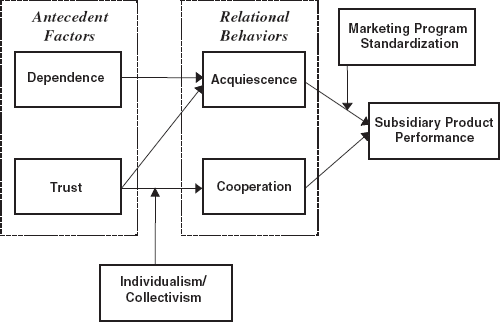
A Model of Headquarters–Subsidiary Relationships
Relational Behaviors in the Context of the MNC
Studies of relationship marketing typically examine different characteristics of exchange relationships (e.g., trust, dependence) in terms of their influence on some desired outcome. More specifically, these outcomes generally represent desired behaviors on the part of one or more of the partners in the exchange. The specific outcomes that are examined tend to differ on the basis of the context of the study. For example, studies of buyer–supplier relationships focus on behaviors such as acquiescence, a decreased propensity to leave a relationship (Morgan and Hunt 1994), or a long-term orientation in the relationship (Ganesan 1994), whereas studies in the marketing channels context focus on behaviors such as cooperation (Anderson and Narus 1990) or flexibility (Lusch and Brown 1996). Across these different contexts, acquiescence and cooperation are consistently highlighted as representing desirable behavioral outcomes from successful relationships (Anderson and Narus 1990; Bendapudi and Berry 1997; Ganesan 1994; Kumar, Stern, and Achrol 1992; Morgan and Hunt 1994). These two behaviors not only are consistent across the relationship marketing literature but also are particularly appropriate in the context of headquarters–subsidiary marketing function relationships in terms of the implementation of marketing program elements in individual foreign markets.
On the basis of findings from previous studies of marketing relationships, these two behaviors are suggested in our conceptual framework to result from perceptions of dependence and trust on the part of managers at the subsidiary's marketing operations. Specifically, successful relationships between the headquarters’ and subsidiary's marketing operations should result in the subsidiary's (1) acquiescence to the headquarters in terms of marketing procedures, directives, and programs implemented in the local market and (2) cooperation with the headquarters’ marketing operation to achieve mutual goals with respect to the marketing procedures, directives, and programs for a particular product. An important distinction between these two constructs, highlighted by Morgan and Hunt (1994), is that cooperation is proactive whereas acquiescence is reactive.
Acquiescence
Acquiescence is defined as the extent to which one party in an exchange situation accepts or adheres to another's specific requests (Bendapudi and Berry 1997; Kumar, Stern, and Achrol 1992; Morgan and Hunt 1994; Steers 1977). Because different subsidiaries in dispersed geographic locations will have different responsibilities and will operate in various market conditions, each subsidiary will possess unique knowledge and experience and may have interests that diverge from those of the headquarters (Nohria and Ghoshal 1994). Therefore, the headquarters faces a need to utilize its unique knowledge in decision making, while somehow influencing the subsidiaries to act in line with its interests. 1 Kumar, Stern, and Achrol (1992), in their assessment of reseller performance in supplier–reseller relationships, suggest that reseller compliance, or the reseller's reception of the supplier's channel policies and programs, is important for the supplier's ability to present its products to end users in the manner it wishes. We similarly view subsidiary acquiescence as important for the headquarters’ ability to present its products to end users in accordance with its proposed marketing plans. In the present study, we perceive the extent to which the foreign subsidiaries act in line with the headquarters’ interests as reflecting the quality of the relationship. Acquiescence then reflects the subsidiary marketing managers’ participation in marketing procedures, directives, and programs that the marketing function at the headquarters attempts to implement, as well as their performance of headquarters’ marketing operation requests.
In addition to the research reported in this article, we conducted depth interviews with global marketing managers at MNC headquarters (n = 5). These interview responses revealed that global managers considered poor relationships to be detrimental to the success of marketing programs to the extent that the poor relationships influenced the subsidiary's marketing operations not to adhere to or accept policies or procedures handed down by the headquarters (i.e., acquiescence).
Cooperation
Cooperation is defined as complementary coordinated actions taken by the headquarters’ and subsidiary's marketing functions to achieve mutual outcomes (see Anderson and Narus 1990, p. 45). Morgan and Hunt (1994) suggest that cooperation requires the two parties in a relationship to participate actively to achieve mutual benefits and that cooperation promotes success in relationships. Similarly, Roth and Nigh (1992) define coordination by foreign subsidiaries as collaborative actions to achieve unity of effort with the MNC and suggest that collaboration is characteristic of effective headquarters–subsidiary relationships. We view cooperation from the perspective of the subsidiary's managers, in terms of their interactions, communications, and goals with respect to marketing procedures and programs for a product.
Dependence-Based Path to Relational Behavior
The dependence of one party on another can be defined as the extent to which the first party relies on the relationship for the fulfillment of important needs (Rusbult and Van Lange 1996). In the present study, dependence reflects the extent to which the subsidiary depends in general on the effective functioning of the headquarters in order to perform its own tasks related to the implementation of a marketing program for a product. In the context of marketing operations at MNC headquarters and subsidiaries, some form of a dependence relationship is likely.
According to social exchange theory, the existence of an imbalance of power due to one party's dependence on the other makes it possible for one party to direct the activities of another (Blau 1964; Molm 1994). The level of perceived dependence of one partner on another is thought to be an important feature of the relationship (Anderson and Narus 1990; Berry and Parasuraman 1991; Blau 1964; Gundlach and Cadotte 1994; Parsons 1964; Smith, Ross, and Smith 1997). The dependence of one party on another is also suggested to be positively associated with acquiescence to that party (Bendapudi and Berry 1997; Blau 1964; Morgan and Hunt 1994). The greater the perceived dependence of the subsidiary's marketing operation on the headquarters, the less powerful the subsidiary's marketing managers will feel, and the more likely the subsidiary will be to acquiesce to the marketing function at headquarters. Although some research in the channels literature has concluded that dependence is not related to control (see Gaski 1984), our view is that a subsidiary's managers should feel compelled to follow directives on the basis of its reliance on headquarters for important resources.
Support for these notions can be found in several related studies. For example, Prahalad and Doz (1981) study the influence of dependence on the strategic control a headquarters has over its subsidiaries. Similar to the view of dependence and acquiescence taken here, Prahalad and Doz's definition of strategic control is the “extent of influence that a head office has over a subsidiary concerning decisions that affect subsidiary strategy” (Prahalad and Doz 1981, p. 5). Anderson and Narus (1990) also examine unilateral dependence as a determinant of the extent to which one firm has influence over its partner, and these authors find a link between unilateral dependence and the use of influence by a supplier over its distributors. In addition, Joshi and Arnold (1998) find that the dependence of a buyer on a supplier in an industrial setting leads to buyer compliance. Thus, the perceived dependence of the subsidiary's marketing function on that at headquarters should result in higher levels of acquiescence. In summary,
The subsidiary's perceived dependence on the MNC headquarters’ marketing function is positively related to the subsidiary's acquiescence to the headquarters.
Trust-Based Paths to Relational Behavior
The trust-based paths reflect the importance of trust in relationships (Bendapudi and Berry 1997; Blau 1964; Ganesan 1994; Garbarino and Johnson 1999; Kozak and Cohen 1997). The literature dealing with trust is vast, and definitions range from those viewing trust as a personality trait (Dwyer and LaGace 1986) to those encompassing beliefs about another's behavior or behavior that reflects the truster's vulnerability to the other (Moorman, Zaltman, and Deshpandέ 1992). In Doney and Cannon's (1997, p. 36) study of trust in buyer–seller relations, the authors define trust as “the perceived credibility and benevolence of a target of trust.” Doney and Cannon's definition captures the motives and/or intentions of the other party and is adopted here. Although many studies in an organizational context focus solely on the credibility aspect (see Moorman, Zaltman, and Deshpandέ 1992; Morgan and Hunt 1994), without specific regard for the notion of benevolence, the emphasis on benevolence may be particularly important in this context, because the subsidiaries in our sample were all wholly owned subunits of the parent corporations. From the subsidiary's perspective, a concern for its welfare may be particularly important in motivating relational behavior, because the headquarters may be seen as “going beyond the call of duty.”
Trust is positioned here as having a direct influence on acquiescence and cooperation (Bendapudi and Berry 1997; Morgan and Hunt 1994). From a relational perspective, trust is important as a mechanism both for persuasion and for encouraging future exchanges. Exchange partners often heed each other's suggestions by virtue of the trust placed in the partner (La Valle 1994, p. 596). Morgan and Hunt's (1994) findings regarding the influence of trust on acquiescence support this expectation. Doney and Cannon (1997) likewise find that trust enhances the likelihood of future interactions among parties. Relatedly, Moorman, Zaltman, and Deshpandέ (1992) find that trust enhances the quality of user–researcher interactions and commitment to those relationships. Similarly, the trust the subsidiary's marketing function has in the headquarters should enhance acquiescence. Multiple aspects of trust embodied in our definition can also be seen as leading to a willingness to follow directives. First, a subsidiary may be more willing to acquiesce to the extent that it perceives the headquarters as likely to keep promises and provide reliable information (i.e., credibility). Likewise, if the subsidiary perceives the headquarters as concerned about its welfare (i.e., benevolence), it may be more likely to perceive directives to be in its best interest and more likely to follow them. More formally,
The subsidiary's trust in the headquarters’ marketing function is positively related to its acquiescence to the MNC's headquarters.
Morgan and Hunt (1994) also find that trust leads to cooperative behaviors and to a decrease in uncertainty. Arguments similar to those provided for the effects of trust on acquiescence can be made for the influence of trust on cooperation. If the headquarters is perceived as credible and as concerned with the subsidiary's welfare (benevolence), the subsidiary may be more likely to perceive objectives as mutually beneficial and may be more likely to cooperate. Relatedly, Ganesan (1994) finds that trust positively influences a retailer's long-term orientation toward a relationship, reflecting a perception that joint outcomes will benefit both organizations in the long run. Thus, trust enhances perceptions that outcomes will be mutually beneficial for both partners. Likewise, Anderson and Narus (1990) argue that cooperative behaviors lead to outcomes that exceed what one partner could achieve if it acted alone and focused only on its interests. Trust, then, is expected to lead to cooperation. Therefore,
The subsidiary's trust in the headquarters’ marketing function is positively related to the subsidiary's cooperation with the MNC's headquarters.
Cultural Influences on Relational Behavior
The behavior and attitudes of managers at foreign subsidiaries are likely to differ from those of managers at the MNC's headquarters if the cultures in those markets differ significantly. Hofstede (1980) found that cultural differences vary along four dimensions: uncertainty avoidance, individualism/collectivism, tolerance of power distance, and masculinity/femininity. 2 On the basis of a study of more than 88,000 employees at subsidiaries of a U.S.-based MNC, Hofstede (1980) created indices for more than 40 countries for each dimension. These indices have been used in more than 60 applications (Sondergaard 1994). The underlying values and attitudes of different cultural groups can influence the behavior of those groups, as well as the nature of decisions they make (Hofstede 1980; Schneider and DeMeyer 1991; Shane 1994; Tayeb 1994). As examples, cultural values can affect organizational processes (Hofstede 1983; Stephens and Greer 1996) and leadership styles of managers (Tayeb 1994). In addition, Tse and colleagues (1988) find that culture influences decisiveness and choice of decision strategies used in marketing situations.
In subsequent studies, a fifth dimension, Confucian dynamism, or long-term orientation, was found (Hofstede 1984).
In terms of cultural influences on relational behavior, the present study focuses on the influence of the individualism/collectivism dimension. Individualism/collectivism reflects the way people in a society interact and has been suggested to be the most pervasive difference associated with national culture (Williams, Han, and Qualls 1998). This dimension of culture also appears most relevant to the study of relationships, given its focus on interactions among people. In more individualistic cultures, unilateral or individual goals take on greater importance than group goals, whereas in collectivistic societies, interpersonal ties take on greater importance, and people are expected to focus more on the needs of the collective group than on their own needs (Doney, Cannon, and Mullen 1998; Hofstede 1984). Our interest in examining the effect of culture, and individualism/collectivism specifically, is to understand conditions under which a relationship based on trust might be more effective in leading to cooperative behaviors.
Recently, the level of individualism/collectivism has been suggested to influence the likelihood of cooperative behaviors in multinational organizations directly (Chen, Chen, and Meindl 1998). Empirical evidence also points to a link between this dimension and relational behaviors. Chatman and Barsade (1995), for example, find that members of collectivistic cultures are more likely to reciprocate in cooperative behaviors. In addition, Williams, Han, and Qualls (1998), in their study of cross-cultural business relationships, find that managers in highly collectivistic countries are more receptive to social bonding, which focuses on personal factors such as trust, than structural bonding, which focuses on strategic objectives. More specifically, managers in collectivistic cultures reacted more strongly to interpersonal factors such as trust than monetary incentives for motivating relational behaviors. Therefore, trust should be more effective in motivating relational behavior among managers in collectivistic cultures than in individualistic cultures. Because cooperation generally reflects proactive behaviors on the part of managers at the subsidiary to achieve mutual outcomes with the headquarters (see Anderson and Narus 1990), the level of individualism/collectivism should influence the extent of cooperative behaviors. Specifically, we expect individualism/collectivism to moderate the relationship between trust and cooperation such that trust will take on greater importance in motivating cooperative behaviors in more collectivistic cultures. The following hypothesis summarizes this expectation:
Trust will have more of an effect on cooperation in highly collectivistic cultures than in highly individualistic cultures.
Performance as an Outcome of Relational Behaviors
In an effective relationship, both partners are expected to receive long-term benefits from the relationship so that both parties can achieve their respective goals (see Morgan and Hunt 1994). Although many factors can be linked to performance, we view the possible performance implications of strong relationships as an important question that is worthy of study. To the extent that the subsidiary's marketing function displays cooperation and acquiescence, we expect the ability of a product to meet the objectives established for the individual subsidiary's market to be enhanced. Similar to Moorman and Miner (1997), we are concerned here with how well the product achieves profitability, sales, and share goals.
The ability of an MNC's headquarters to motivate and control the subsidiary's actions in executing its global strategies is described as a critical aspect of the firm's ability to compete successfully (Doz, Prahalad, and Hamel 1990). Intuitively, the willingness of subsidiaries to follow directives in implementing marketing programs for a particular product should be positively associated with the ability of that product to achieve its established performance objectives. In addition, international cooperative behaviors have been suggested to be key to the success of global companies (Adler 1991). Relatedly, Jap (1999) finds support for the notion that coordination efforts on the part of partners in a dyadic relationship, defined as their pattern of complementary actions and activities, can lead to enhanced performance in terms of profits resulting from dyadic collaboration efforts. From a relationship marketing perspective, relational behaviors should result in both parties in an exchange relationship achieving their respective goals. In our context, achieving the product's goals, as established in the global marketing program, can be seen as a mutual objective. Consistent with these arguments, we propose the following:
The subsidiary's marketing function cooperation is positively related to brand performance in the market in which that subsidiary operates.
Moderating Effect of Global Marketing Program Orientation
Last, as Simpson and Wren (1997) suggest, several nonrelational factors may influence the effect of the nature of an exchange on the outcome of that exchange. Notably, the influence of such nonrelational factors has not been studied extensively. An important aspect of the MNC's marketing strategy is the extent to which the marketing program for the product is standardized across markets or adapted to each market (Douglas and Wind 1987; Jain 1989; Picard, Boddewyn, and Grosse 1998; Quelch and Hoff 1986). This choice of marketing program orientation has implications for both relationship quality and product performance. For example, Jain (1989) hypothesizes that conflict and poor relationships between the marketing functions at an MNC's headquarters and its foreign subsidiaries discourage the transfer of global marketing program elements to individual markets. We focus on standardization versus adaptation in terms of the content of the marketing program, in accordance with Jain's (1989) description of this variable.
The greater the extent to which the headquarters’ marketing function has an orientation toward standardizing the marketing program for a product, the more important the relationship with the marketing function at headquarters would be to an individual subsidiary's ability to implement that program successfully in its market. In situations in which the marketing program for a particular product is customized, such that the subsidiary's marketing function is more autonomous in its developmental efforts or strategy implementation, acquiescence to the headquarters may be less important for the product's ability to meet its objectives. In addition, when the headquarters is attempting to standardize the marketing program, the likelihood of goal congruity between the headquarters and subsidiaries will be greater than when the subsidiaries are more autonomous. Thus, the importance of relational behaviors on the part of the subsidiary for achieving those goals should be less. On the basis of these arguments, we offer the following:
When global marketing program standardization is high, acquiescence will have a greater effect on market brand performance than when standardization is low.
Research Methods
In this section, we describe the procedures used to gather the data in detail. First, we discuss the survey instrument and selection of key informants. Next, we describe the procedures used to assess nonresponse bias. Finally, we present the measures and steps followed in validating the multiple-item scales included in our questionnaire.
Survey Procedures and Sample
We conducted the present study using a mail survey. Where possible, we used existing measures for operationalizing constructs. We administered the questionnaire in English, because target respondents were senior managers at U.S.-based firms. We pretested the questionnaire among 16 academic experts and marketing managers to assess clarity of instructions and scale items. We sent draft questionnaires to participants and made telephone appointments for debriefing after comments were received. Participant comments focused primarily on response format instructions; we made modifications on the basis of their feedback.
Key informants were subsidiary-based marketing managers who were responsible for the marketing activities for one or more products/brands sold in their respective markets. Selecting key informants on the basis of their formal roles in the subsidiary, such that they are knowledgeable regarding the phenomenon under study, is critical in organizational research (Kumar, Stern, and Anderson 1993). Therefore, the sampling procedure required the identification of foreign subsidiaries of U.S.-based global firms and people with the appropriate responsibilities at those subsidiaries.
We developed the sample using the following steps: First, using the International Directory of Corporate Affiliations: Corporate Affiliations Plus (1997), we accessed hierarchies of U.S.-based firms and identified firms with foreign subsidiaries. Using this list of firms and subsidiaries, we attempted to identify target respondents and gain cooperation of the key informant in the survey (see Hartline and Ferrell 1996). It was necessary that there be a company-owned marketing presence in each foreign market. Second, we placed telephone calls to corporate headquarters in an effort to identify marketing managers with the appropriate responsibilities in foreign subsidiaries. When the appropriate contact at headquarters was not available, we called the subsidiaries. This procedure resulted in the identification of 435 subsidiaries from 135 U.S.-based corporations. Third, subsequent correspondence and telephone calls indicated that in a few cases, the foreign office was not appropriate. Elimination of such locations resulted in a final sample of 406 foreign subsidiaries, which represented 133 U.S.-based firms.
A mail questionnaire was sent to each of the identified respondents. As in Dillman's (1978) work, follow-up reminder postcards were sent to nonrespondents after three weeks, and follow-up questionnaires were sent after six and ten weeks. 3 Cover letters outlined the nature of the study and emphasized the confidentiality of the respondents. Respondents indicated on the questionnaires the name of the product or brand, its product category, and the geographic region for which they responded. As an incentive for participation, respondents were also given the opportunity to request a summary report of findings from the completed study (see Robertson, Eliashberg, and Rymon 1995). Initial and follow-up mailings resulted in responses from 143 subsidiaries of 66 different MNCs, for a 35% response rate. These 143 responses represent 36 different country markets of the 49 included in the original mailing. The respondents represented more than 30 industries. The median number of employees at the subsidiaries was 150; the average sales for the subsidiaries in U.S. dollars was 533 million. The respondents averaged 3.33 years of experience in their particular positions and 7.90 years of experience with the subsidiary.
Dillman (1978) recommends reminders after one week and replacement questionnaires after three weeks and seven weeks for domestic surveys. Because international mailings are hampered by the lengthy delivery process, two weeks were added for the reminder postcard, and three weeks were added for the follow-up mailings with replacement questionnaires.
As an additional measure to increase the speed of response and the overall response rate, participants were offered the options of either faxing their responses (Vazzana and Bachman 1994) or using a return envelope. Of the respondents, 17% faxed their returns, and the remaining 83% mailed them or used a courier service such as DHL.
Estimating Nonresponse Bias
We first examined nonresponse bias using the procedures recommended by Armstrong and Overton (1977). As such, we compared the responses from the first mailing with the responses from the third mailing by testing for mean differences on all the variables in the study, including subsidiaries’ characteristics. The results of this comparison showed no significant differences across the waves of mailings on responses to any multiple-item scales or indices or to any questions regarding subsidiaries’ characteristics. (The p-values for these comparisons ranged from .20 to .87.) The same analyses using the first versus the second and third waves combined also yielded no significant differences. In addition, we gathered secondary data on subsidiaries’ characteristics for both responding and nonresponding firms (America's Corporate Families and International Affiliates: Corporate Affiliations Plus 1998). Comparisons across the numbers of employees and total sales of subsidiaries also yielded no significant differences (p ≤ .77 for employees, and p ≤ .43 for sales). Finally, we compared response rates across industry groups (nondurables, durables, and services) and found that they did not differ significantly (p ≤ .40).
Measurement
Preexisting measures were identified where possible and adapted on the basis of the nature of the phenomena under study. Dependence was assessed on a scale adapted from a measure used by Astley and Zajac (1990) in their study applying exchange theory to study subunit power within MNCs. This measure included items intended to assess the extent to which the managers perceive that their subsidiary depends in general on the effective functioning of the headquarters in order to perform its own tasks, and the scale was originally developed with the objective of applying social exchange theory to relationships between subunits of MNCs. Doney and Cannon's (1997) measure of trust was adapted for the study to assess subsidiaries’ marketing managers’ trust in the headquarters. Kumar, Stern, and Achrol (1992, p. 240) develop a measure of reseller compliance with suppliers, which they define as the extent to which a reseller complies with the supplier's channel policies and programs. This conceptualization parallels the concept of acquiescence proposed previously and therefore was adapted for this study. Cooperation was measured on a scale adapted from Song, Montoya-Weiss, and Schmidt's (1997) study of cross-functional cooperation.
In measuring performance, we employed procedures similar to those used by Moorman and Miner (1997), in that respondents were asked to rate the extent to which a particular product achieved various outcomes related to profitability, sales, and market share. We conducted several additional analyses to assess the validity of the performance index. First, an examination of the corrected item-to-total correlations revealed that the estimates for the five indicators ranged from .66 to .86. As such, each of these values exceeds the recommended cutoff value of .50 for item retention (Zaichkowsky 1985). Second, we correlated the averaged index of relative performance (i.e., we operationalized each indicator using subjective measures that reflected performance relative to objectives) (see Moorman and Miner 1997, p. 102) with an absolute measure of market share for the product and market being investigated, controlling for the brand's length of time in the market. This correlation was .38 (p ≤ .01). More important, though modest in strength, this estimate was significant and positive. The absence of a stronger relationship is due, on the one hand, to differences between the relative measure used in testing our hypotheses and the absolute measure of performance and, on the other hand, to the inherent fallibility of self-reported data (see Shimp and Kavas 1984, p. 800).
The culture index values developed by Hofstede (1980) were used to reflect individualism/collectivism, and an index of marketing program elements based on the work of Jain (1989) was used for the marketing program orientation construct. The standardization/customization index included items reflecting various elements of the marketing program for a product, each of which can have varying degrees of standardization or customization. For these latter two measures, positive responses indicate higher levels of individualism and customization, respectively.
We subjected all scaled multiple-item measures that were assessed with reflective indicators (i.e., all measures except the individualism/collectivism and marketing program orientation indices) to purification procedures designed to evaluate dimensionality, reliability, and discriminant validity (see Anderson 1987; Gerbing and Anderson 1988). Across all the scales, we identified five items with low factor loadings (λ < .50) and subsequently dropped them from further analyses. The final measurement scales, as well as Cronbach's a values, are presented in Appendix A. Using the PROC CALIS procedure in SAS, we first assessed the psychometric properties of our final measures using confirmatory factor analysis. Given the limitations of our sample size, we divided the constructs into two subsets: exogenous (e.g., trust and dependence) and endogenous (e.g., acquiescence, cooperation, and performance) variables to form measurement models (see Doney and Cannon 1997). For the second model, the performance construct was estimated as a higher-order factor with two sets of indicators representing sales volume (sales and market share) and profitability (return on investment, return on assets, and profit margin). Although the chi-square statistics for both models were statistically significant (χ 2 = 88.88, degrees of freedom [d.f.] = 26 for Model 1 and χ 2 = 144.99, d.f. = 72 for Model 2), these estimates are sensitive to sample size and should not be considered without examinations of other fit indices (Sharma 1996). Other fit indices (goodness-of-fit index = .88 for Model 1 and .86 for Model 2, Tucker–Lewis index = .82 for Model 1 and .92 for Model 2, relative noncentrality index = .87 for Model 1 and .94 for Model 2) suggest that the measures provide a reasonable fit to the data. In addition, loadings for all indicators were significant (t-values all ≥4.60).
With one exception (acquiescence), Cronbach's a for the final scales exceeded .70, providing evidence of generally acceptable reliability (see Peter 1979). The coefficient a estimate of internal consistency for acquiescence was .67. In addition, composite reliability scores based on the item loadings from confirmatory factor models ranged from .68 to .89 (for these same variables). Before performing more formal tests of discriminant validity, we performed exploratory factor analysis on the two subsets of measures used in the measurement model analyses described previously. No substantial cross-loadings were observed among items across the different constructs. We assessed discriminant validity using the procedures recommended by Gerbing and Anderson (1988). First, we ran confirmatory factor analysis models with two factors involving each possible pair of constructs. In the first model, we constrained the ϕ coefficient to 1.0 and then estimated it freely in the second model. In all cases, we found the model with the free ϕ coefficient to be superior to the model with the fixed ϕ coefficient. Second, we constructed confidence intervals around the ϕ coefficient estimates using two times the standard error of the ϕ coefficient for each pair of constructs. In none of the cases did the confidence interval contain 1.0, which provided additional evidence of discriminant validity. The results of these analyses are summarized in Appendix B.
In an additional effort to assess the content validity of the measurement scales, we conducted a smaller-scale study in which we reevaluated the measures using procedures similar to those recommended by Zaichkowsky (1985) and employed in several studies in the marketing literature (e.g., Netemeyer et al. 1997; Netemeyer, Burton, and Lichtenstein 1995; Saxe and Weitz 1985). Specifically, we administered a questionnaire to expert judges with experience doing key informant research, asking them to rate the degree to which each item represented the constructs in our model. Using the procedure recommended by Zaichkowsky (1985), the panel of 26 expert judges rated each item as “clearly representative,” “somewhat representative,” or “not representative” of the construct of interest. Across all items, mean responses were greater than 2.0, and in no case did fewer than 80% of judges indicate their perception that the item was at least somewhat representative. This 80% level of agreement is consistent with that used by Zaichkowsky (1985) in determining representativeness of items.
Analyses and Results
The summary statistics and intercorrelations for all variables included in the study are shown in Table 1. Moderated regression analysis was used to assess support for individual hypotheses, including the hypothesized moderation effects for individualism/collectivism and marketing program orientation (see Arnold 1982; Barron and Kenny 1986). 4 In an initial series of analyses, multicollinearity was found between the interaction terms and their underlying components in tests of H4 and H6. To address this problem, variables were mean-centered before forming the interaction terms, a procedure recommended to reduce the problems associated with multicollinearity (see Aiken and West 1991; Jaccard, Turrisi, and Wan 1990). As a check on the effect of this procedure, the variance inflation factors (VIFs) for all variables were computed. The largest of the resulting VIFs was 1.35, well below the maximum level of 10.0 suggested by Mason and Perreault (1991; see also Neter, Wasserman, and Kutner 1990, p. 409).
Variable Means, Standard Deviations, and Intercorrelations
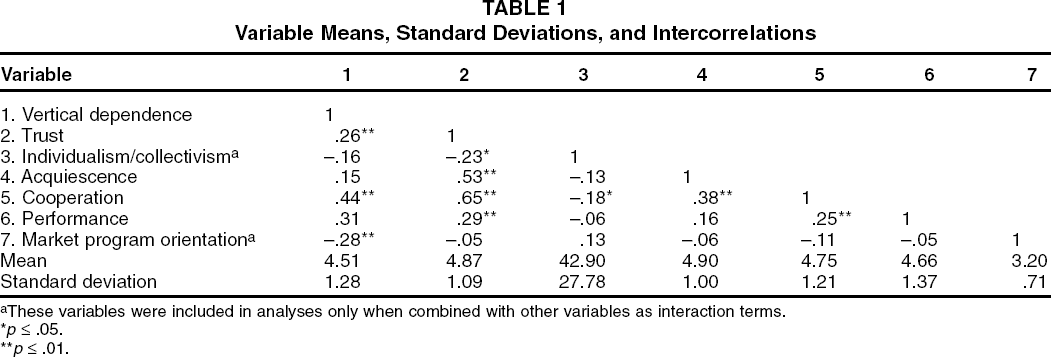
These variables were included in analyses only when combined with other variables as interaction terms.
p ≤ .05.
p ≤ .01.
We replicated the moderated regression analyses using path analysis that employed composite scores as indicators of all constructs (setting error terms at 1 - square root of the reliability for constructs with reflective indicators). We estimated interaction effects in the path analysis using composite score product terms (see Grewal, Monroe, and Krishnan 1998).
Separate regression analyses were performed for each of the three dependent variables (i.e., acquiescence, cooperation, and performance). Three control variables representing the subsidiary's size (sales in dollars) and industry (two dummy variables representing durables, nondurables, and services) were also included in all three regression models (see Moorman 1995). Product terms using composite indices that represented the moderator variables and appropriate main effect variables were also included. Details of the results of these tests are discussed subsequently. Note that plots of residuals for all three equations indicated no outlying observations, and a normal probability plot suggested no violation of the normality assumption (Neter, Wasserman, and Kutner 1990). The results for all three models are presented in Table 2.
Tests of Hypothesized Relationships

p ≤ .05.
p ≤ .01.
Effects on Acquiescence
H1 and H2 predict relationships with acquiescence as an outcome. Table 2, Part A, presents the results of the regression equations used to test these hypotheses. Standardized parameter estimates are provided; the associated t-values are shown in parentheses. As shown, the coefficient for dependence is not significant, indicating a lack of support for H1. However, the coefficient for trust is significant (t = 6.53, p ≤ .01) and in the hypothesized direction, providing support for H2. Thus, it appears that trust has a significant effect on acquiescence, at least for our sample of marketing managers.
Effects on Cooperation
H3 and H4 predict relationships with the subsidiary's marketing function cooperation as an outcome. The results of the regression equations used to test these hypotheses are presented in Table 2, Part B. Regarding H3, trust is shown to be significantly associated with the subsidiary's marketing function's level of cooperation (t = 7.56, p ≤ .01). For H4, the coefficient for the interaction term is also significant (t = −2.04) and in the direction hypothesized.
In an effort to understand the interaction effect, we followed the slope analysis procedure described by Aiken and West (1991). According to Aiken and West, the presence of the interaction term is evidenced by the significance of its coefficient. By means of the slope analysis procedure, the relationship between trust and cooperation can be understood at different levels of individualism/collectivism. The equation is calculated using values of individualism/collectivism one standard deviation below the mean, at the mean, and then one standard deviation above the mean. We substituted high, moderate, and low values of individualism/collectivism in a model that also included main effects of trust and individualism/collectivism. This analysis revealed that at high levels of individualism, the relationship between trust and cooperation is weakest (β = .439), and at low levels, the relationship is strongest (β = .730). These results support H4.
Performance as an Outcome
H5 and H6 predict relationships with product performance in the subsidiary's market. The regression results using performance as the dependent variable are shown in Table 2, Part C. As indicated in Table 2, the data support H5 and H6. A significant coefficient was found for the main effect of cooperation (t = 2.62, p ≤ .01), and a marginally significant coefficient was found for the interaction of marketing program orientation and acquiescence (t = −1.93, p ≤ .056). That is, in support of H5, cooperation had a direct effect on performance, as predicted. The negative coefficient for the marketing program orientation × acquiescence interaction term suggests that the greater the extent to which the marketing program elements for a given product are customized by the individual subsidiary for its market, the weaker is the relationship between acquiescence and performance of that product in the subsidiary's market. Again, the nature of this significant interaction was examined. The slope analysis revealed that at high levels of standardization (low levels of customization), the relationship between acquiescence and performance is strongest (β = .24, t = 1.92), and at low levels of standardization, it is weakest (β = −.092, t = −.77). Thus, and as predicted, it appears that acquiescence becomes increasingly important for performance as the elements of the marketing program for a product are standardized across geographic markets.
Summary and General Discussion
A key objective of this study was to understand the antecedents of relational behaviors on the part of the marketing operations at a global firm's individual foreign subsidiaries. The conceptual model, derived largely from the relationship marketing literature, suggested two such antecedents: the dependence of one party on the other and the trust that one party has in the other (see Anderson and Narus 1990; Bendapudi and Berry 1997; Makoba 1993; Morgan and Hunt 1994). The findings reported here emphasize the importance of dedication-based relationships. That is, trust was found to be significantly associated with both acquiescence and cooperation, whereas dependence was not found to be significantly associated with acquiescence.
The influence of national culture on headquarters–subsidiary marketing function relationships was also explored. On the basis of prior findings (see Williams, Han, and Qualls 1998) regarding the receptiveness of managers in collectivistic cultures to forms of bonding that focus more on personal factors such as trust than on more economic-type rewards, we predicted a moderating effect of individualism/collectivism (Hofstede 1980) on the trust–cooperation relationship (Williams, Han, and Qualls 1998). Our findings suggest that in more collectivistic cultures, trust takes on greater importance in motivating cooperative behaviors.
Finally, the research extends traditional relationship marketing frameworks to explore the influence of relational behaviors on self-reports of product performance in individual foreign markets. Specifically, our findings indicate that there is a positive association between cooperative behaviors on the part of the subsidiary's marketing managers surveyed and the ability of a product to achieve its objectives in the subsidiary's individual market. In addition, we found that acquiescent behaviors take on greater importance to the extent that marketing program policies and procedures are standardized. Following a brief description of limitations of this research, we discuss the implications of our findings for MNC strategy and for further research.
Limitations
Although the survey was conducted among marketing managers who were knowledgeable about the brand or product management activities of the foreign subsidiaries and who interacted regularly with the marketing operation at corporate headquarters, this research suffers from some of the limitations associated with mail surveys. For example, although steps were taken to ensure that the correct person was identified as the key informant, the potential for single-respondent bias still exists. Related to this issue of single-respondent bias is the use of perceptual measures for operationalizing the constructs. Other concerns related to the measures are that subjective performance measures were obtained and that these performance measures were obtained at the same time as other construct indicators. 5 Additional objective firm performance measures and/or external secondary data would have been helpful in validating performance. However, brand performance in foreign markets is not reported widely, and therefore extensive secondary data are not available, particularly when needed for such a large and varied group of individual products and markets. It is also possible that our measures do not fully capture the concepts under study, and caution should be used in interpreting our findings. However, as discussed in our methods section, standard analyses designed to assess reliability and discriminant validity were employed, and our measures were found to be adequate.
As acknowledged previously, the collection of the performance measure contiguous with the antecedent variables is a limitation. In the spirit of providing additional evidence for the proposed model, follow-up performance data were obtained six months later from a single mailing from 21 of the original subsidiary marketing managers. Correlations between this second-wave relative performance measure (see Moorman and Miner 1997) and trust and cooperation were .30 (p ≤ .10, one-tailed) and .52 (p ≤ .05), respectively. Notably, these modest but significant estimates provide some additional evidence regarding the role of trust and cooperation in headquarters–subsidiary relationships and eventual product performance in foreign markets.
Given the correlational design, it is not appropriate to make causal statements regarding the relationships observed among variables. Although we observed associations among certain variables, it is impossible to draw conclusions of causality. Moreover, the potential exists for common methods variance as an explanation for the relationships observed. We investigated the effects of common methods bias using the procedures described by Netemeyer and colleagues (1997, p. 96). In these analyses, we formed two structural equation models using constructs with multiple indicators on the basis of the order of hypotheses (i.e., H1–H3 and H5). A breakdown using two models was needed because of the limited sample size. For both models, we added a “same-source” factor to the indicators of all constructs. We compared an unconstrained model, in which the same-source factor loadings are estimated freely, with a constrained model, in which the loadings are constrained to zero. These analyses resulted in significant differences between the constrained and unconstrained models for both sets of constructs, which suggests the presence of some methods bias (χ 2 diff = 269.18, d.f.diff = 18 for the first model and χ 2 diff = 193.11, d.f.diff = 14 for the second model). However, the strength of the hypothesized paths remained consistent with our findings, even in the presence of this bias.
An additional limitation is the constraint placed on the nationality of the headquarters organization. The sample was limited to foreign subsidiaries of U.S.-based MNCs only, which made it difficult to generalize results across firms based in other countries. However, the study was limited to U.S.-based firms to control for the effects of parent-firm nationality, which might affect management styles, as well as the structure of product management activities. For example, parent-dominated relationships as opposed to more balanced or subsidiary-dominated relationships may be more common among firms based outside of the U.S. Future studies that expand their scope across firms based in other countries should attempt to assess possible influences on firm structure, as well as the organization of marketing activities.
Importance of Relational Behaviors for Performance
The importance of relational behaviors on the part of the subsidiary's marketing operation for product performance in the subsidiary's market was hypothesized in the conceptual framework tested here. Although cooperation was found to be positively associated with the self-reported measure of product performance, acquiescence was not. Acquiescence was, however, found to become increasingly important as the firm attempts to standardize a product's marketing program across geographic markets. Although prior applications of the relationship marketing perspective have assessed behavioral outcomes, such as a reduced propensity to leave a relationship (Morgan and Hunt 1994) and expectations of continuity in the relationship (Garbarino and Johnson 1999; Heide and John 1990), performance implications resulting from those behaviors have not been widely assessed. One exception is the study reported by Lusch and Brown (1996), who examine performance in terms of the efficiency and productivity of wholesale–distributor relationships and find that it is not significantly associated with relational behavior. In addition, supplier performance has been found to be enhanced when suppliers pursue long-term as opposed to short-term relationships with customers (Cannon and Perreault 1999; Kalwani and Narayandas 1995; Naidu et al. 1999). Finally, Jap (1999) reports that coordination efforts on the part of a dyad, rather than one partner, can result in higher levels of profitability. In the study reported here, the emphasis is more specifically on performance outcomes resulting from relational behaviors on the part of the subsidiary's marketing operations. As such, our findings provide evidence of benefits from fostering successful relationships among a firm's subunits.
The finding that acquiescence is not significantly associated with performance, except in situations in which the headquarters is attempting to standardize the marketing program for the product, led us to consider factors that might explain this result. The arguments of Janis (1972) regarding the effects of “groupthink” could be relevant. Given that the subsidiaries operate as part of a system of subunits, acquiescence among all subsidiaries could characterize the overall MNC. According to Janis (1972), acquiescence among a group could lead to group-think, such that creative processes may shut down; this has, in turn, a detrimental influence on performance. Given that our sample is primarily composed of only one subsidiary for each MNC, this is an unlikely explanation. Future studies involving multiple subunits for a set of MNCs would allow for an assessment of multiple subsidiaries, so that performance outcomes based on group-level characteristics could be investigated.
Effects of Trust versus Dependence
One possible explanation for the significance of trust compared with dependence in influencing relational behavior may lie in the subsidiary's marketing operation's perception of uncertainty in its environment as a result of a perceived power imbalance. It has been suggested that a more dependent party may feel uncertain (Etgar and Valency 1983). In addition, in relationships in which one party is more dependent, the perceived individual payoffs for relational behaviors might be lower for the weaker party (Lusch and Brown 1996).
In prior research on relationships in channels, similar evidence has been found regarding stronger effects of trust than of dependence. Specifically, Lusch and Brown (1996) find that the unilateral dependence of a wholesaler on a supplier has no impact on relational behavior. In addition, Lusch and Brown (1996) find that even when a wholesaler is dependent on a supplier, normative contracting rather than explicit and contractual governing mechanisms leads to relational behaviors. Moreover, Gundlach, Achrol, and Mentzer (1995) suggest that governance based on social norms rather than “law” may be more effective in long-term relationships. Bucklin and Sengupta (1992) also find that power imbalance in an alliance reduces the effectiveness of the alliance. Finally, Anderson and Narus (1990) find that dependence, through its effect on the use of influence by a partner, leads to conflict in relationships. Moreover, the literature on power in channels of distribution from nearly two decades ago also seems to indicate that dependence may not lead to perceptions of power and thus may not have the predicted positive effect on acquiescence. In particular, Gaski (1984, p. 23), in his review of studies on power and conflict in marketing channels, concludes that there is “little evidence to support a strong relationship between power and dependence in marketing channels.”
A distinction between dependence and trust, which could be key to understanding our findings, is the observation that dependence leads to an increase in uncertainty whereas trust may lead to a decrease in uncertainty. Morgan and Hunt (1994) find a negative relationship between trust and uncertainty in marketing relationships. Similarly, Beckett-Camarata, Camarata, and Barker (1998) suggest that alliances, in which firms partner for a long-term strategic purpose, are characterized by greater uncertainty than short-term relationships. This uncertainty is due to the greater likelihood in the long run than in the short run that market conditions will change and the weaker party's perception that it may be unable to control its position in the future. Further research could be undertaken in which the degree of ownership or contractual ties between parties in different contexts is measured and the role of dependence in successful relationships is explored. In addition, the distinction between unilateral and bilateral dependence (see Lusch and Brown 1996) provides a direction for further research, and the focus on only unilateral dependence here represents a potential limitation. Variation in bilateral dependence might be expected in relationships between headquarters and subsidiaries, and future studies could similarly explore the effects of bilateral dependence on both the subsidiary's and the headquarters’ behavior. 6
To account for the possible effects of the headquarters’ dependence on the subsidiary, we gathered secondary data on the worldwide sales figures of each multinational firm represented in our sample for the period in which the subsidiary's sales information was provided. We then calculated the percentage of worldwide sales accounted for by each subsidiary for that period and reran our analyses controlling for this ratio as well as the industry code variables already included in the models. In all three regression models, among the sample for which we were able to obtain worldwide sales information (n = 103), the results were consistent with those reported in the article. That is, controlling for the proportion of firm sales represented by each subsidiary, we found support for H2–H6 (t-values for these coefficients = 6.07, 7.18, −2.10, 3.54, and −2.40, respectively).
It is also possible that acquiescence may not have resulted from high levels of dependence because of contingencies not considered here. For example, the nature of marketing program requests being given to the subsidiary might be responsible for the levels of acquiescence. If subsidiaries perceive requests to be potentially detrimental, the subsidiaries may be less likely to comply with the requests. However, our belief is that if the headquarters has consistently handed down requests that are viewed as potentially detrimental to the subsidiary, the trust in the headquarters will be low. Research in marketing relationships suggests that past experiences are related to trust (Anderson and Narus 1990; Morgan and Hunt 1994).
Finally, we performed additional analyses to explore the possibility that dependence has a different relationship with acquiescence than predicted. We considered the possibility that cooperation might moderate the relationship between dependence and acquiescence, given the possibility that a more cooperative environment might enhance the likelihood that dependence will lead to acquiescence. Using regression analysis, we found the interaction between cooperation and dependence to be nonsignificant (t = −.50, p ≤ .62).
Effects of National Culture
The present findings support the premise that cultural differences affect the relationship between trust and relational behaviors. As such, a multinational firm may take different approaches to managing relationships among marketing operations in highly individualistic cultures versus in collectivistic cultures. Given the findings regarding differences among people in individualistic versus collectivistic cultures, differences in attitudes toward relationships and relationship marketing efforts in different cultures might be expected (Williams, Han, and Qualls 1998). Additional research is also needed to investigate how different approaches to managing marketing relationships in these different cultures may influence performance in different markets.
Global Marketing Program Orientation
One additional result from our effort was the finding that a subsidiary's marketing operation's acquiescence to the marketing operation at a global firm's headquarters becomes increasingly important as the firm attempts to standardize the elements of the marketing program across geographic markets (H6). As firms pursue global standardization of the marketing activities, our results suggest that performance is even more dependent on outlying unit acquiescence to programs and directives. Further research should explore more explicitly the influence of a firm's global marketing strategy on its relationships with its foreign subsidiaries.
Footnotes
Final Scale Items

|
Please indicate the extent to which each of the following statements describes your subsidiary's marketing operation using a seven-point scale, where 1 = “to a very little extent” and 7 = “to a very great extent.” To perform its own tasks effectively, the marketing operation at your subsidiary relies on the effective functioning of the marketing operation at headquarters. Knowledge gained in the marketing operation at headquarters is transferred to the marketing operation at your subsidiary. Work in the marketing operation at your subsidiary is connected to the work of the marketing operation at headquarters.
Please rate your agreement with each of the following statements regarding the marketing operation at headquarters using a seven-point scale, where 1 = “to a very little extent” and 7 = “to a very great extent.” The marketing operation at headquarters keeps promises it makes to our marketing operation. We believe the information that the marketing operation at headquarters provides to us. The marketing operation at headquarters is genuinely concerned with the success of the marketing operation at this subsidiary. The marketing operation at headquarters considers our welfare when making marketing decisions regarding this market. Individuals in the marketing operation at headquarters are trustworthy. Individuals in the marketing operation at headquarters are not always honest with us. (r)
Please rate your agreement with each of the following statements regarding your subsidiary's brand or product management activities using a seven-point scale, where 1 = “to a very little extent” and 7 = “to a very great extent.” Generally, your marketing operation conforms to headquarters’ accepted procedures. Your marketing operation has had trouble implementing marketing programs that headquarters recommends. (r) Your marketing operation has frequently gone against the terms contained in headquarters’ marketing operation directives. (r) Your marketing operation accurately performs requests of the marketing operation at headquarters in a timely fashion.
Please rate your agreement with each of the following statements regarding your subsidiary's brand or product management activities using a seven-point scale, where 1 = “to a very little extent” and 7 = “to a very great extent.” People from the marketing operations at both headquarters and your subsidiary regularly interact. There is open communication between the marketing operations at headquarters and your subsidiary. The marketing operations at headquarters and your subsidiary have similar goals. Overall, your subsidiary's marketing operation is satisfied with its interaction with the marketing operation at headquarters. There is a give-and-take relationship between the marketing operations at headquarters and your subsidiary.
Now, rate the extent to which the brand/product you indicated on page 1 has achieved the following outcomes relative to its original objectives for the most recent annual fiscal period using a seven-point scale, where 1 = “to a very little extent” and 7 = “to a very great extent.” Market share Sales Return on assets Profit margin Return on investment
Think about the brand/product you indicated on page 1. For each of the following marketing program elements, please approximate the extent to which headquarters has developed standardized processes that it requires you to use in your market versus allowing your subsidiary's marketing operation to develop and implement market- or country-specific marketing processes. (Check “N/A” if an item does not apply.) Scale: 1 = 100% standardized by headquarters’ marketing operation, 2 = 75% standardized/25% customized, 3 = 50% standardized/50% customized, 4 = 25% standardized/75% customized, 5 = 100% customized by subsidiary marketing operation. Product design Product positioning Brand name used Packaging Price Basic advertising message Creative expression Sales promotion Media allocation Salesforce responsibilities Management of salesforce Use of middlemen Type of retail outlet Customer service |
Notes: (r) = reverse-coded.
Discriminant Validity Analysis for Multiple-Item Scales

| Trust | Vertical Dependence | Acquiescence | Cooperation | Performance | |
|---|---|---|---|---|---|
| Trust | .50 | ||||
| Vertical dependence |
.30 99.71 88.88 |
.55 | |||
| Acquiescence |
.62 22.88 70.60 |
.22 73.26 36.14 |
.42 | ||
| Cooperation |
.79 46.94 157.78 |
.37 33.14 62.10 |
.36 33.14 62.10 |
.56 | |
| Performance |
.29 263.05 281.83 |
.37 112.30 192.43 |
.20 80.81 208.94 |
.24 285.58 230.06 |
.64 |
Notes: Entries below the diagonal show (1) ϕ coefficients (reflecting correlations among constructs), (2) difference in chi-square from fixed (ϕ = 1.00) model and free (ϕ estimated) model, and (3) chi-square for free model. Shared variance values are provided on the diagonal.