






Abstract
The authors investigate the effects of explicit comparisons in differentiating innovations that offer new functionalities to the consumer. Although marketing communications commonly employ explicit comparisons in launching new product functionalities, the authors suggest that such comparisons are not always helpful. The authors show that an explicit comparison of a new functionality with an existing functionality is effective only when the new functionality is offered in a device or physical product that is atypical of the existing functionality. However, when the new functionality is offered in a product that is typical of the existing functionality, explicit comparisons tend to backfire because they merely facilitate the assimilation of the new functionality to the prior functionality. The results of three studies provide significant support for the predictions, and a fourth study demonstrates how the backfire effect might be avoided. The authors discuss implications for communication tactics, new product marketing, and consumer behavior theory.
Prior research suggests that the success of an innovative functionality depends on whether consumers perceive it as a radically differentiated offering or as a minor variation of existing functionalities (Carpenter and Nakamoto 1989; Gatignon and Xuereb 1997; Olshavsky and Spreng 1996; Pechmann and Ratneshwar 1991; Sujan and Bettman 1989). If a marketer wishes to ensure that the innovation is perceived as truly new and different, one key issue is whether introductory communications to the consumer should feature explicit comparisons with existing functionalities (e.g., a comparison of instant messaging with e-mail). Consider the several cases depicted in Table 1 that refer to recent print advertisements in popular magazines such as Good Housekeeping, Vanity Fair, and Wired. Even though the products in question are diverse, in every case a firm has chosen to launch a new functionality using comparisons with an existing functionality. It is plausible that such explicit comparisons drive home the differentiation of the new functionality and thus facilitate the perception that it is new and unique. After all, if the marketer's goal is differentiation, it seems obvious that explicit comparisons should help set apart one functionality from another. Nonetheless, as we demonstrate in this article, there are conditions in which explicit comparisons can backfire.
Recent Examples of Marketing Communications That Explicitly Compare New Functionalities with Existing Functionalities

Note that on account of technological convergence, a new functionality can often be introduced in more than one type of device or physical product (see Bettis and Hitt 1995). Thus, instant messaging can now be used through a variety of devices such as desktop computers, notebooks, pagers, Smart Phones (e.g., wireless telephones with Internet capability such as Nokia's Communicator) and Web pads (e.g., Hitachi's Eplate, Cyrix's WebPAD; see Haskin 1999). Consumers are likely to perceive some of these products (e.g., desktop computers) as typical of the existing functionality of e-mail, because those products are used frequently for that particular functionality and/or because their physical features are deemed to be ideally suited for that functionality (Barsalou 1985, 1991; Ratneshwar, Pechmann, and Shocker 1996; Ratneshwar et al. 2001). Conversely, many other products (e.g., wireless telephones) may be perceived as much less typical of the existing functionality of e-mail, either because they are used much less frequently in that context or because their features are not ideal for that purpose.
Might the type of product or device that serves as the physical medium for a new functionality influence the effectiveness of explicit comparisons with existing functionalities? Researchers previously have uncovered several variables that moderate the effects of comparative advertising, but their studies have invariably investigated the impact of comparisons on consumer perceptions only at the brand level and within narrow product categories (see, e.g., Grewal et al. 1997; Pechmann and Ratneshwar 1991; Rose et al. 1993; Sujan and Dekleva 1987). 1 A mere extrapolation of the prior findings on brand-level comparisons does not make it clear whether explicit comparisons at the product functionality level are necessarily beneficial or whether other variables need to be brought into the picture. Therefore, the key questions addressed by our research are whether, when, and why explicit comparisons in marketing communications help or hurt the perception and evaluation of a new functionality. We focus on the typicality of the product in relation to the existing functionality as an important moderator of the effects of explicit comparisons. We present four studies.
For research on consumer decision-making processes in situations in which choice options are across different product categories, see Johnson (1984, 1988).
Study 1
We first discuss assimilation/contrast and categorization processes in regard to a new functionality when it is explicitly compared with an existing functionality. Next, we draw on prior research on product innovation to link assimilation/contrast effects to consumer judgments. Our conceptualization is depicted schematically in Figure 1.
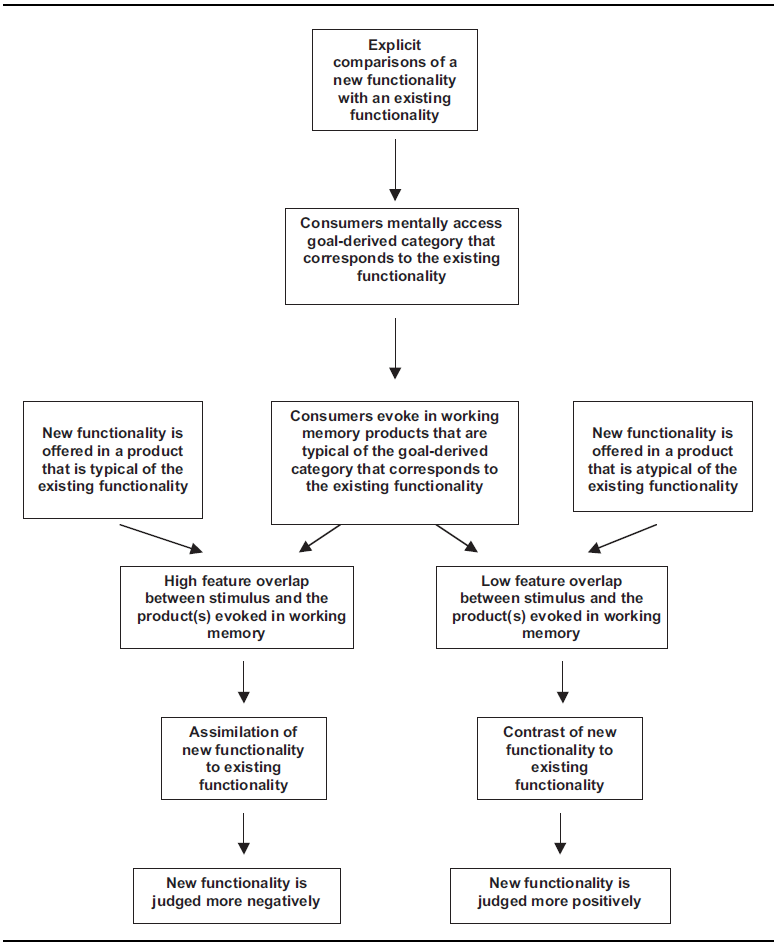
Schematic Diagram of the Theoretical Framework
Assimilation/Contrast and Categorization Processes
When a new functionality (e.g., instant messaging) is explicitly compared with a preexisting functionality (e.g., e-mail), we posit that the latter should serve as a reference standard or context for judgments of the former. Consequently, the evaluation of the novel stimulus may shift either in the direction of the context or away from it (see Buchanan, Simmons, and Bickart 1999; Schwarz and Bless 1992; Wanke, Bless, and Schwarz 1998). These two outcomes are known as assimilation and contrast, respectively; which of the two will prevail in a given situation depends on the degree of overlap between a person's mental representation of the context and the features of the stimulus to be evaluated (Herr 1989; Herr, Sherman, and Fazio 1983). Assimilation is the expected outcome when there is high overlap between the salient features of the judgment context and the novel stimulus, whereas contrast effects are more likely if there is little overlap.
We further posit that the consumer's mental representation of the context will include products that are typically associated with the existing functionality. Specifically, because functionalities make it feasible for consumers to engage in goal-directed actions, we assume that explicit mention of an existing functionality in a marketing communication will prompt consumers to mentally access a goal-derived category of products that corresponds to that particular functionality (Barsalou 1985, 1991; Ratneshwar, Pechmann, and Shocker 1996; Ratneshwar et al. 2001). 2 Consumers should thereby evoke in working memory the product exemplars that are most typical of that goal-derived category (Barsalou 1991; Wisniewski 1995). Barsalou's (1985, p. 636) findings show that the highly typical exemplars of a goal-derived category are products that are frequently instantiated or encountered in relation to the goal or products that have ideal characteristics for serving the goal. Thus, in the previous example, an explicit comparison of instant messaging with e-mail is likely to evoke in working memory typical products such as personal computers that are frequently instantiated or considered ideal in relation to the existing functionality of e-mail.
A key assumption here is that subjects will spontaneously evoke this mental representation only if explicit comparisons are made between the new functionality and the existing functionality, and not otherwise. The data reported in this article are supportive of this assumption; see also Olshavsky and Spreng (1996).
Given that products typical of the existing functionality are evoked in working memory, is assimilation or contrast more likely when a new functionality is explicitly compared with an existing functionality? The answer should depend on whether the new functionality itself is offered in a physical product that is typical or atypical of the existing functionality. Consider when the new functionality (e.g., instant messaging) is offered in a device that is typical of the existing functionality (e.g., personal computer). In such a case, there should be high feature overlap between the new stimulus and the typical products evoked in working memory by the explicit comparison. Consequently, assimilation of the new functionality to the existing functionality (i.e., standard of comparison) should be promoted. Now suppose that the new functionality (e.g., instant messaging) is offered in a physical product (e.g., wireless telephone) that is atypical of the existing functionality. In this situation, there should be a mismatch between the salient features of the new stimulus and the typical products evoked in working memory. Consequently, the new functionality should be contrasted with the existing functionality.
Consumer Judgments and the Effects of Assimilation/Contrast
Carpenter and Nakamoto (1989) have shown that pioneering products are likely to be judged positively and that consumer preferences for a “follower” product are negatively correlated with its degree of similarity to the pioneer. Thus, a follower product can neutralize the pioneer's advantage only by differentiating itself to the point at which it is classified as completely different from the pioneer, rather than being assimilated into the mental representation of the pioneer. Gatignon and Xuereb (1997, see Table 1, p. 83) find a highly significant negative correlation between the similarity of a new product to competitors’ products and the financial performance of the new product. They also find that the more similar an innovation is to its competitors, the lesser is the product's competitive advantage in the marketplace.
Carpenter and Nakamoto (1989) base their work on psychological theory and conduct controlled experiments on consumer preferences to verify their hypotheses. Gatignon and Xuereb (1997), in contrast, approach the issue of product innovation from a strategic management perspective and test their theory regarding the financial outcomes of innovations with survey data from key informants. Notwithstanding these differences in research approach and methodology, the results of both studies suggest that, in general, the assimilation (versus contrast) of a new functionality to an existing functionality should hurt (versus help) consumer evaluations of the innovation. Considered in conjunction with the previous theorizing regarding the effects of explicit comparisons, the implication is that if the typicality of the product influences the relative likelihood of assimilation versus contrast of the new functionality, the typicality should also have a corresponding impact on consumers’ judgments.
H1: When a new functionality is offered in a product that is typical of an existing functionality, explicit comparisons (versus no comparisons) of the new functionality with the existing functionality should result in more negative judgments of the new functionality. However, when a new functionality is offered in a product that is atypical of an existing functionality, explicit comparisons (versus no comparisons) should result in more positive judgments of the new functionality.
Method
Study design and subjects
We operationalized explicit comparisons through print advertisements and tested H1 in a between-subjects experiment with a 2 (typical versus atypical product) × 2 (comparative versus noncomparative advertisement) design. Subjects were undergraduate students majoring in business in the United States and Hong Kong (N = 193); they participated in the experiment for extra credit and were randomly assigned to the various conditions. 3
A separate analysis of the main dependent variable in Study 1 with the country factor as an additional blocking variable produced a statistically nonsignificant typicality of product × type of advertisement × country three-way interaction (p > .11). Furthermore, inspection of the data revealed that the pattern in the means was essentially the same for subjects from both countries. Therefore, for simplifying the presentation, we dropped the country factor from the design and analysis reported in the article.
Stimulus advertisements and manipulation of advertisement format
The advertisements in all four conditions were black-and-white, full-page, and similar in layout. The name of a new functionality, Anytime Entertainment, was used as a headline, and all the advertisements described the new functionality in terms of three specific benefits for the consumer (for a sample advertisement, see Figure 2). The advertisements also showed a picture of the physical product in which the new functionality would be available. In the comparative advertisement conditions, the advertisement's headline contained an explicit claim of superiority over an existing functionality, cable television. Furthermore, the sentence introducing the specific benefits of the new functionality in the comparative advertisements stated, “Unlike Cable Television, with Anytime Entertainment….” In the noncomparative advertisements, the headline did not mention an existing functionality, and the sentence introducing the specific benefits of the new functionality in the noncomparative advertisements simply said, “With Anytime Entertainment, a superior alternative.”

Study 1: Comparative Advertisement for a New Functionality Offered in a Product (Personal Computer) That Is Atypical of the Existing Functionality
Manipulation of product typicality
In the typical product condition, the advertisement's text stated that “Anytime Entertainment is available to subscribers on their TV sets.” In the atypical product condition, this was altered to “Anytime Entertainment is available to subscribers through the Internet on their PCs.” A manipulation check was done with a pretest group of 32 subjects. On nine-point scales, subjects indicated the extent to which they agreed or disagreed with the following statements: “A TV set (alternatively, personal computer) is a typical means of obtaining cable television.” The results showed that respondents perceived a television set as more typical than a personal computer for the functionality of cable television (M = 8.28 versus 2.75, t(31) = 14.5, p < .0001). We then conducted another manipulation test with a separate group of 28 subjects and asked them to rate the perceived idealness of the product in terms of the following items: “A TV set (personal computer in the second statement) is an ideal means of obtaining cable television.” The results of this pretest confirmed that respondents indeed perceived a television set as more ideal than a personal computer for the functionality of cable television (M = 7.46 versus 3.50, t(27) = 8.01, p < .0001).
Procedure
Subjects were informed that a major (anonymous) manufacturer was planning to introduce a high-technology innovation into the market and was interested in consumers’ reactions to this innovation. No brand names were provided because we did not want subjects’ judgments to be based on extrinsic cues. Subjects were handed booklets that included the stimulus advertisement as well as the questionnaire with all dependent measures. The first page of the booklet stated that on the next page they would find an advertisement; they were asked to “look at this ad as you normally look at another ad that you might see in a magazine or newspaper” (see Pechmann and Ratneshwar 1991). Subjects viewed the advertisement in a self-paced manner and then completed all the dependent measures.
Dependent Measures
We measured subjects’ judgments of the new functionality with four nine-point scale items: “What is your overall opinion of Anytime Entertainment” (1 = “very negative” to 9 = “very positive”), “How useful is Anytime Entertainment” (1 = “not at all useful” to 9 = “very useful”), “How innovative is Anytime Entertainment?” (1 = “minor variation of existing product” to 9 = “completely new product”), and “How likely are you to subscribe to Anytime Entertainment?” (1 = “very unlikely” to 9 = “very likely”). The four items were averaged to create an overall measure of consumer judgments (α = .79).
Results
We analyzed the data using analyses of variance (ANOVAs) and used a priori comparisons of means (one-tailed t-tests) to follow up on the ANOVAs. Means for the dependent variables are shown by experiment condition in Table 2. As predicted in H1, the results revealed a significant typicality of product × type of advertisement interaction (F(1, 189) = 22.70, p < .0001). When the new functionality was offered in a product that was typical of the existing functionality, subjects expressed less favorable judgments when the advertisement was comparative rather than noncomparative (M = 5.60 versus 6.43, t(189) = 3.32, p < .001). In contrast, when the new functionality was offered in an atypical product, subjects produced more favorable judgments when a comparative (versus noncomparative) advertisement was used (M = 6.46 versus 5.56, t(189) = 3.60, p < .001). None of the main effects were significant (p > .80).
Study 1: Consumer Judgments of a New Functionality as a Function of Typicality of Product and Explicit Comparisons

Notes: Higher numbers indicate more positive judgments; the theoretical scale range was 1 to 9. Cell sizes ranged from 47 to 50.
Study 2
Although our key hypothesis was supported in Study 1, the dependent measures in that study focused on subjects’ overall judgments. Therefore, we designed a new study with a specific focus on obtaining data for investigating the cognitive processes involved in judgment formation. First, we expected that a comparative advertisement format in general should mentally prime the existing functionality and thereby foster the use of the existing functionality as a standard of comparison for evaluating the new functionality. If so, subjects exposed to comparative advertisements should be more likely to generate thoughts that are comparative in nature. Second, we expected that when a new functionality is offered in a product that is typical of the existing functionality, assimilation processes are likely. In this event, subjects’ thoughts should relate the new functionality to the existing functionality and discount the extent to which the new functionality offers a novel set of benefits. The comparative thoughts generated by subjects thus should be negatively valenced. In contrast, when the new functionality is offered in a product that is atypical of the existing functionality, contrast processes are likely. As in the previous case, subjects are likely to evaluate the new functionality with the existing functionality as a standard of comparison, but in this case, their comparative thoughts should inflate the newness of the functionality and its benefits. The comparative thoughts generated by subjects therefore should be positively valenced in this case.
H2: Subjects exposed to explicit comparisons (versus no comparisons) of a new functionality to an existing functionality are more likely to generate thoughts that evaluate the new functionality in a comparative manner.
H3: When a new functionality is offered in a product that is typical of an existing functionality, subjects exposed to explicit comparisons (versus no comparisons) of the new functionality to the existing functionality are more likely to generate negatively valenced comparative thoughts. However, when a new functionality is offered in a product that is atypical of an existing functionality, subjects exposed to explicit comparisons (versus no comparisons) are more likely to produce positively valenced comparative thoughts.
Method
Study design and subjects
We tested the preceding hypotheses in a between-subjects experiment with a 2 (typical versus atypical product) × 2 (comparative versus non-comparative advertisement) design. The advertisements used as stimuli in this experiment were exactly the same as in Study 1. Subjects were undergraduate students in the United States majoring in business, and they participated in the experiment for extra credit (N = 108). They were randomly assigned to the different experimental conditions.
Procedure
The procedure was similar to Study 1 except that after subjects reviewed the advertisement, they were asked to list all their thoughts. The thoughts could be about the innovation, the advertisement's claims, how the subjects felt about the product, or anything else that came to their minds when looking at the advertisement. They could write as few or as many thoughts as they wanted, and they were allowed to take as much time as they wished.
Dependent Measures
In subjects’ protocols, we first identified the thoughts that involved explicit comparisons with the existing functionality. Next, two independent judges who were blind to experimental conditions coded all such comparative thoughts as either positive or negative in valence. They coded a comparative thought as positive when Anytime Entertainment was perceived as a superior innovation (e.g., “More convenient than cable TV”; “It seems like a good alternative to cable TV”). The judges coded a comparative thought as negative when Anytime Entertainment was perceived as fairly similar or inferior (e.g., “Cable TV is better”; “It's just like cable TV”). Interjudge reliability was high (average r = .91), and all discrepancies were resolved through mutual discussion. Two index measures were then created. The first index was the total number of comparative thoughts listed by a subject, regardless of valence. The second index was a valenced measure of comparative thoughts, which we computed by subtracting the number of negative comparative thoughts from the number of positive comparative thoughts.
Results
As predicted in H2, subjects who were exposed to comparative (versus noncomparative) advertisements listed more total comparative thoughts (M = .77 versus .12, F(1, 104) = 20.60, p < .0001). Also, 50% of the subjects exposed to comparative advertisements listed at least one comparative thought (positive or negative) versus only 11% of their counterparts who were exposed to the noncomparative advertisements (χ2(1) = 19.61, p < .001). The results for the valenced thought index support the hypothesized interaction (H3) between typicality of the product and type of advertisement (F(1, 104) = 8.28, p < .01). When the new functionality was offered in a product that was typical of the existing functionality, the valenced thought index reflected more negative thoughts when the advertisement was comparative rather than noncomparative (M = -.57 versus -.21, t(104) = 1.89, p < .05). In contrast, when the new functionality was offered in an atypical product, the valenced thought index showed evidence of more positive thoughts when subjects were exposed to the comparative (versus noncomparative) advertisement (M = .48 versus -.04, t(104) = 2.47, p < .01).
Study 3
Our conceptualization specifies that the variable that moderates the effectiveness of comparative advertisements is the typicality of the product in relation to the existing functionality. Given the stimuli we used in Studies 1 and 2, however, it could be argued that the effects obtained for consumer judgments might have been caused by the mere fact that television sets, compared with personal computers, represent an older generation of technology. Such an explanation would imply that the comparative advertisements for Anytime Entertainment yielded more favorable judgments when the product was a personal computer and not when the product was a television set, just because of the relative newness of the former. Furthermore, this alternative line of explanation suggests that the perceived innovativeness of the new functionality was undermined when the functionality was offered to the consumer in a physical product (television) that represents a mature technology.
Therefore, a key issue left somewhat unresolved by Studies 1 and 2 is the conceptual nature of the moderating variable that is implicated in our findings: Is it indeed the typicality of the product in relation to the existing functionality as we have argued, or is it the perceived newness of the technology (i.e., hardware) involved in the device? One way of corroborating our preferred explanation and ruling out the alternative explanation is to conduct a new study wherein the product roles are switched such that the typical product is a personal computer and the atypical product is a television set. If we find situations in which comparative advertisements are more effective for a new functionality when the device is a television set (versus a personal computer), we would have evidence that the results of Studies 1 and 2 were not driven by the product's technological newness per se.
A second major objective for Study 3 was to strengthen the theoretical explanation by tying our work to prior research on comparison effects by Dhar, Nowlis, and Sherman (1999), who argue that the type and direction of initial comparison processes have a systematic effect on consumers’ preference judgments. These authors hypothesize and demonstrate that when subjects are asked to focus on the similarities (versus the differences) between two product alternatives in an initial comparison task, the subjects will differ in a predictable manner in their subsequent judgments of the focal alternative. If the processes we theorized previously are integrated with the comparison processes that have been suggested by Dhar, Nowlis, and Sherman (1999), it would enable us to augment the network of constructs implicit in our theorizing and thereby enhance its nomological validity.
Recall that when an explicit comparison involves a new functionality offered in a typical product, the consumer should detect considerable feature overlap between the new stimulus and the products evoked in working memory (see Figure 1). High feature overlap should lead the consumer to focus on the similarities between the new functionality and the existing functionality. In the case of an explicit comparison that highlights a new functionality offered in an atypical product, the consumer should detect a great deal of feature mismatch; consequently, the consumer should focus on dissimilarities between the new functionality and the existing functionality.
A critical assumption here is that explicit comparisons that feature typical and atypical products should lead consumers to focus spontaneously on the similarities and dissimilarities, respectively, between the new functionality and the targeted existing functionality. If it is true that a comparative advertisement that features a typical product spontaneously leads to a focus on similarities (and therefore assimilation), on the basis of Dhar, Nowlis, and Sherman's (1999) work on comparison effects, this effect should be counteracted if subjects are asked to focus on differences between the new and existing functionalities. Consequently, a task focus on differences (versus no task focus) should engender contrast rather than assimilation, and we should thereby find that the new functionality is judged more positively. In this particular case, however, if subjects are asked to focus on similarities rather than differences, the result should be the same as when no specific task focus is provided, because even without a task focus, subjects are presumed to focus spontaneously on similarities.
Conversely, if an explicit comparison that features an atypical product creates a spontaneous focus on dissimilarities, a task focus on similarities between the existing and new functionalities (versus no task focus) should lead to more negative judgments of the new functionality. However, following a parallel logic, in this case instructing subjects to focus on the differences between the new and existing functionalities should lead to the same outcome as when no explicit task focus is provided.
H4: When a new functionality is offered in a product that is typical of an existing functionality and explicit comparisons are made between the new functionality and the existing functionality, a task focus on differences between the new and existing functionalities (versus no task focus) should result in more positive judgments of the new functionality. However, a task focus on similarities between the new and existing functionalities (versus no task focus) should not affect judgments of the new functionality in this case.
H5: When a new functionality is offered in a product that is atypical of an existing functionality and explicit comparisons are made between the new functionality and the existing functionality, a task focus on differences between the new and existing functionalities (versus no task focus) should not affect judgments of the new functionality. However, a task focus on similarities between the new and existing functionalities (versus no task focus) should result in more negative judgments of the new functionality in this case.
The third and final objective for Study 3 was to extend the generalizability of Study 1's findings to a more representative population. It is possible that the student subjects we used in Studies 1 and 2, on average, have a different level of expertise or motivation than the general population in regard to technological products. As such, it would be desirable to replicate the key findings of Study 1 with nonstudent subjects to establish their generalizability. In summary, we designed Study 3 such that we could (1) eliminate a plausible alternative explanation based on the newness rather than the typicality of the product, (2) relate our work to prior research on comparison effects by testing the effects of task focus (H4 and H5), and (3) extend the generalizability of our main findings in Study 1 to the general population.
Method
Study design and subjects
We employed a between-subjects factorial design with eight cells. Six of the eight cells involved explicit comparisons in comparative advertisements, and they crossed three levels of task focus (similarities-task focus, differences-task focus, no-task focus) with typicality of the product (typical versus atypical product). The other two (control) cells involved noncomparative advertisements with no task focus and with either a typical or an atypical product. Subjects were recruited at a local airport, and they participated in the study in return for a small monetary compensation (N = 185). Of the respondents, 48% were female and 52% were male, the median age of the subjects was 31, their self-reported median income was between $50,000 and $74,999, 51% were college graduates, and 61% were employed full time.
Stimulus advertisements and manipulation of advertisement format
The new functionality in this study was Infoexchange. The advertisements were formatted similarly to the advertisements used in the previous studies, and they described the new functionality in terms of three specific benefits for the consumer (for a sample advertisement, see Figure 3). In the explicit comparison conditions, the new functionality was compared with an existing functionality, e-mail.
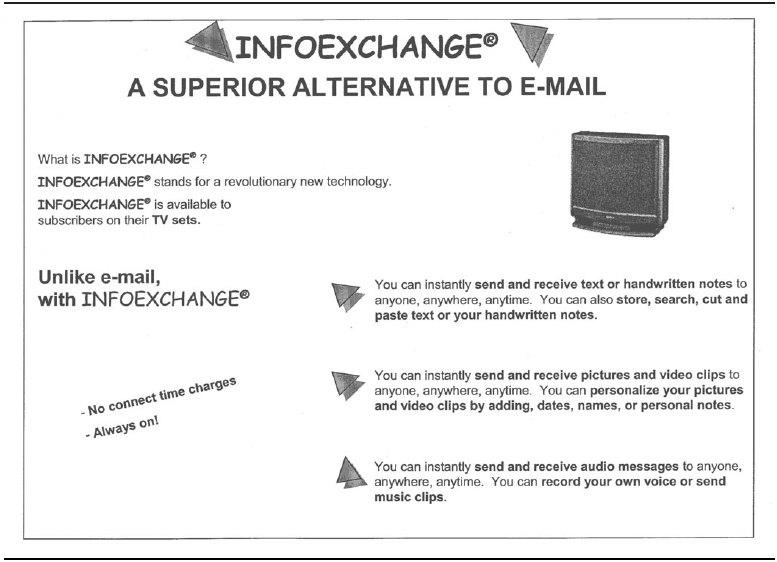
Study 3: Comparative Advertisement for a New Functionality Offered in a Product (Television) That Is Atypical of the Existing Functionality
Manipulation of product typicality
Following the rationale in the introduction to this study, we designed the stimuli so as to switch the roles of the physical products used in Studies 1 and 2. Therefore, in Study 3 the typical product was a personal computer, and the atypical product was a television set. In the typical product conditions, the text of the advertisement informed subjects that “Infoexchange is available to subscribers through the Internet on their PCs.” In the atypical product conditions, the text stated that “Infoexchange is available to subscribers on their TV sets.” As in Study 1, we verified our manipulation of typicality of the product with a pretest group of 20 subjects. The results confirmed that respondents perceived a personal computer as more typical than a television set for sending and receiving e-mail (M = 8.55 versus 1.80, t(19) = 23.4, p < .0001). Another manipulation test with a different group of 30 subjects confirmed that respondents perceived a personal computer as more ideal than a television set for sending and receiving e-mail (M = 8.70 versus 2.83, t(29) = 13.70, p < .0001).
Procedure
The procedure was identical to that of Study 1 except for the task focus manipulations. Immediately after looking at the advertisement, subjects in the similarities–task focus conditions were asked to write a brief reply to the following question: “How is Infoexchange similar to email?” Subjects in the differences–task focus conditions were asked to reply to the question, “How is Infoexchange different from e-mail?” In the no–task focus conditions, subjects were simply asked to list the thoughts that came to their minds while they looked at the advertisement. After this task, subjects provided judgments of the new functionality on the same four items as in Study 1 (α = .80).
Results
We analyzed the data using ANOVAs with a priori comparisons of means (one-tailed t-tests) to follow up on significant interactions; means are shown by experimental condition in Table 3. We first assessed whether we were able to replicate the results of Study 1 in regard to H1. For this purpose, we took into account only the four no–task focus cells of our design, that is, 2 (comparative versus noncomparative advertisements) × 2 (typical versus atypical product). The results confirmed a significant typicality of product × type of advertisement interaction (F(1, 91) = 12.34, p < .001). When the new functionality (Infoexchange) was offered in a product that was typical of the existing functionality (personal computer in this case), subjects expressed slightly less favorable judgments when the advertisement was comparative rather than noncomparative; however, the contrast did not achieve statistical significance (M = 4.80 versus 5.31, t(91) = 1.41, p = .16). But as anticipated, when the new functionality was offered in an atypical product (television set in this case), subjects recorded more favorable judgments when a comparative (versus noncomparative) advertisement was used (M = 6.15 versus 4.79, t(91) = 4.00, p < .0001). None of the main effects were significant (p > .10).
Study 3: Consumer Judgments of a New Functionality as a Function of Typicality of Product, Explicit Comparisons, and Task Focus

Notes: Higher numbers indicate more positive judgments; the theoretical scale range was 1 to 9. Cell sizes ranged from 21 to 26.
Next, we tested H4 and H5 by considering the six cells of the design that involved explicit comparisons, that is, 3 (similarities-task focus, differences-task focus, no-task focus) × 2 (typical versus atypical product). The results of this ANOVA for the comparative conditions revealed a significant typicality of the product × type of task interaction (F(2, 132) = 4.49, p = .01). In support of H4, when the new functionality was offered in a typical product, subjects in the differences–task focus (versus no–task focus) condition produced more favorable judgments (M = 6.51 versus 4.80, t(132) = 4.75, p < .0001). Also in support of H4, when the new functionality was offered in a typical product, subjects in the similarities–task focus and the no–task focus conditions did not differ significantly in their judgments (M = 4.96 versus 4.80, t(132) = .42, p > .60). In support of H5, when the new functionality was offered in an atypical product, subjects exposed to comparative advertisements in the differences–task focus and the no–task focus conditions did not vary significantly in their judgments (M = 6.29 versus 6.15, t(132) = .38, p > .70). When the new functionality was offered in an atypical product, subjects in the similarities–task focus (versus no–task focus) condition were more negative in their judgments (M = 4.97 versus 6.15, t(132) = 3.27, p < .001).
Study 4
The results of the three previous studies provide consistent evidence that explicit comparisons between a new functionality and an existing functionality are counterproductive when the former is offered to the consumer in a physical product that is typical of the latter. In these studies, detailed information regarding the benefits of the new functionality was provided to the consumer in the various advertisements. Nonetheless, the comparative advertisements claimed superiority only at the relatively abstract functionality level (e.g., Infoexchange as superior to email) and did not engage in specific comparisons of the new and existing functionalities at a more concrete benefit level.
When the new functionality is offered in a product that is typical of the existing functionality, might explicit comparisons at a concrete benefit level overcome the backfire effects observed in the previous studies? It may be that in the comparative conditions of the previous studies, the differentiating benefits of the new functionality did not have much impact on judgments because consumers did not mentally access the specific benefits associated with the existing functionality and compare them with those of the new functionality (see also Pham and Muthukrishnan 2002). This line of reasoning is consistent with the evidence in Study 3 that when the new functionality is provided in a typical product, subjects spontaneously focus on the similarities (and not the differences) between the new functionality and the existing functionality. It remains an empirical question whether explicit comparisons at the concrete benefit level would override the assimilation processes engendered by comparisons at the abstract functionality level when the product is typical of the existing functionality.
H6: When a new functionality is offered in a product that is typical of an existing functionality, explicit comparisons (versus no comparisons) of the new functionality to the existing functionality at a benefit-specific level should result in more positive judgments of the new functionality.
Method
Study design, subjects, and procedure
This study had three experimental conditions. Two of them involved exposure to comparative advertisements: one with an explicit comparison at the functionality level only (just as in the previous studies) and the other with explicit comparisons at the benefit-specific level. Subjects in the third (control) condition saw a noncomparative advertisement. All three conditions pertained to a new functionality offered in a product that was typical of an existing functionality. Subjects were undergraduate students majoring in business (N = 94). They received extra credit for participating in the experiment and were randomly assigned to the experimental conditions. The experiment procedure was identical to the one used in Study 1, and subjects provided judgments of the new functionality on the same four items as in that study (α = .86).
Stimulus advertisements and manipulation of advertisement format
The advertisements were based on the stimuli employed in Study 3, but with minor editing of the descriptions of the three key benefits. All three advertisements depicted Infoexchange as available “to subscribers through the Internet on their PCs,” with pictures of a personal computer; note that the pretests in Study 3 had established that a personal computer was a typical product for the existing functionality of e-mail.
The advertisements used in the noncomparative (control) condition and in the explicit comparison at the abstract functionality level were virtually identical to those in Study 3. However, in the condition in which the comparison was at a benefit-specific level, the advertisement also included an explicit comparison of each one of the benefits of the new functionality to a comparable (but presumably inferior) benefit of the existing functionality. Furthermore, the advertisement in this condition was formatted such that the three benefits of the new functionality were horizontally juxtaposed with the comparable benefits of the existing functionality so as to make the comparisons highly salient. For example, one of the benefits of Infoexchange was described as follows: “You can instantly send and receive pictures and video clips anywhere, anytime. You can personalize your pictures and video clips by adding handwritten notes.” On the right of this benefit description, there was a comparative benefit description for e-mail as follows: “You can only send and receive pictures and video clips anywhere, anytime. You cannot personalize your pictures and video clips by adding handwritten notes.”
Results
We analyzed the data using a one-way ANOVA. We used a priori comparisons of means (one-tailed t-tests) to follow up on the ANOVA; means for the dependent variable are shown by experiment condition in Table 4. The ANOVA yielded a reliable omnibus main effect for advertisement condition (F(2, 91) = 8.77, p < .001). We then verified that in accord with the findings of the previous studies for the typical product condition, subjects who saw an advertisement with an explicit comparison at the abstract functionality level (versus the noncomparative advertisement) expressed less favorable judgments (M = 4.16 versus 5.00, t(91) = 2.40, p < .01). More important, as predicted in H6, subjects who were exposed to an advertisement with explicit comparisons at the benefit-specific level (versus the noncomparative advertisement) produced significantly more positive judgments (M = 5.70 versus 5.00, t(91) = 2.00, p < .05).
Study 4: Consumer Judgments of a New Functionality Offered in a Typical Product as a Function of Type of Comparison

Notes: Higher numbers indicate more positive judgments; the theoretical scale range was 1 to 9. Cell sizes ranged from 31 to 32. All conditions in this study involved a new functionality offered in a product that is typical of the existing functionality.
Summary and Discussion
The four studies examine the effectiveness of different communication strategies for launching innovations that involve new functionalities. We argue that when a new functionality is made available in a physical product or device that is typical of an existing functionality, explicit comparisons between the new and the existing functionality cause consumers to discount the novelty of the innovation. But when the new functionality is launched in a product that is atypical of an existing functionality, explicit comparisons foster positive thoughts, and consumers are more likely to think of the new functionality as something truly new and better. We obtained empirical support for our predictions in Study 1 and supported the cognitive process explanation with thought-listing data in Study 2. We ruled out a possible alternative explanation as well as replicated and generalized the findings to a nonstudent population in Study 3. In that study, we also investigated the effects of variations in the task focus provided to subjects so as to obtain converging evidence for our theoretical explanation. Finally, in Study 4 we found that when the physical product is typical of the existing functionality, the backfire effects observed in the previous studies can be counteracted by specific comparisons at a concrete benefit level.
Implications for Comparative Advertising
Prior research has extensively researched and debated the merits of comparative advertising versus noncomparative advertising, but usually in contexts in which comparisons are between brands within the same product category (see, e.g., Gorn and Weinberg 1984; Pechmann and Stewart 1990; Shimp and Dyer 1978). Much of the recent research in this area has focused on a search for moderating variables and on methodological and measurement issues (see, e.g., Grewal et al. 1997; Pechmann and Ratneshwar 1991; Rose et al. 1993). Notwithstanding, as we pointed out previously, the real world abounds with cases in which firms launch innovations with comparisons at the product functionality level rather than at the brand level. The effectiveness of such comparisons cannot be ascertained on the basis of the insights available from previous academic research. Consider, for example, a recent advertisement in Forbes, in which visitalk.com introduced voice and visual communication over the Internet as a new functionality. This functionality was offered in personal computers. The visitalk.com advertisement explicitly compared this new functionality with conventional e-mail, an existing functionality, with sentences such as, “Famous words were never delivered through e-mail.” The question is, Does the visitalk.com comparative advertising strategy make sense? Or would the firm be better off not mentioning e-mail at all?
The results of our research clearly suggest that comparative advertising at the product functionality level can be beneficial for the marketer, but only when the new functionality is launched in an atypical product. In other words, such comparative advertisements seem to be effective at product differentiation provided that the new functionality is delivered through a device (or hardware) that is distinctive and unusual in relation to the existing functionality with which the new functionality is being compared. In contrast, comparative advertisements that explicitly compare a new functionality with an older functionality are likely to backfire if the new functionality is offered in a product that is relatively typical of the older functionality. We speculate that the visitalk.com advertisement fits this latter category, because personal computers are typical products for sending and receiving e-mail. Visitalk.com may have done better to launch its innovation with no mention of e-mail at all. Note that the results of Study 4 suggest that the backfire effect can be overcome with detailed comparisons of the superior benefits of the new functionality with respect to counterpart benefits of the existing functionality. 4
We note that our research was limited to explicit comparisons in print advertisements. Further research might examine the generalizability of our findings to broadcast media, sales presentations, and concept-testing storyboards.
Implications for New Product Marketing and Consumer Behavior Theory
Our findings indicate implications for how consumers process information about new products. For example, Olshavsky and Spreng (1996) demonstrate that categorization of an innovation into an existing category may preclude a careful evaluation of the benefits of the innovation and thus undermine its perceived value. They argue that it is important for marketers to know the types of categories that a new product elicits in consumers’ minds so that the innovation can be positioned as sufficiently different. Olshavsky and Spreng further suggest that for differentiating a new product, the marketer's goal in general should be to encourage effortful, piecemeal processing of product attribute information.
Consistent with Olshavsky and Spreng's (1996) findings, our results show that assimilation of an innovative new functionality into an existing functionality is likely to undermine its perceived value. Furthermore, the negative effects of assimilation can be reversed if consumers focus on the benefits of the functionality in a detailed manner (Study 4). Our results also suggest that for effective differentiation, it is not always necessary that consumers should process detailed attribute information piecemeal. Consumers may perceive an innovation as new and different even if the marketer's communication simply prompts a contrast of the innovation to older alternatives. Such a contrast can be brought about, for example, when a new functionality is offered in a product that is atypical of an existing functionality and explicit comparisons are made between the new functionality and the existing functionality.
Our findings also extend theoretical understanding of assimilation/contrast processes. Prior research in this area has usually examined the relative likelihood of assimilation versus contrast effects through direct manipulations of the standard of comparison or context. For example, Herr (1989) varies the judgment context by priming subjects with different categories of cars (e.g., moderately expensive versus extremely expensive cars). Our results, conversely, suggest that assimilation and contrast can be obtained even when the judgment context itself is kept constant. Specifically, these effects can be engendered when the features associated with the target of judgment—in the present research, the type of physical product associated with a new functionality—vary so as to have either considerable or little overlap with corresponding features in a person's mental representation of the judgment context. Moreover, as we theorized previously, when the evoked judgment context relates to functionality or product purpose, the mental representation is likely to include products that are typical of the goal-derived category associated with that functionality. Further research may produce more insights on the relationship between assimilation/contrast processes and the category members that are retrieved from memory when a particular judgment context is primed.
Further research could also examine the effects of explicit comparisons that vary in the extent to which they highlight similarities or differences between a new functionality and an existing functionality (cf. Dhar, Nowlis, and Sherman 1999). Still another direction would be to investigate the moderating role of product typicality in more detail. Research in the person perception area by Kunda and Oleson (1997) suggests that people often find extremely atypical exemplars to be implausible and that extreme deviations from the norm may not be accommodated easily in people's knowledge structures (see also Weber and Crocker 1983). Therefore, from a product strategy perspective, it may be optimal to launch new functionalities in products that are moderately atypical rather than completely atypical of existing functionalities.
Further research might also study the manner in which a new functionality alters the hierarchical category structure of physical products and thereby affects product choices. One limitation of our research is that we focused on evaluations of the functionality itself and did not inquire into product perceptions, categorization, or choices. A new functionality can often provide additional benefits to the consumer such that the physical product in which the functionality is offered moves into a higher-level taxonomic category. For example, a personal data organizer that also takes and stores photographs might raise the product itself into the category of “mobile, multimedia documentation systems.” 5 Prior research by Johnson (1984, 1988) suggests that consumers might compare such innovations with more conventional products (e.g., handheld devices or digital cameras) by evoking abstract criteria based on such higher-order taxonomic categorization. Further research could empirically investigate this possibility as well as the more general issue of the product choice strategies used by consumers in situations in which new functionalities are launched with explicit comparisons.
We thank an anonymous reviewer for this insight.
Finally, our findings also bear on the literature on “meaningless differentiation” (e.g., Carpenter, Glazer, and Nakamoto 1994). Consumers often infer that a unique and salient product attribute such as the “flaked coffee crystals” in Folger's coffee is important and valuable even when that attribute is irrelevant to the functionality of the product (Carpenter, Glazer, and Nakamoto 1994). Consequently, differences in product form may induce the perception that a product provides an improved functionality (e.g., better-tasting coffee) even when that product is objectively no different from others in the category. But what if a product does provide a truly new functionality? Our findings suggest that product form matters even in this case. Marketing communications that attempt to contrast and differentiate a new functionality from an existing functionality are much more effective when the new functionality is offered to the consumer in a product that is atypical or unusual for the existing functionality. In other words, consumers’ judgments of meaningfully differentiated offerings also depend on the nature and appearance of the physical product. Conventional wisdom in product design holds that “form follows functionality” (see, e.g., Bloch 1995), but our research indicates that form also influences the perception of functionality.