






Abstract
Although boycotts are increasingly relevant for management decision making, there has been little research of an individual consumer's motivation to boycott. Drawing on the helping behavior and boycott literature, the authors take a cost–benefit approach to the decision to boycott and present a conceptualization of motivations for boycott participation. The authors tested their framework during an actual boycott of a multinational firm that was prompted by factory closings. Consumers who viewed the closures as egregious were more likely to boycott the firm, though only a minority did so. Four factors are found to predict boycott participation: the desire to make a difference, the scope for self-enhancement, counterarguments that inhibit boycotting, and the cost to the boycotter of constrained consumption. Furthermore, self-enhancement and constrained consumption are significant moderators of the relationship between the perceived egregiousness of the firm's actions and boycott participation. The authors also explore the role of perceptions of others’ participation and discuss implications for marketers, nongovernmental organizations, policymakers, and researchers.
The boycott is the way we take our cause to the public. For surely if we cannot find justice in the courts of rural California, we will find support with our brothers and sisters throughout the nation.
—Cesar Chavez (qtd. in Why We Boycott [United Farm Workers of America 1973])
We've taken significant actions to improve the lives, opportunities, and working conditions of the people who make our product around the world, and [we] regularly invest in the communities where we do business. And we do this so that consumers can buy Nike products with the knowledge that these products have been manufactured under safe and fair working conditions.
—Nike's response to criticism in Naomi Klein's No Logo (Nike 2000)
Friedman (1985, p. 97) defines a consumer boycott as “an attempt by one or more parties to achieve certain objectives by urging individual consumers to refrain from making selected purchases in the marketplace.” The “urging” of a boycott typically comes from a nongovernmental organization (NGO) that is protesting corporate practices. Thus, boycotts are an extreme case of a broader category of consumer behavior in which social and ethical issues, such as environmentalism, influence purchase decisions. Therefore, a better understanding of boycott participation not only is useful in its own right but also is likely to inform the understanding of ethical influences on buyer behavior in general.
Consumer boycotts date back at least as far as the fourteenth century and have contributed to some spectacular successes for relatively powerless groups. In the United States, boycotts were the key to unionization (Wolman 1916), and the 1955 Montgomery bus boycott marks the beginning of the modern civil rights movement (Friedman 1999). Elsewhere, examples include Gandhi's boycotts of British salt and cloth before Indian independence and the British boycott of Barclays Bank before its withdrawal from apartheid South Africa (Smith 1990). In the 1990s, the business press agreed that boycotts were often successful and were occurring more frequently (e.g., The Economist 1990). 1 Recent prominent consumer boycotts include the European boycott of Shell because of its plan to sink the Brent Spar oil platform at sea and the multicountry boycott of Nike over alleged sweatshop conditions at Asian suppliers. As these examples suggest, boycotts today are more typically focused on corporate practices rather than on broader sociopolitical goals such as civil rights. This shift in boycott focus reflects both the increased power of the modern transnational corporation and, paradoxically, the heightened vulnerability of corporate reputation and brand image, and it is consistent with recent findings that a firm's CSR record affects consumer perceptions of the firm's brands and products (Brown and Dacin 1997; Sen and Bhattacharya 2001). It is with such a context in mind that we develop and test a conceptualization of motivations for boycott participation.
The incidence of boycotts and their success are inherently hard to quantify because of difficulties in identifying calls for boycotts by NGOs and the understandable reluctance of firms to report sales declines due to boycotts or to publicize concessions to boycott organizers.
Motivations for Boycott Participation
Table 1 summarizes prior research on consumer boycotts. Most boycott studies have been conceptual or descriptive (case studies), with a focus on boycott organizers and targets rather than on the consumer. Only two studies have reported empirical research that focuses directly on variables that influence an individual consumer's boycott decision. Kozinets and Handelman's (1998) netnographic study suggests that boycott participation represents a complex emotional expression of individuality and a vehicle for moral self-realization. Sen, Gürhan-Canli, and Morwitz (2001) test a theoretical framework that proposes that a fundamental question underlies a consumer's decision to boycott: Will the boycott be successful? They find that consumers’ participation decisions are influenced by their perception of the likelihood of the boycott's success, their susceptibility to normative social influences (social pressure), and the costs associated with boycotting.
Prior Research on Boycott Participation

Only John and Klein (2003), Sen, Gürhan-Canli, and Morwitz (2001), and Kozinets and Handelman (1998) focus directly on variables that influence a consumer's boycott decision. Other research cited does not focus directly on variables that influence boycott participation, but such variables can be reasonably inferred from the investigation reported.
Sen, Gürhan-Canli, and Morwitz (2001) conceptualize boycotts as social dilemmas, wherein a consumer chooses between the individual benefit of consumption and the wish of a collective to refrain from consumption so that all receive the shared benefits of a successful boycott. Similarly, a theoretical economic model of boycotting by John and Klein (2003) treats boycott participation as a collective action problem, in which individual consumers’ incentives to participate are limited by the knowledge that they are small relative to the market and by their opportunity to free ride on the boycotting of others.
Consistent with the articles by Sen, Gürhan-Canli, and Morwitz (2001) and John and Klein (2003), we view boycotting as a form of prosocial behavior by which “actions [are] intended to benefit one or more people other than one-self—behaviors such as helping, comforting, sharing, and cooperation” (Batson 1998, p. 282). This is broadly referred to as “helping behavior.” Over the years, a substantial body of literature in social psychology has grown from initial analyses of emergency helping to a broad set of studies of helping in many different contexts, including nonemergency helping (Piliavin et al. 1981, 1982); voting, volunteering, and charitable donations (e.g., Chambre 1987; Piliavin and Charng 1990); blood donations (Piliavin and Callero 1999); and corporate philanthropy (Piliavin and Charng 1990). At its core, this research aims to understand when and why people apparently act against selfish interests for the good of others.
Boycotting is a collective act similar to voting, which is a prosocial behavior in which the individual benefit appears to be limited; nonetheless, people go to the polls in large numbers (for a discussion of the collective action problem in voting, see, e.g., Blais 2001; Downs 1957). In the early helping literature, helping typically was not viewed as a collective action problem, but as the literature has broadened in scope, it has incorporated cases (e.g., voting) that involve collective action. Likewise, some charitable contributions (e.g., to local public goods, such as National Public Radio in the United States) are examples of collective action. 2 Boycotting is also related to customer complaining behavior, though complaining typically is neither prosocial in intent nor collective. In most cases, a complaint is a purely individual act that is completely independent of the behavior of others (Blodgett and Granbois 1992; Boote 1998). Nonetheless, the literature identifies one form of complaint as simply exit (i.e., the consumer decides to shun the firm's product offerings in the future), which is akin to an individual act of boycott (Boote 1998; Hirschmann 1970). In addition, as with boycotting, there is a trigger event that prompts a dissatisfied customer to evaluate the relative costs and benefits of lodging a complaint (Blodgett and Granbois 1991; Singh and Wilkes 1991).
As a technical matter, the case of a single helper can often be reformulated as a collective action problem in which there is a set of potential helpers who decide to help with some probability (Lynch and Cohen 1978). In the language of game theory, potential helpers might employ a “mixed strategy.”
An explanation of helping that has received extensive empirical support over the past three decades is the arousal: cost–reward model (see Dovidio et al. 1991). According to this approach, when a potential helper encounters another person in distress, the helper interprets the seriousness of the situation and experiences arousal based on this interpretation. In response, the helper assesses the potential costs and benefits of helping. The higher the net benefit of helping (rewards minus costs), the more likely it is that help will be given. Our approach to boycotting is similar: Consumers encounter an initial trigger event (which we refer to as a firm's “egregious act'‘) that engenders negative arousal. In response, each consumer evaluates the expected costs and benefits of boycotting.
Table 1 indicates that several costs and benefits of boycotting have previously been identified, but most have not been tested empirically. Thus, drawing on the helping literature and the prior boycott literature, we conceptualize the decision to participate in a boycott as akin to the decision to help others in distress, to contribute to a charity, or to donate blood. More specifically, we take a cost–benefit approach to our investigation of boycott participation. Figure 1 depicts our model.

Motivators of Boycott Decisions
Perceived Egregiousness
Consistent with the boycott literature (e.g., Friedman 1999; Garrett 1987; Smith 1990; Smith and Cooper-Martin 1997), our starting point is the observation that, in general, boycott participation is prompted by the belief that a firm has engaged in conduct that is strikingly wrong and that has negative and possibly harmful consequences for various parties (e.g., workers, consumers, society at large). Typically, this perception varies across consumers: Some will consider the firm's actions seriously wrong, whereas others will be less likely to do so, just as people in helping situations often have different interpretations of whether the scenario they witness is serious enough to precipitate intervention (Latane and Darley 1968; Schwartz 1977). To test this idea, we conducted a preliminary study using materials that promote the long-standing boycott of Nestlέ over its marketing of infant formula in developing countries. Perceived egregiousness differed across consumers and predicted both boycott participation and a more negative brand image (Klein, Smith, and John 2003). Accordingly, we propose that the level of perceived egregiousness has a direct impact on boycott participation.
H1: Consumers who find the firm's actions to be more egregious are more likely to boycott.
However, not all consumers who view the firm's actions as egregious will participate in the boycott. In our preliminary study, 70% of participants rated the problematic company practice at or above the midpoint on a composite seven-point scale measure of egregiousness, but only a minority (45%) said that they would definitely or probably boycott Nestlέ. Thus, we ask, Why do people not participate in boycotts in response to perceived egregious conduct? From this perspective, our goal is as much to explain why some people do not boycott as it is to explain why others do.
Answers to open-ended questions suggested that boy-cotters often had multiple and different motivations for participation, which reflected perceived costs or benefits of participation. Drawing from economic and psychological theory, especially the cost–reward model of helping, and from our preliminary study and the boycott literature, we propose four different categories of motivations: make a difference, self-enhancement, counterarguments, and constrained consumption (Figure 1).
Benefits and Costs
Make a difference
The motivation to bring about societal change by participating in a boycott reflects perceived benefits of boycotting. Boycotters may have an instrumental motivation to change the target firm's behavior and/or to signal to the firm and others the necessity of appropriate conduct (Friedman 1999; Kozinets and Handelman 1998). Such motivation is typically tempered by a general “willingness to boycott,” influenced by perceived consumer effectiveness, that affects a consumer's participation in any specific boycott (Smith 1990). Likewise, Sen, Gürhan-Canli, and Morwitz (2001) refer to “perceived efficacy” as the extent to which a consumer believes that each boycott participant can contribute to the achievement of collective goals, and John and Klein (2003) discuss how an exaggerated view of effectiveness might explain why people boycott when the target is unlikely to notice. All this research is consistent with findings that people are more cooperative in social dilemmas if they expect that the group will attain its goals (Wiener and Doescher 1991). It is also consistent with research that shows that helping is more likely when potential helpers believe themselves competent to help and have confidence that their actions will result in positive outcomes (e.g., Midlarsky 1984). Thus:
H2a: Beliefs in boycotting to make a difference predict boycott participation. Consumers who believe that boycotting is appropriate and that it can be effective are most likely to participate in the boycott.
As is shown in Figure 1, we suggest that this and our other cost–benefit motivations directly affect boycott participation. For example, if a consumer believes that by boycotting he or she can change the firm's behavior, the consumer is more likely to boycott beyond the direct effect of egregiousness. We also propose that such motivations moderate the relationship between perceived egregiousness and the boycott decision: The effects of perceived egregiousness may be enhanced or diminished through interactions with the cost–benefit motivations. For make a difference, we expect that the relationship between egregiousness and boycotting is stronger for consumers who believe that boycotts can bring about change than for consumers who do not. This interaction can be inferred from John and Klein's (2003) theoretical boycott analysis and is consistent with helping studies in which perceptions of the seriousness of a situation have been shown to interact with perceived competence to help (Cramer et al. 1988). Furthermore, research on the relationship between environmental concern and related prosocial behaviors, such as recycling, has identified a moderating role for perceived consumer effectiveness (Berger and Corbin 1992; Ellen, Wiener, and Cobb-Walgren 1991).
H2b: Beliefs in boycotting to make a difference moderate the relationship between egregiousness and the boycott decision. When these beliefs are strongly held, the relationship between egregiousness and boycotting is greater than when the beliefs are less strongly held.
Self-enhancement
Although H2a is consistent with Sen, Gürhan-Canli, and Morwitz's (2001) focus on the utility gained from boycott success, we suggest that in addition to such instrumental rewards, there are also intrinsic benefits from boycott participation, potentially regardless of boycott outcome. There is substantial evidence from the helping behavior literature that people's feeling good about themselves and being admired by others are key benefits of helping, whereas self-blame and public censure are consequences of not helping (Dovidio et al. 1991). Thus, our second category of cost–benefit motivations incorporates psychosocial variables that are associated with self-enhancement: Participation enables the boycotter to boost social and personal self-esteem either by associating with a cause or group of people or simply by viewing him- or herself as a moral person. Kozinets and Handelman (1998, p. 477) observe that boycotting seems to allow for a bettering that is “akin to a hygienically cleansing process.” This comparison is reminiscent of Smith's (1990) notion that potential boycotters may believe that they are under a moral obligation to keep away from the company's products in order to have “clean hands.”
Socially embedded expectations or social pressures are also likely to affect the guilt or positive feelings associated with boycotting. The relevance of social pressure for boycott participation is widely acknowledged in the boycott literature (Friedman 1999; Garrett 1987; Rea 1974; Sen, Gürhan-Canli, and Morwitz 2001) and in the helping literature (Dovidio et al. 1991). 3 Thus, self-enhancement through boycott participation includes the avoidance of feelings of guilt or the negative perceptions of others.
People can learn that helping is a good and desirable behavior that is independent of social approval (or direct reward) and thus engage in self-reward. This has been shown to be important to the maintenance of long-term helping, such as repeated and regular blood donation (Piliavin et al. 1982).
H3a: Self-enhancement factors predict boycott participation. The greater the perceived scope for self-enhancement (and avoidance of guilt or social censure), the more likely is a consumer to boycott.
We also expect that self-esteem moderates the relationship between egregiousness and boycotting, such that consumers who perceive an opportunity for self-enhancement are more likely to translate perceived egregiousness into boycott participation. Although to the best of our knowledge this interaction has not been investigated directly in the helping literature, there are helping studies that suggest that perceived egregiousness and self-enhancement motivations interact. For example, participants who are made to feel guilty are more likely to offer help in an unrelated situation to reduce their negative feelings (Carlsmith and Gross 1969), and participants’ experience of a boost or threat to self-esteem affects perceptions of egregiousness (McMillen, Sanders, and Solomon 1977). Boycotting when egregiousness is high (equivalently, giving aid when and where it is most needed) presumably allows for the greatest degree of self-enhancement. Thus:
H3b: Self-enhancement factors moderate the relationship between egregiousness and the boycott decision. The greater the scope for self-enhancement, the greater is the relationship between perceived egregiousness and boycotting.
Counterarguments
Although there are benefits of boycotting, there are also costs. Helping studies show that as costs for helping increase, helping decreases. For example, Schwartz (1977) asserts that in the process of deciding to help another person in need, there is a “defensive step” of assessing potential negative outcomes of helping (e.g., injuring or embarrassing the person in need). Thus, a potential boycotter, even one who perceives the firm's actions as highly egregious, might refrain from participation if he or she believes that boycotting could lead to unintended harm. For example, consumers might not boycott sweatshop suppliers because the protest could hurt those it was intended to help.
Another type of counterargument pertains to the consumer's perception of whether his or her individual contribution will play any role in achieving the collective action goal. In this case, the counterargument pertains to the probability that the consumer's boycott decision will influence the firm's decision. There are two variations. First, boy-cotters might believe that their actions will have no impact because they are too small to be noticed (John and Klein 2003). This is analogous to the argument that there is no point in voting because any individual vote will almost surely not affect the outcome of an election. Similarly, helping often fails to occur because the potential helper believes that he or she is unable to intervene effectively; there is a sense of a powerlessness to change the victim's predicament. Second, boycotters might believe that their actions are unnecessary because they can free ride on the boycott decisions of others. In the helping literature, free-riding tendencies are examined in studies of “diffusion of responsibility,” which find that the probability that a person will help someone in need is drastically reduced when others are also available to help (e.g., Latane and Nida 1981). The cost–benefit model of helping suggests that this occurs because the costs for not helping (e.g., guilt, worry about the victim) are reduced as a result of the expectation that the victim will receive help from others. Similarly, although boycotts require widespread participation to be effective (i.e., to reduce sales substantially), if the boycott is successful all will receive the benefits regardless of whether they participated. Thus, some would-be participants might free ride. 4
Although some of the counterarguments may appear to be simply the reverse of the make-a-difference motivation, analyses reveal that they are two distinct constructs. This is consistent with findings in psychology that the positive and negative sides of the same attitude are often distinct (e.g., Cacioppo and Berntson 1994).
H4a: Counterarguments about boycotting are negatively related to boycott participation. The more a consumer engages in counterarguments, the less likely is the consumer to boycott.
We propose that counterarguments also moderate the relationship between perceived egregiousness and boycotting. Conflict models of choice (Ajzen 1996) suggest that a decision (in this case, boycotting) will not be reached if a person feels powerless (small agent), shifts responsibility to others (free rides), or becomes concerned about potential consequences. Decision making can be impeded even when the stakes (in this case, egregiousness) are high and can result in inaction even when the situation calls for action (Hogarth 1980). Analogously, increased egregiousness may fail to translate into boycotting if counterarguments loom large in the minds of consumers. Thus:
H4b: Counterarguments about boycotting moderate the relationship between egregiousness and the boycott decision. The stronger the counterarguments, the weaker is the relationship between perceived egregiousness and boycotting.
Constrained consumption
The direct cost of boycotting (i.e., forgoing a preferred good) also factors into the consumer's boycott decision. Boycotting is likely to be most costly for heavy users of the targeted company's products before the boycott because such consumers face the greatest constraint on their consumption if they participate in the boycott. Thus, we anticipate that constrained consumption has a direct effect on boycott participation.
H5a: The degree to which consumption is constrained predicts boycott participation. Consumers whose consumption is most constrained by boycotting are less likely to boycott.
If the sacrifice required to help is sufficiently large, increased seriousness of the situation will not necessarily predict helping (Dovidio et al. 1991). Similarly, egregious-ness is more likely to be related to boycotting at lower levels of constrained consumption. We predict that this relationship is weaker at high levels of constrained consumption because even high-egregiousness consumers may find it too costly to boycott. Thus, the degree to which boycotting constrains consumers’ consumption influences the effect of egregiousness on their boycott decisions:
H5b: The degree to which consumption is constrained moderates the relationship between egregiousness and the boycott decision. There is a weaker relationship between egregiousness and boycotting for consumers who suffer the greatest constraint in their consumption.
Estimated Participation of Others
Sen, Gürhan-Canli, and Morwitz (2001) and John and Klein (2003) suggest that perceptions of how many others are boycotting (estimated participation) also affect individual boycott participation. Empirical work on social dilemmas (e.g., Wiener and Doescher 1994) suggests that an increase in estimated participation is likely to lead to an increase in actual participation. In the boycott context, there are many ways such an effect can operate. For example, more people taking part may generate increased social pressure or may affect perceptions of boycott efficacy; when more people participate, an individual consumer may believe that his or her own boycotting is more likely to affect the outcome (because the consumer believes that the boycott is close to a “tipping point” at which the firm might well capitulate). Thus, in addition to a direct effect on boycotting, we might find that estimated participation moderates the effect of self-enhancement or make a difference.
Another possibility is that estimated participation moderates constrained consumption. When the direct cost of boycotting is high, people may be particularly averse to being exploited by others’ free-riding (Sen, Gürhan-Canli, and Morwitz 2001; Wiener and Doescher 1991) and thus may be highly attuned to whether others are taking part. Finally, higher estimated participation may decrease boycotting because it affects the incentive to free ride. When more people participate, the boycott is more likely to be successful, and so the temptation to free ride increases (John and Klein 2003); this suggests that estimated participation could moderate our free-rider variable. Thus, there are theoretical reasons that estimated participation might moderate all four factors. However, the links are complex; thus, our analysis of this variable is more exploratory and lacks explicit hypotheses. 5
These arguments also imply the possibility of three-way interactions between estimated participation, egregiousness, and the variables that we discuss. We do not search for such interactions here because our model is already complex. This discussion also does not exhaust the possible ways that, as a matter of theory, estimated participation might affect boycotting. For example, consumers might infer egregiousness from estimated participation. Our data are not rich enough to distinguish among these potential effects.
Brand Image
Consistent with our preliminary study, we expect that egregiousness affects brand image: Consumers who believe that a firm has erred will have a more negative image of it than will consumers who do not judge its actions as egregious (see Dawar and Pillutla 2000; Smith and Cooper-Martin 1997).
H6a: There is a direct relationship between egregiousness and brand image; the greater the perceived egregiousness, the more negative is the brand image.
We also expect that boycotting damages brand image beyond the direct effects of egregiousness. It is well established in social psychology that actions can intensify attitudes in the direction of the behavior. Both cognitive dissonance theory (e.g., Festinger 1957) and self-perception theory (e.g., Bem 1972) predict that undertaking an action leads to behavior-consistent attitudes. Thus, independent of egregiousness perceptions, consumers who boycott are likely to devalue their perception of the brand, simply because they boycotted.
H6b: The boycott decision mediates the relationship between egregiousness and brand image.
Finally, the management of targeted firms often communicates with consumers to discourage boycott participation. Thus, we also examine responses to messages intended to counter the boycott.
Methods
The Bremmer Boycott
We tested our hypotheses in an empirical study of an actual, ongoing boycott. This contrasts with the work of both Sen, Gürhan-Canli, and Morwitz (2001), who conducted a laboratory study (they informed subjects about an ongoing boycott and manipulated factors predicted to affect participation), and Kozinets and Handelman (1998), who examined Internet chat-room data (they selected sites for the prevalence of boycott discussions). Thus, ours is the first quantitative, consumer-focused study of an ongoing boycott in a natural setting. 6 The advantage of this approach is that we capture real-time reactions to a boycott in the social milieu in which it occurred. Although we lack the experimental control of the laboratory, we gain access to a real boycott, with all its inherent emotion and public controversy, without needing to elicit or simulate moral outrage in an artificial setting.
Miller and Sturdivant (1977) study an actual boycott due to worker mistreatment, but they focus on the effect of one firm's actions on perceptions of an affiliated firm and do not examine consumer motivations for participation.
The boycott in question was called against Bremmer (name disguised), a European-based multinational firm that sells consumer food products, primarily through grocery outlets. The announcement of two factory closings occurred approximately one month before the start of data collection. The closings were a major event that received extensive media coverage, and some consumers began to boycott. 7 Two weeks after the announcement, Bremmer's chief executive officer was interviewed in the media about the closings. A large demonstration at a factory closing was staged a week later, and a group of Bremmer employees and various pressure groups, including an NGO known for its campaigns against globalization, called for an official boycott. Consumers were asked to boycott all the firm's products, but two product brands received the most media attention: the brand made in the factories to be closed (Brand A) and Bremmer brand-name products made in other factories (Brand B). Bremmer had other brands, but only some consumers were aware of this.
Our confidentiality agreement precludes direct identification of the boycott target, and thus we provide no citations here (although, in accordance with our agreement, we did identify the target to the reviewers of this article). The plant closures and resultant boycott were highly significant events that resulted in front-page newspaper articles and major coverage in other media. The negative media coverage included the company's plant closures being described in the press as “brutal” and the company being depicted as a “symbol of corporate greed” because it was making closures even though it was profitable. A government minister even decried the closures as “unacceptable.”
We had access to sales-tracking data for Brand A, which showed an 11% decrease in market share (i.e., 11% of share in the three previous months) in the first two weeks following the announcement of the closings (before the boycott was “officially” called). Sales then recovered somewhat, but for the four months following the call to boycott, market share was down an average of approximately 4%. No significant events occurred during the data collection period (the third to tenth weeks following the call to boycott), and market share remained lower and steady. Sales did not recover to near their preboycott levels until five months after the boycott was announced.
The Study
Our study was conducted by Bremmer's research agency, which used questions that we added to its corporate tracking surveys. We did not have control over the exact wording or the format of the response scales (because of the need to maintain consistency with previous Bremmer tracking studies).
Subjects
A nationally representative stratified random sample of 1216 adult consumers participated in the study through a telephone survey (response rate was 40%). Respondents were asked to participate in “a survey on some companies,” and there was no reference during recruitment to Bremmer or to the boycott. Interviews were conducted in two phases: during the third and tenth weeks after the boycott was called. Women constituted 52.6% of the sample, and the average age was 46. 8
Professionals represented 12% of the sample; mid- to low-level managers and technicians, 15%; clerical workers, 11%; unskilled workers, 22%; and unemployed or retired, 32%. A stratified sampling approach was taken to ensure that sample demographics matched those of the population.
Measurement
Respondents were asked to indicate their opinion of the firm on a three-point scale (from “poor” to “very good'‘). They were then asked whether they had heard about the factory closings (“There have been recent reports in the press about planned factory closings and job losses in the Bremmer group. Have you heard about them?'‘). They were also asked three questions that measured the perceived egregiousness of the closings. Respondents were asked to rate their confidence (on a four-point scale of “no confidence at all” to “complete confidence'‘) in the managers of Bremmer “to not close factories except when necessary” and “to ensure that the factory closings take place in the best possible way for the workers.” A third question asked for agreement on a four-point scale to the statement, “Bremmer must close certain unprofitable factories to avoid putting its entire [product] line in danger.” 9 Respondents were also asked whether they disapproved of Bremmer's actions.
In the media, much of the anger associated with the boycott was attributed to reports that Bremmer was closing factories despite being profitable overall.
The next question asked about boycott participation, stating that there had been appeals to boycott Bremmer in reaction to the factory closings. Respondents were given three possible responses: “I am boycotting the products of Bremmer”; “I am tempted to boycott, but I don't know if I will”; and “I am not boycotting the products of Bremmer.” 10 Respondents were also asked to estimate the percentage of Bremmer customers who were boycotting Bremmer products.
This question was modified in a subsequent phase of the survey. Interviewers first asked if the respondent was boycotting; if the answer was negative, they asked whether he or she was tempted to boycott.
We measured the hypothesized benefit and cost motivators on a ten-point scale (1 = “strongly disagree” and 10 = “strongly agree'‘). Table 2 lists the questions and descriptive statistics for the make-a-difference, self-enhancement, and counterargument items. We measured constrained consumption by previous purchase frequency, because heavy purchasers of Bremmer products would pay a higher price for boycotting than would light purchasers. Respondents were asked how often, in general, they had bought the two focal brands (A and B), on a four-point scale (1 = “never or almost never,” and 4 = “very often'‘).
Descriptive Statistics

Descriptive statistics are for the average of the items within each factor.
Notes: s.d. = standard deviation.
Bremmer management communicated two messages about the factory closings: Three alternative jobs had been offered to each worker in the closing factories, and Bremmer was seeking other companies that would be willing to create jobs at the sites to be closed. In the survey, respondents were asked whether they had heard these messages (“yes” or “no'‘) and whether they were more sympathetic to the firm as a result of these initiatives, on a four-point scale (1 = “not at all” and 4 = “very'‘).
Results
The Bremmer controversy was well publicized: 95% of the sample had heard about the factory closings. Overall, 67% of the sample were not boycotting, 17% were tempted to boycott, and 16% were boycotting. Although respondents overwhelmingly disapproved (81%) of Bremmer's factory closings, most consumers who disapproved were nonboycotters (61%). Only 19% of disapprovers were currently boycotting, and 20% were tempted to boycott but had not yet done so. For most consumers, disapproval of the firm's actions did not lead to boycotting.
We averaged the three measures of egregiousness described previously (Cronbach's α = .73). The mean egregiousness score was 2.79 (recall that responses to these questions were on a four-point scale, and thus higher numbers indicate greater egregiousness). Although 60% of the sample averaged three or higher on the scale, only 22% of this group boycotted (21% were tempted), which again indicates that not all consumers who view a firm's actions as wrong participate in a boycott. 11
Of participants in the sample who were high in egregiousness (scored three or higher) and who disapproved, 25.5% were boycotting, 20.2% were tempted, and 54.3% were not boycotting.
A principal components analysis (PCA) with Varimax rotation of the cost–benefit (motivation) variables found four factors, as we predicted (Table 3). The PCAs conducted factor by factor revealed each factor to be unidimensional. The most strongly endorsed items were the counterarguments, particularly the idea that boycotting would hurt other jobs and would lead consumers to buy foreign products. The least strongly endorsed were self-enhancement items, particularly ones associated with social pressure. As Table 2 shows, all motivations showed the expected differences across boycott groups (all ps < .001). 12
There were no substantial changes over time in the measures reported in Table 2, with the exception that the last wave of respondents gave higher ratings to the belief that “boycotts are an effective means to make a company change its actions” (p < .05), and there were fewer respondents who were tempted to boycott because they were more decided on boycott participation. As a precaution, we included the time of interview as a control in our regression analyses.
PCA with Varimax Rotation: Eigenvalues and Item Loadings

Notes: Numbers in boldface indicate variables included in component.
Regression Analyses
We first indexed our items according to our predicted factors. Make a difference has a Cronbach's α of .78, and self-enhancement has a Cronbach's α of .73. We averaged the two purchase history questions as a measure of constrained consumption (r = .485, p < .01). 13 The counterargument items, while forming a clear factor in the PCA, had a Cronbach's α of only .61; we return to this issue subsequently.
If respondents answered the questionnaire appropriately, the purchase history questions should capture constrained consumption. However, there are two mismeasurement issues that can arise: First, consumers who never purchased Bremmer's products might decide to report themselves as boycotters; second, respondents might have misinterpreted the purchase history question as a question about their current purchases. As a check, we also ran our analyses with the omission of consumers who reported never purchasing Bremmer's products; our results were essentially unchanged.
As Table 2 shows, the mean of each of the motivation variables is consistent with an equal interval dependent variable: In each case, the mean for “tempteds” falls between the means for the nonboycotting and boycotting groups, equidistant or approximately equidistant from the two extreme means. (This was the case across both phases of the data collection.) We thus report simple ordinary least squares regression (i.e., a linear probability model) in our analysis. We also conducted analyses that do not require an interval-scaled dependent variable—specifically, discriminant analysis and ordinal (logit) regression—and we obtained similar results. We centered predictor variables (raw score minus mean; Cohen and Cohen 1983).
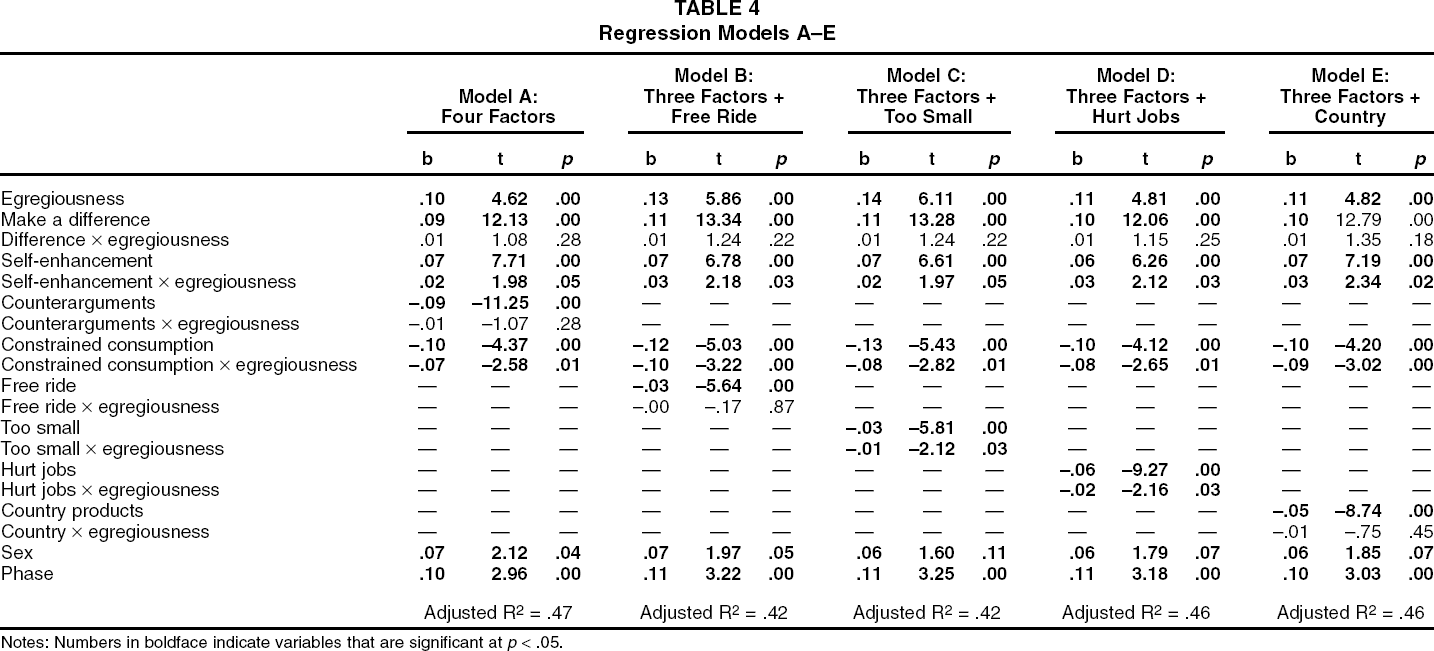
Model A in Table 4 is our benchmark model. It includes egregiousness and all the cost–benefit motivation factors as well as the interaction terms of each factor with egregiousness. We included respondents’ sex in the model (see the subsequent discussion) and added a dummy variable for the phase of data collection. As H1 predicts, egregiousness has a direct effect on boycotting, as do the four sets of cost–benefit factors. There were significant interactions between egregiousness and self-enhancement and between egregiousness and constrained consumption. The make a difference x egregiousness and the counterargument x egregiousness interactions are in the predicted direction but are not significant.
Regression Models A–E
Notes: Numbers in boldface indicate variables that are significant at p < .05.
Table 5 indicates the magnitude of the findings. We use our data to predict how many people in our sample would have boycotted had egregiousness and our four factors been counterfactually lower or higher. 14 For example, had our sample had higher egregiousness (such that mean egregiousness for the entire sample equaled the true mean level for the top third of the sample), we predict that 261 participants would have boycotted, which is a 45% increase from the original 180. Had constrained consumption also been low, we predict that 339 participants would have boycotted. 15 Table 5 also illustrates the interaction effect: Of this increase of 159 (= 339 – 180), we can attribute 50 (= 230 – 180) to the partial effect of the change in constrained consumption and 81 (= 261 – 180) to the partial effect of the change in egregiousness. The remaining 28 (18% of the total change) are attributable to the interaction effect. Our ordinal regression and discriminant analysis approaches yielded similar predictions and interactions.
Illustration of Magnitude of Effects: Predicted Number of Boycotters

Notes: The numbers are based on the linear probability model. In our sample, there were 180 actual boycotters out of 1108 observations (less than our total sample of 1216 because of missing data). For an explanation of how we calculated the predictions, see Note 14.
The low (high) values in Table 5 scale each score such that the mean score for the scaled variable equals the true mean for the lower (upper) third of the actual sample. For example, consider egregiousness. In our sample, the mean value of egregiousness is 2.77. The mean value for the lower third of the sample is 1.85. To construct low egregiousness, we scaled down the egregiousness score for our entire sample such that the mean for the constructed data is 1.85. Thus, we multiply everyone's score on egregiousness by a factor equal to approximately 1.85/2.77 = .668 (our actual scaling factor is slightly lower [.663], because we truncated the data such that the minimum score is still 1). Likewise, to construct high egregiousness, we multiply all scores by a factor of 1.67, which ensures that the mean in our new constructed data equals the actual mean for the top one-third of the true data.
We generated the predictions using the ordinary least squares regression as an indicator function for the respondents in our sample, using the true data for all variables except those noted. Specifically, we used our original regression to identify a cutoff value between boycotting and being tempted to boycott. (We could not simply sum the predicted probabilities because of the tempteds.) Thus, the values in Table 5 should be interpreted as follows: If consumers in our sample had, counterfactually, had proportionately higher egregiousness (such that mean egregiousness was equal to that of the top third of the sample), we predict that 261 would have been above the cutoff and would have boycotted. Had they also had a higher score on make a difference (such that the mean was equal to that of the top third of the sample), our model predicts that there would have been more than 500 boycotters rather than 180.
Although the interpretation of a change in egregiousness is straightforward (the firm's actions could have been perceived as more egregious), a counterfactual change in a motivation is more complex. One interpretation is that the strength of the motivations is indeed mutable for each participant. Another interpretation is that different values of the motivations correspond to different subsamples of the population.
In Table 4, Models B–E, we examine the counterarguments in more detail. Although the four counterarguments loaded on a single factor, they measure different objections to boycotting: free-riding is not the same as refraining from boycotting because other jobs will be threatened. Furthermore, Cronbach's α of .61 is less than the generally accepted cutoff of .70, which suggests that the items should perhaps be represented individually in the regression equation. At the same time, the items are correlated with one another (as indicated by the factor analysis and by the r's ranging from .18 to .45), so the inclusion of all four items in a single equation presents collinearity problems. We thus ran separate regressions (Models B–E) that included each counterargument in turn as an individual variable. The counterargument variables all have significant direct effects on boycotting, and “too small” and “hurts jobs” show significant interactions with egregiousness. All interaction terms are in the predicted direction. 16
Although our analysis raises the possibility of misspecification bias, this appears to be limited given that the results for the rest of the model are similar in all five models in Table 4. In effect, the individual regressions provide an upper bound on the effect of each individual counterargument.
Thus, from Models A–E in Table 4, we find support for H1–H5b (support for H2b was directional but not significant, and support for H4b was directional but not significant, though we found significant differences for the counterargument variables too small and hurts jobs). We find the strongest direct effects for make a difference and counterarguments. The interactions were less powerful but were often significant, and all were in the predicted direction; the strongest moderators were constrained consumption and self-enhancement.
Estimated participation
On average, respondents believed that 27% of consumers were boycotting, which is a substantial overestimate of the actual number that reported participation (16%). Boycotters estimated that 40% were participating. Nonboycotters also overestimated participation (at 23%). When we include estimated participation (see Table 6), the basic model (egregiousness and cost–benefit motivations) remains substantially unchanged, and the explanatory power increases only slightly. Still, perception of others’ boycott activity plays a noteworthy role in the model. Estimated participation has a significant direct effect on boycotting: The greater the number of people a consumer believed were participating, the more likely was the consumer to join in. Estimated participation also interacts significantly with make a difference and counter-arguments. 17 All the signs of the coefficients are consistent with our previous conjectures about the effects of estimated participation.
Regression Model F Including Estimated Participation (Percentage of Others Boycotting)

Notes: Numbers in boldface indicate variables that are significant at p < .05. Mean estimate of the percentage of other people boycotting = 27% (standard deviation = 19.12).
When we include the argument variables separately in this model (as in Models B–E), the interactions between estimated participation and hurt jobs and between estimated participation and country are significant (p < .05), and the interactions with the other two counterargument variables are in the expected direction (p = .24 for too small, and p = .18 for free-riding, which is consistent with the prediction that the incentive to free ride is stronger when more people participate).
Brand image
Tracking data indicated that before public knowledge of the intended factory closings, Bremmer's image was extremely positive: 96% had a “very good” or “good” opinion of the firm, and 2% had a “poor” opinion. This positive rating had dropped to 68% by the start of our data collection, and the percentage of respondents with a negative opinion rose to 30% during the same period. Thus, the controversy damaged an image that had previously been almost universally positive.
Higher egregiousness was inversely related to brand image (β = -.33, p < .001; we report standardized coefficients here for ease of comparison), in support of H6a (see Figure 1). Egregiousness also predicted the boycott decision (β = .31, p < .001). When both egregiousness and the boycott decision predict brand image, both are significant (β = -.24, p < .001, and β = -.27, p < .001, respectively), and the direct path from egregiousness to boycotting drops significantly (from -.33 to -.24, t = 2.19, p < .05).
Thus, we find support for the partial mediation of boycotting on the relationship between egregiousness and brand image (Baron and Kenny 1986). This finding suggests that boycotting itself (beyond the effects of perceived egregiousness) predicts brand image, in support of H6b. The effect of boycotting on brand image remains significant even if all direct effects and interactions (from Model F) are included in the regression (β = -.21, p < .001). 18 From a different angle, among participants who were high in egregiousness (scores of three or greater on the four-point egregiousness scale), 72% of boycotters assigned a “poor” rating to Bremmer, whereas only 24.2% of nonboycotters gave this rating. These figures are much higher than the pre-boycott, full sample “poor” rating of 2%.
An alternative model, in which brand image mediated the relationship between egregiousness and the boycott decision, was not supported.
Other Results
Corporate messages and egregiousness
Respondents who had heard that Bremmer had offered alternative jobs to dismissed workers gave significantly lower egregiousness ratings than did respondents who had not heard this communication (m = 2.58 and 2.86, respectively, t[1203] = 5.04, p < .001). We found similar results for the message that Bremmer had tried to find other firms to employ the workers (m = 2.65 and 2.86, respectively, t[1204] = 4.29, p < .001). For respondents who had heard either message, a positive reaction to the message was inversely related to egregiousness (r = -.32, p < .001 and r = -.19, p < .001 for other jobs and other firms, respectively). However, responsiveness to corporate messages did not moderate the relationship between egregiousness and the boycott decision (interaction terms were not significant). Thus, corporate messages were effective in reducing egregiousness, but they did not disrupt the relationship between egregiousness and boycotting.
Demographics
Age was not a predictor of egregiousness or boycotting (r = -.04, not significant, and r = -.06, not significant, respectively). Respondents’ sex predicted boycotting (χ2 = 11.01, p < .01); 19% of women boycotted compared with 13% of men. Furthermore, in the models presented in Tables 4 and 6, sex was significant. An examination of mean differences between men and women shows that women tend to be stronger on the motivations for boycotting and that there are significant differences in perceived egregiousness, make a difference, self-enhancement, and free-riding.
Discussion
Our study investigated a high-profile social-issue boycott. The boycott target has been widely condemned and has received extensive negative coverage in national print and broadcast media. Respondents were well aware of the issue leading to the boycott and overwhelmingly disapproved of the company's actions. 19 It was a situation that marketers prefer to avoid.
As further (indirect) evidence of perceived egregiousness, a national poll at the time of the boycott found that nearly nine of ten people judged it “unacceptable” for profitable companies to make employees redundant.
The perceived egregiousness of the firm's actions was a powerful predictor of boycott participation. The more egregious a consumer perceived the firm's behavior, the more likely the consumer was to boycott. However, egregiousness notwithstanding, most of the sample was not participating in the boycott. To help understand this, we drew on theories of prosocial behavior and the boycott literature to test a cost–benefit approach to boycott participation. We found that in addition to perceived egregiousness, consumers need to believe that boycotting is an appropriate and effective response (make a difference). Consumers also need to realize intrinsic rewards of boycott participation, potentially boosting or maintaining self-esteem by, for example, avoiding guilt and responding to social pressure (self-enhancement). This has a direct effect and moderates the effect of egregiousness on boycott participation. Furthermore, consumers also take into account the cost of a preferred product forgone (constrained consumption) and the costs of boycott-induced harms and doubts about whether participation is necessary (counterarguments). Many of these costs also moderate the effect of egregiousness on boycotting.
Consumers’ estimates of support for a boycott also appear to influence participation directly, but this effect is moderated by counterarguments (people who counterargued were less likely to boycott when they believed that many others were boycotting) and by make a difference (people who were high in make a difference were more likely to boycott if they believed that many others were boycotting). The (not significant) directional finding for the interaction between estimated participation and constrained consumption supports Sen, Gürhan-Canli, and Morwitz's (2001) contention that when boycotting costs are high, people are particularly averse to being exploited by others’ free-riding and are less likely to boycott. Furthermore, there may be individual differences with regard to boycott propensity, including that women are more likely to boycott than men. We also found that the act of boycotting harmed brand image beyond the effects of perceived egregiousness. Finally, although firm communications did not lessen the effect of egregiousness on boycotting, they appeared to lower levels of perceived egregiousness.
Managerial Implications
At first glance, our findings might appear to be encouraging for managers of targeted firms and disappointing for managers of NGOs that call for boycotts, given the boycott's high profile and the relatively low level of participation (16%). Keeping consumers from becoming boycotters is a key consideration for firms. Asking why consumers do not boycott is likewise critical for NGOs. Our findings suggest that even high levels of perceived egregiousness are insufficient to motivate boycott participation because cost–benefit motivations for participation play a key role.
On closer examination, however, the boycott appears to have inflicted damage on Bremmer. First, the boycott represented substantial lost sales in a highly competitive market (retail audit evidence of sales declines during the boycott corresponded to the level of participation reported in the study); Table 5 reveals that the loss could have been much worse. Second, the boycott provided shoppers with a reason to try competitors’ products. Third, participants’ attitudes were probably hardened against Bremmer through boycott participation. Perhaps the most consequential finding for the firm is that brand image was harmed among both non-boycotters and boycotters. This indirect effect may be far more significant in the long run than the direct loss of sales. Managers of targeted firms must pay attention to nonboycotters as well as boycotters.
More fundamentally, there is empirical support for the argument that boycotts can serve as a mechanism by which consumers can hold firms accountable for perceived CSR failings. As well as being of practical significance to NGOs, this finding is of theoretical significance because it demonstrates enhanced consumer sovereignty (Smith 1990). Changes in company policy following boycotts of Shell and Nike, for example, are consistent with the idea of firms being held accountable in consumer markets and with this pressure translating into a “business case” for CSR (Smith 2003).
We propose a variation of the well-known awareness, trial, repurchase model of buyer behavior as a framework for boycott management. Our awareness, egregiousness, boycott (AEB) model incorporates our findings on motivations for boycott participation and offers propositions for managers of both firms and NGOs. Although we offer propositions to each party separately, each should be aware of the other party's propositions as a source of insight on opposing strategies and tactics. Figure 2 depicts the model with data from the Bremmer boycott.

AEB Model
The first step for the firm is the measurement of awareness. For many boycotts, awareness is extremely low (Friedman 1999). Firms might nonetheless choose to treat a boycott call as a warning signal and investigate the allegedly egregious conduct. Even a small number of protestors might have a valid criticism of the firm's behavior. However, if awareness levels are high or growing, the next step is research to measure the level of perceived egregiousness and to gain a better understanding of why consumers find the firm's actions objectionable. The firm can then formulate its boycott strategy and decide whether to change current practice, engage in mitigating actions, or communicate the reasons behind its actions (Smith 1990). Bremmer was unwilling to reconsider its factory-closure decision, but many firms are not so committed to a policy that prompts a boycott, and this is likely to have a significant impact on the firm's strategy and on boycott success (Garrett 1987). The increasing power of NGOs emphasizes the need for a firm to be particularly careful in assessing its policy commitment (Spar and La Mure 2003).
Our findings illuminate the firm's key strategy decision of whether to fight or to acquiesce to NGO demands. For example, in the Nestlέ boycott, the company initially chose to ignore its critics, then fought them, and eventually acceded to their demands in an embarrassing climbdown (Smith 1990). Our results suggest that this is a highly inefficient strategy because Nestlέ's initial nonresponse enraged activists and probably harmed brand image for the long run, whereas its eventual backdown probably increased perceived efficacy. However, the company's establishing the Nestlέ Infant Formula Audit Commission, an impartial outside group of social auditors, was widely credited with lessening support for the boycott, in part by reducing widespread perceptions of egregious conduct by Nestlέ (Pagan 1986). Nonetheless, a firm's early and easy capitulation to NGO demands might signal weakness and enhance boy-cotters’ sense that they can influence the firm and make a difference. This could prompt further demands as the NGO ups the ante. For example, after being threatened with a global boycott, Starbucks quickly agreed to meet the demand by Global Exchange that 1% of its coffee sales be certified as “fair trade”; Global Exchange is now seeking to increase that percentage to 5% (Sullivan 2003).
Good customer relationships facilitate communication, and prior investments in branding and a socially responsible image can serve as a form of “insurance” to counteract information about egregious conduct (Dawar and Pillutla 2000; Klein and Dawar 2003). Communications should be directed at both nonboycotters and boycotters to reduce perceptions of egregiousness and thereby to protect brand image and to lower boycott participation. For the NGO's part, it must be ready to respond. This leads to our first propositions for firms (P1f) and NGOs (P1n), which are shown in Figure 2.
The next step is to examine whether perceived egregiousness translates into boycott participation. Here, our findings on costs and benefits come into play. If consumers believe that the boycott will influence the firm, they are more likely to participate (make a difference). As P2f suggests (Figure 2), firms can communicate that the boycott is unlikely to be successful. This message must be communicated carefully, for showing that consumer objections have been heard is a key component of P2f. Corresponding strategies for NGOs are suggested in P2n. Consistent with building a sense of consumer efficacy and power, the Ethical Consumer Research Association lists recent boycott successes on its Web site. Another effective strategy for NGOs is probably to start small and build on successes more easily achieved. University apparel was an initial focus of campaigns in the United States against sweatshop labor, and several university administrations quickly acceded to student demands in the face of campus demonstrations (Brixey 2000).
Our findings suggest that people boycott to feel good about themselves (self-enhancement), but they are less likely to participate if they believe that the boycott has negative outcomes (counterarguments). Although managers should refrain from directly challenging the self-enhancement value of social action, their communication of harmful effects of boycotting may lessen the feel-good aspects of participation and reduce the link between perceived egregiousness and boycotting. For example, a firm boycotted because of its low wages (by Western standards) to overseas workers may counter that a “successful” boycott would result in the closure of factories, leaving former employees in poverty. Thus, we propose P3f (Figure 2).
As for NGOs, they should prepare rebuttals to company arguments about boycott-induced harms (P3n in Figure 2). In response to the claim that blacks were hurt most by boycotts of firms associated with apartheid South Africa, NGOs responded that the goal of freedom from apartheid was more important (Smith 1990). Furthermore, a key insight for an NGO that calls for a boycott is that its motivations need not be identical to those of individual consumers. An NGO with a strongly instrumental goal may best achieve its aims by encouraging self-enhancement through boycotting. Thus, with subtlety, the NGO could imply that failure to participate would lead to feelings of guilt. Equally, the use of celebrity endorsements by NGOs can be expected to help boost consumers’ self-esteem through boycott participation. For example, Bianca Jagger has lent her support to the Exxon boycott called over its environmental policies (Whitney 2001). More generally, NGOs should seek media attention to the boycott because this can be expected to increase both awareness and social pressure for participation.
Boycotting entails a sacrifice by the consumer (constrained consumption). For NGOs, the task is to justify and minimize this sacrifice. Firms often cut advertising during a boycott (as Bremmer did) because they do not wish to draw attention to the brand or because they believe that the advertising spend would be wasted. The opposite strategy may be warranted. Well-crafted advertising could strengthen brand commitment and reinforce positive associations to the brand in memory, thus increasing the cost of boycotting and helping counteract the effects of negative information (Ahluwalia, Burnkrant, and Unnava 2000; Tybout, Calder, and Sternthal 1981). Furthermore, advertising that taps into values such as health and safety might be beneficial, because forgoing a product with these attributes may reduce the possible self-enhancement of boycott participation. Thus, we propose P4f and P4n (Figure 2).
Study Limitations and Directions for Further Research
Our research faces some limitations that stem from the exigencies of researching an actual boycott in progress. Although our measures were informed by our prior study, we had neither the luxury of piloting some measures nor absolute discretion over survey content, administration, and the precise wording of questions. However, we believe that these limitations do not materially influence our results and, on balance, are minor compared with the opportunity to study a real, ongoing boycott.
There are issues of generalizability. Our study is of a particular boycott on a specific issue. The egregious act in this case (i.e., factory closings) may be associated with greater self-interest than is the case for boycotts prompted by, for example, animal rights. The boycott was particularly high profile (which is all the more useful to the extent that we were interested in explaining why people do not boycott), but it is possible, or even probable, that our results are not relevant to the many calls to boycott that consumers largely ignore and that management can also safely ignore. In addition, although our data are from a nationally representative sample, they are from a specific country. We doubt that the trigger for this boycott would have had the same resonance in the United States, for example. We have sound theoretical reasons to believe that the motivations we uncovered are quite general, but this remains to be confirmed by research on other boycotts in different countries, prompted by different issues.
It is unlikely that we have uncovered all potential motivations for boycott participation, and further research could investigate other costs and rewards of boycotting that we may have failed to capture in our model. We did not investigate the boycotter's decision-making process, and particularly whether egregiousness leads to a firm's product being excluded from the consumer's consideration set or whether the firm's egregious conduct is traded off against product attributes. The answer may lie in the level of perceived egregiousness: Perhaps at moderate levels of egregiousness, the consumer trades off the firm's conduct, but at high levels, the consumer excludes the product from consideration.
The study also has implications for research on corporate associations and CSR-related issues. Our findings with respect to boycotts may well extend to the broader category of ethical influences on consumer behavior, which implies scope for exploring the role of a similar set of moderators in the models of, for example, Brown and Dacin (1997) and Sen and Bhattacharya (2001). Our work might also contribute to research on complaining behavior, thus suggesting motivations that may underlie complaining (e.g., self-enhancement). Furthermore, our framework could be used to study other collective action situations, such as voting.
Finally, in light of our claims on self-enhancement, we believe that it is appropriate to identify boycotting as part of a broader form of “symbolic nonconsumption.” Writing on possessions and symbolic consumption, Belk (1988, p. 139) states, “That we are what we have … is perhaps the most basic and powerful fact of consumer behavior.” What does it mean when consumers choose not to consume a product because of a social issue associated with the producer? Perhaps we boycott because we are also what we do not have.